“The number 3 is in nature, in our culture and in ourselves. Is the Trinity exposed in its multiple meanings present in religion, science and philosophy, in the division of time into Past, Present and Future, in the Three Powers, in You, Me and that which unites us or disjoint us and in the Id, Ego and Superego of Freud? – Noke Yuitza
A new installation by Giovanna Cerise and featuring pieces by Alpha Auer, Ataro Asbrink, Betty Tureaud, Daco Monday, La Baroque, Noke Yuitza, Paola Milla, Pol Jarvinen and Taralyn Gravois opens on Sunday November 3rd at LEA17.
Give the numbers! is a collaborative exploration of numbers and their meaning, be it practical, philosophical, mystical, factual or fantastical, and their influences on us.
Paola Mills
Given that numbers are central to our lives in so many different ways, the idea of representing them, their many and varied meanings, influences and uses is a fascinating concept, and in Give the numbers! it is one which is intriguingly presented. The main part of the installation is floating in the air as series of platforms interlinked by a teleport system, and presented in a series of two-dimensional frames above which they sit.
The way the various numbers from 0 through 8 are presented and interpreted is highly individual, leading to an absorbing piece which deserved a reasonable amount of time and effort in exploring. Some of the pieces offer interactive elements as well, so keep an eye out for these. When I made my preview visit, elements were still under construction, so there are probably newer aspects to be explored and enjoyed and which I missed when looking around.
5555555 55555 555 – Alpha Auer
When you have finished exploring the sky platforms, do take a trip down to ground level, where you’ll find Giovanna’s Arthimos, a fascinating geometric build which, in the words of the artist, offers, “Fascination and illusion in balance between rationality and irrationality.”
Here the numerical influences are again clear through the use of the various shapes and lines, but there is something else at work here; pan around the build and elements which might initially appear to work together seem to come into conflict; the rational becomes irrational. Even the nature of numbers changes, thanks to the placing of a series of dice around the build, reminding us of how numbers are often linked with chance, and chance, while irrational, often forms the basis of our supposedly rational ability to make decisions.
Arthimos – Giovanna Cerise
There is little guidance on preferred lighting settings, but I do recommend something around Midnight is perhaps the best way to appreciate the pieces, together with a relatively low draw distance to bring each element individually to the fore (with the exception of Arithmos, where a draw distance sufficient to let you see the entire region is recommended). The images here were captured using JAXBlackContrast from Jackson Redstar, with cloud cover set to zero and S/M and Ambient Sun / Moon settings tweaked a little via the colour picker sliders.
Give the numbers! will run through until the end of December 2013.
Collaboration in Second Life is not new, it goes on in many ways and in all corners of our virtual cosmos. Nevertheless, it’s always interesting to see what results when several minds come together in order to create something new.
With this in mind, I hopped over to the Linden Endowment for the Arts recently, where two new installations opened during the last week. Each involves multiple artists working to a common theme (albeit a very broad theme in the case of one!), and each of which has, in the eyes of this beholder at least, produce very different reactions to one another.
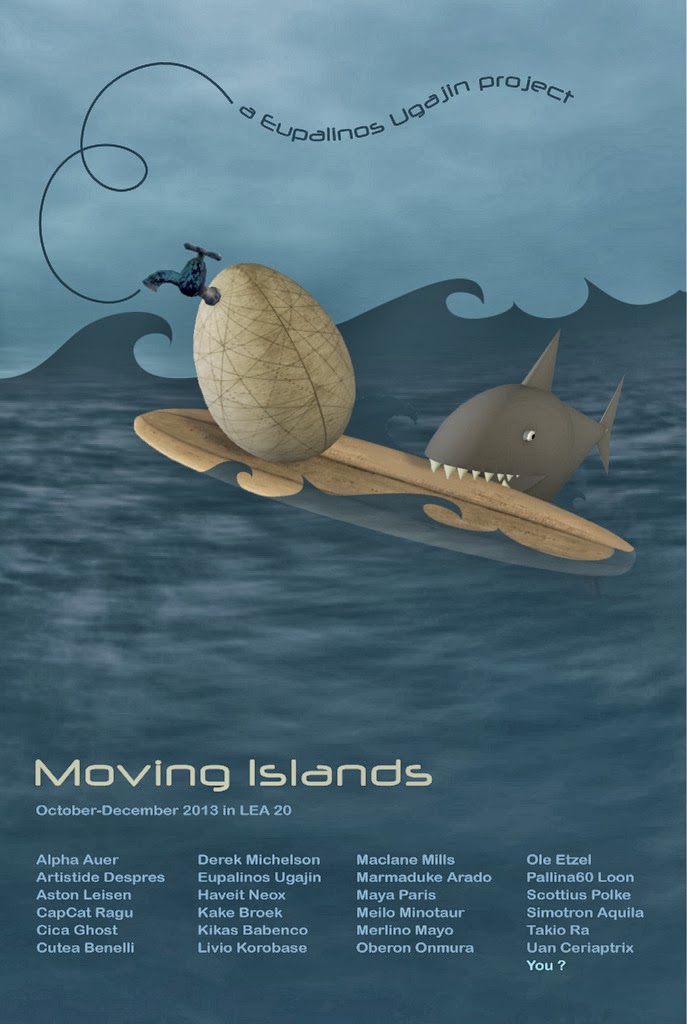
Moving Islands [Rafts] sees Eupalinos Ugajin bringing together no fewer than 24 of SL’s artists (click the poster, left to see the names) to create a piece that freely interprets the central theme of moving islands or rafts, with Derek Michelson providing assistance with scripting and Takio Ra with sounds. The result is a collection of remarkable pieces which are eclectic, quirky, fun, different, provocative, interactive, and more.
With twenty-four participating artists already involved, and the chance for more to be added (Eupalinos is still open to accepting ideas and submissions for artists – even you, as the exhibit’s poster indicates), this is a very busy installation – yet it is not by the same measure crowded. The space above and below water (not all of the islands / rafts are floating) has been used to the fullest, and there’s a lot to see (be sure not to miss the world’s first deep-sea diving … cow!). Do make sure you have sounds on as you move from piece to piece, and you may also appreciate the streamed soundtrack compiled by Eupalinos – all four hours of it!
Moving Islands [Rafts] – Maya ParisThis is very much an interactive installation as well; objects and pieces are always on the move (which makes taking snapshots interesting!) and there are places you can sit and be a part of things – giving another twist to the exhibit’s poster noting you can join the exhibition…
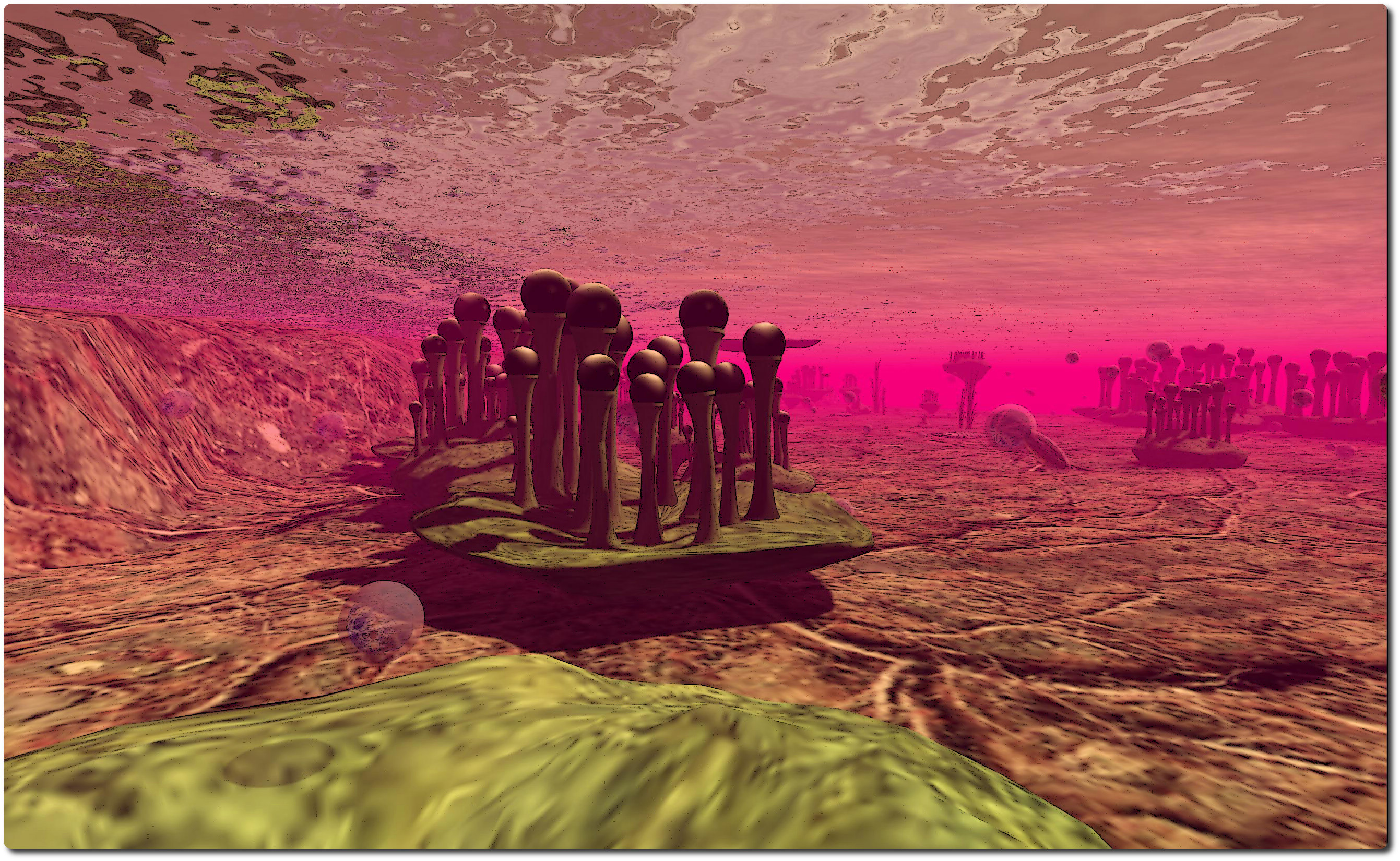
It’s not really fair to single out individual elements in a work like this – especially when some of my favourite artists are featured; but I confess to adoring Meilo Minotaur’s undersea “forest”, and Pallina60 Loon’s Nautilus and its accompanying Steamfish had me smiling, if over-exercised after riding on it!
Moving Islands [Rafts] – Meilo MinotaurThis is an installation you’ll want to take time exploring; some of the artists have provided note cards describing their works, but I felt it more interesting to let each speak for itself. Eupalinos has also compiled a note card listing all of the artists’ websites / Flickr streams, all of which are worth visiting as well. He’s also provided a link to a Dropbox of images for those who wish to make use of it.
Another of the pieces in Moving Islands is Haveit Neox’s Mythic Rafts, which pictures the aftermath of the destruction of the Earth as a result of humankind’s history. “A raft survives the big flood after the polar ice caps had melted,” reads the note card for the piece, “No landmasses were high enough to poke through the new ocean. The Earth had been stretched beyond its limits – pulled apart at the seams.” Given the underlying theme of loss and destructions, It’s something of an interesting (if entirely unintentional on the part of the artist) link to the piece which forms the second part of this review.
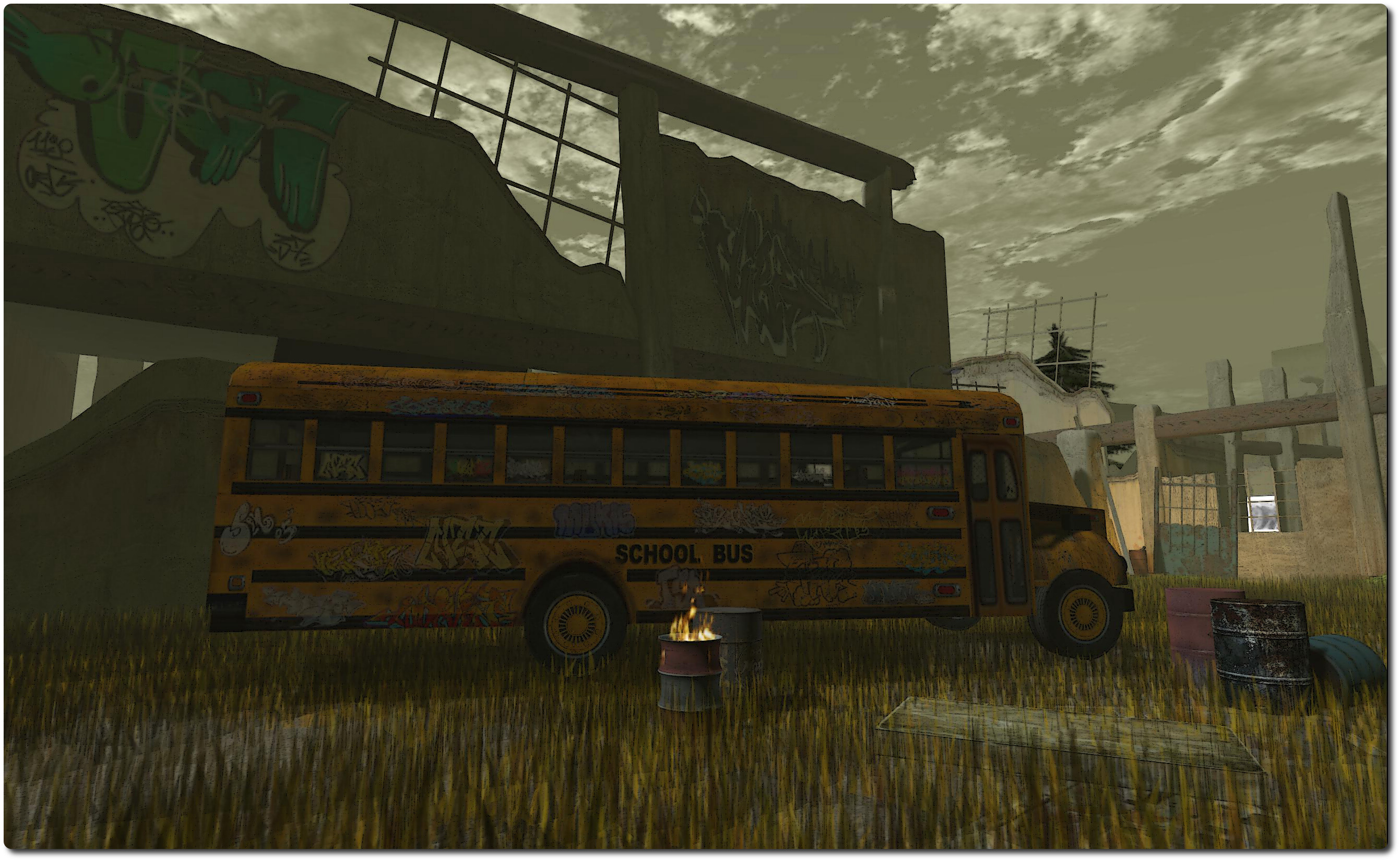
Moving Islands [Rafts] – Oberon OnmuraDestruction, decay and ending seem to be the focus of The Gaia Theory Project, which also pened this month at the LEA. Presented by the Tanalois Group and the torno Kohime Foundation, and directed by Aloisio Congrejo, Tani Thor and Nino Vichan, this installation brings together a total of eleven artists in what is designed to be an interpretation of the Gaia Theory. And therein lies a problem.
As already noted, the installation is very much directed toward themes of destruction and decay, with extinction, loss and death also featuring. Yet the Gaia Theory is about the organic and the inorganic interacting in a complex system which helps maintain the conditions for life to exist on the planet. So by focusing on just one side of the equation – desctruction and decay, etc., – the installation comes across as decidedly lopsided; where’s the re-birth, the growth, the renewal?
There also appears to be something of a negative towards humanity’s role in things which is presented here, The contributions of man appear limited to toxic waste, the extinction of animals, urban decay, etc. Again, it’s not uncommon in discussions around the subject of Gaia for humankind to be referred to as a parasite responsible for upsetting the balances proposed by the hypothesis. However, it again lends a bias to the installation which some might say is at odds with Gaia Theory when taken as a whole – as Ziki Questi argues in her considered review of the installation.
All that said, there is nothing wrong with using art to raise awareness of the destructive forces – natural and man-made – at work in the world today is a valid activity (especially where humanity’s more destructive or environmentally damaging efforts are concerned. Were this the intent with this installation, I’d venture to say it succeeds. However, as an exploration of Gaia Theory, I can’t help feel that it largely (with one or two small exceptions) falls wide of the mark.
Postscript: following the publication of this review Melusina Parkin, one of the collaborators in The Gaia Theory Project contacted me as to her own approach to the piece, which she has presented on her own blog. If you’re planning to visit the installation, I recommend you give her piece a read first.
I’m an unabashed Rebeca Bashly fan. I have been for a goodly while, and still think her 2011 interpretation of Dante’s Inferno was an inspired installation (you can still visit it at UTSA Artspace and see for yourself). Similarly, The Tower from December 2012 was an equally fascinating study.
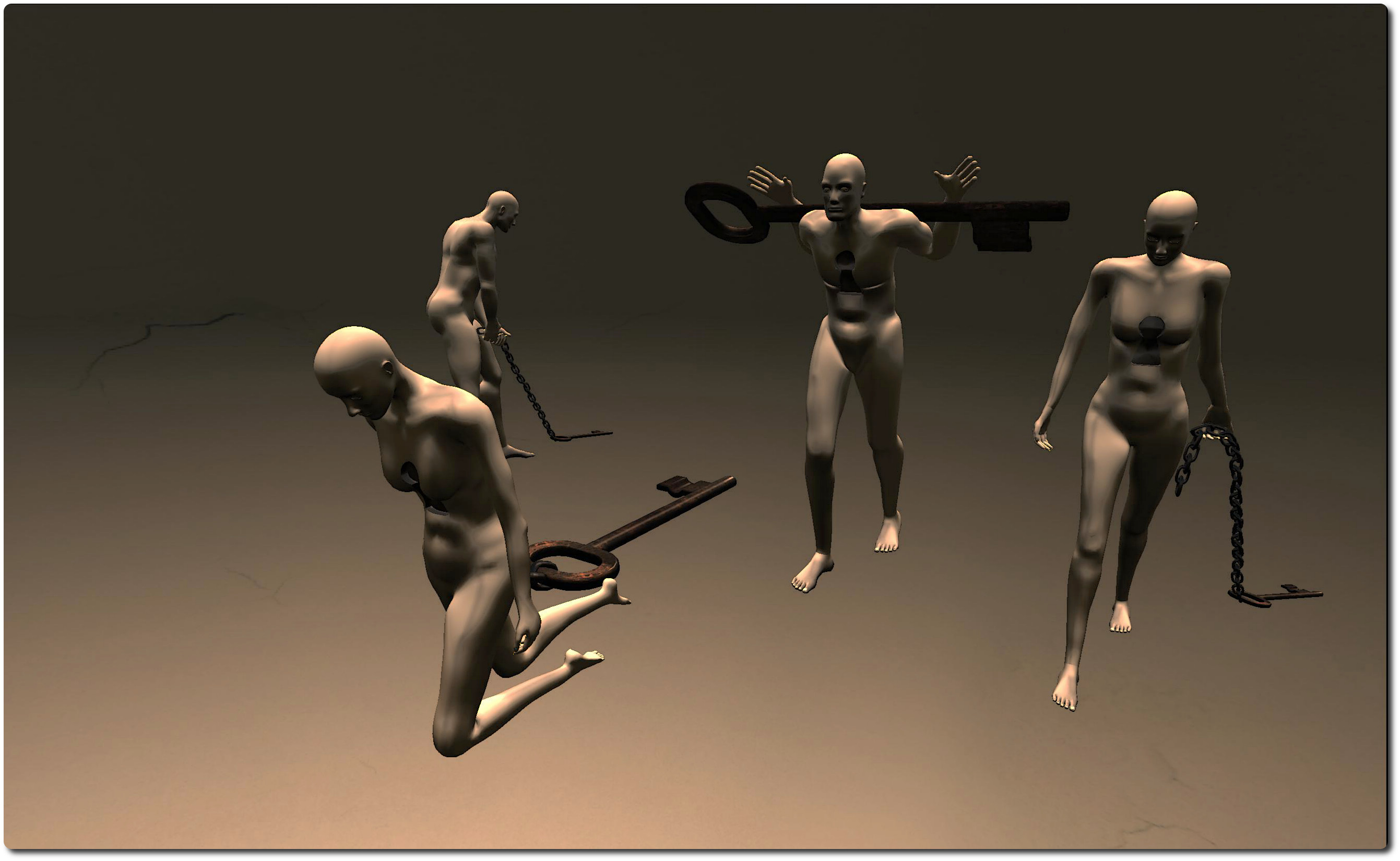
This month she is back at the LEA with another towering (literally – Rebeca does like the vertical medium in SL!) full sim installation entitled Colour Key, which opened on Monday October 7th. Quite how to describe this piece (other than “big”) isn’t easy. The artist herself has very little to say on possible interpretations and meanings, stating only that Colour Key is “all about human nature, breaking your spine to find answers that are under your nose. Explore and discuss, this is a joy to me”
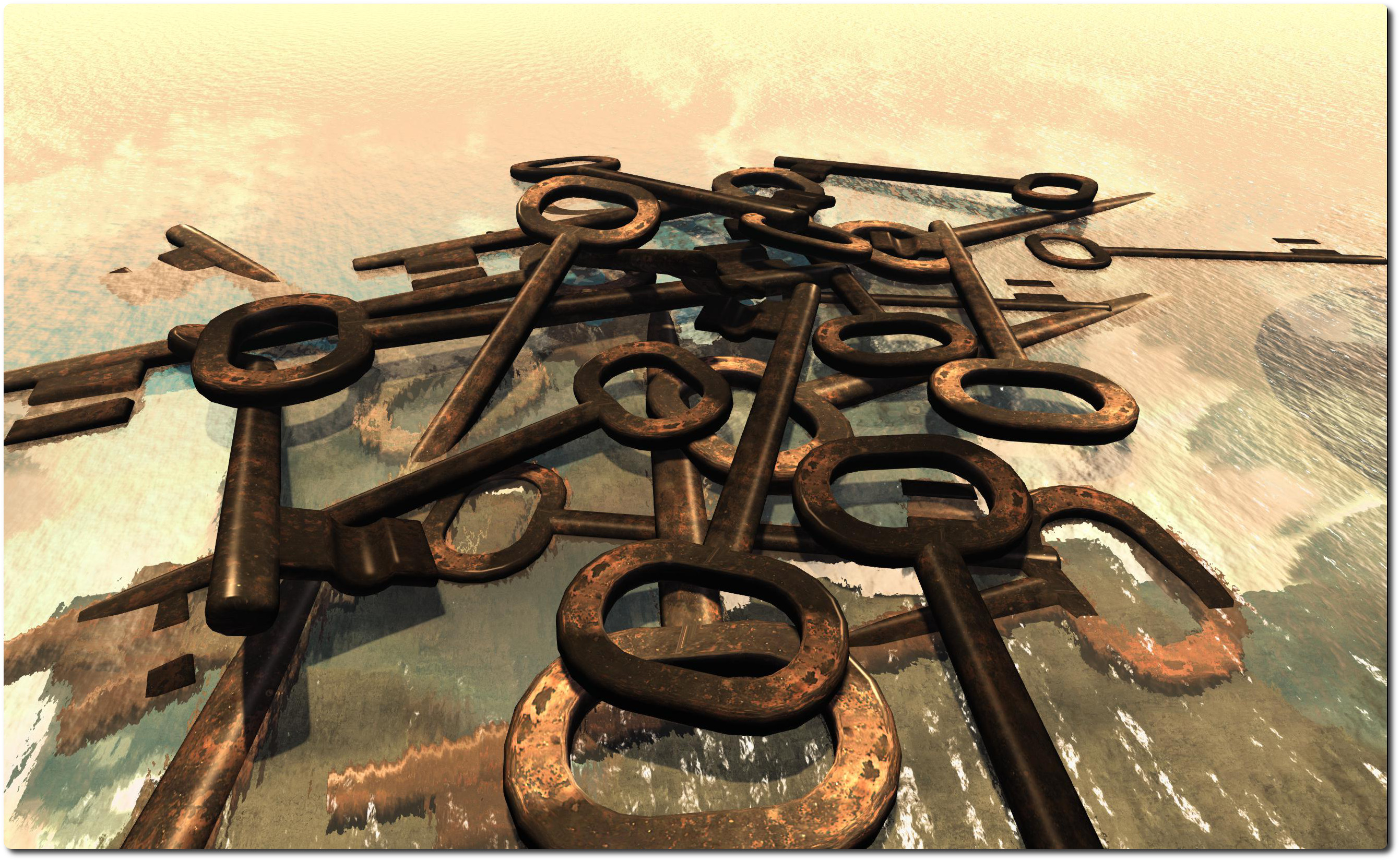
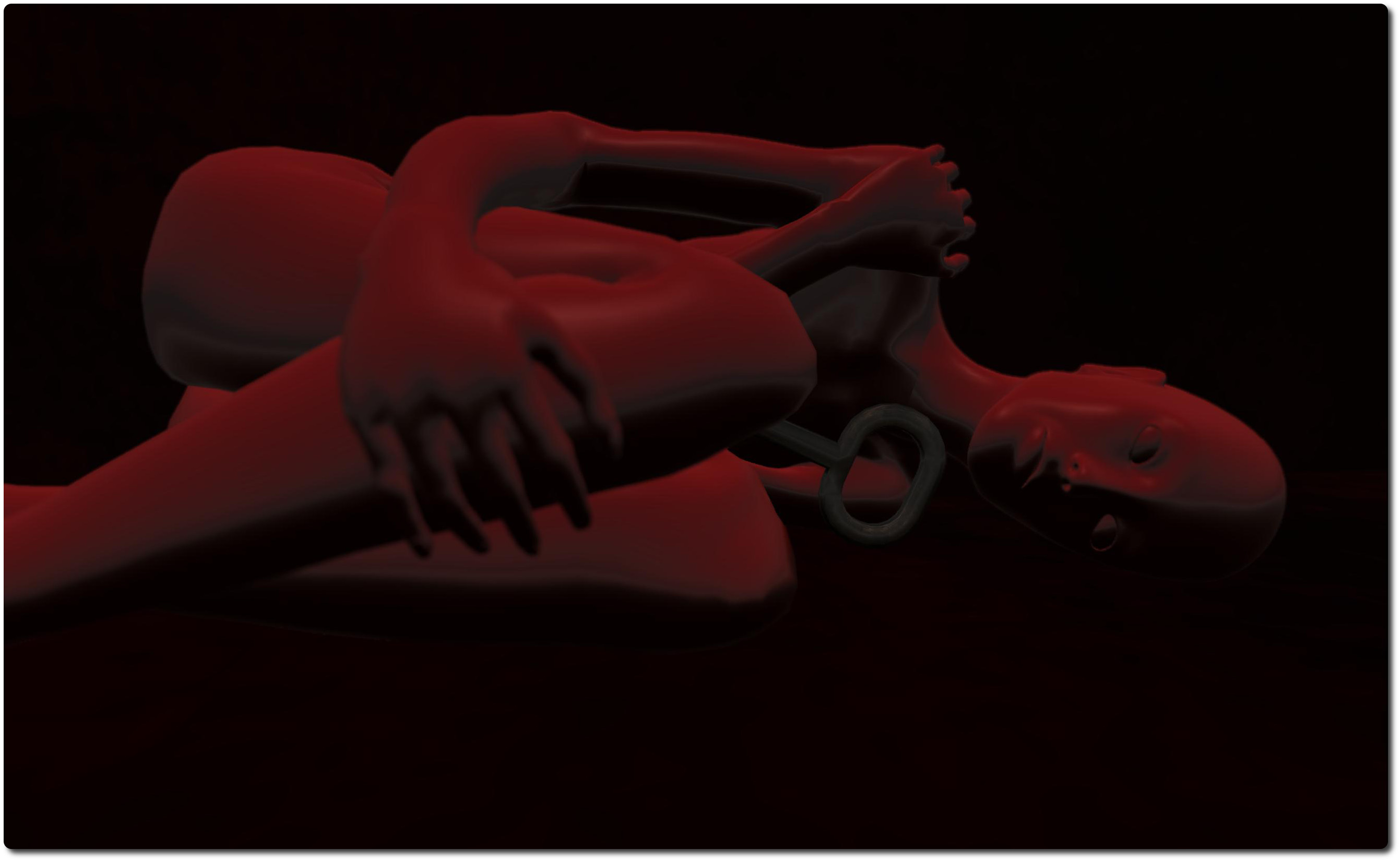
Like The Tower before it, one travels through a tower-like structure passing scenes and images along the way. However, rather than travelling bottom-to-top as with The Tower, this installation takes you from the top down; and whereas The Tower was deeply evocative in the images and scenes presented, Colour Key is more enigmatic. There is a common motif running through the build – that of the key (hence the title) – but the key to what? That’s for the observer to decide; and one’s ideas and views tend to be challenged as one passes through each scene.
This is also a dark build; not in the sense that it is sad or macabre or suggestive of suffering or evil or anything like that. It is literally dark, so much so that if you run with shadows enabled, you may actually want to set them to None (no need to disable ALM, though, unless you’re finding the scenes particularly dark). There are passageways and stairways to walk and climb as you travel down from the top of the tower, and if you’re not careful you’ll risk disorientation trying to make your way through the build with shadows active (particularly after you’ve sat on the box as instructed).
Scale is another feature of the piece. Parts of it are simply huge – such as the gigantic meat grinder poised menacingly over the first part of your journey and through which you must apparently drop. Keep an eye out for a key at each stage of your journey, it provides your only means of moving through the various scenes until you reach the ground.
This is an installation which needs to be explored and experienced rather than simply blogged about. It’ll be available through until the end of October, and a visit is recommended.
Musiclandia, a full sim art piece by Livio Oak Korobase, opened on LEA-11 on Wednesday August 28th as a part of the 5th round of the Artist-in-Residence (AIR) programme. The piece is billed as an exploration of music as an art form, and offers-up the following teaser:
What is the definition of music? What is the relationship between music and mind? What is the connection between music and emotions? Search for your answer in Musiclandia.
It’s a fascinating piece, offering a watery landscape in which musical instruments form a series of set pieces inviting exploration. This is an interactive piece, requiring a reasonable amount of time in order to discover all of its secrets, so it’s worth taking your time to look around each of the pieces and discovering what there is to see and learn – note cards are offered at various points around the installation, providing further information and food for thought.
The arrival point provides some basic instructions – you’ll need sounds active to enjoy the exhibit (although not necessarily media streaming enabled) and you should drop draw distance to 128 or so metres to stop most distractions from the neighbouring regions creeping into your view. There’s no set order to exploring things, just go where your eyes take you, out from the little village square under the massive brick piano and across the water.
Some of the many roles music plays in our lives are explored here; how it can channel a freedom of personal expression, how it can play an emotional, spiritual or therapeutic role. In these explorations, issues of identity and self are also touched upon. Symbolism is also strong here; some of it obvious, some of it less so; when it comes to matters of self, a towering stag, harp held within its antlers, reminds us umuntu ngumuntu ngabantu – “you are who you are because of how you relate to others around you”.
The food for thought comes in a number of forms; the Musiclandia Beach, for example delves into the role of music and sound in creation myths, including the origin of that simple Biblical phrase “In the beginning was the word”. Elsewhere, the Lab and Jam area examines the role of music in therapy, while Feathers and Kites probes matters of self and identity.
In these explorations, Livio draws on the writings of a number of people; some may be recognisable – even notorious / controversial – to visitors, others perhaps not so; but the selected passages do invite further explorations; if you find this is the case, the sources are cited, and the Interwebz are your friend.
Which is not to say that it’s all a dry, intellectual piece; there are plenty of opportunities to find your own self-expression through music, be it via dance, interacting with objects or enjoying the sensation of simply playing an instrument.
The piece isn’t limited to the ground, either, there are a couple of sections up in the sky; Moby and Paradiso. The latter looks like it is intended to be used as live music / entertainment venue, although this is by no means clear (at least, I didn’t get a note card explaining its purpose on my arrival).
Getting around the exhibit can be done on foot, via the teleport map in the village square, or for those who are feeling serene, via a number of Harleywan Haggwood’s flyable kites. As mentioned above, this is a piece that requires a little time – and an open mid – to explore, and the kites are actually a fun way of getting around and letting thoughts and reactions to the piece flow freely.
I recently previewed Sniper Siemen’s new LEA exhibit, Da Vinci’s World. If you’ve not already visited, I really do urge you to do so: the exhibit runs through until the 21st July and is a fabulous piece.
In the meantime, I put together a little video from snaps I took when preparing my original article – please hit the YouTube cogwheel and up the quality to 720p for best results.
Marx Catteneo is a name perhaps known to some. He’s been involved in Second Life since 2007, and has made his mark as a machinima maker with an eye for detail, as with his video of the 2012 Fantasy Faire, and a quirky sense of humour which has created Staying Alive, a somewhat different take on the SL zombie scene to that portrayed in the official promo videos…
As a successful applicant to the 2013 Artist in Residence programme, Marx opens up the doors on the machinima film-making process in May as he starts work on his new web series Nin9, and is offering SL residents the chance to see the sets of the 9-part series, which will be debuting in Spring 2013.
The Streets of Felice, Michigan – a part of a set from Nin9
Set in the fictional city of Felice, Michigan in late 2000, the series is described as a dark and disturbing psychological thriller playing in an alternative reality and which influenced by the likes of Se7en, Twin Peaks, Hitchcock, Basic Instinct, European Graphic Novels. The introduction to the series frames the story:
Francis Maddox, lieutenant and head of the homicide division at FPD, comes across a very nasty Neko murder. It has all signs of a serial killer’s first victim. The crime scene brings back traumatic events from Francis’ past. The investigations will lead him into the seductive world of Neko strippers. Will he be able to withstand the charms of Layla? Is she just a colleague of the first victim, is she involved herself, or is she next on the killer’s list?
The set is currently open to public viewing from now until the 15th of May, when filming the series commences. Built by Rachelle Raviprakash, it packs-in an incredible amount of detail into the comparatively small space of a single region, which beautifully renders the run-down heart of an aging city. Several of the principal locations are present, including the Police Headquarters for District 13 and the strip club where (I assume) the mysterious Layla works.
I’m not sure if the region will remain open to the public during filming, or only open between the times when shooting in going on. The LEA blog post on the project suggests the former might be the case, but without sight of a filming schedule, it’s hard to be sure.
If you do opt to pop along and filming is going on, do note that the region is rated Adult, and that Nin9 is aimed “at an adult audience (it’s not porn but there will be nudity and violence). European graphic novels have a long tradition in this kind of adult genre and many of them are on the edge of art and entertainment (Moebius, Enki Bilal, Jacques Tardi, Schuiten & Peeters).”



![Moving Islands [Rafts]](https://modemworld.me/wp-content/uploads/2013/10/rafts-14_001.jpg)
![Moving Islands [Rafts]](https://modemworld.me/wp-content/uploads/2013/10/rafts-12_002.jpg)


 Inara Pey: Living in a Modemworld