SL project updates: week 11 (2): Server, SSB testing and HTTP news

Update Match 18th: The “mesh only” HTTP test regions, referred to as “coming soon” in the HTTP section of this report are now online on Aditi, and are called MeshTest2 (DRTSIM-203), MeshTest2A (DRTSIM-203A) and MeshTest2H (DRTSIM-203H), respectively. In addition, the sandbox areas (unrestricted access) are also now available as Sandbox HTTP (DRTSIM-203), Sandbox HTTP A (DRTSIM-203A) and Sandbox HTTP H (DRTSIM-203H).

Server Deployments

The planned deployments for the week went ahead as scheduled. Namely:

  • On Tuesday March 12th, the Second Life Server (SLS) Main channel received Baker Linden’s large (as in complex) object rezzing project, designed to improve region performance when rezzing large objects – release notes
  • On Wednesday March 13th, the BlueSteel and LeTigre Release Candidate (RC) channels received a server maintenance package, intended to fix a common crash mode – release notes
  • Also on Wednesday March 13th, the Magnum RC channel received an update to the server maintenance package deployed in week 10, with further improvements / fixes. These included the removal of the fix for VWR-786, which rather than correctly fixing the known issue (IMs to friends not respecting their privacy settings) resulted in all IMs to non friends returning the “User is not online” message, regardless as to whether the recipient was online or not. Release notes for the package are on the SL wiki. The Lab, according to Maestro Linden, is going to have to, “Go back to the drawing board,” to resolve this problem.

As I’ve mentioned in past reports, the aim of this “large object” rezzing project from Baker Linden is to improve how complex objects (those which have a lot of scripts and / or a large file size), with the focus of the work moving the parsing of object files onto a background thread in order to prevent the simulator being choked and performance spiking when such objects are rezzed. As such, the work applies to both in-world objects and attachments, with mesh potentially being a primary beneficiary of the changes. The thought is that the new code may also help frustrate griefers, as the simulator FPS should be better when multiple scripted objects are being rezzed.

SL Viewer

The SL beta and development viewer were both updated on March 14th. The beta viewer moved to release 3.5.0.271843, with updates primarily aimed at CHUI, as anticipated. The development viewer moved to release 3.5.1.271846, and remains broadly in sync with the beta version of the viewer.

Vivox  Updates

Alongside the FMODex (sound system) updates which will be forthcoming after the formal release of CHUI as mentioned in part 1 of this report, Vivox (the SL Voice service) is also due to be updated to version 4.5. Like FMODex, this is unlikely to happen until after CHUI has reached a formal release., but once implemented, this should result in an improvement in Voice quality.

Mesh Deformer

There is still no news on this. Both the issues relating to avatar shapes and weighting are still awaiting internal resources at LL. As such, there is no timeline as to when any movement might be seen on this project.

Interest List – Issues and Further Updates

More interest list updates on Aditi and likely heading for a Release Candidate channel in week 12.

The following fixes, related to the interest list code, should be in an RC deployment in week 12 (week commencing Monday March 18th):

  • A fix issue where you ‘lose track’ of a vehicle after a region crossing
  • A fix for BUG-1795 (“Agent appears in incorrect position to other agents after being moved by a sim teleporter”), which should see an end to avatars still appearing in view after they have used a teleport system
  • A fix for the issue where object moving off-camera would suddenly ‘snap’ into place when you turned your camera so they were in your field-of-view. Whereas up until now, the new interest list code has not sent any updates for such objects, the fix to be deployed in week 12 will once again allow updates to be sent to the viewer, but at a much lower rate than before the interest list code was originally deployed.

The code with these updates is currently available for testing on two regions on Aditi: Solariam (rated: Adult) and Tischeriidae (rated: Moderate). This code also includes updates to improve object rendering (particularly with the viewer set to low bandwidths) and to object cacheing as well, as noted in the first part of this report, and those wishing to do so are encouraged to do so, although testing any improvements to vehicle regions crossings might be contingent upon being Adult verified.

Server-side Baking (SSB) Pile-on / Load Test

The second SSB pile-on load test took place on Aditi on Thursday March 14th, immediately following the Server Beta User Group meeting. The test was undertaken using the latest version of the Sunshine project viewer and appeared to be broadly satisfactory, involving both users and a fair few LL personnel – Nyx (x2, as he had his alt there), Simon, Maestro, Monty, Dan, Don, Log, and others. As with the original test, this took place on two regions – one running the current baking system, the other running the new service. Participants were asked to change outfits using the current service, so that the project team could get some baseline / comparison stats, before everyone moved over to the “new” service on the adjoining region.

Continue reading “SL project updates: week 11 (2): Server, SSB testing and HTTP news”

SL project updates: week 10 (3): viewer, CHUI, SSB and HTTP work

SL Viewer Beta and Viewer Development  and CHUI

There have been updates to both the beta and development viewers. The beta viewer moved to release 3.5.0.271345, and development to 3.4.5.271386. Both releases were focused on CHUI, and according to Oz Linden, “Right now they are almost identical; different only in the viewer number I believe.” He went on to say, “There is significant uncertainty as to when CHUI will come out of the beta channels, and it’s very likely that will remain true for a while yet – that is, that the two will remain pretty similar.”

With one CHUI update having just gone to the beta viewer, the Lab anticipates there will be at least one more update for the project while in beta before it makes any more to the viewer release channel.

Server-side Baking (SSB)

Server-side Baking saw the release of a further viewer update – 3.4.5.271419 – on March 7th, which was partially in response from information gained from the first public pile-on / load test for SSB, held on Thursday February 21st.

Commenting on the ongoing work to integrate SSB into TPVs at the TPV Developer meeting on Friday March 8th, Oz linden thanked the TPVs for their work to date on trying to integrate the viewer-side SSB code into their offerings in order to keep the project on track. “I’m very pleased to say that right now it does not look like support for it [SSB] in third-party viewers is going to end up being the limiting factor on when it can be deployed,” he said, although he did caution against showing any complacency in getting the code to a deployable condition.

Merge with CHUI

Also at the TPV Developer meeting, Nyx indicated that overall, the project viewer for SSB is becoming more and more stable, and that his team now has and initial merge with the CHUI code, which they are going to be “hammering on”, prior to pushing it to the internal Sunshine branch. As such, the most recent release of the SSB project viewer is possibly the last push prior to CHUI appearing in the viewer.

Given there are concerns over the merger and its possible impact on TPVs, Nyx is going to see if it is possible to maintain a side branch of the SSB viewer code which does not include the CHUI merge, which could continue to receive fixes and make it easier for TPVs to obtain them, however, until this has been looked into in more detail, he is unwilling to commit to how easy it would be to achieve and maintain – or how long for.

Second Pile-on  / Load Test

Serer-side baking - further testing on March 14th
Serer-side baking – further testing on March 14th

Attending the Server Beta meeting in week 10, Nyx Linden announced that the updated viewer will be required  for a further pile-on / load test, which has been scheduled for Thursday March 14th. The test is liable to be in much the same format as the first test, and those wishing to participate are advised to attend the Server Beta meeting on Aditi ahead of time (the meeting commences at 15:00 SLT on Thursdays).

Those wishing to take part in the test should also ensure they are using the latest version of the SSB project viewer linked-to above, as this as this has been specifically set-up to enable correct logging of data, etc., for the test. Nyx hopes that the latest updates to the logging parameters, coupled with the recent inventory fixes applied to Aditi should do much to both lessen the impact of Aditi issues should they occur and make them easier to identify when analysing feedback. However, Nyx suggested that those who have experienced Aditi inventory issues and who wish to join-in the test on March 14th should log-into the Sunshine test regions ahead of time and confirm that they can access their inventory using the project viewer.

Continue reading “SL project updates: week 10 (3): viewer, CHUI, SSB and HTTP work”

SL project update: week 9 (2): servers, HTTP, SSB

Server Deployments – week 9

Server Life Server (Main) Channel

As noted in part 1 of this report, the Second Life Server (SLS / Main channel) received the server maintenance project which was on all three RC channels in week 8, comprising miscellaneous bug fixes, and the improved region restart notification. Deployed on Tuesday 26th February, the roll-out was followed by a number of issues being reported via the deployment forum thread.

Issues have included:

  • Parcels / regions vanishing from search for a period of time following the restart (an issue WolfBaginski Bearsfoot gave some thought to in commenting on part 1 of this report)
  • Further region crossing issues, with loss of control followed by “broken” camera positioning after recovery. This issue has been reported at some of the Simulator and Server Beta meetings previously, and Eric Gregan has produced a video demonstrating the problem as it occurs on some aircraft, although he’s also come up with a means of avoiding the issue which may or may not work for people.

  • Problems with Dwarfins attachments.

Release Candidate Channels

On Wednesday February 27th, all three Release Candidate channels received a new server maintenance package which includes a fix for a crash mode (see the release notes (BlueSteel)). No significant issues have been reported for this deployment.

SL Viewer

The Communications Hub User Interface finally made its debut in both the SL development and SL beta servers, arriving as release 3.5.1.270826 for the development viewer on Tuesday 26th February, and 3.5.0.270825 for the beta viewer on Wednesday 27th. I’ve provided a brief introduction to CHUI, and there is also a video from Torley Linden.

CHUI is liable to remain in beta for a “Good long run”, to quote Oz Linden. Hopefully, this may mean that materials processing will be the next significant viewer update to arrive as a project viewer.

Interest List

The recent updates to Andrew Linden’s interest list work are apparently won’t reach a RC channel in week 10, but should see deployment in week 11 (week commencing Monday 11th March). This work includes fixing issues with avatar appearance teleporters which use llSetRegionPos(), as well as correcting problems where objects which change appearance behind the camera ‘snapping’ into place when you rotate the camera back.

Server-side Baking

On Friday March 1st, Linden Lab unexpectedly released an updated version of the SSB project viewer (release 3.4.5.271118), which includes their approach to overcoming the problems of the Z-offset capability common to many TPVs being broken as result of the SSB code. The new approach, which I was able to outline when it “launched”, introduces an additional shape slider into the Edit Shape floater; as such, the ease-of-use of the approach, particularly for those who may swap between different avatar shapes (e.g. “normal” and petite) is very questionable.

The new "Hover" option in the Edit Shape panel for adjusting avatar height offsets in the Sunshine project viewer. Not the most elegant solution
The new “Hover” option in the Edit Shape panel for adjusting avatar height offsets in the Sunshine project viewer. Not the most elegant solution

Continue reading “SL project update: week 9 (2): servers, HTTP, SSB”

SL project news: week 4 (3): viewer, CHUI, SSB, more materials, oh my!

SL Viewer Beta

Issues within the 3.4.5 code have prevented viewer releases progressing through beta, with the code stuck in QA while LL tackled them. However, it appears the majority are now either fixed or on their way to being fixed, and an updated beta viewer should be appearing next week, which should see the beta viewer come pretty close to alignment with code in the development viewer, with the latter only having “a couple” of things not added to the beta branch.

Communications Hub User Interface (CHUI) Project

There have been a rapid series of merges between the CHUI project viewer code and the development viewer recently (as seen in my Viewer Round-up Page and weekly summaries), helping the former to keep pace with the latter, with the most recent CHUI development release (3.4.4.269464) being made on January 25th.

Speaking at the TPV Developer’s Meeting on Friday 25th January, Oz Linden indicated that a formal merge of the CHUI project viewer code with the development viewer code branch “pretty soon” (possibly in the next two weeks, putting it ahead of the server-side baking project). However, according to Nyx Linden, the plan will be to not merge CHUI with the server-side baking project for as long as possible, so that TPVs have the choice of deciding whether they wish to integrate both projects into their own code at the same time or not.

CHUI is viewed as potentially the more problematic implementation for some TPVs to undertake as it involves more widespread changes to the UI, and, and project lead Merov Linden pointed out, the need to refactor a number of areas within the viewer to work with the CHUI elements. As some TPVs have already made substantial changes to the communications floater and other aspects of the communications elements of the UI, there is also a need for these TPVs to work through the code and see how it works with / impacts / breaks / undoes the changes they have made, in order for them to make a proper determination as to which code to adopt / maintain, and which code to ignore / discard.

Avatar Baking (Server-side Baking or SSB)

Work in progressing on all sides of this project, with the various TPVs working on integrating the initial code release from LL into experimental versions of their viewers (with varying degrees of success) and LL working on “bug stomping” and fixes. As commented on in my week 3 project report, there are concerns over the speed of releases for updated code from LL and general visibility of JIRA items.

Nyx Linden was on-hand at the TPV Developer Meeting on the 25th January to provide an update and field questions.

Nyx linden discusses server-side baking at the TPV Developer meeting (stock)

In terms of the server-side code, there have been a number of fixes which should have rolled-out to Aditi on Thursday 24th January, although the status of these had yet to be confirmed at the time of the meeting. Various issues are still to be fixed, such as some avatars being reported with heights which don’t match LL’s computations (particularly very small / petite avatars and very big avatars), which may be down to a mis-match between the way some viewers are calculating avatar height and what the server is anticipating receiving in terms of a value range.

The viewer code has also been receiving a number of updates and fixes, which should be available for use by TPVs and in an updated version of the project viewer in the next day or so. These updates include a required fix for an issue whereby edits make to a wearable item are not saved unless the user also changes something else they are wearing (for example, edits made to a blouse are not saved unless the user swaps the pants they are wearing).

Currently, and so far as I’m aware at the time of writing, Cool VL viewer, Singularity and Radegast all have experimental builds of their viewers / clients which incorporate the code and which are being used purely for testing purposes, with Exodus planning to start merging the code shortly. Niran’s viewer has reported issues with the new code “breaking” RLV/a which (so far) haven’t been reported by other TPVs.

Given the overall pace at which things are progressing on LL’s side, particularly with CHUI and dealing with issues uncovered within SSB itself, it is likely the original eight-week window for TPVs to integrate the SSB will be extended inasmuch as the deployment of SBB to the main grid is now likely to be slightly later than LL may have originally anticipated.

Continue reading “SL project news: week 4 (3): viewer, CHUI, SSB, more materials, oh my!”

SL project news week 2 / 1, 2013: avatar baking, materials processing, CHUI and more

SL Beta Viewer

There have been some rendering issues with the last release of the beta viewer (3.4.4.268497, December 20, 2012) which had caused the Lab a slight headache in that not all tests are giving the same results. However, a further 3.4.4 release is anticipated for either Monday 7th or Tuesday 8th January, 2013, which includes various fixes. Whether these are related to the rendering issues is unclear. However, they have not as yet been merged into the Sunshine Project (Avatar baking – see below).

CHUI – Communications Hub User Interface

As reported over the holiday period, the CHUI project is moving forward, with a further update of the project viewer and several updates to the development version of the viewer, possibly the result of code refactoring work which had been indicated as being required prior to the holidays. However, as of the TPV Developer Meeting of Friday 4th January, 2013, it was unclear as to whether this refactoring work has been completed.

CHUI: TPVs may cherry-pick from the code

Currently, the code has yet to be made available to TPVs, and concerns have been raised by some TPV developers that integrating the CHUI code could be as much a headache as the Avatar Baking code. Given the work some have put into the communications elements of their own viewers, it is also possible that some might opt to cherry-pick which elements of the CHUI code they will adopt. Whether CHUI is liable to be deployed before or after the Avatar Baking project remains to be seen, as the Lab has yet to make a decision either way.

Server-side Avatar Baking

Avatar bake fail
Avatar bake fail

Project Sunshine, the work to implement a new server-side baking process, kicked-off (as far as  TPVs are concerned) just before Christmas. This represents a substantial code merge for TPVs, and one which is going to take TPVs a while to handle as a result, hence the reason why LL have given TPVs a long lead-time on the project, with around an eight-week window available for them to work on the code, provide feedback and assist with testing.

As mentioned in my detailed look at the new service (see link above), any deployment of the server code will be dependant upon further and significant load tests, which are viewed as essential in ensuring the new compositing service has sufficient hardware for it to support avatar baking across the entire grid. At the time that article was written, Nyx indicated that details on how the load tests would be handed had not been finalised.

Speaking at the TPV Developer Meeting, Oz indicated that these tests are still under consideration, and as such, much in the project is still up in the air in terms of unknowns. Obviously, on way in which load tests can be carried out is to have more test / development viewers available to enable greater testing of the server-side code, so overall implementation of the new service is somewhat symbiotic, and it is unlikely there will be a large-scale deployment of the service prior to TPVs being sufficiently comfortable / up-to-speed with integrating the code into their viewers.

As such, it is unlikely that there will be any major move on the Lab’s part to push the project forward much before the end of February. With regards to this, Oz commented, “Obviously, what we’d like to know is that we’ve got at least one version of all the third-party viewers that are prepared to cope with it, and that certainly getting an affirmative on as many of those as possible before we make a final call on what our target dates are would be really great. So that’s why we’re keeping the pressure on you to do that testing, as we’d rather you were ready before we were.”

Materials Processing

The materials processing project continues to move forward, although there are growing concerns over the fact that the viewer will be required to run in deferred mode (i.e. with shadows & lighting active) in order for the new capabilities to be properly rendered. This means that computers which do not have sufficient processing capabilities to run in deferred mode will not be able to render the effects of normal and specular maps, and so will not see the effects of materials processing.

When life gives you lemons, map them: on the left, a normal map, on the right, a normal and a specular map together (credit: Mind Teat Studios)

However, this does not mean that those unable to run SL reliably or reasonably with deferred rendering enabled will have their SL experience negatively impacted. The expectation is that users on such system will continue to see SL as we all see it today, regardless as to whether or not in-world objects and avatar attachments (prim, sculpt or mesh) are using the new materials capabilities.

However, this is also conditional on content creators understanding how to correctly make use of materials process as it will apply to Second Life (especially those trying to leverage the new capabilities, but who may not themselves be able to run the viewer in deferred mode), and ensuring they use underpinning diffuse maps (textures) of a suitable quality. To help ensure this, Oz Linden has stated he will give those at the Lab responsible for the Good Building Practices guide on the wiki a nudge so that it is expanded to cover materials processing.

That materials processing does require running the viewer in deferred mode has given rise to concerns as to how widely the capability will be adopted. However, the Lab has no plans to try to implement materials processing in a way which does not require deferred rendering (assuming this could be done). This is not to exclude anyone from experiencing it, but rather because the capability simply requires deferred rendering to be enabled. Whether or not the capability will introduce an additional overheads to running in deferred has yet to be fully determined.

In the meantime, the repro for the viewer-side code required for materials processing will be officially made available (it was accidentally exposed just before Christmas), some time in the next two weeks or so, and a project viewer should appear shortly thereafter. The server-side code is thought to be in, “Pretty good shape.”

Continue reading “SL project news week 2 / 1, 2013: avatar baking, materials processing, CHUI and more”

SL project news week 47: server issues, HTTP texture fetch and pathfinding

Server Deployments

Week 47 marks Thanksgiving in the USA so as reported last time, there have been no server-side deployments for the Release Candidate or main channels, and no rolling restarts. This is liable to continue into week 48 (week commencing Monday 26th November), as there is unlikely to be any deployment to the main channel. There will, however, be deployments to the RC channels, details TBA.

HTTP Updates – Texture Fetching

After indicating that there would be no viewer releases during week 47 in the run-up to Thanksgiving, the Lab rolled out the first of the 3.4.3 beta releases  – 3.4.3267135 – on November 20th. The major change to this is the inclusion of the first phase of Monty Linden’s new HTTP-based texture fetch capability, designed to significantly improve texture rezzing within the viewer. As the release notes state:

A new scheme for performing HTTP operations is introduced with this release. It is intended to reduce crashes and stalls while performing HTTP operations and generally enable performance and reliability improvements in the future. In this release, it is being used by the viewer’s texture retrieval code. Our expectation is that it will provide consistent and predictable downloading of textures. As well as the usual problem reporting, we’re also interested in confirmation of improvements where this release improves your experience.

The HTTP texture fetching code is now available in the latest SL beta viewer (3.4.3.367135)

The code for these improvements has already started appearing in some TPVs, and will doubtless be available across all flavours of the viewer in the near future.

Observable improvements in rezzing times have been reported by those who have used the project viewer releases of this code, so it should yield benefits for those using the beta. Monty Linden, who is handling this project is apparently now working on further improvements to the server-side of the equation, which should see additional improvements in the future.

Also pushed out during the week was a new version of the development viewer – 3.4.3.267201.

It is currently not clear when the renewed roll-out od beta and development viewers will result in updates appearing with the production version of the viewer, I believe that this may be additionally delayed while other requirements are put in place related to the Steam link-up (the code for the Steam link-up already having been merged into the beta viewer).

Volumetric Pathfinding

Also during the Tuesday Simulator meeting on November 20th, the question of volumetric pathfinding came up, and how pathfinding might be extended into the air, to allow birds, etc., and under Linden water. There are a range of issues with doing this – perhaps the biggest being the actual demand. There is also the matter of keeping birds and the like from crashing into buildings and skyborne objects, or in keeping fish in the water.

During the meeting, Baker Linden passed a question on the subject to Falcon Linden and indicated that Falcon felt, “It’d be about 3 months of work to get volumetric pathfinding — and that still wouldn’t handle dynamic avoidance (which is the hard part). Theoretically, it’s not that hard — it’s having to rework some Havok systems to work with intermediate data.”

This doesn’t mean that the work is about to be undertaken in any way whatsoever – just that were LL to consider it, getting the basics going for volumetric pathfinding going would take around three months. However, even then, unless the issue of dynamic hazard avoidance, it is unlikely this is something we’ll be seeing in SL for a while yet.

Server-side Object Rezzing Performance

Baker Linden indicated that he has started looking at server-side object rezzing. This work isn’t connected to Andrew Linden’s Interest list work, which is related to which assets the simulator should be loading ready for rezzing, but is rather focused on reducing the server-side lag which is induced when an object physically rezzes in a region. As Baker explained during the meeting, “If you get a really complex object, with many large meshes, or large LLSD files, it takes a while to rez into the world. I’m trying to reduce that.”

There are no timescales associated with the work, although it is expected that it will include avatar attachments as well as in-world objects have less of a performance / fps hit on the region when rezzing complex items, particularly in Baker can get the parsing of large object files to work asynchronously, which currently does not occur. Whether this will translate to visible viewer-side improvements is debatable.

SL Issues

Homestead Performance / Memory Issues

There have been growing reports of region performance issues occurring across the grid. These primarily appear to be impacting Homestead regions – although it can be encountered on full regions as well.

Essentially the problem manifests itself (for most users) when they find they are unable to rez objects in-world and / or as attachments, while raw prims created in-world may rez, but are reported as turning phantom on creation. The issue appears to be large and abnormal memory usage by the region’s physics system, although the precise causes as to why it is occurring are currently unknown.

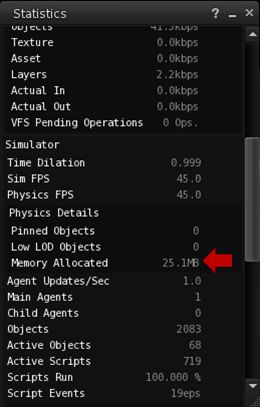
Physics memory use can be monitored via the Statistics floater (CTRL-SHIFT-1)

Regions are allocated a fixed amount of memory that can use. In the case of a full simulator, this is about 1GB, while Homesteads are allocated around 250MB. Generally, physics memory usage for a region – even a busy one – is around 40-80MB. However, on affected Homestead regions, the physics memory use is reaching or exceeding 200MB.

When the physics memory for a simulator gets abnormally high (close to or on 90% of the allowed maximum) internal region safeguards kick-in and prevent object rezzing in an attempt to limit further calls of the region’s memory and keep it alive. This is the behaviour people are witnessing in their regions. The safeguards themselves are designed to help prevent regions from becoming unstable during griefing attacks. However, the problems people are experiencing appear to be entirely unrelated to any form of griefing, and are thus causing a certain amount of head-scratching at Linden Lab.

Reed Linden, in responding to a support request from Motor Loon, provides clear guidelines on what to do if you have a Homestead and experience these issues. It is thought that the most likely culprit for the problem is an unidentified memory leak, but this has yet to be confirmed. Reeds comments regarding particle systems are fascinating. Particles tend to be more viewer-intensive than server, and as many commented at the Simulator User Group meeting on Tuesday 20th November, it would take something bizarre to be going on for particles to be impacting region performance; however, at least one region affected by the issue appears to have a large number of particle emitters in operation.

A further interesting twist came at the meeting itself, when a pathfinding snake and a number of pathfinding characters were rezzed, and the region suffered a severe performance hit (sharp FPS drop experienced by all attendees, sharp increase in both physics memory use and time taken to ping the region) which appeared to be linked with the snake (which was set to follow its creator around) re-calculating its path to both follow its creator and avoid other avatars / objects. However, when the snake was re-rezzed a short time later, no similar issue was noticed, with the region using around 116MB physics memory, with no other outward performance issues.

I the meantime, and as the Linden dev team continue to investigate the issue, if you experience this kind of problem, please ensure you raise a support ticket, supplying as much information as possible, including region name / simulator version (from HELP > ABOUT (either Second Life or the name of your viewer), the time the problem occurred, how it manifested and, if possible, information from the Statistics bar: memory used, FPS and physics performance details, etc.