TeamFox SL: in the front line of the fight against Parkinson’s disease

There have been a number of reports in the media of late about a potentially significant breakthrough in the fight against Parkinson’s disease.  These reports, which have appeared on the pages of the Parkinson’s UK website, and through agencies such as Time Warner Cable News, are about a new vaccine which might slow, or even stop, the progression of the disease.

The vaccine is being developed in Austria with partial funding from the Michael J. Fox Foundation for Parkinson’s Research (referred to simply as the MJFF), and the publication of the reports on the work suggested an opportunity for me to write about the ongoing work of TeamFox SL here in Second Life in the battle to find a lasting cure for Parkinson’s disease, and in helping to support people diagnosed with Young Onset Parkinson’s Disease.

Parkinson’s is a degenerative disorder of the central nervous system, which manifests itself in many ways. The most visible symptoms are related to movement: shaking, rigidity, slowness of movement and difficulty with walking, but it can cause bladder and bowel problems, speech and communication difficulties, vision disorders, and can also give rise to psychological problems such as depression. Around one in 500 people suffer from the disease world-wide and there is currently no known cure, although symptoms can be controlled through medication, therapy and, in some cases, surgery.

It is most often seen as a disease affecting people of 50 or older, but this in itself masks a fact: a form of Parkinson’s disease can strike people at a much younger age, and one in twenty of the 8 million Parkinson’s sufferers worldwide is below the age of 40. This variant of Parkinson’s is known as Young Onset Parkinson’s Disease (YOPD).  It differs from older onset Parkinson’s because genetics appears to play a stronger role in YOPD compared to older onset, and the symptoms may differ, together with the response to medication.

Michal J. Fox highlighted the fact that Parkinson’s, often considered an “older persons” disease, can strike at any time, when, at the age of 29, he was diagnosed with Young Onset Parkinson’s disease (image via Photo: Laura Cavanaugh/Film Magic)

One of those under the age of 40 who was struck by the illness was Canadian-born actor, Michael J. Fox, who started showing symptoms as a YOPD sufferer when he was just 29 and filming Doc Hollywood. In 1998, he revealed his condition to the world before establishing the MJFF in 2000, which is dedicated to carrying out research into both combating the symptoms of Parkinson’s disease and to finding a cure. It is now the largest non-profit organisation researching Parkinson’s.

Funding such an aggressive research campaign as run by the Foundation doesn’t come cheap, although they are massively targeted in how they spend their funds. So, to help with fundraising efforts, and in response to Michael’s fans wanting to help with efforts in 2006, the MJFF established Team Fox, a grassroots community fundraising programme. In the eight years since it’s formation, Team Fox has raised over $27 million to help the Foundation’s research through a wide range of public-focused activities and events – which include Second Life, where TeamFox SL is helping to lead the fight.

TeamFox SL was founded by Solas NaGealai. In 1999, well before her involvement in Second Life, she was diagnosed with YOPD. “It was the same time as Michael J Fox disclosed his condition to the public, making my diagnose less tragic and me feeling less alone,” she says of her situation. “The hardest part about being young with Parkinson’s is learning how to juggle a career and a family, along with the life changing illness.”

When first diagnosed, Solas was a full-time fashion designer. However, as the illness progressed, she was forced to leave that career behind. Fortunately, her discovery of Second Life allowed her a way to re-engage in her passion for design, and she founded her own fashion label at Blue Moon Enterprise.

Even so, she wanted to do more, particularly to help with the Foundation’s work. “I knew I could not sit idle,” she says. “To quote Michael, ‘Our challenges don’t define us. Our actions do.’ The strength and optimism I saw in Michael created a spark inside me. With that optimism, I wanted to find a way to give back to the MJFF, to show support and help.”

That way came with the founding of Team Fox. Not only did Solas direct 100% of the proceeds from the sales of her SL designs to Team Fox, she also established TeamFox SL in 2008, the first Team Fox presence to be established in SecondLife, and to be officially sanctioned by the organisation.

Solas wearing one of her own gowns

Team Fox SL is dedicated to raising funds for the MJFF, disseminating information about the disease, and providing support for those diagnosed with the illness and their families. In this latter regards, TeamFox SL places special emphasis on providing information on YOPD and helping those diagnosed with YOPD.

This focus is for two reasons; the first is Solas’ own experience as someone diagnosed with YOPD who has trod the route faced by many others diagnosed with the condition and the unique challenges it presents. YOPD sufferers are faced with having to consider how to manage a chronic disease while engaged in career, perhaps raising a family – or even starting a family – and maintaining as high a degree of wellness as possible for as long as possible.

The second reason for the focus on YOPD is the SL demographic itself. YOPD affects people who are 40 or younger; an age range which probably defines the greater portion of SL users, and so it is probable than many of those diagnosed with Parkinson’s and who use Second Life are afflicted by YOPD.

In terms of fundraising, TeamFox SL helps to organise events and activities throughout the year and works closely with other Parkinson’s disease support groups in Second Life, particularly Creations for Parkinson’s, established by Barbie Alchemi, the daughter of Fran Seranade, whose own remarkable story I covered in these pages in 2013, and has also been the subject of The Drax Files: World Makers.

Perhaps one of the most high-profile events co-organised by Solas and co-hosted by TeamFox SL and Creations for Parkinson’s, was the Michael J. Fox Premiere Party, held at Angel Manor in September 2013 to mark the star’s return to television in his own series, and at which a staggering L$425,000 was raised in just three hours through donations and a special silent auction.

Continue reading “TeamFox SL: in the front line of the fight against Parkinson’s disease”

Virtual humans: helping us to talk about ourselves

Hi, I’m Ellie. Thanks for coming in today. I was created to talk to people in a safe and secure environment. I’m not a therapist, but I’m here to learn about people, and would love to learn about you. I’ll ask a few questions to get us started…

These are the opening comments from SimSensei, a virtual human application and part of a suite of software tools which may in the future be used to assist in the identification, diagnosis and treatment of mental health issues by engaging people in conversation and by using real-time sensing and recognition of nonverbal behaviours and responses which may be indicative of depression or other disorders.

SimSensei and its companion application, MultiSense, have been developed by the Institute for Creative Technologies (ICT) at the University of Southern California (USC) as part of wide-ranging research into the use of various technologies  – virtual humans, virtual reality, and so on – in a number of fields, including entertainment, healthcare and training.

In 2013, SimSensei and MultiSense underwent an extensive study, the results of which have just been published in a report entitled, It’s only a computer: Virtual humans increase willingness to disclose, which appears in the August 2014 volume of Computers in Human Behaviour.

It is regarded as the first study to present empirical evidence that the use of virtual humans can encourage patients to more honestly and openly disclose information about themselves than might be the case when they are directly addressing another human being, whom they may regard as passing judgement on what they are saying, making them less willing to reveal what information about themselves they feel is embarrassing or which may cause them emotional discomfort if mentioned.

Ellie is the "face" of SimSensei, part of a into the use of virtual tools and software to help address health issues
Ellie is a virtual human, the “face” of SimSensei, designed to interact with human beings in a natural way, and build a conversational rapport with them as a part of a suite of software which might be used to help in the diagnosis of mental ailments

SimSensei presents a patient with a screen-based virtual human, Ellie. The term “virtual human” is used rather than “avatar” because Ellie is driven by a complex AI programme which allows her to engage and interact with people entirely autonomously.

This focus of the software is to make Ellie appear as natural and as human as possible in order for her to build up a rapport with the person who is talking to her. This is achieved by the software responding to subjects using both verbal and nonverbal communication, just like a human being.

During a conversation SimSensei will adjust its reactions to a real person’s verbal and visual cues. Ellie will smile in response to positive displays of emotion – happiness, etc., she will nod encouragement or offer appropriate verbal encouragement during pauses in the flow of conversation, and so on. Rapport is further built by the software being able to engage in small talk and give natural-sounding responses to comments. For example, when one subject mentioned he was from Los Angeles, her response was to say, “Oh! I’m from LA myself!”

SimSensei’s interaction with a patient is driven by MultiSense, which is  technically referred to as “multinodal perception software framework”. MultiSense uses a microphone and camera to capture and map the patient’s verbal and nonverbal responses to SimSensei (facial expression, the direction in which they look, body movements, intonations and hesitations in their speech pattern, etc.). This data is analysed in real-time, and feedback is then given to SimSensei, helping to direct its responses as well as allowing it to detect signs of psychological distress which might be associated with depression disorders or conditions such as post-traumatic stress disorder (PTSD), and react accordingly.

During the ICT study, SimSensei and MultiSense were used to screen 239 people aged between 18 and 65, who were invited to a setting where they could interact with SimSensei as if they were undergoing an interview for admission to a hospital or clinic. On their arrival, some of them were told that they would be interacting with a fully automated piece of software with no human involvement at all, while others were told they’d be interacting with a computer avatar operated by a human. In reality, participants were assigned a fully or semi-automated virtual human entirely at random and without regard to what they were told.

When analysing the results, researchers found that those who believed they were talking purely to a virtual human were far more willing to divulge information and answer personal questions than those who had been told another human being was directing the virtual human. Researchers also noted that those who believed they were addressing a computer programme showed more intense emotional responses in their facial expressions than those who had been told beforehand that there was a human being operating the SimSensei virtual human.

MultiSense tracks the subject's facial expression, head and eye movements, body language as well as the tonal quality of their voice and what they are saying. Here, the subject' discomfort in talking about something results in gaze aversion, a downward look, fracture comments, all noted by MultiSense (and marked in red), which then helps drive the SimSensei virtual human's reactions and verbal response (shown in the crentral information box outlined in blue)
MultiSense tracks the subject’s facial expression, head and eye movements, body language as well as the tonal quality of their voice and what they are saying. Here, the subject’ discomfort in talking about something results in gaze aversion, a downward look, fracture comments, all noted by MultiSense (and marked in red), which then helps drive the SimSensei virtual human’s reactions and verbal response (shown in the central information box outlined in blue) – click to enlarge

Feedback was also gathered from the test subjects after their interviews, with those who believed they have been interacting with a computer programme indicating they felt far more comfortable in revealing information about themselves than had they been addressing a human being. By contrast, those who had been told that Ellie was being operated by a human being tended to indicate that they would have been more open in their responses to questions if they had felt they were only addressing a software programme.

Jonathan Gratch is a both the co-author of the study’s report and the Director of Virtual Human Research at ICT. Commenting on the study in a July 2014 article published in the USC News, he said, “We know that developing a rapport and feeling free of judgment are two important factors that affect a person’s willingness to disclose personal information. The virtual character delivered on both these fronts and that is what makes this a particularly valuable tool for obtaining information people might feel sensitive about sharing.”

Jon Gratch leading the USC's ICT research into the use of virtual humans and related technologies in a wide range of areas
Jonathan Gratch leading the USC’s ICT research into the use of virtual humans and related technologies in a wide range of areas

Gratch and his colleagues are keen to stress that SimSensei and MultiSense are not intended to replace trained clinicians in dealing with people’s health issues. However, the results of the ICT’s study suggests that given patients are more willing to disclose information about themselves both directly and through their nonverbal reactions to the software, the use of virtual humans could greatly assist in the diagnosis and treatment process.

In particular, the ICT is already initiating a number of healthcare projects to further explore the potential of virtual humans and the SimSensei / MultiSense framework. These include helping detect signs of depression, the potential to provide healthcare screening services for patients in remote areas, and in improving communication skills in young adults with autism spectrum disorder. Research is also being carried out into the effective use of virtual humans as complex role-playing partners to assist in the training of healthcare professionals, as well as the use of the technology in other training environments.

As noted towards the top of this article, the SimSensei  / MultiSense study is just one aspect of the ICT’s research into the use of a range of virtual technologies, including virtual reality and immersive spaces, for a wide range of actual and potential applications.  I hope to cover some more of their work in future articles.

Related Links

Images via the Institute of Creative Technologies and USC News.

The Drax Files Radio Hour interviews: defining the real and the virtual

radio-hourEpisode #22 of  The Drax Files Radio Hour was posted on Friday June 6th. With the “live” podcasts currently on hiatus until August 2014, this is the first of a series of more in-depth interviews with people from across Second Life and beyond.

As usual, and as well as being available on the show’s website and on Stitcher, episode #22 is also on YouTube, and embedded at the end of this article.

This first interview show primarily focuses on Tom Boellstorff (Tom Bukowski in SL), a professor of anthropology at the University of California, Irvine, who has studied such subjects as the anthropology of sexuality, the anthropology of globalisation, the anthropology of HIV/AIDS, and linguistic anthropology, publishing numerous books and papers along the way.

Tom has been involved with and in Second Life for over a decade, being one of the early pioneers on the platform, at a time (2004) when there were perhaps 2,000 active SL accounts and concurrency was measured in the hundreds. He has authored and co-authored two notable titles on the subject of virtual worlds in that time, namely Coming of Age in Second Life: An Anthropologist Explores the Virtually Human, (Princeton University Press, 2008), and Ethnography and Virtual Worlds: A Handbook of Method (Princeton University Press, 2012, co-authored with Bonnie Nardi, Celia Pearce & T. L. Taylor).

Tom’s name may also been familiar to some for his involvement in the story of Fran Swenson (Fran Seranade in SL), a Parkinson’s Disease sufferer, whom I wrote about in 2013, and who was also featured in The Drax Files: World Makers segment #13, in November 2013.

Tom Boellstorff (image: Univ. of California)

This is a wide-ranging interview, commencing at 05:06 into the recording,  which encompasses, but is not limited to, such diverse but inter-related topics as how we define – or perhaps should define – virtual worlds; the differences (and similarities) between virtual worlds and other digital spaces; the challenges of defining what is meant be “real” and what is meant by “virtual”; and a discussion on communities of intent and their role within Second Life – and SL’s role with them. Along the way there are some thought-provoking challenges to how we perhaps think about SL and how we may actually contribute, to a degree, to the broader misconceptions surrounding SL simply through the language we use when referring to it.

In terms of providing a definition of virtual worlds and virtual environments, Tom offers up the idea that they can be defined as any place or activity which allows you to “go AFK” (away from keyboard) – that is, you can stop interacting with others involved in the same space / place / activity and then return, and whatever was going on prior to your stepping away continues (and perhaps, in some cases, evolves) during your absence, and is still there where you return.

This is something of a mind-boggling concept and definition, particularly when Tom goes on to suggest that the very first virtual environment came about not in the digital era, but in the earliest days of the telephone, when two people were engaged in a conversation, and one momentarily put the telephone handset down to do something, then rejoined the conversation without actually hanging-up. As such, it’s liable to have some frowning at the idea.

However, when taken alongside his comments about place (or the sense of place), one can see where he is coming from. With place entered into the equation (actually, one of the foundations of the discussion), then it is easier to understand his contention, and to agree with his view that standalone games, as immersive to the individual as they may well be,  are not really virtual spaces in the sense that Second Life, or even a Skype call, can be considered virtual spaces. Second life continues after we log-off, the same way that life at either end of Skype call continues after the call ends; stop playing a standalone game, and that’s it, there is nothing else until you start playing it again.

Such definitions of virtual worlds might sound very academic: interesting for a thesis or a book, but with little other meaning. However, as Tom goes on to explain, this is actually not the case:

I actually think it’s very important because it is amazing how much confusion there is out there about all of these technologies. There’s a lot of misunderstanding and confusion, and so … I spend a lot of time doing definitions, and i think it is just as important as the interesting, sexy stories about the cool things people are doing, because if we don’t have a basic understanding of what we’re looking at, it really makes it hard to figure out why its important.

Continue reading “The Drax Files Radio Hour interviews: defining the real and the virtual”

The Drax Files 13: People can learn, and grow and heal together

In September, I covered the story of Fran Swenson, an 86-year-old suffering from Parkinson’s Disease, her daughter Barbara, and their experiences and times within Second Life.

I wasn’t the first to come to Fran’s story, which is remarkable in the way Second Life has had a positive and uplifting impact on her life; Hamlet Au did that way back in February.  But such is her story, it does deserve to be heard and re-told, be it through blogs like Hamlet’s or this one, or through media coverage such as in the San Diego Union-Tribune.

Barbara and Fran
Barbara and Fran

Now, both Fran and Barbara – Fran Seranade and Barbi Alchemi respectively in Second Life – get to share their story and their insight and wisdom in the latest edition of The Drax Files. And I’m not exaggerating when I say that, in what has already been a truly outstanding series, this is the most powerful segment to yet come to our screens.

Having lost her husband to Parkinson’s in 2003, Fran found herself diagnosed with the illness the following year. Over time, she relocated from the east coast of the United States to the west, and as a result, her son Ken, still living on the other side of the country in Florida, proposed the idea of using Second Life as a means of bringing the family together more easily, offering to build a home for them in-world.

Barbara, also residing on the west coast, admits that, initially, she wasn’t that keen on the idea. Like many people, she considered SL as little more that a sexual playground, coupled with a steep learning-curve for those not particularly well-versed in the nuances of virtual worlds and / or computer games and environments. It was easier to point a derisive finger at Second Life users than to become one. But once encouraged to give it a go, Barbara soon found herself converted. What’s more, she was amazed when she started witnessing Fran’s response to the platform, both physically and mentally.

Fran’s experiences with Second Life have resulted in Barbara establishing Creations for Parkinson’s, and Creations Park in SL – both of which are designed to bring sufferers of the disease and their friends together in an environment where they can meet and share and enjoy themselves pursuing a wide range of activities.

Fran’s story is also one which has come to the attention of academic researchers such as Tom Boellstorff, an anthropology professor at UC Irvine, and Donna Davis, a strategic communications professor at the University of Oregon and who now leads the Thursday group sessions at Creations.

Fran's experiences have been a focus of study for Tom Boellstorff
Fran’s experiences have been a focus of study for Tom Boellstorff

It was Boellstorff who pointed to the possibility of Second Life triggering “mirror neurons” in Fran’s mind. These are, as Barbara explains in the video, the neurons which allow us to pattern and mirror what we see in others. While there is some controversy as to their classification and origin, their effect on assisting the learning capabilities of young children is fairly widely recognised, and the theory is that in Fran’s case, her mirror neurons are reacting to her time in Second Life and are forging new pathways to connect her mind and body, offsetting some of the impact Parkinson’s is having on her.

While Fran’s own case is still the subject of study and so precludes definitive conclusions being drawn from a medical standpoint, the fact remains that the therapeutic value of Second Life on her own real life – allowing for the fact she is active in other areas of her life as well – is very genuine. In this, she is not alone; several research studies have shown that while our avatars can be highly stylised and all tend to be youthful in appearance, our identification with them can have lasting and positive benefits on our lives in so many ways.

“The avatar represents who I really feel inside,” Fran tells us, “When I look at my avatar, I feel like I’m looking at myself.” This reaction is not unusal; and it does act as a kind of positive affirmation that may well – perhaps thanks to mirror neurons again – offer something of a fountain of youth for the mind which can manifest itself as real physical improvements in health, vitality and happiness and in our self-identification.

Creations Park, founded by Barbara and a centre where people with Parkinson's Disease from around the world and their friends can share, relax, and enjoy  themselves in a stress-free environment offering a broad range of activities
Creations Park, founded by Barbara and a centre where people with Parkinson’s Disease from around the world and their friends can share, relax, and enjoy themselves in a stress-free environment offering a broad range of activities

However, to think this is a story about the potential impact Second Life may have on health issues is to only pick-up on half the story. This segment of The Drax Files is much deeper than previous episodes because it very much expresses the reality that far from being something that sets us apart from “real life”, Second Life is something which both enriches our real world experiences, and allows us the freedom to be who we really are in ways that are all too frequently denied us elsewhere in life.

Oscar Wilde once said, “Man is least himself when he talks in his own person. Give him a mask, and he will tell you the truth.” But was he necessarily right? Modern life requires we wear so many masks: the mask we wear to work, the mask we wear to church, the mask we wear when among strangers, the social mask, the stern-mum-and-dad mask we sometimes have to present to the kids, the mask we wear when joining-in with “the crowd”, or “the lads”, or “the girls” when on a night on the tiles, and so on. All of them  allow us to express aspects of ourselves, but those aspects are always constrained to what we believe we should be projecting to those around us, rather than necessarily actually being who we are as a whole person.

Of course, Second Life also allows us to wear a huge range of masks in-world, and allows us to do so free of the constraints  society would otherwise demand of us. We can be truer to different facets of our personality, to our hopes, our wants, and our desires. But the greatest gift Second Life perhaps gives us is that it actually allows us, if we’re willing to do so, to create and foster environments where we can all safely lay all our masks aside and simply be ourselves without fear of recrimination or judgement.

This is something not lost on Barbara, “We’re free to be who we really are,” she points out. “Sometimes  people can be terribly shy, but in here, they open up for some reason. Meeting here with our avatar is a totally freeing experience, there is a deeper level of connection. We really let down our mask, and we are authentically ourselves; who we are will get expressed in our avatar. We’re out of the box.”

Fran and Fran and friends

We often talk about overcoming the perceptions of all those who would see Second life as a den of digital iniquity and a haven for basement dwellers unable to “get a life.” Perhaps this is the way to do so. Not by attempting to challenge such ideas head-on or argue against them, but to show that Second Life and environments like it are not only capable of allowing completely free rein to our imaginations and creative abilities, but that they are a very valid social extension to people’s lives; that rather than being a means to escape the world, they offer a means to more fully engage with the world at large, and can actively expand our understanding and appreciation of the world through our interactions with the people behind the avatars.

When you combine this aspect of outreach and connection with the free-ranging creative opportunities within Second Life, you have a medium which, as we have all recognised in our time in-world, exceptionally powerful on so many levels for each and every one of us, regardless of age, social standing, background and so on. It’s not about hiding away or needing to escape from the tribulations of life or being unable to express ourselves in real life. It’s about extending and expanding and enriching our lives.

“This is about all people,” Barbara says towards the end of the piece, “Using their creativity in a positive way to make a new world.”

She’s right.

Continue reading “The Drax Files 13: People can learn, and grow and heal together”

Keeping in shape in InWorldz

There has been a lot in the blogsphere over the last twelve months about virtual world and matters of health.

For example, there’s Fran Seranade (Fran Swenson in SL) and the benefits she’s personally experienced in using Second Life as a sufferer of Parkinson’s disease which has led to Donna Davis of the University of Oregon and Tom Boellstorff, an anthropology professor at UC Irvine researching the matter in-world.  Virtual Ability has a long history of helping people with disabilities make full use of SL for the betterment of their real lives, and the Centre for ME/CFS and Other Invisible Illnesses is based in Second Life. There have also been numerous projects involving medical workers, such as the research performed by a team at the Imperial College London to improve patient management skills among surgical residents at hospitals.

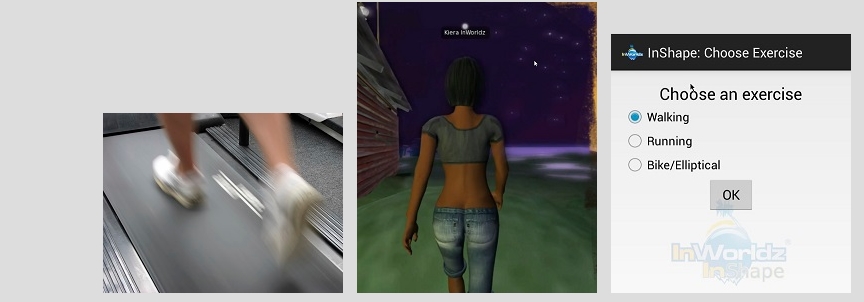
Now over on InWorldz, the team there have taken things a step further – literally and figuratively – with an app which allows you to exercise at home while still exploring InWorldz.

InWorldz InShape is currently available for Android devices, although iOS / Windows versions are promised for the future. It essentially gathers data on your real-world exercising when using a treadmill, stationary exercise bike or elliptical bike / trainer, and translates it to in-world movement. Thus, people using it can explore in-world regions with their avatar which exercising, and even compete against one another.

InWorldz InShape: spend time in-world while exercising at home

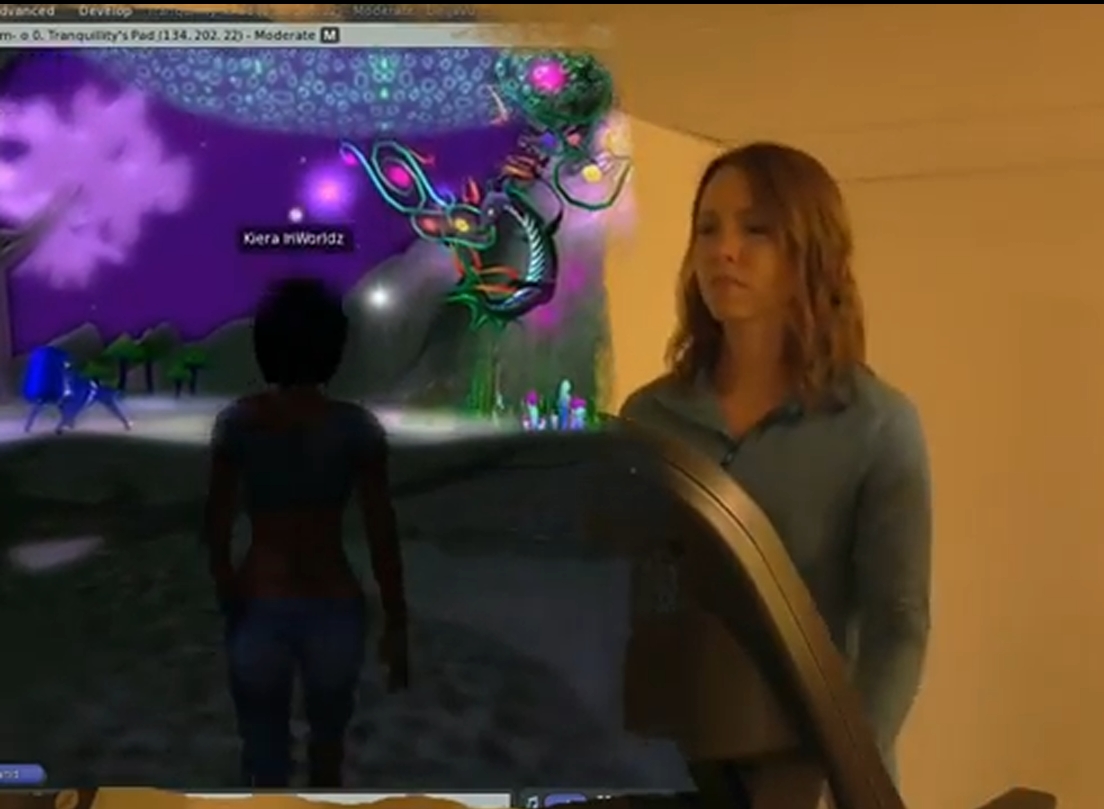
The app and idea are still very much beta, but already InWorldz residents have built a park where those with the app can go for walks / runs / rides, and there are plans to start weekly exercise sessions, allowing users to meet in-world and go through a routine together on a “group treadmill” while also exercising at home. The InWorldz team also hope that residents will build race tracks, walks and so on to make use of the app and offer further opportunities for combining fitness training with in-world activities with friends, making it easy to keep fit together.

InWorldz InShape in action: a walk in the park in-world (left) while exercising at home (r)

An InWorldz beta programme for the app has been launched, and the InWorldz team are looking for people to join them in trying it out. Those wishing to sign-up will need to have an InWorldz account and meet the following requirements:

  • Be in good enough physical health to start or participate in a light exercise programme (consulte your doctor if you have any concerns)
  • have enough time to participate in testing once a week, during the weekend, for about 45 minutes
  • own or have access to an android powered phone (Android 2.3.3 or later)
  • own or have access to: An exercise bike, elliptical, or treadmill and a computer or tablet that can run a viewer (/Lumiya) connected to the InWorldz Grid.

Those meeting these criteria can register their interest at the InWorldz website.

A demo video has been produced, hosted by InWorldz’s own Tranquility Dexler, which provides an in-depth look at the app in use.

This looks like a very practical and fun application for a virtual world environment, and could potentially see a lot of new opportunities for competitive undertakings in-world or bring a whole new dimension to something like the RFL track walks for people – again, providing due care is taken with RL fitness condition.

I’m keen to sign-up myself, but I don’t have the requisite exercise equipment. I wonder if they’ll ever be able to include a rowing machine and a lake to paddle across …?

Related Links

All images courtesy of InWorldz.

The Michael J Fox VIP Premiere Party in aid of Parkinson’s Research

Fox-fundThursday September 27th will see a special series of events take place across the USA and Canada – and in Second Life.

They are to both mark the premiere of Michael J. Fox’s new TV series and to raise funds for the Michael J. Fox Foundation for Parkinson’s Research.

The Second Life event, which kicks-off at 15:00 SLT is the only one of its kind to be taking place in a virtual worlds, and is a co-production between Creations for Parkinsons and Team Fox SL, and organised by Team Fox SL coordinator Solas (solasnagealai).

And there is still time to be a part of the magic!

Tickets are L$1,000 (and limited to 100), with all proceeds going directly to the Foundation via Team Fox, its official grass-roots fundraising arm. The party will run through until 18:00 SLT and will take place in the elegance of the Rose Theatre Ballroom at Angel Manor.

To obtain your ticket:

  • Visitor the vendors at Angel Manor or Creations Park
  • or copy and past the following in open chat: secondlife:///app/group/84fb7135-bf2f-7d66-a30b-98ecee9cd5a8/about – The Group Tag is your ticket.

Event Schedule

  • 15:00-16:00 SLT – live music with Satin Galli
  • 16:00-18:00 – live DJ Graywolf with handpicked music by Michael’s son Sam along with trivia games and prizes

VIP Auction

The afternoon will feature a special VIP Auction with some exceptional items:

  • A chance to work alongside DB Bailey, an architect who provides unique spaces with complex vibrant textures zealously executed are walks of art, and learn his magic!
  • A one-of-a-kind complete avatar, MICHELLE, a high quality, attractive female Shape and Skin from PYRO. Comes with Eyes, Lip Gloss and Hair
  • Two minutes of video magic about them self done by Draxtor Despres the man behind “The Drax Files” http://draxtor.com/
  • A unique fashion!  From inspiration to creation,  Solas NaGealai  owner of  BlueMoon enterprise  will make you the perfect second life garment
  • Tea and talk with “Creations Mom” Fran Seranade herself, the inspiration for Creations for Parkinson’s, Enjoy some time with this lovable wise woman.

And more! All proceeds from the auction, and raised throughout the event, will go to the Michael J. Fox Foundation for Parkinson’s Research.

So, don’t delay any longer. Be a part of this magical evening – there is still time!

Please note the dress code is formal attire is preferred.

Related Links