Sous le ciel de Paris (under the sky of Paris) is the name given to a sky platform designed by Tolia Crisp of Frogmore fame). It’s a little corner of Second Life occupying Full region parcel of 5120 sq metres. Little in the way of any description is supplied, other than Welcome to my home, but what is offered is bound to be a delight to those seeking a backdrop for their avatar photography.
This is a place set amongst the rooftops of Paris, a part of the city where many of the houses built in the Napoleonic period have been converted into apartment blocks such that rooftop spaces have become gardens, outdoor terraces and places to relax.
Sous le ciel de Paris, February 2022
There centre point for this is one roof area in particular, a space alongside a cosy little apartment laid out with planters growing flowers and vegetables, bee hives vie with a hen coop for attention, cats and kittens play in the Sun, and saplings sit within oversized vases to provide a further sense of the countryside in this otherwise very metropolitan setting.
It’s a welcoming spot; a place the apartment owner can come home to and unwind tending to flowers, gathering fresh veggies for cooking or tending to hens and bees – or just fussing with their cats under the blue sky. But that’s not all; this is a place that is clearly put together with a view to sharing it with neighbours, a little “coffee shop” having been set up to one side.
Sous le ciel de Paris, February 2022
Some of the neighbours also seem to have entered into the spirit of things – one has created a slight precarious walkway to link a home-made studio with the “garden”, and other has lain an iron ladder to bridge the gap from their rooftop, and a route via a fire escape that leads to another little hidden “terrace in the sky, nestled under high roofs and smoking chimneys; a place where yet more coffee and fresh baked goodies can be enjoyed and people might share a dance or two.
Sous le ciel de Paris, February 2022
With places to sit indoors and out, this is a location that could be idea for avatar photography, and joining the Frogmore group (the parcel is under the Frogmore banner) will provide rezzing rights for props – but please be sure to ick them up afterwards.
I would point out that there are a lot of textures packed into the space and these can take a little time to fully render, and I did have one or two issues on my system with getting all the mesh to rez (solving with right-clicks here and there) – but none of this prevented me from appreciating this little corner of SL.
Sous le ciel de Paris, February 2022
Addendum: If you do take the opportunity to take photographs using Sous le ceil de Paris as a backdrop (e.g. for fashion / style posts, etc.) – or indeed any other location in Second Life, please do make sure the location is credited.
Crisp Kringle – Frogmore Christmas Region, December 2021 – click any image for full size
“It’s small but I wanted to be able to add details,” Tolla Crisp told me after inviting me to visit her winter setting, an offshoot of her Frogmore (and Mousehole) regions (although quite separate from them). I have no problem with small settings, even when a complete Homestead region is concerned, because small can often be better.
In the case of Crisp Kringle – Frogmore Christmas Region, small brings us a little and engaging touch of Tolla’s homeland, as she notes in the About Land description:
A tiny Swedish Village of childhood memories, snow covered landscape, warm Fika Shoppes, and the light sound of Reindeer paws.
Crisp Kringle – Frogmore Christmas Region, December 2021
For those unfamiliar with fika is at the heart of Swedish coffee culture, a social institution involving the practice of taking a break with a beverage and snack that is widely accepted as central to Swedish life. Traditionally, it involves a cup of coffee enjoyed with a pastry, although the coffee can be replaced by alternate hot beverages such as tea and hot chocolate, and juices and squashes for children. In addition, the term can also be used to mean an informal meeting, generally within a business and between management and business.
Crisp Kringle – Frogmore Christmas Region, December 2021
Crisp Kringle offers plenty of opportunities for both. Along the little village street can be found a little fika café where a hoot drink and pastry can be enjoyed indoors, while a couple of outdoor spots offer either hot chocolate or mulled wine for those needing a warming of the hands an tummy without necessarily wanting to stop and sit a while. And while the idea of a fika and a meeting might be couched in business, here it also relates to the way people can visit, meet, explore and enjoy entirely informally.
Crisp Kringle – Frogmore Christmas Region, December 2021
From the icy landing point, the street rises by a series of steps to pass between various small businesses (including one with a sense of being Santa’s workshop) before descending down to another frozen body of water. This is large enough to support some ice skating (skates available via a sign on the ice), with the ice certain think enough to support a lot of weight, despite someone having hack a hole through it for some ice fishing, as evidence by the reindeer (large and small) stress testing it from time to time with heavy jumps.
Crisp Kringle – Frogmore Christmas Region, December 2021
Also to be found are cabins where further warmth can be found, together with opportunities for cuddles, or the for daring, an outdoor, coal-fired hot tub awaits. While for those who fancy a quite skate away from the main pond and the town, a small pond sits over the hills.
Small, but with a lot of detail to be discovered and photographed, Crisp Kringle – Frogmore Christmas Region offers a nice winter setting with just a hint of Christmas to be found within it without a hint of the usual schmaltz to spoil it.
Crisp Kringle – Frogmore Christmas Region, December 2021
Mousehole, June 2021 – click any image for full size
Tolla Crisp contacted me recently to extend an invitation to visit her new region holding, Mousehole, located to the south of her famous Frogmore, a place I’ve covered numerous times in these pages due to it’s sheer beauty. The two are connected to it via footbridge, with Mousehole expanding on the Cornish theme folded into the current iteration of Frogmore (which you can read about here), making both regions ideal for a joint visit, as well as each one standing on its own.
A Full region using the standard 20K land impact, Mousehole takes its name from the Cornish fishing hamlet of Mousehole (pronounced maʊzəl, orPorthenys in Cornish), located in the far south-west of the English county, on the shore of Mount’s Bay. Like Frogmore, the overall design is the work of Dandy Warhlol (terry Fotherington), whose hand and eye helps to give that flow of continuity between the two regions.
Mousehole, June 2021
With a population of around 700, Mousehole has a long history as a fishing village that dates back to the 1200s. However, in modern times it is noted more as a visitor / tourist destination and for its many festivals and community events that are held throughout the year.
Whilst taking its name and a lot of its inspiration from the hamlet and Cornwall’s rugged coastline, the design also offers and inland setting that offers a mix of hints of Mousehole village and the wilder aspects of the county. Combined, these give the region a unique look and feel whilst also giving a hint why almost a third of Cornwall’s coast and some of its inland areas are designated Areas of Outstanding Natural Beauty (ANOB) – giving them the same status as a national park.
Mousehole, June 2021
The main part of the region is open to the public, encircled by a broad beach broken by rocky outcrops to form smaller coves typical of the kind that might be found along the Cornish coast. Along these sands are places to sit, bars to by found, opportunities for swimming or simply floating on the water.
Sitting within this are two upland areas which might be seen along the upper reaches of Cornwall’s rugged coast around Mount’s Bay, but which equally bring to mind the wilds of Bodmin Moor. Separated by a sandy divide that offers a shortcut between the north and south sides of the island, these two uplands are rich in greenery and home to individual scenes.
Mousehole, June 2021
The larger of the two offers a setting that might have been lifted from the village itself – most notably the famous Mousehole Pub, which shares the hilltop with a stone-built house and a country church. No roads are visible here, however; instead, the buildings stand surrounded by moorland grass grazed upon by donkeys (Cornwall and neighbouring Devon are also noted for their donkeys), with visitors free to wander across the hilltop and perhaps cross the bridge spanning the shallow gorge to touch the second upland.
This smaller hill is home to an abandoned house (I admittedly found the motel sign outside to look and feel out-of-place), its garden overgrown and nature starting to reclaim its interior. Forlorn and decaying, it has the feel of a place that one might come across deep in the Cornish moorlands, once home to a farm or the retreat of a wealthy tin mine owner and his family, now long abandoned and forgotten.
Mousehole, June 2021
Further touches of Mousehole and its surrounds can be found within the region. Just off the southern coast, for example, is an islet that is mindful of the small island of St. Clements sitting just off the entrance to the village’s harbour. Be mindful that the in-world island is actually a private residence, however, so do be wary of trespass.
Also, just off on of the beaches lies the entrance to a cavern. Find your way inside and you’ll discover a little homage to the tale of a hermit who was said to once lived along the coast at Mousehole.
Mousehole, June 2021
Rich in detail and touches – off to the west is a smaller island, home to another little bar and also what might be an abandoned military facility of a kind that can be stumbled across around the English coast – Tolla’s Mousehole is another delight to explore and photograph – and a delight to explore.
Tolla Crisp invited Caitlyn and I to visit Frogmore 4.0, the fourth iteration of her popular themed region which recently opened to visitors.
Once again, the setting draws its primary inspiration from the county of Cornwall, in the South-west of England – a place noted for its moors, hamlets, fishing, surfing, beaches and rugged beauty and which was the inspiration for the design we last saw in June 2020 (see Frogmore’s Cornish twist in Second Life). However, the design adds a couple of little twists of its own to the mix as well as offering a completely new look.
Frogmore 4.0, March 2021
Those twists take the form of a corner inspired by London’s Notting Hill, with another part taking the name “The Shire” – although whether this is a reference to Tolkien’s eponymous home of Hobbits or a reference to the shires of England in all their diverse beauty, is open to interpretation.
Now making use of the Land Impact bonus available to full private regions, this iteration has been designed by Dandy Warhlol (Terry Fotherington), who has been responsible for all of the various Frogmore designs. This ensures something of a continuity of approach as the region changes, helping to give it a sense of evolution / life in keeping with the continuing focus on Cornwell for on its inspiration.
Frogmore 4.0, March 2021
With this iteration, the region offers a look and feel of the more rugged parts of Cornwall’s coast that can feature rocky coves with little fishing hamlets tucked into them. Split into a series of islands, there is no set route to finding your way around the region, instead, visitors can wander as they please, causeways and bridges connecting the various areas.
The core influence for this design is the north Cornish fishing village of Port Isaac. It’s a place that may not be familiar to those outside of the UK, but since 2004 it has been the setting for the comedy series Doc Martin, at least one season of which has been streamed in the United States.
Frogmore 4.0, March 2021
It is also the home of Fisherman’s Friends, a male singing group who have been performing sea shanties since 1995. In 2010, they garnered worldwide attention after signing a recording deal with Universal Music, and their story was used as the basis for a 2019 romantic comedy film. The village is also part of the Baltic Live Cam network, with a 24/7 webcam stream.
Listed as a Conservation Area due to the buildings at its centre representing 18th and 19th century architecture, Port Isaac is historically significant, having likely been founded in Celtic times; its Cornish name, Porthysek means “corn port”, reflecting the use of the bay in shipping corn grown inland to centres of populace. It’s importance as a point of trade grew in the Tudor period, when Henry VIII had the bay dredged and the main pier and breakwater constructed. Apart from the corn that gave the town its name, cargoes of coal, wood, stone, ores, limestone, salt, pottery and heavy goods also passed through the harbour.
Frogmore 4.0, March 2021
However, pilchard fishing formed the backbone for the village for most of its history up until the late 1800s, with fishing still part of village life today, together with tourism. A curiosity with Port Isaac is that it shares a stretch of the coast with the hamlet of Port Gaverne; whilst separated b around a kilometre, the latter is often to be an outlier of the village, something that might be reflected in the way elements of this design stand aside from the rest, but nevertheless appear to be part of the whole.
With its harbour cove caught at low tide complete with breakwater, the heart of the region captures something of Port Isaac’s waterfront look whilst offering a wilder, more rugged landscape that is not so densely packed with houses and buildings. These are represented by the cluster of houses, barns and public building clustered on the island directly to the north.
Frogmore 4.0, March 2021
The Notting Hill aspect to the region can be found in the south-west corner, where an antiques boutique typical of those found along Portobello Road is waiting to be found. Sitting on a finger of land reached by a covered bridge, it sits separated from the main Cornish village element by The Shire.
This is a location that sits both aside from, yet a part of, the rest of the region. As already noted, whether one takes the area’s name from Tolkien or stands in reflection of England’s shire counties is a matter of choice. Certainly, there are no Hobbit holes waiting to be found, and the buildings, drywalls and gardens are suggestive of places like the Home Counties shires mixed with a dose of Yorkshire and Derbyshire. However, the high mountains surrounding the region – which are definitely not of England – give a New Zealandish feel to the setting, putting one in mind of the likes of Peter Jackson and his iconic visualisation of Middle Earth through his films, and thus call forth thoughts of Hobbits.
Frogmore 4.0, March 2021
As with all of the Frogmore iterations, this setting is rich in opportunities for photography, exploration and simply sitting and enjoying the view. Do be aware, however, that given many of the buildings are furnished, it is a place packed with mesh and textures, and this can have an impact on viewer performance, so be prepared to make allowances should this be the case.
But that said, from the compact gathering of houses and buildings clinging to the shorelines and cliffs complete with narrow streets, to the sweep of a northern beach overlooked by the ruins of a promontory fort, the richness of the Cornish landscape is hard to deny; while the twists within – the hints of Portobello Road to the touch of the Mediterranean in some of the buildings – make Frogmore a delightfully engaging visit.
Frogmore 4.0, March 2021
To mark the re-opening of the region, Tolla is holding a photography competition with a L$17,500 prize pool, details of which can be found here.
Frogmore, June 2020 – click any image for full size
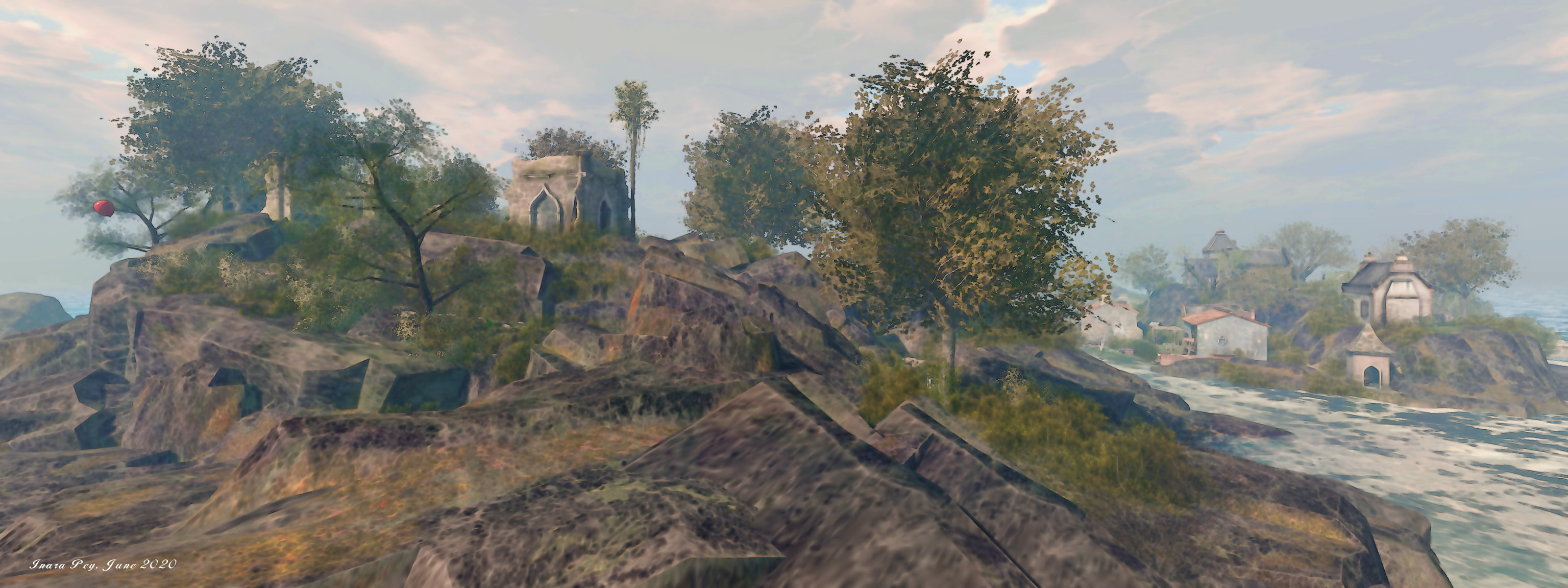
We recently made a return trip to Frogmore on the recommendation of Shawn Shakespeare, who nudged me about it having received another seasonal update, and with it a change of influences. Still held by Tolla Crisp and once again laid out by Terry Fotherington, the region now draws on a summery England for inspiration – specifically the county of Cornwall in the south-west of the country.
This is a multi-faceted design, surrounded on all four sides by water rather than making use of any region surround. “Multi-faceted” because it draws on multiple influences from the Cornish landscape, rather than being a representation of any specific part of that county, while the lack of any region surround allows it to be presented as an island setting in is own right and a place unique to the world of Second Life.
Frogmore, June 2020
These Cornish influences are reflected in right across the region, from the shaping of the land through to many of the buildings found within it. For example, the landing point sits to the south-east, in an upland region that might represent the more rugged aspects of the country’s moorlands, the ruins at its top perhaps suggestive of the ruins of one of the old wings of Bodmin Jail (although admittedly, in the physical world, the core of that building is in much better shape than the ruins in the region).
Similarly, across the region, in the north-west corner lies a secluded beach back by a rugged curve of hilly coastline. It is typical of many of the little coves that might be found around the Cornish coast, whilst the round rounded structure that guards one end of the beach carries echoes of Restormel Castle or Trematon Castle.
Frogmore, June 2020
Exploring the region is a case of following the path down from the landing point and around and between the rocky shoulders of the hills to reach an inland bay. Here, tucked into the curve of the southern uplands is a small tidal harbour, clearly with the tide out, although the breakwater still has its feet in the water, rowing boats sitting high and dry on the seaweed-edged sands. West of here is a working waterfront of unusual design – I’ve no idea if it is inspired by an actual place, but the lay of the stone built wharves and water channels is intriguing, and potentially a magnet for camera lenses.
To the north, a narrow causeway links the bulk of the region with its north side element, laid out as a line of smaller islands. The first of these is home to the secluded beach mentioned above, complete with an old lighthouse (another building design that has gained a lot of popularity among region designers of late).
Frogmore, June 2020
Beyond this and daisy chained to it by bridges, the second island appears to be drawn from a number of Cornish influences, both coastal and moorland. Within this is a cosy little bar waiting to be found, whilst the third island offers another classic building oft found within region designs: the Runestone castle, here used to offer a cosy home with a slightly bohemian feel.
For those who have visited it, exactly how much the region captures the heart of Cornwall is a matter of personal familiarity with the subject. As noted at the top of this article, if you enter the region in the expectation that you’re visiting a reproduction of a part of Cornwall, you’ll likely be a little disappointed. However,. take the region as drawing on a number of Cornish influences rather than a particular place, and the echoes and motifs are hard to miss, whilst allowing Frogmore to stand as a place in its own right.
Frogmore, June 2020
What cannot be denied, is the fact that it is a very photogenic region, although some who have shadows enabled on their systems may want to disable them when moving around between shots in order to maintain frame rates.
To mark the region’s new look, Tolla is running a photography contest between now and July 15th, 2020. On offer is a total prize pool of L$17,500, to be split between three winners (L$10,000 going to the first place winner). Submissions can be made via the Frogmore Flickr group, and must be on the subject of the region (and can include avatars / be post-processed). Group membership to the in-world Frogmore group is not required, but all submissions must be titled Frogmore 3.0 Photo Contest 2020, and include the artist’s name. Entries will be judged by a panel of three.
Frogmore, November 2019 – click any image for full size
We first visited Frogmore in August 2019, when it was located on a Homestead region. It has now relocated to a Full region that includes the full region land capacity bonus, and we were invited back to take a further look at the expanded setting by Bengta’s SL partner, Atze Boucher.
In the original build, Frogmore offered a focused interpretation of a childhood in Öregrund, Sweden. with the new Full region installation, that focus is broadened somewhat, with Bengta and Atza noting, ” we share with you a touch of life in Sweden and the magic that is Scandinavia”. This has resulted in a location that blends much of what will likely be familiar to those who visited the original Frogmore with much that is new, thus presenting a setting that carries with it a sense of returning to a familiar place in life, whilst also offer more opportunities for exploration and discovery.
Frogmore, November 2019
For those who have visited previously, that sense of familiarity is imbued on arrival: the cinder road is still there, forming the landing point and pointing the way between wooden buildings sitting on a narrow waterfront with the sea on one side and rugged steps of hills on the other. The ocean-facing wharves are still there as well, but a walk along the road will reveal that the buildings fronting them have been a little thinned out, before the road arrives not at a rocky headland, but at a large harbour market that may well be past its prime.
I say “past its prime”, because the main pier looks to be in need of repair, and the waters next to it don’t appear that welcoming to fishing boats (there’s even a poor piano caught in the detritus floating there), while the buildings on the headland look tired, with a couple now given over to entertainment, rather than serving market buyers with fish and produce. Even what might have been a large, solid warehouse looks to be in the process of being re-purposed as a art gallery.
Frogmore, November 2019
Elsewhere, other familiar sites await discovery. The rocky stream bubbling its way through one of the original setting’s two main islands, and which drew my attention during or first visit is still waiting to be found – although I don’t recall it being blocked off at both ends.
Other familiar elements include the need to scramble over rocks to get from place to place in some part of the region, which can give a sense of being on a hike when exploring, while the oyster bar still stills above that main cinder-topped road.
Frogmore, November 2019
The move to a Full region has also allowed for expansion, with several new areas appearing in the new design. There are coastal camping cabins, inland paths switch-backing through the landscape between rocky spines and hills, leaping narrow brooks with the aid of bridges and fallen tree trunks. An old cable-car system runs somewhat diagonally across the largest island, while the two smaller island to the north and east show signs of more occupation that I recall from our August visit.
All of this makes the “new” Frogmore – or as Atze termed it to me, “Frogmore 2.0” – well worth exploration, as there is so much that is new – including multiple new spaces to sit on your own, share with friends or experience a little intimacy with a lover. However, it does come with a caveat: perhaps a little too much has been packed into the region in terms of unique textures and volume of mesh, as a visit can really impact viewer performance if you have options such as shadows enabled or have a mid-to-high draw distance (e.g. 120m or more).
Frogmore, November 2019
I also found the issue of the region surround taking time to render to be apparent here (an issue I experienced and other commented on with the original Frogmore). In my case it took some 70-80 minutes for the surround to pop into view, hence why it is absent in the majority of images here – all of which were taken in that time period. I’ve no idea how common this issue might be with this build – but a lack of the surround doesn’t unduly spoil the region’s looks.
However, those points noted (both of which can be dealt with by either ignoring the surround, or by making some adjustments to the viewer), the new Frogmore is as photogenic as the original. Those who do take photos are invited to submit them to the Frogmore Flickr group.