Of Retrospect and a tango in Second Life

Ocho Tango Place; Inara Pey, October 2018, on FlickrOcho Tango Place – click any image for full size

I last wrote about Ocho Tango Place in 2015, as a part of a visit to artist Mistero Hifeng’s gallery space and store. The club and Mistero have long shared a Homestead region, and they still do; but while I’ve written about Mistero’s gallery in the intervening years, I’ve not been back to visit Ocho Tango Place since 2015.

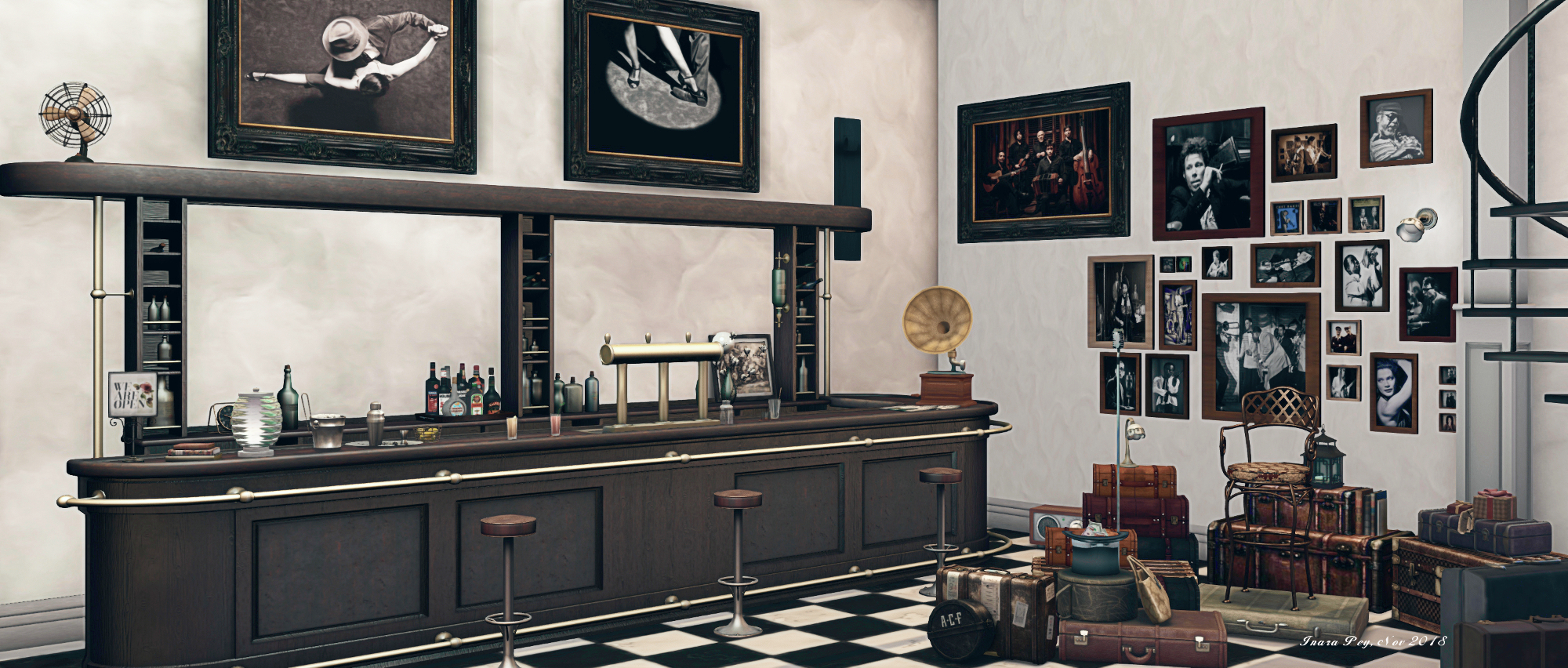
Focusing on the tango, Ocho Tango Place is billed as a location for milonga and romance. At the time of my 2015 it sat atop a plateau above the rest of the region hosting it and Mistero’s gallery. However, whether this continued to be the case after September 2015, when both Mistero and Ocho Tango Place relocated to their current home is unclear.
Ocho Tango Place; Inara Pey, October 2018, on FlickrOcho Tango Place

What is clear is that today, both club and gallery now share a more integrated space. The latter has always used water in its design, and this continues through to the half of the region used by Ocho Tango Place, as designed by Megan Prumier and Sheerpetal Roussel, who owns the club.

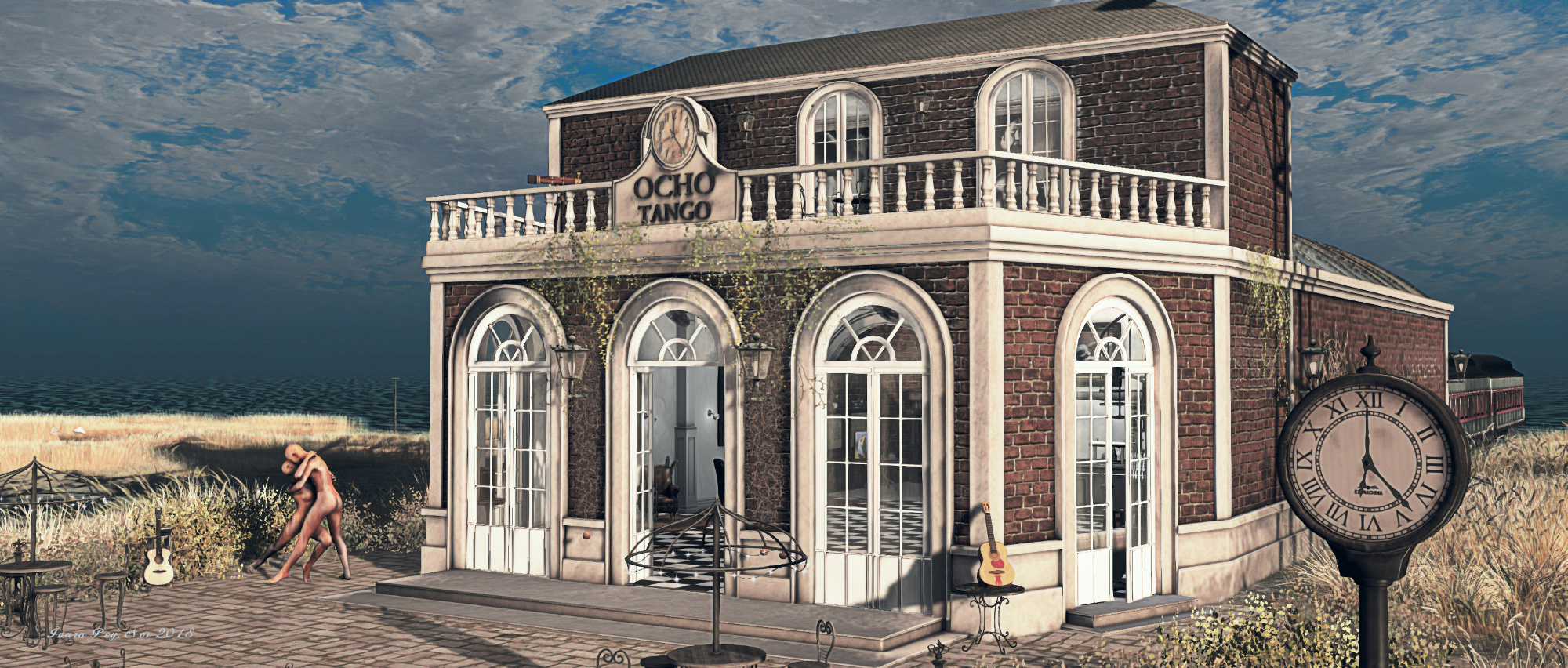
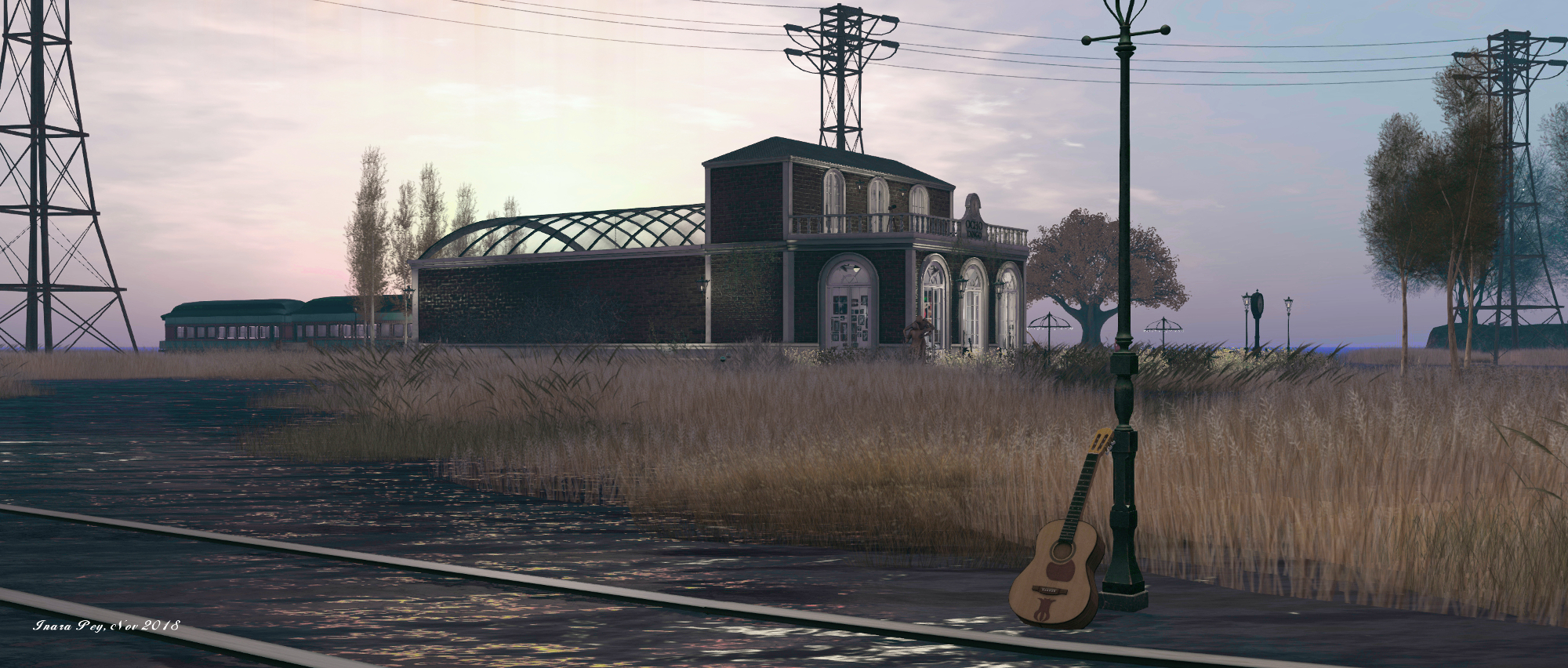
Located to the east of the land, the club sits as an island of brick and stone – a former railway station – watched over by the tall figures of steel pylons silently carrying power lines. A terrace before the building offers outdoor seating, a wooden walkway reaching out over the shallow water to the landing point. A locomotive with tender and rail cars can be found at the rear of the club, venting steam as it sits on a single track.

Ocho Tango Place; Inara Pey, October 2018, on FlickrOcho Tango Place

Trees – most of them slender and birch-like – and grass mixes with the water across the rest of the setting, form  moist islands stretching to the horizon. The are broken into small groups by both clear water channels and the parallel lines of rail track as they curl around the parcel to arrive at buffers, the iron fingers of street lamps marking their route.

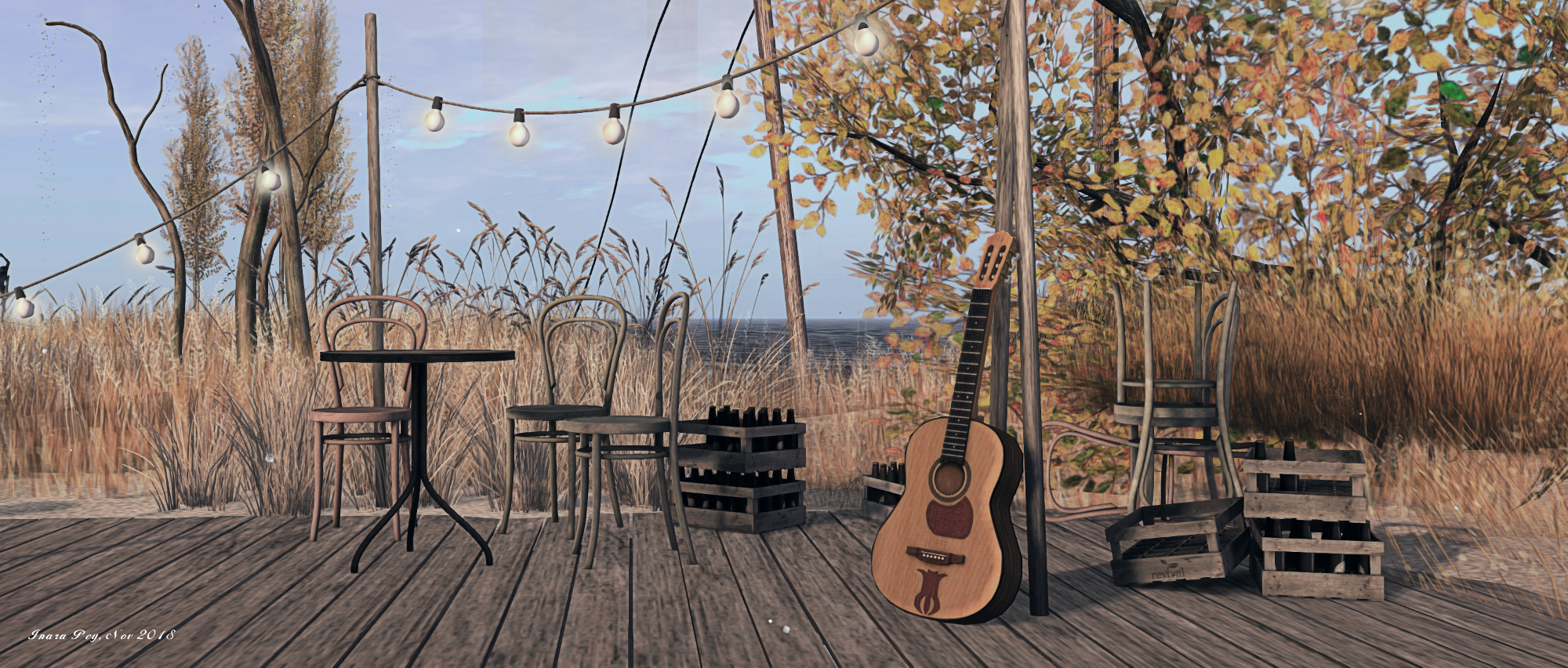
In the midst of this, a lone sandy hump rises bearing a denuded tree. Draped with blankets and with blankets and cushions beneath, it is one of several places people can sit and pass the time, along with the club’s terrace and upper floor. More can be found scattered across the parcel (and even higher up – check the power lines!). Further to the west is an outdoor events area lies over another low-lying sandbank offering a place for those seeking a little romantic privacy whilst dancing.
Ocho Tango Place; Inara Pey, October 2018, on FlickrOcho Tango Place

Wildlife in the area takes the form of origami flamingoes standing in the water or circling overhead, presenting a slightly surreal, but fitting aspect to the setting for those who fancy exploring it. They are balanced by a family of ducks enjoying the freedom to swim on the waters beyond the club to the east.

I’m not sure on when events are held at Ocho Tango – there is no events board available, and while there is a dedicated group for the club, it didn’t have any details of past events when I checked to offer some frame of reference. However, the audio stream carries music in keeping with the theme of the club, allowing those wishing to enjoy a dance to drop in and pass the time whenever they wish.
Ocho Tango Place; Inara Pey, October 2018, on FlickrOcho Tango Place

Coupled with Mistero’s gallery space alongside it (with TP to his store), a visit to Retrospect and Ocho Tango makes for an engaging visit, mixing art and dance together in a visually striking setting.

SLurl Details

Return to a Meadow Rose in Second Life

Meadow Rose; Inara Pey, October 2018, on FlickrMeadow Rose – click any image for full size

It’s been almost 18 months since my last visit to Meadow Rose, the evocative region designed by Rye Falmer. A lot has happened since then, so a return visit has been on the cards for some time.

The biggest change is that Meadow Rose has relocated. Rye had time away from SL, so the move may have been necessitated by that, but it has given him the opportunity to expand the estate with a second Homestead region directly adjoining it, which he calls Meadow Rose Glen. Surrounded by tall off-sim mountains, and with sandy roads and tracks, both Meadow Rose and Meadow Rose Glen offer a charming, beautifully landscaped setting that will easily please the eye and camera and offer the heart a touch of romance.

Meadow Rose; Inara Pey, October 2018, on FlickrMeadow Rose

There is much about the “new” Meadow Rose that draws upon previous incarnations that make a return visit as much a delight as a first-time discovery. Like returning to a place in which happy times were once spent, the region includes elements from past builds that stir memories and give a warm feeling of familiarity, even while the overall layout of the expanded estate offers much more than was previously the case.

This is perhaps most noticeable with the main dwellings within the region. Taking a distinct Tudor lean, they perhaps initially suggest a period setting. However – as I noted when writing about my previous visit to Meadow Rose, there is more than enough evidence surrounding them to make it clear that while the buildings are period, the setting is modern.

Meadow Rose; Inara Pey, October 2018, on FlickrMeadow Rose

Meadow Rose is also a place that is distinctly Adult in theme. D/s / BDSM is part of the estate’s offerings, although by-and-large this is not so in-yer-face as to put the sensitive off. Rather the reverse, in fact: with one or two exceptions, most of the Adult aspects of social interaction here and safely tucked out-of-sight, such as in the cellars beneath the manor house.

There are other elements here that remind those who recall Meadow Rose in its previous incarnation: the deer roaming among the wild flowers, the chapel, the castle ruins, the Romany cap and the stables. Although it should be pointed out that the latter now are part of the more adult nature of the region, offering a place where equestrian activities can be enjoyed without the use of ponies of the four-legged variety.

Meadow Rose; Inara Pey, October 2018, on FlickrMeadow Rose

Water played a significant role with prior designs for Meadow Rose, and this is perfectly reflected – and expanded upon here, with both Meadow Rose and Meadow Rose Glen encompassing natural inland water features whilst Meadow Rose  also includes a little coastal mooring area and boatyard. Meadow Rose Glen, meanwhile offers a counter to the old castle ruins, an intact castle setting (which again has some D/s / BDSM undertones).

Exploring the estate really is a case of arriving and then following the dusty roads and seeing where they lead. There’s no risk of getting lost, and the roadways are laid out in such a way as to carry the visitor right around and through the estate, revealing all the little touches, all the settings, all the places for sitting, dancing and romancing along the way.

Meadow Rose; Inara Pey, October 2018, on FlickrMeadow Rose

Back when I last wrote about Meadow Rose, I mentioned that one of the most striking aspects of the design was that it felt like a visit to one of the grand estates managed by the National Trust here in the UK, noting:

That is, lands held for generations by a family, bearing all the hallmarks of their long ownership during which the passing of time gave rise to different forms of house – castle to manor, for example – but which are now maintained for the wider appreciation of the general public, their gates and doors open to visitors to enjoy them in their natural splendour.

With the estate now expanded across two regions, this is perhaps even more true with it today; there is very much as feeling that This is the setting long occupied by a landed family that may have started life here in what are now the ruins of an old castle guarding the waters leading into the bay in which the island sits before moving eastwards to the slightly higher ground where the more imposing bulk of the intact castle lies, before moving back to the centre of the land to build the grand manor house – and then spreading outward from there as the generations passed.

Meadow Rose; Inara Pey, October 2018, on FlickrMeadow Rose

Impressive in its design, appealing in its beauty, expansive in its size, Meadow Rose is a treasure to visit. Should you enjoy your visit as much as I did, please consider making a donation towards the estate’s continuance in Second Life, and perhaps also consider contributing photos to the estate’s Flickr group.

SLurl Details

Glenrosa’s tranquillity in Second Life

{ Glenrosa }; Inara Pey, October 2018, on Flickr{ Glenrosa } – click any image for full size

Update: {Glenroas} has closed. SLurl have therefore been removed from this article.

The Destination Guide led me to { Glenrosa }, a stunning Homestead region designed by Brandi Monroe and her SL partner Gabriel (gabriel4botto) which – at the time of writing – deservedly sits within the Editor’s Picks section of the DG.

It is a place specifically designed to encourage exploration; a countryside location caught in the early bloom of morning, where the rising mist drifting across unpaved paths and between wooded hills gives a siren call for us to eat a warm breakfast, don thick coats and hiking boots and set forth before the Sun gets too high above the horizon. The region description adds to this call, inviting visitors to “set off down the winding road or take the shoreline,” and noting that whichever route is taken, surprises await discovery.

{ Glenrosa }; Inara Pey, October 2018, on Flickr{ Glenrosa }

The winding road in question lies close to the region’s given landing point, located just above the shoreline on the north coast. Two dry stone walls cup the landing point within their arc, the shingle coastline presenting a view of the broad, flat sea watched over by a squat off-shore lighthouse just away to the east, framed by the rising Sun.

The two dry stone walls are prevented from touching one another by the tall pillars that between them support wrought iron gates guarding the road. The stone stags atop the pillars, together with the region’s name, give the impression this is some landed estate, with the overall ambience of the setting giving me the feeling I could be somewhere in the remoter parts of Scotland – although admittedly, banyan trees aren’t typically found in Scotland.

{ Glenrosa }; Inara Pey, October 2018, on Flickr{ Glenrosa }

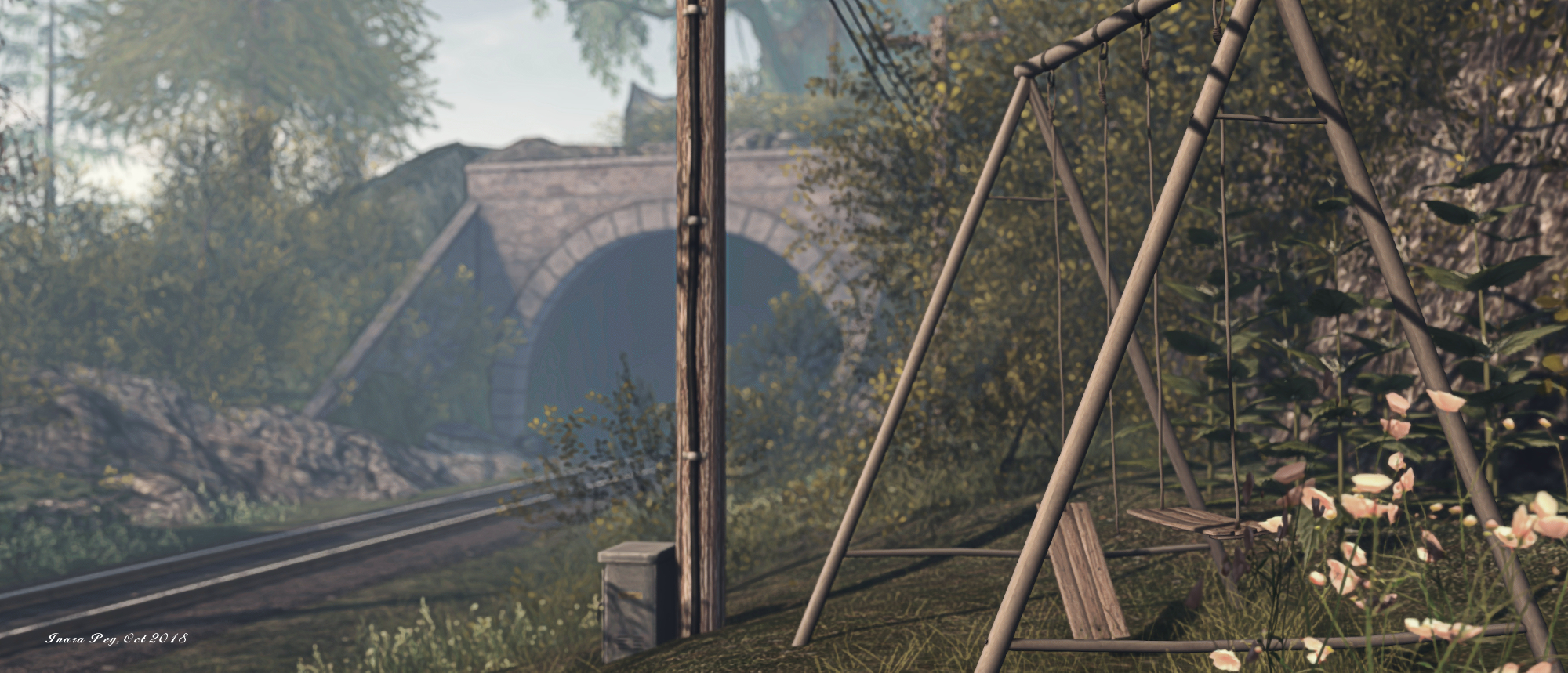
This feeling was heightened during my wanderings by the discovery of a single-track railway line running the short distance from a tunnel to a set of buffers, passing a small country station along the way. Clearly a spur line, it is not hard to imagine a small regional train – perhaps a privately owned steamer – pulling into the station with one or two vintage rail cars, so that visitors might alight and explore before the train reverses its way back down the track.

The feeling that this is – or once was – a private estate is further heightened by the presence of a grand hunting lodge at the end of the road leading up from the landing point. Furnished throughout, the Lodge shares the setting with a small chapel a short distance away, atop a  rocky hill. No longer used as a place of worship, the chapel is surrounded by gravestones, giving the impression it may have once been a family chapel and burial plot.

{ Glenrosa }; Inara Pey, October 2018, on Flickr{ Glenrosa }

The house can also be reached along the coast, following the shingle beach towards the Sun and where it broadens alongside the lighthouse before turning south. Along the way, it passes steps leading up to the chapel and one of the surprises in the region: a grand piano sitting under the banyan tree; one of several places where time can be spent in quiet contemplation.

More such places can be found scattered across the landscape, from a little deck built out over the cold-looking waters close to the lodge, to up over the train tunnel, where a little vagabond camp has been set up. This is reached by way of a small house overlooking the railway line on one side, and out across the fir trees and rocky hills of the estate on the other. Down the slope from this little house, possibly once cared for by whoever many have at one time lived in it, is an orchard, still very much being cultivated, although the house itself no longer appears to be a working home.

{ Glenrosa }; Inara Pey, October 2018, on Flickr{ Glenrosa }

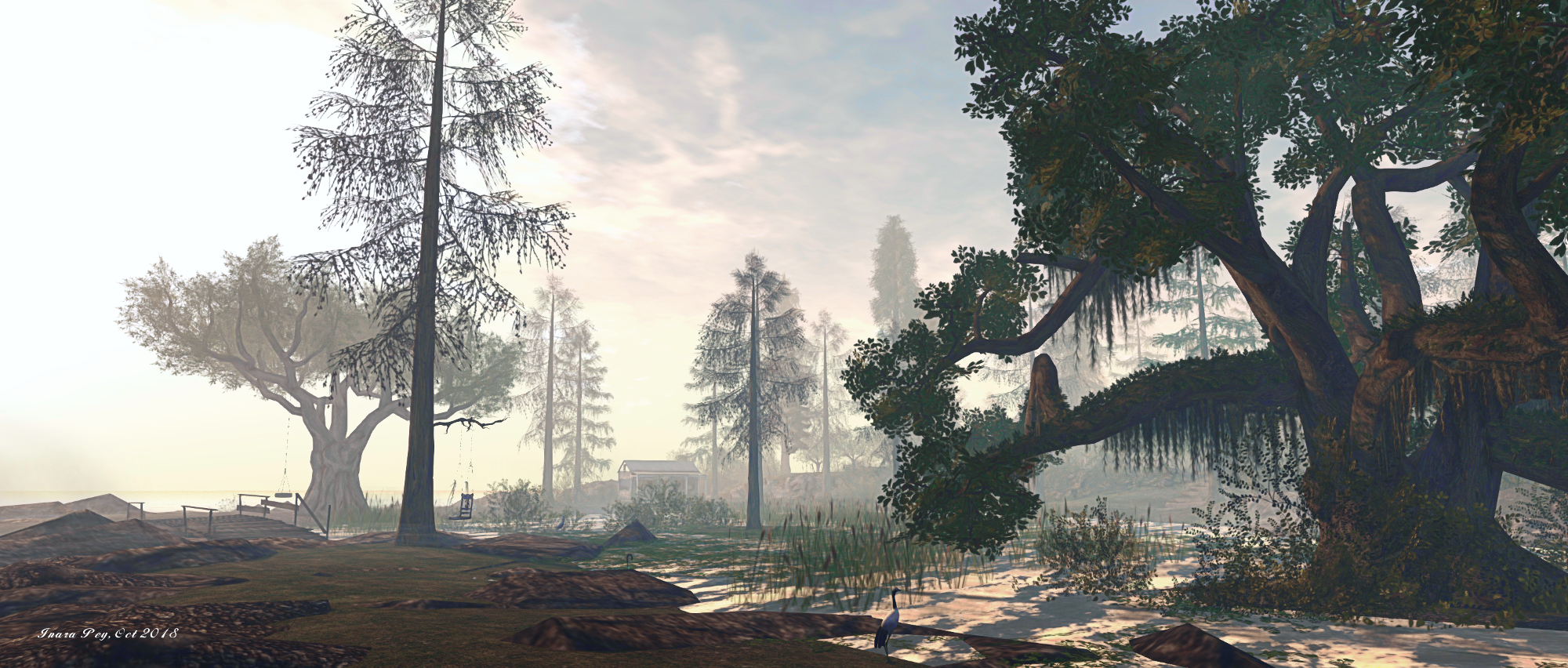
A cinder track continues beyond the beach behind the main house, arcing slightly up and away from the coast before dropping back to rejoin the shingles. It leads the way to where part of the land has been flooded to form a natural inlet, its narrow neck spanned by an old bridge. Here the setting, with reeds and trees growing from the water and the wooden shack to one side, is perhaps more mindful of a Louisiana swamp than a place sitting somewhere on the Scottish  coast – but it still feels very much a part of the overall landscape, and it offers more places to sit and spend time in the region.

Caught by the rising Sun, { Glenrosa } also lends itself to other daytime windlights – although for once I’ve tended to keep to the default in the images here. Those who do take photos are invited to add them to the region’s Flickr group, and there is more than enough here to keep anyone’s camera busy.

{ Glenrosa }; Inara Pey, October 2018, on Flickr{ Glenrosa }

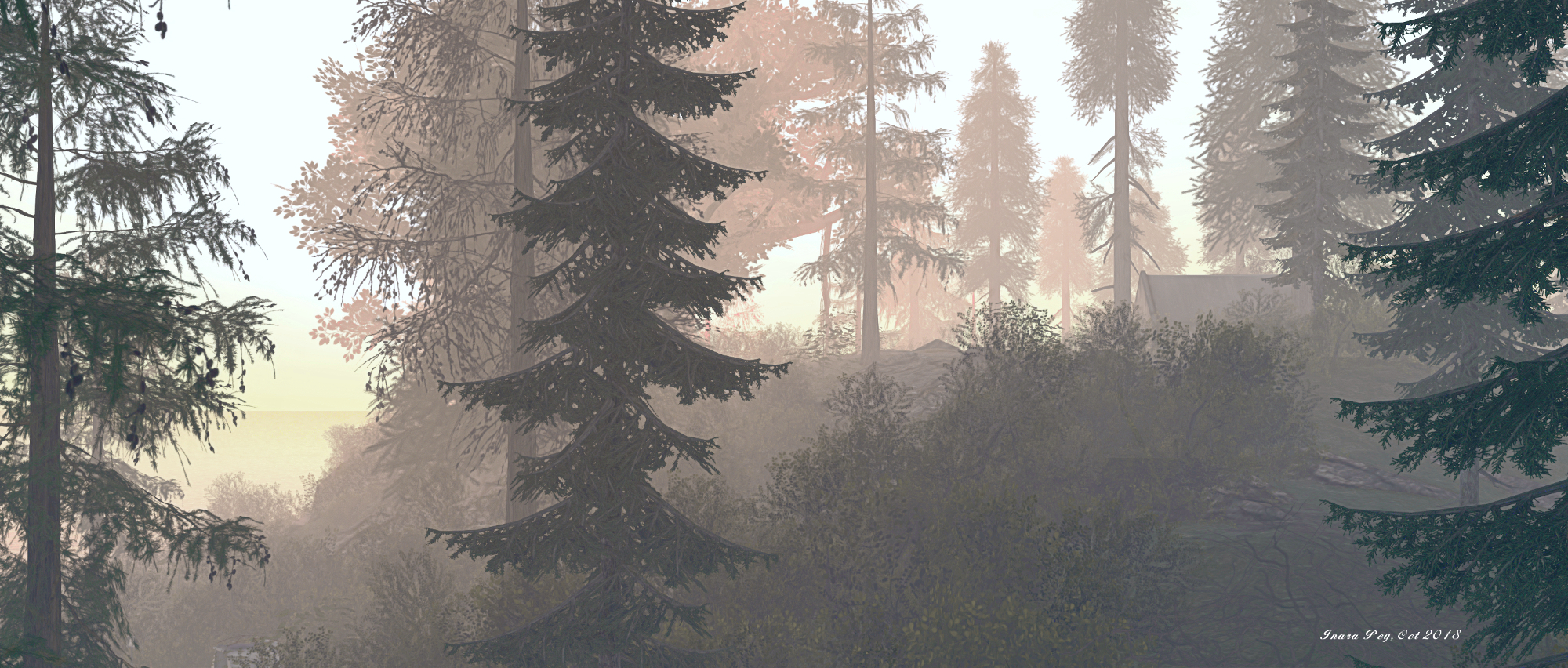
Although sitting within a sim surround, I confess I found the rolling, rocky landscape dominated by fir trees, to be more attractive with it derendered to present a more coast-like setting (although just having one side of the region open to water would have really done the trick). Nevertheless, with its gently undulating landscape, this is a place of beauty rounded-out by a gentle soundscape and is definitely not a destination to be missed.

A taste of Andalusia in Second Life

La Frontera; Inara Pey, October 2018, on FlickrLa Frontera – click any image for full size

La Frontera, a homestead region designed by Zaffy Bailey (zaffin) and Pete (PeteSunny), opened its doors to the public recently, offering an opportunity for visitors to spend a little time in a setting inspired by Spain’s autonomous region of Andalusia.

Focusing on a terraced village setting among the steps of high, sandy hills, the region presents a simple, elegant setting visitors are invited to explore and photograph – there is an invitation to upload images to the region’s Flickr group – and to enjoy the general relaxed ambience of the village and the beach below.

La Frontera; Inara Pey, October 2018, on FlickrLa Frontera

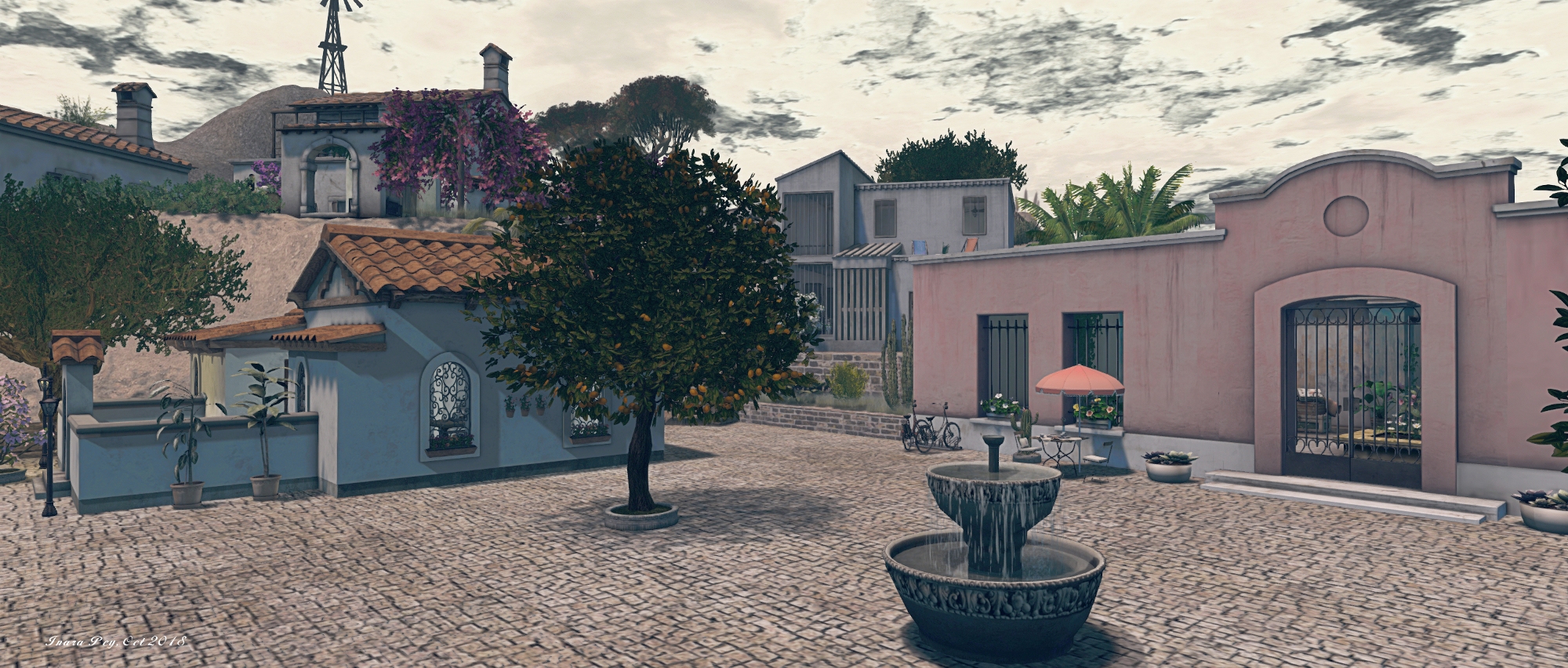
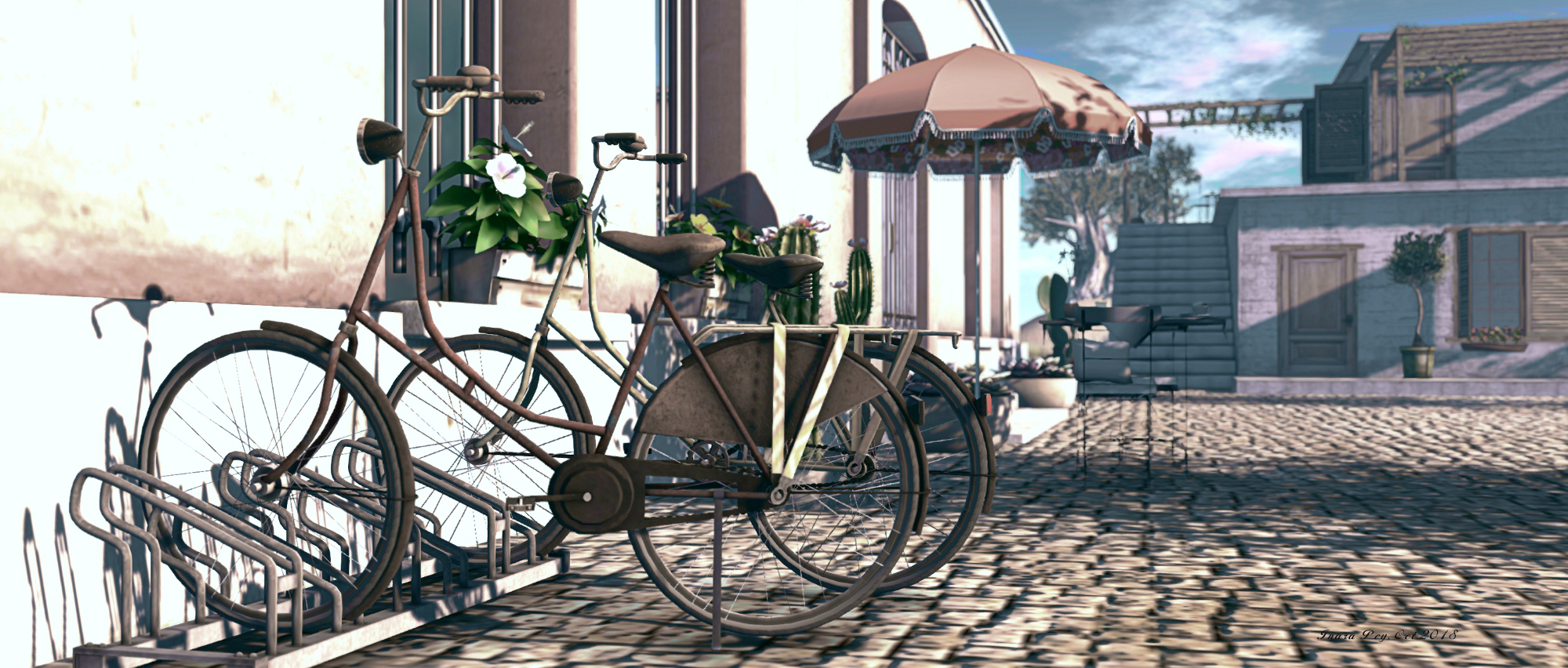
The little village is split into two by the steps of the hill, with the landing point set in the terraza of the large part. As befitting the location, the building here are adobe-fronted, with some offering a nod towards Moorish architecture again in keeping with the inspiration for the region, while others are perhaps a little more Tuscan in styling. Bicycles are racked to one side of the fountained square, but to be honest, the cobbled and stone-stepped paths winding between and down from the village’s buildings are better followed on foot.

There are several of these paths, ranging from simple dirt tracks cut into a hill, others ancient stone steps, carefully cut and placed and suggestive that there may once have been something far older than the current houses sitting upon the hill, and still others rough stones loosely planted in the sandy soil. Each offers a route of exploration, either up or down from the terraza, making any exploration a matter of following where your muse leads.

La Frontera; Inara Pey, October 2018, on FlickrLa Frontera

Nor are the paths alone in finding a path down the hillside; a stream, rising up above the village, tumbles by way of falls, channel and sloping path down to where the sea awaits (a second waterfall drops more directly to the sea on the north side of the island). With its rushing, turbulent water crossed here and there by bridge and steps, the fast-placed stream may have, over time, played a role in helping to separate a low-lying sandbank from the rest of the land.

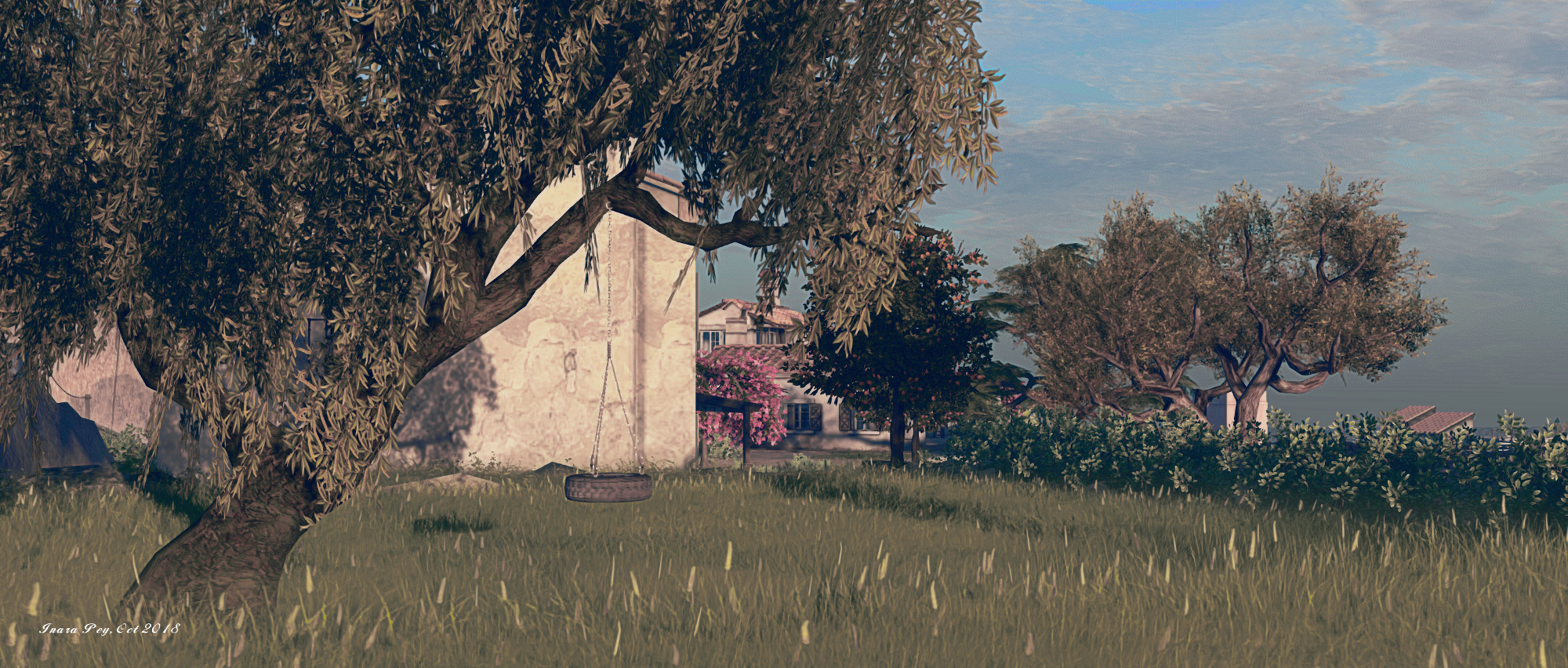
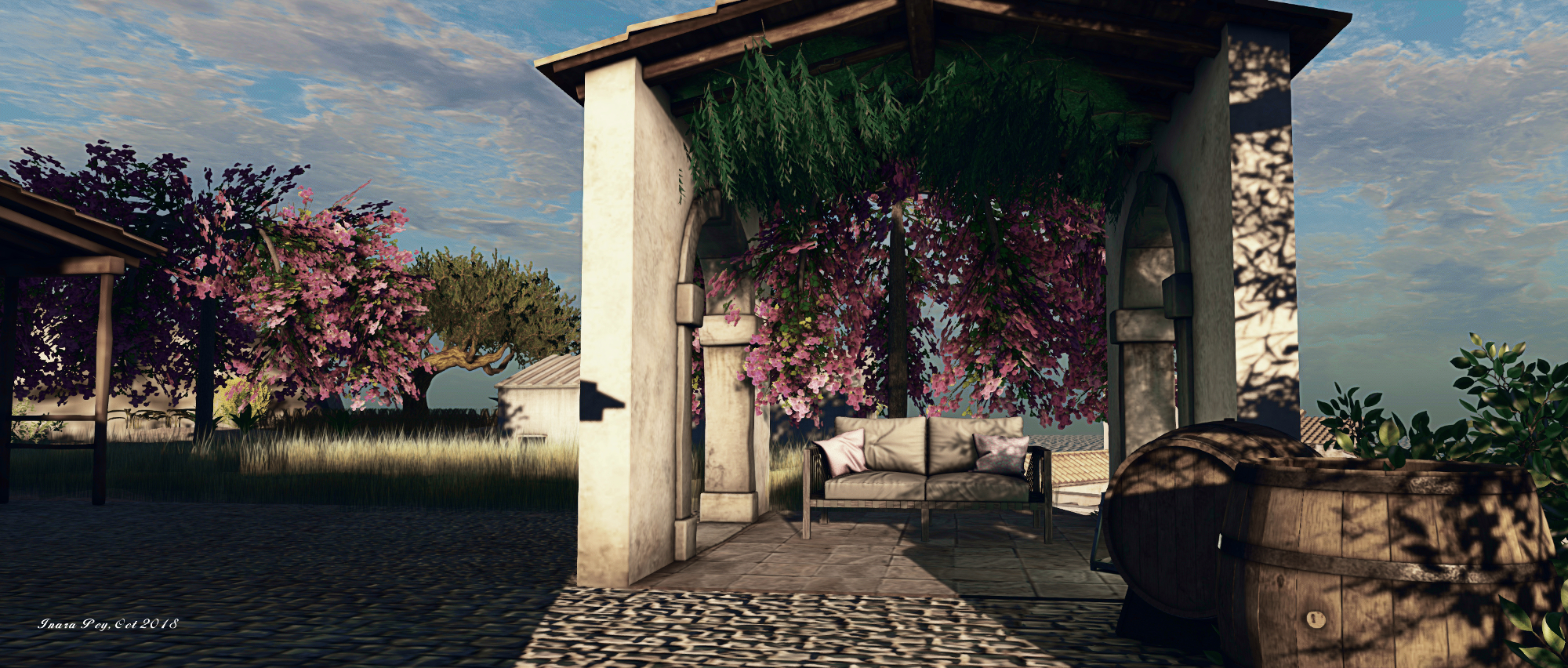
The home of scrub grass, a scattering of trees, wild flowers and tall reeds, the semi-circular sandbar offers a beach where a tan can be gained, and the skin cooled by either a dip is the sea or in the pools to be found on the sun-dried earth of the bank.  It is connected to the rest of the land by two humpbacked bridges that stand almost guard-like, one either flank of what might have once been a walled orangery. This appears to have once been a part of a larger formal garden, although only the flagstones of a terrace and a central water feature now remains.

La Frontera; Inara Pey, October 2018, on FlickrLa Frontera

A wooden board walk also spans the arc of water separating the sand bar from the rest of the land. Follow this and it will take you to the near-hidden secret of the region: and underground music venue. Located inside a high-ceilinged cavern, this offers plenty of space for those wishing to dance. Zaffy tells me the plan is to make this the venue Whether this will be a “formal” venue for dancing / music is unclear to me; during my visit, Zaffy was either engaged in building or AFK, as my enquiry went unanswered.

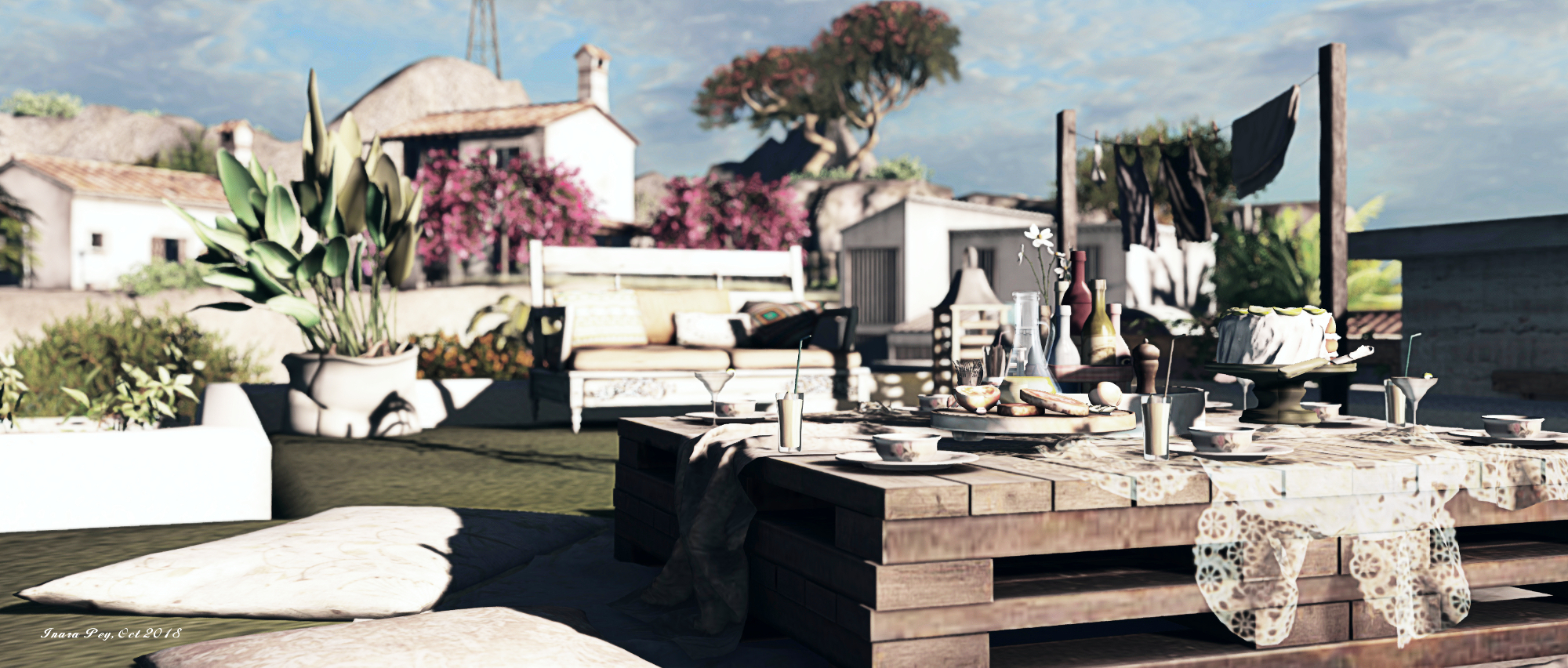
Throughout the region are plenty of opportunities to sit and appreciate the setting, from the beach, through the gardens up to the village – including up on some of the roof tops and verandahs, all the way to the highest peaks (or higher still in the case of the windmill standing well above the land to the north-east). There is also a subtle sound scape to add aural depth to the region as one wanders the paths and trails.

La Frontera; Inara Pey, October 2018, on FlickrLa Frontera

Offering uncluttered charm, plenty of opportunities for photography and perfectly suited to being seen under a variety of warmer windlight settings, La Frontera is a delight to visit, and a reminder to those of us sitting on the cusp of winter that warmer days and days in the Sun really aren’t that far away.

SLurl Details

With thanks to Shakespeare for the pointer!

The natural beauty of Cold Ash in Second Life

Cold Ash; Inara Pey, October 2018, on FlickrCold Ash – click any image for full size

Leaf (Peyton Darmoset) and Julz (Juliette Rainfall) are among my favourite region designers. Their region designs of Erebos Harbor (read more here), Cloudbreak (read more here) and Ash Falls (read more here) is among the best natural settings to be found in Second Life. So when I received an invitation to pay a visit to their latest creation, I made sure I had the opportunity to spend a fair about of time visiting, and hopped over to take a look.

Cold Ash is the in-world home for the Cold Ash brand of menswear, and the latest iteration of the region has been fabulously designed by Leaf and Julz as both the home of the store and a photogenic place to visit and appreciate.

Cold Ash; Inara Pey, October 2018, on FlickrCold Ash

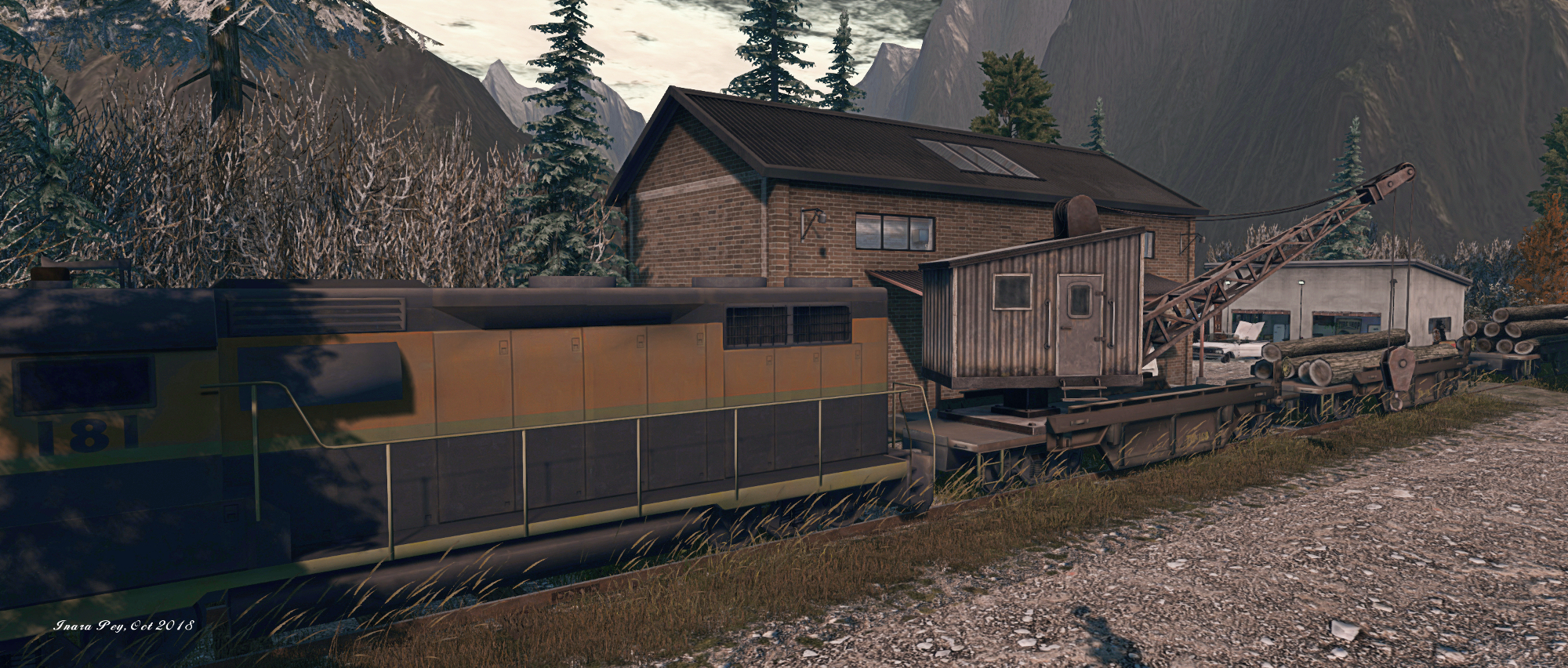
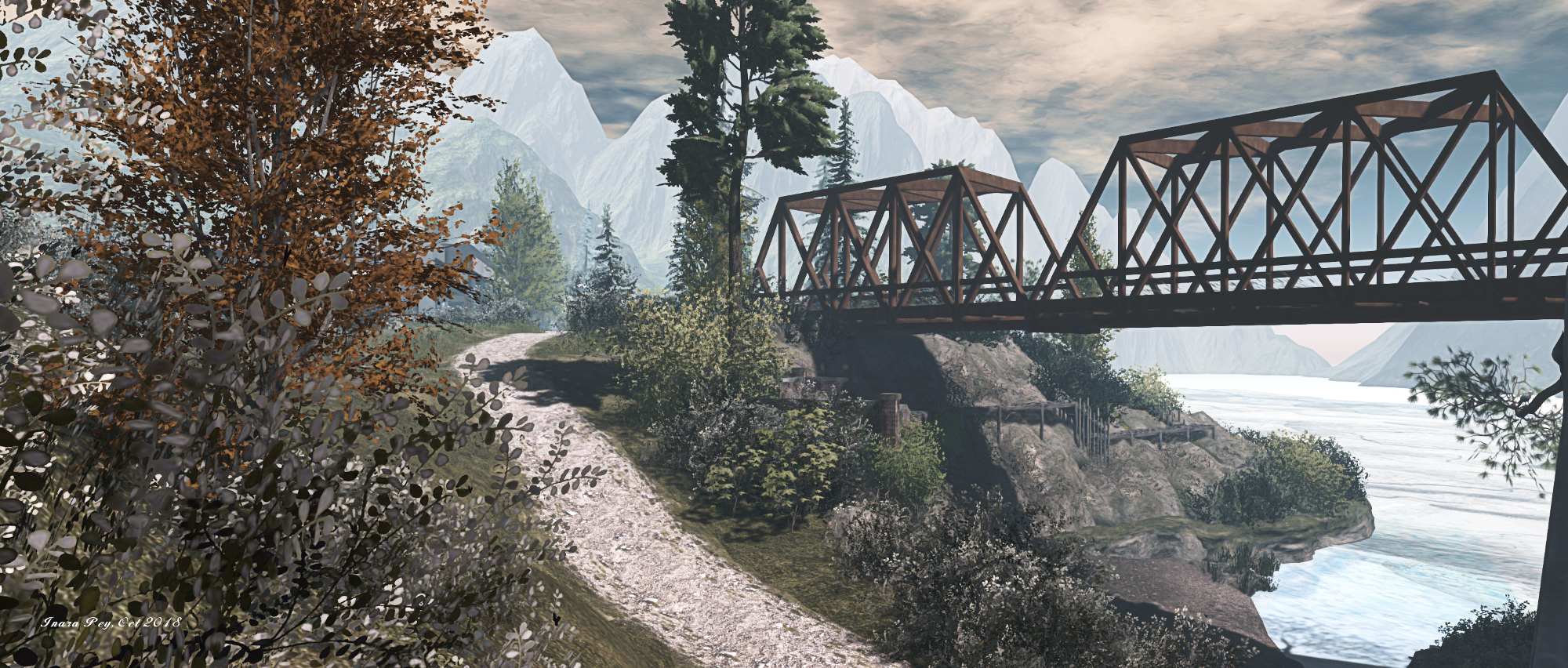
Visitors arrive, appropriately, at the store itself, located towards the north-east corner of the region. This sits on a large plateau that is typical of the rugged nature of the island and resembles a large, converted warehouse. A railway track runs past the front of the store, separated from it can a broad gravel road that narrows into a winding footpath. Both the path and the railway track form an integral part of the region’s design.

Running from a tunnel on the northern extreme of the island, the tracks to where a metal framed truss bridge spans a watery gulf to reach a southern island. The gravel path gently curves its way down the slope alongside the bridge to also span the water, this time via a low-sided cement bridge, before curling up the slope of the second island, passing under the railway bridge as it does so.

Cold Ash; Inara Pey, October 2018, on FlickrCold Ash

Both track and path lead the way to a lumber yard that takes up the larger part of the second island, the land falling gently on the north side, where the trunks of felled trees lie, already stripped of their branches. Wooden steps run down the slope as well, offering a way down to the single beach running along the coast. This arcs back to another set of steps leading back up to the gravel footpath, offering a small loop around this part of the island.

Which is not to say this is all there is to see on the island. The lumber yard includes a workshop where the logs from cut trees can be cut and worked, prior to being loaded onto rail cars outside. A car workshop sits alongside the lumber shed, looking perhaps a little incongruous given there are no open roads here, but it does actually work within the setting, lending further character to the region.

Cold Ash; Inara Pey, October 2018, on FlickrCold Ash

The main island also offers routes down to the coast. The first is another winding path reached via a crossing over the railway tracks close to the store.

Two more are to be found to the water’s edge, both wooden walkways. The first commences close to the rail bridge and passes under it to reach the eastern coast. The second is hidden from view up-slope from the tracks. However, while it offers a way down to the western waters and provides a view back along the channel between the two island, it also leads to a private residence. Be aware the security orb guarding the house is on a short fuse, so keeping a distance is recommended.

Cold Ash; Inara Pey, October 2018, on FlickrCold Ash

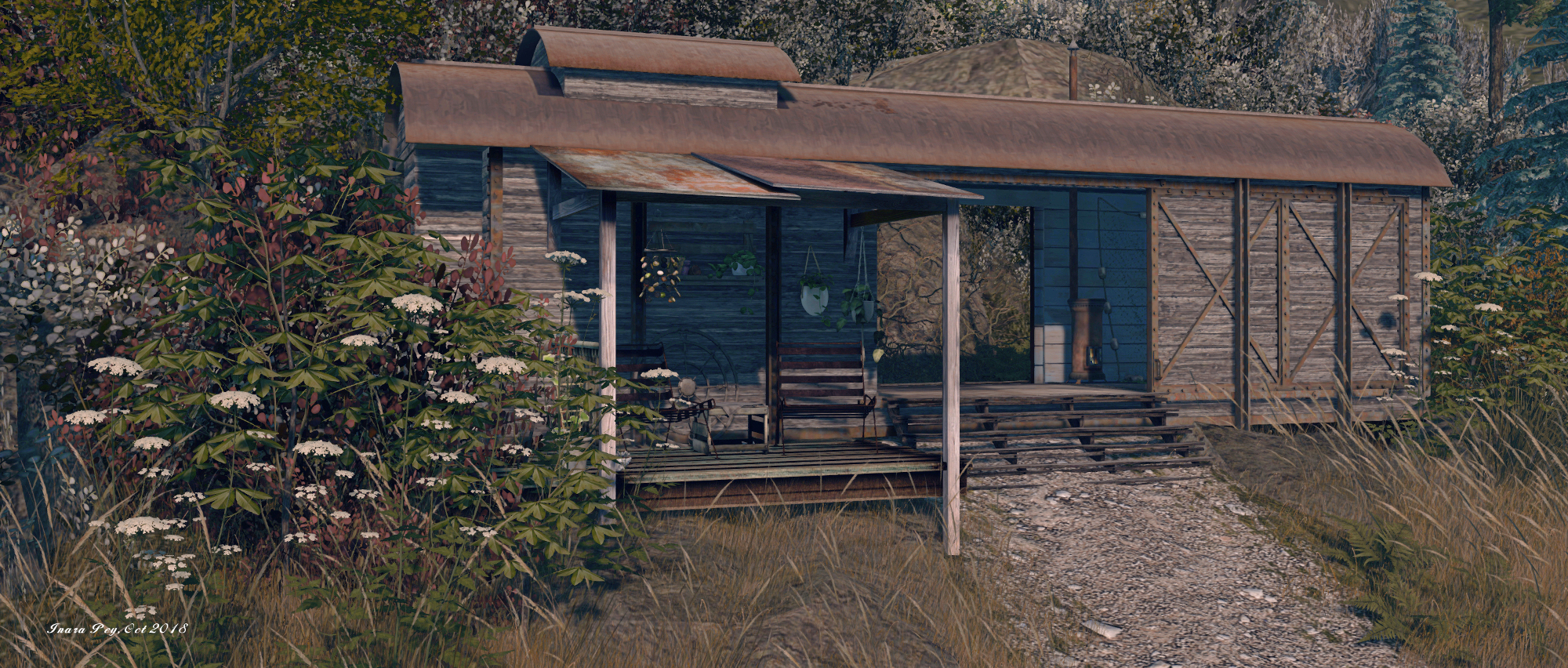
Walk along the eastern coast of the main island, and you’ll find a little hideaway made from a converted railcar doubling as a little warehouse, a wooden porch offering a place to sit.

Carefully married with its sim surround, with a balanced soundscape and a subtle use of wildlife – such as the gulls flying between the two islands – this is another marvellous setting, richly photogenic. With the look of a coastal headland thanks to the way it joins with the surround peaks, Cold Ash is another truly eye-catching design by Leaf and Julz, one that should be visited and appreciated, whether or not you’re looking for apparel; and for the men, it offers the perfect excuse to try out new clothes while enjoying a walk around the islands.

Cold Ash; Inara Pey, October 2018, on FlickrCold Ash

SLurl Details

Returning to the beauty of Winter Moon

Winter Moon; Inara Pey, October 2018, on FlickrWinter Moon – click any image for full size

Incredibly, it’s been five years since I last wrote about to Winter Moon, the always evocative Homestead region designed by Dream Shadowcry (see here for more). How I’d managed to let it drop from my list, I’ve no idea – so my thanks to Annie Brightstar for the reminder via Twitter.

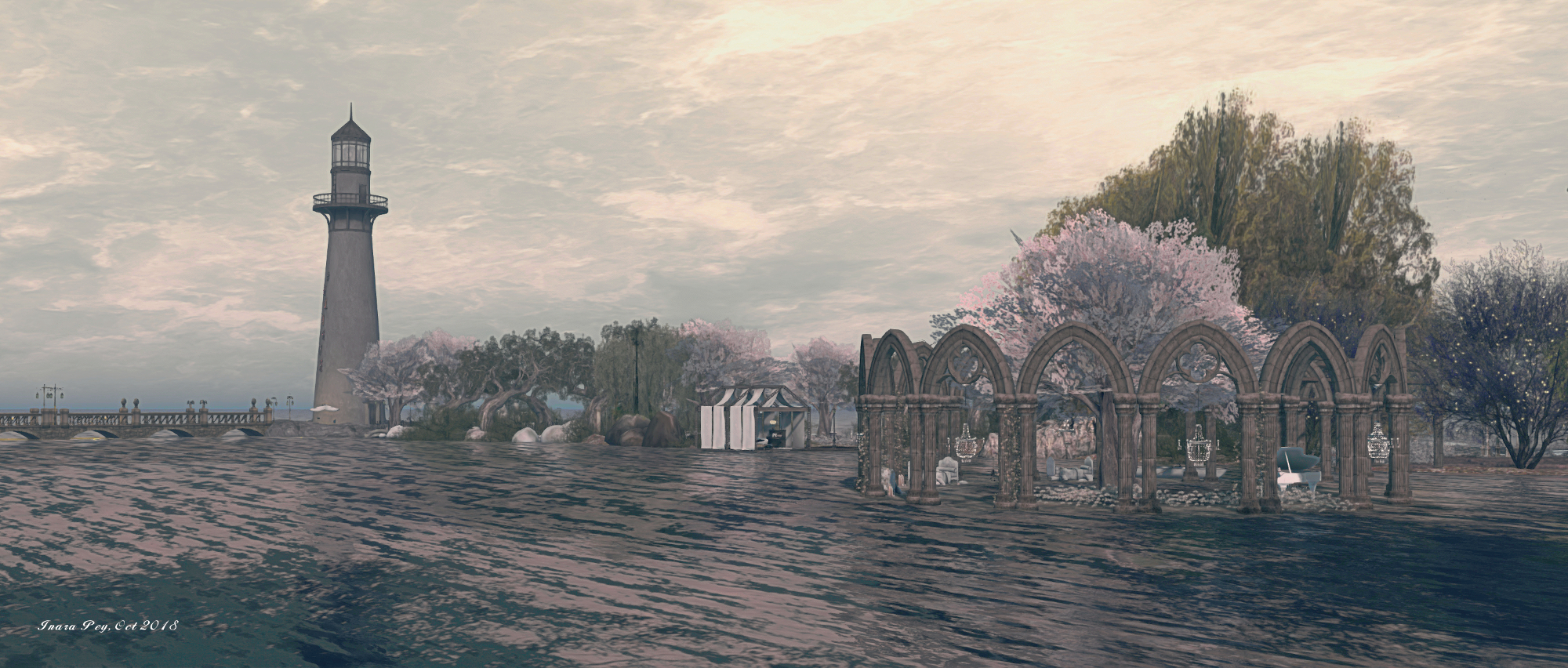
In 2013, the region was a near-perfect embodiment of a monochrome setting, watched over by the tall tower of a lighthouse and making good use of water and coastline to present a memorable location. The lighthouse is still there, something of a signature piece for Winter Moon, and the use of water is retained, giving a feeling of familiarity after so long since my last visit, but unsurprisingly, everything has changed.

Winter Moon; Inara Pey, October 2018, on FlickrWinter Moon

From a monochrome photograph to a lover’s sanctuary, the transformation is wonderful to see – as are the many details that link this iteration of the region with past versions. The aforementioned lighthouse for example, or the ivory piano and the curve of a rocky arch; the upturned boat on the beach and the elegant use of water and land to present a memorable, romantic place in which to spend time.

Resembling an atoll with its southern aspect open the sea, the region sits beneath a default pink misty sky. Atmospheric when it comes to romance, the environment serves to make walking the ring of the atoll a journey of discovery. However, those wishing to take photographs may want to try an alternative windlight – and I have to say that doing so in no way diminishes the sheer beauty of the design; it can also make finding one’s way through the more wooded parts of the island easier.

Winter Moon; Inara Pey, October 2018, on FlickrWinter Moon

An informal path runs around the island, progressing from the landing point in thee west, not far from the lighthouse, to pass over flowered field and under leaf-heavy boughs. Circling a good part of the inner pool of water, it leads the way to where the land climbs towards a set of high, narrow cliffs forming a curtain on the east side of the island. Water tumbles down three sides of this high divide, which separates the lagoon on one side from and eastern expansion of beach on the other, a beach that circles visitors back to the open mouth of the lagoon, spanned by a bridge that reaches out to the lighthouse.

The beach, with broad sands and cut into three by narrows channels spanned by low bridges, looks out on three compass points, and is reached via wooden steps running down from the northern end of the high cliffs. Scattered across the sands are numerous places to sit in the Sun or under shade, be that shade from a windswept tree or the lacy drapes of an Arabesque pavilion.

Winter Moon; Inara Pey, October 2018, on FlickrWinter Moon

The beach isn’t the only place available for sitting: more chairs and perches can be found up on the cliff top, whilst array around the lagoon and seaward coasts are more pavilions and chairs sitting under the boughs of trees.

There is a wonderful mixing of styles here that increases the sense of beauty and romance. The Arabesque pavilion mentioned earlier, for example, sits on the beach like a tent in the desert, not far from the steam flowing outwards from tumbling falls where African elephants sit and bathe. Within the rounded shallows cupped by the land, and elven-like series of arches march out over the water to form a circle where couples can sit or dance to suitable music from the piano sited there; while from numerous trees chandeliers perhaps suits to the halls of some great Georgian house  hang to light the woodland paths.

Winter Moon; Inara Pey, October 2018, on FlickrWinter Moon

Throughout, there are many little touches that bring Winter Moon to life as a place used by lovers – such as the typewriter to be found in a waterside pergola, a heartfelt letter caught on its rollers or the champagne waiting on ice in another pavilion. Over all this, the susurration of water washing the shore or falling from high rocks mixes with the song of birds and the tinkling of chimes caught on the breeze, combine to add further depth to the setting, bidding visitors welcome and encouraging them to stay.

Beautifully imagined and executed, with a lot to see and discover, Winter Moon comes with a fitting dedication:

You know that place between sleep and awake, the place where you can still remember dreaming? That’s where I’ll always love you, that’s where I’ll be waiting.

Winter Moon; Inara Pey, October 2018, on FlickrWinter Moon

For lovers, romanticists, grid travellers and photographers alike, this is a region that remains an enduring place to visit and appreciate – and return to.

SLurl Details