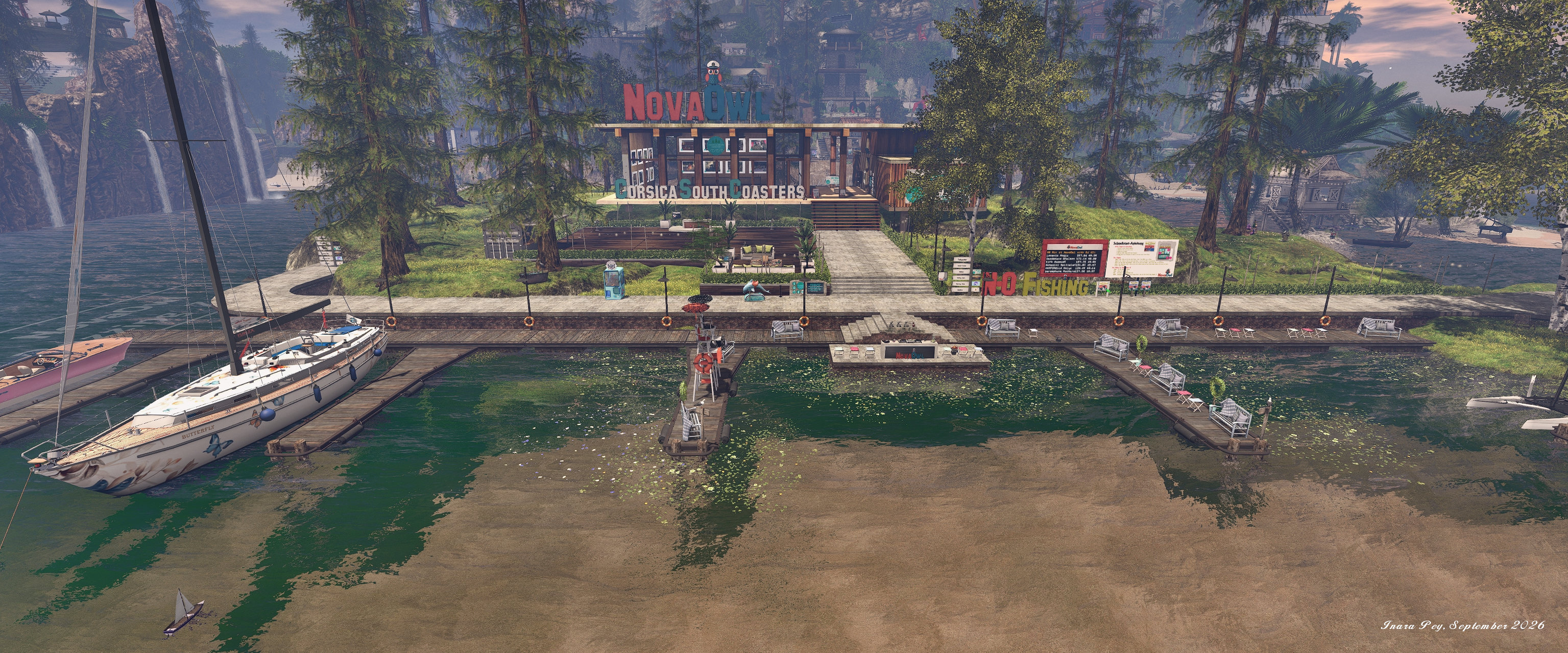
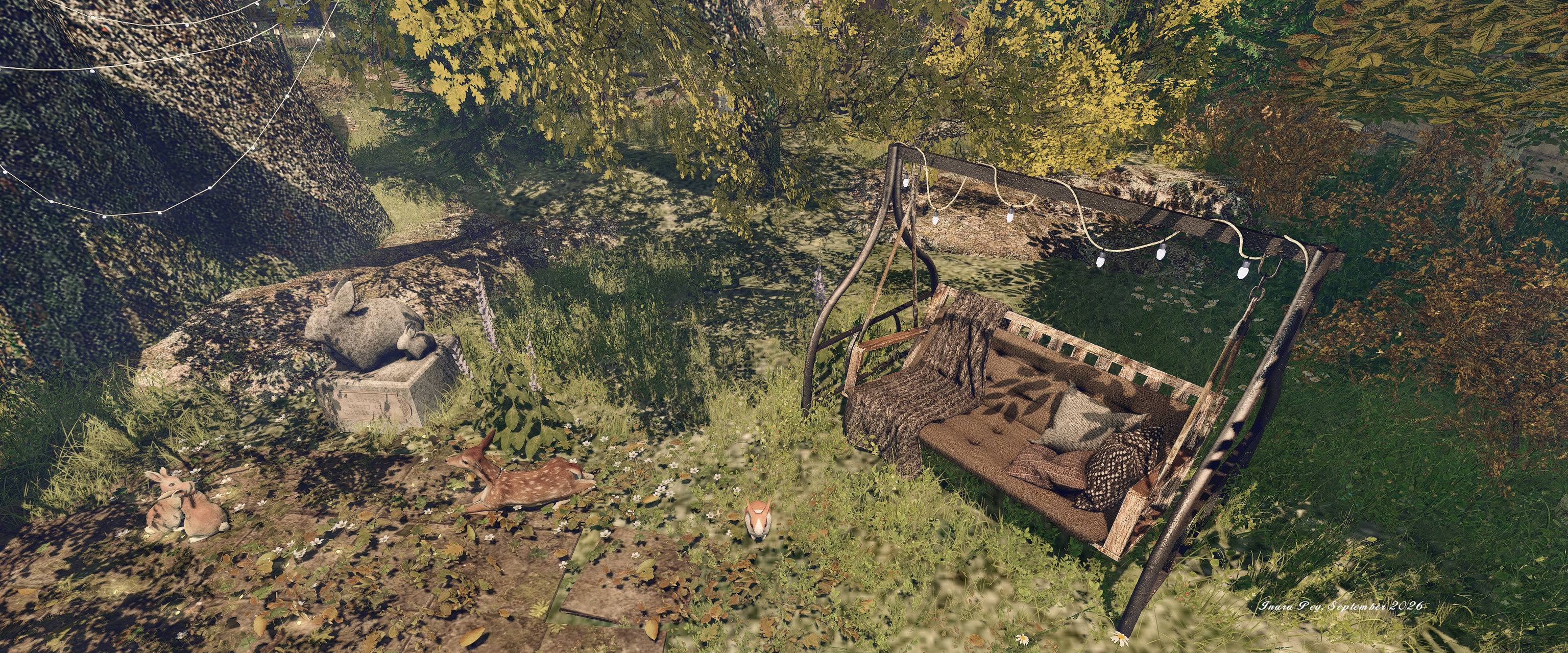
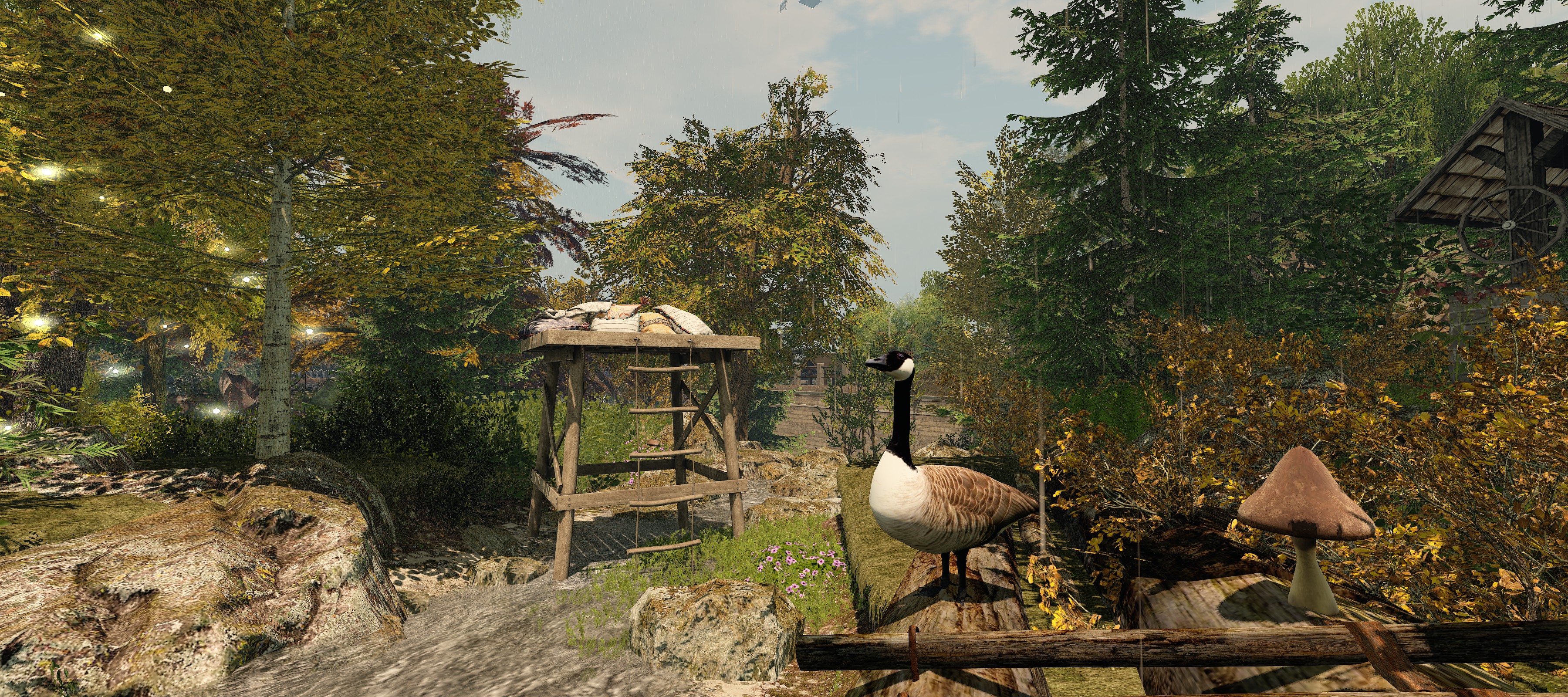
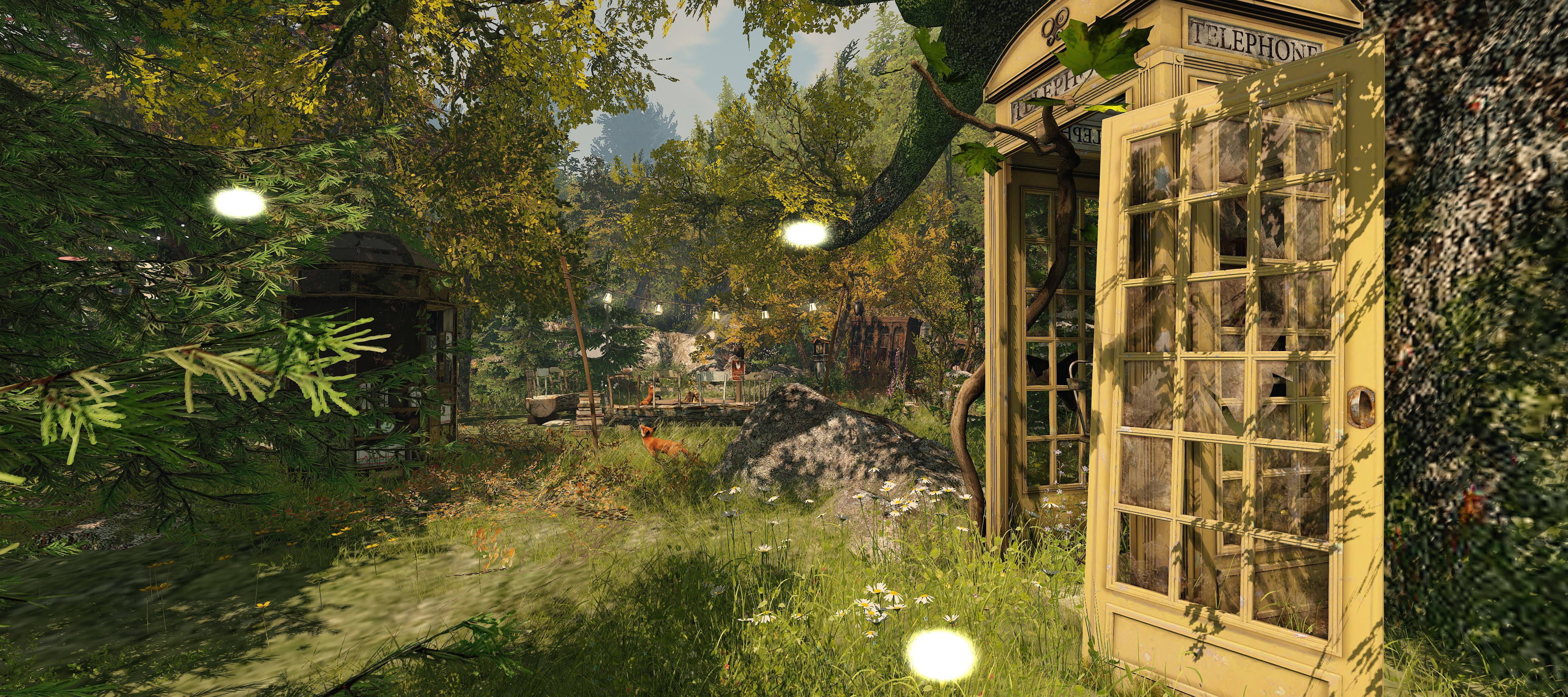
Grauland / Primary Colors, September 2024 – click any image for full size
MorganaCarter, who is one of multiple people who have pointed me to various regions and parcels over the years, dropped me an IM directing me to Jim Garand’s Grauland Flickr group, and specifically to an image and message simple in form, but very saddening:
Many people in SL have regarded Grauland as a favourite location; a place to visit and enjoy, each new iteration bringing something special to our digital world.
For more than seven years I’ve routinely visited it to appreciate Jim’s work and to blog about it. And while I didn’t managed to captures every single version of the region which arose in that time, I did cover 30 – and I will genuinely miss being able to visit it and see what else has come forth from Jim’s fertile imagination.
The builds Jim has presented with Grauland were always unique, although there were certain themes to which he would return – sci-fi, urban, minimalist, industrial -, but no single design ever re-tread exactly the same path as any previous design.
My first visit was in March 2019; I think that was to the first region build Jim had opened to the public – but I could well be wrong on that. At that time, the region was leaning heavily into a landscape-as-gallery, featuring things like an arrangement of great concrete blocks (a geometric motif which would oft appear in Jim’s designs in various guises), an indoor galley and outdoor 3D displays.
Art always remained a part of Grauland, be it front-and-centre, as in March 2020 with Grauland Castle and Art Park and again in July of that year in which an ancient henge, modern architecture and statuary all combined with the landscape, or with June 2021’s Grauland Falls; sometimes it was more subtle, as with October 2021’s Grauland’s Lights, where geometrics forms and a cityscape served to highlight the use of lighting in Second Life; sometime it even appeared to be a natural part of the architecture or urban space – a graffiti-marked statue here, wall paintings there…
As well as offering unique designs, Grauland could also present places inspired by locations in the the physical world – tropical islands, deserts, urban centres and industrial outlands and more. Iceland in particular became the focus of two designs (both favourites of mine, as I’ve always loved the times I’ve spent in that country) – July 2023’s Grauvik and February 2025’s Grauvik 2 – both of which were set on a fictional island just off the Icelandic coast.
As noted earlier, Grauland also took us to places far away from Earth. Some of these carried with them the opportunity for visitors to create a back story to account for the mystery which might be implied within them (November 2023’s Grauland / The Deity Machine) or engage their their sense of adventure, as with January 2023’s visit to a space station and a Mars-like planet, together with The Grauland Cluster (September 2025) and June 2026’s visit to the Spires of Sector 7.
One – The Last Trees, from April 2024 – might be seen as gentle warning about the perils of unchecked global warming here on Earth, whilst Arrakis / Fremen Home in May 2025 offered a take on Frank Herbert’s Dune.
One of my favourite industrial designs Jim produced was Grauland / Primary Colors (September 2024), a marvellous setting in which primary colours were very much part and parcel of the build, often in the most subtle of ways (just look at the use of red on the locomotive), and which very cleverly gave a hint as to where it might reside were it in the physical world thanks to an advertising board.
Grauland is going to be missed by many, and there is so much more that might be written about it, but I’ll close here with the words I left for Jim on the Grauland Flickr group – if you’re also a fan of his work, I hope you’ll leave some words of appreciation as well -, and a couple more images.
Will always appreciate the work you put into Grauland, Jim, and in being able to visit and blog. Many, many, thanks for all the time and effort and consistently building special places for us all to enjoy.
The Looking Glass, July 2026 – click any image for full size
It has been a decade(!) since I last visited The Looking Glass, the stunning region that is home to creative genius of Marcus Inkpen and Sharni Azalee, supported by ColeMarie Soleil.
It’s been a place which has captured imaginations time and again down the years, and has been on my list of places to revisit for a fair while, particularly since the more recent graphical and performance improvements made to the viewer.
The Looking Glass, July 2026
For those who may not be familiar with the work of Marcus (aka artist, musician, writer and actor J. Matthew Root) and Sharni, they are two long-time Second Life creators with a focus on fantasy designs.
Those who participate in the annual Fantasy Faire will likely be more than familiar with their work; between them they have over a decade and more, produced marvellous regions for that event.
The Looking Glass, July 2026
For his part, Marcus specialises on architecture, while Sharni creates everything from furnishings and décor items to plants and flora to mystical and fantasy elements, many of which are used to bring life to their designs, as is amply demonstrated in the Fantasy Faire worlds and within The Looking Glass.
Both are incredibly talented artists, and I’ve had the pleasure of witnessing their work in the past as both a reviewer and judge of University of Western Australia art events (now sadly gone from SL), in which Sharni’s work has been justifiably the recipient of multiple awards.
The Looking Glass, July 2026
The Looking Glass offers a truly marvellous means of immersion into their combined work. Almost everything within the region has been created by either Sharni or Marcus, and can be found in The Looking Glass (TLG) store, which is perfectly blended into the setting, residing as it does within a number of buildings.
However, the region isn’t merely a showcase of designs; it is a world to be explored from its waterfront Landing Point through to the islands serenely floating in the sky. Within it can be found places of romance such as the ballroom, places to share in the company of someone close, gardens of fae and magical delights, places for celebrating dance and music, corners of mystical goings-on – there is even a hidden crystal chamber awaiting discovery (among other hidden places).
The Looking Glass, July 2026
And, of course, there is the citadel climbing nigh-on 200 metres into a sky slowly brightening in response to a rising Sun.
With hundreds of windows lit from within and staring all around, the citadel alone is a place of wonder in its design and size and as a place of exploration and discovery. Not only does it feature the core of The Looking Glass store (with more to be found within the Basilica and the Feed your Head store close by), it houses an art gallery recalling Fantasy Faire Builds by Marcus and Sharni from times past, together with an exhibition of Marcus.
The Looking Glass, July 2026
To help people find their way around, there are teleport stations, but for initial explorations, I really recommend stating on foot; the stations are plentiful enough to be easily found during on-foot explorations.
That said, there are areas within the region which do require the teleport system to reach them. Chief among these are the upper reaches of the citadel, which include a Library with an outdoor space and neighbouring room However, the teleports do not connect to all the points of interest; some, such as the floating islands and upper reaches of the citadel (which I believe are open to the public) appear to require flying to reach them.
The Looking Glass, July 2026
Stretching out from the citadel tower and diagonally across the region is a great bridge, its arches taller than any of the buildings clustered to either side of it. Easily spanning woodland at water channels, the bridge extends out to the events amphitheatre whilst offering a magnificent, lantern-lit look back at the great tower.
With its own dome of stars twinkling under the lavender-tinged sky and cross which blazing meteors arc, this is another magical place. As well a offer a stunning view at the citadel, the bridge offers an excellent vantage point to look out over the town and lands below, providing a marvellous view of the great open-air ballroom in its ring of ruins.
The Looking Glass, July 2026
A ramp curls around the tor on which the amphitheatre stands, providing access both to and from the ground. I do suggest walking up (or down, if you come to the amphitheatre from the citadel) it and through its tunnel.
Keep your eyes peeled as you do, and you might find the entrance to one of the hidden secrets of The Looking Glass. Another is to be found here as well, just be prepared to get a little wet when accessing it J .
The Looking Glass, July 2026
The Looking Glass is a place of great beauty and a huge attention to detail. Tucked away throughout are corners presenting places of retreats along with the floating islands. There are also touches of whimsy to be found as well – who knew hobbits drove VW Beetle convertibles, for example!
There are also more semi-hidden places to steal away to, some of which add a certain sense of character and life to the setting. Several of the buildings, far from being mere display pieces are furnished, with one or two heightening the sense of mysticism present throughout.
The Looking Glass, July 2026
Even some of those which are not furnished have been set to enhance the feeling that this is a place where times and life passes: lights shining from windows, fires visible in hearths – even a bureau tucked into the small bay of a house, topped by an ornate Moroccan tea set and softly lit by a lamp, gives the impression someone is at home.
To summarise – a genuine work of art from the tallest tower to the most hidden of chambers. Timeless, it sits as a song to the creative potential of Second Life.
The Mobile Learning Centre: general information boards
Back in June 2026, I wrote a piece on the Mobile Learning Centre, a Linden Lab created experience geared towards incoming users accessing Second Life via the Second Life Mobile app (and those existing users who are new to SL Mobile) gain familiarly with using the app and finding out more about Second life as a whole.
As there is also a broadly similar experience for new users coming into Second Life using the Desktop, I thought it only fair that I revise / replace the original piece with one covering both. Hence this new article.
The Mobile Learning Centre is one of the SL Mobile Experiences seen when logging-in to the App, and accessed by tapping the GO button.
Like most tutorial experiences current and past, the Learning Centres take a familiar route of guiding users through a series of lessons.
However, and unlike many past tutorials of this nature, these avoid trying to cover everything some might regard as “essential”, these Learning Centres focus on the absolute basics in getting started: moving, jumping, chatting, sitting, standing, teleporting. This allows them to be useful without being overwhelming because of the volume of information a new user is being asked to digest in a single pass.
As a brief overview, both experiences:
Present the same lessons, information and challenges in the same environment, in a manner consistent with whether the user is using the Desktop viewer or SL Mobile.
Take the form of a space station, with learn-by-doing lessons progressing through a number of rooms to which the user gains access by “collecting” (walk through) large stars, whilst including a “side quest” in which the user “helps” the captain of the space station.
Have teleport portals and boards to places like the Welcome Hub and other new user experiences to help the user increase their engagement with the platform and learn more.
Control additional options and challenges, offering opportunities for entertainment whilst learning.
The stars to be “collected” are colour-coded to the the rooms to which they are required in order to gain access, and form a core part of the lessons being provided in each of the learning rooms. The number of stars required to access a room is presented on the door to that room.
The arrival point for both experiences comprises informational boards on most of the above – collecting stars, the side quest, etc. Together with the first elements of the tutorial signage.
These tutorial graphics are simple, direct and easy to follow. They’ve been specifically designed to communicate necessary information without relying heavily on text, thus avoiding complications of translation, localisation, etc. They are also obviously application focused: users at the SL Mobile Learning Centre will see graphics specific to the Mobile app, and those at the Desktop Learning Centre will see graphics specific to the Desktop viewer.
Learning Centres: movement tutorial graphics for SL Mobile (left) and Desktop (right)
This does mean that in places, the Desktop Learning Centre does have more such graphics than the Mobile Learning Centre, but this is to be expected because of things like the different modes of control available in the Desktop viewer. This can be seen at the arrival point of the Desktop Learning Centre, which includes graphics on text chat range and camera manipulation (the former included not only because it is essential to understanding text chat but also because it was found new users often ask a question of a mentor within places like the Welcome Hub – and then walk out of range before a reply could be provided).
From the arrival point, and after walking through two yellow stars, users can progress down a ramp to collect the stars needed to access the next tutorial room – this one focused on avatar navigation using an elevated walkway. This is followed by a room focused on jumping / flying (placing users in an aquarium!), prior to a visit to the ship’s bridge to earn the thanks of station’s Captain.
The Mobile Learning Centre: elevated walkway
At the lower end of each experience, there is a large, galleried social space. This contains places to sit (with graphics on how to do so) and the option to collect red stars to open a floor accessway to the tar Run challenge, located underneath the area and accessible once five red stars have been collected. However, this is where the similarities between the respective areas in the two experiences end.
Within the Mobile Learning Centre, this area includes the teleport portal to the Welcome Hub, a teleport board to other experiences and instructions on how to access the Destination Guide and teleport to locations. There is also a side room with a picture gallery of locations in Second Life, together with windows looking out over what appears to be a black hole.
The Learning Centre: portal to the Welcome Hub and instructions on accessing experiences and the Destination Guide
By contrast, the same area within the Learning Centre makes no reference to the Destination Guide, and as the Welcome Hub teleporter is located at the arrival point (together with a portal to the Adult Hub), it is also absent. However, it does provide access to a much larger social area.
Called the Moonview Zone, it comprises group of beanbags set around low tables which are all set around a central bar. A huge viewscreen / window to one side looks out over an alien world. Facing this are two further teleport board and instructions on setting a home position and creating landmarks (but, again oddly, nothing about accessing the Destination Guide). Also within the Moonview are the entrances to two challenges: an obstacle course to further refine walking / jumping abilities and the Ring Challenge to test flying skills. Rewards may be given on the completion of either.
Desktop viewer Moonview Zone
The Desktop Learning Centre also offer a “mid-level” area which includes links to the Second Life social media outlets; a landmark giver for various community gateways offering free items to new users; and two boards of the single-player Merge game (Darkmoon Edition), and a Group joiner for the SL Friends For Life Group.
Whilst a similar area is present in the SL Mobile Learning Centre, it is currently empty, perhaps because of the current level of SL Mobile’s capabilities.
Desktop viewer learning Centre: Ring Challenge
It’s likely that some might feel the Learning Centres don’t cover enough essentials – what about IMs? what about text chat in the Mobile app? What about inventory access? And so on. However, offset against this is the need to keep things as useful as possible in order to get users started without overwhelming them.
Take IMs as an example: do you just cover person-to-person IMs? Then what about Group IMs? If you are covering Group IMs, then surely at least the concept of groups needs explaining (even allowing for the joiner mentioned above). And what about conference calls? And so things spiral – and the same is true for things like inventory on the Desktop.
In this, it is also worth noting that these Learning Centres don’t reside in a vacuum or are a one-stop, “That’s all folks!” form of learning. There is at least the Welcome Hub for further guidance – although I do have a small caveat here, which I’ll come to. Further, these Learning Centres have been developed using feedback gathered from users, and they have been involved in A/B testing with other new user on-boarding tutorials, and both have consistently scored well with incoming users.
The Mobile Learning Centre: finding Rilo
My one caveat mentioned above is that currently, the Welcome Hub is geared solely towards the Desktop viewer. Even with mentors present to at least explain the existence of the Desktop viewer, it struck me that this could be confusing to incoming users on SL Mobile. Perhaps a dedicated landing area for those teleporting from the Mobile Learning Centre might help alleviate this? It could even include a teleport back to the Learning Centre for those who may have accessed the portal there prematurely / in error.
Other than this, I found both experiences pleasant and easy to follow. There is potentially space to add further information / tutorial infographics if the need arises (e.g. to reflect SL Mobile’s increasing capabilities, if required). The graphics are mostly language-free, as noted, and of a size and form where they should be easy to follow regardless of nationality or eyesight; the lessons suitable for what they are trying to achieve and the Desktop viewer challenges off of the Moonview Zone reasonably engaging.
The Mobile Learning Centre lack a Moonview Zone, substituting a destinations showcase instead (albeit without location names or teleports)
If you do opt to pay a visit to either, you can follow the SLurl to the Desktop learning Centre as given below (it’s also in the Destination Guide), but for the Mobile Learning Centre, please do so via the App itself – you’ll find the Learning Centre listed in the Experiences.
Soul Deep, July 2026 – click any image for full size
I dropped in to Kaelyn Elara’s Soul Deep recently, some 16 months after my last visit. At that time the region comprised a series of islands under a summer Sun, the design by Kaelyn and Jacky Macpherson. Richly detailed and with paths and trails to wander, it was a place I found relaxing for exploring both on foot and on horseback.
For my July 2026, I found the region was now a single, roughly T-shaped island caught in that period of time when summer is vying with autumn (or fall if you prefer) for our attention.
Soul Deep, July 2026
It’s a setting that comes with an almost poetic description by Kaelyn:
Where the salt wind carries whispers of Autumn. Wander weathered beaches, follow winding paths through golden grasses, and rest beneath trees that lean toward the sea.
Here, hammocks sway, campfires glow, and gulls wheel above an ocean that feels endless. This is a place for slow breaths, long looks, and soul-deep moments, where hope drifts in like the tide and stays a while.
– Kaelyn Elara on Soul Deep
Soul Deep, July 2026
The Landing Point sits close to the northern coastline of the “bar” to the island’s “T”, sitting on a rough path running west-to-east and between two of the three buildings to be found here. One of these, off to the east, is a café space while the one to the west is a cosy cabin. Both have a little camp site close by.
The island is low-lying; a mix of scrub grass, sand and trees, the ground broken here and there by groups of rocks. Off to the south, at the end of the second arm of the island sits a large wooden house (the Piper Hideaway by Cory Edo), this one with a little camp fire outside. Another trail meanders down to it from the north end of the island .
Soul Deep, July 2026
There are two Teegle horse rezzing hitching posts with this setting. When touch, these will offer a selection of horses of various breeds and sizes -turn of your AO and then right-click the horse to mount / sit. The mostly open nature of the island makes riding easy (just mind the beach fencing!).
The beaches offer places to sit and relax as gulls circle overhead (or keep watch on things from local signs!) and sailboats lie offshore. it’s a genuinely relaxing setting, rich in local sounds.
Soul Deep, July 2026
What I love about Soul Deep is the continued simplicity Kaelyn and Jacky place in their designs; the settings are always entirely natural in look and feel, never overcrowded; just rich in details and small touches.
Just take the way the cabin and the house are furnished – both are open to the public – or the way the café and its seating are laid out; they all offer a sense of life and presence, but never of any artificiality or sense of being props.
Soul Deep, July 2026
The same is true for the landscaping and the the items and objects to be found around the island – the rowing boats, the signs – everything has a simple, binding beauty.
Photogenic and peaceful, Soul Deep continues to present the perfect getaway setting to soothe the mind.
Notable Art Gallery, July 2026 – click any image for full size
The delightfully named Perspective Doodles is a Full private region leveraging the Land Capacity available to those regions to present a Group-held setting with multiple elements from ancient ruins through a town-like commercial district and a games-focused spa, and an art gallery.
It was the latter – the Notable Art Gallery – which drew me to the region. The work of Nyte Vargas Siegel Setner (Nyte Vargas), the gallery is designed to offer a rich mix of Second Life and physical world art and photography, poetry and special exhibitions and challenges. And it is extremely well organised and presented.
Notable Art Gallery, July 2026
Sitting within its own garden space, the gallery occupies an imposing conservatory comprising six major rooms all connected by glass spaces and built around two ornate fish ponds. Five of the main rooms and the linking glass-enclosed walks present art, with the foremost room forming the Gallery’s foyer.
The gallery’s programme is a mix of collections by the artists in residence, together with themed exhibitions and and art-related challenges. A schedule on the latter two can be obtained from the desk to the left side of the foyer when entering, along with a Group joiner for those wishing to be kept appraised of future events, challenges and activities. To the right of the foyer is an second desk promoting the artists in residence, all of whom have their collections displayed through most of the rest of the conservatory.
Notable Art Gallery, July 2026
To the rear of the gallery is a lawned garden with some seating space, together with a wall area to one side of the main building which I assume is for outdoor displays – perhaps seeing use during the themed exhibitions and art challenges. I also gather there will be a further exhibition space for child avatars as well.
Beyond the gallery, the region offers several more areas which might be explored, including a town-like commercial distract and the spa mentioned above, the building of both the spa and the town having a Tudor look to them. The spa has a mix of table-top and playable games within it, but being honest, I didn’t really spend too much time at the spa (or the town) – other than to make may way down from the spa to the beach tucked away below it and to spot the 7 Seas Fishing tucked away below the commercial area.
Notable Art Gallery, July 2026
This is because I was somewhat more attracted by the land separating the gallery from the town and spa, together with the ruins to the north-west of the region.
The former comprises both open grazing and a fenced paddock, the open area given over to horses some cattle and a wandering stag saddled for riding, while the fenced paddock is home to more cattle and quietly grazing sheep. Although the saddled stag cannot be ridden, the small stable to one side of the field does offer a horse rezzer for those who would like to take a ride, and there is a bubble rezzer sitting alongside the stable if those wishing to float around the region.
Perspective Doodles: paddock, July 2026
However, the most interesting feature of the open field is the gathering of four glowing portals around a central raised plinth with a spiralling blue light. While the portals may not be actual teleports, they add a sense of mystical intrigue to the setting; why are they here? who might have placed them so, and for what reason?
Meanwhile, the ruins – which can be reached directly from the Gallery’s garden via an archway on their west side – have their own mystery. They are called the Ruins of Eiralith, although I have no idea if this is an intentional reference to The Beginning after the End or not.
Ruins of Eiralith, July 2026
Aged, some with their facing weathered away, guarded by dry stone walls and standing in their own grounds, the ruins have been repurposed into an open-air cathedral for hosting weddings. Wisteria is draped over walls and beams giving the ruins a romantic feel, and I particularly liked the lone arch sitting at the head of steps leading up from the main ruins, standing as if it is the last remnant of a great bell tower.
The mystery of the ruins comes in the form of strange, luminous fungi growing in corners. The growths cast a soft, otherworldly light over their immediate surroundings and their presence adds an otherworldliness to the ruins. Close by, a group of standing stones gives a further sense of antiquity to this part of the region.
Ruins of Eiralith, July 2026
If I’m totally honest, I couldn’t help be feel that the commercial area was perhaps a little at odds with the rest of the region, largely because of the great expanse of the cobbled base on which it stands.
To be fair, I’ve no idea if it is still a work-in-progress, but my impression was that it could do with more to break-up the expanse of cobbles: maybe planters and young trees growing within tree grates and some seating. But that is a personal view; the position of the commercial area is such that it doesn’t overpower the rest of the setting to the point of distraction.
Notable Art Gallery, July 2026
Overall, and as noted above, the gallery is excellently presented with the art rich and varied. The care put into the schedule of exhibitions and events should hopefully encourage repeat visits, and I hope such activities will also be advertised through the likes of the .:SLArt:. Group – something I would most certainly recommend if this is not already the case.
Similarly, the Ruins of Eiralith offer a focal point for photography and quiet, gentle exploration, with a particularly charming place to sit on the very edge of the northern cliffs and offering a view down to the remote beach below. Both the gallery and the ruins make for an engaging visit to Perspective Doodles, with the pastoral feel of the fields and livestock add their own touch to the region.
Binnancumb Village, July 2026 – click any image for full size
In 2018, I visited Bellefleurs, an Elizabethan-styled grand manor house which at that time occupied a Homestead region (see here for more). As I noted in writing about it, it caught my eye when first seeing in the Destination Guide as it immediately put me in mind of Somerset’s Montacute House, a spectacular Elizabethan Renaissance house now operated by the National Trust.
A lot has happened since then. For one thing, Bellefleurs has relocated and, whilst still occupying a Homestead region, it now adjoins a Full private region, the home to the engaging village of Binnancumb.
Bellefleurs and Binnancumb Village, July 2026
The estate and village are the work of India Canning, a woman clearly from my part of the world, and who has an admirable sense of humour going on her Profile (I particularly like the take on a line of Elizabeth I’s Tilbury Address of either August 9 or August 19 – depending on whether you are using Old Style or New Style calendar references – 1588). Combined, they offer a mix of public and private spaces reproducing the very best of England’s Green and Pleasant Lands.
Spectacular Bellefleurs Great Lodge is the former hunting estate of the Duchesses of Ominum and Demnoncia. This Elizabethan great house offers a curated Renaissance art collection, a Salon Music series, dances, En Garde, and other events.
Bellefleurs description
Bellefleurs, The Great Lodge, July 2026
At the time of my first visit, the grand house – which in part was indeed inspired by Montacute House – was the hereditary seat of the Canning Family and home of the Duchesses of Ominum, and came with a fascinating backstory which marvellously wove the Cannings into the fabric of English history. The region on which the house sat at that time was also home to the House Sakura Companion Guild.
In its current form, the Canning Family seem to have faded into history, and House Sakura appears to be no longer active. This leaves the house under the care and oversight of the Duchesses of Ominum and Demnoncia, as noted in its description above, whose largesse allows us to continues to enjoy and appreciate it.
Bellefleurs, The Great Lodge, July 2026
Nevertheless, none of the historical care put into the house has been lost. Rooms are exquisitely furnished in the manner of such a stately home surviving down the centuries. Fine tapestries hang from panelled walls, each one a reproduction of an actually tapestry from the 15th and 16th centuries, while chandeliers hang from ceilings.
This is very much a museum of art from the Renaissance period, the upper floor of the house particularly rich in carefully scaled and presented pieces, although there are some to be found on the ground floor along hallways and within some rooms.
Bellefleurs and Binnancumb Village, July 2026
Events within the Music Salon are advertised as being held every Sunday at 19:00 SLT, and there are regular En Garde (fencing) activities with the grounds behind the house, where eight pistes (including one for training) can be found.
Also to be found at the rear of the house is a beautifully garden and manicured lawns, with trimmed boxwood hedging providing boundaries to the immediate grounds of the house on either side. Just outside of the eastern most of there, where one of the two roads to Binnancumb Village might be found (the other being at the front of the estate at the landing Point), where steps also lead down to a small cove-like beach.
Binnancumb Village, July 2026
The walk (or ride for those making use of the horse rezzer at the Bellefleurs’ Landing Point – perhaps one might also be put on the western road?) to the village travels first past farmlands. These provide a mix of crops and open grazing for sheep and cattle, the fields neatly marked out by low walls.
Binnancumb village itself is again a perfect representation of England’s heart, buildings of age and independent styling blending together in a community space mixing private residences (very clearly marked to avoid trespass) with public destinations readily accessible to visitors. Chief among the latter is the Abbey of St. Hild (currently under restoration, but available on a limited basis for weddings), the tithe barn just across the road (available on a limited basis for events), and the local pub.
Binnancumb Village, July 2026
The pub, the Lion & Bear is a grand Tudor-style building dating to 1487. It sits at the northern end of the east road up from Bellefleurs, just before it starts to loop around part of the village to meet the west road. On offer at the pub are events, films, dancing, chess and more fencing. A spur road from here leads down to a little port, house to the main rental office.
I generally try not to take direct photos of private residences within regions open to the public so as not to encourage trespass (although sometimes, the layout of a location means they might creep into the background of images). However, there are time when they fit the theme so ideally, they are hard to ignore, so a couple of pictures of the houses in the village do appear here.
Binnancumb Village, July 2026
Bellefleurs and Binnancumb Village are excellently conceived and executed. Neither is intended as a role-play region nor should they be taken as such. They are places to explore and enjoy, the natural beauty of the design highly photogenic.