Of Ravenmere Redwoods, BREATHE & chat with Anu Papp in Second Life

Ravenmere Redwoods, August 2026 – click any image for full size

Back in January 2025 I visited Poetic Moon, a homestead region held by Anu Papp and which she and Dandy Warhlol (Terry Fotherington) had created as a stunning setting – and you can read about it here.

So when Anu invited me to pop over and preview a new make-over for her Full region of Ravenmere, which she has also developed in collaboration with Dandy to create the quite magnificent Ravenmere Redwoods.

Ravenmere Redwoods, August 2026
I got this region from LL back in 2009, so I have been its keeper a very long time. Its name used be Ravenhart, but today it’s the most beautiful. I live in Northern California, which inspired this build.

– Anu Papp discussing Ravenmere Redwoods

From Anu’s comment and the design’s name, it should be obvious that the region offers a celebration of the California’s mighty Sequoia tree. However, this is more than just a place of the imagination: Anu used data from the physical world to create the terrain maps used in the design to give the region its overall towering appearance.

Ravenmere Redwoods, August 2026

As regulars to these pages know, I love settings in SL which bring with them a twist of somewhere in the physical world, shaped by the creating minds behind them, and Ravenmere Redwoods totally fits this. There is so much packed into its – literally towering – design.

The landing Point sits some 80 metres above sea level, the region lies surrounded by high forested peaks, some with snow sitting within shadowed sculpts and dips in their sides, immediately mindful of the Sierra Nevada, where the mighty redwood can be found.

Ravenmere Redwoods, August 2026

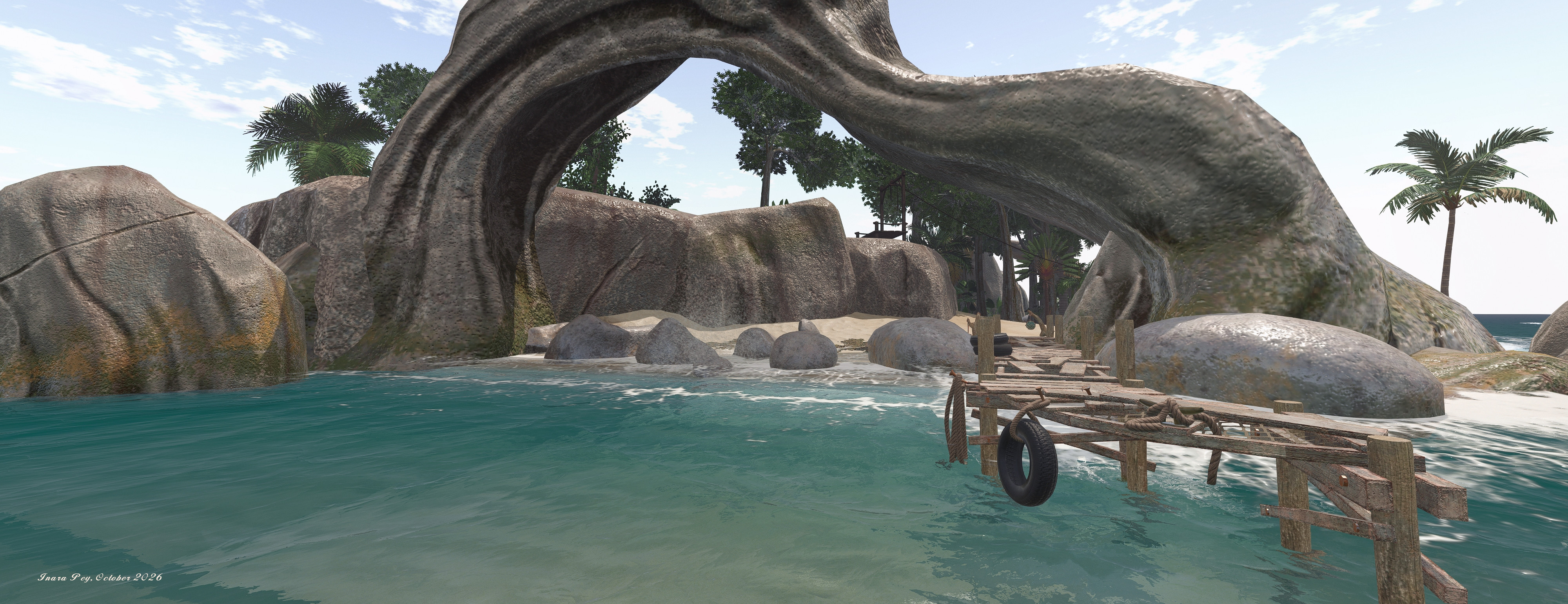
However, the land also drops away to one side, providing steps for giants (and trails and paths for us lesser folk!) down to an eastern coastline. This comes complete with a rocky cove that has perhaps seen better days as a focus for commercial fishing, but which also sits as a reminder of all the hidden bays and little coastal centres of activity which once hugged (and still do hug, in some cases) the coastlines of California and Oregon.

Between these two upper and lower extremes is a setting utterly rich in detail, perfectly conceived and photogenic to the point of being a work of art.

Ravenmere Redwoods, August 2026
This is a place for people to come to and relax. It’s not for business, there are no rentals.  I disabled fly within the region and I’d like people to explore carefully; there are so many hidden areas. All I ask is that people keep activities PG.

– Anu Papp discussing Ravenmere Redwoods

One of those details might be easily missed by visitors on arrival should they be tempted to set out along the path leading away from the Landing Point. However, by turning around and walking just past the fence behind them, they will find a trio of heady walkways stretched out between some of the huge trees, presenting bird’s eye viewing of the rugged and misty lands below.

Ravenmere Redwoods, August 2026

There’s also a path to be found here as well, running down through the mists and past a fire look-out point, twisting its way to come by turn and and corner to where three redwoods stand guard over a covered a wooden bridge.

Here again, the temptation might be to simply walk on by and over the bridge – which is a route that should be taken as a part of overall exploration, as it will carry visitors on along the eastern shoulder of the setting where more redwoods tower over more regularly-sized trees and a superb view down over the coast can be obtained.

Ravenmere Redwoods, August 2026

But those paying attention as they reach the covered bridge might spot a sign Some Place Else. It offers a path of discovery to another mountain lake and a grand overlook.

Similarly, just beyond the bridge the path splits again, this time offering a way down to a further overlook above a quite magnificent ribbon lake, complete with a café perched above it to one end, and further trails running around and over it for further exploration.

Ravenmere Redwoods, August 2026

The two eastward paths eventually join up to point people towards an unexpected – but still fitting perfectly within he region – location: a henge out on a headland. Here, again, keep an eye out for a rocky secret: a crafty little path perhaps originally cut by the passage of water, now offering and alternative means to reach the coastal bay.

Across the region are multiple places to sit and relax. Many are nicely tucked away to give a sense of natural privacy. Some are bobbing on the waters of the lakes and tucked away on the waterfront.

Ravenmere Redwoods, August 2026 – BREATHE

Those following the highland path from the Landing Point will eventually come to an old summer house straddling the path (passing another route down the mountainside along the way!). Beyond this is a large open deck space. This is the Ravenmere BREATHE Meditation Centre.

Breathe Meditation is a place to gather in stillness, breathe together, and remember that our individual practice becomes more powerful when shared in community. It’s a place for people to find peace. On Sundays, I’ll be hosting 30-minute meditation sessions there for those who wish to join me at 7:00am SLT.  Please wear white attire if attending!

– Anu Papp discussing BREATHE at Ravenmere Redwoods

Ravenmere Redwoods, August 2026

Those who can’t join Anu on Sundays can still nevertheless partake of the opportunity for meditation on their own or with friends – or simply use the space for a quiet time of conversation of contemplation.

That said, wherever you wander within the region, you’re going to feel nothing but peace and harmony.

Ravenmere Redwoods, August 2026

Rich in wildlife and a fitting soundscape and captured until a Shared Environment ideal for viewing it (although it does lend itself equally to others), Ravenmere Redwoods is genuinely beautiful – a work of art, as I’ve already noted.

When visiting, please do keep in mind the following:

  • The region will only be open to full public access for a period of one month from August 15, 2026, after which it will return to Group access only.
  • Group access will provide rezzing rights for photo props, etc., – but as always, do please remember to pick things up again.
Ravenmere Redwoods, August 2026

My sincere thanks to Ana for the invitation to visit ahead of time and for taking the time to chat with me about Ravenmere Redwoods; it was greatly appreciated. Also, my congratulations, to her and to Dandy for creating such an outstanding place of beauty in Second Life.

Slurl Details

Ravenmere is rated Moderate

A visit to Frog’s Garden in Second Life

Frog’s Garden, August 2026 – click any image for full size

I was led to Frog’s Garden by the redoubtable Sam Rougefeu (Dodderi Haifisch), after he pointed to the setting recently on Twitter. Sam is, like me, an avid explorer of Second Life and he records his explorations and discoveries via his blog Exploring Second Life – and if it’s not on your reading list, then I suggest it should be 🙂 .

Frog’s Garden is the work of Kaoru Darkstone and occupies roughly one sixth of a Full private region exercising the additional Land Capacity bonus offered to such regions by Linden Lab.

Frog’s Garden, August 2026

Although occupying the south-eastern corner of the region, and so open to the sea on two sides, the setting keeps just its eastern end open, drawing a curtain of vertical cliffs around the other three.

Doing so is actually to the setting’s advantage, allowing it to come across as a tranquil setting far from the pressures of the world; a place where travels can rest and recharge their batteries.

Frog’s Garden, August 2026

This is place of gentle contrasts, from the rough, shingle shoreline to the cliffs with their tumbling screens of water and the streams and pools to which they give rise, all of which shelters groves of tree, blankets of flowers and grasses and meandering paths.

Within it, as well, are three physical places to spend time, each of which gently contrasts with its two neighbours.

Frog’s Garden, August 2026

The first of these is the large, modern café. Such is its prominence, I’ve opted to use it as the Slurl Landing Point for this article, as none appears to be set or enforced within the parcel.

The other two are, by turn of the footpath leading away from the café, a Shinto shrine sitting within its own grounds and tucked back into a corner of the setting. Close by, but sitting behind its own dry stone wall in a little need of repair, sits a small vegetable garden, most likely growing fresh produce for the café.

Frog’s Garden, August 2026

Of the three, the café offers the most comfortable place to relax, with both indoor and outdoor seating. The temple forms a nice retreat, although it might be a little disappointingly empty for some. However, in his piece, Sam does point out it is a memento from a now-closed location in SL, so its currently condition perhaps shouldn’t be critiqued too much.

Which is not to say the café is left as the only place to sit – there is a table and chairs out at the little open-sided barn at the vegetable garden, and some other little spots are to be found through the simple act of wandering.

Frog’s Garden, August 2026

This is a place for careful exploration, as there are a lot of details which might be missed – I’ll leave to find the tiny waterside shrine and the deer tucked away among the trees for example.

The shoreline here is not one for sunbathing or paddling; whilst there is a path running down to it, the shingle and rocks are all fairly rough and liable to be indifferent to the comfort of bare feet. However, this actually adds to the attractiveness of Frog’s Garden, as nature can be indifferent to our needs, and not very stretch of coastline is necessarily sandy.

Frog’s Garden, August 2026

That said there are perhaps a couple of rough edges to things here and there: the base on which the café sits could be a little tidier and one of the bridges is perhaps a little oddly placed. But these are very minor grumbles.

The one thing the parcel could benefit from, however, is a Shared Environment which brings out more of its natural colour and depth. After initially taken some shots using the default environment, I did find myself switching to one of my personal EPP Day skies; should you visit Frog’s Garden, you might want experiment with your own EEP settings.

Frog’s Garden, August 2026

Frog’s Garden is a charming corner of Second Life rich in detail and ideal for those who love café hopping around the grid. My thanks to Sam once again for pointing me towards it!

SLurl Details

The PALM: art and minimalism in Second Life

The PALM, August 2026 – click any image for full size

The start of the week saw an invitation arrive from Nomore (Manoji Yachvili) to visit her homestead region and latest art exhibition, Cellophane.

Whilst I was unable to make the opening due to pressures elsewhere, I was extremely pleased and surprised to receive it; earlier in 2026 Nomore had closed her Homestead region to public access, and had also offered what looked like being a final exhibition of her art, hosted by Dido Haas at Nitroglobus Roof Gallery (see: Of Inventory, art and the artist in Second Life). I was therefore keen to hop along and see both the region and the exhibition.

The PALM, August 2026

I’ve covered past iterations of Fading Shadows numerous times in this blog, and have always enjoyed how Nomore has blended natural setting, architecture and art to create a flowing sense of space and environment.

This is very much in evidence with this iteration for mid- 2026. Entitled The PALM, it presents a minimalist, windswept coastal area of sand and dunes into which the rolling tide has sculpted inlets and bays, and the slopes of the dunes and hills have been smoothed and rounded by the passage of the wind.

The PALM, August 2026

There is a sense of age to the setting, both in the way the sands have been so shaped, and in the fact that that an old stone watchtower guards one corner of the setting, the wreck of sailing ship caught on the shoals below it, guarded by an orca.

Across the region, to the north-east, the land becomes rockier, the sands rising to cleave to a table of rock on which sits Nomore’s private home, and the only part of the region off-limits to visitors.

The PALM, August 2026

These are not the only structures present within the region; Nomore has a captivating means of incorporating various architectural styles into her region designs which both perfectly fit the aesthetic and which can serve as a home to her art exhibitions. The PALM is no exception.

Scattered across the landscape are four modern building designs, each home to a themed exhibition of Nomore’s Second Life and physical world art. As with many of her past region designs, these have been blended into the setting through the use of texturing and materials – something perhaps most apparent here within the cliff house gallery on the north side of the setting.

The PALM, August 2026

Cellophane, Nomore’s latest exhibition is housed with Cory Edo’s Jura Cottage, a building I’ve oft considered playing with myself (still might!), which here again Nomore has superbly blended into the setting through careful retexturing of the base and some of the outer walls

The exhibition is – like many for Nomore – something of a reflection of personal feelings and outlook and accessible commentary designed to prod us into thinking about life and the planet around us. For me, this always makes Nomore’s exhibitions especially attractive; they are both visually and mentally engaging and multi-layered.

The PALM, August 2026

Cellophane offers food for thought on modern society and its outlook on a range of matters from global warming through to questioning the purpose of art, whilst gently reminding us that we are all stewards of this planet, and we all have a responsibility for actively caring for it.

In this the use of cellophane / plastic particularly layered; its convenience makes it both ideal for simple preservation, whilst at the same time it is one of the most ecologically damaging materials we can use and which we often so carelessly dispose. It is also a perfect metaphor for our willingness to be inactive participants (if you will) in expressing concern for the directions the world around us seems to be taking.

The PALM, August 2026

These thoughts and ideas have helped shape The PALM as a whole; reading the artist’s reflection on the exhibition sheds light on the nature of the region’s form and the idea of slow erosion. Thus landscape and art further come together.

In this, there is perhaps a wider contrast hidden without the quiet beauty of the region; particularly in the contrast between the flotsam and jetsam of human vacationing scattered over the sands and the quiet reminders of the beauty of life in all its forms in our oceans, and which can be glimpsed as we explore the landscape.

The PALM, August 2026

Which is not to say the PALM is all about Deep Thinking. Its minimalist beauty is captivating and photogenic; there are multiple places to sit and simply chat or enjoy the passing time; there are opportunities for padding out on the waters via little boats or have a little fun on a springboard.

Nor is the art within the region confined to the gallery spaces or even the ground. Elements of art have been carefully folded into the setting in the form of sculptures, whilst an active Experience operating within the region can be used to hop between the ground-level galleries and those up in the air over the region, which house Nomore’s personal collections of art.

The PALM, August 2026

In short, there are multiple reasons for visiting The PALM – and I very much hope that after reading this, you will hop over and see for yourself. My thanks to Nomore for the invitation, and apologies for no making the opening event!

Slurl Details

  • The PALM (Fading shadows, rated Moderate)

Sun, sand and sea at Shamone Beach in Second Life

Shamone Beach, August 2026 – click any image for full size

I recently received an invitation from Robin Lobo to visit Shamone Beach and Shamone Surf, two regions within the estate operated by Sharon (Sharon Twist) under the Veteran’s Network banner.

Designed by Robin, the two regions – Shamone Beach being a full Private region leverage the available Land Capacity bonus and the Shamone Surf a Homestead – present a tropical archipelago neatly melding with off-region islands and the remaining regions in the estate (which fall outside of this article, although the SLurl to the main regions is supplied at the end; I’m uncertain if the islands in the remaining regions are public or private) to give a sense of wide open waters as might be found in a South Pacific cluster of islands.

Shamone Beach, August 2026

The largest island in the group takes up most of the north-west of Shamone Beach, presenting a rocky setting crowned by a private residence (clearly marked), with the rest of the island open to public exploration, complete with signs to help guide the way and avoid trespass.

To the east of the main island is a second island split between a rocky, tree-crowned hill and a humpbacked beach of golden sands. This neatly straddles the boundary between Shamone Beach and Shamone Surf, and provides access to the main physical attraction within the archipelago: surfing.

Shamone Beach, August 2026

Completing the group are three more islands marching across the southern extent of Shamone Beach, one of which is a sandy events and social space, able to keep its head above any tides long enough to grow a crown of stubby, grassy hair into which acacia trees have been able to transplant themselves.

The second of these three islands is dominated by the tall cone of a volcano. It is separated from the main This may have once been a part of the main island given the closeness and similarity of the rock formations, but if so, the sea has long since cut a channel between them. However, there’s no danger of the volcano upsetting the beauty of the setting with a rude eruption as it appears long extinct and its crater flooded. Between it and the events island a little round hump of sand pokes its head above the open waters as an island-beach retreat.

Shamone Beach, August 2026

The waters between the islands are relatively shallow – doubtless the reason why surfing can be enjoyed here as the waves coming in from deeper waters shoal and raise themselves up. However, the waters are far from deserted: orca, shark and stingrays are to be found swimming around and through them (so those opting to take a swim themselves might want to take a little care!), and alligators seem to be looking for a snack on the low hump of the events sand bar!

Passage between the three largest islands in the group is facilitated by a rope slide and footbridge for those who prefer not getting their feet wet, whilst bubble rezzers are to be found here and there for those wishing to drift around on the winds when passing between them – or when trying to reach the smaller isles.

Shamone Beach, August 2026

This is a place where relaxation and having fun are carefully stirred together to meet the needs of anyone seeking to just relax and share time under a warm Sun or who might wish to have some fun with various activities – surfing, riding a jet ski, swimming, dancing…

Places to sit and chill are to be found right across all of the islands; some are obvious (particularly along the beaches) others might take a little finding. Some spots might come as a surprise (I had no idea Hobbits enjoyed tropical holidays! 😀 ), and some might challenge those prone to vertigo! Those seeking the jet skis will find them moored in a little cover on the main island (keep inside the marker buoys when departing), or alongside the tiki house on the volcano island – the dock there also gives with opportunity to go swimming with a dolphin!

Shamone Beach, August 2026

I’m not really one for beaches and the like – not for holidays in the physical world, at least; I prefer to get out and about and explore 🙂 . This perhaps leaves me with an unfair bias against beachside resorts and the like in Second Life (whilst also perhaps explaining why I do spend a fair amount of time in-world exploring!).

However, when it comes to Shamone Beach and its surroundings, I really did enjoy wandering, poking, photographing and generally having fun. Robin has put a lot of care and attention into making the islands both relaxing and fun – and to ensure visitors can do both without ever feeling like they might be intruding on the privacy of the house on the top of the main island.

Shamone Beach, August 2026

The is genuinely a place offering something to see at pretty much every turn, be it a little place to sit and pass the time somewhere or the surprise of coming across a cosy hobbit hole or suddenly realising the shadow passing by you whilst swimming belongs to a gentle stingray, happy to leave you in peace if you do the same.

Do, however, mind the coconuts when wandering some of the beaches, as some of them can be very energetic. Some don’t so much fall from from their tree as they do launch themelves from it with gusto – as I found out whilst paddling in the shallows! 😀

Shamone Beach, August 2026

My thanks again to Robin for the invite – and for the delay in getting this piece written up; and also to Sharon for a brief chat during my more recent visit and before the Tuesday Restart Monster chased us both off of the islands!

Slurl Details

All regions rated Moderate

The remarkable Kio Zen Garden in Second Life

Kio Zen Garden, August 2026 – click any image for full size

Kio Zen Garden occupies roughly a quarter of a Full private region boosted by the Land Capacity bonus from LL. The work of Truebow Magic, it is a remarkable garden-temple-venue setting melding ancient Japanese architectural styling and modern aesthetics into a genuinely unique location.

This is a place very much a place of two halves: the ground-level areas, and the upper gardens. The latter sit on massive slabs of rock just above the former, extending out across the parcel from the cliffs which curtain off Kio Zen Garden from the rest of the region on two sides, supported by huge columns of rock like giant table legs.

Kio Zen Garden, August 2026

This is a design approach which can often come across as unnatural, giving rise as it does to large cavern-like spaces which are simply too regular to have any sense of having been naturally formed. However, that’s not the case here; such is Truebow’s design – including her choice of rock materials – that it is possible to travel through the entire setting without being aware of any sense of artificiality in its design.

Before going any further, I will note that Kio Zen uses a dedicated Shared Environment, and this really should be used when visiting, as it really brings out the depth of care which has been taken to blend materials, colour and form into the design. Given the nature of the region as a whole, I’d also suggest that a high draw distance is not required (particularly given Kio Zen is nicely screened from the rest of the region), nor is the use of shadows particularly required in order to see the setting at its best.

Kio Zen Garden, August 2026

The upper level, reached via two sets of wooden stairs, is split into three distinct areas. The largest of thee is a broad, flat Zen garden focused around a shallow body of water and given a sense of peace by a mix of surrounding high rocky cliffs, wooden curtain walls and the strategic use of bamboo.

Paths circle the outer reaches of this garden, with stone walkways providing the means to cross the central body of water, connecting several areas in which visitors might sit and pass the time. Wind chimes hang from frames and a mix of pagoda and paper lanterns illuminate paths and dapple the waters with light.

Kio Zen Garden, August 2026

The second elevated area is reached via a wooden walkway stretching across the northern side of the parcel close to the high cliff wall. Here the Zen garden theme continues, although the focus is very much on the temple occupying this space.

Crossing the walkway from garden to temple does reveal part of the lower elements of the setting and might give a hint of the unnaturalness of the base elements of both garden and temple if one is given to seeking them out – but the reality is, such is the work Truebow has put it blending rock with treetops, gardens (upper and lower), waterfalls and wooden walkways, everything does flow together naturally.

Kio Zen Garden, August 2026

The lower garden space between these two raised platforms forms one of four areas occupying the ground level of the parcel, with the focus within them being a mix of social spaces and the celebration of music. It is also where, for me, the magic of the setting is revealed.

These four areas can be broadly split into the aforementioned garden space, running north from the beach Landing Point, the Landing Point itself (where a teleport board might also be found), a second open garden space with the third upper section of the setting occupying its south-west corner, and a quite magnificent series of venue spaces and walks underneath and extended to either side of the rock table supporting the Zen garden.

Kio Zen Garden, August 2026

It is here that the sense of ancient-meets-modern permeates Kio Zen to great effect. Whilst home to spaces intended for music events, the structures under the rock are built in the shinden-zukuri style from Japanese classical history. This design emphasised open-sided geometric spaces linked by similarly open-sided walkways, the use of natural materials such a cedar wood for roof tiles rather than ceramics, and a minimalist approach to furnishings.

All of this is very much in evidence through these main structures, the high, sloping ceiling of which do much to hide the overhead rock (also helped by the clever use of large drapes over the overwise open-to-the sky roof ribs in places which both give the impression of being inside a building whilst further disguising the flat rock face above).

Kio Zen Garden, August 2026

Painted cloth and wooden side panels are also used, working with waterfalls and well-placed trees and plants to prevent the rock walls and columns from heavily intruding into the spaces and gardens spaced around the main sturctures.

Open to the sea at one end, and with side paths and walks stepping own off of the wooden halls and rooms, this area is genuinely stunning in its blending of styles, forms, architecture, nature, lighting, water and ancient and modern – but I’ll leave you to find “secret” lounge space tucked away within it!

Kio Zen Garden, August 2026
The remaining lower garden space can be reached directly from the Landing Point. It offers an outdoor event area in the form of a cannabis garden (whether grown for recreational use or in reflection of the plant’s use in fibre production and Shinto rituals, I’ll leave you to decide!) and a further cavern topped by a garden space.

The cavern forms a further music space and hangout complete with outdoor deck seating at one end, just beyond a small jazz lounge which appears to be awaiting the arrival of the musicians. Above this, the flat garden space is crowned by an eye-catching ring of arched bridges spanning the tall columns of rock supporting the roof of the hangout. These are open to circumnavigation as well as connecting this corner of the setting with the paths leading to the Zen garden.

Kio Zen Garden, August 2026

There is much more that might be said about Kio Zen Garden, but the truth is it should be seen for itself. Every aspect of its design has been carefully considered, and it comes together as a physical work of art.

Slurl Details

A Japanese Garden in Second Life

Japanese Garden at Hope Island – click any image for full size

Located in the sky over Project Hope Island is the simply named Japanese Garden, the work of the wonderfully named Sharpy Fhang. It’s a place perfectly described by its name, sitting as it does cupped within the palm of surrounding hills above which a morning Sun is casting its rays to create an aurora-like treetop haze before falling across a Zen garden winding between the trees and through torii gates.

Walk and explore the Japanese Garden at Project Hope. Come and explore, sit and reflect, visit the music garden, or just enjoy the sounds of the waterfalls and feel the serenity at this inspirational garden of peace and happiness.

– Japanese Garden at Project Hope Destination Guide description

Japanese Garden at Hope Island, August 2026

This is a place of sublime peace and beauty, where the sound of water bubbling along little brooks and streams harmonises with the call of birdsong whilst lanterns and lamps illuminate the many paths, silent guides for visitors ready to explore the garden and all it has tucked within it.

These paths are all unhurried in the directions they take or in the time they takes to reach anywhere in particular; there is no reason to hurry; places to sit are plentiful, pools of gravel set aside of gentle dancing contrast with the large central body of water spanned by a large bridge alongside of with lanterns gently float. The land climbs gently as it moves further away from the Landing Point, flattened stone steps placed in little groups as if easing the ascent further.

Japanese Garden at Hope Island, August 2026

Fed by streams the bubble down to it through narrow channels, sometimes ducking under rocks before reappearing the central large pond reflects natural and artificial light in gentle ripples, koi carp swimming just under the its surface. The paths loop gently around it, whilst red crowned crane wads its shallows, content to share the water with the fish below rather than trying to make a meal of them.

A small hot spring borders the pond for those who feel the need to soothe tired muscles, whilst at its upper end where water from one of the garden’s streams enters it, a further sign of harmony can be found as cats and songbirds share a little plank bridge, content to sit and sleep together as the water trips over stones and rocks below them.

Japanese Garden at Hope Island, August 2026

Whichever branch of the paths visitors take from the Landing Point, they all eventually meet with one another, allowing the waters of the garden to be circumnavigated and the gentle climb up to the northern end of the gardens to be completed.

Take the path offered by the red bridge and it will pass by way of a pagoda-like bell tower and a gated entrance and a cobblestone path reaching out to a bench overlooked by a tall waterfall. Skirt the edge of the pond in the other, and you might find yourself passing little shelters, shrines and a place to enjoy steaming delicacies (just don’t disturb the cats!).

Japanese Garden at Hope Island, August 2026

The most northern end of the garden is the preserve of a large single-floored house. Open to the public, it features two large wings of two rooms apiece, a linking hallway passing over waters flowing out from the falls just behind the house.

It is here that the music retreat in the Garden’s description can be found, complete with a koto for those who wish to play it. For those who might find the hot springs a little too much like broiling themselves, there is a large cold water pool sitting between the house and the cobbled path out to the waterfall overlook.

Japanese Garden at Hope Island, August 2026

There is one little quirk within the setting which may not be immediately obvious. It sits overhead as if watching over the gardens and appears accessible to anyone visiting, although I didn’t spot any obvious means of getting up to it other than a sit TP. It’s a quirky little addition to the garden below, yet somehow it still “fits”.

With plenty of opportunities for wandering or spending time in solo contemplation or with a friend, Japanese Garden at Project Hope is a peaceful and engaging setting – an ideal spot for recharging one’s batteries.

Japanese Garden at Hope Island, August 2026

Slurl Details