Winter Solstice, November 2021 – click any image for full size
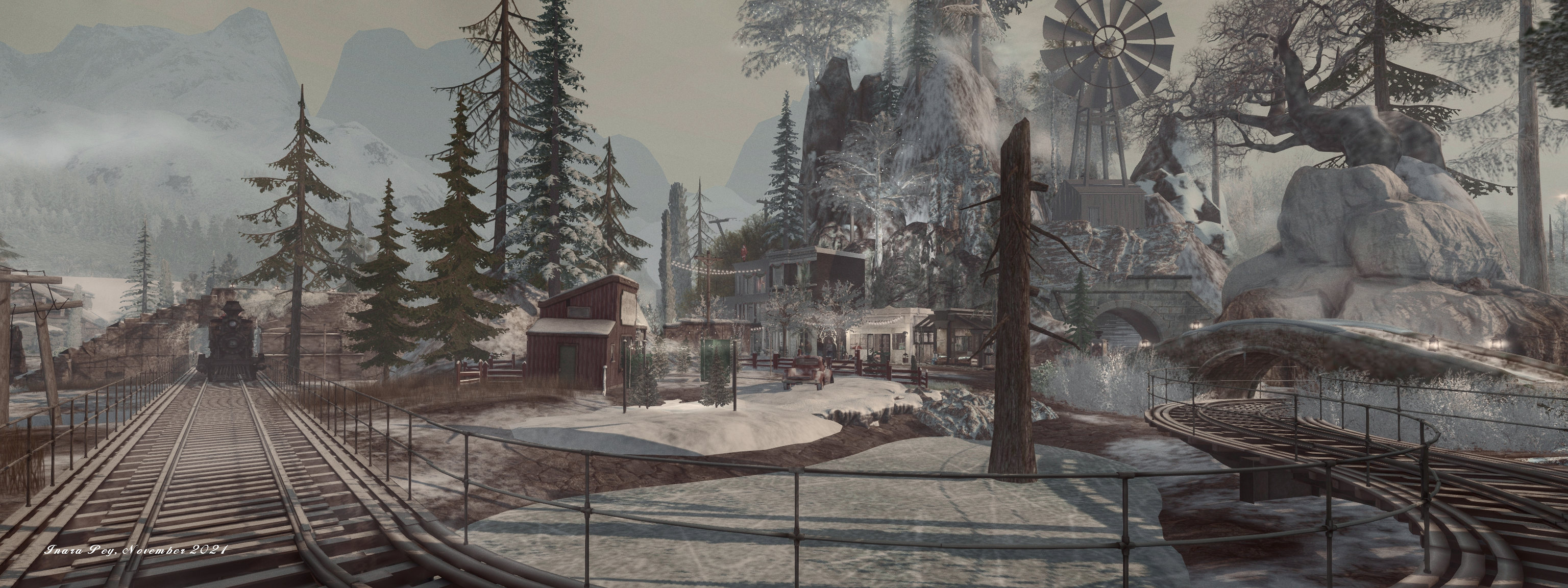
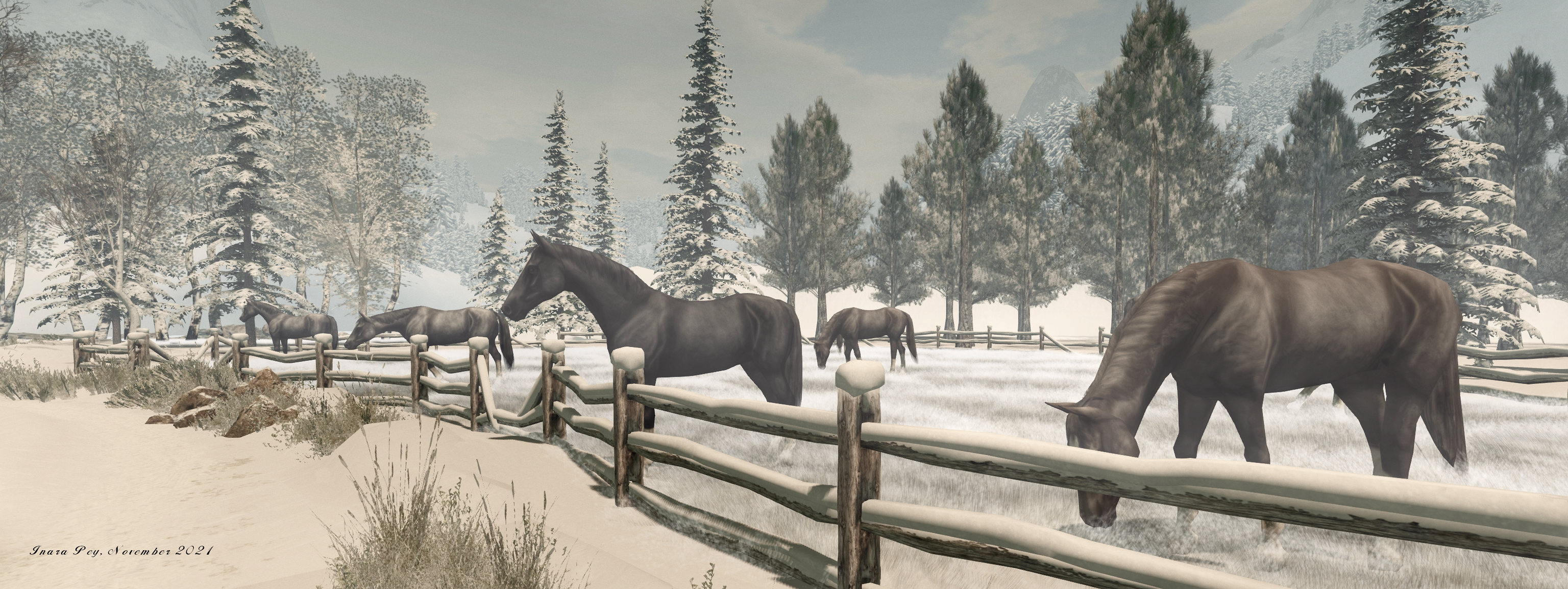
Winter Solstice is another region that offers a mix of public spaces and private residential parcels that I recently had occasion to visit. As a Full region, it offers to the north and south – the later separated from the rest of the region by a body of water that cuts deep into the landscape, leaving the centre of the region open as a public spaces built at the foot of a tall mountain.
Held and designed by JasmineSnow (jasminesnow333), it is the home for her estate’s main rental office, but offers a lot of opportunities for photography throughout the public spaces whilst also containing a subtle nod towards Christmas through the presence of a Santa or two, whilst a number of static mannequins give further level of life to the setting.
Winter Solstice, November 2021
Most of this can be found along the region’s “main street” that runs south-to-south along the foot of the central mountain, with shops, places to grab a hot drink and even a small stables where horses can be found. Behind the street, the mountain rises, from which a single track railway track emerges to mark the edge of the water that cuts into the region to the south, before running up to the north and then back to around to re-enter the mountain, marking an informal boundary between the public spaces and the rental properties along north side of the region.
There are also opportunities for activities such as ice skating an horse riding to be found within the region – again, allowing for the private residences. As well as the main street, the eastern end of the region provides plenty of open space for wandering, sitting, whilst to the west there is a music and event space.
Winter Solstice, November 2021
Beyond this, there is not a lot more to say – simply because the region, simply because it genuinely speaks for itself. It is photogenic, both thing the built-up area and in the open spaces. And with this in mind, rather than prattle on, I’ll leave you with further images and encourage you take a visit.
Winter Solstice, November 2021Winter Solstice, November 2021Winter Solstice, November 2021
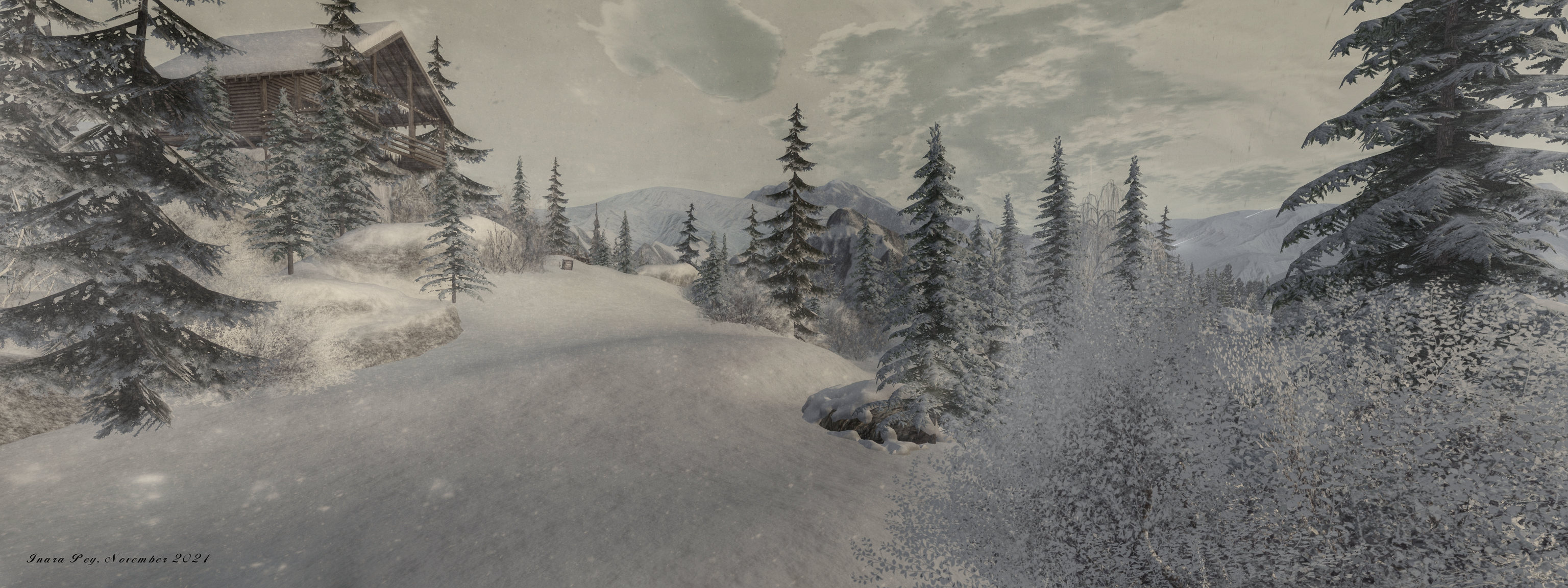
Echo Ridge, November 2021 – click any image for full size
For me, one of the somewhat difficult aspects in writing about regions in Second Life is how to deal with those locations that offer a mix of public spaces and private residences.
I say this because while many of these regions try to strike a balance between public / private, there is always a risk that I’m encouraging a degree of possible trespass / invasion of people’s personal space by suggesting people go and visit. As someone who appreciates her own home spaces and the retreat they offer, I’m possibly being overly sensitive in this, but it is something I can’t shake. There’s also the fact that there are regions that have a bias towards rentals that makes writing about their public spaces difficult, simply because of the volume of homes and the limitations they place on exploration and discovery.
Echo Ridge, November 2021
Such is not the case with Echo Ridge, a Homestead region that forms a part of Elvira Kytori’s White Dunes Estate, some of which I have covered in the past in these travelogue pieces.
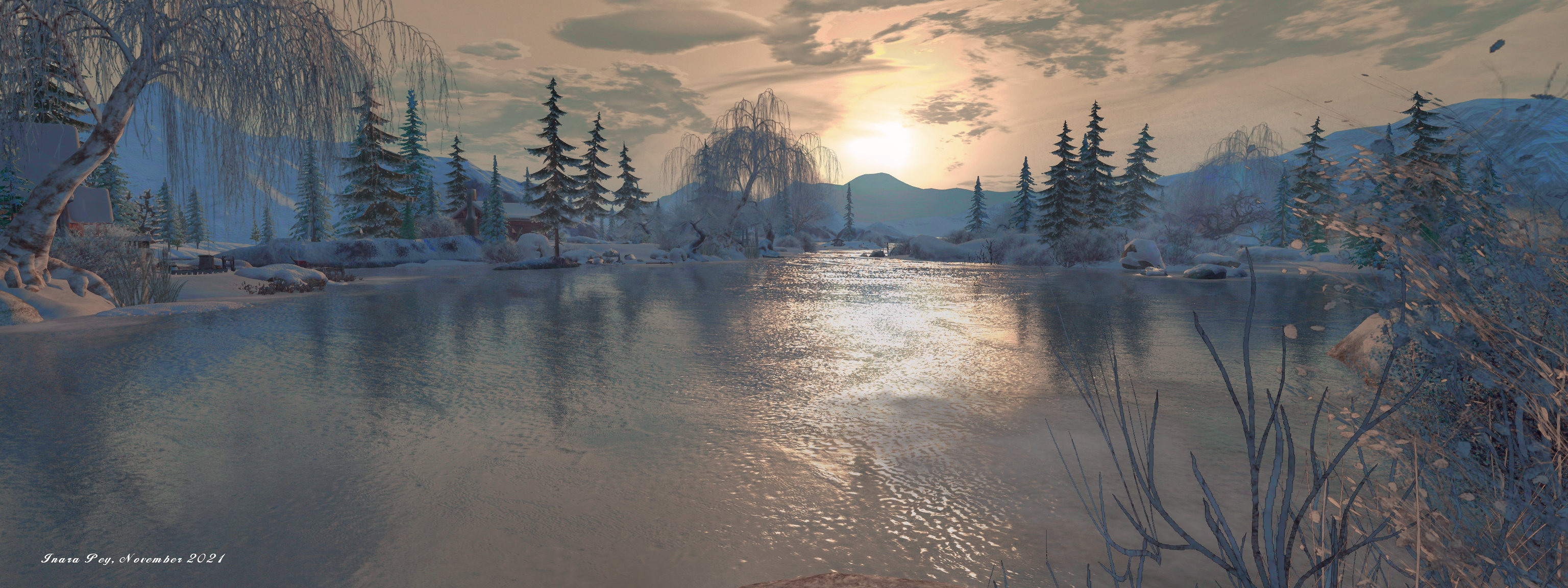
What drew me to Echo Ridge is its layout and current wintery setting. Comprising a single large northern landmass, surrounded by high peaks that in turn encompass a scattering of smaller islands, it has only four rental properties within it. These are placed far enough apart within the setting that, with the intervening waters being frozen, allows for exploration without huge risk of trespass. Add the overall winter dressing the region has, and this layout also allows for numerous opportunities for photography and also for some winter pursuits such as sledding and skating.
Echo Ridge, November 2021
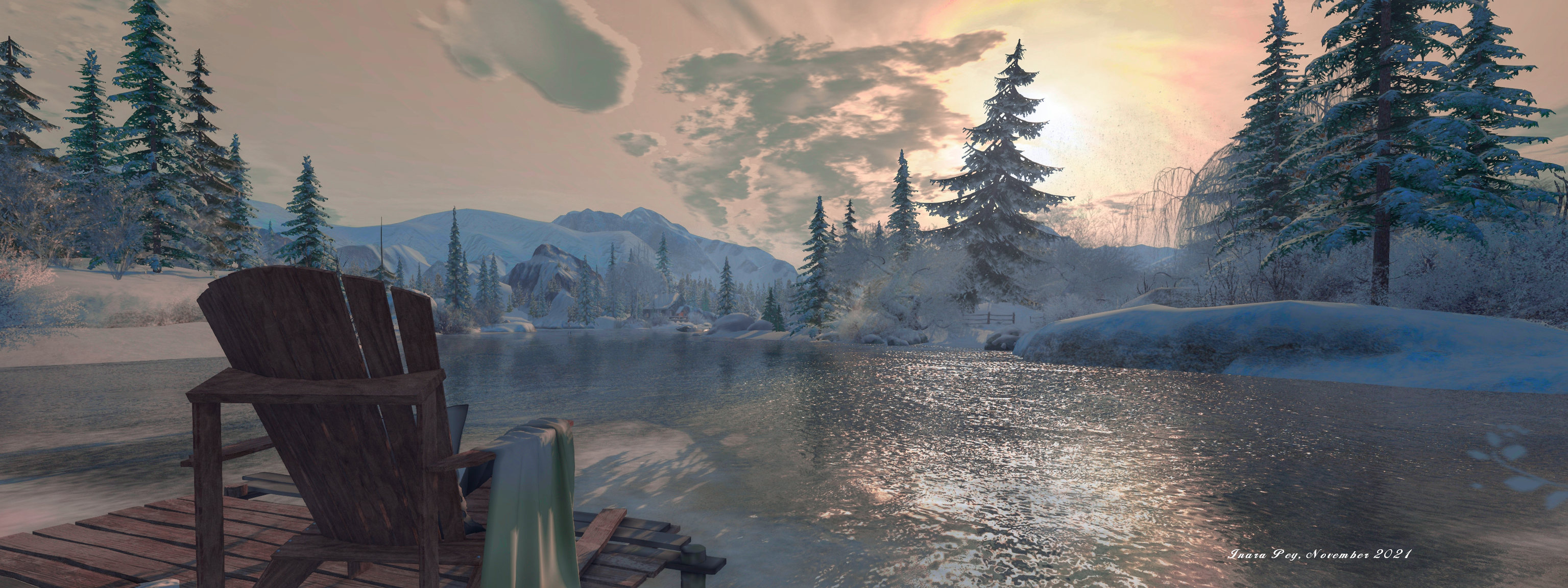
The landing point for the setting is tucked into a southern island that offers plenty of room for wandering, places to sit and views across the rest of the region. From here it is easy to see the surrounding rental properties, and perform a quick check on parcel boundaries (right-click on the ground each house stands on) to spot the extent of private areas.
Beyond this, it is a simple matter of setting out to explore as you will; there are no set path other than the ice-coated waters, and they will lead you where you wish. The northern landmass additionally offers a snowy path that arcs around it, skirting one of the rental properties as it does so, to offer more views and opportunities for photography.
Echo Ridge, November 2021
The magic here, however, is in the combination of small details, considered landscaping and the region’s EEP setting which is simply perfect. With the Sun hanging lower in the sky, it gives the region a very wintery feel that makes you want to done clothing that’s going to keep you warm as you wander across the snow or slide / skate over the ice.
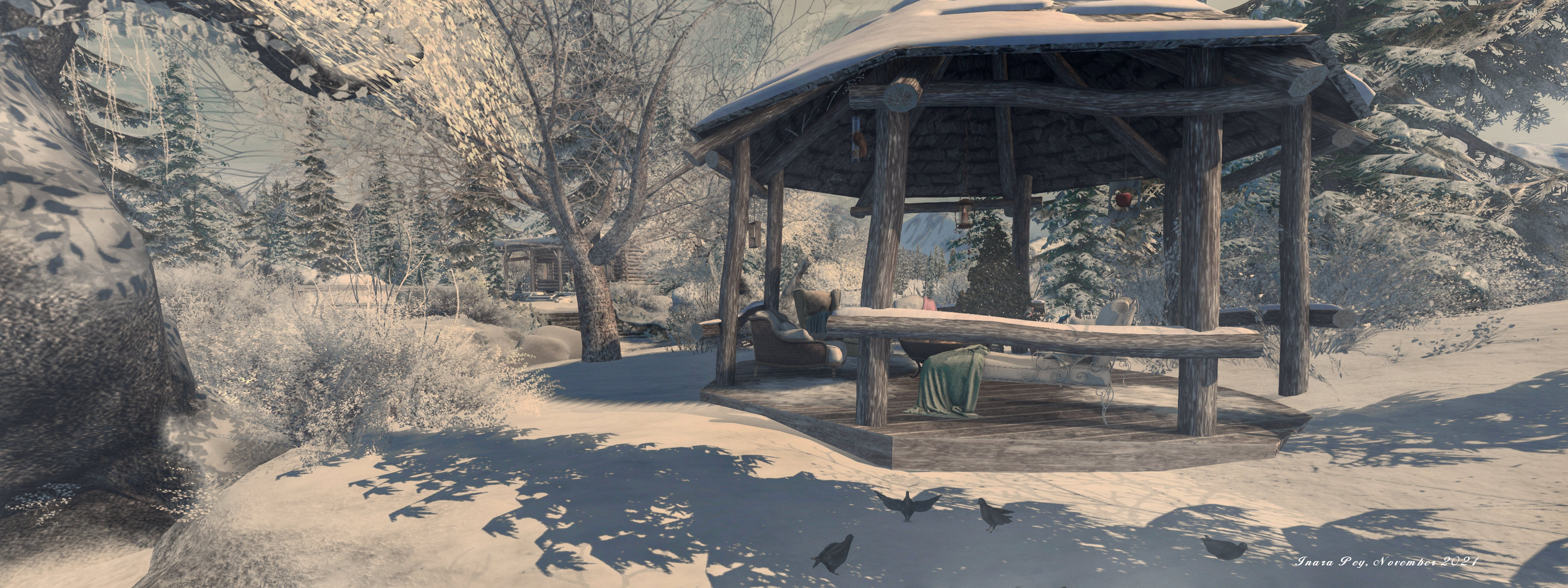
These details come in many forms, but for me the most notable is the wildlife to be found right across the region – herons and egrets keeping a regal eye on all that is going on, Arctic foxes playing on the ice, deer wandering the snow, doves trying to work out what the slidey stuff they are skating on might be and sandpipers ignoring the snow as they prance the water’s edge looking for food under the cold white blanket while song birds await visitors to the region’s gazebo, so they might serenade them.
Echo Ridge, November 2021
Really, there is not too much more to be said about Echo Ridge, simply because the region design speaks entirely for itself. It’s clear that a considerable amount of thought has gone into making this an attractive winter setting without going overboard on things. This makes the region beautifully understated when first seen, and increasingly attractive the longer one spends within it.
My thanks, as always, to Shawn Shakespeare for the point and landmark.
Skrunda-3, November 2021 – click any image for full size
Not long after the start of the year, I dropped in to Skrunda-2, the recreation of a Soviet-era town called “Skrunda-1” in Latvia. Designed by Titus Palmira, Sofie Janic and Megan Prumier, the region was a visit I very much enjoyed, so when Lien (Lien Lowe) dropped me the LM for the second iteration of the build – called Skrunda-3 -, I knew I’d have to drop back in and have a look around.
For those who have not visited previously, allow me to provide a little history to help frame this build: in the 1960s Russia established a radar facility some 5 kilometres from the Latvian regional centre of Skrunda as the home of two Hen House (Russian system name Destnr) first generation space surveillance / early warning radar systems. Its position within the Baltic state meant it was of major strategic importance to the Soviet military, having an uninterrupted view of airspace over the Western Hemisphere so it could “see” NATO / US space-based activities like missile launches. In fact, it was one of only two such facilities Russia constructed for this purpose in the 1960s, the other being near Murmansk, provide a view over the Arctic and north pole towards the United States.
Skrunda-3, November 2021
Such was this strategic importance, that the radar station grew an entire town around it, supporting some 5,000 personnel and their families at its peak, offering them all the amenities they might expect: swimming pool, theatre, a school, and so on, and well as “Soviet typical” apartment blocks and more – including dedicated electrical power generation and water supply system, enabling it (again, in typical Soviet style) to be entirely self-contained.
As a military installation, Skrunda-1 served its purpose through to the 1980s, with the radar systems being upgraded over time, until the decision was made to use the site as the location for three state-of-the-art radar systems that would have been ready to start operations in the 1990s, however, the collapse of the Soviet Union meant that the new facilities were never completed. Instead, in the post-Soviet era, Russia reached an agreement with the Latvian authorities to continue to run the Destnr radars through until 1998, after which they had to dismantle them and withdraw from Lativa before the end of 1999 – which they did.
Skrunda-3, November 2021
What was left behind became a ghost town, most of the buildings stripped bare but left standing, roads all in place – and something for the Latvian authorities to deal with. During the next 15 years, the town was left to nature’s ways, despite attempts to sell the land for redevelopment, around half of the land eventually being converted into a training ground for the Latvian national armed forces, although much of the deserted town still remains.
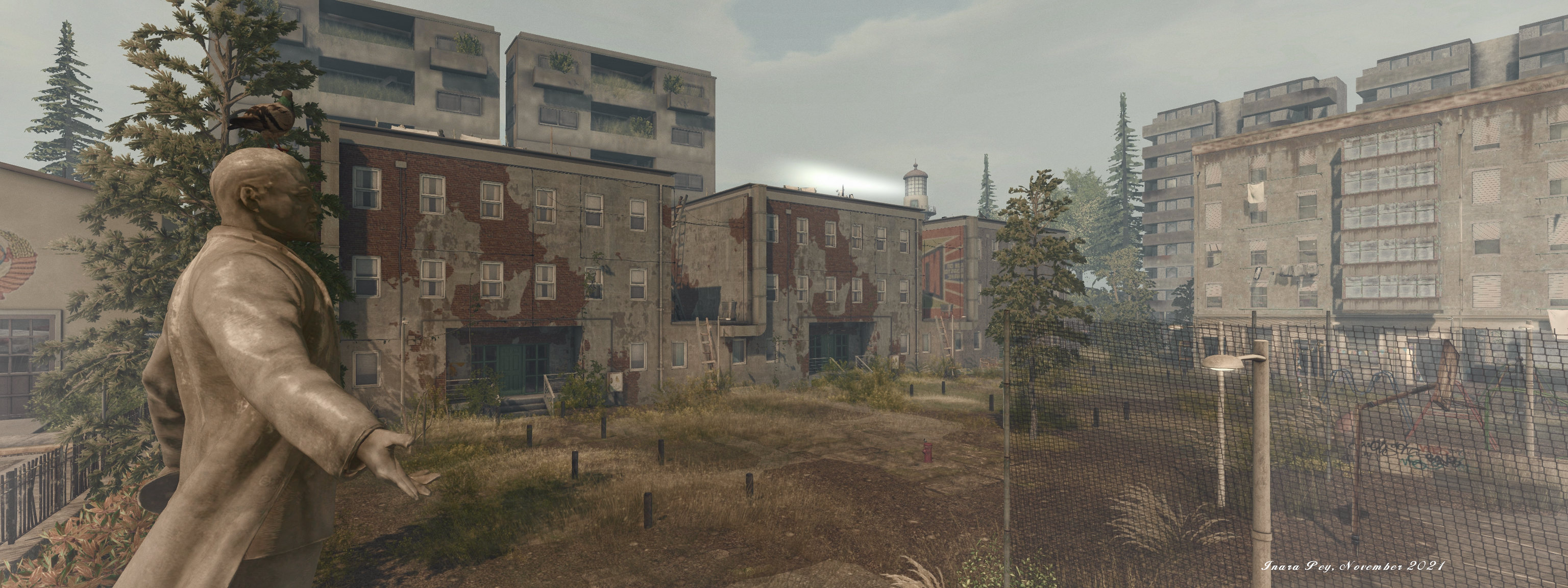
It is in this deserted, overgrown state that Skrunda-3 is offered – as was the case with Skrunda-2. However, whilst that version placed us fairly squarely within the residential parts of the town, this iteration offers more the the “business end” of the town and an iteration perhaps more rooted in the imagination of the builders. I say this because as far as I’m aware (and based on admittedly minimal research), Skrunda-1 was built far enough inland it does not have any form of deep water port, however, Skrunda-3 features an significant dockland area. expanding on a waterfront area found within Skrunda-2.
Skrunda-3, November 2021
This is something that gives the region a unique flavour unto itself, and presents a feature that makes up from the absence of any radar facilities the Russians took with them when they left and in all likelihood, a more interesting environment to explore than a load of military blockhouses. To further offer a sense of continuation from Skrunda-2, this build also has some of the apartment blocks tucked to one side, suggesting that were we to walk beyond them, we’d find ourselves within the previous iteration of the design.
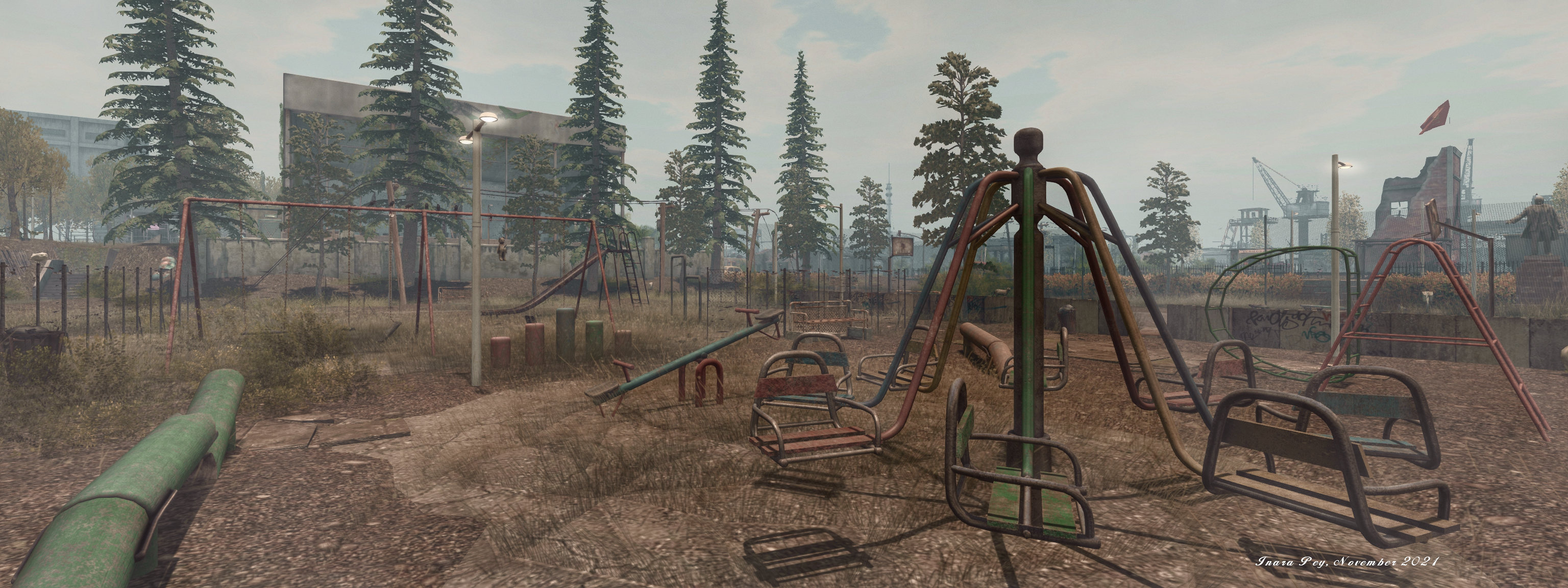
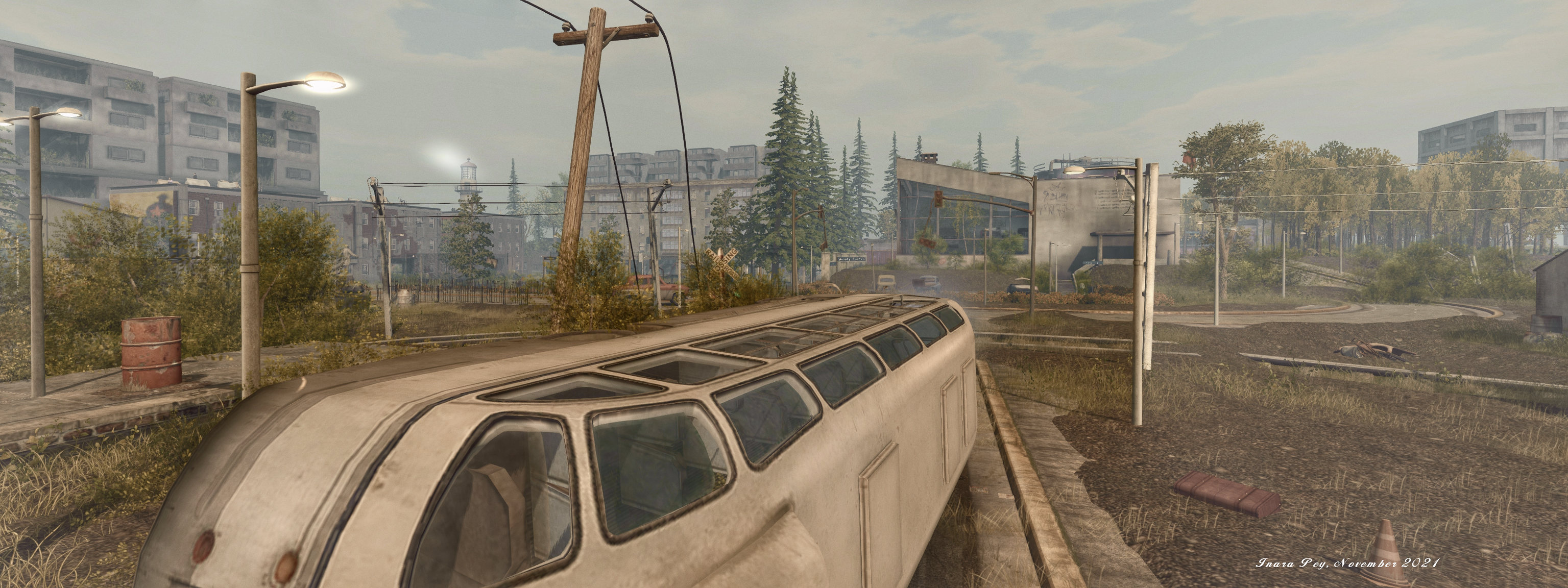
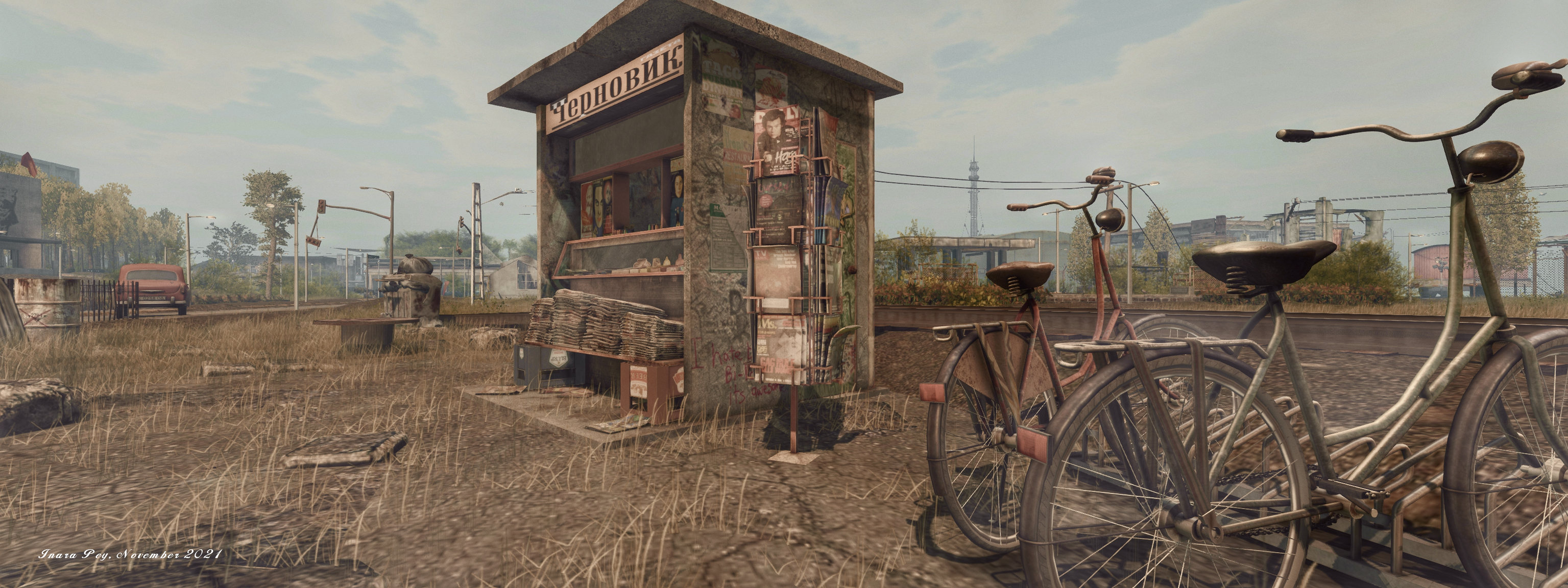
As with Shrunda-2, there is a lot of small details to be found within this build that make it something of a work of art in itself, from the graffiti on walls to the placement of the abandoned vehicles to the suggestions that either the town was deserted in a manner that saw possessions left behind, or that it has at times been used as a home by the dispossessed.
Skrunda-3, November 2021Where the former is concerned, there is a sense of family and abandonment within buildings and rooms; with the latter, there is a sense of loneliness and a feeling that despite those hidden souls who may have been forced to live among the deserted buildings have formed a community: within an open space, a stage for live music has been put together, completed with a battered – but presumably still tuneful – upright piano. A short distance away, a warehouse building has been converted into an art gallery, displaying images captured from within Skrunda-2. And over all of this, someone has even managed to restore electrical power, adding a further twist to the idea that whilst abandoned, the town enjoys a secret life.
Payment of L$150 brings visitors rezzing rights, allowing for photographic props and poses to be used, adding to the photogenic nature for the setting, while the supplied sound scape helps to give further depth to explorations.
Skrunda-3, November 2021
Standing with echoes of Skrunda-2, and sharing a common historical heritage, Skrunda-3 is nevertheless entirely unique in its presentation and design, making it a further ideal visitor for the Second Life traveller.
The Way of Life, November 2021 – click and image for full size
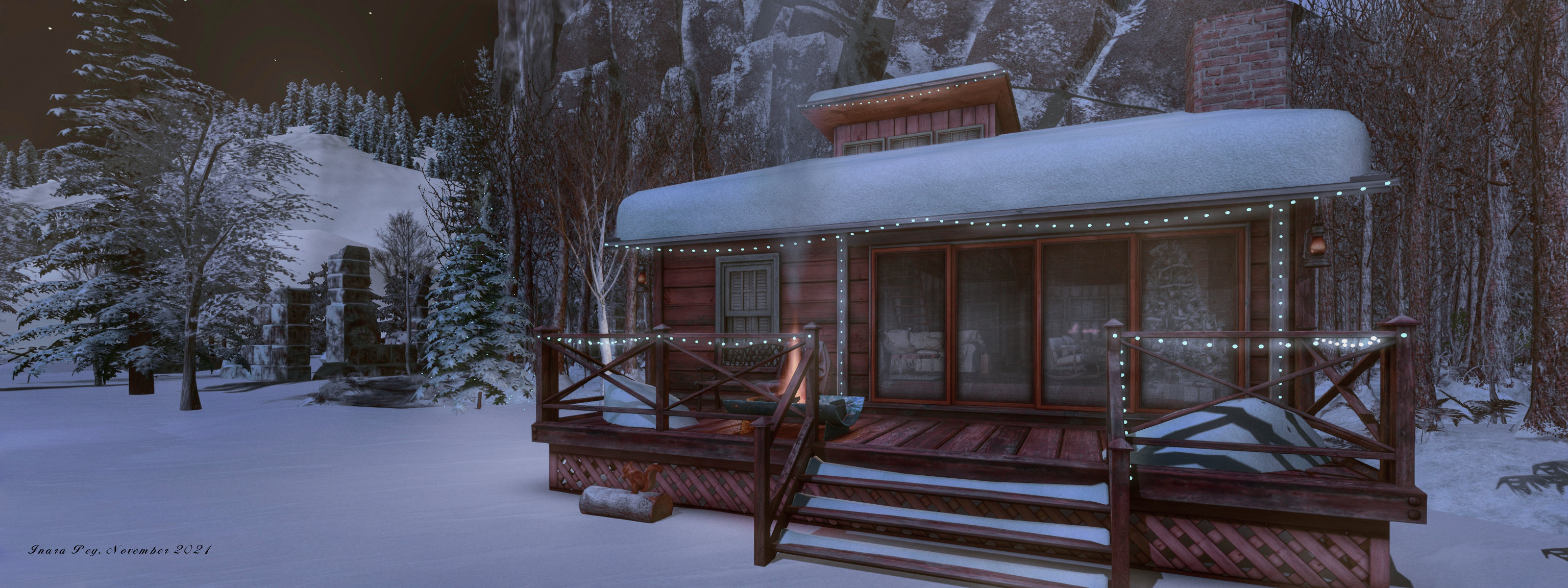
As I’ve mentioned recently, the end of 2021 is approaching, bringing with it (for the northern hemisphere at last) the cold of winter. For Second Life it means we’re in the time of year that sees outburst of snowy realms across Second Life. Over the last few days I’ve been hopping around a number either as a direct result of my own poking around or on the recommendation of friends. One of the latter is The Way of Life, a Homestead region held and designed by Dum (dumeric Asp), and which came to my attention by way of Shawn Shakespeare.
If sledding and snowboarding happen to be you thing, then this is a good place to visit – although these are far from the only reasons, as we’ll get to shortly. I mention both here and now because the landing point sits on the top of a towering table of almost sheer-side rock, running east-to west across the southern side of the region, dropping from its squared top by means of a snow-covered slope as it does so.
The Way of Life, November 2021
Bounded on three sides by Tuscan-style buildings, the fourth side of this mesa is formed by the aforementioned slope, which has at its lip both sled and snowboard rezzers. These allow the adventuresome to descend the slope via the piste, either directly or using the slalom markers and ski jump, to reach the region’s lowlands. For those not so enamoured of such pursuits, a path does descend the slope close to one of the sheer sides of the snowy mesa, marked by fir trees that stand to attention on either side of it, guarding the way.
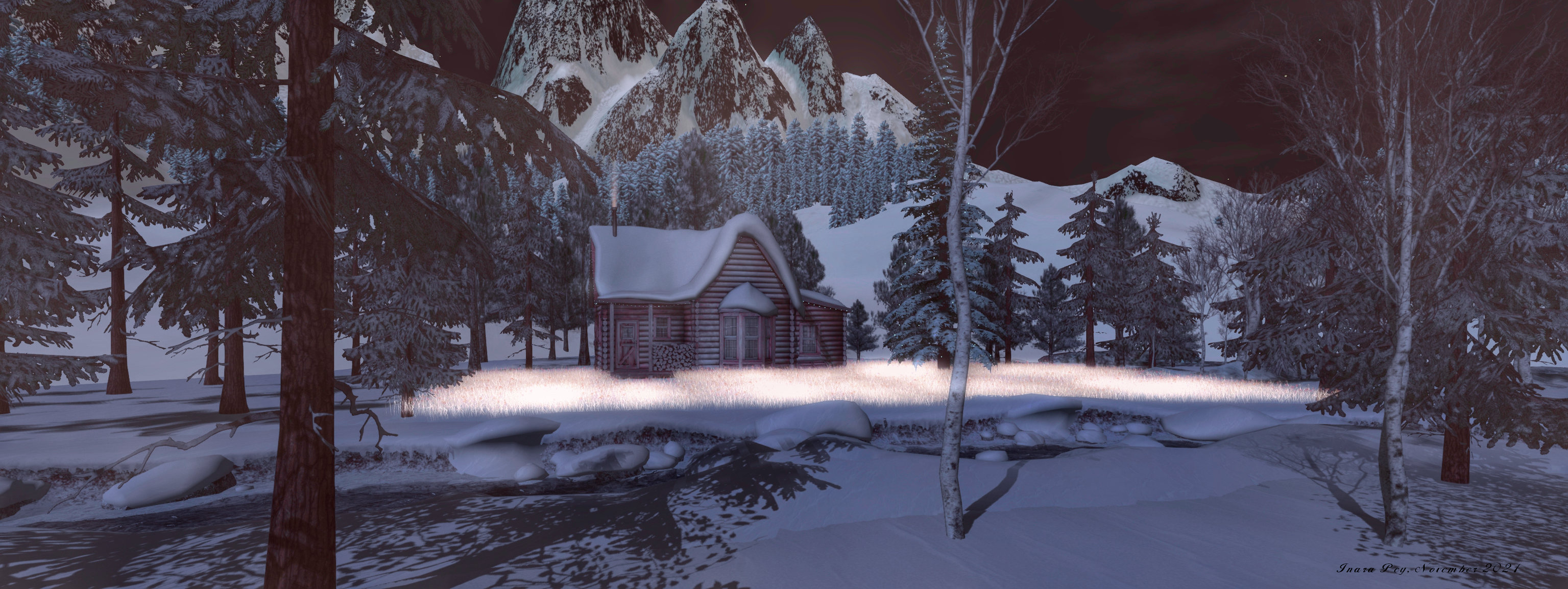
At the foot of the slope, the region spreads itself northwards from a snow-dusted Zen garden, the land almost entirely flat in nature, cut through in part by a meandering stream that flows southwards from the large lake that sits to the north, its frozen surface yet offering a glimpse of water moving below, flowing towards the throat of the stream. Around the lake lay a trio of cabins, all of them apparently open to the public to enjoy as they explore, whilst a second stream winds inland from a larger, mountain-bound (and off-region) body of water to feed the lake, explaining the movement of water under its covering of ice.
The Way of Life, November 2021
Whilst somewhat transparent, the ice is nevertheless dense enough to allow for ice skating, and skate givers are dotted around the rough shoreline for this purpose, offering more opportunities for exercise and fun.
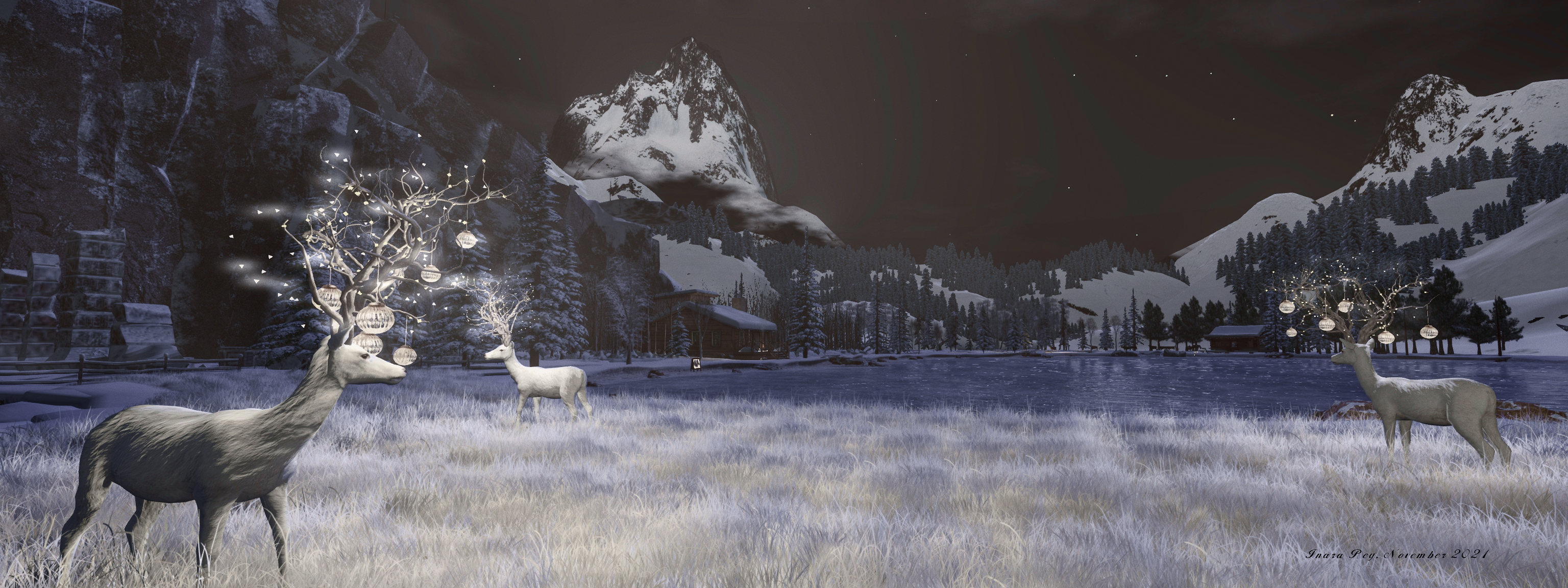
The lake, cabins and landscape are caught under a midnight sky (other EEP setting are available, consult your viewer for details 🙂 ), with bright pools of grass rising above the snow to vie with the lake for attention. One of these is fenced-off, the retreat for horses, straw bales stacked alongside the cabin nearest them in readiness to become a source of food. Elsewhere, the grass is home to lantern-bearing snow deer and white-furred wolves.
The Way of Life, November 2021
Under the lee of the region’s mesa lie the ruins of some ancient structure tucked tightly into the lee of the mesa, the wreck of a helicopter alongside. Quite how the latter got here is open to conjecture, but it offers one of many interesting backdrops for photography.
The three cabins within the setting are all lightly but comfortably furnished, Dum here being assisted by a number of friends in supplying décor elements and furnishings. Thus they make for welcome breaks from the cold outside – although there are a number of sit points to be found out under the stars and on porches for those who prefer. At the time of my visit (given it was only pre-US Thanksgiving November), Christmas / holiday decorations were at a minimum (some lights strung around a couple of the outdoor trees, and a tree and holly around the mantelpiece within one of the cabins), so the region sit as a nice wintertime setting rather than a holiday time setting, which frankly makes it all the more (to me) attractive place.
The Way of Life, November 2021
For those who wish to use the setting a s backdrop for avatar photography, rezzing is open to all, with auto-return set to 2 hours – but if you do put props out, please do remember to take them back to inventory rather than leaving to to auto-return to vacuum them up and drop them on you; that way the environment is left cluttered for other visitors.
Aside from the glowy grass (the wonder / irritant of Full Bright) that to me didn’t feel quite right, even allowing for the lanterns placed out (or carried by the snow deer presumably in an attempt to explain its glow, The Way of Life is an easy-to-explore, tranquil setting that offers a charming and cosy location that should not be overly stressful for most systems (the default environment gave me between a 30-45 FPS average with shadows enabled), while the snowboarding, sledding and skating give visitors the option to have a little fun whilst visiting.
The Way of Life, November 2021
My thanks, as always, to Shawn for the pointer and LM.
Ashemi, November 2021 – click any image for full size
It’s been a little over three years since my last visit to Ashemi, the ever-evolving Oriental-themed region designed by the team of Ime Poplin, Jay Poplin (Jayshamime) and Shaman Nitely (see: Ashemi: an Oriental reprise in Second Life), although I believe for some of the intervening period, the region may have been absent from Second Life. So, when Shaman kindly dropped me a line to renew my acquaintance with the setting, I was happy to accept.
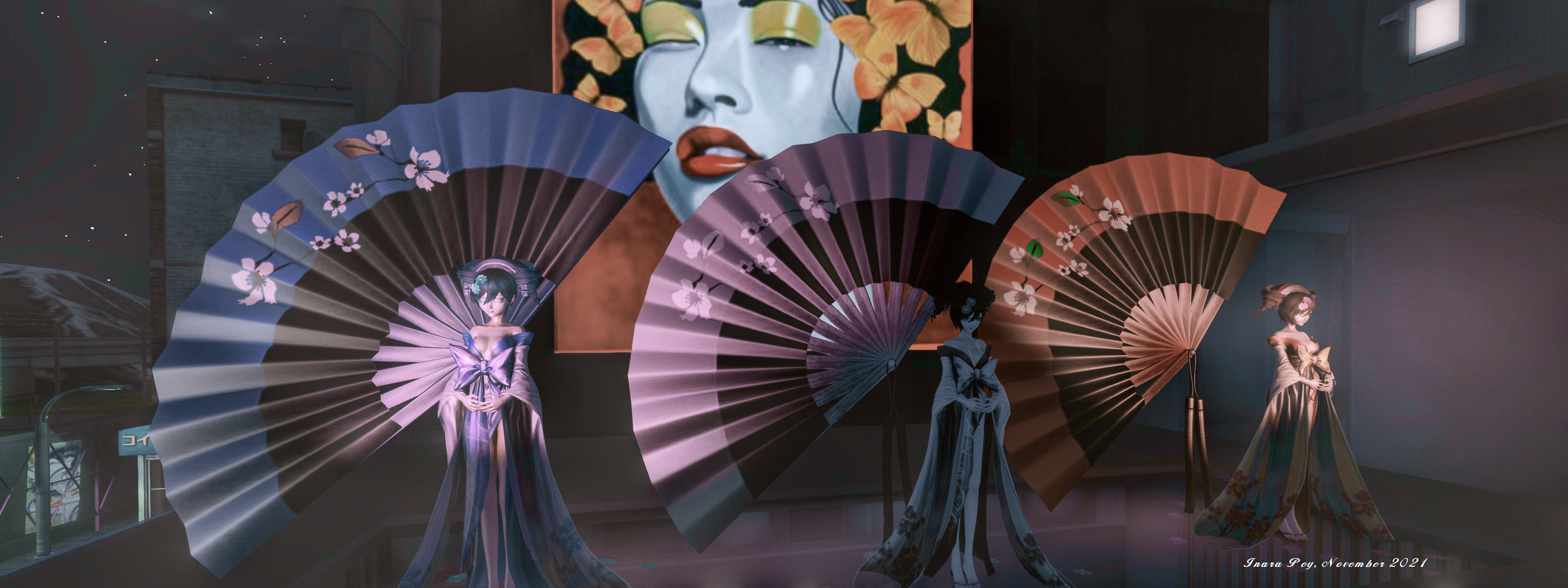
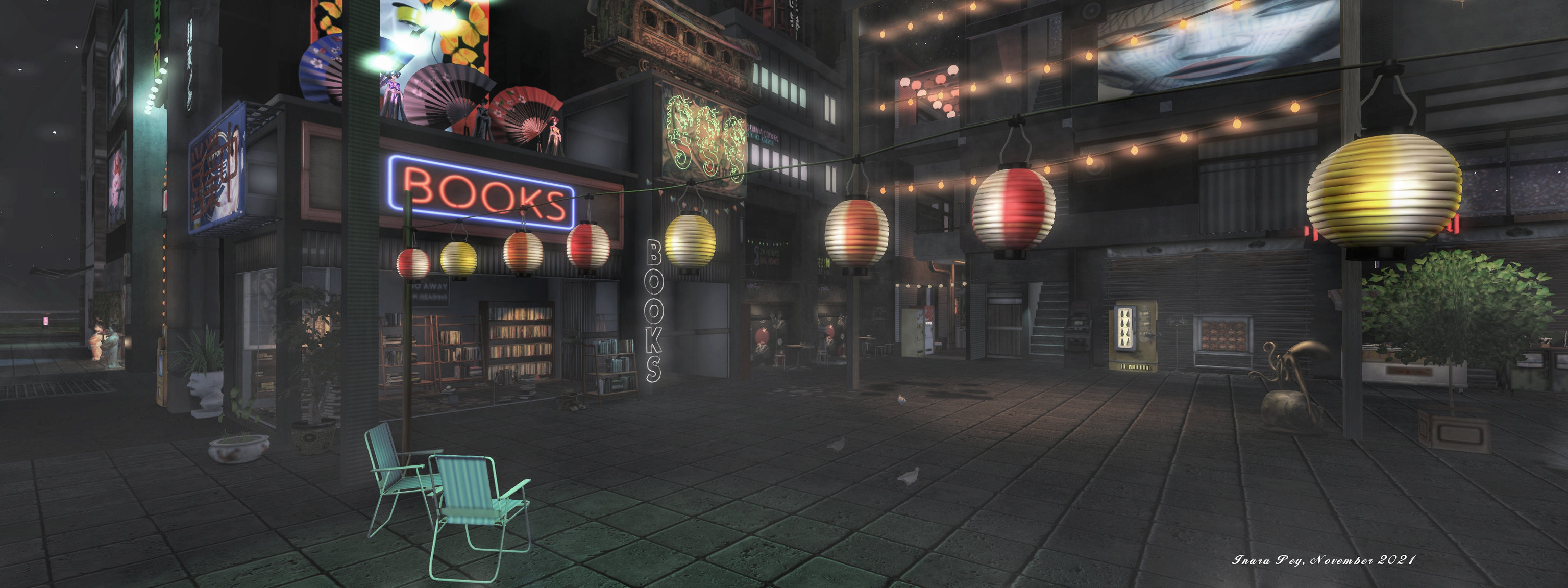
As with its past incarnations, Ashemi offers a busy urban setting primarily designed to be seen under night-time conditions – witness the huge Moon hanging in the sky! – although it also lends itself to daytime settings as well, as I hope some of the images herein demonstrate. I’ll also note a couple of things up front, as they both help with any visit.
Ashemi, November 2021
The first is that you really should have local sounds enabled. This is a cityscape that offers a rich sense of depth through the use of a rich sound scape. Not just cars, cicadas and so on, but the sounds of people as they hold conversations indoors and out; the echoes of shouts and laughter along train platforms, the clatter and chiming of crockery and glasses – all of which gives further depth to the setting.
The second point is that Ashemi really is a place that can clobber performance; under the default EEP and with shadows enabled, I was looking at around 4.5-6.7 FPS on average on my not-top-of-the-range-but-reasonably-OK system. Flipping to my preferred EEP settings, and so often seen in my images (as they tend to get attached to me for travelling), this clambered its way to 9-10.8 fps. So, if you are on a mode-to-lower-range system, you might want to toggle shadows on when needed and otherwise leave them off.
Ashemi, November 2021
This is a setting that carries with it echoes of earlier iterations of Ashemi, whilst at the same time offering something entirely new. The lightness of touch with the familiar – for those who remember past versions of the city – may help prompt the imagination to consider that we are within the same metropolis, but a different district or prefecture. Or we can accept what we see as an entirely new setting. like those past iterations, this is a busy place – not in terms of textures, mesh etc.), but in style. The ambient sounds suggest a place where people work, live and relax. The buildings offer a mix of outer high-rises and smaller, inner buildings that include places of business and entertainment as well as transit points and homes.
But whereas the Ashemis of the past tended to feature water within them, here is has been pushed outwards, as if roughly shoved away to make way for humans. Nevertheless, whilst waterside walks may have vanished, this setting carries with it places where a degree of peace and relaxation might be found – although one in particular may require a little effort to find, while others may have their solitude poked at by the noise of the unruly masses.
Ashemi, November 2021
There is also, perhaps a sense of age here that may not have been quite so prevalent in previous iterations. Older, more traditional houses have been converted to places of business, whilst the concrete blockhouses common to the latter part of the 20th century peer over fences and wall as if to see what is going on. Sad to say, as well, that such is the age of this district, it appears to have become something of a littering ground, as can be seen within the local cemetery; clearly no longer used, it is home to unwanted bodies of metal, plastic stone quite aside from the souls who might still be interred within. And as one wanders, so might the slow lament of a violin be heard – or perhaps it is a kokyu.
Some interesting references might also be found here for eyes that seek and feet that walk. For example, outside of one place of work there might be found a certain car awaiting the call of lightning; down another street you might prompted to ask who ya gonna call? Throughout all, NPCs further bring the setting to life as they work in garages, await a train or walk down pathways.
Ashemi, November 2021
Rich in detail with assorted opportunities for photography, Ashemi remains an engaging visit – if one a little hard on the system, as noted, although this should not stand in the way of any visit.
My thanks again to Shaman, Ime and Jay for the invitation to visit and explore once more!
Coven of Crows, November 2021 – click any image for full size
When Shawn Shakespeare first sent me the landmark to Coven of Crows, I initially thought that perhaps it would led me to a region offering something of a Games of Thrones theme. Well, I was entirely wrong – and all the better for being so. Not that I have anything against the books or the TV series; just that having recently waded back through the first three volumes A Song of Ice and Fire, I am a little full with the likes of Jon Snow, Daenerys Targaryen, Petyr “Littlefinger” Baelish, Cersei and Tyrion Lannister et al.
A Full region carrying the private island land capacity bonus, and designed by Sena Heartsong, Coven of Crows is, to quote the About Land description “a place between worlds, ruled by crows and magical souls”, to which I would add, “and a place with secrets awaiting discovery”, for such is the case on all counts.
Coven of Crows, November 2021
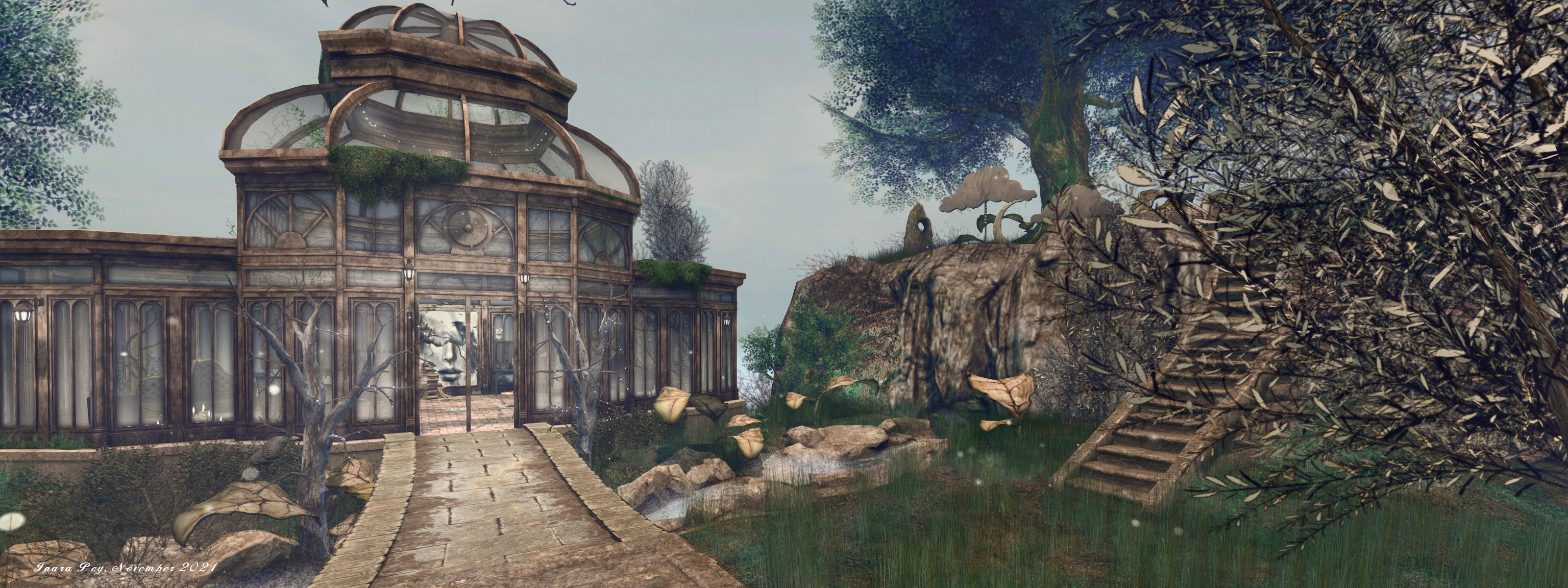
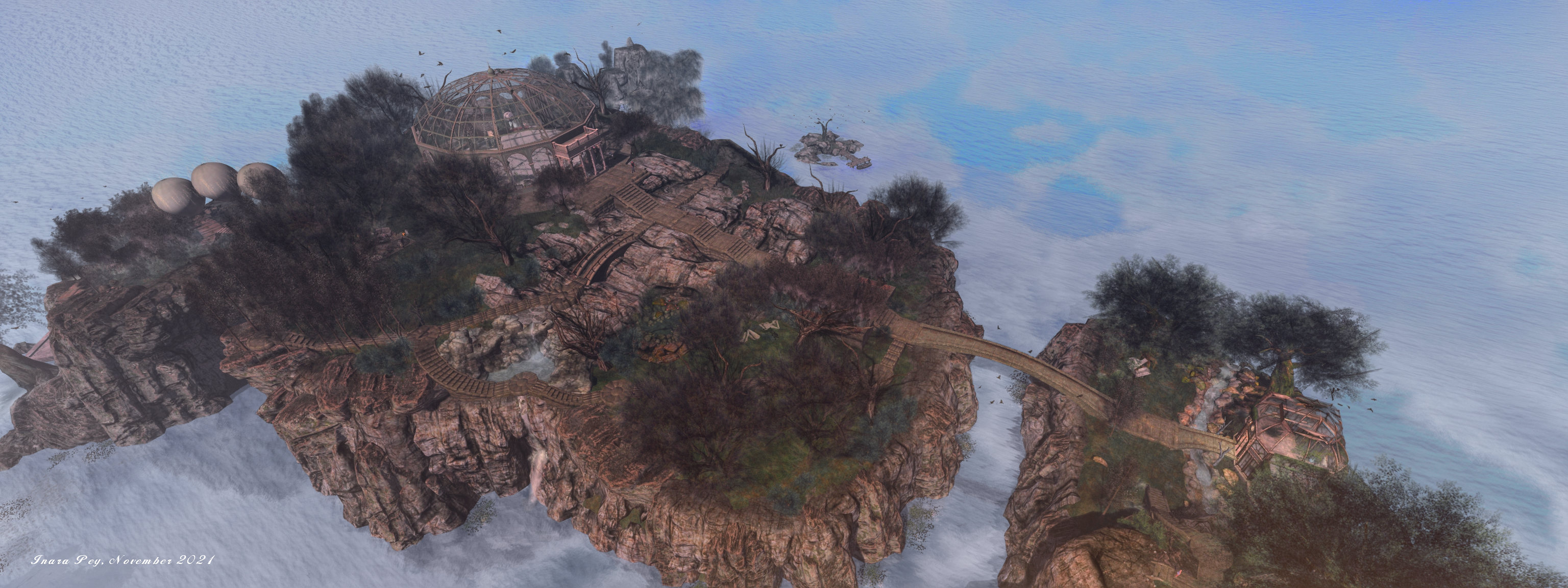
Set in a south-north orientation, the region comprises two main rugged islands linked via the single span of an elegant stone bridge, a handful of smaller isles scattered to either side of them. The more southerly and smaller of this main islands rises on near-vertical cliffs to form the landing point. This sits within a large conservatory offering comfortable seating, information, and wide open doors standing in invitation, from which an arrow-straight path runs due north, passing over a stream that issues forth from the island’s peak and thence over that graceful bridge to reach the larger island.
Here, atop cliffs every inch as sheer as those of the southern island, the great flags of the path rise by way of broad flights of steps to where a great palace of steel and and glass rises, beckoning visitors towards it as its domed roof rises above the tree tops.
Coven of Crows, November 2021
Intended as a place of music and dance, this circular house of glass of not the only destination upon this larger isle, however, for the path to it branches severally. One arm runs to the west to join with the island’s edge where water falls to the sea below and views might be taken of the islands that sit on the calm waters below. From here, the path joins with a second, as as it passes on around the island’s edge – and of which, more anon.
A further arm of the path points east, joining with an unpaved way that switch backs down to the waters edge and a small dock, one of many scattered among the islands. These docks form places where a boat might be rezzed (touch the dock and allow time for said boat to be delivered if one is not already available), such that travellers might make their way by water between the various isles.
Coven of Crows, November 2021
To the west, two of the islands are linked one to the other by way of a floating bridge, to the east, the two islands can each only be reached the use of the boats. All have points of interest to be found, be they ruins, or round pavilion with cosy bed, or long-dead tree. To the north lies the last of the islands, a high-topped nub of rock, a balloon-supported bridge linking it to the largest island in the group. A long finger of steps crooks its way down one side of this isle, the ruins to top and bottom offering points of photographic interest.
But to return to the large island and the path that runs to the west and north around its high-placed lip. This is the same path as gives access to the high, balloon-held bridge, beyond which it ends in steps that present the way down to a broad shoulder of rock, where another switch back of rocky path winds to the waters below – and the candle-lit entrance to mine-like tunnel entrance might be found. Enter this, and you will find a long passage, a throat hewn of rock that might swallow you into its depths by way of path and stair.
Coven of Crows, November 2021
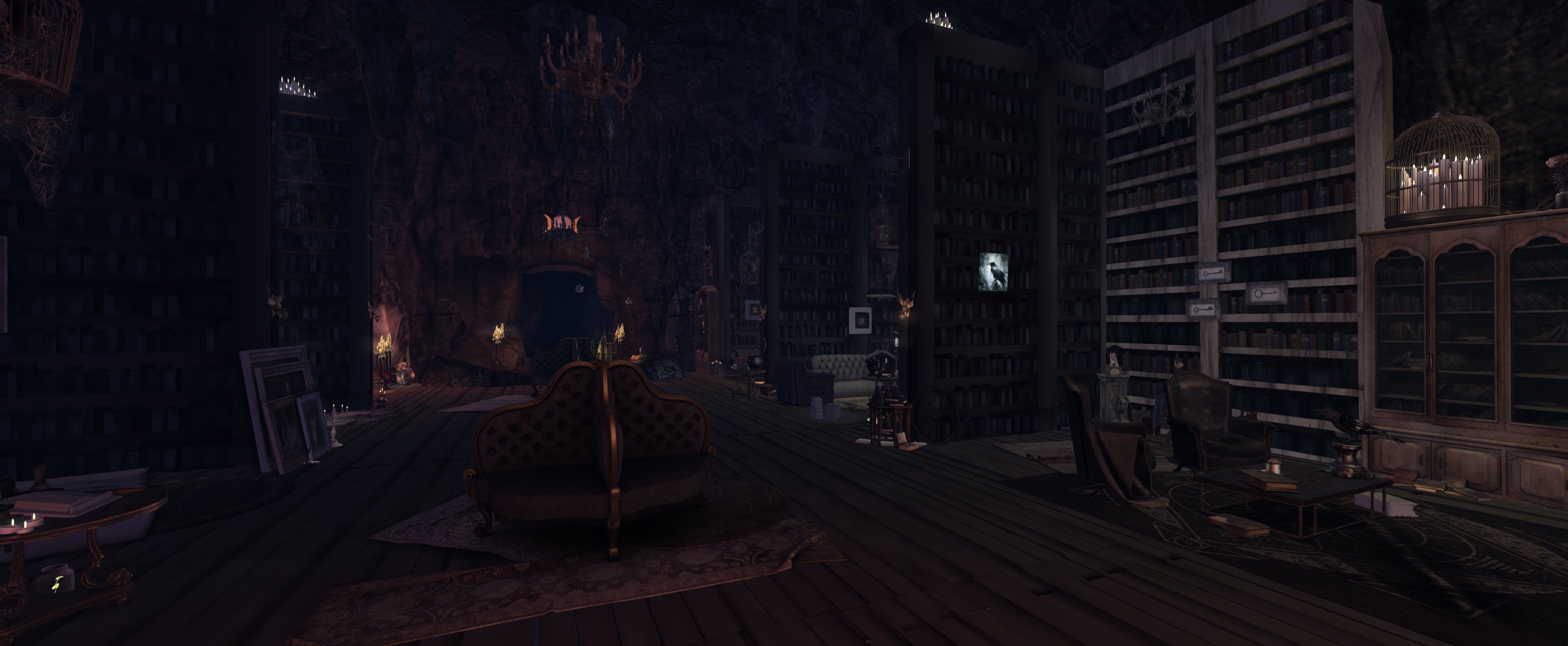
To enter it is to step into the region’s secret; for as the tunnel descends, so does it arrive at a huge cavern. High-ceilinged from which multiple chandeliers hang, and the broad entrance to a building hewn into the rock draws the eyes. Its columned façade forms the backdrop to what is at first glance a stage, and the great cavern a further place for dance. But a door in the façade gives access to a room beyond, wherein just a hint of the tales from Game of Thrones and thoughts of Aria Stark’s journey might reside.
Facing the entrance to this great chamber is a second tunnel, sitting on the far side of wood and door. Here the path runs beside water over which candles float, and the carved statue of a goddess rises. Thus with this small cavern and the chamber it faces, the mysteries of the island become clearer. But they are not the last of the secrets awaiting discovery, for the path leads onward to where another chamber sits, one perhaps with the largest surprise of all; a place that might be accessed through a second tunnel, one within its entrance somewhat hidden from the the view of the world at large.
Coven of Crows, November 2021
Watched over by the crows of its name, their caws and cries filling the air, this is a region rich in detail without being overly burdensome on the viewer; a place where many photographic opportunities await, as do places to sit and cuddle or simply pass the time. Recommended.











 Inara Pey: Living in a Modemworld