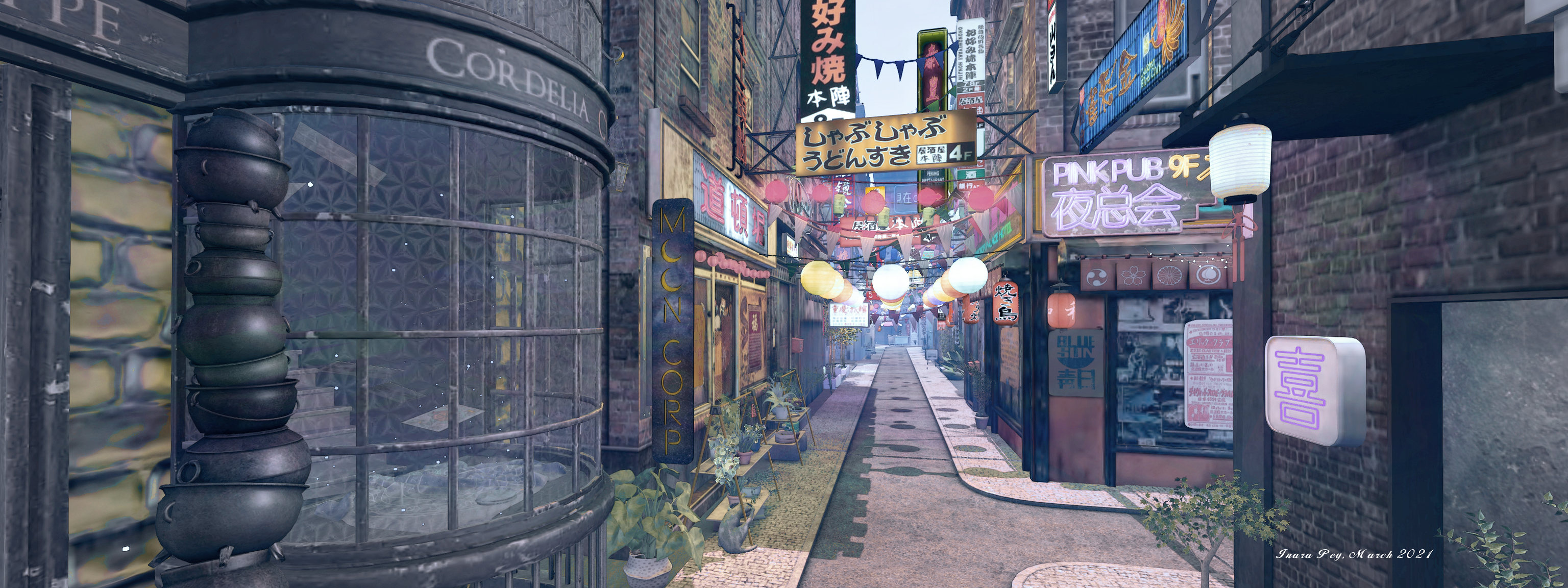
ChicLand’s allure in Second Life

ChicLand, March 2021

I’ve recently received several suggestions / invitations for region visits, which I’m trying to work my way through in some semblance of order – thank you to everyone who sends them by IM, note card or via the blog itself.

One of the locations passed to me a couple of weeks back was for ChicLand. It came via Morgana Carter after I wrote about Poison Rouge (see: Sampling some Poison Rouge in Second Life), with a note accompanying it to explain that like that region, ChicLand is both the home of a store – Lilo Denimore’s ChicChica  (I’m using the region’s formal designation in this piece to differentiate it from the store) – and a landscaped public setting open to visitors, so might I be interested in taking a look?

ChicLand, March 2021

A Full region, Chicland is a setting of multiple parts. The store itself is located in the sky, reached via a teleport in the from of a large arrow at the main landing point. As such, it does not intrude into the multi-faceted landscape that flows outwards from the landing point to offer a rich assortment of locations and ideas to explore, appreciate and photograph.

At the foot of the steps leading down from the landing point is a broad French  boulevard, lined by the façades of tall town houses and places of business, vehicles parked at the roadside and under the shade of the richly blossoming trees that march down either side of the road.  Blossom petals drift on the breeze that’s gently funnelled by the height of the houses, the fluttering of the petals attracting the attention of a local cat. Static NPCs provide further depth to the scene, the mother and daughter in front of the ice cream kiosk particularly grabbing attention thanks to the upturns cone on the path nearby its former topping now oozing over the concrete suggesting a slight accident has prompted a return to the kiosk to stem the resultant upset.

ChicLand, March 2021

The road winds on to pass under the single span of an elevated walkway (that it goes nowhere makes no difference, it acts as a unique form of gateway) to arrive at a fresh produce market that offers a view across the region whilst remaining separated from it by the surrounding wrought iron fence; to reach the landscape beyond the fence it is necessary to either jump it or, more easily, re-trace steps and find an alternative route – thus encouraging exploration.

One of these alternate routes reveals the cleverness in parts of the design: one of the façades of town houses is double-sided. On the one side it forms an aspect of the street scene first encountered on leaving the landing point, whilst on the other it offers another row of of house fronts overlooking a marvellous walled garden space (one of two in the region, in fact, the other being alongside the produce market). The use of the façade in this way thus gives the impression the urban aspect of the region is much larger than its actual footprint.

ChicLand, March 2021

The walled garden here offers a lot to take in, including a path through to the rest of the region – although you do have to pick your way through the flowers growing around the borders of the garden space in order to reach the gates. Beyond the garden sits open countryside through which a stream meanders and which is watched over on the far side by a Tuscan style farmhouse sitting atop a low butte of rock and reached by a rough park.

A dusty track winds across this open landscape from the bridge connecting it with the town’s garden. This passes along the side of an orchard that straddles the path up to the farmhouse, and points the way to more places to discover: a little pergola where tea from a samovar might be enjoyed with some sweet desserts, and also a vine-enshrouded garden bar where a more varied selection of refreshments might be had. There’s also a playground and a Romany caravan to be enjoyed along the way, each offering views across the stream to two eye-catching terrariums.

ChicLand, March 2021

From the end of one arm of this dusty track, a grassy trail points the way onwards to the lee of the rocky table on which the farm house is perched. It leads to a cosy vineyard where the freshly decanted produce of vine and fermentation might be sampled in comfort.

Lightly furnished and sitting slightly above a walled courtyard, the farmhouse offers another retreat – although how to reach it from the courtyard may initially have you guessing, given it appears to sit on a sheer-sided block of rock with no visible steps cut into it. But check around to one of the sides, and you’ll find a steep, grassy slope provides the means to scramble up to the house. The courtyard itself is home to a little vegetable garden and cows and geese, both of which make it a little noisy, but for those who do not mind and farmyard noises, further freshly press grape juice and nibbles at a table are awaiting enjoyment.

ChicLand, March 2021

All of this and several more elements I’ve not mentioned in the piece make ChicLand a joy to explore. Each of these elements stands both as a part of and a part from, the whole, offering both a continuous setting and a series of individual vignettes that can uniquely catch the eye and / or camera lens. However, what I found particularly attractive were all the little touches awaiting discovery that give the region a sense of life.

There’s the mother / daughter vignette at the ice cream kiosk I mentioned earlier, complete with dropped cone. It is balanced by a woman holding up a small boy, both of them looking to the same point, inviting the suggestion they are posing for a photograph. There are also little touches of humour awaiting discovery – and I do mean little! – as anyone who spots grandpa gnome, his audience and his clearly less-than-happy wife will doubtless agree!

ChicLand, March 2021

Rich in detail throughout whilst avoiding overly taxing the viewer, ChicLand has much by which to commend itself to the casual visitor and the Second Life explorer alike, with the teleport up to the store offering the chance to mix a little shopping with exploration and photography.

Slurl Details

Crossing The Divide in Second Life

The Divide, March 2021

A tweet from Second Life blogger and photographer Rig Torok concerning one of his recent region outings set a bell clanging in the back of my head when it showed up in my time line. It featured an image of, and URL to, a place called The Divide,  was sure we’d visited in the not-to-distant past, but which which failed to show up on my listed of blogged destinations.

That prompted me to rifle through Windows Explorer, and sure enough, there was a folder from December 2019 with a couple of photos of the setting, some rough notes  – and nothing else; so we’d clearly visited, but for whatever reason, had either never fully explored or I’d simply forgotten to go back for photos and write-up thoughts for a post. Hopefully, this piece will therefore make up for things.

The Divide, March 2021

The work of Xen (Xenia Nordberg) and Coriel (Coriel7766), and sitting on a sky platform over a Full private region that leverages the Land Impact bonus, The Divide is described as a study of contrasts, an expression of duality inspired by the works of Hayao Miyazaki.

For those unfamiliar with Miyazaki, he is a Japanese Anime artist, writer, director and producer of animated films. He is internationally regarded as one of the accomplished film-makers and story tellers in the history of animation. His work is characterised by a range of recurrent themes, including humanity’s relationship with nature and technology, elements of which are evident within The Divide, both directly and indirectly.

The Divide, March 2021

Humanity’s relationship with nature is perhaps most clearly shown in the divide within the setting: to one side, and containing the landing point, sits a very Japanese theme town or village. To the other lies a sinuous, climbing valley, the separator between the two a narrow river channel spanned by bridges.

On the one hand, these two settings speak of both more prevalent aspect of our relationship with nature in our standing apart from it in our towns and cities of concrete and glass whilst constraining its presence to parks and gardens. On the other it represents our underlying need to embrace nature and the escape it can offer in its open spaces and amongst its flora and fauna.

The Divide, March 2021

The town itself is a marvellously compact affair that packs a lot into it, which  admittedly can make moving through it a little heavy going thanks to things like texture loads; I found it easier to disable shadow rendering entirely other than when actually taking snapshots, just to get the textures to load in a little faster and to offer smoother walking / camming. Streets run between an assorted collection of buildings, bunting and lanterns stretched overhead as if for a festival, a subway station hinting at a connection with places further afield whilst hiding a surprise.

While a good number of the town’s buildings are simple façades, others offer interiors to be explored, adding depth to the setting’s sense of place. Little side gardens may also await discovery, again harking back to the idea of our relationship with nature in the manner they offer retreats from the hustle of the street life just a few metres away. An interesting curio sits on the west side of the town: a mushroom-like rock rising above the surrounding buildings, topped by an ancient ruin that is itself home to a able-top D&D style game.

The Divide, March 2021

The human / technology reference is also much in evidence throughout, from the very obvious – all the neon signage, the vehicles, and so on – to the more subtle (anyone spot the reference to a certain film franchise focused on technology?). There’s also the pointers to the speed of modern life such as the “fast food” kiosks for grabbing a bite while on the move, countered by little temple-like places where life can be put on pause and more spiritual matters addressed.

Across the water, the valley and parkland offers the means to escape and explore and presents an interesting mix of themes and ideas. There are Chinese elements such as the of pandas in their bamboo copse, for example, and more studies in our relationship with nature, notably typified by the little shrines along the path that climbs up into the hills.

The Divide, March 2021

To the south of the setting, beyond a bamboo curtain sits a ramshackle home. Reached via a concrete bridge, it again echoes the ideals of relationship: humans living within nature, with our relationship with technology represented through the use of a converted shipping container for the house – the same kind of contain that is used to transport all our little electronic and computerised gizmos around the globe aboard massive ships guided by satellites circling the world high overhead.

Some of the landscaping along the valley and its climbs could perhaps do with a little tidying up, but as long as you follow the paths and steps, you shouldn’t have too much of an issue in finding your way around. Make your way all the way to the top of the steps that wind up through the head of the valley, a zipline awaits to offer a faster way back down – just mind the trees on your way!

The Divide, March 2021

Rich in detail, expressive in design, The Divide presents a lot to be discovered and enjoyed. My thanks to Rig for the reminder.

Slurl Details

An Enchanting Small Town in Second Life

Enchanting Small town, March 2021

Enchanting Small Town is a homestead region design by Nataly Moonwall that opened earlier in the year, but which I’ve only recently managed to hop across to and see. For those seeking something of a urban setting for photography (albeit sans props, as there is no group available for rezzing rights), it could be a useful place to visit.

Step away from the stresses of life and chill in this realistic small town. A place to hang out & explore. Take great pictures. Beautiful, relaxing beach. Café, Playground, Jazz Club and more! Enjoy.

– Enchanting Small Town About Land description

Enchanting Small town, March 2021

Compact in size and easy to explore, the setting very much has a US West Coast vibe to it, set out as a waterfront location overlooking a sloping beach and backed by taller buildings and hills and suggest it could be part of a larger coastal setting.

The beach and the waterfront are the focal point, the latter comprising a main road that doubles as parking for the beach, being a dead end. Behind it sits a large, modern house that appears open to the public – although the sign on the main gates offers a stark warning to trespassers! The general design of the house, complete with infinity pool to the rear (which may have worked better facing the open sea), oozes wealth. But for me, it wasn’t the house – as excellently furnished as it is – that held my attention.

Enchanting Small town, March 2021

Bracketing it are two pedestrianised areas that caught my attention the most. One is fronted by what looks to be a recent development of boutique shops adjacent to a subway entrance and small newspaper kiosk. This area runs around to an older part of town with apartment houses and narrow streets that is fronted by a motel entrance.

The entire layout here suggests that at one time the waterfront road may have continued around to the motel, but the construction of the boutique shops prompted the broader pedestrianisation and the opening of the subway station entrance / exit.

Enchanting Small town, March 2021

The main entrance to the subway lies beyond the motel, where the West Coast feel starts to merge with a sense of the the other side of the United States: the signage for the station (and that over the smaller entrance / exit) would clearly be more at home in New York. While there may not be a station under the entrance, it points the way to the local jazz club, a cosy place that sits within a neighbourhood that again perhaps suggests New York than Santa Monica, further adding to the region’s mix of West Coast / East Coast vibe.

To the other side of the main house is a further pedestrian thoroughfare that leads to to a small recreational park. It is home to one of those small community supermarkets together with a bubble tea café for those needing some refreshment; it’s the kind of place someone might come to people watch, although it is currently more home to the local pigeons and doves.

Enchanting Small town, March 2021

Whilst most of the buildings in the region are façades, places like the café, the supermarket and jazz club, as well as the furnished house, add depth to the setting by providing places for people to go to and spend time within. Further depth is added by the inclusion of areas of the setting including props such as cars, etc., but which are not currently directly accessible, suggesting things could be moved around to present different areas to explore.

With the beach awaiting swimmers and sunbathers, a beach bar waiting to serve cocktails and opportunities for photography throughout, Enchanting Small Town makes for an easy, engaging visit.

Enchanting Small town, March 2021

SLurl Details

Cherishville’s coastal spring in Second Life

Cherishville II, March 2021

We were drawn back to Lam Erin’s Cherishville on the advice of region super sleuth Shawn Shakespeare, who noted to me the region has relocated since our last visit in mid-2020, and has been redressed for the spring season.

The last time we visited, Cherishville has been given a look of tropical splendour that mixed a splash of the Caribbean with a twist of the Mediterranean, whilst also carrying a sense of timelessness. For the new setting, the region – now referred to as Cherishville II – has moved to a somewhat more temperate climate in terms of its setting. However, while sporting a new look, it retains that air of timelessness.

Cherishville II, March 2021

I say this because as you explore the region, elements pop-up that give cause to consider it to be in a certain period, but then others appear to suggest something else. For example, on arrival I felt I’d dropped into a coastal setting that is in the immediate post World War II era. A 1940s Citroen is parked at the roadside, whilst a worn-out 50’s style car is slowly being overtaken by grass and weeds. Similarly, a boat moored close by has that 40’s / 50’s styling about it, whilst across the water the ruins of a large house look as if they are the result of ordinance of some kind having struck it. But then, in looking around, other details surface that suggest the region is placed in a more recent period.

Take, for example, the ruined house; it sits on one arm of the local harbour’s cove, the east and west ends still standing, the middle long gone, the wreckage having been cleared so that the space created might be used as the outdoor forecourt to a café-bar. This sits slightly set back from the ruin as you look at it, and is of a distinctly modern architectural form – that of a giant coffee mug, complete with handle, its brickwork almost pristine – suggesting it belongs to more recent times then the post-war years. Similarly, the two motorbikes parked outside of the old walls to the property suggest they are far more recent than the 40s or 50s, particularly given the off-road looks of one of them.

Cherishville II, March 2021

These dichotomies extend to the overall design of the region, which tends to suggest it might lie somewhere along the Atlantic coast of France (allowing for the presence of the surrounding mountains, hardly a feature of the western coast of that country!), but which can also awaken thoughts of the more remote parts of the North American continent, or in my case (again allowing for the off-region mountains)  in places brought to mind thoughts of Cornwall or Ireland. Thus, a further layer of magic is added to the scene.

The bay mentioned above is home to both the landing point and a small hamlet that might have once seen fishing as a potential mainstay, although those times may well have passed. While there is a fishing boat present, it is out of the water and up on stocks; whether it is undergoing repairs or restoration is open to debate, but it’s ageing condition matches that of the buildings close by, suggesting that it and they no longer see regular working use.

Cherishville II, March 2021

The hamlet’s presence spreads beyond the curve of the region’s inlet, extending eastward from where the café bar sits on the northern coast. Here again, the buildings offer a sense of age as they huddle around the foot of a narrow hill to reach an old stone built farmhouse. The flank of the hill directly behind this farmhouse has neat rows of lavender marching up it, as if going to war against the remnants of an ancient fort the crowns the hill. With its circular walls standing without evidence of ever being part of a larger structure, this put me in mind of the promontory forts of Cornwall and Devon – although similar ruins may well be found elsewhere in Europe.

While the slope from farm house to fort can be climbed, the best way to reach the latter is via the road that points south from the harbour and the landing point before meandering its way around the landscape. This is ideal for exploration on foot or – if you have one – via a wearable horse.

Cherishville II, March 2021

Running under tree and beside more lavender neatly arrayed in a field, this is one of those roads that, while you know you are confined to a single region, has the feeling of genuinely going somewhere. As you follow it, the bay and the buildings around it are gradually and naturally obscured by the trees and the lie of the land, whilst what lies ahead is similarly gently revealed as you explore.

It’s possible that at one time the fort offered a commanding view over the bay and the surrounding landscape, but the passage of years have seen the slopes around it become the home of trees that now match and exceed it in height such that whatever command it once had has long since passed. Now it sits with stones worn by weather and moss, a memento of a bygone era and, perhaps, the setting for lover’s trysts.

Cherishville II, March 2021

Beautifully laid out and presented, this iteration of Cherishville ensures the region retains its reputation as a photogenic highlight of Second Life.

SLurl Details

A little amusement at GEL Park in Second Life

GEL Park, looking towards Space and Funland, March 2021

Sitting within the GEL residential community that spans some 40-ish regions, GEL Park is billed as an all-mesh public amusement park that offers some 26 different rides for the enjoyment of all who visit. It grabbed my attention after appearing in the Recently Added section of the Destination Guide, so over the weekend, I suggested to Caitlyn we hop over and take a look.

Utilising the entire ground level area of a Full private region and extending into the air overhead, the park is laid out in the manner of many a physical world amusement park – as anyone who has been to the likes of Disneyland, Six Flags Alton Towers and so on will likely recognise. There’s the familiar “main street” style of entrance next to the landing point, complete with mini arcades and store spaces (some of which are available for rent), with the rest of the region divided into five areas: Space, Adventure, Imagine, Yesterland and Funland.  There’s even a cable car to help give the sense of arriving from a distant car park.

GEL Park, March 2021

Most of these areas carry something of a theme to them. For example, Space has a distinctly futuristic look to it and features rides related to rockets, etc., that culminate in the region’s version of Space Mountain. Meanwhile, Yesterland takes a trip into the past with rides themed on ancient Egypt, Vikings and Atlantis. However, there is some degree of cross-over: Funland for example, includes Torgon’s Space Ride, whilst it is hard to miss the Stagate franchise references in a couple of Yesterland’s ancient Egypt themed rides.

While there is a lean towards rollercoasters, the park does offer a good mix of rides large and small, and anyone who enjoys amusement parks in the physical world will feel right at home among the dodgems/bumper cars, drop rides, pendulums and spinning rides,  and so on to be found here.

The rollercoasters themselves come in both of the common varieties: those with cars on the track and those with cars suspended from the track. Some have apparently been specially built for the park, others are commercially available and some have a touch of history to them. Torgon’s Space Ride, for example, first appeared at SL13B, and I can recall riding it there and am pleased to say it is as enjoyable now as it was then.

Yesterland, GEL Park, March 2021

There are a number of different approaches taken in how the different rides operate. Several will start automatically, waiting a number of seconds before setting off; some require you manually start them either via chat or the use of a supplied HUD, and some are triggered through the use of a local experience.

The latter are generally the rides that are located on sky platforms above the region, the experience intended to move you relatively seamlessly between ground and ride and back again. You’ll be asked to join it the first time you pass into the ground-level entrance for one of these rides (indicated by an area of deep shadow you’ll need to walk through); thereafter the experience will freely move you back and forth as required without any prompting or clicking.

The best way to appreciate most of the rides is to switch to Mouselook view, as this gives a more realistic sense of actually being on the ride (screen allowing), although a couple can result in a certain motion-induced giddiness, so a little care might be needed. Some rides will automatically drop you into Mouselook when you sit on them, others may require you to toggle it yourself.

Imagine, GEL Park, March 2021

This being SL, some of the rides can have the odd case of the jitters or have one or two small oddities (one rollercoaster is so compact, part of it seem to slice through you as you ride it!) but none of these hiccups actually prevent enjoyment of any given experience. My only real niggle was that I found the Haunted House ride in Adventure to be just that little bit too long (but then, I also feel the same way about LL’s annual Haunted House ride that rolls out each October).

Should the rides all get a little much, the north-east corner of the region presents Imagine, a garden space to wander within. This is home to paths, sculptures and water features, with places to sit and just unwind for a bit. It is also home to the Imagine Theatre, which I assume is home to dance productions and events – there is a auto-subscription board to one side of the theatre stage for the Imagine Dance update group (touching the board again will allow you to unsubscribe).

GEL Park – a Mouselook view whilst inverted in a loop, March 2021

Amusement parks are not new in Second Life (I’ve covered a number previously in these pages), and can be hit-and-miss events for visitors. However, GEL has a clean, open design that makes for an easy, fun visit, and aside for the minor hiccups mentioned above, all the rides worked for us.

SLurl Details

  • GEL Park (GEL Community 38, rated General)

Frogmore’s fourth in Second Life

Frogmore 4.0, March 2021

Tolla Crisp invited Caitlyn and I to visit Frogmore 4.0, the fourth iteration of her popular themed region which recently opened to visitors.

Once again, the setting draws its primary inspiration from the county of Cornwall, in the South-west of England – a place noted for its moors, hamlets, fishing, surfing, beaches and rugged beauty and which was the inspiration for the design we last saw in June 2020 (see Frogmore’s Cornish twist in Second Life). However, the design adds a couple of little twists of its own to the mix as well as offering a completely new look.

Frogmore 4.0, March 2021

Those twists take the form of a corner inspired by London’s Notting Hill, with another part taking the name “The Shire” – although whether this is a reference to Tolkien’s eponymous home of Hobbits or a reference to the shires of England in all their diverse beauty, is open to interpretation.

Now making use of the Land Impact bonus available to full private regions, this iteration has been designed by Dandy Warhlol (Terry Fotherington), who has been responsible for all of the various Frogmore designs. This ensures something of a continuity of approach as the region changes, helping to give it a sense of evolution / life in keeping with the continuing focus on Cornwell for on its inspiration.

Frogmore 4.0, March 2021

With this iteration, the region offers a look and feel of the more rugged parts of Cornwall’s coast that can feature rocky coves with little fishing hamlets tucked into them. Split into a series of islands, there is no set route to finding your way around the region, instead, visitors can wander as they please, causeways and bridges connecting the various areas.

The core influence for this design is the north Cornish fishing village of Port Isaac. It’s a place that may not be familiar to those outside of the UK, but since 2004 it has been the setting for the comedy series Doc Martin, at least one season of which has been streamed in the United States.

Frogmore 4.0, March 2021

It is also the home of Fisherman’s Friends, a male singing group who have been performing sea shanties since 1995. In 2010, they garnered worldwide attention after signing a recording deal with Universal Music, and their story was used as the basis for a 2019 romantic comedy film. The village is also part of the Baltic Live Cam network, with a 24/7 webcam stream.

Listed as a Conservation Area due to the buildings at its centre representing 18th and 19th century architecture, Port Isaac is historically significant, having likely been founded in Celtic times; its Cornish name, Porthysek means “corn port”, reflecting the use of the bay in shipping corn grown inland to centres of populace. It’s importance as a point of trade grew in the Tudor period, when Henry VIII had the bay dredged and the main pier and breakwater constructed. Apart from the corn that gave the town its name, cargoes of coal, wood, stone, ores, limestone, salt, pottery and heavy goods also passed through the harbour.

Frogmore 4.0, March 2021

However, pilchard fishing formed the backbone for the village for most of its history up until the late 1800s, with fishing still part of village life today, together with tourism. A curiosity with Port Isaac is that it shares a stretch of the coast with the hamlet  of Port Gaverne; whilst separated b around a kilometre, the latter is often to be an outlier of the village, something that might be reflected in the way elements of this design stand aside from the rest, but nevertheless appear to be part of the whole.

With its harbour cove caught at low tide complete with breakwater, the heart of the region captures something of Port Isaac’s waterfront look whilst offering a wilder,  more rugged landscape that is not so densely packed with houses and buildings. These are represented by the cluster of houses, barns and public building clustered on the island directly to the north.

Frogmore 4.0, March 2021

The Notting Hill aspect to the region can be found in the south-west corner, where an antiques boutique typical of those found along Portobello Road is waiting to be found. Sitting on a finger of land reached by a covered bridge, it sits separated from the main Cornish village element by The Shire.

This is a location that sits both aside from, yet a part of, the rest of the region. As already noted, whether one takes the area’s name from Tolkien or stands in reflection of England’s shire counties is a matter of choice. Certainly, there are no Hobbit holes waiting to be found, and the buildings, drywalls and gardens are suggestive of places like the Home Counties shires mixed with a dose of Yorkshire and Derbyshire. However, the high mountains surrounding the region – which are definitely not of England – give a New Zealandish feel to the setting, putting one in mind of the likes of Peter Jackson and his iconic visualisation of Middle Earth through his films, and thus call forth thoughts of Hobbits.

Frogmore 4.0, March 2021

As with all of the Frogmore iterations, this setting is rich in opportunities for photography, exploration and simply sitting and enjoying the view. Do be aware, however, that given many of the buildings are furnished, it is a place packed with mesh and textures,  and this can have an impact on viewer performance, so be prepared to make allowances should this be the case.

But that said, from the compact gathering of houses and buildings clinging to the shorelines and cliffs complete with narrow streets, to the sweep of a northern beach overlooked by the ruins of a promontory fort, the richness of the Cornish landscape is hard to deny; while the twists within – the hints of Portobello Road to the touch of the Mediterranean in some of the buildings – make Frogmore a delightfully engaging visit.

Frogmore 4.0, March 2021

To mark the re-opening of the region, Tolla is holding a photography competition with a L$17,500 prize pool, details of which can be found here.

SLurl Details