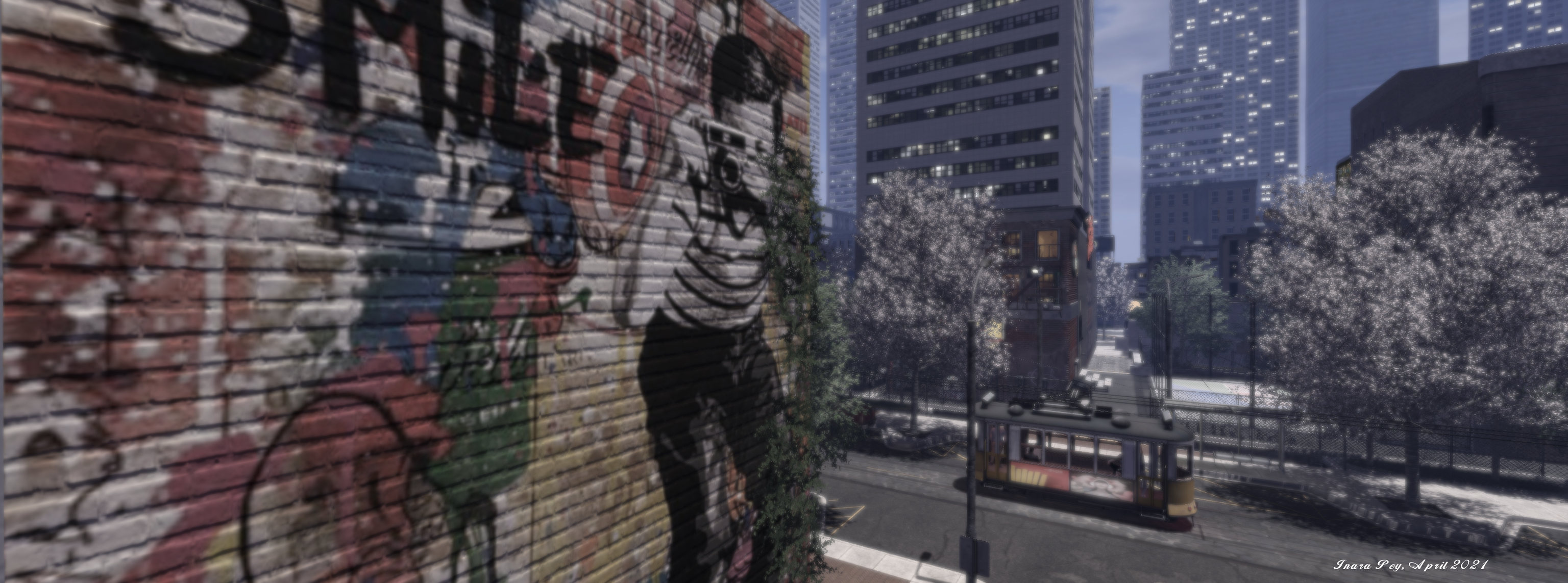
Downtown in Cravone City in Second Life

Cravone City, April 2021

Paradox Ivory has been responsible for some engaging region designs in Second Life (see my pieces D 0 X: an Island Fantasy in Second Life, Emerging from a Tokyo Street Subway Entrance and A return to Tokyo Street and a visit to Umi); little wonder then, that she was selected by Bhad Craven to bring into being his vision for Cravone City, his Full region that finds inspiration in the great cities of the US East and West coasts.

Utilising the land impact bonus available to Full private islands, Cravone City is place for SL business, being the home to brands like Bad Unicorn and Bhad’s own Scotch, and is open to both casual urban role-play and photography.
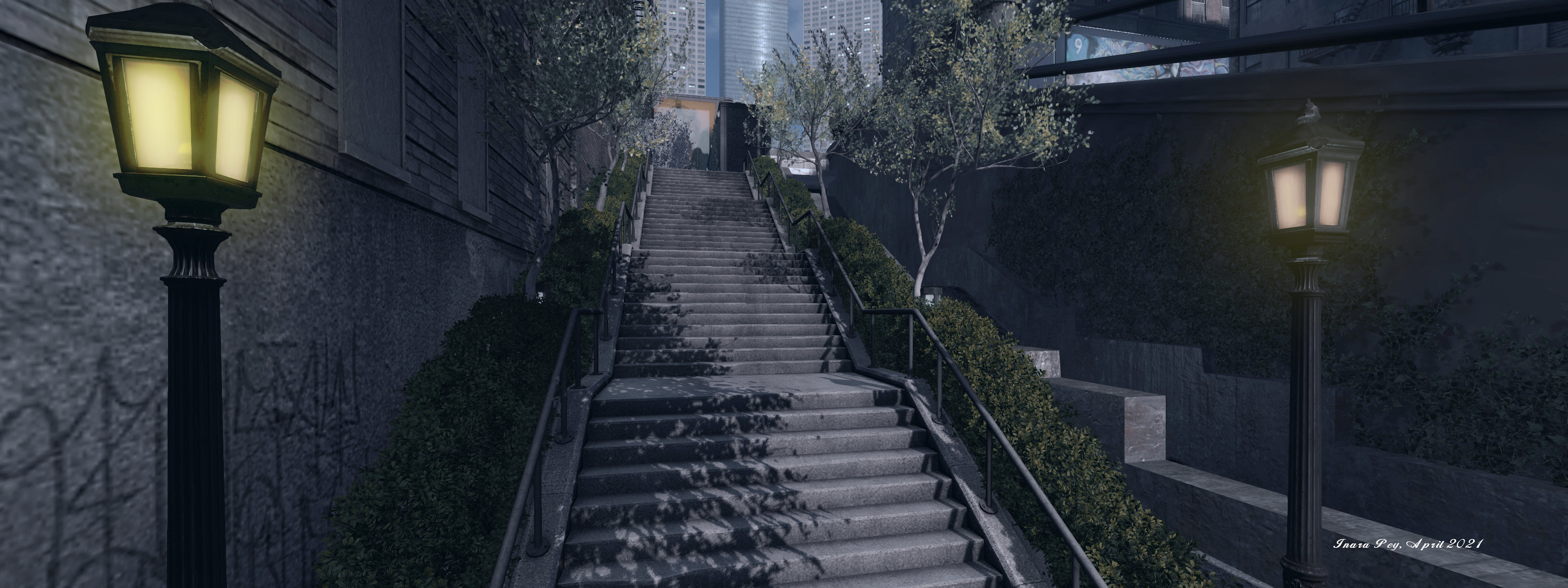
Cravone City, April 2021

The  setting has the feel of being one of those downtown locations that can often be found a major cities: a place surrounded by the tall fingers of modern office blocks and apartments, but which retains the buildings and streets of an earlier age, a time when cities were beginning to grow vertically as space became an increasingly valuable commodity.

Cravone City, April 2021

Thus, this is a place of buildings five to eight storeys tall, with shops setting under town houses faced by wrought-iron fire escapes and sash windows that look out onto the world whether open or closed. It’s a place that commuters pass through on trains that carry them to the glistening towers of the “new” city at the start of the working day, then back out to their suburban homes in the evening, perhaps barely aware it even exists.

Which is not to say that the world is simply passing by this place without interest. The major roads are now wider than perhaps they once were, speaking to their update to detail with hight volumes of traffic, and there is a certain gentification going on: some of the building have façades that are younger than the rest of them, whilst here and there modern stores have moved in, and boutique cafés are making their presence felt.

Cravone City, April, 2021

All of this gives a certain richness to the setting. As with a real city the old rubs shoulders with the new, and while it is possible to tour what is here by keeping to the broad, sunlit main streets that dive the setting into city blocks, so to is is possible to wander off the beaten track and discover the older, narrower streets; places where renewal perhaps hasn’t reached, or where some might go to find more adult forms of entertainment.

So it is that Cravone City has about it a sense of life, here and there aided by the presence of static NPCs. But just where it might be in the world is entirely up to the imagination. There are clear touches of New York, Los Angeles and San Francisco to be found here, but away from the major roads with their American lean, this could easily be somewhere else entirely – thus offering a lot of opportunities for that free-form role-play.

Cravone City, April 2021

Opportunities for the latter and – perhaps more particularly for photography – can be found throughout, while the touches of detail – the graffiti, the manner in which life spills out of of some of the townhouses and onto their fire escapes, the corners turned into gardens, and so on add a further layering to the sense of lives being lived here.

I don’t know if any kind of urban role-play takes place in the region – I suspect interest was generated following it being highlighted in the Destination Guide in March – but there is no denying Cravone City’s photogenic charms, making it an interesting visit for the SL traveller.

Cravone City, April 2021

SLurl Details

A return to the Butterfly Conservatory in Second Life

Butterfly Conservatory, April 2021

In  2017 I visited the Butterfly Conservatory, the work of Ry Heslop. I found it to be an engaging visit – one you can read about in Of lepidopterans, owls, bugs and honey in Second Life. I actually lost track of the conservatory a little while after that visit, so was pleased to learn via the Destination Guide that it has made a return to Second life and has a new home and it went on the list for places to (re)check out.

Butterfly Conservatory, April 2021

Once again occupying a sky garden, the conservatory shares the space with the Merge Club, also operated by Ry. A mover is in operation at the landing point, so don’t be surprised if you find yourself being shuffled away on teleporting – this is presumably to keep those arriving for events at the club from stacking up on one another’s heads.

A  crossway on the footpath points the way to the three primary locations on the platform: a dining area under a pergola, the club, and the Conservatory – the latter unmissable in its impressive new building.

Butterfly Conservatory, April 2021

Within the building is a lush semi-tropical environment, home to a wide variety of flora and  – more importantly in this context – butterflies. These can be found circling the plants, while nearby signs offer information on the species you are seeing.

Butterfly Conservatory, April 2021

Following my initial visit to the Conservatory, I noted that it might be easier for those who have a hard time reading in-world text if the signs also acted as note card givers. As a result of that comment, Ry contacted me to say that’s exactly what would be done in the next update to the gardens – and it is an approach that has been continued through to this iteration; so do be sure to touch them as you follow the paths around to learn more about the butterflies that are to be found here.

Butterfly Conservatory, April 2021

The indoor gardens are beautifully laid out, with split level path leading visitors around them, a café, sculptures, water features and more. In addition, a branch of the path directs visitors to a wing of the building containing the Birds of Paradise aviary – a part of the Conservatory that I think is new to it; at least, I don’t recall it from my 2017 visit.

Butterfly Conservatory, April 2021

Outside of the main building are two further areas to be explored, one providing information on a number of species of beetles and bugs, the other on bees, and their importance to the world as a whole. With the latter – and again tooting my horn a moment – Ry has also followed through on my 2017 suggestion and provided more information on exactly why bees are such a vital part of the ecosystem.

Butterfly Conservatory, April 2021

What I found particularly pleasing about my original visit to the Butterfly Conservatory was its simple elegance in being both an informative and charming visit one can appreciate for both its content and the thought and care that has been put into its design and layout. This remains very much the case with this iteration as well; so if you’ve not been to the Butterfly Conservatory before – make sure to add it to your list of places to visit and enjoy; you won’t be disappointed.

SLurl Details

Letting off steam with Zany Zen Railway in Second Life

Riding Zany Zen’s Railway – April 2021

Back in April 2020, I wrote about Rydia Lacombe’s work in mapping all of Second Life’s railway networks (see: Mapping Second Life’s mainland railways). I ended the article by musing the idea of doing an occasional series about the Second Life Railroad (SLRR) network, even going so far at to contemplate a title for the series: From the Footplate. However, in June of 2020 the Lab launched a video series on the subject, prompting me to put the idea onto the back burner.

However, had I gone ahead with that series, I would have started with the Zany Zen Railway (ZZR), located in the heart of Jeogeot.

Riding Zany Zen’s Railway – April 2021

Created and operated by fellow “Brit” Zen Swords-Galway (ZenriaCo), it’s one of the most unique lines to be found in Second Life, being a) almost entirely scratch-built by Zen (with rolling stock scripting by Dizzi Sternberg, Janet Rossini and NightShade Fugu) and b) it is and narrow-gauge service, something of a rarity in SL. There’s also the fact it offers something of a celebration of UK in the most subtle of ways.

This last point can be seen on arrival at one of the two terminus points for the railway, Little Coverston, located in Gaori. Here, above a small Welsh coastal hamlet (complete with RNLI station) sits a stone built station, the entranceway to which is lined by posters advertising places to Ely, Whitby and the famous Rheilffordd Talyllyn – Talyllyn Railway, itself a narrow-gauge railway and Welsh tourist attraction that runs along the line that original carried slate from the quarries to the port of Tywyn. Incidentally, it was also the first narrow-gauge railway in the UK to be authorised by Act of Parliament for the transport of passengers.

Riding Zany Zen’s Railway – April 2021

It’s very much a passion project that grew into something I could never imagine. I’ve been lucky over the last few years to have some help with a few bits and bobs; the passenger carriage update last year couldn’t of been done with out a friend.

Zen discussing her Zany Zen Railway

Roughly three passenger trains an hour run along the ZZR, so if you arrive between services, you can take a wander along the street below and maybe pop into the Welsh Dragon to refresh yourself or, if it is open, the local corner shop to grab a sandwich or snack to enjoy on the train.

The rolling stock on the ZZR is all designed and built by Zen herself, and is incredibly well detailed

One of the reasons the service may appear slow is that – like many narrow gauge lines – the ZZR is predominantly a single track, one that is shared with goods trains. This means that passenger services often have to wait at the one double section of track to allow the freight service to pass. Not that this should be a problem; it simply gives passengers more time to appreciate their surroundings.

From Little Coverston the line runs east and then south, with a station at Seogyeo where that double section of line can be found, allowing trains to pass one another. The station is also home to the ZZR museum, offering a history of the line’s development that is very much worth hopping off the train to see – you can always catch the train once it has been down and back along the line to resume your journey. Also at Seogyeo is the chance to wander the streets of the local Welsh-themed village that is fully in keeping with the railway, and designed and built by RoaryCymru.

Seogyeo station, April 2021

After Seogyeo, the line continues south, passing over an extensive viaduct and then through a cutting to arrive at Ahndang, a little country station typical of a bygone era here in the UK, before continuing on to Somdari – actually the point where the line originally started. The ZZR’s engine sheds are here, giving visitors the chance to see more of the engines – all of which are beautifully designed (and there may well be a couple in the sidings along the line).

Another of an aspects of the ZZR that make it so engaging is the level of scripted automation and detail: station signs neatly display arriving services, levers shift as points change, carriage doors opening as closing as the trains sit alongside platforms, and so on. The ride can admittedly be a little rickety – but anyone who has ridden a narrow gauge knows that can be the case – as can be the tightness of the curves.

Looking back along the tracks on the Zany Zen Railway, April 2021

Zany Zen’s isn’t the longest or the fastest railway, nor does it have the biggest trains;  but that’s precisely the point. ZZR isn’t supposed to be big and bold and charging along; rather, it is an accurate interpretation of an English narrow gauge line that has been re-purposed from its original use to provide an engaging excursion people can enjoy – and one  I recommend you try if you haven’t already.

SLurl Details

Docking at Resilient Station in Second Life

Resilient Station, April 2021

Note: the Blushock team relocated and have established a new setting, the USS Sleipinir and Planet Freya – of which more in my update – Boarding the USS Sleipnir in Second Life, so the SLurl within this article has been updated to reflect the new location.

In January, I visited Planet Idun, home of Jasper Point and Ymir base, the operations centre for the Blushock team (see: An away team mission to Planet Idun in Second Life).  It was a fascinating and engaging visit, one that gave me the opportunity to meet with the region’s co-creator Fazzy Constantine (Faisel Constantine). And in the last week, Fazzy contacted me with an intriguing invitation:

We’ve got a full sized region and have been working on our next location for 11 days. We’re close to being ready to open, and I’d like to invite you to come for a sneak VIP preview.
Resilient Station, April 2021

It was an invitation I could hardly refuse given how much I appreciated my trip to Idun, so over the weekend I took the opportunity to warp over to the facilities – and was even more impressed by what I found.

As a small amount of background information (you can find more at the Blushock coalition website), the focus of the group is the Vanaheim star system located in the beta quadrant of the Milky Way galaxy. Centred on a cool, blue giant star, the system has a total of seven planets, two of which have been found suitable for habitation by the mix of races making up the coalition: the ice world of Vanargand and the tropical Idun.

Resilient Station, April 2021

Resilient Station is the latest of the Blushock facilities – in fact the team’s newest base of operations. It  is located on – or within – a 200-300m diameter asteroid orbiting Vanaheim over a period of 19 terrestrial years. By nature the asteroid appears to be typically carbonaceous in type, carrying the official designation of VH706-C, although the Blushock team have christened it – in keeping with the use of old Earth Norse mythology names within the Vanaheim system – Baldur (brave or defiant), thus matching the station’s name of Resilient.

Asteroid VH706-C, better known as Baldur, is a newly discovered body which was discovered by the BluShock team. Originally discovered during one of the teams planetary scans, they sent one of their mechanics, weeks later, to do a recon of the 200m tall rock that was orbiting the star and planets. It was decided that the asteroid would make for a good base of operations for the future, as Idun was becoming more and more unstable for everyday life.

– From the Resilient Station backstory

Resilient Station, April 2021

The landing point is located within a smaller asteroid occupying the same orbit as Baldur. It is where newcomers can gain a degree of orientation and set their viewers appropriately – it is absolutely essential to enable the viewer’s Advanced Lighting Model (Preferences → Graphics → check Advanced Lighting Model) before proceeding to the station proper. Shadows are not required, nor is setting the viewer to High / Ultra (although both will increase the visual enjoyment of the setting). Visitors should also obtain a visitor ID badge from Holly, the station’s AI, who can be found on various wall panel displays in what is a nice nod to Red Dwarf.

Touching the door access panel alongside Holly at the landing point will transfer visitors down to the main reception centre in the station itself. This sits alongside the main docking / landing bay for incoming ships; it is the largest of four such bays that have been hewn out of the asteroid’s rock, with several external locking and landing facilities to provide additional facilities for visiting craft.

Resilient Station, April 2021

Where you go from here is a matter of choice – although do note that some parts of the station have restricted access (as you would expect from such a facility). Exploration can be carried out on foot using the stairways and via the station’s elevator stations that provide access to all of the levels, from engineering at the base of the asteroid, to the very impressive arboretum located on the uppermost level.

An incredible amount of detail has been put into the build by chief architect Noah Constantine (NoahLion); the overall design is entirely logical in nature; major area of occupation are placed deep within the station where they can be protected from cosmic gamma rays and the excesses of local solar radiation without the need for additional shielding (the bedrock should provide that; the exception being the arboretum, although that could well have specialised shielding within the material of the dome. The overall feeling is of a pristine centre of operations – again, well in keeping that the station has only recently been constructed.

We got the region on March 20th. Noah had it ready to move to for role-play by the 23rd, and the rest of us helped decorate and furnish it. We’ve got lots of new planets planned too. Idun was just the 2nd attempt – but this station will be staying.

Fazzy Constantine on Reslient Station and Blushock’s plans

Resilient Station, April 2021

Similarly, the main landing bay is through-and-though, ideal for manoeuvring large vessels in and out of it, whilst the smaller bays leave more than enough room for shuttles and other small craft to manoeuvre within their confines. True, there is a fair amount of debris occupying the same space as the station – presumably chunks of rock that were broken free during Resilient’s construction – that look like they might be a hazard to local navigation; but presumably these will be cleared away in due course.

Two places most definitely worth seeing in the station are the aforementioned arboretum on level 8 and also the spa and pool on level 2. There’s also  Vanaheim’s Eclipse and the public and crew facilities on levels 5 and 6. But really, the entire station fully deserves careful exploration.

Resilient Station, April 2021

Resilient Station is a genuinely superb design that officially opens its doors on Tuesday, April 13th, although visitors are able to explore now. For those wishing to catch upon the story of the Blushock Team should visit the official website and particularly take a look through the Events section for a recap of what’s happened through until now.

My thanks to Fazzy for the invite to get this first look, and kudos to Noah on the work in developing the station’s look and feel. I look forward to future visits!

Resilient Station, April 2021

SLurl and Website

Visiting IMAGOLand’s new home in Second life

IMAGOLand, April 2021

I’ve been visiting Mareena Farrasco’s IMAGO art gallery in its various forms for the last few years (check the IMAGOLand tag  in this blog). However, and as Shawn Shakespeare recently reminded me, I haven’t dropped in to see it since Mareena relocated and expanded its offerings using her IMAGOLand title.

The new location continues to offer art exhibitions – the galleries now located in skyboxes, rather than using the ground level’s open spaces as once was the case for IMAGO. Waht’s more, they share the sky with a number of other public areas which are connected to the ground via a teleport network.

IMAGOLand, April 2021

The ground itself presents an open, low-lying island which is probably best thought of as offering a series of populated vignettes rather than having a contiguous theme stretching through it. There’s no set landing point, so I’ve arbitrarily selected a location nor far from the region’s centre, where sits a teleport disk and a directory of destinations (sit on the disk for the menu dialogue in order to TP rather than touching the directory).

Close by is one of the vignettes: an open-air dance floor and stage where an Animesh band is playing.  Most of them appear to be engaged in a ballad of some kind, although one of the guitarists looks as if she’s off in a hard rock / metal riff of her own!

IMAGOLand, April 2021

Beyond this stage lies a bar where patrons and staff are engaged in coming, greetings and reading – and thus the frame of the island is set: simply wander the landscape and you’ll come across much such settings, some large, others small. Some can be reached via the teleport system, but it’s honestly worth taking the time to wander on foot, as there are some that can be easily missed just hopping point-to-point. The use of static and Animesh NPCs helps to give the setting an interesting sense of life – particularly along the beach (although I wouldn’t recommend arguing with the seagulls laying claim to the little rowing boats – they are big enough to make their objections felt!).

When you feel you’ve seen all the ground has to offer, the teleport system can be used to reach the gallery spaces. At the time of my visit, these were home to exhibitions by Mareena and Carelyna (Carelyna Resident).

IMAGOLand Gallery #1: Mareena Farrasco – Painting the Summer

In Gallery 1, Mareena presents Painting the Summer, an utterly gorgeous collection of rendered paintings taken from around Second Life that capture the warmth and delight of slow summer days, both in subject and the muted tones used in their post-processing.

Looking through the images within the exhibition, I realised that Mareena and I are frequently drawn to similar focal points for our images – notably bicycles and rowing boats. However, Mareena has a superb talent not only for turning her images into watercolour-like works of art, she also frames them in a way that tells a story  – a technique I have yet to come anywhere near achieving; these are painting that you feel you could simply step into and explore, or join her as she sits or stands in contemplation within some of them.

IMAGOLand Gallery #1: Mareena Farrasco – Painting the Summer

Red Alert is the title of Carelyna’s striking and evocative exhibit, occupying the second gallery space and featuring 15 large format images together with a series of oversized props.

It may at first be difficult to assess whether there is a central theme within this selection that reaches beyond the predominant use of red within all of them. However, closer examination of each image together with its title helps crystallise the theme of danger  – hence Red Alert – each represents.

IMAGOLand Gallery#2: Carelyna – Red Alert

This danger spans the personal – as seen in the likes of Femme Flamme, with its essence of la femme fatale, Addiction, Alone With Myself with its suggestion of isolation and depression – to more global themes of concern such as global warming (Crying out for Rain and the Titular Red Alert) and ecological disaster (Burning Forest. some, like Never Enough…. appear to span both personal and global excesses (personal exemplified in the idea of spending too much time in the Sun; global suggested by the vivid red and the loss of our protective ozone).

Rendered in styles that range from painting to etching, and which mix elements of abstraction and expressionism, this is a genuinely stylish collection of images that can be appreciated both for the artistry involved in each piece and for the interweaving of ideas and expressions.

IMAGOLand Gallery#2: Carelyna – Red Alert
Beyond the galleries,the teleport network can also be used to reach a photographic studio(although props cannot be rezzed even by group members) and a little setting called Storyteller Burrow, which I admit I’m not clear on as to its purpose. These share the same platform with one another and a small club space, although the latter was not connected to the teleport system at the time of my visit., so many or may not be part of the main facilities within the region.

Art remains the primary attraction at IMAGOLand, although the ground level offers its own attractions as well. As such, I look forward to seeing what future exhibitions are unveiled here.

SLurl Details

Broken Mountain is rated Moderate.

From Kuga to home: a tale of 264 region crossings in Second Life

Using open water between Stilt Homes and Houseboats to try a turn of speed during my trip from Kuga to Second Norway

With the opening on the Alpine theme homes (see: Lab announces Linden Homes Chalet Theme released), Satori and all points north (including Blake Sea and Second Norway) have directly connected to Jeogeot and Sansara (and points north) via Bellisseria. This set me wondering what it would be like to complete an “epic voyage” by either boat or aircraft (or possibly both, and perhaps even with a land vehicle or two) through all or some of the connected lands.

I was by no means alone in this line of thought; in fact in just the last 24 hours Marianne McCann made a flight from Bay City to Hollywood Airport on the Eastern side of Blake Sea, a distance of 279 regions, as reported in the Bay City Post. So I thought I’d try a trip of my own.

Before setting out from Kuga, I make sure the boat was properly fuelled

So as not to simply follow in Mari’s prop wash, I decided to start from close to the location of my only Bellisseria Houseboat, on the western side of the continent and within throwing distance of the SS Galaxy. From there – or more particularly, the rez zone at Kuga – I’d attempt to cross Bellisseria by boat and air, and then continue onwards and around / over Satori, across the Blake Sea and finally back home to Second Norway.

For the first stage of the trip – Kuga to Pegleg Channel, I opted to take my Piaggio Little Bee. This classic tender style speed boat is still one of the best available in Second Life, packed with features and a joy to drive. My selected route took me south over relatively open water to Caladium, then along the river running west-east along the divide between the original Bellisseria regions and the first major land expansion.

My choice of water route across Bellisseria in places left me grateful I’d opted to use one of my smaller boats …

Of variable width, this channel is fun to navigate in a small enough boat, offering excellent views of the Victorian Theme of Linden Homes on both banks and well as a chance to discover some of the “hidden” nests of houseboat that lie inland.

PegLeg Channel can be found well into Bellesseria, in what is effectively the continent’s inland sea. It’s significant in that it has a local rez zone tucked below the familiar lighthouse’ allowing me my first switch of vehicles with an initial 33 region crossings completed at various high and low speeds. From here I would take to the air to cross overland using my DSA G58 Baron in floatplane mode, heading by way of Log Homes to my own Stilt Home.

All change! At Pegleg Channel I switched to my G58 Baron for an airborne leg of my journey

This flight was relatively smooth, although I did find myself climbing to over 150 metres to try to escape the nagging of security orbs. I also slightly miscalculated my course, so I arrived at the east coast somewhat south of where I needed to be in order to cross into the Stilt Home regions. However, a quick bank and short run along the coast and I was back on track, turn north-east(ish, with variations) to get up and cross to the channel where my current Stilt Home resides, and where I planned to swap back to water transport.

Mooring the ‘plane with a further 55 region crossings made, I took to my Bandit SRV210 to strike east once more and, after a second error (bloody mindedness in refusing to flick to my browser to check a functional map), it was across open water and into the Alpine Homes regions, which are divided by some very broad waterways that make for easy and fast navigation. Clocking up 68 more region crossings, I arrived at Buffalo Springs, where a rez zone would let me take to the air again for what I expected to be the hardest part of my trip – getting across the Mainland continent of Satori. 

Banking over the Alpine Homes in readiness to come around a start my descent in Buffalo Springs

For this leg of the trip I  shifted over to my Spijkers and Wingtips MD-900 helo and encountered my first and only region crossing mishap – a complete disconnect trying to cross from Buffalo Springs into Carmine Sky. This was actually a convenient point to have the problem, given I’d just left a rez zone, so no massive back tracking. It was also ironic, as I’d literally just boasted to a friend in IM that I’d made 140+ region crossings without incident…

The flight across Satori brought my only other mishap: an encounter with an utterly aggressive security orb that left me like a freshly fallen lemon, standing on the edge of the region in question. Again, not wishing to backtrack, I checked the Map, found a GTFO depot several regions further along the highway that sat just over a region away, and use a wearable horse to ride over to the road and thence to the depot. Then, with a fresh helo rezzed, I was off again, eventually passing back over water to fly on to Meauxle Bureaux, then shortly after turn due north to reach Blake Sea Kraken – another 81 region crossings successfully made (I’m not counting the security orb as a failure). 

Passing over the home of the Moles …

Twelve crossings later I was at Foliage, a grass airstrip with over-the-water helipads. It’s an airstrip I’m fond of, so with a sleight of hand to allow for the rez zone being entirely on dry land, swapped the MD-900 for a Piaggio / WALT Searoo for the final leg – a run up the Blake Sea Channel and into Second Norway and thence home – a trifling 15 more crossings.

The elapsed time for the trip was just over 3 hours, including the detours and re-log. In all I completed 264 region crossings and experienced just the one serious issue (although obviously, there were the expected losses of vehicle control for a second or so after each crossing – but no additional issues of camera slewing, etc.).  As such I’m counting the trip a complete success.

Almost home! cruising into Second Norway in my WALT Searoo

I admit to being surprised by the use of so many security orbs in Bellisseria, rather than the supplied security systems. I wonder if this might be down to orbs generally being 1 or 2 LI and the Linden supplied controls around 5. I  was also surprised at the heights to which some reached; growling at someone just 30 metres over your head is understandable – but when they are at 130+ metres? That’s excessive.

But anyway, this was a fun trip, and one I might repeat in the future, likely with a different destination in mind and using different vehicles / craft.