I’ve always enjoyed Luis Lockjaw’s region builds, particularly his Templemore designs from Hesperia through to Lutz City, going by way of Elysium City, so an opportunity to visit his latest Templemore design – Templemore Cove – carried with it a certain anticipation.
Past Templemore builds have had something of a fantastical feel to them, one rooted in reality, but with a twist of fantasy that has made them attractive to the eye whilst tickling the the imagination. For this iteration, things are a little more straightforward: the presentation of a shoreline town clearly in a tropical / sub-tropical location, rich in palm trees and surrounded by off-shore islands sitting is water that – going by the trawlers docked to one side of the region – rich in fish.
Templemore Cove, August 2020
The town itself could be anywhere, but has a distinctively central / southern American feel to it, so much so that by turn, the setting suggests it might be somewhere in Florida, at others perhaps somewhere like Cuba or another large Caribbean island, or perhaps somewhere like Panama or San Salvador.
Florida is particularly evoked by the luxury yachts and powerboats to the east, the pools and neon Motel signs. Cuba and South American townships are suggested by the sun-faded gay colours of buildings, be they apartment houses or places of business, together with – in places at least – the age of some of the types of vehicle to be found. Swimming pools are much in evidence, whilst the town is built along a grid pattern that is again suggestive of somewhere in the United States, as do the broad board walks. And whilst most of the buildings are shells, it doesn’t prevent visitors appreciating their attractiveness.
The Templemore builds have always had an association with music, and that is very much the case here, with stages to the south and east, whilst the north-side beach offers a chance to escape and relax.
Templemore Cove, August 2020
It is clear that throughout, considerable care has been put into this design – as is always been the case with Luis’ region builds. However, it would be remiss of me if I didn’t point out that this detail comes at a cost: this is a full region with the private region land capacity bonus – and this has been used to the maximum in terms of the amount of mesh and texturing (and if not in terms of physical capacity), all of which can place a significant load on a view that is running with shadows enabled, a higher draw distance, etc.
As an example of this, whilst taking photos with shadows set and a draw distance of 190 metres, I found my fps bouncing fairly heavily between single-digits and mid-teens with under half-a-dozen avatars in the region, some times dropping as low as 4-4.2 fps, which made moving uncomfortable. Things were marginally better with shadows off, but it’s possible those on older systems may well find Templemore Cove heavy going.
Templemore Cove, August 2020
Nevertheless, Templemore Cove has an attractiveness that is worth seeing, particularly if you do enjoy taking photos of Second Life locations.
At the start of August 2020, we made the move to Second Norway (see Farewell, Isla Pey, hello, Isla Caitinara). Since then we’ve been settling in, and as I noted a few days ago, I’ve been playing with a scene rezzing system so that we can have a choice of homes on our island (see: House changing with a scene rezzer in Second Life – and we’re up to three designs now 🙂 ).
However, what surprised me about our move was the feedback (comments on this blog and via IM) from people under the misapprehension that the April / May change in ownership of the estate had somehow resulted it in being “broken up” and replaced by “cookie cutter islands”. In fact, while there have been changes to the estate, much of the original Second Norway remains – and as a frequent visitor-turned-resident, I can also say that none of its spirit has been lost.
In this, I hope this small selection of photos helps to illustrate that point.
The central regions in the estate still have their road and rail system – the latter having (I understand) been ungraded. For water access, this roads mean that the familiar drawbridges are still present
Of course, the airport is still there – as can be seen in the banner image for this piece. So to – contrary to rumour – the road and rail system, as shown above.
The estate also has a good mix of residential and commercial spaces – Motor Loon’s famous MLCC brand is still present for example. On the south side of the estate, AustinLiam has taken this a stage further – an entire group of regions set out as a village, offering his houses and commercial units and other buildings in a contiguous setting with roads, waterfront areas, moorings, and more.
AustinLiam’s regions on the south side of Second Norway
Of course, there are the outer islands – which in the future may well expand, depending on demand, but the Vanity Bonito’s team have also put in new infrastructure that offers opportunities that may not have been so readily available previously: such as the Eidet Event Centre sitting on is own wooded island.
The Eidet Event Centre, Second Norway
Residents within the estate have also sought to offer places of interest as well – camp sites, vacation centres, air fields (although the latter seem to mostly lack rez zones) – all of which add to the estate’s appeal.
Another look at Austin Liam’s commercial regions
With a balanced approach to building codes and themes, as well as offering tenants terraforming rights on their islands, Second Norway is a good mix of the “old” – the central regions with their roadways, rail lines, airport and bridges – and the “new”, with the updated island designs, allowing it to both retain its character whilst offering newcomers a good mix of opportunities.
So if you’ve not paid Second Norway since the changes, now’s the time to hop in your boat or ‘plane, pull up the map and take a look!
Distant Edge, August 2020 – click any image for full size
Distant Edge is a Homestead region designed by Remuera Seetan as “a quiet and serene place where you can reconnect with nature”, and inspired by the rugged islands of northern latitudes – although which side of the Atlantic those islands might be is up to the visitor.
A rugged setting offering a sense of the magnificent desolation only nature can create, Distant Edge is also a place where music has helped to form it, be it through the pub / club nestling within the shoulders of the western hills, or through the presence on a lone piano overlooking a windswept southern shore.
Distant Edge, August 2020
The pub is by far the largest building on the island, although the high cliffs and peaks to the west keep this fact hidden from view from the rest of the island.
Instead, when first arriving on the deck of the landing point, sitting on the edge of the bay that cuts deeply into the island, at treated to views across the water to a cottage and windmill occupying the north-eastern headland, and of the lighthouse further along the southern headland.
Distant Edge, August 2020
Finding the pub is a matter of following a sandy path through the grass, or cheating and using the teleport board at the landing point – which means potentially missing a lot of what else the island has to offer. The latter includes the aforementioned piano within its netted pavilion, a cosy summer house, numerous places to relax on the beach or on the water or the shrine tucked away on the northern coast.
Some of the paths are marked by old railway sleepers set out across the ground while others, such as the path up to the highlands – also worth following – are far more natural in nature. The coastal areas offer a mix of beaches to walk, sloping hills and low-slung cliffs.
Distant Edge, August 2020
Reached by passing through a rocky arch, the pub offers a large deck for dancing, while the interior – a converted fish warehouse by the looks of things – offers alcohol, pool and a place to relax. Music is provided three nights a week, although I couldn’t find a schedule at the time of our visits.
Distant Edge is one of those places that doesn’t require a lot of description – it genuinely speaks for itself. Caught under a cloud-laden sky that in places is releasing rain, rounded out by a local sound scape, it offers a rewarding opportunity to explore and take photographs. Those who do take photos are welcome to submit them to the region’s Flickr group.
Broken, August 2020 – click any image for full size
Shawn Shakespeare recently indirectly reminded me that it has been a year since I last wrote about Natalia Corvale’s Broken, the homestead region she has long dedicated to anyone who has lost someone they loved, offering setting that are rich in natural beauty and offering places to escape the madness of the world.
For the current iteration, Natalia offers strands of previous themes to the region design, as well as offering something entirely new with a touch of south of the border, down Mexico way.
Broken, August 2020
Surrounded by the high sandstone mesas of an off-region surround, and ringed at it edge by a slightly broken circle of rocks and plateaus that, from ground level appear to blend with the surround, the majority of the region sits as flat grasslands, dried and risking a turn towards yellow under the Sun. Joshua and Junipers with a mix of cacti give a further sense that the region sits on the edge of an arid region – one perhaps just beyond the surrounding rocks and mesas – although it is kept from drying out completely courtesy of the rive that sluggishly cuts though it.
The landing point sits offset somewhat from its centre, sitting close to a little adobe village built around a fountained-topped plaza. painted in different colours from yellow to a dour brown.
Broken, August 2020
The little houses may only be shells, but this is intentional, as they are really there to provide places to sit – and such places are one of the familiar elements found within Natalia’s designs. The majority of this seating in on the roofs, although a courtyard between three of the houses offers ground-level seating, while tables and chairs on the stone slabs of the little square are set with tables and chairs, an a outdoor tequila bar to one side offers refreshments.
Just beyond the incomplete wall of the village and across the other side of the landing point, sits a little church. Flat-topped, it may still have a row of bells strung from a metal frame, but this chapel is unlikely to be a place of worship now. The pews have all long gone, and the old upright piano that may have once accompanied hymns is now left with only a rusting lamp and crates of empty, ageing beer bottles for company.
Broken, August 2020
Horses are another motif from past Broken designs, and they can again be found here, out on the grasslands, brazen drinking from the village fountain and even keeping watch from up on a high peak, a couple of chairs close by for those wishing to do the same.
Indeed, such is the lie of the land that those who have a wearable horse might be tempted to slip it on and take to the hoof to explore. This is something this iteration of Broken has in common with the the August 2019 version, and is a manner of exploration that I can again recommend this time around, offering as it does a way of discovering all the various seating points in the region in a manner entirely in keeping with the setting – although admittedly, there are a couple of seating areas not well suited to horseback access!
Broken, August 2020
As is always the case with Broken, this is another engaging design from Natalia, one worth spending time exploring and enjoying, although for photography, you might want to experiment with environment settings.
Eterea is a homestead region designed by Coqueta Georgia that again offers visitors a sense of tranquillity and release, coupled with a certain sense of magic and a gorgeous sprinkling of artistic expression.
A Homestead region, Eterea may initially present itself to new arrivals as just another island garden; but looks can be deceiving, particularly first looks. The landing point sits on a north facing cliff, looking out over a shallow bay, the shoulder of the island rising behind it, steps offering a way up through arched trees to where a dodecagon greenhouse awaits.
Eterea, August 2020
Glass-sided and domed, and with a grand columned entrance, this greenhouse is delightfully furnished. Tall bookcases stand sentinel on two sides, wheeled steps placed for the convenience of those wishing to browse, two cosy arrangements of easy chairs, sofas and low tables at their feet. A gramophone and an old bakeite telephone give a sense of age to the setting, while a harp, grand piano and harpsichord vie for the attention of the musically inclined.
Bric-a-brac throughout gives this setting a decidedly cosy feeling, and its not hard to imagine it as a centre of conversation and companionship with a slight Bohemian edge, the drapes slung from the high dome helping to cool it during the day, and the light of the high chandeliers and other lamps spilling out through the wall walls in invitation to others to come join with the music and conversation by night.
Eterea, August, 2020
The greenhouse offers the first clues to the artistic nature of the region as well as it sense of magic. A finely-crafted boat floats over the grand piano, suspended beneath a pair of translucent balloons, whilst paintings lie stacked in corners or behind bookcases and some of the chandeliers also float serenely beneath the glass dome without any physical connection. It is here that some of the motifs found throughout the rest of the region may first be evidenced: the religious in the form of a swing with angel’s wings, together with a reproduction of the Netherlandish (Antwerp Mannerist) triptych The Last Supper (circa 1515-1520); the fantastical (the aforementioned floating boat), and the artistic.
Outside, this grand pavilion is surrounded by a garden of wild flowers and shrubs, whilst shaded patios offer more places to sit (including playable table-top games), while the island drops away from this high vantage point to curve west and north to its far headland. A long dogleg of stone steps runs down to the rest of the island, and from the top of the steps, it is possible to spot another of the island’s mystical elements as a great blue whale (somewhat popular among region designers) swims through the air, slowly circling an upland area just shy of that far headland, a smaller garden on its back.
Eterea, August 2020
The path running along the spine of the island leads the way past several areas where explorers can sit and appreciate the setting, together with multiple opportunities for photography within the little vignettes that have been carefully, but naturally set out along and just off the route. One of these, an octagonal greenhouse, sits as both a cosy retreat – cats allowing! – and a place from which to observe the local owls. Onward, the path passes under the circling Whale (mouse over it and sit if you wish to join the ride), passing above a small beach cupped in the island’s arms as it does so. before descending to where an old and damaged wooden pier extends out into the shallow waters that cover the bulk of the region.
It is on and over this water that the magical and artistic elements of Coqueta’s design flow together, fusing into a captivating scene. Small islands are spotted over the water, three little more that rocky plinths for statues, one as ribbon-like sandbank, and the largest the home to a fresh-water pool. Further out, aged board walks raise and fall above the waves, suggesting a path to be followed, a twin line of telegraph poles pointing the way to them.
Eterea, August 2020
Here, caught in rising sea mist is a fabulous mix of floating boats under balloons – larger versions of the one in the greenhouse -, chairs backed by angel wings floating flower lanterns and coloured umbrellas. Three spiral stairways of stone rise to coloured doors. ladders and strings of chairs alongside them offering opportunities for poses. Beyond the green door a wooden board walk spirals stairway-like up to the heavens, crowned by a chair that again sprouts angelic wings and has a halo floating above it.
Words don’t do justice to this northern element of Eterea, offering as it does such an expressive mix, it needs to be seen to be appreciated, whilst the region as a whole is marvellously presented and rich in detail, with multiple opportunities for photography.
Saturday, August 15th 2020 marks the start of a new public experience in Second Life when the Virtual Peale formally opens its doors to visitors from both within and beyond the platform.
Virtual Peale is a collaborative project involving The Peale Centre for Baltimore History and Architecture and Linden Lab, and with the support of Virtual Ability Inc. It encompasses an in-world reproduction of the historic Peale Centre building, which will be used to host a range of virtual exhibitions and events that both mark the original building’s foremost roles as both a museum, and its modern day role as a cultural heritage centre for the City of Baltimore.
Some of the images of the Peale building over the decades, located in the Virtual Peale entrance hall
As one of the most historic buildings in Baltimore, the Peale Centre building is a US National Historic Landmark, appearing in the US National Register of Historic Places. It first opened its doors to the public on August 15th, 1814 as the first purpose-built museum building in the United States. It was designed by Robert Cary Long, Baltimore’s first native-born (and self-trained) architect, and commissioned by Rembrandt Peale, whose father, the artist, inventor, naturalist and politician Charles Willson Peale (1741–1827), had co-founded the Pennsylvania Academy of the Fine Arts and Philadelphia Museum in 1805.
The Peale building functioned as a museum from 1814 through to 1829, becoming famous for its exhibitions of natural history, militaria and selections of art by some of history’s most renowned painters from around the world, together with works by members of the extended Peale family, most of whom – including Rembrandt Peale – were accomplished artists in their own right. In 1816 the museum made history by becoming the first gas-lit building in Baltimore, Rembrandt following the example of his brother Rubens, Rubens, who had installed similar lighting in the family’s Philadelphia Museum. Doing so allowed Rembrandt to gain the backing needed to establish the Gas Light Company of Baltimore, the first commercial gas light company in America, and this in turn resulted in Baltimore becoming the first US city to be illuminated by gas street lights.
One of the ground floor rooms of Virtual Peale with (l) a drawing of Rembrandt and Rubens Peale demonstrating gas-powered lighting, and (r) The Artist in His Museum, a self-portrait by C.W. Peale painted in 1822, the original now hanging in the Pennsylvania Academy of the Fine Arts
In 1829/30, the museum relocated, and the Peale Building became Baltimore’s City Hall through until 1877. In 1878 it became the location of the first public high school for African Americans in the city, prior to passing into commercial use from 1879 through until 1929. Following an extensive rebuilding programme, in 1930 the building returned to its roots as Municipal Museum of the City of Baltimore, although it was referred to simply as “The Peale Museum”. It continued in this role through until 1997, gaining considerable recognition over the years for its collection of Peale portraits, its annual art and photography events and for several exhibitions combining the history and architecture of Baltimore, such as the nationally acclaimed Rowhouse: a Baltimore Style of Living, a celebration of Baltimore’s distinctive row houses.
Today, the building forms the nucleus of The Peale Centre for Baltimore History and Architecture, and is in the midst of renovations to restore it to its former glory. Once completed, this work will allow it to function as a historic heritage centre / place of learning through the 21st century, including enabling local cultural communities to share their authentic stories of the city both through live performance and on-line.
Another of the ground floor exhibition spaces within Virtual Peale. Note that many of the items throughout the museum are interactive – left-click them for information to be displayed in local chat
To mark the 206th anniversary of the building first opening to the public, the Virtual Peale will similarly be opening its doors within Second Life on what has become known as Founder’s Day for the building. Through it, visitors from across Second Life and beyond will be able to learn about it and the Peale family and participate in special virtual exhibitions.
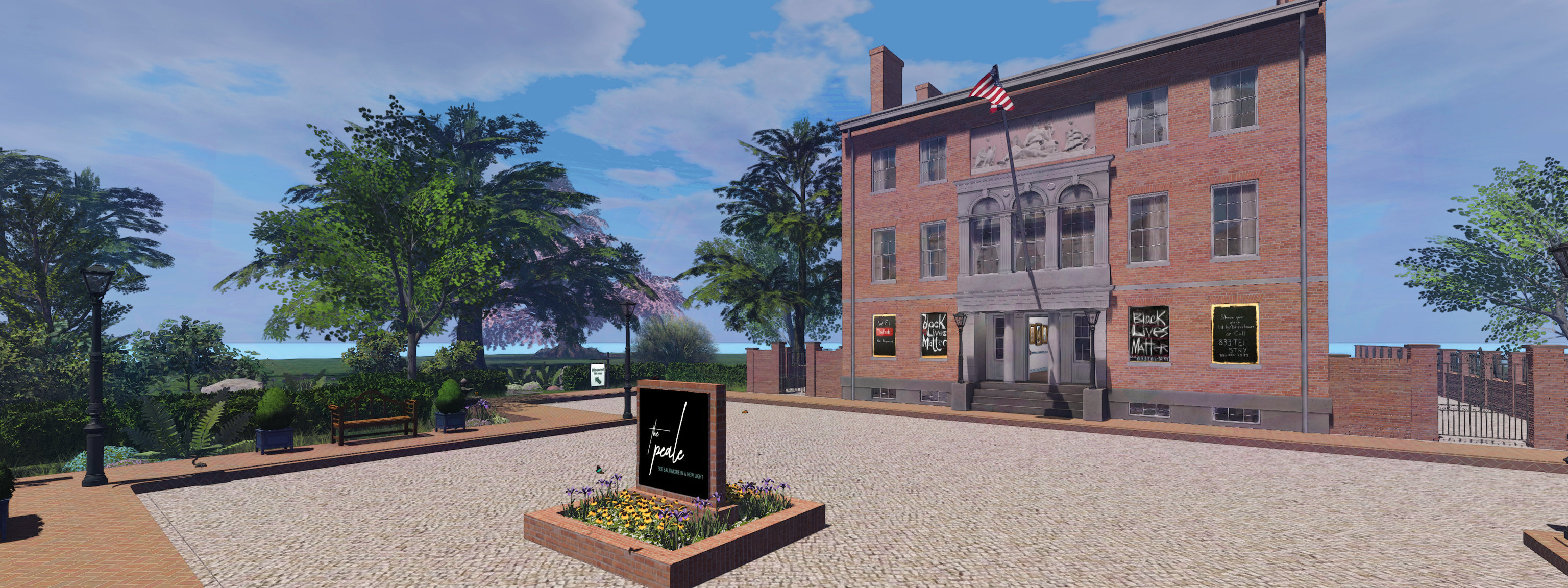
Developed from a 3D model of the Peale Museum building originally created by the Imaging Research Centre at the University of Maryland, Baltimore County (UMBC) for the university’s Visualising Early Baltimore project, the Virtual Peale reproduces the original’s historic frontage and includes a virtual take on the Peale gardens. Inside, the building presents aspects of the physical Peale Centre’s interior, with exhibition spaces that help tell the building’s story and the work of the Peale family as artists, curators, inventors, and naturalists. The one departure from the original floor plans is the long entrance hall leading to the main lobby area, which is used to present photographs of the original Peale building throughout its history.
The Virtual Peale Garden
For the first exhibition, Virtual Peale presents Redefine/ABLE: Challenging Accessibility, marking the 30th anniversary of The Americans with Disabilities Act of 1990.
Originally developed by students from the University of Maryland (UMD), to be presented as a cross-platform, multi-site exhibit utilising both the UMD’s College Park campus and the Carroll Mansion Museum in Baltimore, thanks to the SARS-CoV-2 pandemic, Redefine/ABLE has been re-imagined as an immersive Second Life experience. It is designed to address diversity, inclusion and ableism, and seeks to engage audiences about the successes and challenges of persons with disabilities in Maryland and beyond.
Developed with a grant from Maryland Humanities, and with the support of the National Endowment for the Humanities and the Maryland Historic Trust, and with the active support and advice of Virtual Ability, Inc., Redefine/ABLE can be found in the Virtual Peale’s second floor Picture Gallery – actually a teleport that leads to a separate platform than is automatically activated on climbing the stairs and “entering” the exhibition space.
The Redefine/ABLE exhibition in Virtual Peale, featuring interactive panels
By using the space in this way, with teleports connecting exhibits with the main building, it will be possible to expand Virtual Peale’s internal layout to offer additional gallery spaces. Some of these will reflect and expand on exhibitions that can also be found in the physical world, whilst others will be inspired by the Peale’s programming and partners, allowing the Peale in Second Life to become a creative hybrid of physical and imaginary museum spaces.
It has been thrilling to develop this new experience of the country’s oldest museum building in Second Life. Thanks to the amazing work of Linden Lab and Virtual Ability, Inc., we are now able to welcome a huge new community to the Peale, and share its rich history as well as the authentic stories and creativity of Baltimore with the largest and oldest virtual world on the Internet.
– Dr. Nancy Proctor, Executive Director of the Peale Centre
In addition to providing input and advice on hosting the Redefine/ABLE exhibition, Virtual Ability has also played a key role in developing Virtual Peale: most of the interior detailing has been put together by Eme Capalini of Virtual Ability, and she also spent time developing a “Mastodon Hunt” to help celebrate the ties the museum and C.W. Peale have to the unearthing of the first mastodon skeleton to be found in the United States that went on to become the focal point of the museum’s opening exhibition and the subject of C.W. Peale’s 1086 painting, Exhuming the First American Mastodon (a reproduction of which can also be found inside the Virtual Peale building). Further, Virtual Ability are assisting The Peale Centre in helping members of the public sign-up and join Second Life for this opening event.
The Redefine/ABLE exhibition in Virtual Peale
Also included in the Virtual Peale build is the StoryTelling Studio. As noted above, a major part of The Peale Centre for Baltimore History and Architecture is to keep alive authentic stories about the City of Baltimore through live performance and on-line events, and the Storytelling Studio is a part of this, together with a partnership the centre has with Libraries without Borders. It is also something the Peale Centre wants to extend into Second Life.
So, if you are a resident of Baltimore and / or have a story connected to Baltimore and its history you’d like to share, the Peale Centre would like to hear from you. contact them by dropping your details and story via note card into the mail box inside Virtual Peale, or if you prefer, you can use the Peale Centre’s Add A Story page, or reach out of project members through the Peale’s in-world group or e-mail them at info-at-thepealecenter.org.
You can learn more about Virtual Peale and the work of the Peale Centre via the Lab Gab video below.
Virtual Peale Opening Event
As a part of the opening, Virtual Peale will host three events on Saturday, August 15th, 2020 (all times SLT):
08:00: a tour of Virtual Peale, hosted by David London, the Peale’s Chief Experience Officer.
09:00: a panel discussion, Accessibility and Inclusion in Physical and Virtual Spaces, featuring George Ciscle, Curator-in-Residence Emeritus at Maryland Institute College of Art; Alice Kreuger, founder of Virtual Ability, Inc.; Monica Rhodes, Director of Resource Management, the National Park Foundation; and Dr. Jeremy Wells, Associate Professor in the Historic Preservation program in the School of Architecture, Planning and Preservation at the University of Maryland.
10:30 (approx): a further tour of the Virtual Peale and open Q&A session with representatives from The Peale Centre and Virtual Ability.




 Inara Pey: Living in a Modemworld