An empire of books in Second Life

The Empire of Dreaming Books, May 2020

We received an invitation to visit The Empire of Dreaming Books by the region’s co-creator, Num Bing. Together with Clifton Howlett, she has created an environment to honour the Zamonia series of books by German comic creator and author, Walter Moers.

Captain Bluebear tells the story of his first 13.5 lives spent on the mysterious continent of Zamonia, where intelligence is an infectious disease, water flows uphill, and dangers lie in wait for him around every corner.

– A description of the Zamonia books and their protagonist, Bluebear

The Empire of Dreaming Books, May 2020

In particular, the setting recreates a part of the city of Buchhaim., located in western Zamonia on the Dull plateau  on the dry, flat, steppe country not far from the border with the South Desert. The city sits on the convergence of many trails across the plains, and is famous for two things. 

The first is Buchhaim’s countless book stores and second-hand bookshops, printers, publishers and all things involving literature. It’s a place where the evening hours are traditionally called “wood time”, when poets of all kinds present their works in dining rooms and everyone can listen at will. The second is the extensive network of catacombs lying beneath the city.

The Empire of Dreaming Books, May 2020 – click any image for full size

It is said that it is in the centre of the city is where the influence of the Buchimists (alchemists who mainly experiment with books, words and literature) of Buchhaim is the greatest. It is also the the part of  the city Clifton and Numb have recreated for their build. Specifically, they present the Schwarzmanngaße, the oldest alley in city, which spirals its way inwards to shop number 333, the home of Phistomefel Smeik and his bookimistic laboratory.

Number 333 is also where you can find the landing point for the build. From here you can step inside Herr Smeik’s store and thus find your way to the catacombs (via teleporting), or follow the Schwarzmanngaße on its outward spiral to the city’s edge, where paths offers routes of exploration around the outlying lands.

The Empire of Dreaming Books, May 2020

Wandering these outlands will reveal multiple places to appreciate the city from a distance. These retain bookish themes – some in quite a novel ways: even the bird stands offer a book or two to read! Thus, it’s worth taking time to explore on the ground before using the teleport to reach the catacombs.

I say this because the latter really are extensive – after two visits, there is still a lot I’ve yet to reach – so going to the catacombs could distract from ground-level explorations. While it is possible to “cheat” by flycamming around the tunnels and chambers, doing so is hardly keeping in the spirit of exploration, and also risks missing the finer details awaiting discovery. The tunnels wind their way up and down, connecting chambers one to the next – although some are also dead ends in terms of finding a way through all of the tunnels, thus adding to the sense of exploration and discovery.

The Empire of Dreaming Books, May 2020

Books feature strongly throughout the catacombs, which can make things feel a little “samey” in wandering through them – but the chambers offer their own individual themes that more than compensate for this. From cosy lounges to vast, tiered libraries, there is a wealth of detail to be found throughout these chambers – so much so, more than one visit may be required to appreciate them all.

Many of the chambers offer a further surprise in keeping with the catacombs of Buchhaim: they are home to buchlings (booklings). Often depicted as bloodthirsty cyclops species in Zamonian legends that eat everything that gets in their way, buchlings are actually the most intelligent and educated form of existence of the catacombs of Buchhaim. They worship, collect, maintain and read books, and believe they are the ones who have the most literature, because they only have to read it while others have to write, proofread, publish and sell it.

The Empire of Dreaming Books, May 2020

Within Numb’s and Clifton’s catacombs, the Buchlings are to be found  in tunnels and chambers, sometimes standing innocently and sometimes getting up to a little mischief (or trouble). Their presence further reinforces the region’s homage to the Zamonia books, as does the name for the setting: The Empire of Dreaming Books was the title of one of the volumes of work by Hildegunst von Mythenmetz, the most famous Zamonian writer of his time.

A truly magical setting, The Empire of Dreaming Books is well worth the time taken to visit and explore.

The Empire of Dreaming Books, May 2020

With thanks to Cube Republic and MorganaCarter for their suggestions to visit the region as well.

SLurl Details

Visiting A Favela in Second Life

A Favela, May 2020 – click any image for full size

A favela is a unique, low and middle-income, unregulated settlement or neighbourhood in Brazil that has experienced historical governmental neglect. With a history dating back to the 1800s, most modern favelas appeared in the 1970s due to rural exodus, when many people left rural areas of Brazil and moved to cities, but could not find regulated places to live, and the 2010 Brazilian census reported that around 6% of the country’s population lived in favela or similar housing.

Around Rio de Janeiro, the favela cling to the sides of the hills, looking from a distance like colourful buildings – a colourful façade can oft disguise the crowded nature of a favela, with their tightly packed houses with little inthe way of open space, and where people strive to find a little corner of a rooftop in place of having any form of yard or garden.

A Favela, May 2020

The largest hillside favela in Rio de Janeiro (as well as in Brazil as a whole, and the second largest shanty town in Latin America) is Rocinha; and this mini city-in-a-city might well be the inspiration for the latest design by Lotus Mastroianni and Frecoi called, appropriately enough, A Favela

Unlike their past builds, such as RioSisco Studio Pictures, ChatuChak or Kun-Tei-Ner, all of which covered a complete region, A Favela occupies a 4096 sq metre parcel, and sits as a sky build. This makes a a very compact build, but the space is effectively used to recreate the look and feel of a portion of a favela: the houses are stacked vertically, some buildings looking like there might be multiple apartments, others looking like that are single homes with one room atop the last; some have traditional water tanks, others have the famous blue roof-top tanks provided by power and water company Cedea.

A Favela, May 2020

As with their physical world counterparts, these buildings are made of a variety of materials, their roofs concrete or sheets of corrugated sheets of metal. Between them, a single road winds up the side of a rocky hill, the houses forming deep canyons, the “cliffs” of which and dotted with verandahs and windows. Towards the top of the setting, the road levels before apparently vanishing into a tunnel, above which a backdrop rises, offering a sense of the favela continuing up the mountainside while Christ the Redeemer stands with arms outstretched on a more distant peak.

Like a real favela several of the buildings have steps leading up to rooftop areas that offer places to sit, whilst walls are given life through the application of graffiti paintings or thanks to clothes and towels hung to dry from rails placed outside of windows. Further life is added to the setting through the inclusion of dogs and cats in passages on and rooftop “yards”, while pigs and chickens wander the road’s twists below, ignoring the old cars and trucks parked at the roadside (one of them so out of condition, it needs the help of large stones to hold it in place). Birds circling overhead and a sound scape give a further depth to the setting, rounding it out nicely.

A Favela, May 2020

A small, detailed setting ripe for photography and offering a small glimpse of life in parts of Rio and Brazil.

SLurl Details


Wandering the Woods of Whimsy in Second Life

The Woods of Whimsy, May 2020 – click any image for full size

Update, June 3rd: It appears Woods of Whimsy has closed.

Gilfalma Ashbourne recently invited us to visit her recently opened Mainland parcel, Woods of Whimsy. Within it, she has created a garden setting with something of a Middle Earth setting that stirs in one or two other influences to create a space of natural beauty ripe for exploration and photography.

The Woods of Whimsy, a Tolkien inspired land, mixes virtual gardening with a love of magic and the divine. Here paths meander through waterfalls, threading ancient ruins with a verdant splendour.

– Woods of Whimsy description

Woods of Whimsy, May 2020

Bordered by water on two sides and high cliffs on the other two, this is a place that blends the space between these borders to create an environment that is richly evocative. Fronting the high cliffs, the parcel’s uplands step gently down to the lowlands then in turn eases into a cypress-laden swampland that is fed by a stream that also tumbles from the uplands. To the east, the boundary to the parcel is marked by a river-like body of water which, together with a curtain of trees. makes for a natural border between the woods and the neighbouring region.

Sitting within the lowlands and nestled between stream and river, are the ruins of a church, an overgrown graveyard beside it. Forming the parcel’s landing point, the ruins don’t immediately feel particularly Tolkien-esque – but first looks can be deceptive when taken as a part of the whole.

Woods of Whimsy, May 2020

Beyond the walls of this ruin, a number of grassy paths run outwards through the trees, one to a riverside conservatory, another passing along the curtain of trees and river border to reach an ancient rotunda by way of a camp site. The third points the way towards the inland corner of the parcel, and it is here that things become more Middle-Earth in nature.

This last path itself further splits in to three a short walk from the old church, the rightmost arm of which climbs by way of slope and stair to reach arches and gardens that might be taken for outlying areas of Rivendell.

Woods of Whimsy, May 2020

Rich in statues (one of which is very Entish in nature)  and the remnants of statues, the climb gives the setting a feeling of great age, so much so, that the presence of these gardens and structures perfectly enfolds the old church and the gazebos below, making them very much a part of the landscape; even the Roman temple located at the end of a further branching of the path sits within the elvish nature of the climb.

Waterfalls tumble from numerous points in the cliffs, filling pools. These are again fully in keeping with the elvish feel to the region  – the elvish love of water being well established in Tolkien’s lore.  Follow two of the upper reaches of the paths climbing and winding over the highlands, and it is possible to find your way down to one of the most iconic elements of Middle Earth, and the starting point for his published tales: a hole in the ground, one dressed entirely in keeping with the opening of The Hobbit.

Woods of Whimsy, May 2020

In a hole in the ground there lived a hobbit. Not a nasty, dirty, wet hole, filled with the ends of worms and an oozy smell, nor yet a dry, bare, sandy hole with nothing in it to sit down on or to eat: it was a hobbit-hold, and that means comfort.

– J.R.R. Tolkien, The Hobbit, 1937

This is not the only hole in the ground within the parcel; another of the ground-level paths offers a route to where a tunnel leads into the roots of the high cliffs, and a realm that brings forth a more dwarfish feel to the setting – one that at its entrance has an echo of Middle Earth: a cobweb and a spider.

Woods of Whimsy, May 2020

True, it’s not a spider to match those found in Mirkwood, but it’s hard not to see it and think of that part of Bilbo Baggins’ journey to the lonely Mountain. Connected by these tunnels are a number of chambers, one of which in particular carries a motif from another modern fantasy epic: G.R.R. Martin’s A Song of Ice and Fire.

All of this barely scratches the surface of all that is to be found within the Woods of Whimsy with its places to sit, blending of themes, multiplicity of paths and trails that give the parcel a sense of size beyond its boundaries – and the feeling that somewhere, perhaps, up in the hills and among the cliffs there just might be a path leading down into Rivendell proper. Most definitely a much-see destination for all virtual travellers.

Woods of Whimsy, May 2020

SLurl Details

An Endless Yes in Second Life

Yes – Endless, May 2020 – click any image for full size

In April 2020, we visited SombreNyx’s latest design for Endless, her full region (see A journey to Orkney in Second Life). It’s a region we’ve often visited to appreciate Sombre’s work, and it has also been the home to at least one build  –  located in the sky over Sombre’s work – by Jackson Cruyff. It was Jackson’s work that drew us back to Endless, as he has recently completed another sky build.

Entitled Yes, this new build that keeps up with the rugged island feel of Endless 58-58N, albeit with a more mountainous look to it. It is also a most unusual setting, as Jackson explains:

A set of rickety structures, barely held together, creaky and possibly perilous. On the mountain top, optimism against all odds, and turkeys.

– Jackson Cruyff

Yes – Endless 58-58N, May 2020

From the landing point – a wooden deck built over an outcrop of rock sitting just off shore from the main island – a rope bridge points toward the route of exploration. Not that the latter is hard to miss; directly in front of any arrival, the island rises from grassy lowlands to the high rocky peak of it single mountain that tend to beckon to anyone on the landing point deck.

Trees and bushes are scattered over the lowlands, which undulate gently while rocky outcrops mark the coast. There are no beaches to be found here, and no distractions from the main features of the island.

These take the from a set of five wooden board walks, each raised on stilt-like legs. Each offers something different: a walk out over the waters of a small bay, a circular walk looping around a central deck, a figure-of-eight that offers an infinity walk over bushes and a camp site; a second circular walk that passes endlessly through a rocky arch in the mountain’s foothills; and the greatest of them all, a swirling climb offering the way up to the summit of the mountain.

Yes – Endless 58-58N, May 2020

From a distance it is possible to mistake the latter walk as perhaps part of an old-style roller coaster, or scaffolding designed to enclose some form of tower or similar structure. Only the long arms connecting it with the flank of the mountain suggesting it is in fact something else.

The impulse to climb this structure first is completely natural – but I’d urge you to leave it until last, and explore at least a couple of the other board walks first. I say this because this large structure makes for an interesting climb. Vertigo is not a common sensation people tend to experience in Second Life, and few things in-world tend to be a challenge to the senses. However, these are the feelings a climb around and up this walk can cause.

Yes – Endless 58-58N, May 2020

I say this not in any way negativity; rather it is to Jackson’s credit that a walk up the spiralling board walk can result in very real sensations of giddiness. In this I’d venture to say a walk up to the top of the structure is one of the more unique experiences found in Second Life.

Once there, a more sedate walk along the uppermost outstretched finger of the board walk will take you by stair, ramp and additional climb to the mountain top, where can be found a deck on which to appreciate the view and the aforementioned turkeys.

Rounded out by a subtle sound scape that is again in keeping with Endless 58-58N, Yes is a location well worth taking the time visit and appreciate.

Yes – Endless 58-58N, May 2020

SLurl Details

  • Yes (Endless 58-58N, rated Adult)

Cherishville’s tropical summer in Second Life

Cherishville, May 2020 – click any image for full size

Lam Erin is a gifted landscape artist who is also responsible for the design of Cherishville, a Homestead region we have enjoyed visiting on a number of occasions over the past few years. This being the case, it was an obvious choice for a re-visit when we heard Lam have redressed the region for spring / summer 2020. For this design, Lam has turned to what is something of a traditional theme for the summer months in Second Life: a tropical setting that also includes a Mediterranean touch with the style of buildings selected for it.

Surrounded by off-region islands, the setting is in two parts: a smaller circular island that has the appearance of perhaps once having been a major fortification, but which is now home to a pair of stone houses and an old, copper-domed watchtower / lighthouse. Facing this, the rest of the region forms a curving finger of an island, the north-western end of which continues the theme found in the smaller island: cut-stone walls rising to a table-flat top, its paved parapet offering a walk for those so inclined.

Cherishville, May 2020

It’s easy to imagine this area as either a continuation of the old fort – the ruins of which still occupy a part of the round island – if not actual fortification, then perhaps barracks or similar. Now, however, it home to a Mediterranean-style villa and a farmhouse-style home, each with is share of outhouses, all perhaps built using the stones that once formed the fort’s own walls.

Beyond this, the land drops to a curved beach that cups a shallow bay in its arms. Curving north and east, it forms a beach-come-sandbar backed on its east side by rocks, with a single large outcrop supporting a second lighthouse. This is not a pristine place; the sand and the buildings on it show signs of age, while the north-eastern tip of the sandbar is home to a windmill that puts its time of construction as 1918. All of this gives a further sense of presence to the region and the idea it has been inhabited for a long time.

Cherishville, May 2020

An ageing psychedelic VW van and an old Lambretta / Vespa style scooter sitting on the beach give the suggestion that the region might have once been connected to one or more of the surrounding islands, allowing them to be driven here before being deserted.

The beach offers numerous places to sit, from deck chairs to sun loungers  to rowing boats, while those prepared to explore the south side of the island will find an old fisherman’s hut sitting atop a shelved beach. It offers a little more privacy than the more open beach.

Cherishville, May 2020

There were one or two rough edges to the setting we couldn’t help but notice during our visits – a building or wall set slightly above ground here, floating plants there, one or two unsupported flights of steps. These can be a little unsettling once noticed, and give the impression the region may have been put together in a hurry. However, during one of my return visits I did see Lam working on things, so it’s likely this ruffles are liable to be smoothed out as he has time.

As noted at the top of this article, tropical  / Mediterranean themes tend to be a popular choice for region designs as spring progresses into summer in the northern hemisphere. What sets Cherishville apart is the sense of longevity / history I’ve alluded to here that is imbued in the region’s design; this allows a visitor to build up a story about where the island might be, and the past it may have seen.

Cherishville, May 2020

SLurl Details

A South Shore Bay in Second Life

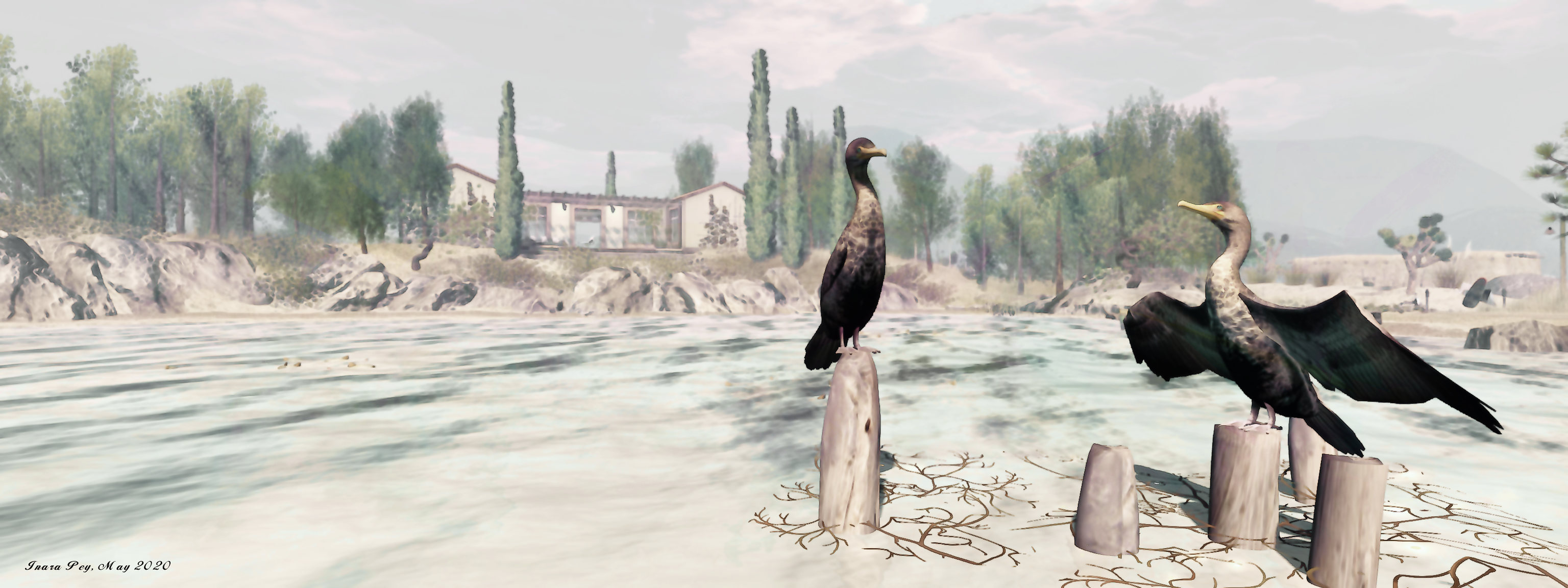
South Shore Bay, May 2020 – click any image for full size

Designed by Sloomi, South Shore Bay  on the Homestead region of Malaekahana Island, is presented as a place with a touch of a Mediterranean summer about it. A mix of public spaces and four private residences (three of which – I think – might be available to rent), it is a simple, easy-on the eye place with much to offer.

Built around a central lake, the island has a slight lagoon feel to it, the land opening out to the north and south to form rounded, low-lying headlands. Three of these have houses built on them, one of which id definitely private, the other two being two of the possible rentals. The remaining headland, occupying the south-west corner. The track connecting this beach with the path circling the lake also forming the region’s landing point.

South Shore Bay, May 2020

With a mix of Joshua and palm trees, the beach offers plenty of parasol-shaded places to sit and admire the sea view, the path leading to it also home to a small open market. Should you get peckish when visiting, a bar sits at the northern end of the sweep of the sand, with fresh fish and chips on offer.

Take the lake path eastwards, and it will take you along a narrow waist of low land caught between the gentle sweep of a seaward bay and the flat-topped hump of a hill that is home to the remaining summer house on the island. In terms of location, this perhaps offers the best views, one out across the bay to the off-region island, the other inland over the region’s lake. This lake appears somewhat tidal: there is a narrow channel to the west that connects it to the sea, and the sands just above the current water line appear to have a high tide mark running around them, as if the water level can periodically increase.

South Shore Bay, May 2020

To the east, the island has a rich screen of trees through which the footpath passes. By no means dense, the trees are sufficient enough to screen one of the beach houses from the path, whilst also perhaps sheltering the lake from any eastern winds, as well as holding the sands along the top of the hill in place.

After passing through the trees, the path swings closer to the lake than the sea, providing space for another much smaller beach on its seaward side, complete with a cuddle space on an old rowing boat before a further copse of trees serves to screen the south-east house from the rest of the island and provide any occupants with some privacy.

South Shore Bay, May 2020

A further bay sits on the north end of the island, nestled between the two headlands there. A little more rugged in nature than the southern bay, this is home to a colony of seagulls, while for those who don’t fancy walking, a balloon with single pose swing slung under it circles  slowly overhead.

An easy-going, comfortable design with multiple places to sit and finished with a gentle sound scape, South Shore Bay presents exactly what it says in the About Land description states: a quiet place to relax.

South Shore Bay, May 2020

SLurl Details