A corner of England with a twist of Tolkien in Second Life

Greenhouse, December 2019 – click and image for full size

Currently in development, and with a planned “official” opening on December 28th, 2019, is a new development occupying the Blake’s Channel regions of Greenhouse (for so long the home of The Greenhouse, one of the oldest and most striking public spaces within the Blake Sea regions and their surrounds), and the neighbouring Mare Nostrum.

The development is the work of friend and artist, Drwyndwn (pronounced DROO-in-doon) Tyne, aka Drw (“Droo”), undertaken in cooperation with the Greenhouse’s creator, Aislin Keynes – who retains a house within Greenhouse – and with neighbour Transparent Banshee, who owns Foliage to the west, home of his Sky Hye Gallery (see: A Sky Hye art gallery in Second Life) and the Foliage air field.

Green house, December 2019

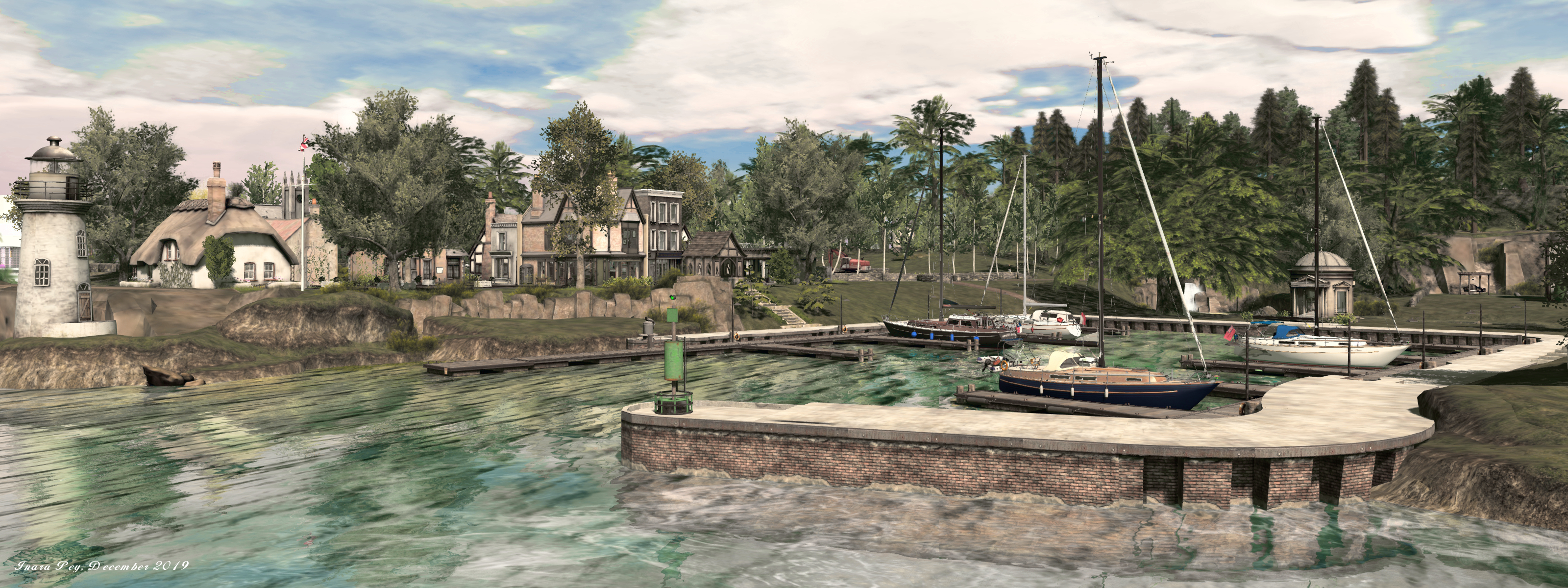
Greenhouse is built along the lines of an English coastal village; and while slightly idealised in places, it is certainly reflective of places that might be found around the coastline of southern England. There’s a small parish church with an accompanying vicarage, a pub very much in keeping with many a small English pub, a memorial to those the village and its surroundings have lost to the two world wars, and a pleasing mix of architectural styles to the houses and shops.

The homes in the village are available for rent, and form a part of the estates operated by Patrick Leavitt (there’s a rental office within the village). These form a mix of houses, cottages, flats and a narrowboat – with the two largest properties also offering region-sized sky platforms for use by their tenants. All of the landlocked homes come with a slip for mooring at the Greenhouse Marina on the east side of the region.

Greenhouse, December 2019

The north end of the village is marked by a large manor house that also sits alongside the Balboa Canal. I’m not sure if this will be a public building or offered for rent (work was still in progress during our visit), but the lands around the village and the marina are all largely public spaces, as are the streets, shops, church and pub in the village – although obviously the rentals are private.

Facing the village from across the marina is Sawson Park, dedicated to the memory of Chad Sawson, the previous owner of the land, who passed away in 2019. This includes a pavilion, formal garden and open meadows backed by a bubbling brook, on the far side of which is the private home of Aislin Keynes, and more meadow lands that extend into Mare Nostrum – of which more in a moment.

Greenhouse, December 2019

Drw has taken a lot of care to create an environment that is entirely natural in look and feel; the village, marina, park and open spaces are all perfectly integrated to offer a contiguous landscape facing Blake’s Channel, and which is carefully screened from the private islands to the north whilst also blending nicely with the Balboa canal and Banshee’s land to the west.

In particular, the position of the Foliage airstrip means that the village potentially offers an ideal home for those who enjoy both sailing and flying – they can make use of a slip at the marina for their boat(s) and hop across to Foliage to rez a ‘plane or helicopter for flying. In this respect, and region boundaries allowing, I wonder if an arched bridge between Greenhouse and Foliage might not be worth considering?

Greenhouse, December 2019

But what of the Tolkien reference in the title of this piece? Well, that brings us to Mare Nostrum. To reach it, take the path through the village from the landing point I’ve given, going first west towards the church, then turning north towards the manor house. You’ll come to a crossroads, the east running path of which is pointed to by a sign indicating the way to Mare Nostrum. This will take you up by path, bridge and stair up into the halls backing both Greenhouse and Mare Nostrum and the woods of En’ Duin Forest (not sure of the derivation here, other that duin is both Sindarin and Quenyan (duinë) for “river” – so (forest) of the river?). Here you’ll come across a twisted trunk of a tree forming an arch over the path, and a sign: Warning. You are about to enter someone else’s dream.

The warning might sound foreboding, but don’t take it to heart. Follow the path on and upwards, and I guarantee that the sight you’ll see will be comparable to the wonder Bilbo Baggins felt on first seeing Imladris, the home of Elrond Half-Elven.

En’ Duin Forest, December 2019

Perched on high cliffs that fall away sharply to the lands and waters below and over which water tumbles in slender curtains, is one of the most Tolkien-esque settings I’ve come across in Second Life. Like Elrond’s Last Homely House East of the Sea, it is both welcoming and yet clearly screened from both land and water to present a hidden realm. Within its buildings, works of men and elves are blended to offer a unique setting, and Tolkien’s writings are given due homage through art on the walls, while the natural gardens and greenswards between the trees give one room to breathe and feel renewed.

Below these high houses is a natural bay, bordered on its western side by a long stone pier. Looking down on it, it is not hard to imagine one of Círdan’s great ships slipping into the bay to moor here, thus linking En’ Duin to Beleriand as well as to Imladris. A graceful bridge connects this pier with a path that runs around an old smithy, now converted for ale and wines (a vineyard lies close by) and which feels almost Hobbitish despite its size, and thence up the hills to join with that leading up to the hillside houses.

En’ Druin Forest, December 2019

Taken as a whole, Drw’s work at Greenhouse and Mare Nostrum is simply gorgeous – and available to everyone to enjoy (just please respect the privacy of those renting in the village!). There is a huge amount to be seen and aprreciated within both regions, as I hope I’ve indicated here, and the En’ Druin Forest offers plenty of scope for fantasy photography. Kudos to both Drw and Patrick for the development of the regions, and for wanting to make them as publicly accessible as possible.

SLurl Details

Lambie in Second Life

Lambie, December 2019 – click any image for full size

Update, December 29th: Lambie has closed!

Lambie is a new Homestead region design by marinestella that offers something of an escape from the deep snows of winter, with a minimalism that – at the time of our visit – was still so new it was still being worked on, so details may have changed a little between what you see on a visit and what is noted here.

The simple aesthetic of the design in some ways offers a distant echo of one of SL’s popular and missed regions: Roche, in its original form (see this article from 2012 and this one from 2015); although this echo is purely coincidental, rather than anything deliberate.

Lambie, December 2019

This echo comes from the lay of the land: the large central lake surrounded by a path running around it bordered here and there by buildings. However, It is only in this similarity of the design that the echo of Roche can be found; for the rest, Lambie is its own design.

Sitting between the path, with its smattering of snow, and the lake is a ring of denuded trees, their lack of leaves and the colour of the water pointing to this being something of cold place, if not one caught in the depths of winter. The trees are broken in four places by broad gaps that sit almost like the cardinal points of a compass to allow unhampered access to the waters of the lake.

Lambie, December 2019

The buildings around the ring of the island comprise a little farm hut, an open-sided barn and outhouse and a bus stop shelter. To the east of the island is a small, time-worn beach, little more than a ribbon, the fence-like line of concrete flood barriers separating it from the rest of the landscape (other than for a single gap), while just offshore stand the remains of overhead power cable pylons. These are mirrored on the west side of the region by more broken pylons, the positioning of each set suggesting the land once extended much further outwards than is now the case.

The overall setting is both suggestive of cold air and passing gusts of light snow, and also of warm times and sunlit opportunities for photography. It’s the kind of place that encourages people to cuddle up to share one another’s warmth – or perhaps share a warming drink of hot chocolate or similar.

Lambie, December 2019

There’s also a feeling of age to the setting: the building look careworn, the grass and trees have a sense of being long used to the changing seasons, while the lake offers its own detritus to match the broken outlying pylons: a Ferris wheel car long separated from its wheel, an old pier with a broken section that lies canted and partially sunk a few meters away.

Lambie does suffer from some issues in its design: the track around the island doesn’t feel like a natural part of the landscape and has physics disabled, causing visitors to sink into it for example. However, finished with a subtle sound scape and with a smattering of sea birds wheeling in the sky, this is a region that is easy on the viewer as well as on the eye. For those in the mood, a pedal boat rezzer is available on the west side of the island for trips around it.

SLurl Details

  • Lambie (Miranda, rated Moderate)

The Rusty Nail in Second Life

The Rusty Nail, December 2019 – click any image for full size

The Rusty Nail is a new Homestead region designed by BadboyHi offering a mix of photogenic setting open to the public and four rental opportunities for those seeking a Second Life home. We were pointed to it by Shawn Shakespeare, and were also welcomed by BayboyHi (aka Busta), who has been keeping himself busy with a number of designs of late.

For The Rusty Nail, he presents a rugged, hilly island that has a sense of being somewhere in the tropics, although the fauna clearly indicates it is very temperate in climate. The coastal areas to the south-west and along the western side of the region offer shale and muddy flats deeply cut by inlets that are crossed by low wooden bridges and board walks and are home to a smattering of trees and bushes.

The Rusty Nail, December 2019

The landing point is tucked into the south-western corner of these lowlands, where a shack sits on a raised platform over a mud flat, the shale before it presenting space for music and dancing. A path runs eastwards from here, spanning one of the inlets via two of the aforementioned board walks and bridges, a careworn path on the far side of the bridge running up a shallow channel that appears to have at one time been cut into the rocks there by water action. The path ends at the gate of one of the rental properties – so please avoid trespassing further if the house appears to have been rented.

The rentals should be mentioned here as they have clearly been selected with care to match the environment. All four sit on decently-sized parcels and are all unique to one another in style. They are separated such that it’s possible for any occupants to feel as if they are the only ones living on the island. Three of the houses are perched just above the south, east and north coastlines of the island, presenting seaward views, with two having direct private access to the water.  The third sits up and back from the water, with a short finger of public waterfront between it and the sea –  although given the lay of the coast to the west of it, it is unlikely explorers wandering to it will be a problem.

The Rusty Nail, December 2019

The fourth house sits more inland compared to the others, occupying the shoulder of an east side island that affords it good views over the open sea to the south and east, and which is particularly notable for being located above the island’s river valley. The latter is home to a café bar sitting on a deck overlooking the clear waters of a quite broad stream that bubbles up from a pair of springs nestled at the foot of the hills closing off the inland side of the cove, before flowing out to meet the sea.

Presenting a slightly oriental look, the café is open to visitors and residents of the island and offers a convivial meeting point. A ladder that dips into the waters from the side of the deck suggests swimming in the stream is allowed – a low-slung bridge at the stream’s mouth ensures it is not open to water vehicles – although the water looks a little too cold for casual dipping. Board walks on either side of the cove provide access to two of the rental properties, so again, do be aware of the risk of trespass if exploring beyond the café and its deck.

The Rusty Nail, December 2019

Those venturing to the north-east corner of the island will find another public space. This is home to a copper brazier in which a warm fire is blazing, a semi-circle of trunks converted into seating and a hot chocolate bar enclosing it in the arms of a cosy semi-circle. A deck steps out over another mud flat close by, the height of its legs suggesting the mud beneath it may well be flooded by incoming tides.

For photographers, The Rusty Nail offers a lot to occupy the eye and camera, while those seeking a home may find the size of the properties here (which all appear to be pre-furnished) attractive – rental information and LI allowances can be obtained from the rental boards located in each parcel.

The Rusty Nail, December 2019

SLurl Details

Serene Footman’s Scottish vision in Second Life

Lairig Leacach, December 2019 – click any image for full size

Open for a short period over the holidays is Serene Footman’s latest creation, and for this setting he has turned his eye to the central highlands of Scotland, in the Lochaber region, home of the Grampian mountains and the Mamores ridge. In particular, Serene takes his inspiration from an area close to Stob Bàn Munro that includes the Lairig Leacach bothy.

For those unfamiliar with the term, “bothy” refers to a basic form of accommodation or shelter. In the former guise, it provided accommodation for gardeners  / workers on an estate (such as the one in the Royal Gardens at Windsor Castle). In the latter guise – and how it is used within Serene’s Lairig Leacach – a bothy offers free shelter for anyone wishing or needing to use it in remote mountainous areas across Northern Ireland, Wales, Northern England and Scotland, where they are particularly common and number in the hundreds to offer shelter for those hiking or climbing in the highlands and / or temporary places from which freshwater fishermen cast fish for salmon, etc.

Lairig Leacach, December 2019

The mountain bothy is analogous to similar shelters across the mountainous regions of Europe, such as the Alps. But it is somewhat different to at least some of its European brethren, as Serene notes:

Unlike the ‘refuge’ or ‘refugio’ that is typical of the Alps, bothies are unstaffed, contain no supplies or proper bedding. A bothy is usually just a simple hut – often a converted farm building. It is maintained only through the care and diligence of those who use them, and the goodwill of a network of volunteers making up the Mountain Bothies Association.  

– Serene Footman, writing about Lairig Leacach

As such, the MBA describes the use of a bothy as “camping without a tent”, as you’ll need everything associated with camping sans a tent in order to stay in a bothy

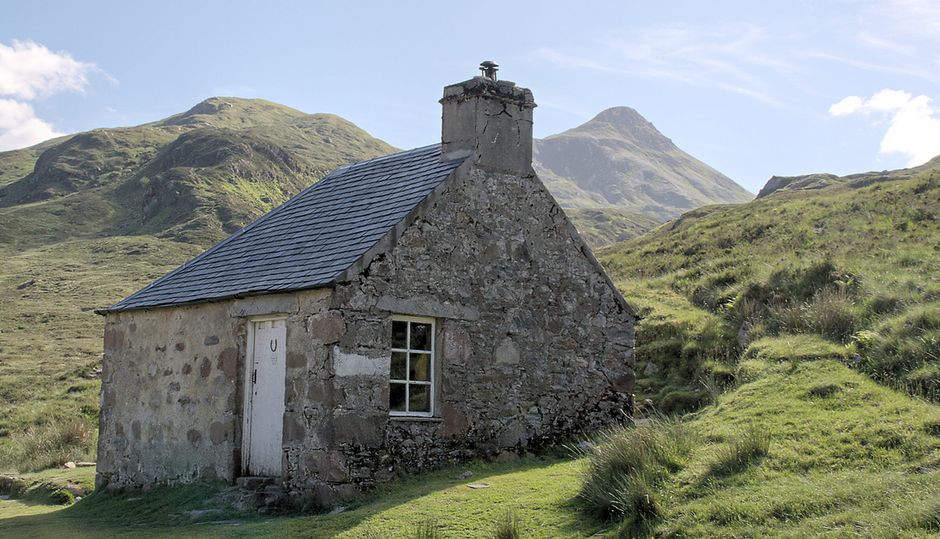
The Lairig Leacach Bothy, Lochaber, Scotland, with Stob Bàn Munro behind it. Credit: Chris Bowness

In particular, the Lairig Leacach Bothy is regarded as one of the primary examples of the Scottish Mountain Bothy. It sits on the the old drovers road linking the Great Glen with the south, and is a popular stopping point for hikers climbing the hills of the Grey Corries range, and cyclists travelling through the pass. Oft-photographed, it has been maintained (and refurbished) by the MBA since 1977, and can also see use during the stag hunting season (late October through mid-February), when the public are advised to contact the local estate prior to wandering at large around the Grey Corries.

The bothy is the centrepiece for Serene’s build, caught as it is in the depth of a snow-heavy winter. Made specifically for the region by artist and mesh designer Impossibleisnotfrench (aka Harry Cover), and the detail afforded it is superb. The structure of the bothy is a faithful reproduction, and like the original, backs its way into the slope behind it. Inside, the sparse nature of the accommodation is also reproduced (those staying in the bothy during the colder months are advised to carry coal for stove!), and Serene has included some excellent touches to his – the MBA sign on the door, and further information sheets from the MBA framed on the walls inside.

Lairig Leacach, December 2019

As with the original, the bothy sits close to a bubbling burn (stream), but here the landscape – due to the constraints imposed by region size – diverge from the actual Lairig Leacach area around the bothy. While there are woodlands Lochaber, they are not as close to the bothy as seen within the build. The placement of the trees is interesting.

On the one hand, when compared to the open, rolling glen in which the actual bothy sits, they might appear to be something of an incursion, and interrupt the landscape when compared with photos such as the one by Chris Bowness shown earlier in this article. On the other, however, Serene’s build is inspired by the bothy and its surroundings, not a one-to-one reproduction; therefore the trees help to offer an alternative setting that in no way spoils the finished region. Indeed, given the noted constraints imposed by region size, the trees help break up what might otherwise be a limited sense of depth between the bothy and the off-sim peak that represents the 999m high summit of Stob Bàn Munro.

Lairig Leacach, December 2019

The fact that this is a setting inspired by Lairig Leacach rather than a reproduction also leaves room for some of Serene’s little touches, such has his signature placement of chairs in his builds. There’s also the large frozen pond of the landing point that perhaps reflects Serene’s reference to the region as a “vacation” region as it seem to invite visitors to perhaps try a little ice skating (but bring your own skates!).

Overall, however, Lairig Leacach once again demonstrates Serene’s mastery of the art of representing physical world locations within Second Life. The region is captivating in design and in detail – and makes for a worthwhile visit given it winter appearance.

Lairig Leacach, December 2019

SLurl Details

Tonarino: an oriental curio in Second Life

Tonarino, December 2019 – click any image for full size

Shawn dropped a landmark for Tonarino, a Full region with a distinctly Japanese look and feel. A group design, the region is split into five major parts – not all of which are open to the public. To the south is a square block of a flat island, topped by scrub grass and what appears to be a café, while off to the west are three more fairly regularly shaped islands in a north-to-south line.

The majority of the region, however is given over to a large landmass the rises from east to west, and is home to a small semi-urban setting that sits at the end of a single line of railway track. A wooden bridge connects the little town with southern islands, and on crossing it, I found no evidence that the island and it’s café are not open to the public.

Tonarino, December 2019

However, given that the westward islands are separated from the main landmass both physically and by the fact the lay of the land largely hides them from view, they would seem to be collectively for private use. Certainly, the middle of the three islands – and the only one that offers a landing point for those making use of the pedal boats available from the western shore of the town –  is restricted to Group access only. Given that the north and south islands either side of it are only connected to it and are without any obvious at which to come ashore for those using the pedal boats, there is the suggestion that they are also private. Either way, I opted not to risk trespass.

The eastern side of the main landmass offers a mix of buildings from cement blockhouses with shops on the lower floor to little apartments on the floor above to stores and eateries modelled along more “traditional” lines all split into little groups by a small grid of roads and by the railway line. Sitting among them is space to grow vegetables an fruit although part of this ground is apparently lying fallow under the snow. To the west, between the hills, the ubiquitous school blockhouse that is often found within regions with a modern Japanese theme, squats as it overlooks the pedal boat moorings mentioned above.

Tonarino, December 2019

The railway line terminates with a station that’s little more than a waiting room with a bus stop neighbouring. On the other side of the track the land that is being cleared for building. A stream tumbles from the hill to the south-west to run parallel with the train line as it emerges from a tunnel under the hill before it eventually turns inland to cross the stream via a trestle bridge. Stone steps also climb the hill to overlook the waterfall and to provide access to a small cemetery.

To the north-east another craggy hill rises, stone steps cut into its face. It is home to the solid presence of an old temple sitting within a small garden, a little refreshment stand lurking just outside the gardens for those feeling hungry after a climb up the steps or a time of prayer in the temple. A (large) step down from this on an out-thrust shoulder of rock is an traditional Japanese walled house. Reached via separate steps, this appears to be linked to the spaces for growing fruit and vegetables, suggesting they may be owned or managed by whoever lives within the house.

Tonarino, December 2019

Looking careworn and a little tired under its light covering of snow, the setting at Tonarino has a very lived-in feel that offers scope for photographers looking for backdrops for avatar studies or who enjoy landscapes that feature buildings and urban / suburban settings. Places to sit may be few and parts of the region off-limits to most, but these don’t detract from any appreciation of the Tonarino.

SLurl Details

On the Other Side for Winter 2019 in Second Life

On The Other Side, December 2019 – click any image for full size

We last visited On The Other Side in February 2019, when the region – designed by xxMichelle20xx and Indrielx – was all set for spring (see: Back On The Other Side in Second Life). But given it does change with the seasons, we decided to go and see what the winter months might have brought forth – and it turns out that the region has been transformed into a marvellous rural winter wonderland.

Surrounded by a range of mountains, On The Other Side forms a little coastal area or island setting, watched over by a red brick lighthouse and within which the buildings are few and far between, the majority of the landscape being a haven for assorted wildlife. Even so, there are some echoes of past designs to be found, some of which might be easy to spot by returning visitors, while others might require a little searching out.

On The Other Side, December 2019

As with past designs, the landing point is underground – in this case a wintry cavern decorated as a (perhaps chilly) reading room. From here the way out into the region gets a trifle foreboding – a drop down to a lower cave via ladder brings visitors to the remains of five unfortunates lying in the snow and a ghostly figure, palms aflame, apparently pressed against the frosted exit to the cave. Step through this into the region proper, and then next surprise awaits: a large bear, angrily rearing up on his hind legs at you.

While all this sounds menacing, once you’re past the bear (who is actually quite harmless, giving rise to the temptation to comment “Why, Paddington! What big teeth you’ve got!” when passing him), you’ll find yourself in a marvellous winter landscape where admirable restraint has been shown in putting out falling snow (often a performance killer) and which keeps itself predominantly as a landscape in winter, rather than a frame for all the usual seasonal trappings for the end of December.

On The Other Side, December 2019

Most of the region looks open to the public, although there is a high table of rock to the south-east topped by a small cabin that might well be private: there is no obvious path up to this, and we weren’t going to start forcing our way up the one obvious slope to reach it for fear of trespass were it to prove to be so.

The cabin looks out across a gently curving bay, its sand dusted in snow, to where that lighthouse rises from the north-eastern headland. Both cabin and lighthouse have a little comic reflection of Santa on roof and chimney, while the lighthouse is open to the public as the region’s Christmas hang out.

On The Other Side, December 2019

But it is the lands between and to the west of these headlands that holds the attractions of the region. Marked by rocky uplands with snowy trails winding around and between them, and in places marked by paths and steps climbing their slopes, the region here feels more expansive than its 65,536 sq metres. This is a landscape blanketed in snow and home to a mix of fir trees and naked oak, birch and maple, their trunks an boughs well whitened with hoarfrost.

Across the setting there is much to be found, with the animal life mixing domesticated cows and sheep with horses, wildfowl, deer, reindeer, wolves, seals, penguins, raccoons, otters, jaguars, pandas – even a giant turtle!. Most of these form scenes-within-scenes across the region, awaiting discovery and photographs, gathered together in a little vignette that stands both on its own and as a natural part of the whole. More are set out quite naturally – although the pandas clearly have the right idea for dealing with the cold!

On The Side Side, December 2019

Everywhere across the region, from the southern seal cove to the northern cave (home to Ganesh, who has also featured in past iterations of the region) are places to sit and spend time. These range from chairs set out on decks or along the eastern beach (which offers surfing for those feeling like they need a cold dip!), to a cosy huts and blanket-laden carts and sleighs people and huddle and cuddle within to keep warm. For those wanting to escape the snow and cold, a barn and the Christmas Hangout offer more places to sit and enjoy the warmth of a fire (we were also appreciative of the hot cider as we explored!).

Previous versions of On The Other Side have included more eclectic elements to them, aspects that offer a little twist of fantasy. This is also this case with this build: anchored to the ground by a stout rope and held aloft by magical runes circling below it, floats a tiny island. Reached by climbing the rope, it offers another place to sit – and quite the high point to view the region as a whole; however, getting back to ground level in head-first descent can be a little dizzying!

On The Other Side, December 2019

Beautifully designed, accompanied by an ideal sound scape and filled with detail, On The Other Side once again offers a delightful, highly photogenic region that should not be missed.

SLurl Details