Wandering Highland Hills in Second Life

Highland Hills, August 2019 – click any image to enlarge

Highland Hills is the name given to a quarter Full region designed by EloiseBlake, and it is a place that packs a lot into it. Open to the sea on two sides, the parcel is described as the “Highlands of Scotland. A forgotten era. Ruined, rural and rustic. Where nature has claimed its home.”

As a representation of the Scottish highlands, I’d perhaps suggest the parcel is intended to offer some the many aspects of the highlands – the rugged hills, the rough, weather coastline, hints of glen-like slopes (al be they narrow), rushing streams, and so on – rather than any single place within them. In doing so, it presents a rough-hewn landscape that is entirely its own, one that invites exploration.

Highland Hills, August 2019

The ruins referenced in the description come in multiple forms, from the great round bulk of a coastal tower, sitting atop a shoulder of rock and protected on two sides by open sea – or perhaps intended to command an offensive view over the waters – to the squat rectangle of a castle keep brooding against the western cliffs of the land.

Between and around these two are multiple signs of what might have once been an extensive fortification – the ruins of curtain walls, ached entrances that might once have been guarded by stout gates, the remnants of a chapel, and so on. Are these all symbolic of a once might castle that dominated the landscape at some point in the past? Or are they indicative of multiple attempts to fortify and hold the land during different times in its violent history? That’s one of many questions the visitor might be tempted to ask, although the lay of the land perhaps points to the various ruins being somewhat separate in nature.

Highland Hills, August 2019

More recently, the land has become home to a small farm, the house of which sits in the lee of the great round tower, with a cattle barn sitting across the parcel from it, overlooking the eastern coast. The latter is intended to be the home for shaggy highland cattle, but the cows appear to have had other ideas, an open gate affording them the opportunity to wander down to the rocks sitting above the coastal waters.

Also down among the rocks can be found the detritus of human life: abandoned crates, broken rowing boats and so on – some of which offer places to sit. More places to sit and relax can be found scattered across the parcel, most of them easily reached from the landing point by following the dirt tracks that roll away from it. One of the latter will take visitors past the great tower, then the little farmhouse, and onwards to where beehives have been carefully set among the heather. Just to one side of these a great tree has, at some point in the past collapsed, its aged trunk now a convenient bridge by which to reach the rectangular castle keep.

Highland Hills, August 2019

In truth, getting around parts of the region can require a bit of scrambling and / or searching. Take the main steps up to the castle keep, for example. They link keep with an entry arch and one of the tracks running through the land – but the entrance itself is blocked by the stones that have fallen from the top of the arch, the keystone presumably having given way at some point in the past. On the one hand, this leaves visitors struggling to get over the fallen stones in order to climb the steps beyond, but on the other it cleverly encourages people to look for an alternate route – and those who do can be rewarded by further discoveries of hidden spots on their way up to the keep.

Similarly, finding the way up to the round tower is – without cheating – a little bit of a game of exploration. While it is possible to get up to it from inland, the easier route perhaps lies elsewhere. All I’ll say by way of a clue is that to go up, you first need to go down.

Highland Hills, August 2019

Finished with a sound scape fully in keeping with the setting, Highland Hills makes for a diverting visit with plenty to see without taking up a huge amount of time, and opportunities for photography, and pictures can also be submitted to the parcel’s Flickr pool.

SLurl Details

An Alternate Reality in Second Life

Alternate Reality, August 2019 – click any image for full size

Designed by SimoneFiore on behalf of region holder ThisIsMyAltsAlt, Alternate Reality is a homestead region open to the public on the basis of joining the local group (no fee required).

Offering a simple, low-lying island, it is a place with plenty of space, most of which is open to the public, with the exception of the house located towards the north-west of the region, sitting within a private parcel clearly denoted by ban lines should you get too close.

Alternate Reality, August 2019

Predominantly sandy, Alternate Reality is home to scattered clumps of grass, all of varying sizes, which break through the surrounding sand like islands poking up above the surface of an ocean.

These little islands of green sit under the shade of trees that grow above them, tress that largely suggest that this is place located within temperate, rather than tropical climbs – although there are a few palm trees and other suggestion that perhaps we’re not that far from the warmer tropics.

Alternate Reality, August 2019

Within this setting are numerous opportunities for photography (as group access is required, rezzing of props is also possible) and some fun activities – including a see-saw, beach volleyball and swings. There are also multiples places to sit and relax. These can be found along the beach  in shaded little hideaways. Or, for those who prefer, there is a bar, with indoor and outdoor seating, again offering opportunities for photographs while the deck across the sand from the bar is a DJ’s set-up, suggestive of music events.

This is an easy location to tour, requiring little in the way of description, offering a quiet getaway that demonstrates that when it comes to landscaping, sometimes, less really is more. So, this being the case, and unusually for me, I’ll leave you with a couple of back-to-back photos.

Alternate Reality, August 2019

SLurl Details

A Nordic story in Second Life

Nevglide Gaard, August 2019 – click any image for full size

Nevglide Gaard is described by its designer and holder, Neaira Aszkenaze as “the second chapter in the Nevgilde Story”, continuing as it does the Nordic theme of Neaira’s builds, which are intended to offer something of a feel of the wilds of Norway. We visited the first chapter, Nevglide Forest, back in late 2018 (see: Nevgilde Forest in Second Life), so when Shawn Shakespeare poked me with a reminder that Nevglide Gaard was open for exploration, we were happy to hop over and resume explorations.

This second chapter sits within a new – and slightly smaller – location: a parcel of some 8176 sq metres. It sits with a north-south orientation, two sides open to the sea and the entire design once again proof that you don’t actually need an entire region to create something eye-catching and worth visiting.

Nevglide Gaard, August 2019

The parcel offers a rugged finger of Norwegian coastline, knuckled by bare rock that cut by a single west-flowing stream that tumbles down from the northern wooded uplands to reach the sea. No landing point was enforced at the time of our visit, so I’ve arbitrarily set one for this article using the small island located at the southern end of the parcel, and separated from the rest of the setting by a shallow neck of water spanned by flat-topped rocks for easy crossing.

The island, with its little camp site, offers an excellent vantage point from which to view the rest of the land, looking northwards over the narrow curve of a beach sculpted into the landscape by time and water, past the single house that stands above it, and onwards towards those northern highlands. Reindeer graze on the upper slope of the island, while a set of wooden steps lead down to the water’s edge and the rocky crossing to the beach.

Nevglide Gaard, August 2019

Backed by a shelf of flat rock, the beach is a mixture of sand and shingle, a partially-finished raft lying just offshore. Steps lead up to the lone house, a marvellous and cosy wood-framed abode designed by Neaira herself (as an aside, her store sits in the sky over the parcel – see her profile for a TP – although the house does not appear to be offered for sale, sadly).

The house is clearly the home for the largely self-sufficient: chickens and goats are being bred, apples are being grown, and a and pump offers the means to get fresh, clean water from deep below ground.  Meanwhile, the bric-a-brac around the house and grass yard further adds to the sense that this is  very much a “working” home, those occupying it enjoying their lifestyle and the freedoms it brings.

Nevglide Gaard, August 2019

A path winds down from the north side of the little plateau on which the house sits to meet with a log bridge for those who wish to cross the fast-flowing stream and climb the rocky uplands. Wooded but with shallow and deep ledges of their own, these uplands can be scrambled up using further log climbs and offer another vantage point for looking out over the land, as well as an alternate landing point should you opt to take a landmark of your own.

Like Nevglide Forest before it, this is a place that is easy to explore and that encourages people to tarry for a while, whether they wander, or relax on the wooden deck to one side of the house or down on the beach or out on the little southern island.  Rounded off with a subtle and immersive sound scape, Nevglide Gaard is a place to lift the spirit as well as offering plenty of opportunities for photography.

Nevglide Gaard, August 2019

SLurl Details

Rain, sand, surfboards and go karts in Second Life

Totem Beach, August 2019 – click any image for full size

Totem Beach is a Homestead region designed by Tlaloc Beresford designed to give visitors a range of land and water activities for their enjoyment.

Nestled along the Pacific North West, Totem Beach awaits those enjoy the ocean and forests of the region. Surf the waves, dive the canyons, or walk through the forest and lay down some roots of your own in this beautiful region.

– The About Land description for Totem Beach

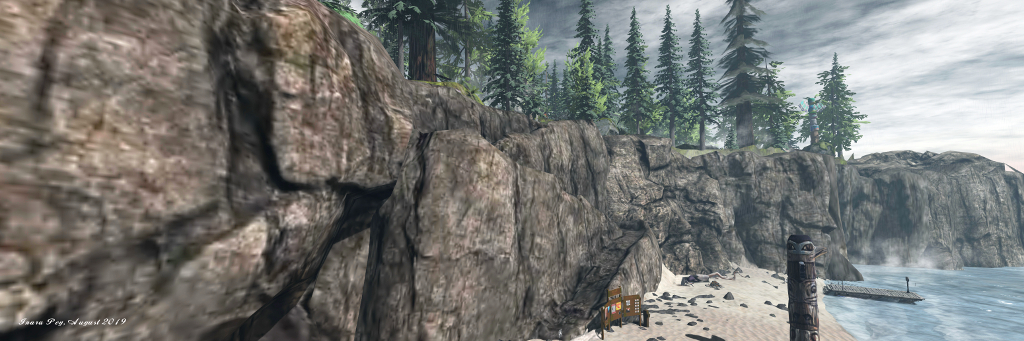
The ground level of the region is largely given over to water – a rocky bay caught in the arms of tall hills. These lie partially open the sea to the west, but curl around to the east to form a backdrop to the region’s single landmass, a range of high cliffs oriented north-to-south, overlooking a west-facing ribbon of sandy beach.

Totem Beach, August 2019

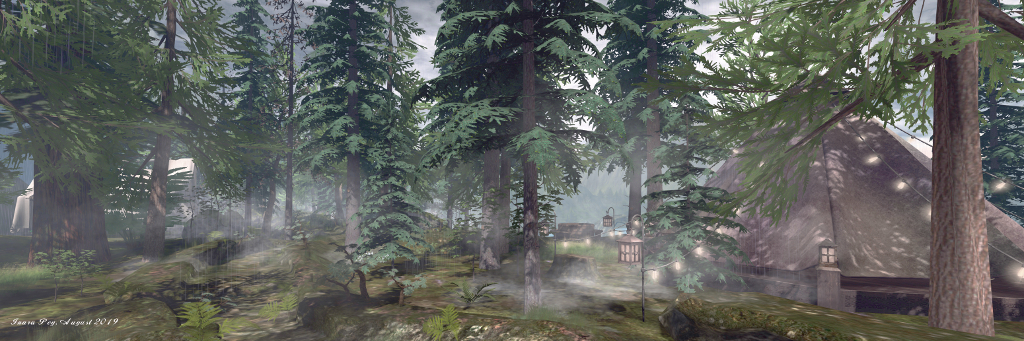
The setting embraces the Pacific North West’s  reputation for rain, which falls from the sky to the beach and the cliff top woodlands alike. Up on the cliff tops, the rain causes a ground mist to rise, which lurks around the trunks of the trees.

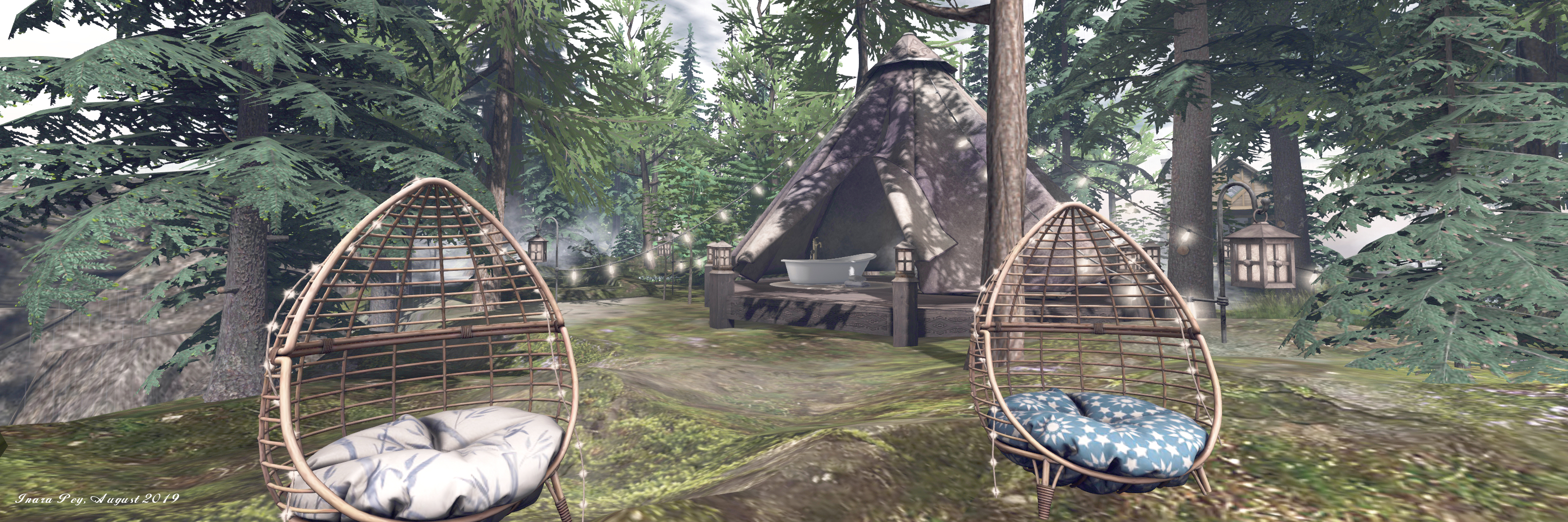
The woods are cut by a path that follows the western lip of the cliffs that connect various tepees, tents and cabins that are available for rent (note that those that are rented nay have parcel access control enabled, and thus blocked from public access.

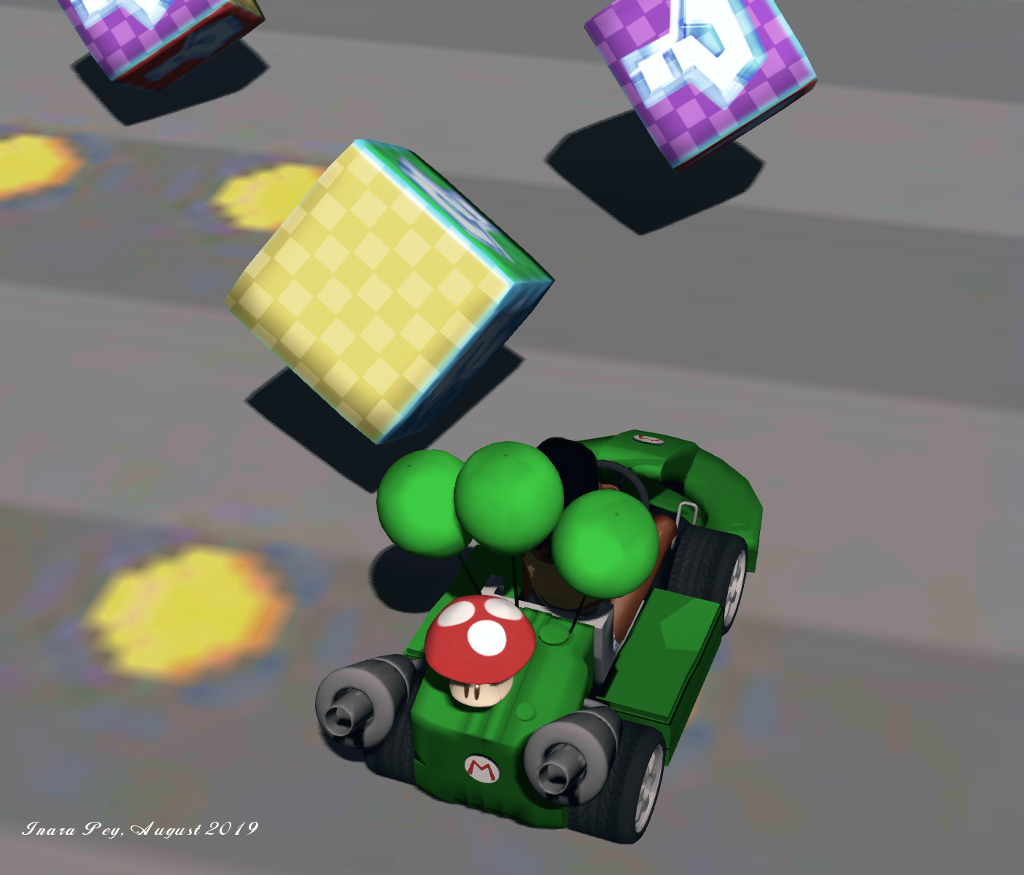
Totem Beach, August 2019 – Mario Karting with power-ups!

Another path winds down to the beach, where surf boards and a jet ski rezzer await those who join the region’s group (which includes rezzing rights), allowing them to enjoy time out on the water and surfing on the region’s incoming waves.

For those who prefer quieter pursuits , there are places to sit and watch the action along the beach and up on the cliffs, while those who like their action on land can take any of the region’s teleport points up to the go kart track area hidden in the sky.

The latter offers two courses to race either against the clock or other drivers – or both. The system is based on the Mario Kart franchise, including the ability to chose one of several of that game’s Karts (I opted for Yoshi’s because – well, Yoshi  🙂 ). As it is based on Mario Kart, it also includes power-up boxes that provide weapons to take out your opponents (bursting the balloons on the back of their karts with each hit) and bonuses, allowing for something of the full measure of the game to be met.

For those looking for a public region that offers things to do that aren’t too taxing, Totem Beach offers an easy-going diversion that can be fun when visited with one or more friends.

Totem Beach, August 2019

SLurl Details

Paper folding and letters in Second Life

The Sim Quarterly: Orizuru

The Sim Quarterly is a new artistic endeavour by Electric Monday. This homestead region is intended to offer artists a three month period in which to display their work.

Art and the virtual world, Second Life© are very similar —you are able to both find yourself and immerse yourself (and maybe even lose yourself) in something totally unlike what you already know. The experiences you gain help you grow and form new opinions about the world. That is what I hope this sim can provide over time. I am very excited to bring to you a quarterly art project by way of The Sim Quarterly.

– Electric Monday, describing The Sim Quarterly

The Sim Quarterly: Orizuru

For the first installation Electric presents Orizuru (“folded crane” or “paper crane”) by Kaiju Kohime with Electric Monday. With a focus on origami that plays into the use of paper as a writing surface and its use in  artistic expression, this is the story of two people who communicate entirely by letter and in the hope of meeting.

The landing point for the installation is in the sky, where an introduction can be found, together with a teleport down to the installation proper.  Here the story begins at a little pair of houses and an ice cream van, where two figures stand back-to-back, symbolising the story’s protagonists, Elise and Henri. Sheets of paper drop from the hands of the male figure, pointing the way to the water where the first two letters between the couple can be found.

The Sim Quarterly: Orizuru

Follow the stepping stones to the nearby island, and further pairs of letters between Elise and Henri can be found, their story unfolding on the written pages. Colours beneath the water tehn lead visitors onwards to more of the story as it unfolds across the installation.

Will Henri and Elise meet? That’s for those who visit to decide.  The landscape, meanwhile, with its folded cranes, origami birds and paper rocks and trees, with paper clouds floating overhead, presents a visually attractive setting in which to follow the story.

The Sim Quarterly: Orizuru

Those wishing to keep up-to-date with events at The Sim Quarterly can do so via the website and photographs can be submitted to the region’s Flickr group, which is also hosting a photo contest – details available in-world at the region’s landing zone.

SLurl Details

Drune IV: an Aftermath in Second Life

Drune IV: Aftermath – August 2019 – click any image for full size

In January 2019 we visited 2019-XS by zee9. At the time, I noted:

The region has an adult edge to the role-play, and is intended as an extension to her previous (and now departed) build Drune. I’ve not seen that design, but will say that while compact, 2019-XS has a certain ambience that is hard to define, but has seen me make three visits to it in order to fully appreciate the ambience and setting.

Well, we’ve recently had the opportunity to immerse ourselves in Drune design, as zee9 2019-XS has been remodelled into the fourth chapter in the series, Drune IV: Aftermath.

Drune IV: Aftermath – August 2019

Maintaining much of the look and feel of 2019-XS (and previous Drune builds) in terms of general layout, Drune IV Aftermath presents an environment in which it is clear that, as the region name suggests, some form of cataclysm has befallen the city.

The once pristine roads, neon-lit by business signs, cleaned by robots and home to electric vehicles, now lie broken and slowly being overcome by plant life. Power cables hang and lie in disarray, and the once bright buildings are slowly being overcome by vines and creepers.

Drune IV: Aftermath – August 2019

Exactly what has come to pass is hard to say: is the disaster man-made or natural? Did the city bring it upon itself, or has some external factor played a role? These are the questions that roll through the mind in exploring the elevated walkways, the roads and the alleyways.

But it is clear that human life has not entirely abandoned the city. Some of the street lights still work, and free-standing floodlights illuminate stairways and other areas, drawing their power from generators that must have some form of fuel supply or means to be recharged, even as more light is shed from many of the windows peppering the tall towers.

Drune IV: Aftermath – August 2019

More signs of habitation can be found along the shadowed streets, where makeshift stalls have been set-up by people trying to eke out a living. Some of these are lit by neon signs, again suggesting an operating power source, while others rely on lamps suspended from the beams of the elevated road sections.

The lifestyle of those who remain has perhaps taken a turn towards post-apocalyptic hedonism, going  by some of the market stalls, while a nightclub similar to that found within 2019-XS appears to still be in use. It sits at street level almost in reflection of another dance space sitting atop the tallest of the city’s towers. Elsewhere, follow the faint sounds of a piano playing and you may eventually be led to the entrance of what might once have been a plush club, but which now sits behind broken doors, squatting in its own gathering mould.

Drune IV: Aftermath – August 2019

The region used to be open to free-form role-play, and while I’ve no idea if this is still the case but the region certainly still captures elements of a range of sci-fi / cyberpunk films, including the likes of Blade Runner, Neuromancer, and Strange Days and even, despite its presentation of nature victorious, the Fifth Element. And even without the role-play, Drune remains an engaging visit.

SLurl Details