Binemist by three

Binemist, Mystical Falls; Inara Pey, September 2014, on FlickrBinemist, Mystical Falls (Flickr)

Almost exactly a year ago
I came here for the very first time*
Looking up at the rocky island
From a boat on the waves of the Linden Sea

So might the late John Denver have written had he been in my shoes during my recent return to Binemist, Bine Rodenberger’s delightful home region. Because it was almost exactly a year ago, in September 2013, that I first visited Binemist, and it’s been a place firmly marked in my little book of places to revisit ever since.

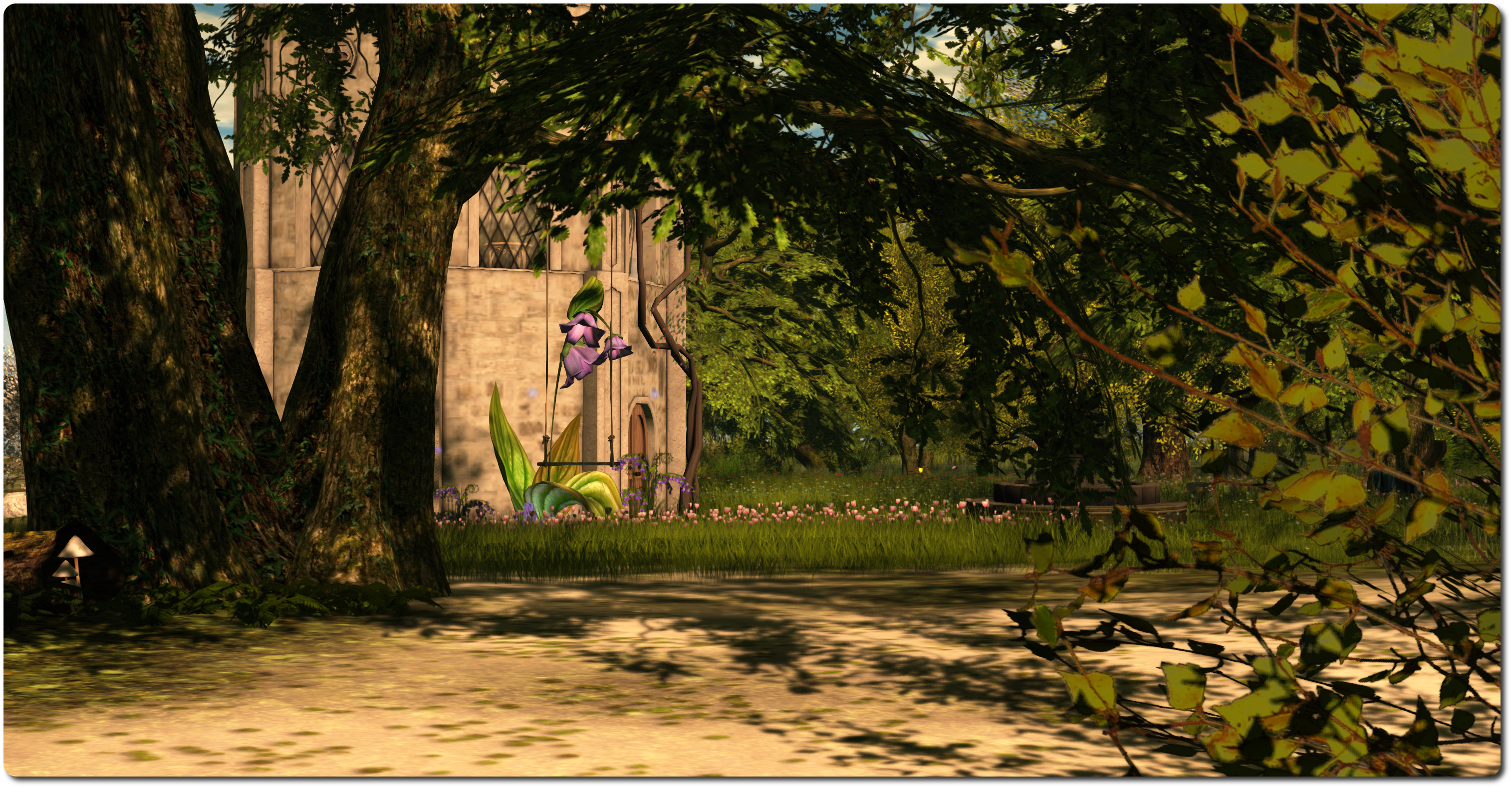
At that time, the region had a distinctly Nordic feel to it, suggestive of a rocky coastal area and ancient buildings with a possible Norse influence. By January 2014, it had altered somewhat, leaning more towards a means of displaying Bine’s art collection, whilst still retaining a water theme and adding peaceful woodlands to the mix.

Now the region has been further remodelled, and the result is quite beautiful. Water remains a strong element within it, and the Nordic echoes can still be found, but this time the design extends much further: high into the sky and down under water, Bine having created a marvellous environment to explore and in which photographers are welcome.
Binemist, Mystical Falls; Inara Pey, September 2014, on FlickrBinemist, Mystical Falls (Flickr)

Visitors initially arrive up in the sky, at a distinctly un-Nordic slice of Tuscany, complete with villa and grapes growing on the vines. A welcoming note card informs you that although you’re in the sky, there’s no danger of falling to the ground unexpectedly, before inviting you to explore – and I would suggest that you accept the invitation; the villa and its gardens offer some delights awaiting your discovery.

Also awaiting your discovery are the means to access the rest of the region. Bine provides clues in the note card to what she refers to as “potholes”, but I prefer to think of as portals (and I love the animations played on some of these as you make use of them; very different for the usual touch-and-TP, and they add a further charm to your explorations).

Binemist, Mystical Falls; Inara Pey, September 2014, on FlickrBinemist, Mystical Falls (Flickr)

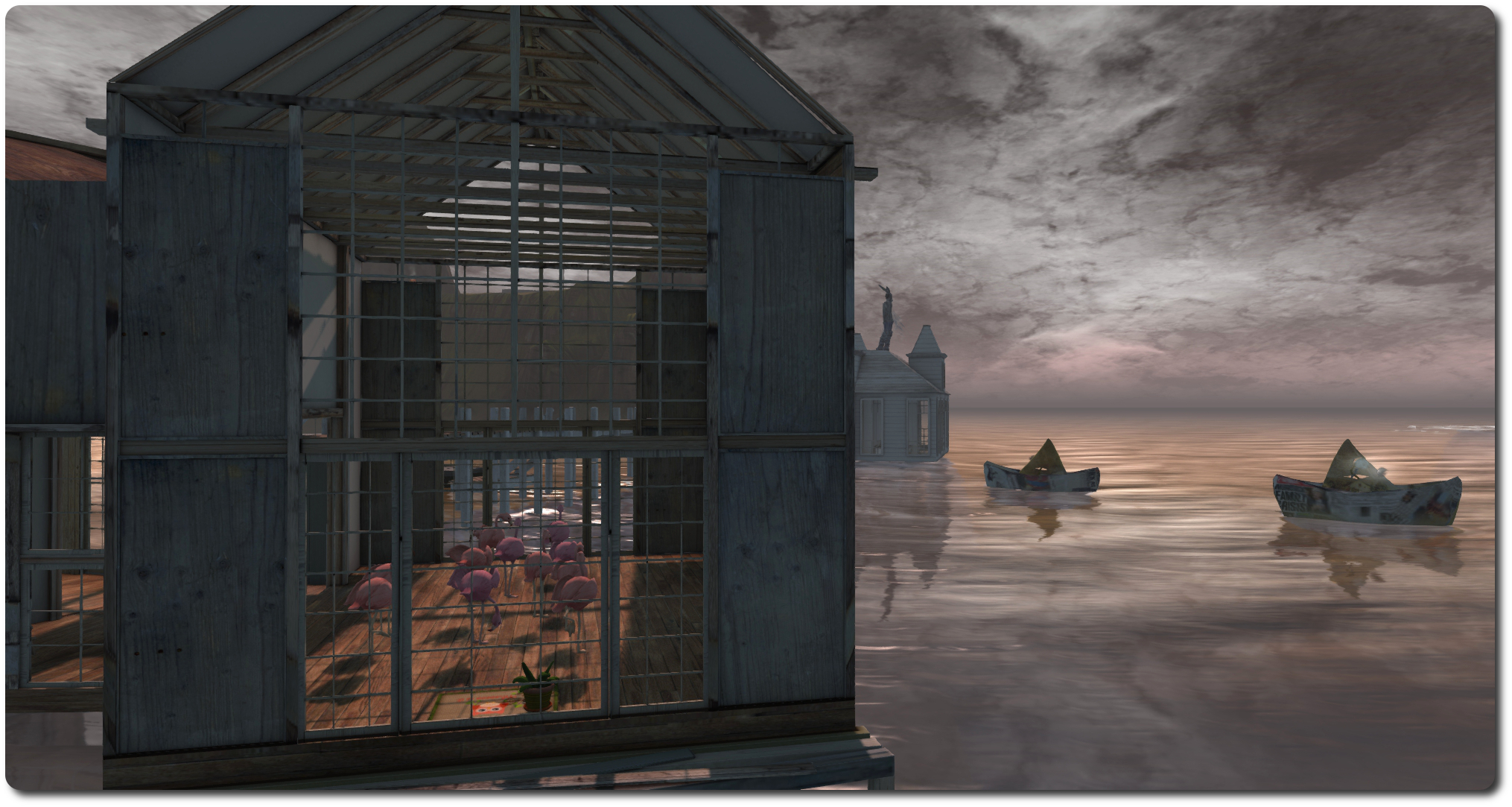
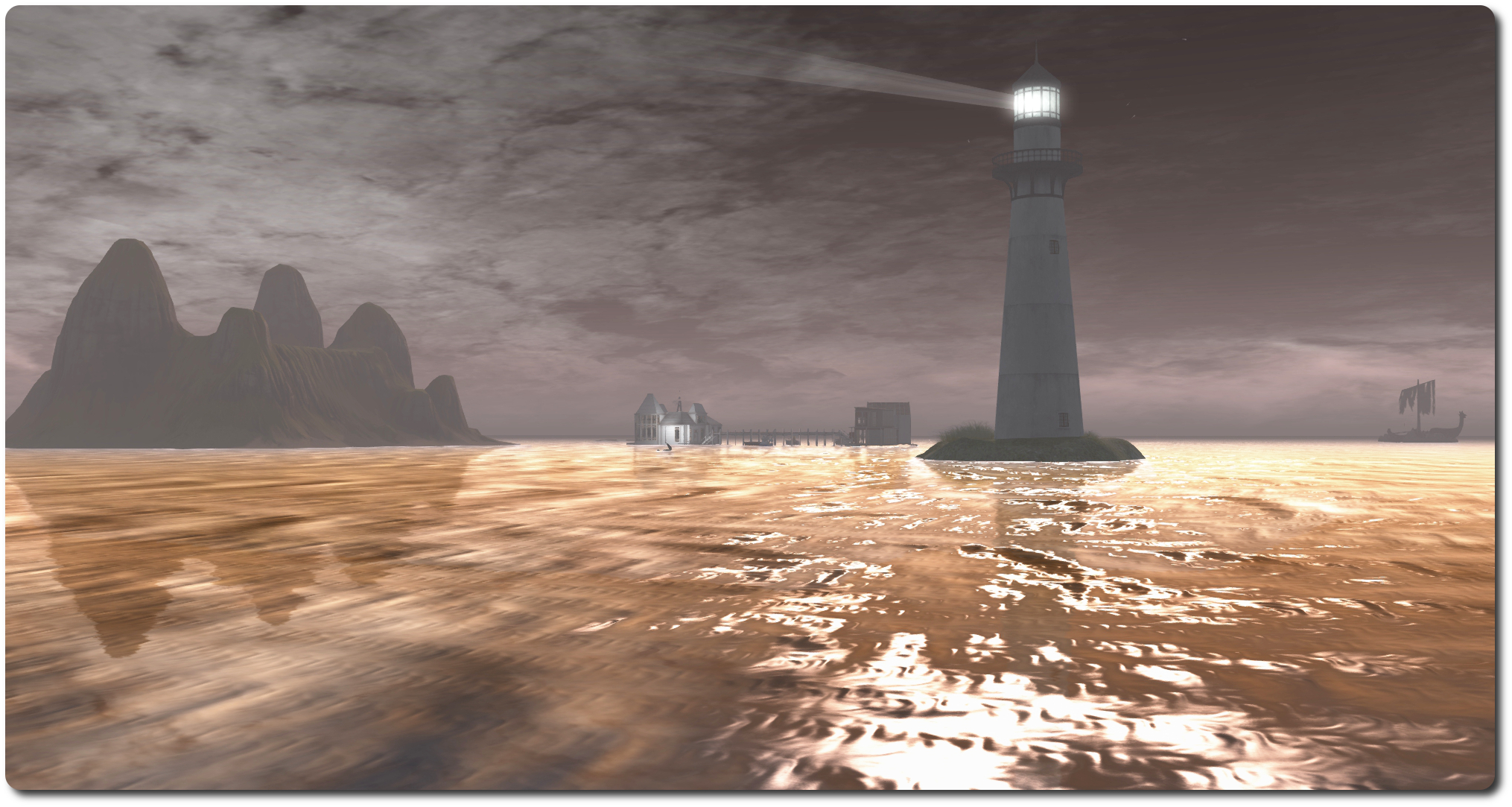
Where these lead you depends upon the one you opt to use; you’ll either be delivered above or under the waves. Both locations offer motifs which may well be familiar to those who have visited Binemist in the past. Above the water, for example, there is the familiar appearance of a tall, craggy island, albeit it not quite a rough-edged and untamed as perhaps previous islands here have appeared; there’s the tall finger of the lighthouse standing watch, and a wreck of a Viking longship – Bine’s signature nod to her heritage – lies further out to sea.

Which is not to say this is a re-run of what has gone before; far from it. The new Binemist is a world unto itself, beautifully unique in setting and style, from the buildings resting peacefully on the water to the low-lying sandbar with it own unique attractions, and on down under the waves.

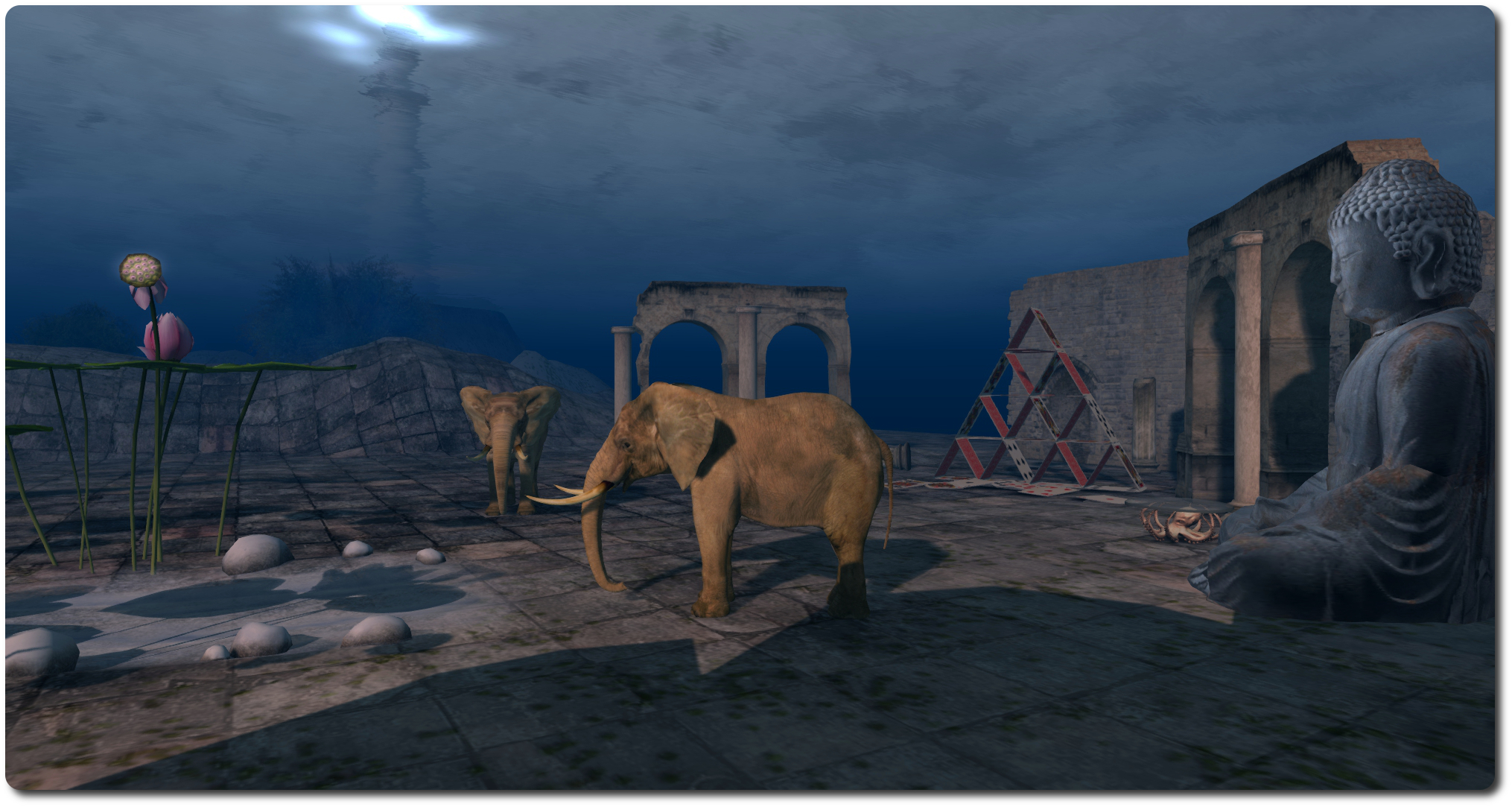
Under the water is where the garden of Binemist might be said to reside, because here is a rich landscape split into a number of scenes you can discover in turn by following the sandy paths. Each is unique to itself, but again, certain motifs are used to link them together as you explore.
Binemist, Mystical Falls; Inara Pey, September 2014, on FlickrBinemist, Mystical Falls (Flickr)

Art plays a strong role through the region, as it has done in Bine’s past builds, and one of the delights of a visit is coming across familiar pieces in entirely new settings, as well as pieces which may not have previously been seen within Binemist.

All told, region remains a lovely place to visit, and somewhere not to be missed during your travels across SL. Highly recommended.

Related Links

 * Opening lines from “Love is the Master”, by john Denver.

Disappearing down the rabbit hole in Second Life

Dysphoria - Alice in Wonderland, Oxygen Island; Inara Pey, Septmber 2014, on FlickrDysphoria – Alice in Wonderland, Oxygen Island; (Flickr)

Dysphoria – Alice in Wonderland offers the lovers of fairy tales, the adventures of Lewis Carroll’s Alice, and fantasy an atmospheric and intricate place to explore which comes with a slight twist. This homestead region is the work of sim designer Muse Muliaina, who defines herself and her work through a quote from Alert Einstein which should perhaps be the manner in which we all approach Second Life – if not life itself:

Imagination is more important than knowledge. For while knowledge defines all we currently know & understand, imagination points to all we might yet discover and create.

The landing point for the region is up in the air, and from the moment you arrive, the fact that you’re in a region that takes as its foundations Alice’s adventures is immediately clear – there is only one direction to take, and that’s down the rabbit hole!

Dysphoria - Alice in Wonderland, Oxygen Island; Inara Pey, Septmber 2014, on FlickrDysphoria – Alice in Wonderland, Oxygen Island; (Flickr)

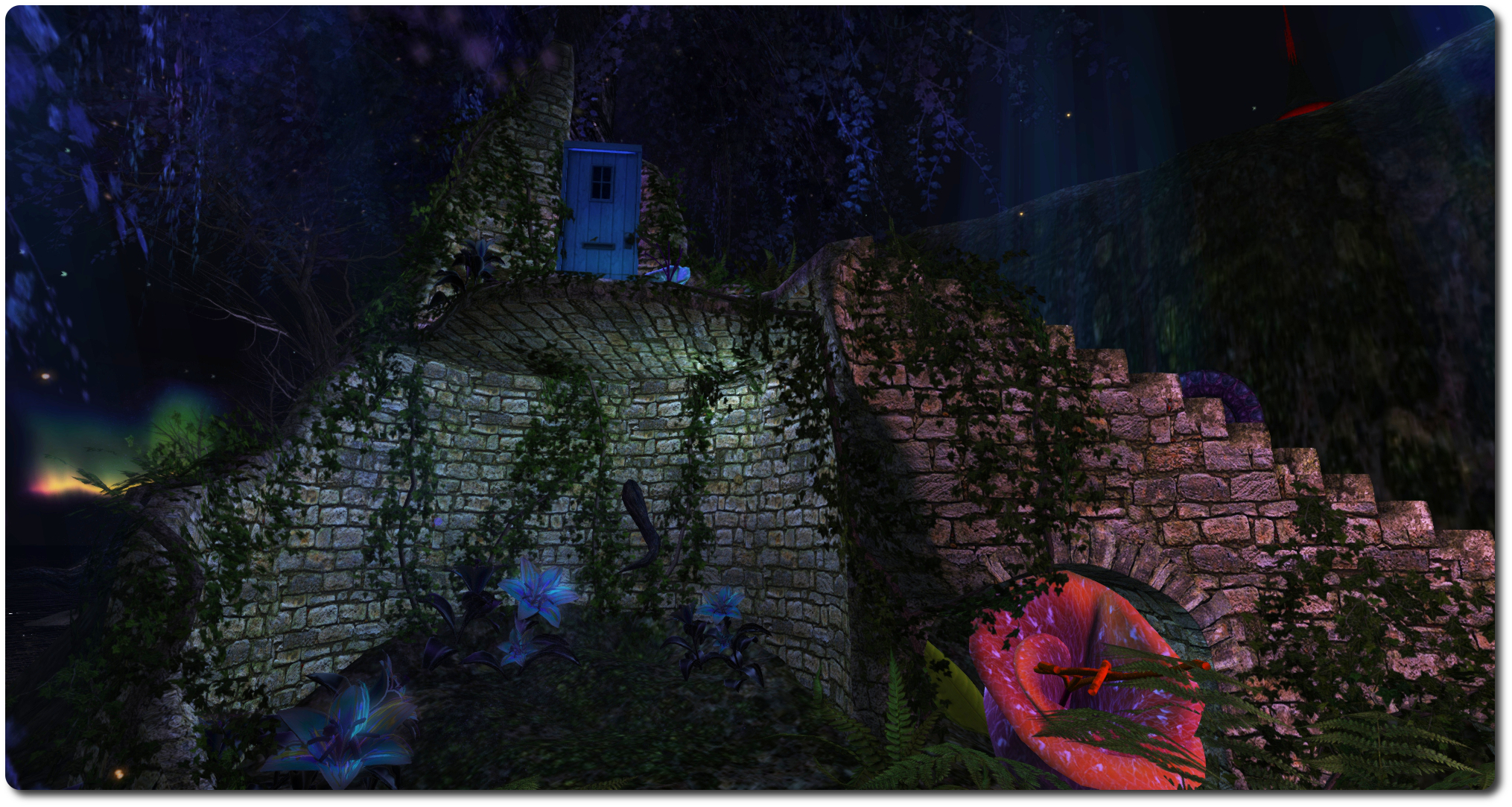
This will bring you down to a very large room with a very small door. There’s a bottle labelled Drink Me under the table, but given your relative size, it’s probably safe to say you may have drunk from it without realising .. although there is nothing stopping you from taking a further sip…

To proceed further, you’ll need to join the region’s group, which involves a slice of cake and a key. Once this has been done, you can proceed through the little door (an anywhere teleport door), which will deliver you to the region proper – but before you do, make sure you have either accepted the region’s windlight setting or have set your viewer to midnight or a nighttime windlight; that way you’ll experience the region as Muse intends.

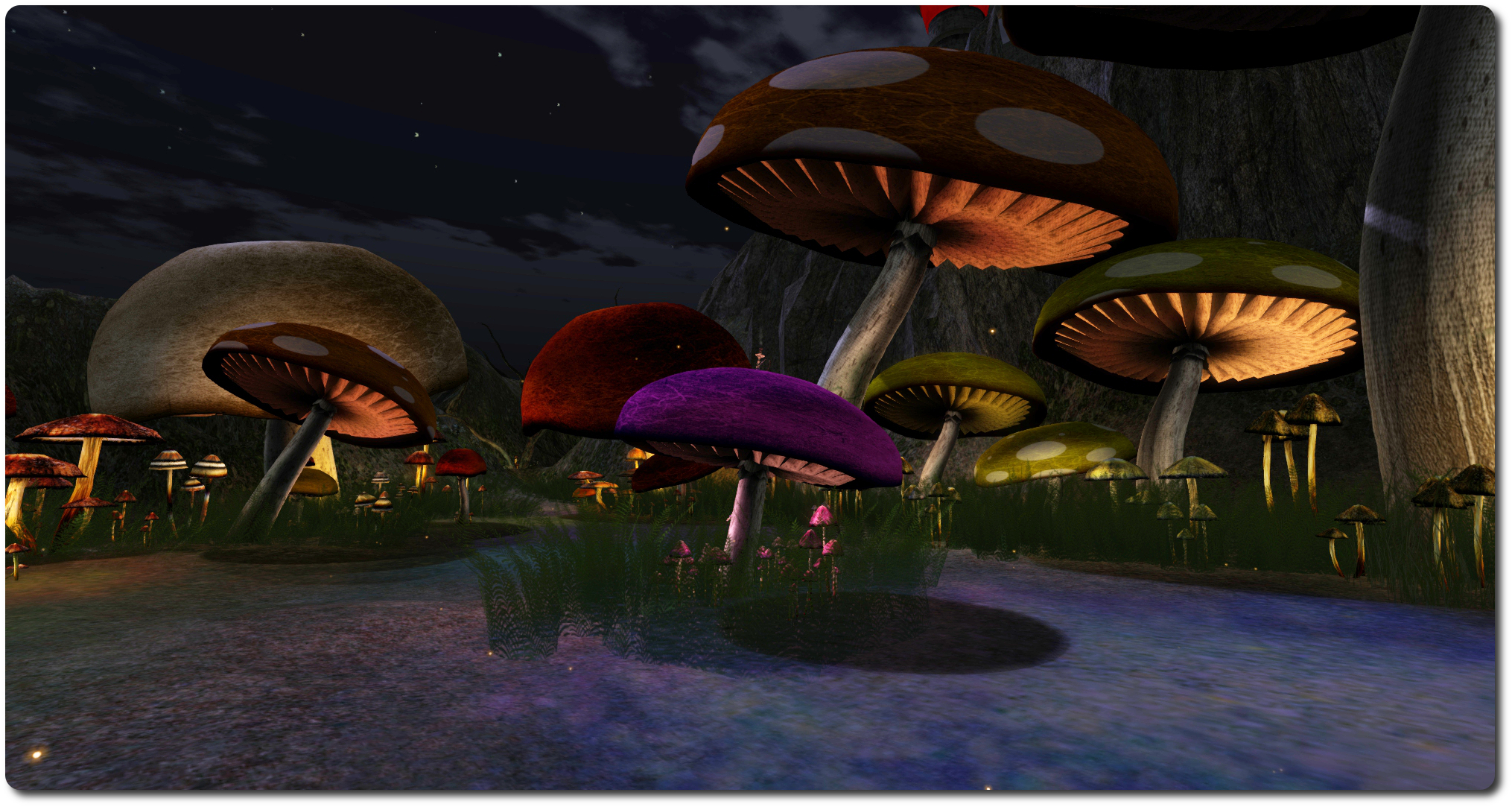
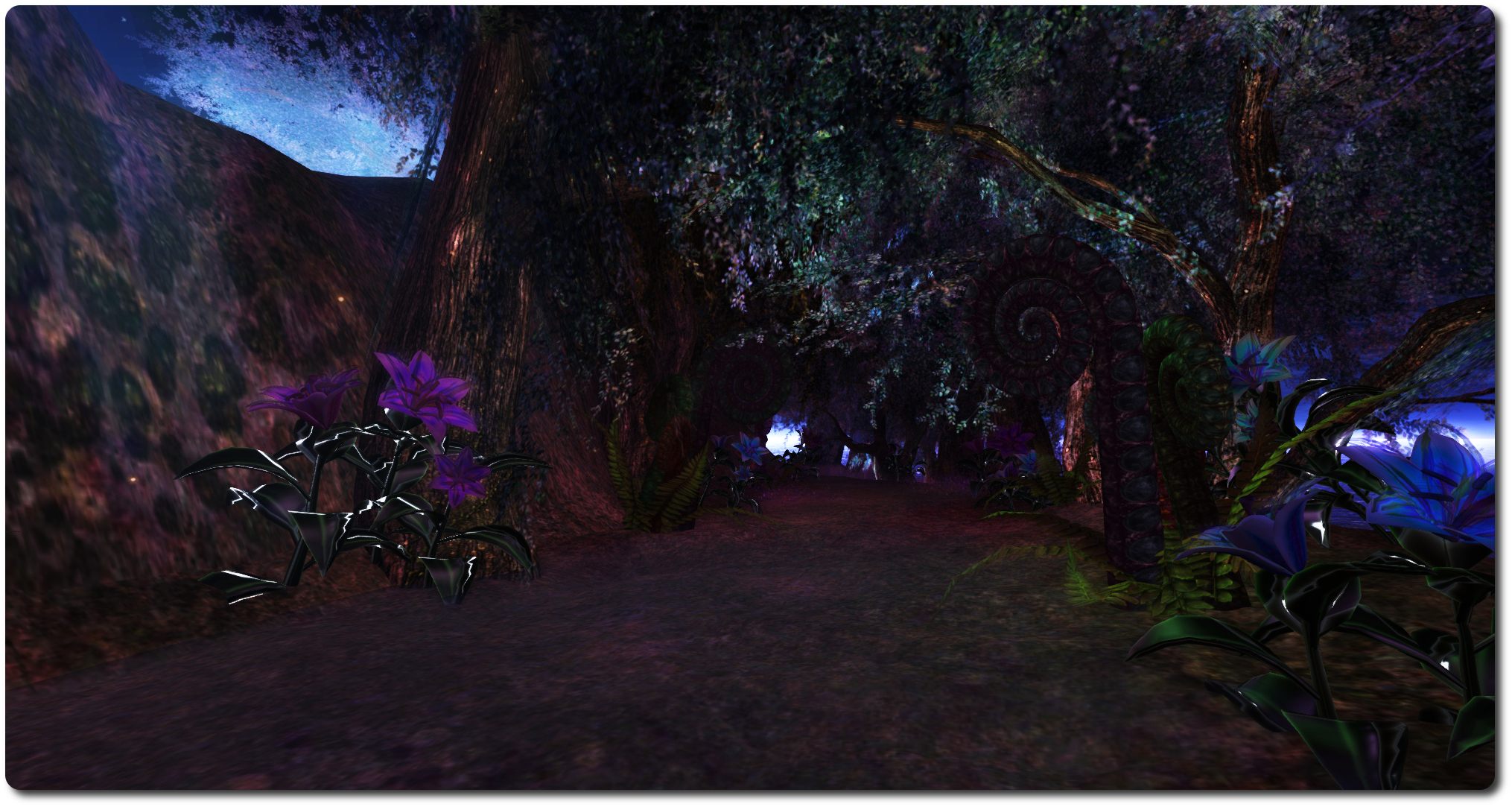
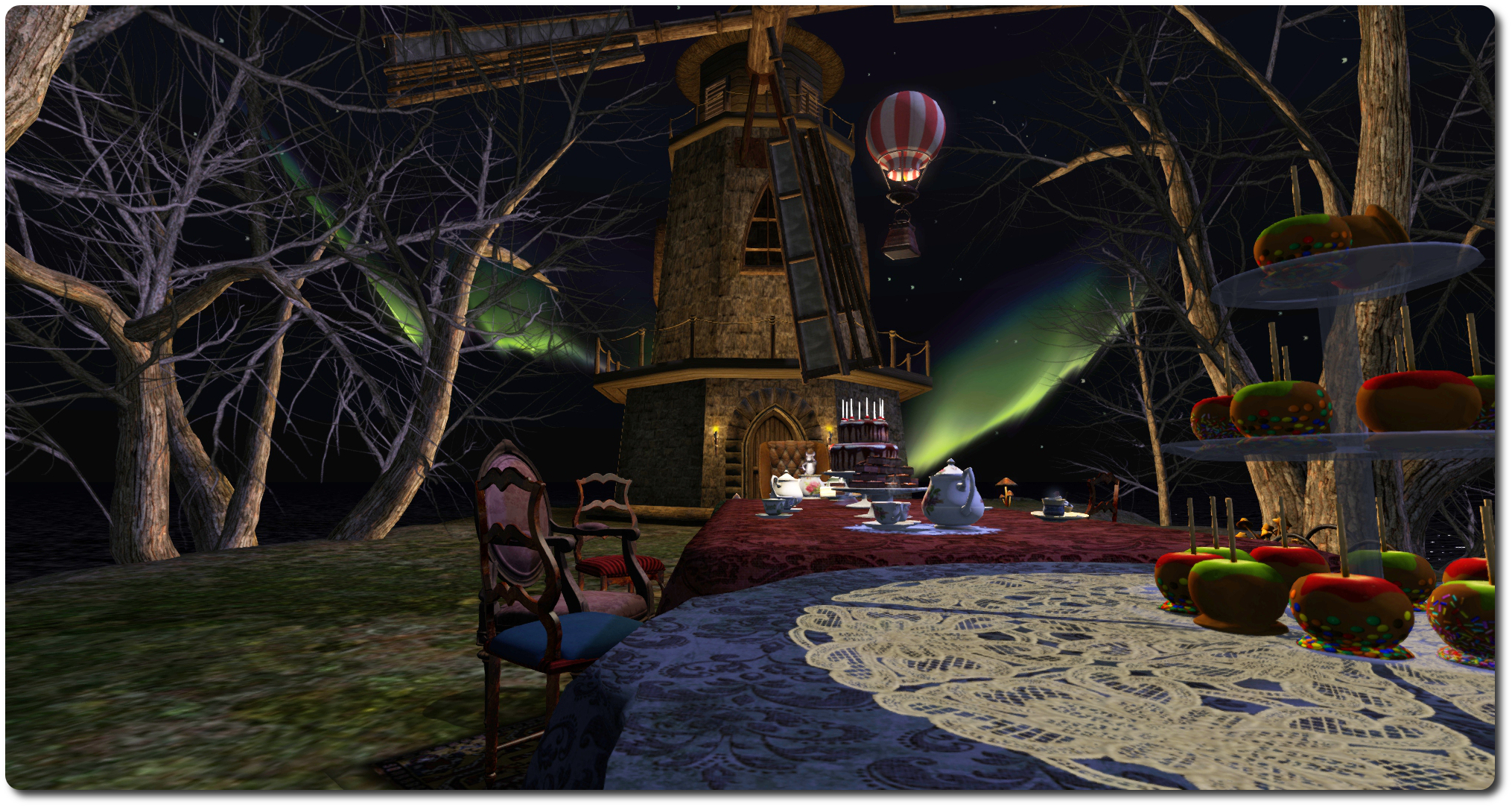
Now, as mentioned, this is a place that brings together fairytale, fantasy and elements of Alice’s adventures. So in your travels you can make your way to the Enchanted Forest and Gardens, through the Wonderland Warren, visit the Mushroom Circle, sup at the Mad Hatter’s Tea Party and make your way to the Red Queen’s castle.

Dysphoria - Alice in Wonderland, Oxygen Island; Inara Pey, Septmber 2014, on FlickrDysphoria – Alice in Wonderland, Oxygen Island; (Flickr)

However, not all here is quite as it seems. So if you find the Cheshire Cat’s grin a little unsettling, or the White Rabbit’s reading matter a little curious (not to mention the things he tends to hide under the fireside rug) or what happens when you accept the invitation to sit in his bedside chair leaves you a little uneasy, it is all entirely intentional.

From the White Rabbit’s place, you can make your way through the swamp, under the gnarled trees and past the ghost. Then, if you hang a left at the bloody red glow, you can make your way up to the Red Queen’s castle. Or, if this isn’t to your liking, the continue on and you’ll reach the Mushroom Circle, and from there it is a short walk to the Mad Hatter’s tea party.

Despite the darker elements to it, this is actually a quite delightful and enchanting region which can quickly captivate, particularly in the richness of detail and subtle touches – note the recurrence of the chessboard motif, echoing Alice’s looking glass adventures, and that of the deck of cards, reference her trip to Wonderland. Do please make sure you use the default or a nighttime windlight; if you don’t, you stand to miss out on a lot of the charm and whimsical elements of the region. Whether or not you are a fan of Lewis Carroll’s (or should I say Charles Dodgson’s?) classic, Dysphoria – Alice in Wonderland offer an intriguing and quite photogenic place to visit, and well deserving of its selection as an Editor’s Pick in the Destination Guide.

Dysphoria - Alice in Wonderland, Oxygen Island; Inara Pey, Septmber 2014, on FlickrDysphoria – Alice in Wonderland, Oxygen Island; (Flickr)

Related Links

Journey through a lost paradise

Bastet's Paradise, Aphrodite; Inara Pey, Sept 2014, on FlickrBastet’s Paradise, Aphrodite (Flickr) – click any image for full size

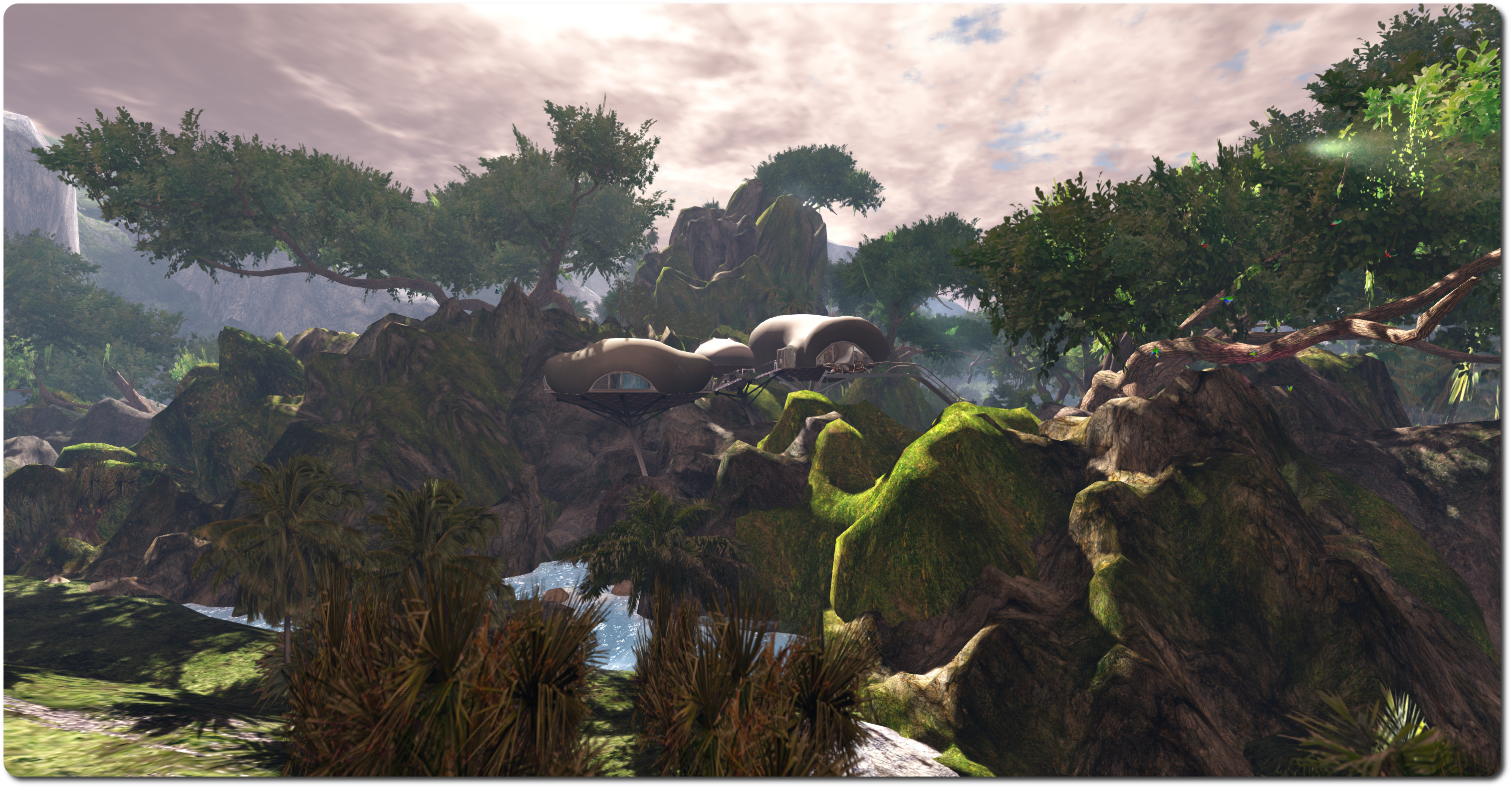
Bastet’s Paradise, referred to in the Destination Guide as The Lost Island, is a beautiful enigma inviting exploration. Designed by Tek Scientist, the region is a curious blend, offering a rich landscape for people to enjoy and explore, places to sit, or share or to dance, mixed with curious shades of adventure, fantasy and science-fiction.

The Landing point sits alongside a garden conservatory, complete a barbecue and outdoor kitchen, and offering a place for people to sit and, if they wish, enjoy a meal. All of which sounds nicely suburban; except the conservatory and patio appears to be sitting in a jungle clearing overlooking a river and with elephants standing close by…

Bastet's Paradise, Aphrodite; Inara Pey, Sept 2014, on FlickrBastet’s Paradise, Aphrodite (Flickr)

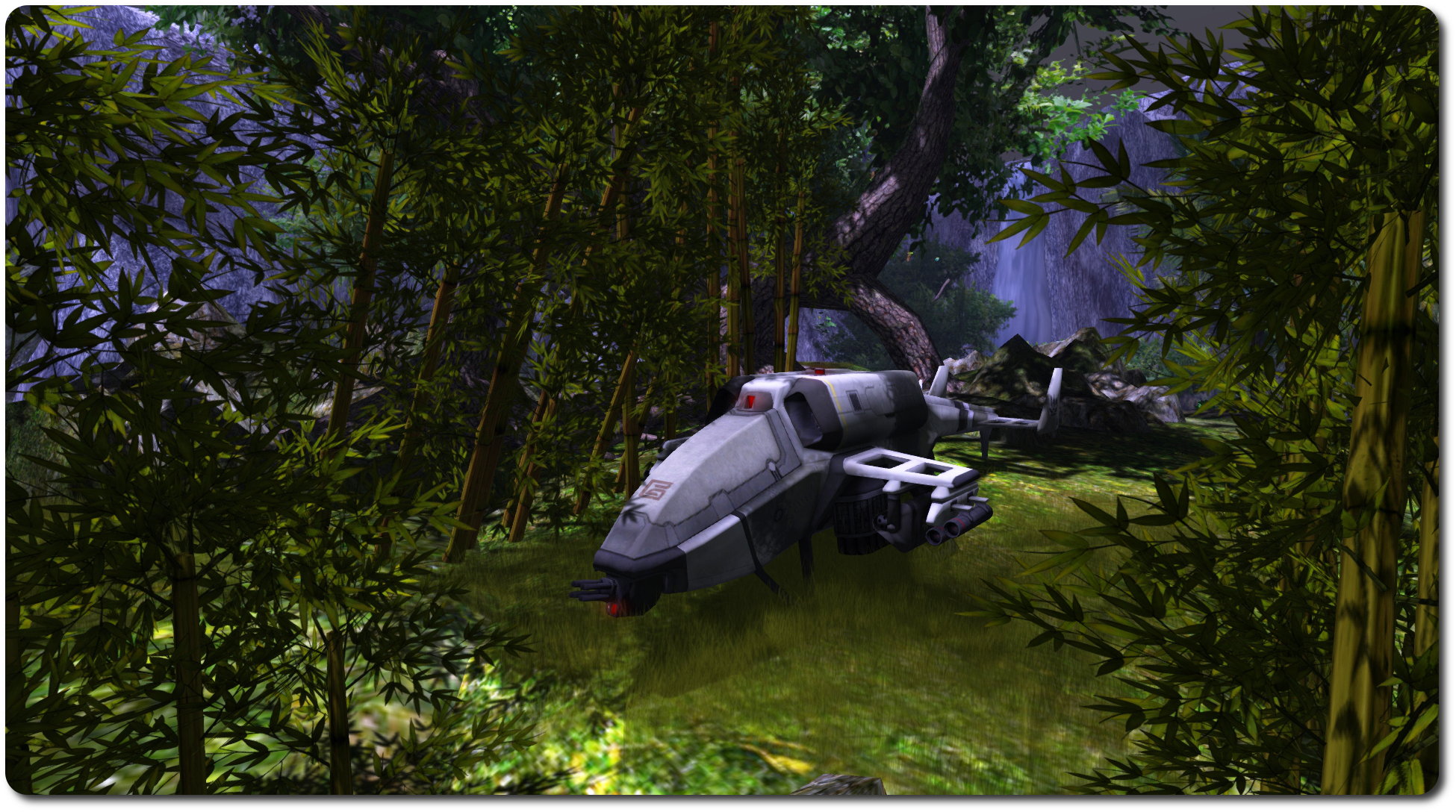
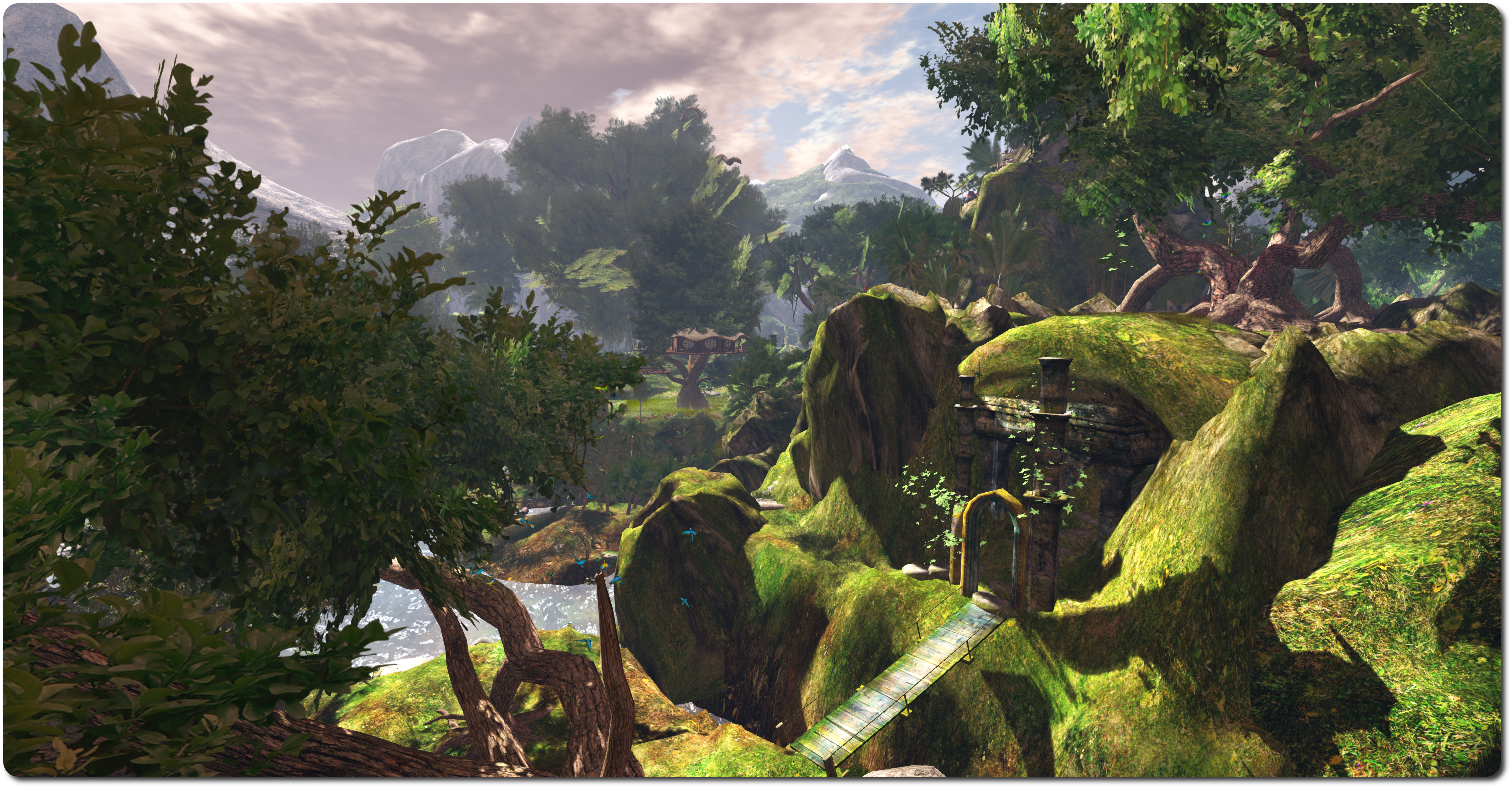
So, are we in Africa? Well, not entirely; the ruins a short walk away suggest we might be in South America, while beyond them a rounded tree house suggests something one might find hidden in Middle Earth, while the tiger roaming beneath the trees perhaps points towards the Indian sub-continent.  Elsewhere things have a distinctly sci-fi edge to them, suggesting we are in fact on another world, far removed from Earth; so perhaps this place is a far-flung colony deep in space, an Eden created by human hands, where the animals of old Earth wander amidst the broad trees and ancient stones of a long vanished civilisation, and surrounded by tall mountains.

Careful exploration is required here, and if you’re into SL photography, you may find you’re spending a lot of time cycling through windlight settings, as so much of the region offers itself to photography and a range of lighting conditions. Do be a little careful in you explorations, however, as the sim surrounds do encroach on the region in places, which can lead to a few problems such as bouncing against the region boundary while roaming. Be aware as well, that if you take to the air, not all the trees are set to phantom, which can also lead to unexpected collisions.

Bastet's Paradise, Aphrodite; Inara Pey, Sept 2014, on FlickrBastet’s Paradise, Aphrodite (Flickr)

But don’t let that put you off; Bastet’s Paradise really is worth taking time to explore. I loved the otherworldly feel to part of the region – the play of glow and light across surfaces which gave the upward flowing water an entirely “alien” look and feel as it moved across rocky surfaces as if they were shimmering in their own right. Elsewhere, catching sight of distant mountain tops through the trees gave me a feeling of being in Lothlorien or perhaps Greenwood the Great before darkness crept into it, and looking out towards the distant Misty Mountains.

For those who simply want a place to chill, Bastet’s Paradise offers plenty of scope – there are places to sit to be found under trees, on the shoreline, inside the assorted buildings  – and even floating out of the water in a giant soap-bubble! Intan dance systems can be found throughout the region as well, and for those wanting a more romantic / intimate space, there’s a teleport system which will carry those who find it up to a skybox overhead.

All told, an interesting place to visit.

Bastet's Paradise, Aphrodite; Inara Pey, Sept 2014, on FlickrBastet’s Paradise, Aphrodite (Flickr)

 Related Links

River belles and paddle wheels

Dixie Queen, Dutch Harbor

Living near Blake Sea offers a lot of opportunities for sailing and flying  – and for discovery. Back in September 2013, I wrote about my meanderings across some of the core regions of Honah Lee,  and I’ve made mention of other destinations in the region as well.

While flying recently, I came across something I hadn’t noticed previously, and that’s three sternwheel paddle steamers tied-up at the quayside. Intrigued on seeing them from the air, and spurred by a request for more information on them coming from another member of the Avatar Social Network, I set out for a closer investigation.

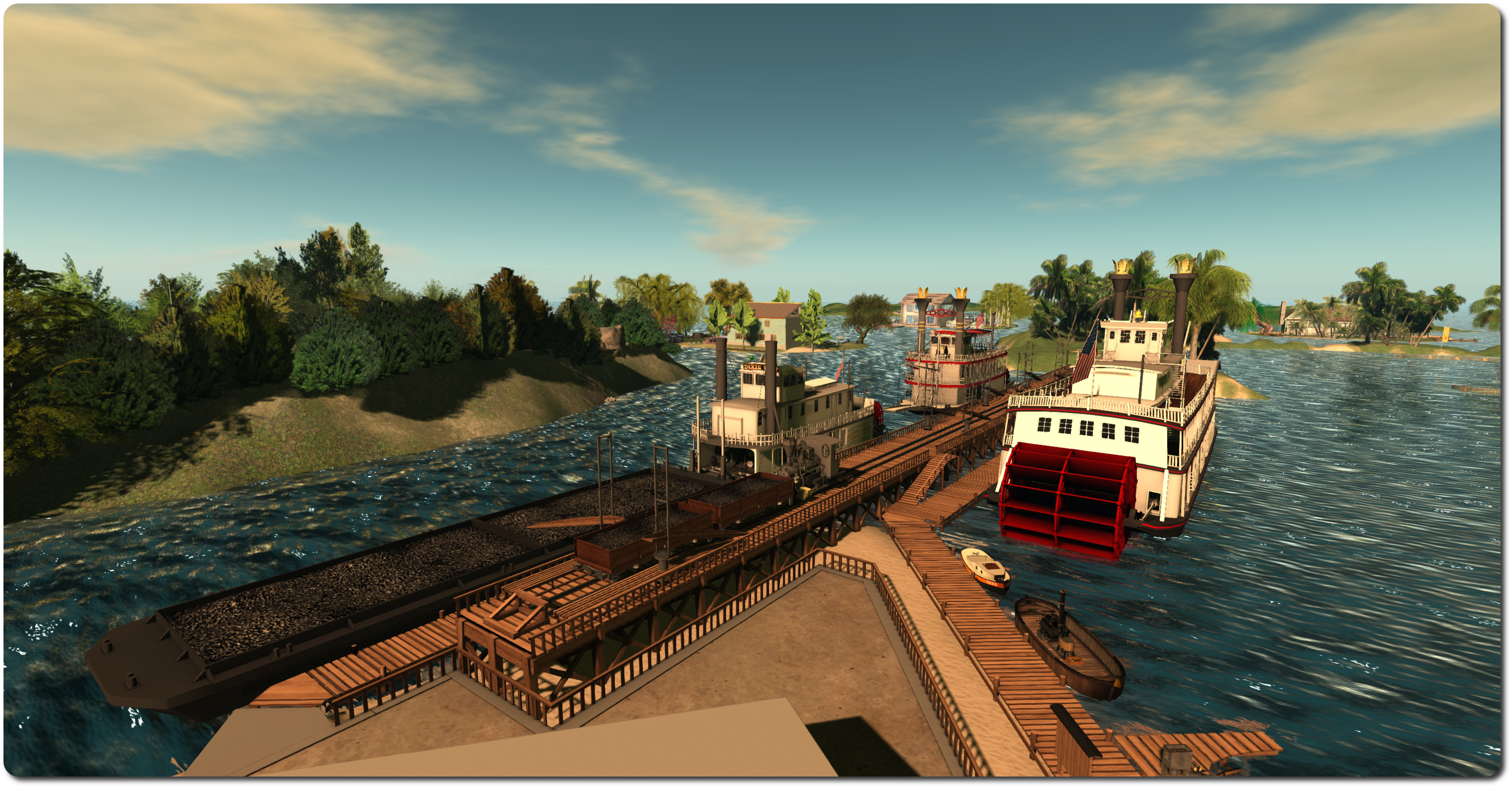
The three boats are part of the Bandit Steamboat Company, owned by Analyse Dean (who built them), of Bandit Boats fame. They can be found just across the water from her store, alongside the wharf belonging to the Dixieland Coal Depot. For those arriving at the Bandit Boats quay, you can either fly over to the coal depot, which lies to the west, or you can take the little steam ferry across the water – just walk onto the ferry, don’t try to sit on it!

Looking over the wharf: on the right is the Dixie Queen, on the left, the Dixie Tow and her coal tender, and behind her, the Dixie Belle

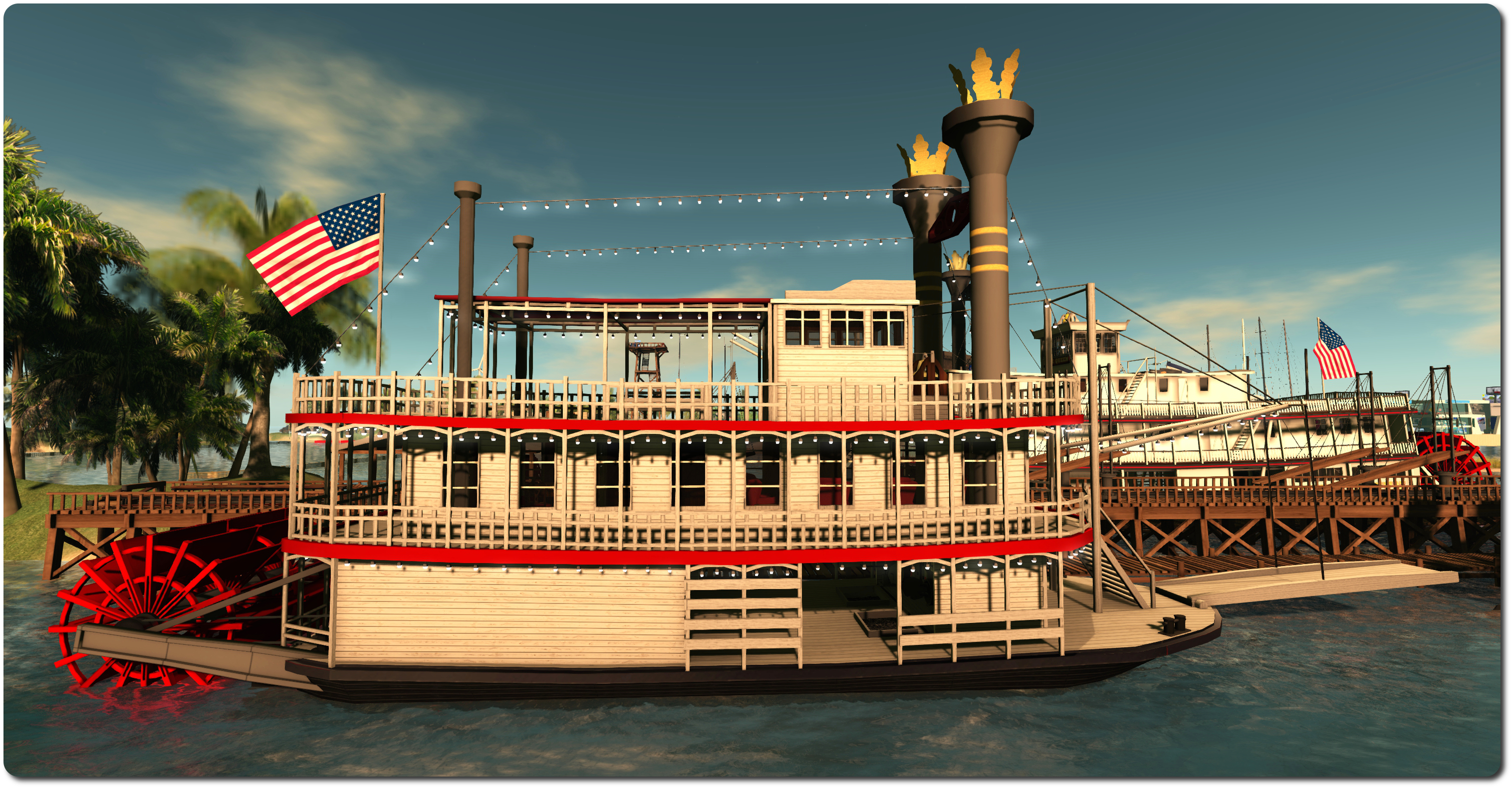
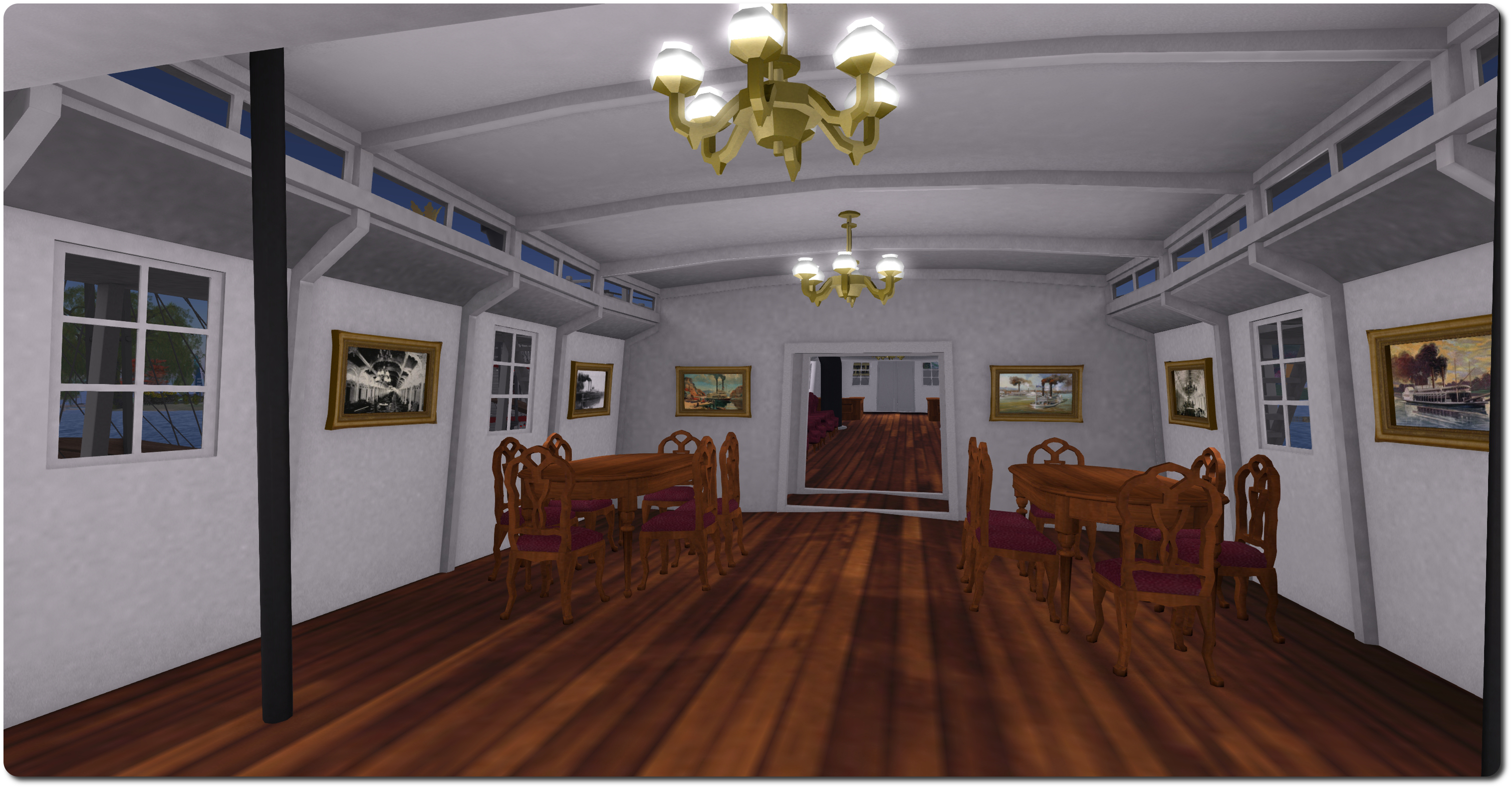
There are three steamers at the wharf, the largest being the Dixie Queen, seen at the top of this piece and again at the end, which offers a large passenger salon, what appears to be a dining area, and up on the top deck, a couple of small cabins and what might be a saloon where it’s easy to imagine card games going on as the boat makes her way up the Mississippi and Ohio rivers.

Across the quay from the Dixie Queen sits the Dixie Belle, a slightly smaller sternwheeler, offering just a salon and gaming room on her upper deck, although there is a small promenade deck above, just behind the wheelhouse. Like the Dixie Queen, the Belle’s lower deck is given over to her steam engines, bunkers and cargo space.

Dixie Tow
Dixie Tow: workhorse steamer

Moored in front of the Belle is the Dixie Tow,  a reminder that the life of a Mississippi steamer wasn’t necessarily devoted to Maverick-style adventures; it could be hard work, lugging cotton bales and cargo downriver, or in the Dixie Tow’s case,  pushing coal tenders around.

Dixie Bell actually started life as a part of a build Analyse did for the TYC December boat show in 2013, when it formed a part of her Deer Hunt. Dixie Queen and Dixie Tow are both part of a larger work in progress, and are intended to be sailable with a crew of a skipper, a pilot and stokers; in addition, the Queen will be able to carry passengers.

The Dixie Belle
The Dixie Belle

In particular, Analyse is hoping to recreate some of the atmosphere of the heyday of the great sternwheel paddle steamers as they plied the rivers of the American mid-west – including the legendary (and sometimes fictional) races between them.

“Considering that even the biggest sea in SL is barely as wide as the Mississippi at some points, I think SL is a great place to recreate this,” Analyse told me as we talked about the project. The work is already some nine months into development, and still has some way to go before things are ready to launch; but when she’s ready, Analyse will be offering both the Dixie Queen and the Dixie Tow for sale – and will be organising steamboat races as well; something she hopes will prove popular.

Part of the reason the project is taking so long to develop is that Analyse needs to devote time and attention to her primary boating business. She also wants to make the steamers to give as much a feel of sailing the old sternwheelers as is possible. This has involved building and scripting a steam engine simulator (a mock-up of some elements of this can be seen at the north end of the quays).

Inside the Dixie Queen

“Currently the steam engine itself is in test in a single boiler launch, and when that’s concluded it will be transplanted for the 4 boiler system,” Analyse told me. However, there is more to capturing the feel of travelling (and racing!) a riverboat than the engines, as she goes on to explain. “Among other things, I want an interactive system for the passengers where they can walk the deck, have dinner, go dancing, play musical instruments, you know, the stuff they did back then!”

Once the Queen is ready, not only will it go on sale, Analyse will be holding weekly races. “[It will be ] a race between two steamers, with a set start and finish, but no waypoints, so that’s up to the skipper to decide the route, much like in the Mississippi days!” she says. And like the races of old, there will be hazards to face, such as sandbars which boats must navigate around or between, and even the need to refuel, as Analyse explained with a smile, “The Dixie Tow was made purely for the purpose of refueling the Queen at some halfway point. [So it’s] pull up alongside and shovel like mad!”

The Dixie Queen
The Dixie Queen

In the meantime, The Dixie Queen, the Dixie Belle and the Dixie Tow sit moored and open to visitors, and Analyse tells me that SL photographers are welcome to use the boats for photo shoots if they wish – rezzing is enabled, although people are obviously asked to clear-up anything they use prior to leaving.

For my part, I have to say I enjoyed my exploration of the boats and my chat with Analyse, and I’m also looking forward to the first race – which I certainly hope to be able to cover in these pages, and perhaps even be a passenger aboard one of the participant steamers!

Related Links

The serenity of Sarawak

Sarawak; Inara Pey, August 2014, on FlickrSarawak (Flickr) – click any image for full size

I finally made it to Sarawak, the home region of outstanding SL photographer Ermandalee. I’d actually been intending to visit since around the end of July, but time and tide have been keeping me away; as did the fact that many of SL photographers and bloggers have visited; I scarcely feel any pictures I take do justice to the region compared to their work.

But, time smiled favourably upon me, and with an hour or so on my hands I jumped across for a visit, and I have to say I’m glad I did. Given Ermandalee’s eye for detail and expression, which can clearly been seen throughout her Flickr steam, it will come as no surprise that Sarawak is beautifully conceived and presented; the camera can scarcely be turned without a picture being framed.

Sarawak; Inara Pey, August 2014, on FlickrSarawak (Flickr)

Predominantly rural in nature, Sarawak presents what might be a coastal scene, a flat headland with mountains rearing beyond and cut through by water to form a small series of islands linked by bridges, both stone and wooden.  A house is built out over the waters of one of the inlets, a sign welcoming visitors to Ermandalee’s home, which doubles as a small gallery presenting some of her photographs. Just across the water are signs of a farm or small holding: a barn where horses can be found, bales of hay and the rounded form of a stone windmill. The soil here is obviously rich, as a scarecrow stands guard over a field of yellow flowers.

The pastoral feel to Sarawak continues through the wildlife to be found across the region. Ducks swim in some of the inlets or waddle on the shorelines, geese rise from one of the smaller islands, gulls circle overhead while deer roam the grasslands, birds sing against the backdrop of flowing water and the gentle ringing of chimes caught in the breeze.

Sarawak; Inara Pey, August 2014, on FlickrSarawak (Flickr)

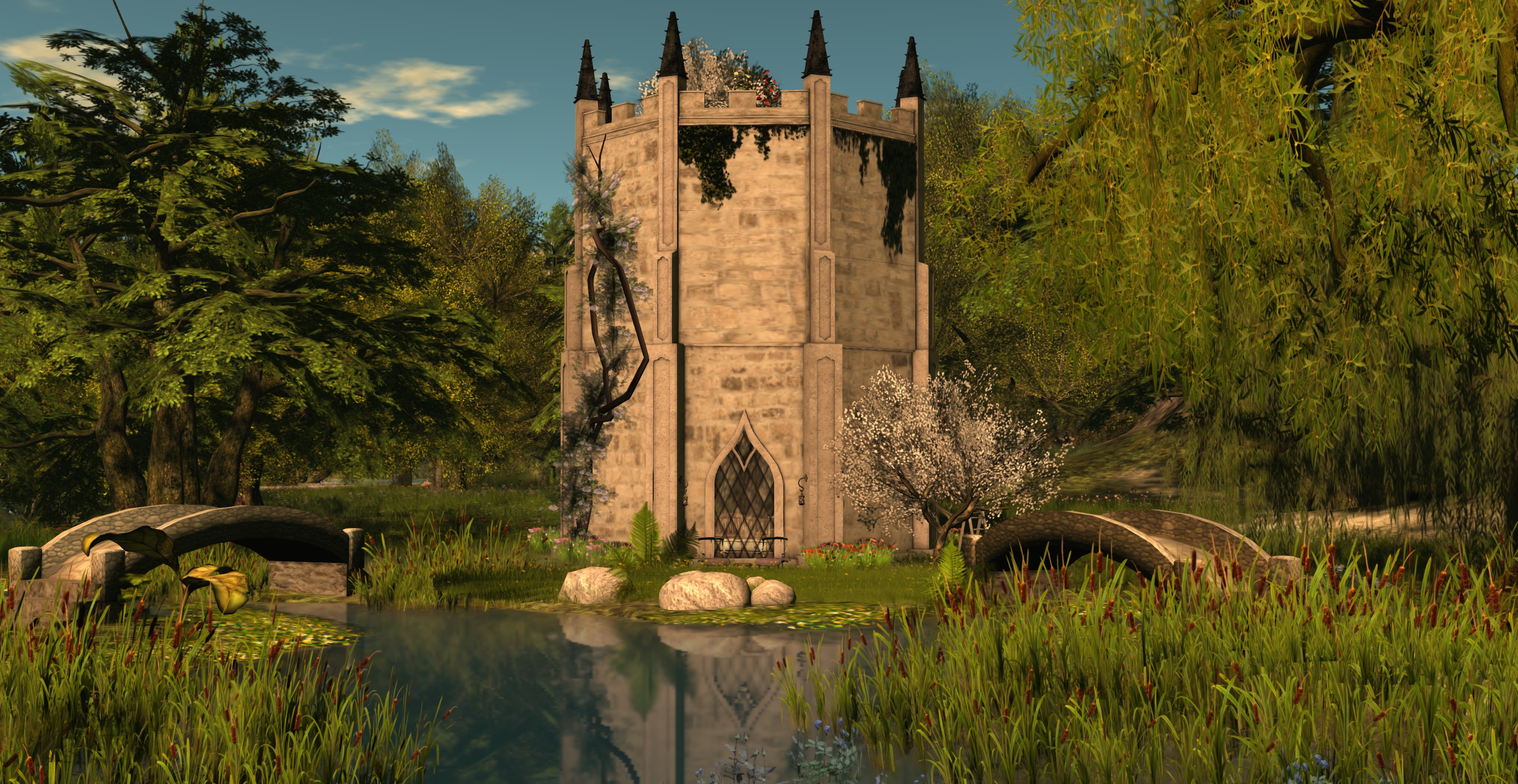
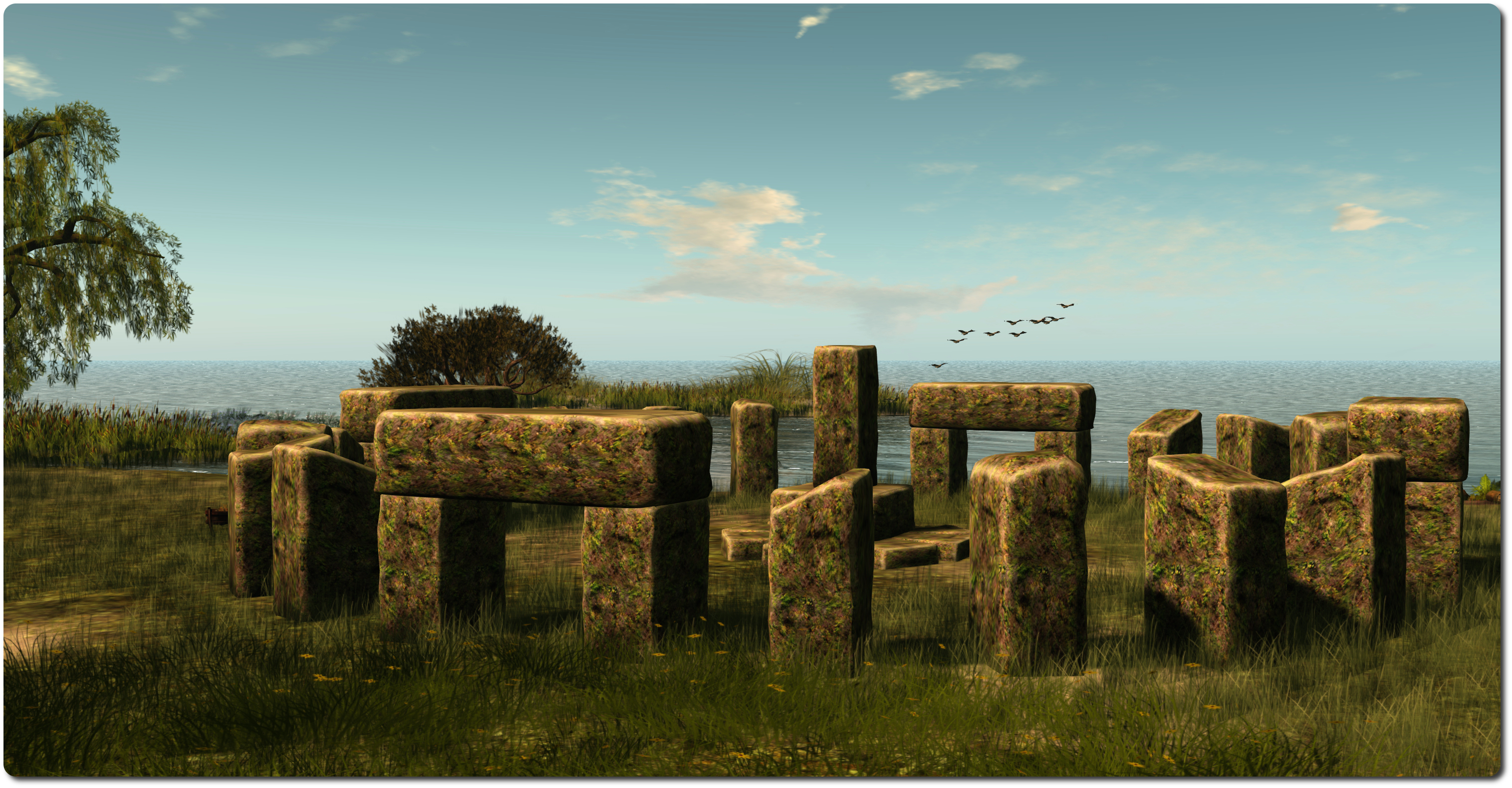
But there is more here than a simple country scene; I understand that Ermandalee originally had it in mind to build something more towards the fantasy side of things. Eechoes of this can be found as one wanders the region, mixed with a touch of ancient mysticism.  A tall tower stands to one side of the region; close to a set of falls stands a statue and pavilion of distinctly elven look and feel, while on the shoreline sits a circle of mossy standing stones.

The combination of elements within Sarawak is enticing; inviting one to try to define where it the world it might reside. To me, parts of it suggest the great outdoors of Canada (or at least, how I imagine them to be): lakeshore cabins, rich forests, tall mountains. At the same time Sarawak speaks of being more European in nature, while the fjord-like channel to the north-east suggests something slightly Scandinavian.

Sarawak; Inara Pey, August 2014, on FlickrSarawak (Flickr)

However you see Sarawak, and whether you witness it in the default windlight setting, suggestive of a cool late summer evening (or perhaps early morning, depending on your mood), or whether you opt for one of your own (as I did), it is a beautiful place to visit and explore.  With its many offerings of places to sit, down on the ground and up in the trees, it offers an open invitation to visitors to stop and rest a while.

Given the serenity one feels when wandering through the region, it is an invitation easily accepted.

Sarawak; Inara Pey, August 2014, on FlickrSarawak (Flickr)

Related Links

Daydreams of lighthouses three

The Colder Water, Daydreams; Inara Pey, August 2014, on FlickrThe Colder Water, Daydreams, (Flickr)

The Colder Water, located on the homestead region of Daydreams, is without a doubt one of the most atmospheric and evocative regions I’ve visited.  Both minimalist in one direction, yet rich in content and imagery in another, Jordan Giant’s design has an immersive attractiveness that is quite breathtaking.

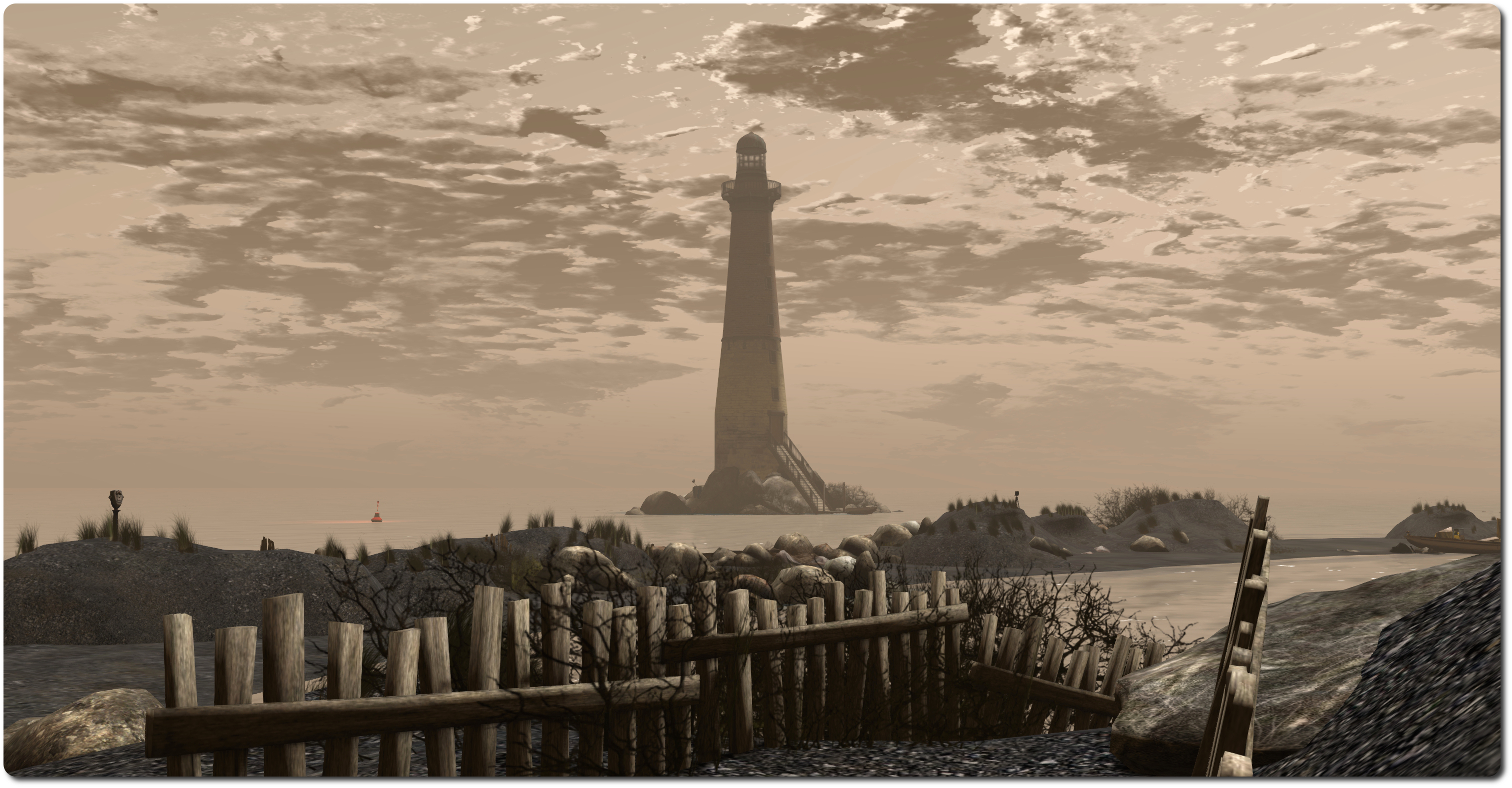
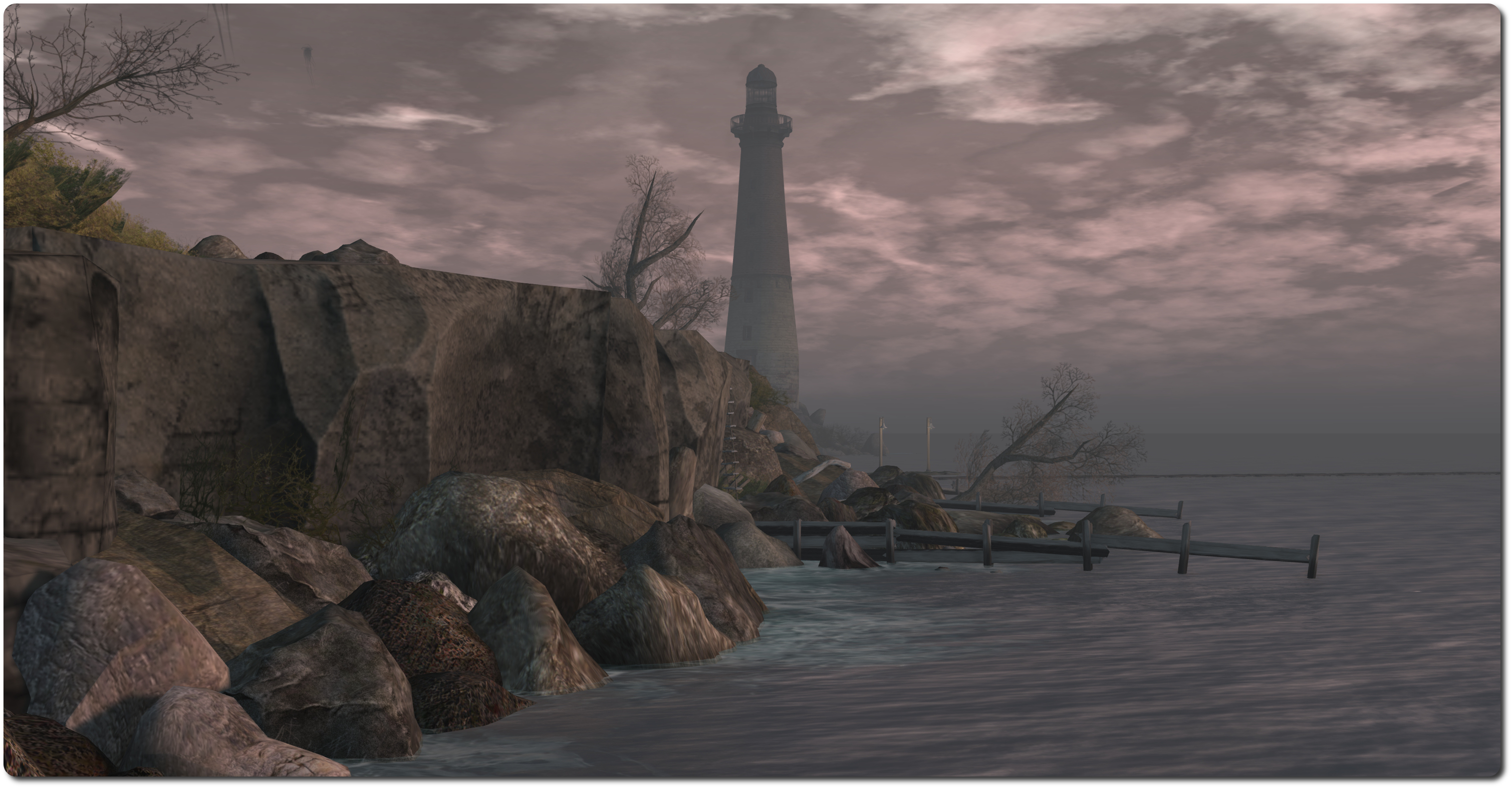
A curved island, what might be all that’s left of a long-extinct and drowned volcano, sits low in the sea, black gravel beach curving gently between two uprisings, each with its own lighthouse. The slender form of a third rises from rocks a little offshore, forming a triumvirate of silent watchers.

The Colder Water, Daydreams; Inara Pey, August 2014, on FlickrThe Colder Water, Daydreams, (Flickr)

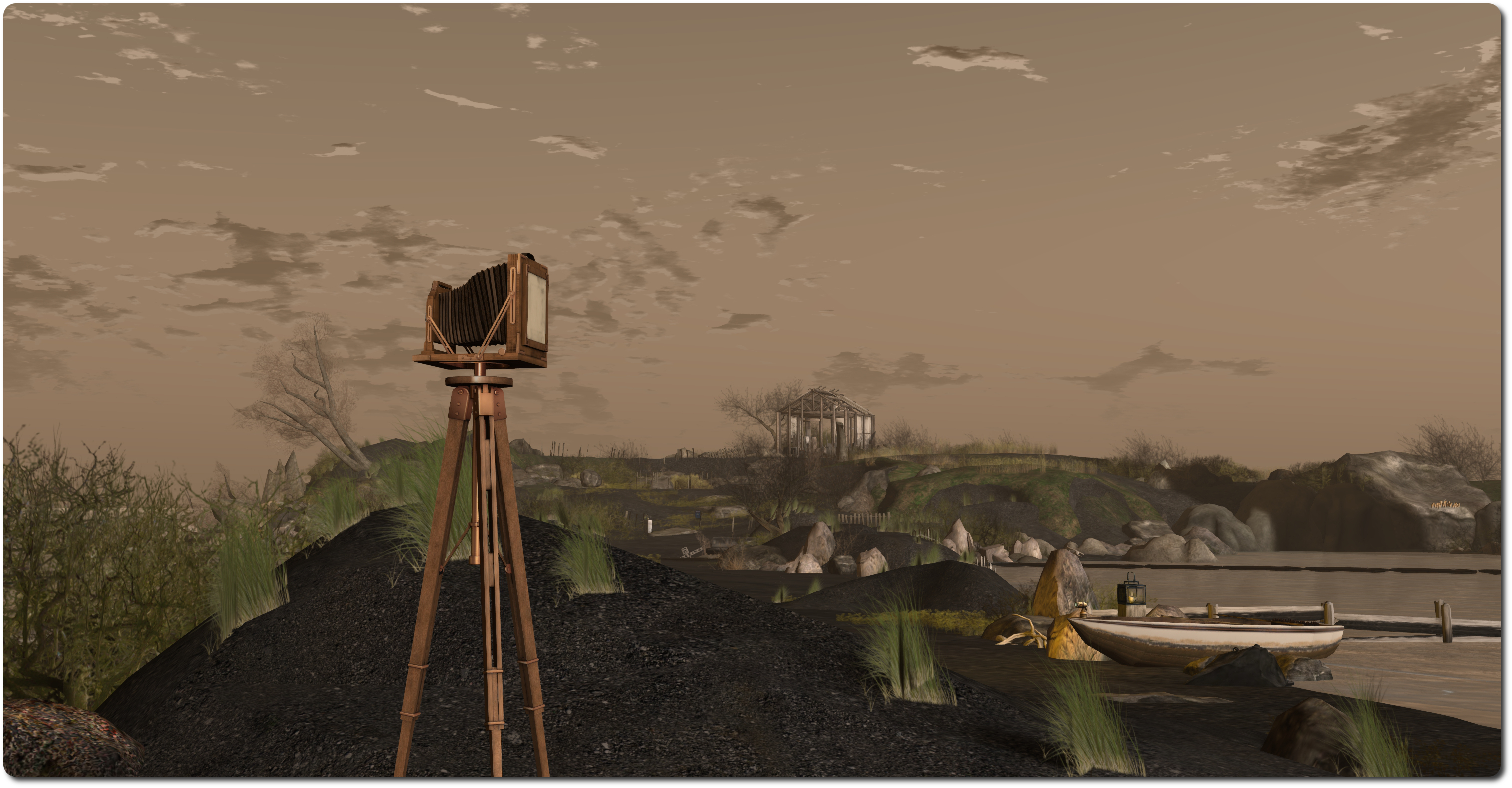
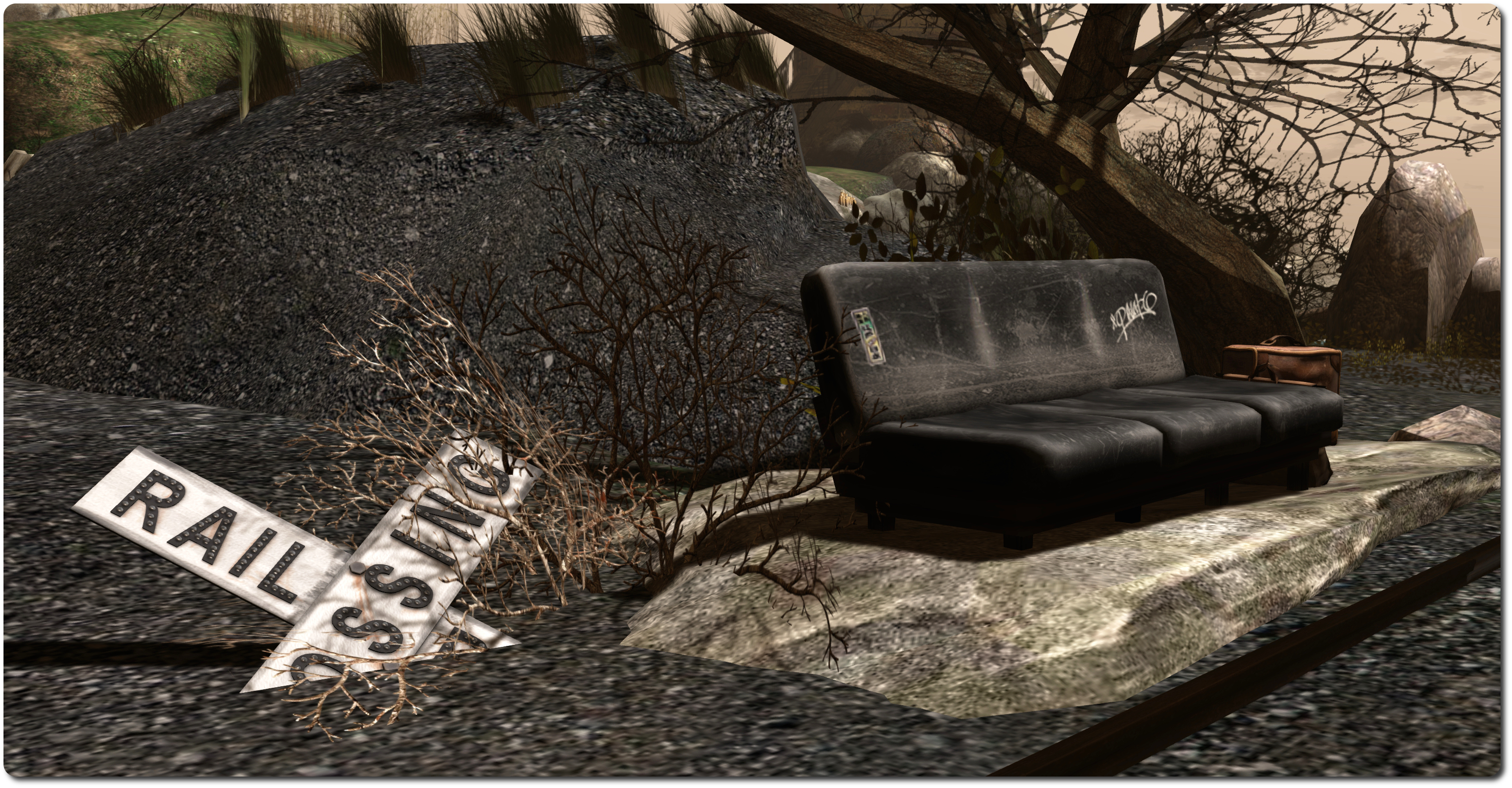
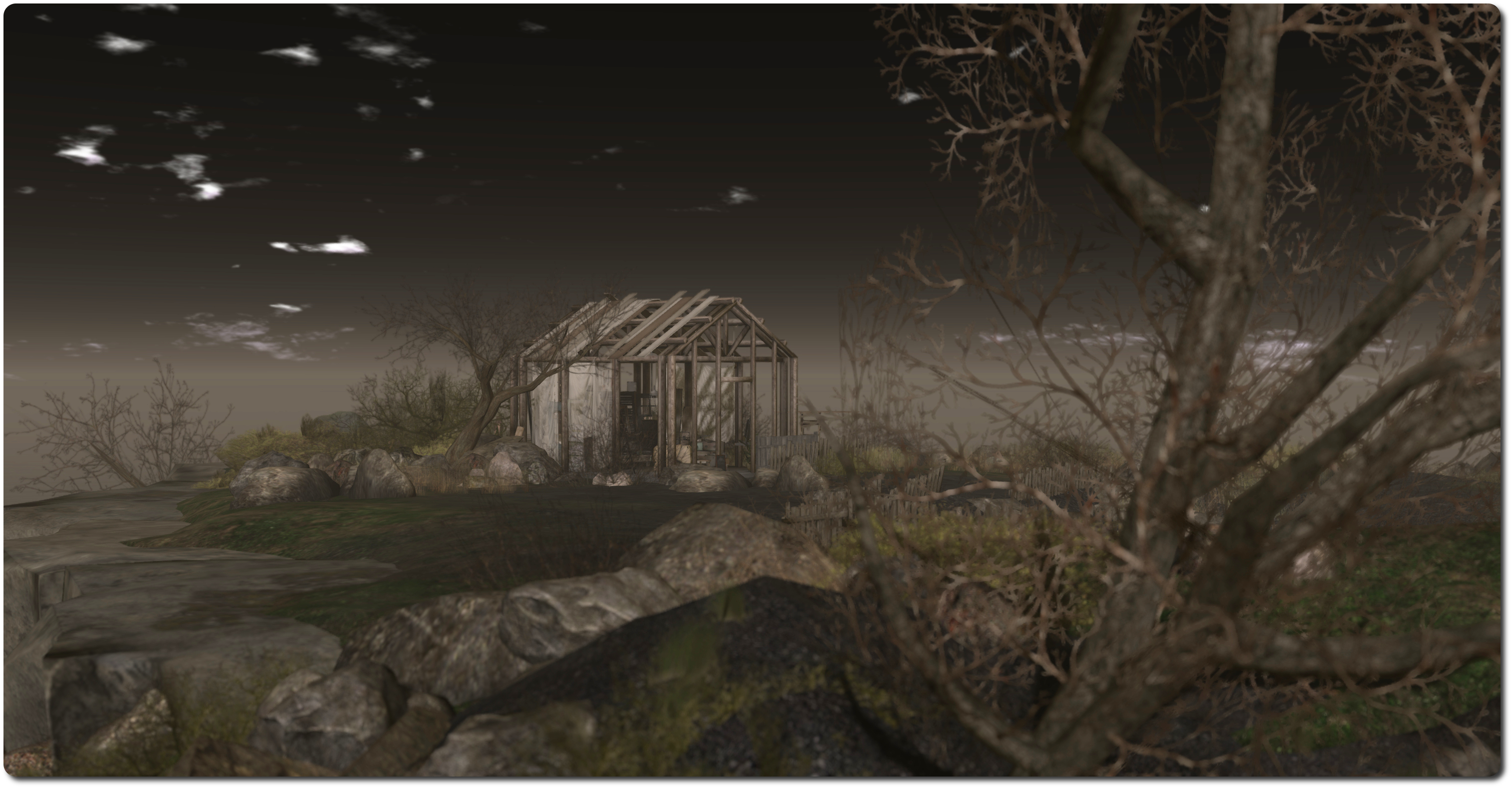
The island, largely bare of foliage other than moss, tough grass and skeletal trees, shows odd signs of former habitation. A railway track cuts across the narrow neck beneath the western uplands, running out into the shallows on either side. A path from here leads up through lines of old fencing to an old shed or wood-framed house sitting in disrepair on a low rocky plateau, the rounded flank of a lighthouse nearby.

There is a feeling of quiet age here; the lighthouses all stand deserted, two with lights extinguished and the third rudely decapitated, iron dome almost lost amidst the rocks at its feet. In the grey waters, buoys flash a warning in place of the sweeping lights from the brick-built towers, and even these appear to be uncared for; one has broken from its anchor chain to be carried among the rocks by the flow of the tide.

The Colder Water, Daydreams; Inara Pey, August 2014, on FlickrThe Colder Water, Daydreams, (Flickr)

There is a haunting beauty to this island that seeps into the mind; a quiet voice encouraging the visitor to say, or those who have departed to return once more. There is an enigmatic feel to this place as well; the volcanic shores suggestive of an otherworldy place, a sensation enhanced by the jellyfish floating overhead.

But above all, this is a place which speaks of tranquility within its suggestion of age and distance. As it speaks to the mind, encouraging one to to stay, so to does it soothe the soul. The balance here is perfect, and further enhanced by the selected tracks of the audio stream, which is an absolute must listen for visitors. Also – make sure you view the region with the default windlight (I’ve used alternatives in some of the images on this page).

The Colder Water, Daydreams; Inara Pey, August 2014, on FlickrThe Colder Water, Daydreams, (Flickr)

Hard fingers rise
On crescent Moon’d shores.
Tides flow around rocky knuckles
While boats rest with idle oars.

Red lights blink warning
Where cyclopean eyes once roamed.
Whilst on bare rocks, pale candles
Keep a vigil of their own.

The Colder Water, Daydreams; Inara Pey, August 2014, on FlickrThe Colder Water, Daydreams, (Flickr)

The arrowed headland
Has long gales withstood,
And offers comfort
Under shuttered wood.

Curled stony tail
Sweeps from the arrow’s head.
To bridge-reached door
The traveller is led.

The Colder Water, Daydreams; Inara Pey, August 2014, on FlickrThe Colder Water, Daydreams, (Flickr)

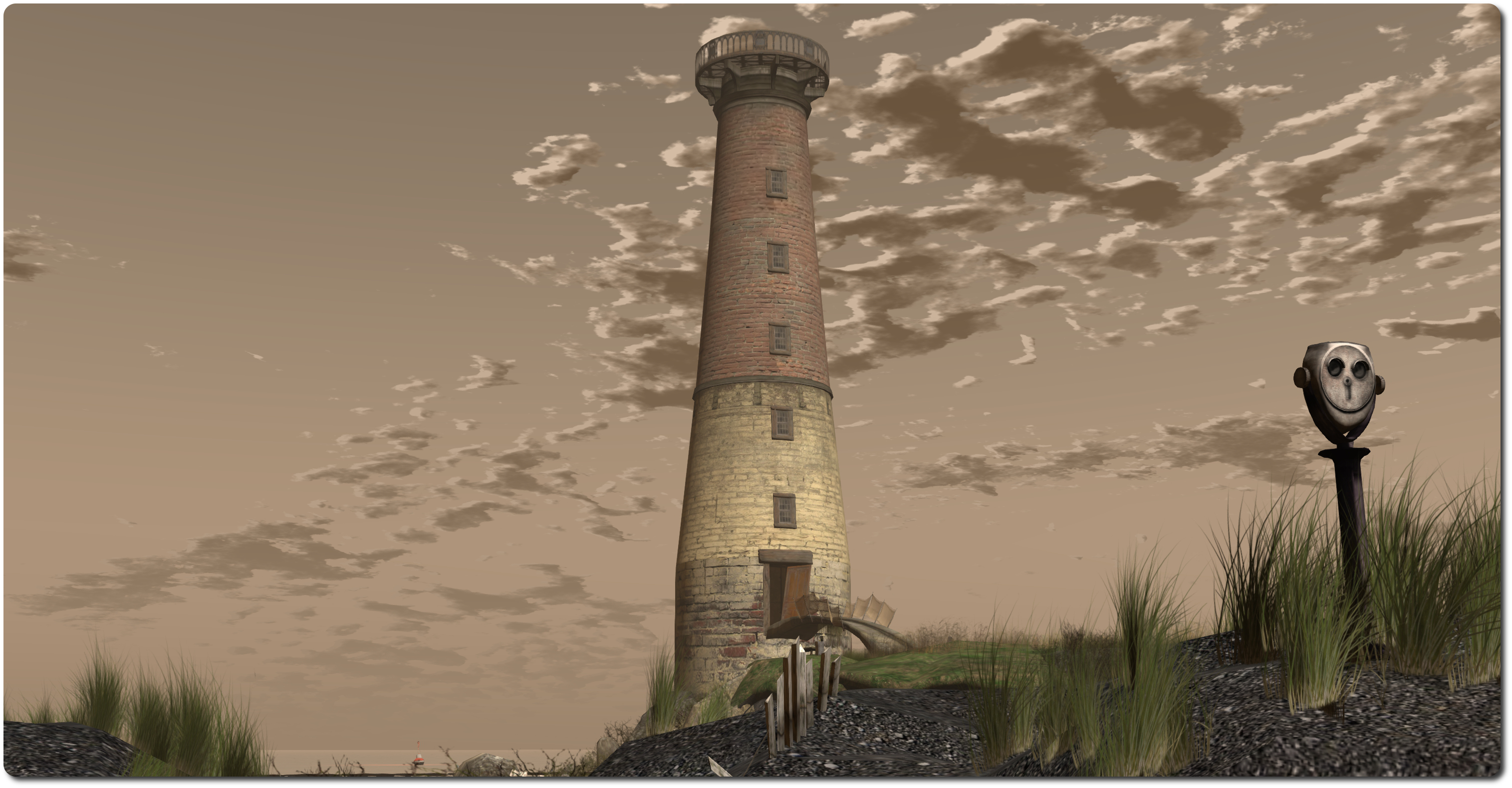
Here points a finger
to cloud scudded skies;
Glass nail long broken,
Distal phalanx scythed.

Climb the twisting circle
To high wrought iron’d tip.
And find the telescope, upward turned
To watch the stars, not passing ships.

Rough hewn beauty
Spread with naked trees
Marks this isle of
The lighthouses three.

Related Links

with thanks to Caitlin Tobias for the pointer.