Aech’s Basement: a new Sansar RPO experience

Aech's Basement, Sansar; Inara Pey, March 2018, on FlickrSansar: Aech’s Basement – click on any image for full size

Thursday, March 29th marked the US opening of Steven Spielberg’s Ready Player One, the film based on Ernest Cline’s 2011 novel of the same name. Few can fail to have heard of either film or book – which features a VR “metaverse” made up of thousands of worlds, called OASIS. To mark the opening of the film, but with much less fanfare, Sansar Studios, the 3D / VR modelling and experience design team at Linden Lab, recently opened Aech’s Basement in Sansar.

Described as being “interpreted from the original ILM design for Ready Player One, from Warner Bros. Pictures, Amblin Entertainment and Village Roadshow Pictures.” Aech’s Basement is the second Ready Player One experience to be presented by Sansar Studios, the first being Aech’s Garage (read here for more).
Aech's Basement, Sansar; Inara Pey, March 2018, on FlickrSansar: Aech’s Basement

I can’t speak for the movie as I’ve not seen it yet, but in terms of the book, and with one or two liberties taken to ease avatar movement, the experience hits pretty close to home. And like Aech’s Garage before it, there is a wealth of detail and subtle touches packed into it which are – for those with a keen eye and love of sci-fi and films or the 1980s – a treat to find.

Aech had named his chat room the Basement. He’d programmed it to look like a large suburban rec room, circa the late 1980s. Old movie and comic book poster covered the wood-panelled walls. A vintage RCA television stood in the centre of the room. hooked up to a Betamax VCR, a LaserDisc player and several vintage video game consoles. Bookshelves lined the far wall, filled with role-playing game supplements and back issues of Dragon magazine.

Ernest Cline, Ready Player One, Chapter 3
Aech's Basement, Sansar; Inara Pey, March 2018, on FlickrSansar: Aech’s Basement

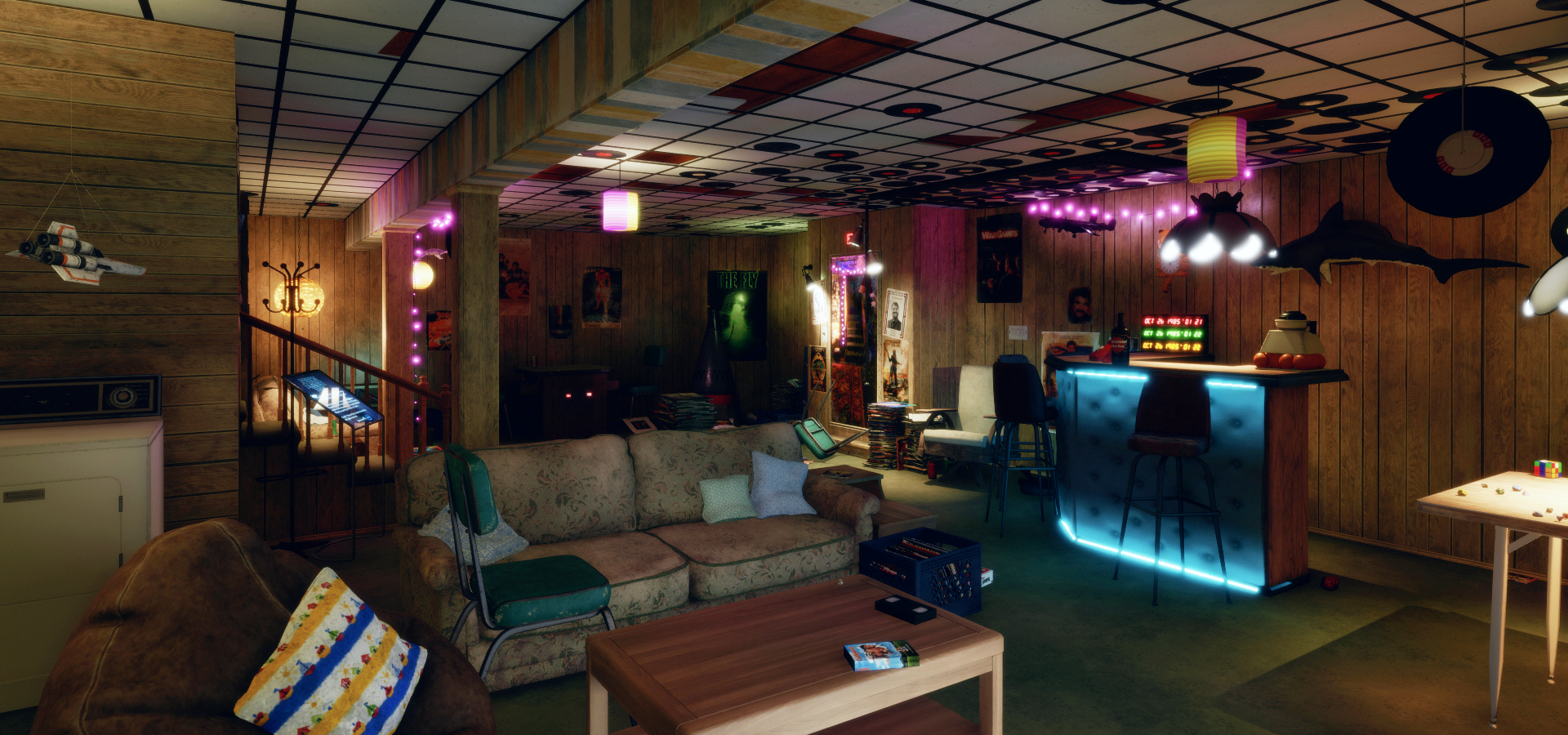
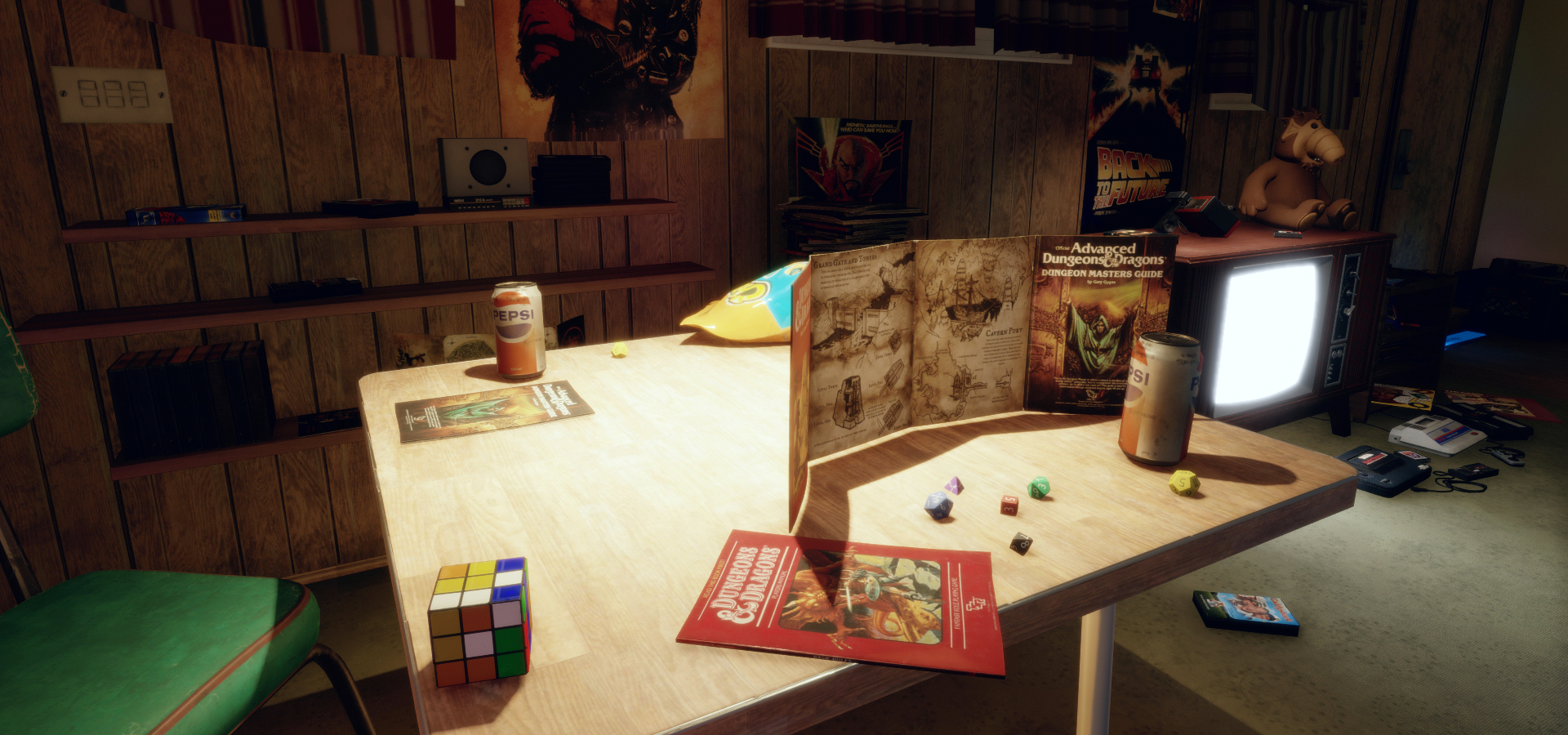
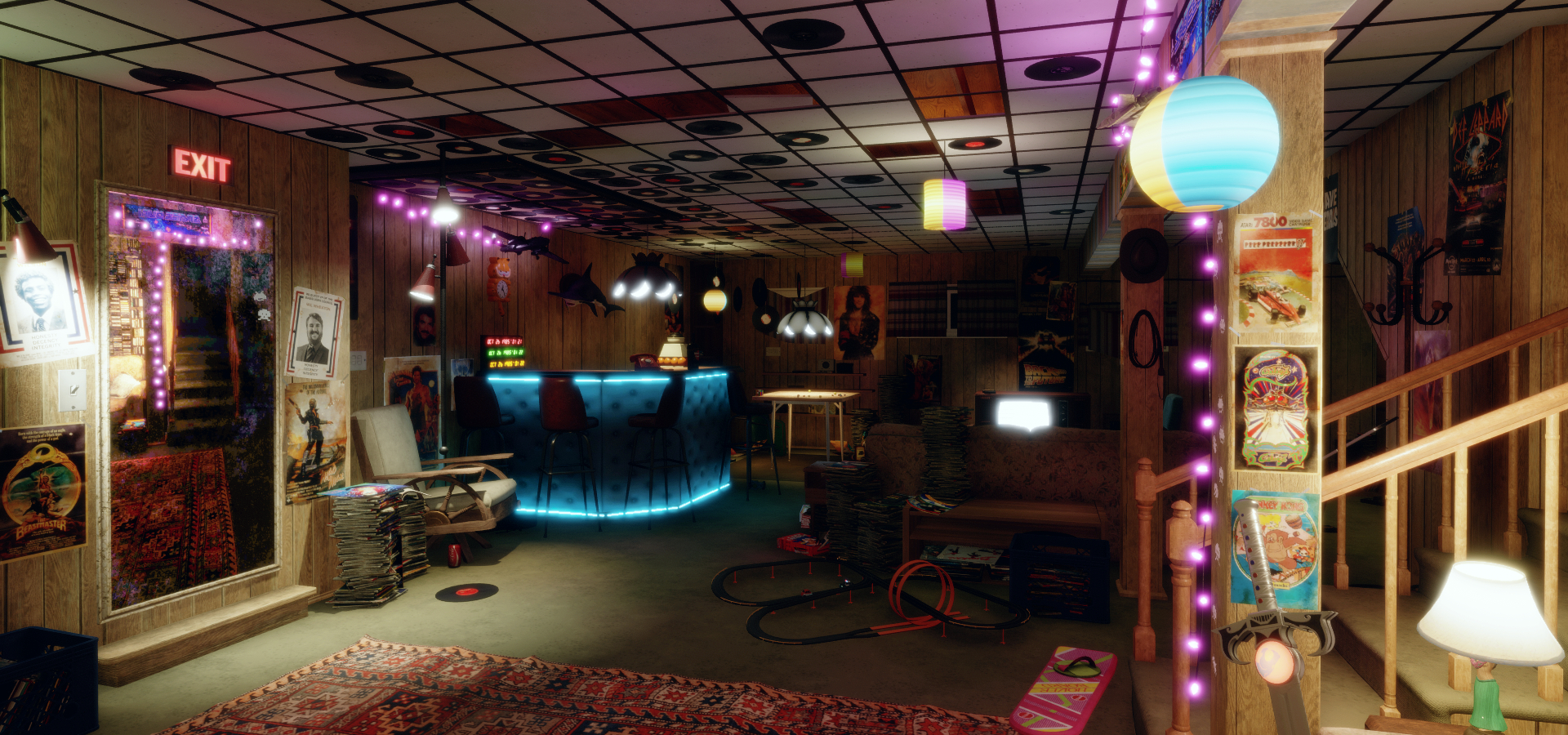
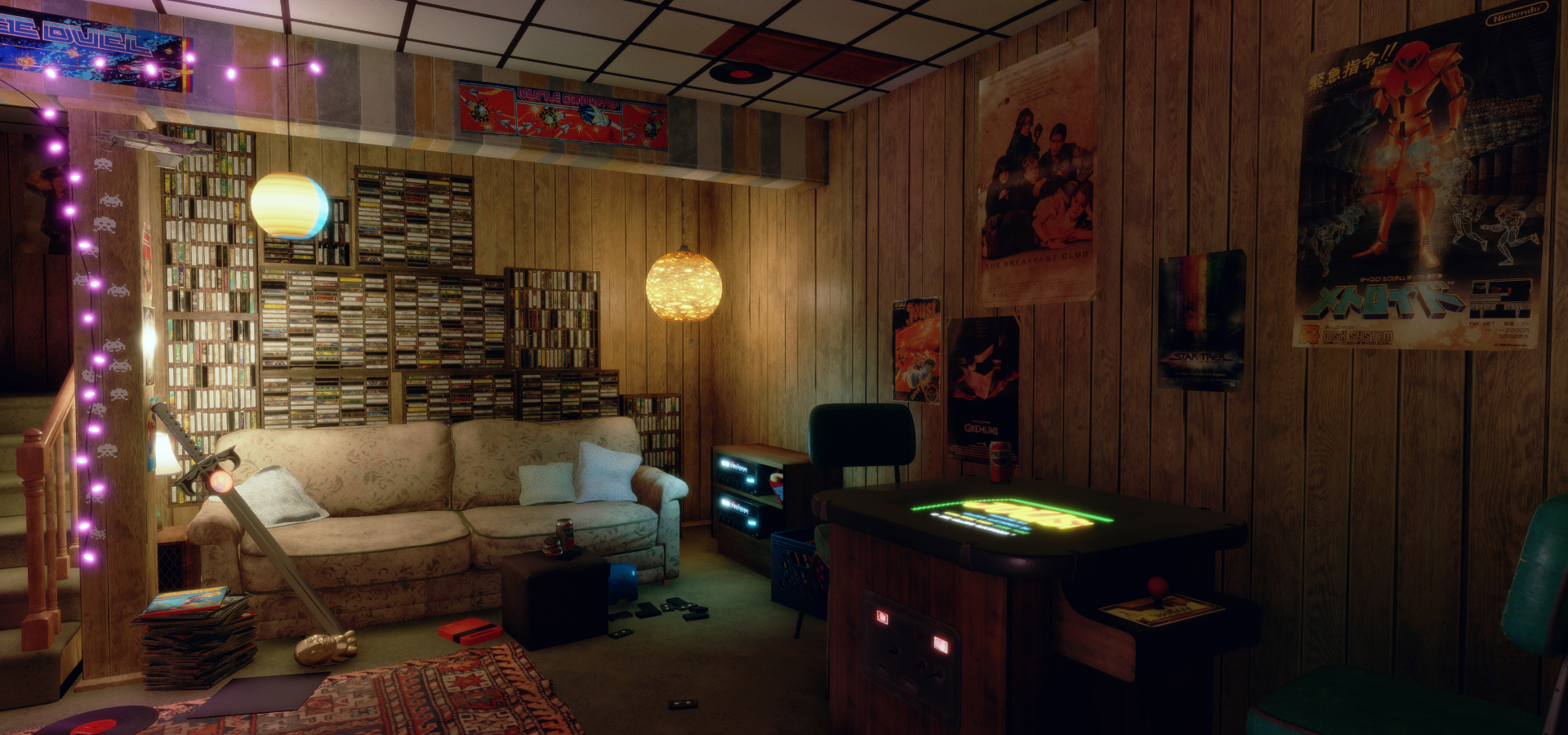
Unlike the book, where avatars visiting Aech spawn at the top of the stairs leading down to the Basement, visitors to Aech’s Basement in Sansar spawn in the basement itself.  Walls panelled in wood, as per the book, it is literally chock-a-bloc with 80’s references. The RCA TV is there, although it has been moved against a wall, rather than occupying the centre of the room, its place taken instead by a sofa. However, the consoles are there on the floor in front of it – two Segas and what looks like (from a very quick Internet search, I confess to being no expert), a Mattel Intellivision. The 80’s posters are on the wall celebrating films of the era, and albums by popular 80’s musical artists are scattered around.

A little liberty has been taken with the video tapes, as they are VHS rather than Betamax, while against a wall near the spawn point sit racks of audio cassettes. The rest of the space – in suitably 80’s style lighting – is furnished as one would expect a den to be – large, plump sofas, armchairs past their prime, a games table and – against one wall, a bar.
Aech's Basement, Sansar; Inara Pey, March 2018, on FlickrSansar: Aech’s Basement

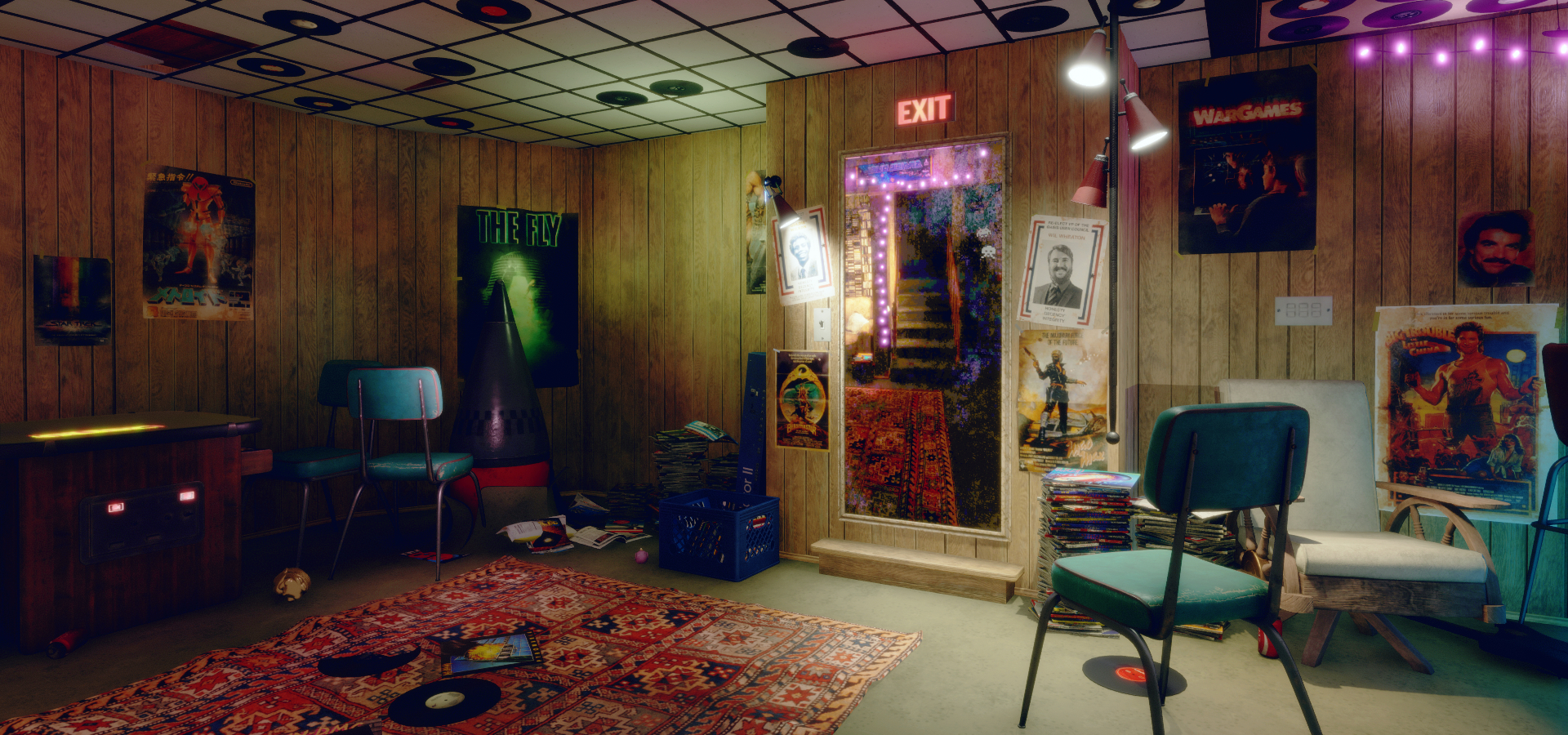
The Easter eggs are to be found all over – from the posters , albums and VHS films, through to models from Buck Rogers in the 25th Century and Battlestar Galactica, to space invaders climbing down a ceiling support – and more (I’m just not going to spoil the fun of finding them for yourself). I particularly like the election poster for Wil Wheaton (he of Star Trek the Next Generation fame, as well as a respected blogger, narrator of the Ready Player One audiobook and – in the novel – the vice-president of the OASIS User Council).

Connected to Aech’s Garage by a door at one end of the room, the Basement is a lot smaller than that experience, and can great a little crowded with more than half-a-dozen avatars in it; however, it is as visually rich. Sansar’s quirky interactive capabilities do mean things can get thrown around, but hopefully, this will improve as those interactive capabilities are refined.
Aech's Basement, Sansar; Inara Pey, March 2018, on FlickrSansar: Aech’s Basement

Sponsored by Intel, and licensed by Warner Brothers Entertainment, Aech’s Basement and Aech’s Garage make for an ideal joint visit to the world of Ready Player One, whether or not you’ve seen the film and – in the case of the Basement – especially if you’ve read the book.

Experience SLurl

Visiting the Drew Struzan Gallery and Studio in Sansar

The Art of Drew Struzan: The Studio Experience

On Friday, March 23rd, the The Art of Drew Struzan: The Studio Experience opened in Sansar. As the name suggests, it is a celebration of the art of celebrated illustrator, Drew Struzan – and it is perhaps one of the most visually superb and compelling experiences yet to surface on the platform, particularly for anyone (like me) with a love of films and all that goes with them (I love both film art and film soundtracks).

Drew Struzan

The Art of Drew Struzan: The Studio Experience is part of the The Hollywood Art Museum (HWAM) project, established by Greg Aronowitz with the aim of encouraging artists in the digital medium to find fresh inspiration in the traditional arts of Hollywood’s past, through the preservation and education of art used in entertainment.

I provided something of a “preview” of the opening, including a (very) brief look at Drew Struzan’s career here – which I hope you’ll read alongside this article.  For this piece, I’m focusing purely on the presentation of Drew Struzan’s work as it appear sin Sansar. But first, some preliminary notes:

The experience is in two parts: a gallery of Drew’s work, and a reproduction of his physical world private studio.  Access is via the gallery experience, which can be reached in one of two ways – via a direct URL, or via the Hollywood Art Museum experience – just walk to the entrance of Sound Stage 6, which advertises the exhibition, and you’ll be transferred to the gallery experience.

Both experiences can be enjoyed in VR mode or Desktop mode. However, if you’re visiting in Desktop mode, I suggest using first person view (toggled via F3) to get the best view of the art.

Also note that some of the pieces displayed in the “cinema” part of the gallery have associated audio recordings of Drew talking about them, indicated by a set of push buttons beside the art. These buttons work in both VR and Desktop mode. Instructions are provided on a board by the entrance to the “cinema”, but in brief:

  • Walk up to a button to trigger the audio track (only audible to you). Once playing, you can move away from the button so others can also trigger the audio. Slowly moving away from a button will stop the audio playback before the end, if needed. VR, users can additionally use their controller’s trigger button to start / stop the audio.
  • Note that if you step up to another button while audio from one is already playing, the current track will stop and be replaced by the audio for the button you are next to.
Name those films; the 20th Century Fox 50th Anniversary art produced by Drew Struzan in 1984, now part of The Art of Drew Struzan: The Studio Experience

Taking the Tour

The gallery space is divided into a number of distinct areas. The “lobby” area features some of Drew’s fine art, with portraits of Abraham Lincoln and Bob Dylan together with a self-portrait, as well as a more classic piece of art (Autumn) and more. A hallway leads off this, displaying more of his fine art, including a fabulous self-portrait in pencil and a phenomenal study of Albert Einstein, before reaching the “film” element of the exhibition, which starts with some magnificent pieces celebrating George Lucas, 20th Century Fox together with the art used for the cover of Spielberg / Williams collaboration soundtrack album. There’s also a collection of truly amazing portraits of some of Hollywood’s greats, which Drew produced for US postage stamps and for Franklin Mint.

Sinatra (l, for Franklin Mint), and John Wayne, Edward G. Robinson, Jimmy Stewart, Johnny Carson, Lucille Ball and Henry Fonda (all produced for US postage stamps), and Cary Grant (r)

Beyond this is the “cinema” exhibition space, and the collection of Drew’s film-related art, and the point where the audio options are available.

This features individual film posters (including the 1977 Star Wars “Circus” poster Drew produced with Charles White III, complete with the story of the poster’s unique look related by Drew), placed along the main corridors.  In the centre of the gallery is a walk-through of “comprehensives” – drawings showing the initial layout and composition of a proposed artwork for the client to approve before going to the final illustration –  Drew has produced over the years. There is also a section featuring a Hellboy poster and a Star Wars poster showing the creative process in stages from initial drawing through to final poster; and a special display dedicated to the Back to the Future trilogy.

The Art of Drew Struzan: The Studio Experience

This entire environment is visually stunning. The set is that of an old-style movie theatre with Deco lighting, red carpets and ornately-panelled ceilings, completed by excellent lighting. There is a richness to it that really give the environment a sense of place; exploring it in first-person genuinely gave me the sensation of being there – no headset required (although I imagine I’ll be totally blown out of my chair when I do get to see this experience in VR). As to the art – it has to be seen to be appreciated; it is just astounding, and the images here do not do it justice.

Beyond the “cinema” gallery is the entrance to Drew’s private studio – just walk up to the door marked Enter Here to be transferred to it.This is again stunning: a complete and accurate reproduction of Drew’s physical world studio. Just how accurate? Well, it has been produced by the Sansar Studios team working in collaboration with Insight Digital, a company specialising in photogrammetry and laser scanning to recreate sites of antiquity in digital format for detailed examination. some of their work has already been imported to Sansar at the Voyage Live: Egypt experience, and you can read about that work here.

Drew’s studio – reached via The Art of Drew Struzan: The Studio Experience

For Drew’s studio, Insight took over 4,000 photographs of his workspace and laser scanned the objects and items inside it. “They went front, back, side, top, bottom, behind. Everything!” Drew says of the work. The result is – if I might use that word again – stunning.  literally everything from the original studio space is here, beautifully reproduced.

The wealth of detail is extraordinary, and I strongly recommend careful exploration and viewing, simply because there is so much to see (watch out for the drawer with the stash of paints…). While touring, a couple of people did comment that things seemed a little big, but I assume the space was slightly scaled up to reduce issues of avatars colliding with one another when looking around in groups. And when you have (eventually) done, use the door beneath the deer head to return to the gallery.

Drew’s studio – reached via The Art of Drew Struzan: The Studio Experience

A truly marvellous and visually impression pair of experiences, and kudos to Greg Aronowitz, Insight Digital and the Sansar Studios team under Jason Gholston for bringing it all together, and very special thanks to Drew Struzan for sharing both his art and his personal space with us in this way.

Experience URLs

Eternity in Sansar

Sansar: Eternity

Eternity is the name of the fifth experience by C3rb3rus that I’ve visited in Sansar. I’ve previously blogged three of the others – 2077 and Darkwood Forest in-depth and The Diner as a part of my coverage of the Sansar’s Scariest competition – I have yet to write about Floating Temple, as I’m waiting to see if it develops further!).

Eternity is on a much smaller scale than the previous designs by C3rb3rus – but it is intricately and beautifully detailed and animated, making a visit a must. It’s a single scene environment, presenting an enormous structure in two parts, standing atop an island of floating rock, serenely suspended in the air.

Sansar: Eternity

The first part of this structure is open to the sky above, its high walls an intricate lattice of wood (or copper?) supported by beautifully embossed metal ribs. In general design, it appears church-like: a long, narrow nave leading to a short transept / choir / apse. The aisles either side of the nave are represented by two intricately patterned ramps which gently slope up along the line of the structure to follow the outward curve of the walls. Directly in front of the landing area, almost blocking the way forward, is a great mechanical horse running at the gallop without ever-moving.

To call this a work of art would be an understatement; it is quite simply magnificent. held above a platform on which gears turn and roll by a single supporting pole, this horse is a masterpiece of construction. Burnished in bronze, its legs are fully and naturally articulated, moving with the fluid grace of a horse, head and neck moving in unison with its strides. Partially covered by engraved plates and partially open to the world, the beast has a mechanised interior which rocks and moves in response to its gallop, almost as if driving it, even though none of the gear wheels (understandably) are turning.

Sansar: Eternity

Beyond the horse – which can be viewed from the rough floor of the structure or the ramps on either side – visitors can make their way to the “transept” where more mechanical wonders await. The “floor” here resembles the partially exposed inner workings of a clock or pocket watch with gears meshing and turning and flywheels rocking. A raised dais continues this theme, stretching back towards a single opening. Overhead, an orrery turns embossed metal worlds in orbits around a central point. While one of these worlds is ringed like our Saturn, they do not otherwise appear to be representative of our own solar system.

It’s a stunning, magical setting – but again, the orrery and floor workings can easily be overlooked as eyes are drawn to the far wall of their structure. Solid in nature, all of its entire face is a fabulous tribute to the elegance of clockwork mechanisms, complete with a great brass-like device standing in the middle, above that open doorway mentioned above.

Sansar: Eternity

Surrounded by the copper / bronze gears and flywheels, this round face has the look of both a clock – albeit it one telling time in a way foreign to the human mind – and the great circular window of a church or cathedral.  Indeed, the vertical face on which it is mounted – part of the second, fully enclosed structure in the scene – does through its very shape, heighten the feeling of this being a church, a place raised to the glory of Time.

Eternity is a marvellous portrayal of both our relationship with, and insignificance before, Time itself.  The horse running at the gallop is the very embodiment of tempus fugit, the orrery a reminder that some things endure within the passage of time for far longer than we do, while the great engraved heart suspended by chains above it perhaps stands testament to our own fleeting mortality.

A marvellous, richly detailed and evocative installation.

Experience URL

Sansar: client Atlas update and Anu’s Copper Valley

Sansar: Copper Valley

As per my 2018 week #3 Product Meeting notes, the Sansar Client Atlas has been updates to include the new Popularity sort option and currency indicator.

When selected from the sort drop-down menu (see below), the Popularity option orders the listed experiences in a tab by current real-time use, so those with avatars actually visiting them will be listed first. In addition, those experiences with avatars in them have a concurrency indicator in the top left corner of their thumbnail image. This is a near real-time indicator that the experience is in use at the time it is seen in the Atlas.

Client Atlas: popularity in sort drop-down (circled), and the concurrency indicators (arrowed) available for all experiences with avatars in them on all tabs

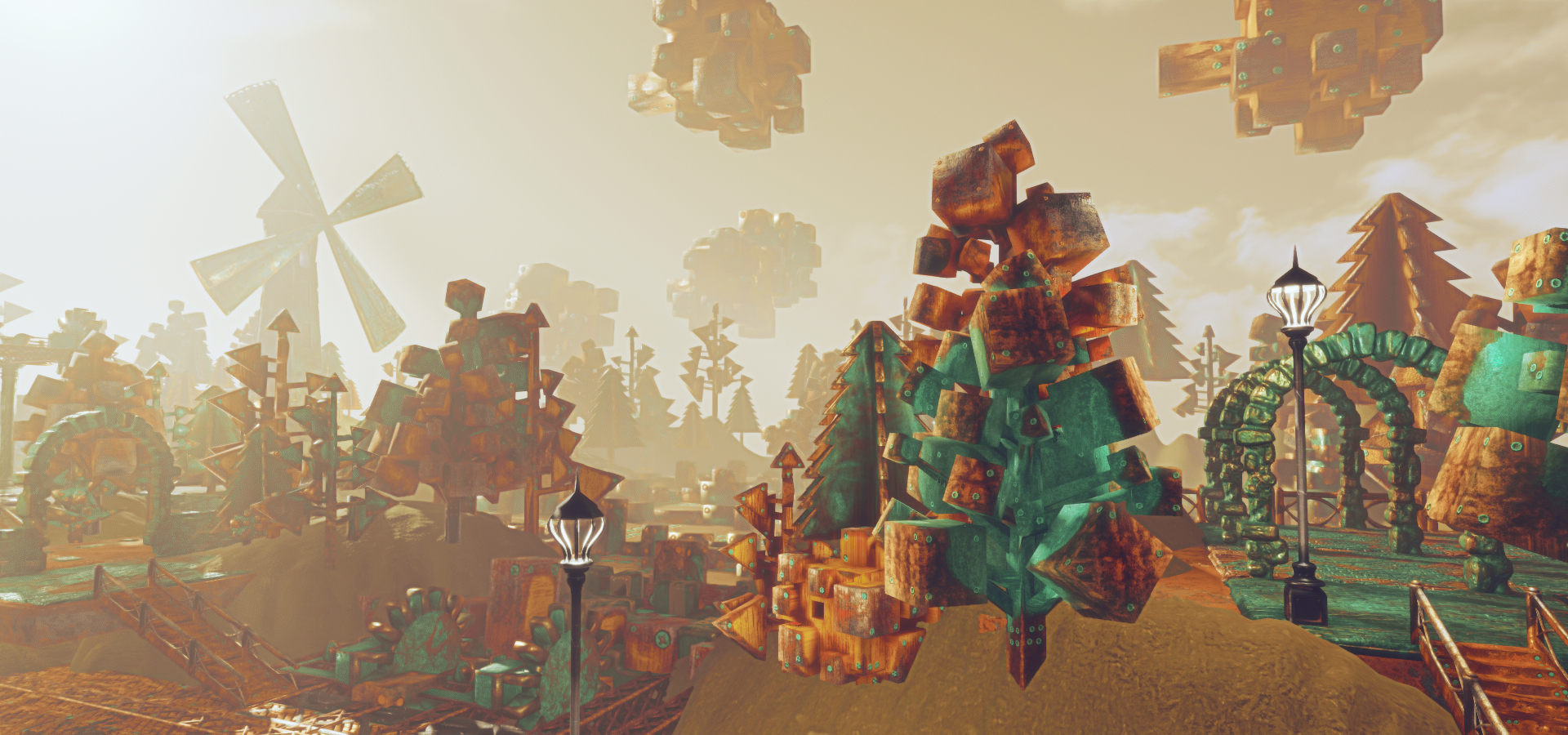
The banner images from that Product Meeting report was an advanced look at a new experience by Anu Amun, which is now publicly listed in the Atlas, by the name Copper Valley. A work-in-progress, it offers a mechanoid landscape inspired by steampunk.

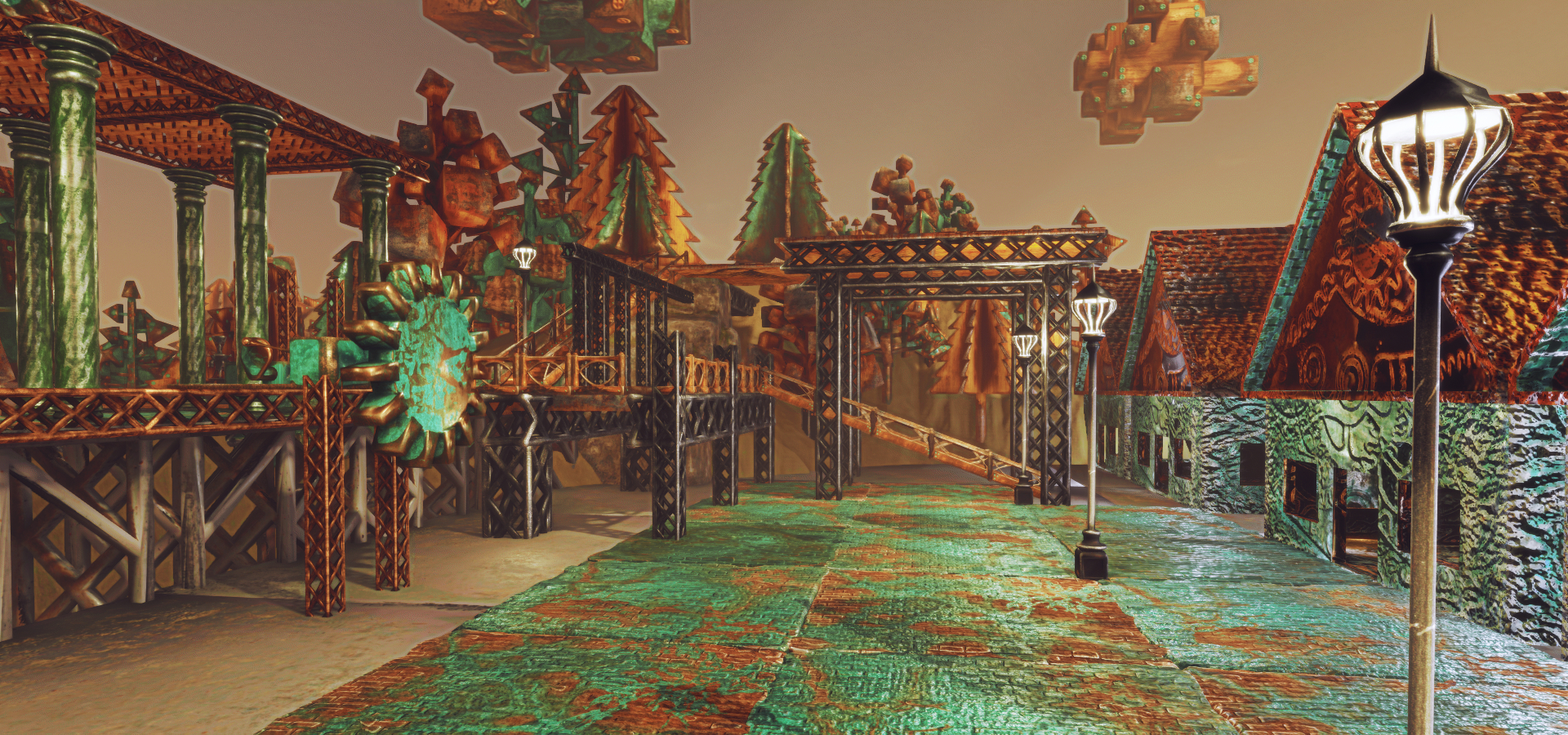
The spawn point for the experience drops visitors onto a platform roughly in the middle of this curious landscape. A raised walkway runs behind the spawn point, linking a tall windmill, sails slowly turning, with stairs leading up to another platform. Steps also offer ways down to the lands below – on one side a row of little houses, their walls and roofs seemingly made of copper – walls green and aged-looking, the roofs pristine.

Sansar: Copper Valley

On the other side, through peculiar trees, looking like they’ve been cut from blocks of metal or cut from heavy sheets, and past Mecano-like seats, to where massive blocks rotate as if on long axles hidden just below ground, rising and falling from flat fields of screwed-down metal plates. Overhead, great bulky clouds drift across a dusty sky with “normal” clouds at much higher altitudes.

It’s a strange environment, complete with it own enchantment; a mechanical place where the sandy hills are gradually giving way to more of the metal plate fields with their rotating axles of blocks. So much so, that in one corner, the “fields” are still under construction.  Exploring this realm is a case of following the elevated paths, climbing the stairs, descending the steps and following your nose – but be warned! Some surfaces aren’t as solid as others.

Sansar: Copper Valley

Having enjoyed Anu’s Anu, I admit to being curious as to where Copper Valley might go. In the meantime, it makes for a most unusual visit.

Experience URL