Storytelling in Sansar

Sansar: Through the Waterfall – Jasmine

As a new – and still developing / evolving platform – Sansar is currently perhaps more a place for experimentation for many, rather than a place to inhabit or use productively (which is not to say it cannot fulfil use cases, as I hope my article on the recent Voyages Live: Egypt tour shows). Because the platform can be seen in this way, I’m constantly looking out for experiences that push Sansar’s current capabilities just that little bit harder – and Linden Lab has been encouraging experience creators to do just this, initially through their Creator Challenge, which took place a few months back (see here for more), together with the Halloween-themed Sansar’s Scariest contest, which closed its doors to entrants in mid-October 2017.

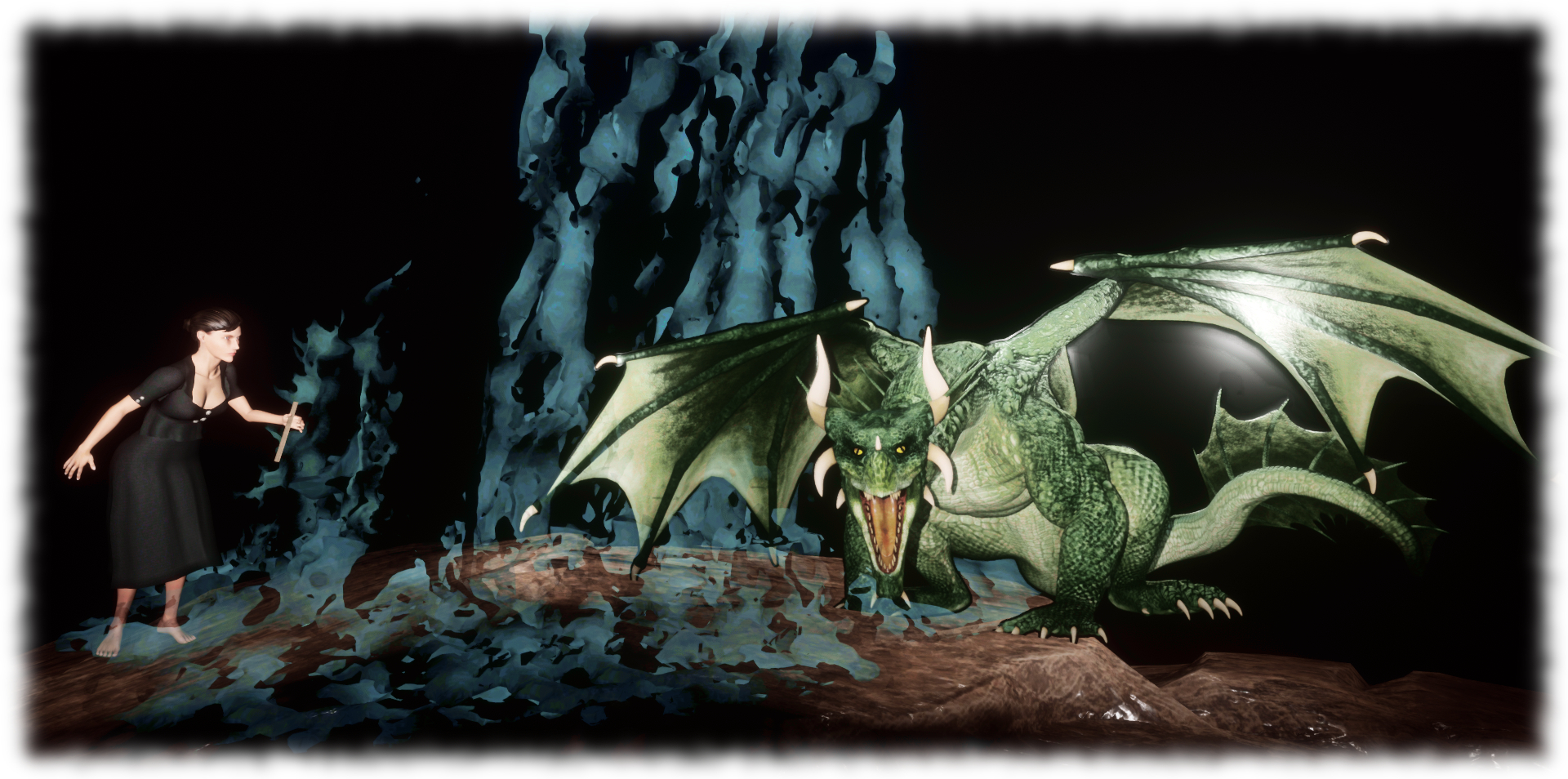
Creator Jasmine has used both competitions as a means of experimenting with Sansar’s potential as a storytelling platform. For the Creator Challenge, she produced Through the Waterfall: Enter Another World, which actually took the prize for Best Narrative Experience. This is the not-entirely-happy story of what happens to two young girls in the aftermath of a tragic car accident.

Sansar: Through the Waterfall – Jasmine

The story starts atop a giant desk on which visitors are informed, Without dreams, we can never become more than that which we already are… , together with an invitation to jump down to the floor and find the first of a series of keys.  Each key, when walked upon, teleports the visitor to a chapter in the unfolding story. It’s a fairly linear piece,  requiring the visitor to “fill in” the blanks of the storyline, so to speak, but the crafting and use of media and music help move things forward through the six chapters. I’m not going to say more here so as not to spoil anyone’s visit.

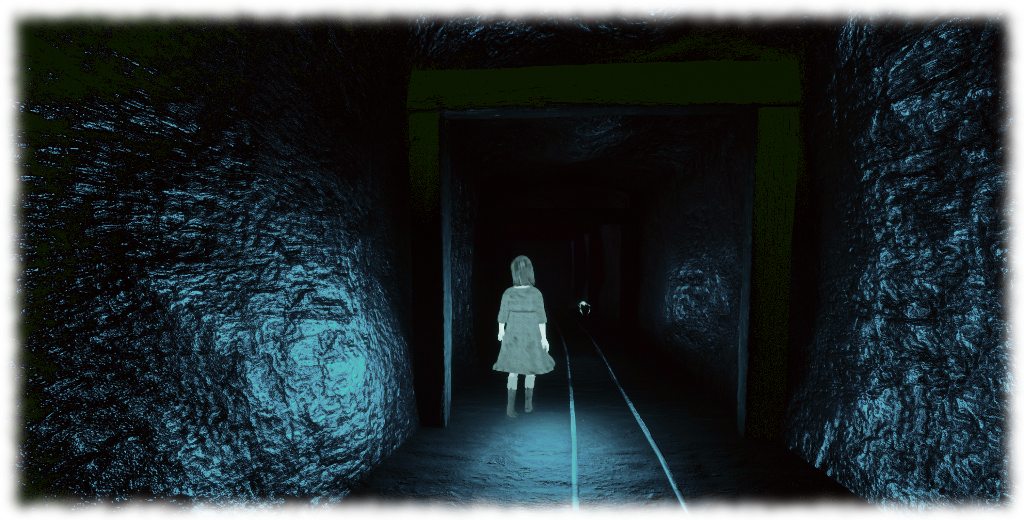
Miner Difficulties is a further narrative-based experience, with the story developed by Jasmine, and scripting / choreography by Galen (the two of them working under the title of Through the Waterfall). The similarities between this story and that of Through the Waterfall: Enter Another World are fairly clear: both start in similar surroundings, both involve the visitor in an unfolding narrative (an introduction and three chapters for Miner Difficulties, rather than the intro and six chapters of Enter Another World). However, it is the differences in the way the story is managed with that sets Miner Difficulties apart from Jasmine’s earlier work and helps mark how Sansar’s capabilities are gradually unfolding and lending themselves to more sophisticated use.
Sansar: Miner Difficulties – Jasmine and Galen

Whereas Enter Another World relied upon the discovery of keys and narrative deductions on the part of the visitor to link the six chapters of the story, Miner Difficulties uses two “living” guides to steer visitors through the story and piece together events. These are a little bird and a little girl.

Again, I don’t want to spoil a visit, so I’m not going to say much on what to expect. Suffice it to say that the bird acts as a guide through the woods, leading visitors to the little the girl (and then continues onwards with you as you travel with her). The girl also acts as a guide  – but as well as leading you onwards, she also talks to you as she does so, giving a natural structure to the narrative. Both bird and girl are beautifully choreographed and give a great sense of depth to the experience.

Sansar: Miner Difficulties – Jasmine and Galen

To those used to the complexities and capabilities of Second Life, these experiences may seem a little simplistic. However, they do demonstrate the potential for Sansar to become a platform for storytelling – and with the growing capabilities for both VR and Desktop mode interactions, it will be interesting to see how narrative-based experiences develop.

In terms of Halloween / ghostly experiences, I found Miner Difficulties one of the more involved in Sansar, and deserving of its status as a featured experience.

Experience URLs
A Regency picnic in Sansar

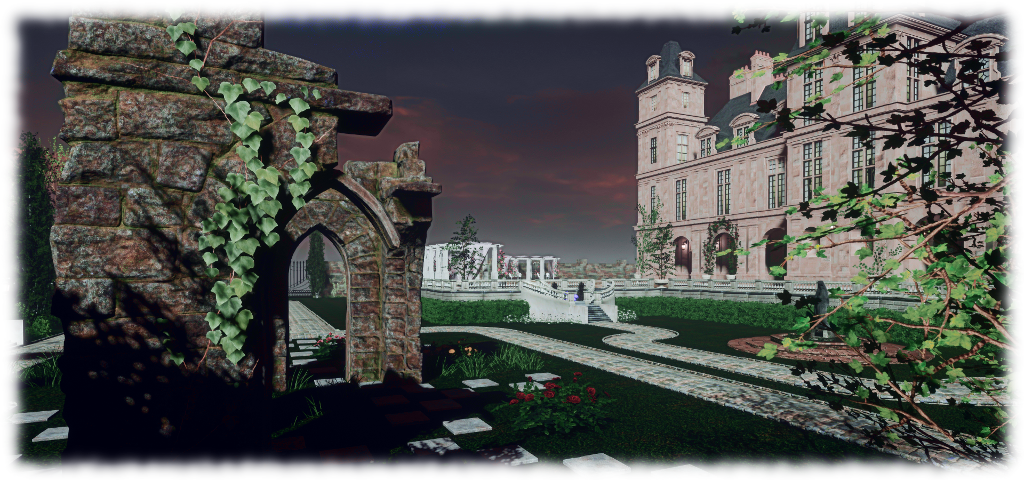
Picnic at Mr. Darcy’s

Step back into Regency England and pay a visit to Mr. Darcy’s splendid manor house and grounds. Here you can picnic as you watch the croquet match (even play), waltz to a sweet melody on the vast marble terrace or just take a long walk to gather your thoughts.

So reads the invitation from Solas (SolasNaGealai in Second Life) for people to visit Picnic At Mr. Darcy’s, one of her Sansar experiences. For those seeking a relaxing, period walk and time with a friend, it could be just the ticket – albeit with a little bit of a twist in places.

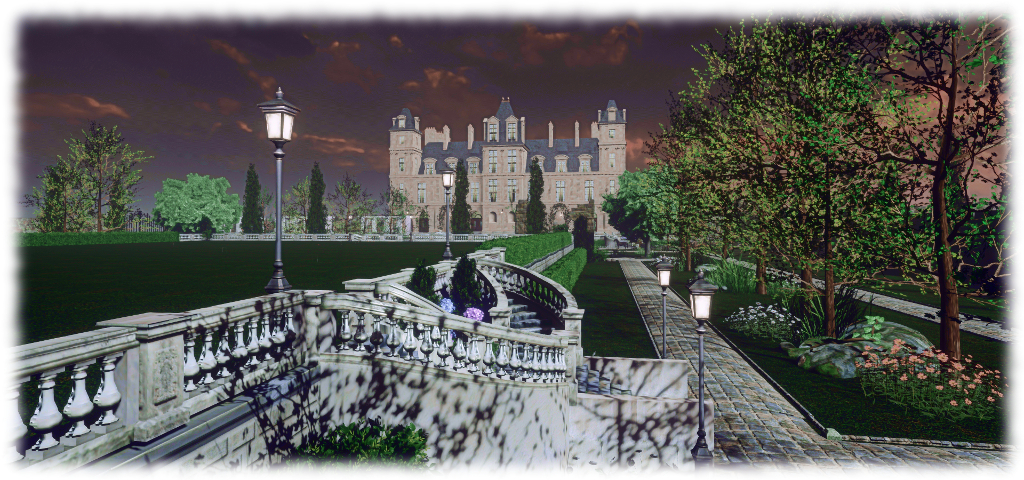
As the invite states, visitors are offered the chance to visit the grounds of Fitzwilliam Darcy’s magnificent Pemberley manor house as imagined by Solas, and spend time exploring them. A visit starts on the grand lawn, with Tchaikovsky‘s waltz from Sleeping Beauty playing in the air. Behind the lawn, the façade of the house rises as a stately edifice, while immediately alongside the spawn point is the promised croquet game. Alas, play would appear to be restricted to those in VR mode (although those in Desktop mode could perhaps play a variant of the game based on tossing the balls around!).

Picnic at Mr. Darcy’s

A single oak tree grows from the lawn, shading a picnic blanket with hamper and gramophone beneath its branches. A pergola sits close by offering further edible delights – clearly, Mr. Darcy likes to entertain and keep his guests well fed! A formal garden borders the raised lawn and separates it from the manor house. Reached via stone steps which curl down from the cardinal compass points of the lawn, the gardens offer paved paths ready for visitors to stroll.

The grand house itself rises from a marble topped terrace which sits above the gardens, affording a grand view out over the gardens and lawn, the remains of an earlier building – perhaps left as a folly –   sitting between house and lawn. More pergolas sit on the terrace, and it is easy to imagine an afternoon dance being held here one fine summer’s day, with ladies and their gentlemen gliding over the tiles of the terrace, or sitting in the netted shade of the pergolas.

Picnic at Mr. Darcy’s

Unfortunately, the house is but a façade, and not a place to be itself explored. I would also suggest the sitting itself is to the rear of the house, rather than the frontage; there is no broad drive one might expect, leading up to a grand entrance designed to reinforce the status of the owner. This does not detract from the setting, however; rather the reverse, as it suggests visitors are indeed guests of Mr. Darcy, having already been formally greeted and show through the house to the gardens.

What I particularly like about this design are the little eclectic incongruities. Mr. Darcy is a Regency man, in his prime in the early 1800s – yet the choice of music comes from the opposite end of the 19th century, well outside of the Regency period (1890). Similarly, the gramophone sitting beneath the oak tree on the picnic blanket belongs more to the early 20th century, while the modern game of croquet on the lawn and the gas lamps both lean more towards the period immediately after the Regency.

Picnic at Mr. Darcy’s

But again, rather than detracting from the scene, these touches add an interesting depth. Dances, for example, were very much part of the period, and whilst from a later time, it is nevertheless easy to picture gowned ladies and tailcoated gentlemen gliding over marble of the terrace to the Sleeping Beauty waltz and quietly conversing. Similarly, the presence of gas lamps in the grounds suggest that Mr. Darcy is forward thinking, adopting the technology just as it starts to make a public appearance on the street of England, while the croquet set perhaps indicates he has an interest in the game just ahead of it being more formalised through recognised rules. Even the gramophone gives a certain “feel” to the scene – a reminder that we are perhaps travellers from another time, looking in on Darcy’s world.

I hope that as Sansar’s capabilities develop, Solas will enhance this scene; it would be a joy to return at some point in period garb and genuinely participate in a dance at Pemberley (out on the terrace or perhaps even indoors in a suitable hall!), or enjoy a game of croquet whether in VR mode or Desktop mode, or simply wander the gardens and see more flora and accompanying fauna appear.

Experience URL

Visiting the House of Woe in Sansar

House of Woe

Halloween is approaching, and in both Second Life and Sansar, suitably themed regions and experiences are appearing; the chance of a US $10,000 prize in the Sansar’s Scariest.

I’ve no idea if House of Woe by Nick the Brain Guy is an entry in the Sansar contest, but as it attracted my attention in the Atlas, I decided to hop in and take a look. It’s a nicely interactive experience – one which can actually take up a fair amount of time, and can be enjoyed in a group. However, it does have one or two issues.

Welcome. I see you made it out of this dreadful storm.  I am the butler, and I greet you in the name of Baron Nicolas Winterborne, lord of this house and grounds. He’s quite the master of obscure knowledge you know; his wife is too, but I would advise steering clear of her.  Now, now! No need for hysterics! I bid you enter – and staayyy…

House of Woe

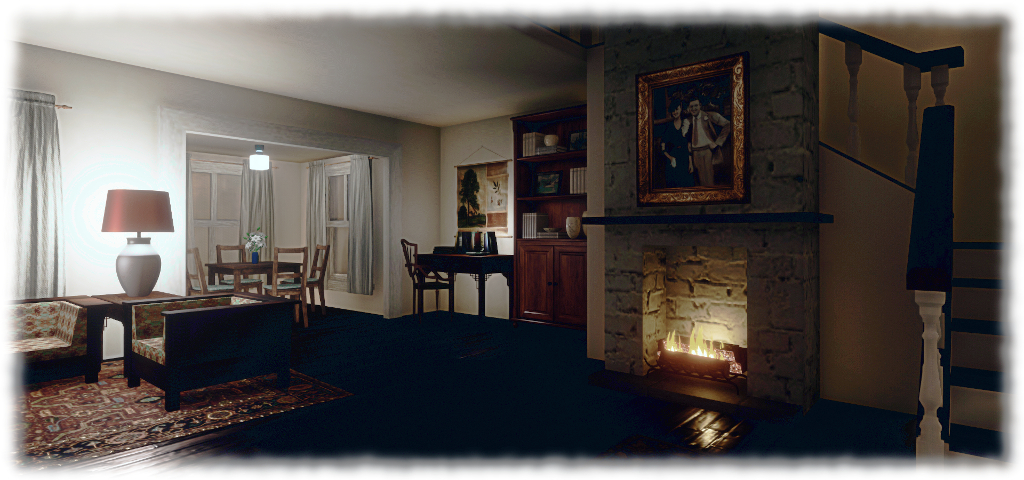
Thus resonates a sepulchral voice as you arrive in the entrance hall of a great manor house, the doors to the dimly lit hall creaking open before you as lightning flashes and thunder peels against the hiss of rain and howl of wind. Before you enter the main hall, I strongly advise you collect one of the candlesticks to one side of the entrance way  (left-click to select and pick up in Desktop mode); you will need the light! More are scattered around the house should you be forced to drop one to collect something else.

I don’t want to give too much away from those who wish to solve the mystery and “escape” the house. Suffice it to say, there are three items scattered through the house (which extends over several floors) which must be found and carried to the entrance. What they are I’m not saying – you’ll have to discover this for yourself. Just explore the main hall carefully, and listen for the disembodied voices of Lady and Lord Winterborne who will respectively tell you what to do and offer clues as to where to find things.

House of Woe

This is an involved experience, requiring time to complete. It’s also one ideal for tackling in a small group – say 2-4 people – which makes carrying things a lot easier, as well as adding to the fun of exploration and discovery. However, it is an experience not without one or two problems.

The ambient lighting, for example, is far too dark (i.e. a blank screen) in places when in Desktop mode – thus making candle carrying essential. Ryan Schultz, whom I bumped into while exploring, reported these same locations offered sufficient illumination to be navigable sans a candle when in VR mode. However, a bigger frustration lies in carrying things (at least in Desktop mode). In fairness, this isn’t a fault in the experience per se, being an overall Sansar issue, but it does unfortunately intrude into enjoying House of Woe.

House of Woe – my candle has ended up embedded in the wall as a result of the door i’ve just walked through “snatching” it from my “hold” – a Sansar issues, rather than something specific to the experience, which can cause frustration

Simply put, a collision with something (again, I’m talking in Desktop mode, as I don’t use VR headsets, so cannot speak to those) – a door for example – when carrying an object, can “snatch” the object away from you, requiring you to pick it up again. Depending on where the object ends up (it could be embedded in / behind a wall, for example), this can get maddeningly frustrating when it happens a number of times, causing gritted teeth and muttering (and demonstrates why Sansar isn’t as yet ready for the more casual user).

Which is a shame, because House of Woe can be an involved visit as you wander around, up, down and through the mansion – and there are a lot of hauntingly nice touches to look out for, as well as trying to find the special objects.

Experience URL

Virtual Egyptology: a journey in time in Sansar

Voyages Live: Egypt: people arrive at the cenotaph at Gebel el-Silsila. as recreated in Sansar from a model built by INSIGHT Dr. Phillipe Martinez is centre foreground in the blue jacket

On Wednesday, October 4th, I was one of a number of people who joined a special immersive “voyage” through ancient Egypt, visiting three sites of antiquity which are not open to the public in the physical world, but which have been digitally re-produced in a virtual environment for the purposes of study, and have also been optimised for presentation in Sansar.

Joining us for the journey were Kevin Cain, Director of INSIGHT – the Institute for Study and Implementation of Graphical Heritage Techniques (also sometimes called Insight Digital) and Dr. Philippe Martinez, INSIGHT co-founder and Lead Archaeologist, author, and University of Sorbonne professor.

The cenotaph at Gebel el-Silsila, located on the banks of the river Nile, available to visit in Sansar

INSIGHT, in collaboration with the Egyptian Ministry of Antiquities, has been at the forefront of digitally capturing sites of antiquity in Egypt, and Dr. Martinez himself was one of the earliest exponents of computers and 3D capabilities in archaeology.

In the 1980s, for example, he encoded the decoration of 12000 blocks dating to the time of Amenhotep IV – Akhenaten, discovered reused in the 9th pylon at Karnak. The database was then used under artificial intelligence techniques with the output of hundreds of virtual reconstructions belonging to the first temple dedicated to the god Aten. Also around that time, he spent two years working on a 3D reconstruction of the ancient Egyptian temples of Karnak and Luxor.

Kevin Cain (l) and Dr. Phillipe Martinez (r) and, inset, their respective Sansar avatars (again, left and right)

INSIGHT’s work now involves state-of-the-art techniques such as LiDAR (Light Detection and Ranging), a surveying method that measures distance to a target by illuminating it  with a pulsed laser light and measuring the reflected pulses, and photogrammetry, the science of making measurements from photographs. INSIGHT’s work in recreating sites of anitiquity in 3D was also intriguing revealed during some of the earliest looks inside Sansar prior to the Creator Preview opening, when images of the tomb of Nakhtamon (“TT341”) were used in various promotional talks and demonstrations of the platform (see here for an example).

The tomb of Nakhtamon is one of three locations thus far reproduced in Sansar in a collaboration spanning INSIGHT, the Sansar Studios team, the University of Sorbonne and the Egyptian Ministry of Antiquities. Both it and the cenotaph at Gebel el-Silsila, were scheduled stops on the tour, but such was the interest shown in the tour and in INSIGHT’s work, the tour was  extended to include a reconstruction a section of the Ramesseum “Coronation Wall”.

Tomb of Naktamon (“TT341”) in Sansar – part of the collaboration with INSIGHT and visited on the tour

For the purposes of the event, the two primary destinations together with the Voyage Live: Egypt experience, where people initially gathered, were spun-up in their own special instances. This meant that casual visitors to either Voyages Live: Egypt or the locations on the tour would not feel that they were intruding on a private event or have their own visit spoiled by a group of avatars suddenly crowding them out and getting in the way.

This in itself demonstrated a key strength of Sansar: the ability to spin-up instances of experiences to deal with special events and the like, without necessarily having to close them off from public access / other uses occurring at the same time.

The Ramesseum “Coronation Wall” reproduced as a 2 million poly model in Sansar, optimised from an 800 million poly original.

At Voyages Live: Egypt, attendees were introduced to Kevin Cain and Philippe Martinez, and a little time was spent talking about INSIGHT’s work, the backgrounds of our guides (Mr. Cain, a specialist in computer graphics and imaging worked widely in the film industry before a fascination with preserving sites of antiquity drove him to establish INSIGHT as a non-profit entity specialising in the digital recording and mapping of sites of antiquity, as which has now worked in a dozen countries around the globe).

INSIGHT’s work is not only fascinating from a lay perspective – offering the potential for VR and a platform like Sansar to open-up historical sites for education and learning across all ages without putting the actual site at risk – but because it is of very real benefit in helping to preserve ancient sites from accidental damage, whilst providing archaeological teams an opportunity to effectively study locations even when the locations themselves are not open to study, again to help preserve them.

Continue reading “Virtual Egyptology: a journey in time in Sansar”

Sansar gets spooky in Spinnervale

Sansar: Spinnervale

What happens when you’re invited to dinner with friends, only to arrive at their little place in the country as the Sun is setting and the Moon rising and find music playing, the front door open, but no-one home? All you have is a hurriedly written plea for help:

Please help!!

Bob went to the wood this morning saying he’d be back in a few minutes, but he never returned. I’m worried!!

I’ve gone to look for him. Please come help me. Follow the river until you see the rock bridge and cross the river into the woods. I’m going to look at the cave and also lover’s leap. I don’t think he would have gone to Bat Hollow.

You’d hopefully set out to to provide the requested assistance. And thus you’d be drawn into the realm of Spinnervale, the seasonal experience designed by Debi Baskerville.

Sansar: Spinnervale – where are your hosts?

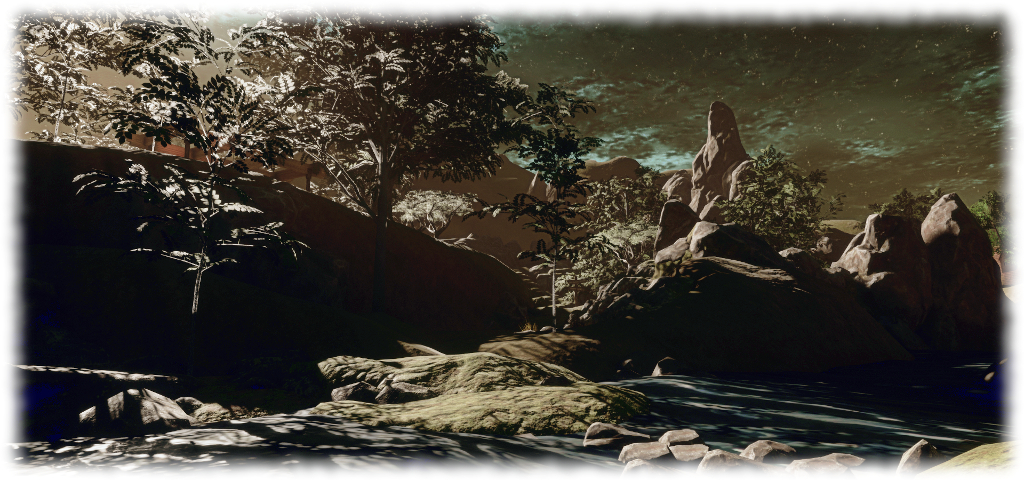
The river you’re asked to follow is located behind the house, a short walk away. “Rock bridge” is perhaps a little bit of a misnomer, as what you’ll actually be looking for is a set of stepping stones fording the water a little way upstream from the house.

On the far bank, the path turns sharply right, running under the shadow of a low cliff and up a shallow rise to where a sign points the way to either Lover’s Leap or to the Great Cavern. The way to Lover’s Leap is marked by steps cut into the rock, offering an easy route up to the plateau above. Before you take either route, however, walk down the far side of the slope and take a torch from the waiting basket (“get light” in chat). The best thing to do from here on is to swap to first-person view, as the light cast by the torch will accurately follow your camera and moves (what appears to be a function error within Sansar prevents it from doing so when in third-person view).

Sansar: Spinnervale – the river crossing

Here the route passes a pergola with benches beneath, strung by the nets and folds of spiders’ webs – a portent, perhaps? Facing the gazebo is a rocky formation weathered to form a set of natural step climbing upwards, inviting you to follow. They lead the way up to a wooden bridge crossing a narrow gorge – the infamous lover’s leap. Beyond this, the route winds up into the trees and shadows, where webs once again become prominent – and larger shadows move within the darkness!

The path to the Great Cavern offer move of a clue that you might find those you’re seeking – the steady beat of slightly ominous music. As you approach the entrance to the cavern, another noise will grow: a strange sucking, hissing sound, coinciding with the appearance of more webs. And inside the cavern you …

Sansar: Spinnervale – Bat Hollow

Well, you’ll have to pay a visit yourself and find out. However, particularly sensitive arachnophobes may want to think twice, both in the cavern and in the hills above Lover’s Leap!

Spinnervale is an entertaining experience given the time of year, and Debi has come up with a handy way of allowing for object interaction (remembering Spinnervale was opened before the Discovery Release made more direct object interaction possible in Desktop mode). It’s a nicely atmospheric build and makes for a fun explore.

Experience URL

The beauty of Digital Arts in Sansar

Digital Arts Gallery: from left to right – Natalie Shau, Ben Heine, Keith Webber Jr (far wall), Grégoire A. Meyer, and Martina Stipan

While it is still gaining form, Sansar is already attracting both artists and those with an interest in art, and I’m slowly working my way through the art-related experiences currently available in the Atlas and dropping into whatever catches my eye. Places such as the Digital Arts Gallery, designed and curated by Mad Max, and which focuses on the work of digital artists from around the globe – which I admit piqued my curiosity for a very specific reason when I saw the Altas entry.

The setting is well conceived and executed. Visitors arrive in a small lobby area with windows to three sides offering a view of a late evening sky – it’s as if we’re high in a skyscraper somewhere, about to enter an exclusive gallery space. A larger hall opens off this foyer space, neatly dissected by a central display area of alcoves, and which offers choice of routes through the gallery: right and through the Featured Artist display, or left through the “collected artists” section.

Digital Arts Gallery: Adam Martinakis – Golden Boy and Materialised

The Featured Artist at the time of my visit was Adam Martinakis. It was seeing his name in the Atlas entry for the experience that caught my eye; I first encountered his digital sculptures in 2012 through a piece written for Don’t Panic. I was immediately struck by the depth of his work: digital it might be, but it carries with it a realism and texture which truly makes it physical and tangible. It’s hard not to look at them and feel you’re looking at a 3D creation, one which if you could touch them, would reward you with the feel of cut stone or slick paint finish beneath your finger tips; there is a marvellous quality to the filigree elements of Golden Boy (featured in this exhibition and seen above left) which is so beautifully rendered it presents a wonderful sense of it own existence in the physical world.

The images selected for this exhibition span Martinakis’ work from 2011 through to the present. Alongside of Golden Boy, and among his more established works offered here are Love for Light,  The Departure of Innocense [sic] and The Remains of a Memory. His more recent work is also represented, and I found myself strongly drawn to Adam, rich in substance and metaphor, while Last Kiss is simply mesmerising. I do admit to hoping to see Baptised by Fire – Prometheus or The Divisions of Pleasure offered here, but only because both pieces made such an impression on me when seeing them for the first time five years ago. However, their absence in no way detracts from the exhibition.

Digital Arts Gallery: Adam Martinakis

To the left of the entrance the gallery displays selected works by Keith Webber Jr., with a focus on his Abstract Fractal series, the remarkable and simple absorbing, Martina Stipan, who at just 19 years of age is already renowned for her digital landscapes, Natalie Shau,and  the remarkable Ben Heine with a trio of his remarkable digital portraits. To the rear of the gallery is art from famous music albums and series of panels by Zoran Cvetkovic and Zdravko Girov, tracing the history of Skopje from earliest times to the 20th century.

Digital Arts Gallery is beautifully minimalist in approach, offering the perfect environment in which to showcase the work of these artists. The lighting is almost perfect, thanks to the considered use of emitters (“almost” because Ben Heine’s Marilyn Monroe was unlit at the time of my visit). Even the looped music track feels appropriate to the gallery (although I’m admittedly biased towards music with a new age Celtic leaning, particularly when a Bear McCreary like hint weaves through a part of the music, as it does here).

Digital Arts Gallery: Grégoire A. Meyer

This is an exhibition which can be visited and appreciated with or without a VR headset. When visiting in Desktop mode, I would suggest moving to first-person mode (F3) and touring the gallery to more fully appreciate the art. If you’re adept with Sansar’s (still basic) camera controls, then F4 and flycamming offers another good way to appreciate the art here (in fact, I admit to spending a lot more time flycamming in Sansar than walking or running at the moment!).

Mad Max is open to feedback on the gallery, and to suggestions for future artists he might exhibit there. I have a couple of names I’ll endeavour to get to him for consideration. Should you visit and think of an artist you’d like to offer to Max, contact details are on the rear wall of the gallery.

Digital Arts Gallery: Martina Stipan

Experience URL