Linden Lab’s Dio and Versu websites appear

Update, February 19th, 2014: dio and Versu were discontinued by Linden Lab on February 19th, 2014. Links to their websites, etc have therefore been removed from this article.

Update January 1st, 2013: I finally took a proper look through the Versu FAQ and have provided further information in a new report.
LL logoLinden Lab have slipped out the initial cuts of the Dio and Versu websites. Currently, there is nothing on the corporate website relating to the latest items in the new product line-up from the Lab, although Dio caused a stir early in 2012 when a nascent website bearing the name was accidentally made public.

Neither of the new websites give much away – Versu in particular is rather bland, but both point to the new products potentially approaching a point where they’ll be launched in the near future.

The Versu website placeholder from Linden Research, December 2012

Versu will be the first product to emerge from the Lab directly as a result of their acquisition of LitleText People, also early in 2012, and has previously been described by Rod Humble in a Techcrunch article as, “Procedural interactive storytelling. Basically you set the motives and the behaviors of the individual characters and the plot gets generated as you go, and each time it’s different.”

Techcrunch themselves interpret this as meaning, “The idea here is to tap into collaborative storytelling, something that’s been gaining in popularity in online spheres, as evidenced by the traction social writing startup Wattpad has seen. But with Versu, Linden Lab adds a gaming element to interactive storytelling that essentially allows players to create their own characters which then write themselves. It seems like a smart way to capitalize on the observer tendency that’s turned Second Life players into story watchers.”

The new website, as shown above, currently gives little away, however, this is liable to change as the release / beta / however LL opt to launch, draws closer.

The new Dio website, by contrast, has more in the way of content. This is unsurprising, as it appears that Dio is actually the next product on the runway to follow-on from the launches of Patterns and Creatorverse. However, whether the content is genuine or simply placeholders for testing purposes is unclear, at least to me, as I’m not a Facebook user – and Facebook is required to log-in to the site (if log-ins are indeed open).

Again, in talking to Techcrunch in November, Humble described Dio as, “A web experience called Dio that’s really hard to explain, which I like. It’s sort of like Second Life without the graphics, or Facebook but trying to be more of a creative space.” He goes on, “So it’s a web experience and you create your space, but within the spaces, everyone has their own avatar and avatars carry inventory. The way you navigate from space to space is via doors, and you can make things like a MUSH [multi-user shared hack] or hobby space very easily.”
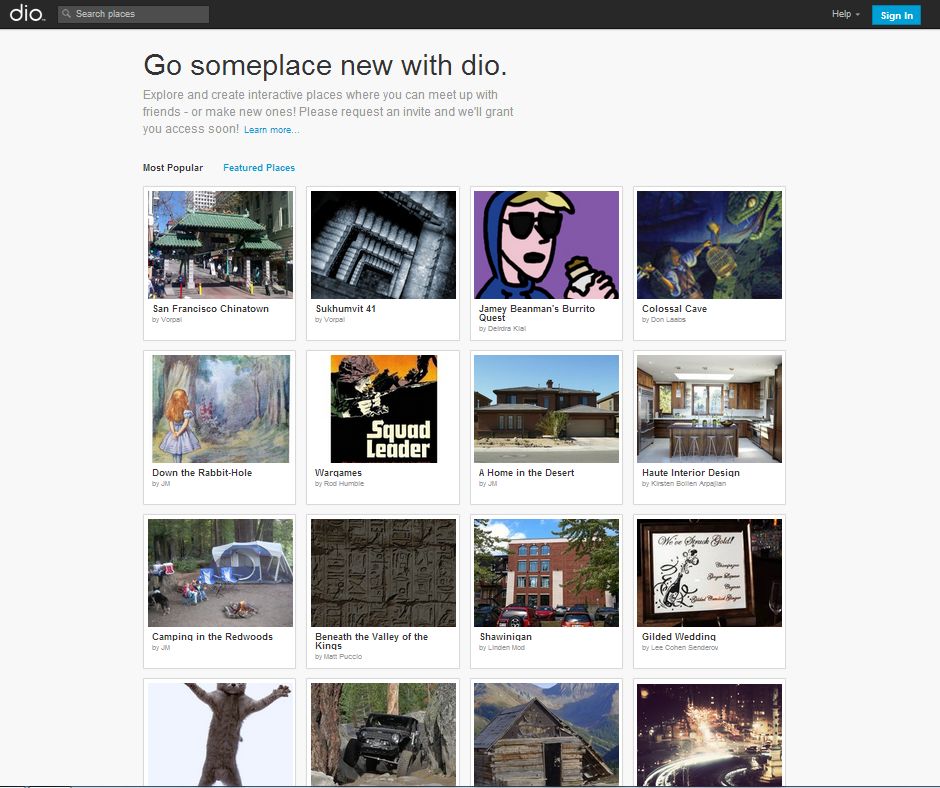
The new Dio website homepage (click to enlarge)

As noted above, logging-in to the Dio website requires a Facebook account, and even the “request an invite” button leads to the Facebook log-in page. Whether the latter is intentional or not is currently unclear; however, limiting log-in to Facebook may limit Dio’s appeal to SL users, but would obviously open it out to the entire Facebook community, potentially raising its visibility.

Clicking on any of the options on the home page is possible, but again, little is given away as to what they do, or to provide more insight into the site than Humble’s description to Techcrunch.
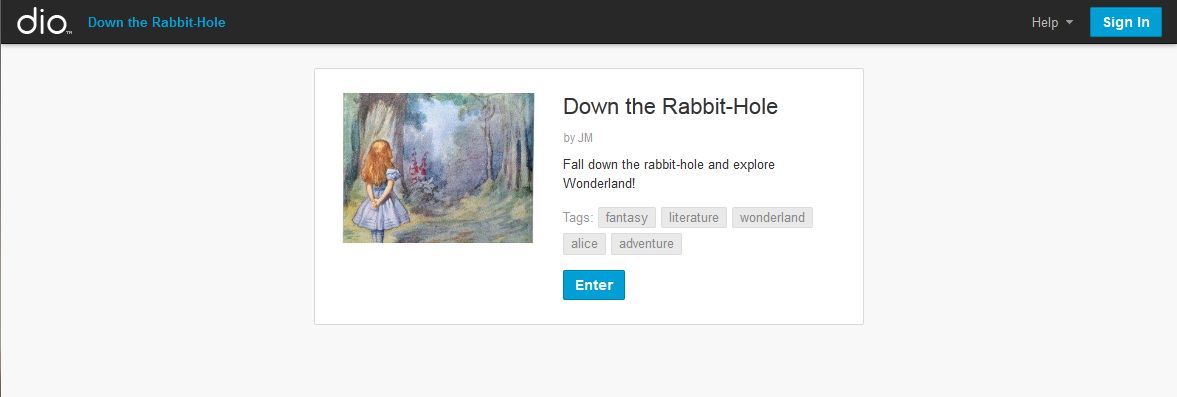
One of the options ("albums"?) within the Dio website
One of the options (“albums”?) within the Dio website

Some of these options allow you to drill down further, but overall, it is currently hard to see how things link together and how “avatars” and “carrying inventory” fit within the scheme of things. Options then range from games through what appear to be tour guides, to business portfolios, to collaborative projects, discussion groups and personal photo albums, making Dio something of a melting pot of ideas and potential uses.

For those interested / curious about the directions LL is taking vis-a-vis new products, then these two websites are potentially to the two to watch as 2013 unfolds, even if right now, they raise more questions than they answer.
Related Links

Webspace with avatars and inventory – Humble talks dio and Versu

Update, February 19th, 2014: Creatorvers and dio were discontinued by Linden Lab on February 19th, 2014. Links to their websites, etc.,  have therefore been removed from this article.

Details of a kind are starting to slip out about LL’s new product stream. We’re now already very familiar with Patterns and Creatorverse, the latter of which reached the Android platform at the start of the week, coming to it via the Kindle range of tablets.

Creatorverse: iPad, Kindle and Android so far

An article in Techcrunch provides some more insight into the remaining two products of which we’re already aware, Dio and Versu.

The article starts off with a positive comment on Second Life itself:

Linden Lab, the company that created Second Life and grew that online community into one of the most colorful, varied online social networks in the world, is doing some very different things for the first time in many, many years.

Admittedly, this quickly slides into the murkier waters regarding declining user numbers, observing rather interestingly that “passive viewing becoming the dominant interaction method”, before bringing up that beloved subject of many a journo reporting on SL, that of its “sordid past”.

I’m not entirely sure what is meant by “passive viewing”, but I suspect that relates to many of the more populous venues in SL being clubs (of every sort) whereby avatars are dancing but most of the conversation is going on in IM, giving the illusion that everyone is sitting in silence watching avatars gyrate twist and turn individually or in groups, or twirl gracefully around the dance floor like pairs of professional ballroom dancers. While the image is true, I’m not entirely sure how representative of SL it is as a whole.

But I digress.

In the article, Rod Humble confirms the upcoming order of the remaining two initial product releases from the Lab, with Dio coming up next, followed by Versu.

“The next project is a web experience called Dio that’s really hard to explain, which I like. It’s sort of like Second Life without the graphics, or Facebook but trying to be more of a creative space,” Humble is quoted as saying in the Techcrunch article. He goes on, “So it’s a web experience and you create your space, but within the spaces, everyone has their own avatar and avatars carry inventory. The way you navigate from space to space is via doors, and you can make things like a MUSH [multi-user shared hack] or hobby space very easily.”

Dio: “webspace with avatars” (image from an early version of the Dio website, and not necessarily representative of how the finished product will appear)

Continue reading “Webspace with avatars and inventory – Humble talks dio and Versu”

Slightly Mad Avians: Humble talks Creatorverse, Versu and Dio

Update, February 19th, 2014: Creatorverse, Versu and dio were discontinued by Linden Lab on February 19th, 2014. Links to their websites, etc, have therefore been removed from this article.

Looking through the pingbacks on my blog comments, I was curious to see one show up on the 23rd October 2012 linking to an article I wrote back at the start of the year. Curious at to why someone would be linking to an old article, I went to have a look.

Turns out the article linking to me is from Kotaku, a games-related blog run by Gawker News – and the article itself is an interview with Rod Humble. (which came to me via Kotaku’s Australian site) Needless to say, I was more than a tad surprised to have someone interviewing our own Rodvik linking to my blog (oh, be still, beating ego!), so I decided to have a read through.

The piece itself is obviously about the Lab’s new and upcoming products, and it gives some interesting insights into the thinking behind them.

“Just about everybody I know who isn’t in the games business or programming business comes to me with a game idea or a website, and the truth of the matter is, quite often, they can’t make it.”

the article quotes Humble as saying. He then goes on:

“There’s this big barrier. They look at something like C++ [programming] code and, frankly, it looks like a big equation. It just looks like gibberish.

“The more we can make tools that are just fun to use—all of a sudden you are making something you wanted—you can focus on the creativity than mastering this arcane set of symbols. We can hopefully bring more people into that fold of ‘hey, you made something!'”

Thus is the broad thinking behind Patterns, Creatorverse and the still-to-be-seen Dio and Versu, which are apparently going to be appearing something in the next month – if not before the end of this one, depending on how you read quotes from elsewhere.

Creatorverse itself comes in for some attention in the piece – Humble describes it as being his five-year-old daughter’s favourite game at the moment, and it is referred to as coming out “later this year”. Whether that is a result of the interviewer misunderstanding Humble (the interview was via ‘phone), or whether it is because the release date may have shifted while the wheels at Apple (or elsewhere) turn slowly, isn’t clear.

What is clear, however, is the novel way Creatorverse is pitched in the interview:

In the near future, his company will put out a program for iPad called Creatorverse, which will let people use shapes and physics to create basic 3D systems and, yes, games, then share them for anyone else to download and play. Think of making a game that lets you fling shapes into other shapes—your own “Slightly Mad Avians”, he offers as an example, if you get what he means.

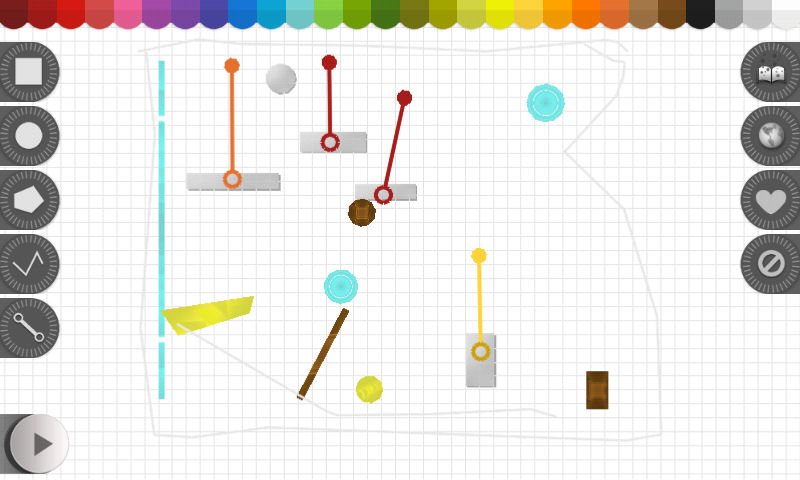
Creatorverse

While Slightly Mad Avians could stand as a title in its own right (along with Perturbed Pigeons, a name Darien Caldwell suggested to me the other evening in an entirely unrelated conversation…), it’s nevertheless a curious hook on which to hang a description of Creatorverse – but an interesting one in terms of mental images….!

What is of greater potential interest, however, is the comments about the upcoming Dio and Versu.

Dio is described as: “A website that lets people create rooms out of their personal images and videos, connects them to other people’s rooms and lets people share the space.”

While it has previously been described as “A room creator, in which players can do everything from construct a choose-your-own adventure to develop an interactive wedding album,” and Linden Lab managed to accidentally give people something of a quick peek at an early iteration of a website connected to Dio back at the start of the year, the comment in the Kotaku piece implies that the website appears to be the product, rather than in support of it. It’ll be interesting to see how people react to this.

Versu, meanwhile, gains a little more flesh on the bones given in an interview with Giant Bomb, with Humble describing it as, “A platform that lets you make real interactive drama” by giving you “the ability to create characters within a story and then, thanks to the AI, see that “those characters will have emergent properties as you play through the story.” He goes on to admit that this is pretty ambitious and admits to an element of “Tilting at windmills” in order to bring it to a wide audience.

The article goes on to talk in more detail about Patterns, which many of us – and many more in the gaming community – are enjoying even in its nascent (or as Humble puts it, “not even pre-baked”) form. It also talks about Humble himself and his arrival at Linden Lab, which leads to a good mention of Second Life:

It makes perfect sense that Humble would wind up at Linden Lab, the company best known for the virtual world Second Life. It’s as successful a canvas for the communal creation of a virtual world as there’s been. It’s been a viable digital canvas for about a decade now has been populated by users who make their own buildings and vehicles, who design contraptions, contort physics, stage elaborate events, form societies, and pioneer the art of inhabiting elaborate second skins that express inner or otherwise impossible creativity and desires.

It’s a positive read, and well worth taking a few minutes out to read through.

Related Links

Dio: Linden Research register a trademark and put-up a beta site

Update 31st May: Tateru has provided the following update with feedback from Linden Lab on the new website: “The Dio staging/test server has now been closed off, and Linden Lab expresses thanks for the notice of the security issue. Linden Lab also adds that yes, it is not ready to talk about it in any detail other than that it will be something new and completely separate from and unrelated to Second Life and that it is not yet ready for public consumption.” As such, the links to the site given in this article no longer work. (With thanks to Tateru for permission to quote her update.)

Tateru has reported on a new trademark having been registered by Linden Research Inc. You can find the full details on her site, but the key point is that it is for an entirely new product – called Dio (which, among other things, Wikipedia points-out is the Italian name for “God”).

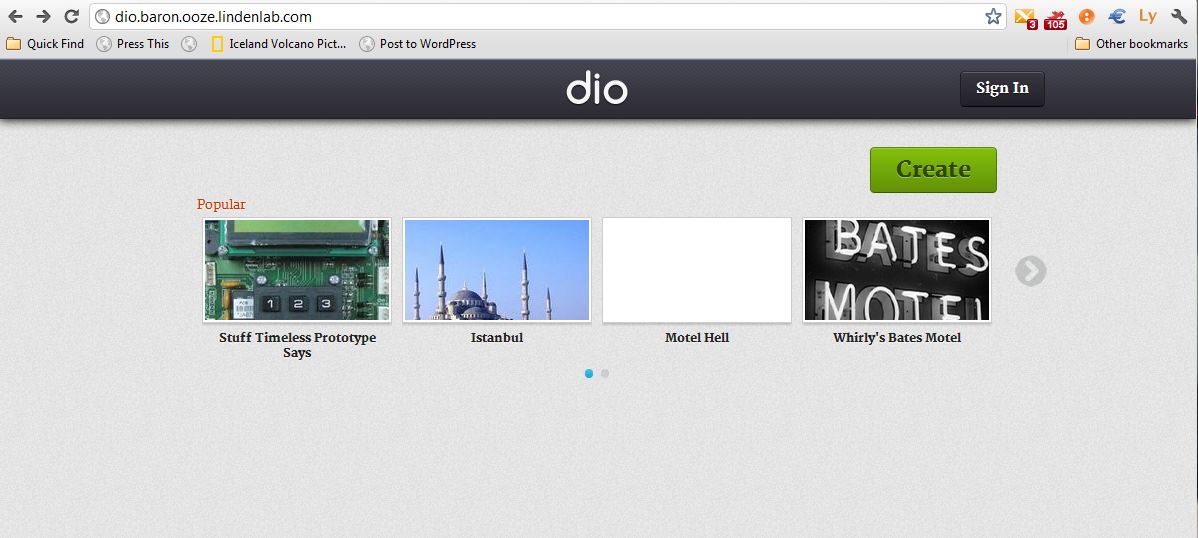
The name would appear to be connected to a new website, which has a rather interesting home-page:

New website

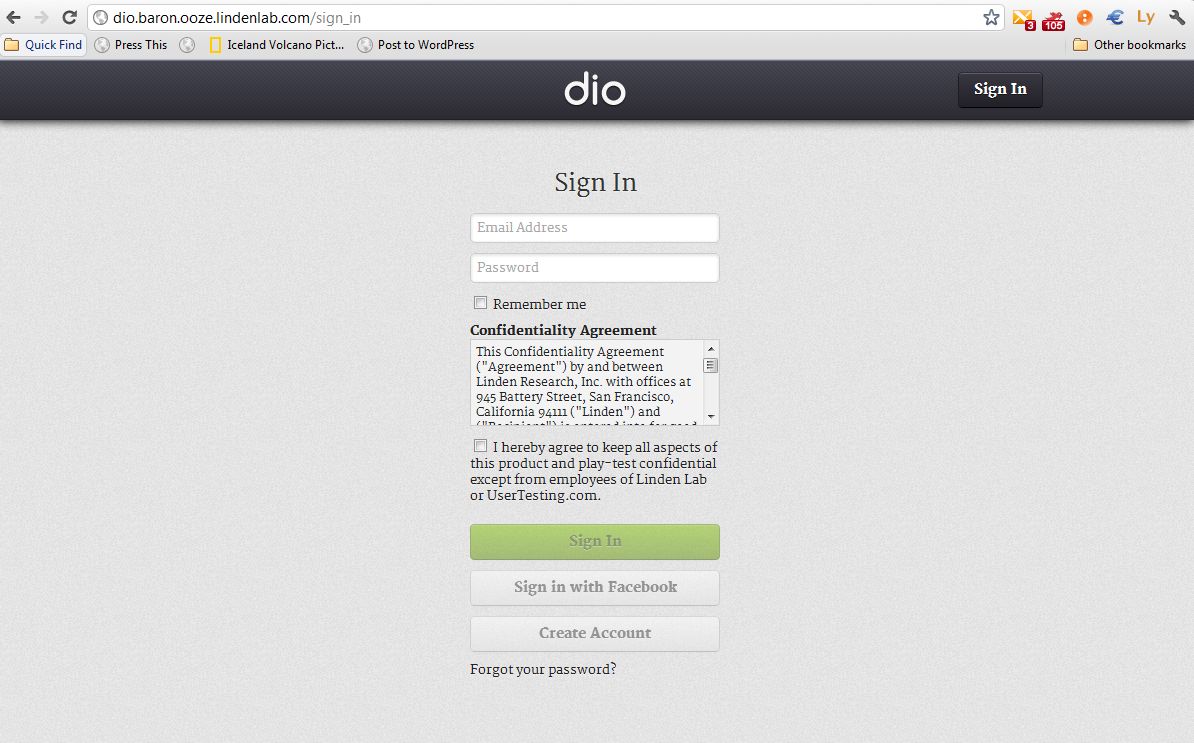
Any attempts to go further than this page leads to a log-in page with confidentiality statement (as identified initially by Miro Collas):

Log-in page

The metadata for the pages supplies a clue to their purpose: “Dio allows you to create and play user-created stories.” As such, it’s a reasonable to assume the website is connected to Linden Lab’s range of “new products”, first alluded to by Rod Humble at SLCC-2011. Details were vague then, but have become clearer thanks to various clues dropped by Humble himself and as a result of other goings-on, including:

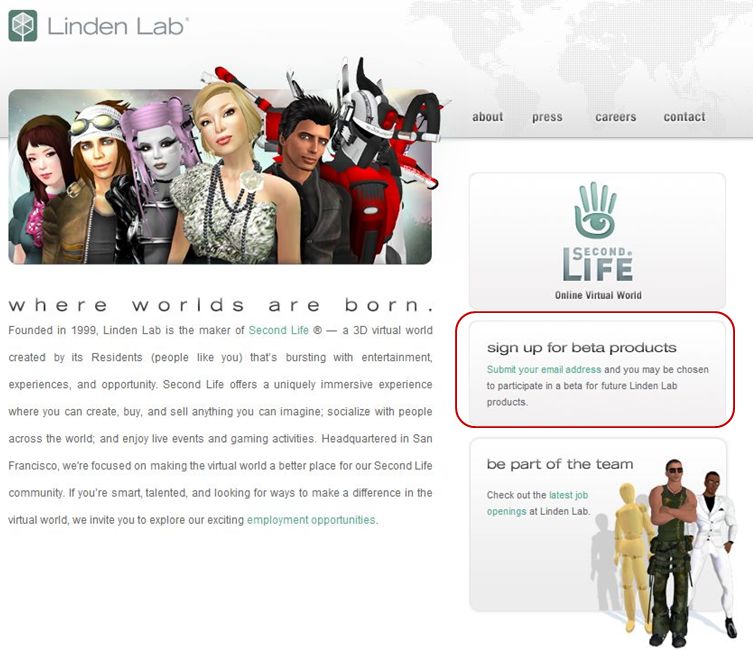
Given the site links to a secure log-in, complete with confidentially statement also points towards it being connected to Linden Research’s call for product Beta Testers, initially made in March this year and which still appears to be open.

Call for Beta volunteers – opened March 2012

Speculation on the site is open to all – doubly so given, as Tateru points out, security is somewhat billoxed – allowing people to discern rather a lot, including URLs for image assets, one of which is rather novel to say the least, and another to what appears to be an Apple-related wallpaper. Others appear to be more “game / story” related.

One of the images gleaned via examination of the Dio site’s source-code

Commenting on Tateru’s article, Psyke Phaeton points out that site’s URL’s might be an oblique reference to Baron Bwimb of Ooze, the self-proclaimed baron of the Paraelemental Plane of Ooze, in the Dungeons & Dragons fantasy role-playing game, and provides a link to  another webpage from the site, entitled “Baron’s Test Story”.

Speculation is bound to continue now the cat is out of the bag. Tateru is seeking further feedback from Linden Lab, and will update her article if / when any feedback is forthcoming. I’ll follow suit here, depending on the amount of information that is forthcoming. In the meantime, for more speculative analysis, keep an eye on her comments page.

With thanks to Tateru Nino, Miro Collas and Pyske Phaeton. Note that some of the image links given in this article may become unresolvable, depending on how the apparent security breaks in the Dio website are fixed.