2019 SL User Groups 39/2: Content Creation summary

Alternate Reality, August 2019 – blog post

The following notes are taken from my audio recording of the Content Creation User Group (CCUG) meeting, held on Thursday, September 26th 2019 at 13:00 SLT. These meetings are chaired by Vir Linden, and agenda notes, meeting SLurl, etc, are usually available on the Content Creation User Group wiki page.

This was a shorter than usual meeting.

ARCTan

Project Summary

An attempt to re-evaluate object and avatar rendering costs to make them more reflective of the actual impact of rendering both. The overall aim is to try to correct some inherent negative incentives for creating optimised content (e.g. with regards to generating LOD models with mesh), and to update the calculations to reflect current resource constraints, rather than basing them on outdated constraints (e.g. graphics systems, network capabilities, etc).

Current Status

Work is continuing on getting the logging and analysis elements of the project up and running. Right now the (in-development) test viewer is described and pouring out a lot of “gibberish” on frame draw rates and all of the attributes in a scene, and the idea is to try to pull this together into a predictive model that is more accurate than the current rendering cost model.

Project Muscadine

Project Summary

Currently: offering the means to change an Animesh size parameters via LSL.

Status

  • Largely on hold while ARCTan is being focused on.
  • A bug whereby physics parameters weren’t being correctly applied has been resolved and a fix should be available in the next viewer update.
    • The default viewer-size avatar animations (fidgets, eye tracking, etc), were disabled for Animesh and have not been re-enabled, this update only applies to physics params.

Environment Enhancement Project

Project Summary

A set of environmental enhancements (e.g. the sky, sun, moon, clouds, and water settings) to be set region or parcel level, with support for up to 7 days per cycle and sky environments set by altitude. It uses a new set of inventory assets (Sky, Water, Day), and includes the ability to use custom Sun, Moon and cloud textures. The assets can be stored in inventory and traded through the Marketplace / exchanged with others, and can additionally be used in experiences.

Due to performance issues, the initial implementation of EEP will now likely not include certain atmospherics such as crepuscular rays (“God rays”).

Resources

Current Status

  • A new graphics resource – Euclid Linden – joined Linden Lab last week. He is currently finding his way around the rendering system and will be working on EEP in the near future.
  • A further graphics expert is due to start with LL in the next month, and once up to speed, they will also be lending support to EEP.

General Notes

  • Script breakage: there have been a number of reports filed concerning script breakage recently (see: BUG-227669BUG-277667 and BUG-227659 for examples). The reports have been noted by the Lab but have yet to be triaged
  • The next CCUG meeting will be on Thursday, October 10th.

2019 SL User Groups 38/2: Content Creation summary

Grauland, July 2019 – blog post

The following notes are taken from my audio recording of the Content Creation User Group (CCUG) meeting, held on Thursday, September 19th 2019 at 13:00 SLT. These meetings are chaired by Vir Linden, and agenda notes, meeting SLurl, etc, are usually available on the Content Creation User Group wiki page.

ARCTan

Project Summary

An attempt to re-evaluate object and avatar rendering costs to make them more reflective of the actual impact of rendering both. The overall aim is to try to correct some inherent negative incentives for creating optimised content (e.g. with regards to generating LOD models with mesh), and to update the calculations to reflect current resource constraints, rather than basing them on outdated constraints (e.g. graphics systems, network capabilities, etc).

Current Status

  • An unexpected / unintended side-effect of Bakes On Mesh is the baseline avatar rendering cost has gone up by 1,000. This is due to the additional channels being added in support of BOM (so a basic, naked system avatar will have a complexity of 2,000 instead of 1,000). Vir is going to correct this.
  • Just as a reminder: there is no certainty as to how ARCTan will work – the Lab is focused purely on data gathering at this point, not on implementation. As such it is far too early to discuss policy, rules, implementation, etc.
  • One aspect that is being considered is to provide a set of in-world tools and / or example models to allow creators better understand what ARCTan might be doing and how it could affect their work. Again, this could only be done when LL is in a position to start moving forward with ARCTan.

Should Existing In-World Content Be Excluded?

One area of discussion on ARCTan has been the matter of existing in-world content: should it be subject to the new ARCTan calculations (whatever they might be) or excluded?

  • Arguments for excluding existing in-world content include:
    • Less risk of upset if changing values sees an increase in the land impact of items, prompting confusion among users (“why is my 16 LI bed now 26 LI?”).
    • Reduction in the possible large-scale return off objects by parcels / regions where ARCTan changes take them over their limit.
    • “Easier” to implement, as new costs only apply to “new” content.
    • Less work for content creators in updating their documentation (note cards, MP listings, vendor boards, etc.) to correctly reflect the “new” LI values for their goods that are changed as a result of ARCTan.
    • Reduces the risk of “permanent” content breakage in instances where the LI for objects rises to impact user’s ability to have them in-world, and the creator is no longer active to provide better optimised updates.
  • Arguments against excluding existing in-world content include:
    • Potentially limits the purpose of ARCTan in educating users about using decently optimised content.
    • Introduces questions on how new limited should be applied. On upload? On rezzing?
    • If on rezzing, user confusion may not be negated (“when I rezzed this bed last week it was only 16 LI; now when I rez it, it is 26 LI! Why?!)
    • ARCTan will not be an overnight implementation. LL plan to try to work with creators and users to provided information on changes, and work as far as possible to minimise the risk of content return.
  • The idea of excluding existing content has not been ruled out. But again, until the Lab have baselined their data, carried out experiments and tests in order to see the likely impact of various adjustments to the calculations / costs and investigated what can be done to mitigate some of them (e.g. increase the land capacity of regions), nothing can be decided one way or the other.

Core Content Projects Summary

  • Animesh Follow-On – Project Muscadine: effectively on hold while Vir focuses on ARCTan.
  • EEP: work continuing on rendering bug fixes, with additional resources being added to the project.

General Notes

  • Avatar Impostering
    • Concern has been raised over the complexity handling on Animesh with impostering. Currently, Animesh objects are handled the same as avatars. However, as they are a lot less complex, there is an argument to say Animesh should be handled differently to avatars when impostering.
    • This is being taken into consideration, with the possible introduction of a “max Animesh” setting for the purposes of impostering Animesh.
    • Whether or not this will affect the current baseline for impostering avatars is unclear; the work is still only at the point of discussion.
  • Mesh uploader:
    • There are reports of a rise in issues when uploading mesh models – failure to complete the upload, coupled with the production of hard-to-decipher “mav” errors.
      • So far as the Lab is aware, nothing has changed within the viewer or on the simulator side that might be causing the problems. Those encountering such problems are asked to file a Jira, preferably with  viewer log files.
      • There is a viewer with improvements to the mesh uploader in development. This may not resolve the issues, but it should offer improved feedback and messaging during the upload process.
      • It’s been suggested that the problem could be due to recent updates to Blender in saving .DAE files.
    • Many 3D tools are moving to use / support the glTF file format, which is currently subject to much discussion / criticism. Linden Lab has no plans to support the format at this point in time.
    • A few months ago, it was indicated that custom origin point (pivot point) for meshes would be implemented. This work is currently awaiting some back-end changes. As such, until these changes are made, the work is on hold.

2019 SL User Groups 37/2: Content Creation summary

Athenaeum, July 2019 – blog post

The following notes are taken from the Content Creation User Group (CCUG) meeting, held on Thursday, September 12th 2019 at 13:00 SLT. These meetings are chaired by Vir Linden, and agenda notes, meeting SLurl, etc, are usually available on the Content Creation User Group wiki page.

Animesh Follow-On – Project Muscadine

Project Summary

Currently: offer the means to change an Animesh size parameters via LSL.

Current Status

  • The viewer updated to version 6.4.0.530473 on Wednesday, September 11th – however, this is to parity with the EEP RC viewer, rather than any new features being added.
  • Viewer work is currently on the back-burner for now, while Vir is working on ARCTan. As such, it’s likely that the project will proceed with small updates  – such as those in the current project viewer – rather than gathering together a larger number of updates and releasing them together.
  • A potential update still under consideration is to revise the current throttle (limiting Animesh character to updating twice every 10 seconds). This was put in place to prevent people using the system as an alternative means of animation (and potentially thrashing performance)s.
    • Some have done informal testing with up to 20 Animesh characters changing shape under scripted control as fast as the current throttle allows and using 115 parameters, apparently with little performance impact.
  • Animesh objects currently count towards the overall avatar imposter limit – although it is possible these might be split.
    • The “pro” side of this is that Animesh objects have a fairly fixed rendering complexity.
    • The “con” side is how things might change if Animesh characters start having attachments.
    • It would also mean further complexity with graphics settings in the viewer.

Environment Enhancement Project

Project Summary

A set of environmental enhancements (e.g. the sky, sun, moon, clouds, and water settings) to be set region or parcel level, with support for up to 7 days per cycle and sky environments set by altitude. It uses a new set of inventory assets (Sky, Water, Day), and includes the ability to use custom Sun, Moon and cloud textures. The assets can be stored in inventory and traded through the Marketplace / exchanged with others, and can additionally be used in experiences.

Due to performance issues, the initial implementation of EEP will now likely not include certain atmospherics such as crepuscular rays (“God rays”).

Resources

Current Status

  • Work continues on rendering bug fixes.
  • There is still no indication as to when this might be promoted to release status.
  • A lot of EEP documentation is currently in the forum threads. There has been a request to move this to the wiki – or at least is the Knowledge Base, which is current a focus for documentation from the Lab.

ARCTan

Project Summary

An attempt to re-evaluate object and avatar rendering costs to make them more reflective of the actual impact of rendering both. The overall aim is to try to correct some inherent negative incentives for creating optimised content (e.g. with regards to generating LOD models with mesh), and to update the calculations to reflect current resource constraints, rather than basing them on outdated constraints (e.g. graphics systems, network capabilities, etc).

Current Status

  • Progress has now resumed, with Vir working on hooking new data gathering code into the viewer code base to allow more widespread data gathering.
  • The code currently isn’t available in a public viewer repository (in part because it is not ready).
  • It has been suggested that allowing Firestorm to use the code would potentially allow for a broader cross-section of representative data to be gathered. However, the core data gathering code is baked into viewer, and making that alone available for FS to adopt at this point in time could be difficult.
  • There are concerns that major changes in the costs of in-world objects could see an increase in Land Impact values that could in turn see large amounts of content returned.
    • This is something the Lab is concerned about as well, and it has previously been indicated that if this proves to be a significant risk, then steps will be taken to mitigate this – see Project ARCTan in 2018 SL UG updates #7/3: TPV and Web Meetings.
    • It’s been suggested that ARCTan could offer a new “invisible” mesh asset type: anything that is created uploaded after ARCTan is (eventually) deployed must conform to ARCTan; mesh in-world prior to ARCTan is not governed by ARCTan – as was done with Materials. Vir indicated this might be one option, at least during the initial roll-out of ARCTan.
  • There is a lot of chatter / speculation in the forums about what ARCTan “might” or “will” be; Vir’s response to this is again that no decisions have thus far been made by the Lab as the project is still in its early stages. Therefore, people should not put too much stock in forum thread unless it is posted by the Lab.
  • It’s important to note that beyond data gathering, LL haven’t even decided how ambitious the project will be overall.

Bakes on Mesh

Project Summary

Extending the current avatar baking service to allow wearable textures (skins, tattoos and clothing) to be applied directly to mesh bodies and heads.

Resources

Current Status

  • There has been extensive discussion on Bakes on Mesh in the forums, including ideas on future extensions, some of which are being pulled in by the Lab for additional consideration (which is not to say they will happen).
  • There is an unofficial list for BoM support (last updated at the end of August) which may help those interested.
  • Cathy Foil has been investigating the local edit issue she reported at the last meeting (see:) wherein odd results when using the appearance editor that correct themselves on exiting the appearance editor and when baked via the Baking Service. In her case, it appears the problem was due to a slip-up at her end of things involving a mesh with different UVs, although a Jira has been filed on a related issue.
  • There is a report that eye textures applied via BoM appear darker than if applied directly to the mesh. A Bug report is to be raised on this.

2019 SL User Groups 35/2: Content Creation summary

(fae forest), July 2019 – blog post

The following notes are taken from the Content Creation User Group (CCUG) meeting, held on Thursday, August 29th 2019 at 13:00 SLT. These meetings are chaired by Vir Linden, and agenda notes, meeting SLurl, etc, are usually available on the Content Creation User Group wiki page.

Bakes on Mesh

Project Summary

Extending the current avatar baking service to allow wearable textures (skins, tattoos, clothing) to be applied directly to mesh bodies and heads. This involves viewer and server-side changes, including updating the Bake Service to support 1024×1024 textures, but does not include normal or specular map support, as these are not part of the existing Bake Service, nor are they recognised as system wearables. Adding materials support may be considered in the future.

Resources

Current Status

  • BoM is now live. See:
  • There are some local edit issues  – some already noted in the viewer release notes – that can produce odd results when using the appearance editor which correct themselves on exiting the appearance editor and when baked via the Baking Service.
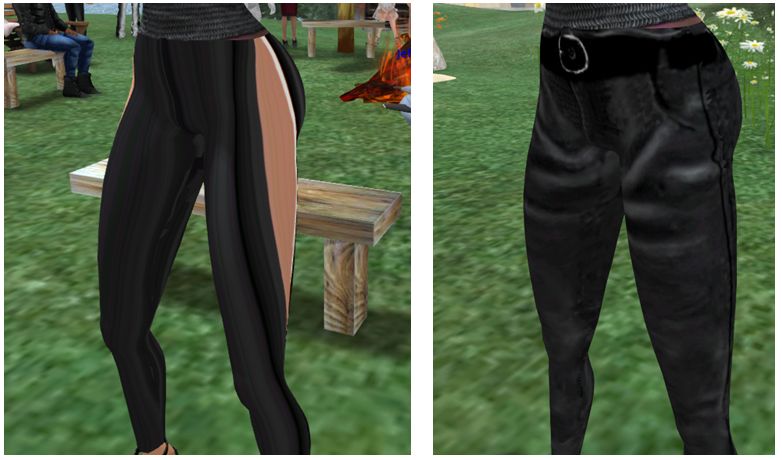
Cathy Foil has noted this glitch than can occur with Baked_Lower wearables on BOM: when editing locally in the appearance editor, the leg does not appear to be masked correctly by the wearable (which is also incomplete at the waist). Once baked, however, the wearable appears correctly applied and in full (r). Credit: Cathy Foil.
  • Some of these local edit issues may not be specific to Bakes on Mesh, but may be more noticeable as a result of BoM, and the Lab is looking to resolve them.

Animesh Follow-On – Project Muscadine

Project Summary

Currently: offer the means to change an Animesh size parameters via LSL.

Current Status

  • The simulator support on Aditi (the beta grid) – DRTSIM-421 (region Bakes on Mesh) has been updated, but there are no feature changes within it.
  • The project viewer has been merged with Bakes on Mesh (as the release viewer) and is passing through the Lab’s QA, and so should be appearing soon.

ARCTan

Project Summary

An attempt to re-evaluate object and avatar rendering costs to make them more reflective of the actual impact of rendering both. The overall aim is to try to correct some inherent negative incentives for creating optimised content (e.g. with regards to generating LOD models with mesh), and to update the calculations to reflect current resource constraints, rather than basing them on outdated constraints (e.g. graphics systems, network capabilities, etc).

Current Status

  • Work has now resumed.
  • First part of this is to continue data-gathering and look at re-aligning some figures based on the changes made for Animesh.
  • Thus far, the project primarily comprises enhanced logging to assist the Lab in data collection, allowing information on the overall cost of a specific avatar or in-world object to be gathered.
  • Once enough data has been gathered across a broader enough spectrum of content to give the Lab confidence they have a good understanding of things, then work can start on adjusting the cost calculations for rendering, etc.
  • It’s important to note that any user-viewable changes as a result of ARCTan are still some way off, and the Lab will be staging things to let users know what is happening when, and what it is likely to impact.
  • There was a lot of general conversation towards the end of the meeting on what people hope ARCTan will do (e.g. forcing creators to make proper use of avatar LODs, etc.).

Environment Enhancement Project

Project Summary

A set of environmental enhancements (e.g. the sky, sun, moon, clouds, and water settings) to be set region or parcel level, with support for up to 7 days per cycle and sky environments set by altitude. It uses a new set of inventory assets (Sky, Water, Day), and includes the ability to use custom Sun, Moon and cloud textures. The assets can be stored in inventory and traded through the Marketplace / exchanged with others, and can additionally be used in experiences.

Due to performance issues, the initial implementation of EEP will now likely not include certain atmospherics such as crepuscular rays (“God rays”).

Resources

Current Status

  • Work continues on rendering bug fixes.
  • The number of remaining issues is “trending downwards”.

Misc. Items

  • The upcoming Voice RC (or project) viewer mentioned at the last TPVD meeting still has a couple of issues preventing it from surfacing in the Alternative Viewers page.
  • The Umeshu Maintenance viewer (currently version 6.3.1.530411, merged with Bakes on Mesh) could be promoted to de facto release status as early as week #36 (commencing Monday, September 2nd), in a break from the Lab’s preferred 2-week gap between release promotions.
  • Date of next meeting: Thursday, September 12th, 2019.

2019 SL User Groups 34/2: Content Creation summary

Scarlett Isle; Inara Pey, July 2019, on FlickrScarlett Isle, blog post

The following notes are taken from the Content Creation User Group (CCUG) meeting, held on Thursday, August 22nd 2019 at 13:00 SLT. These meetings are chaired by Vir Linden, and agenda notes, meeting SLurl, etc, are usually available on the Content Creation User Group wiki page.

Bakes on Mesh

Project Summary

Extending the current avatar baking service to allow wearable textures (skins, tattoos, clothing) to be applied directly to mesh bodies as well as system avatars. This involves viewer and server-side changes, including updating the Bake Service to support 1024×1024 textures, but does not include normal or specular map support, as these are not part of the existing Bake Service, nor are they recognised as system wearables. Adding materials support may be considered in the future.

Resources

Current Status

  • An internal meeting at the Lab held immediately prior to the CCUG suggests Bakes on Mesh could be promoted to release status early in week #35 (week commencing Monday, August 26th, 2019).
  • It was therefore requested than anyone intending to test BoM to do so over the weekend and file any issues they find via Jira bug reports ASAP.
  • There are some known issues that will be listed when the project is promoted to release status, and which will be noted in the Bakes on Mesh knowledge base article when BoM is promoted to release status.
  • The major element in understanding how BoM works is understanding how the additional channels supplied for Bakes on Mesh work. These are:
    • LEFT_ARM_TATTOO – baked to left arm.
    • LEFT_LEG_TATTOO – baked to left leg.
    • AUX1_TATTOO – baked to aux1.
    • AUX2_TATTOO – baked to aux2.
    • AUX3_TATTOO – baked to aux3.
  • Unlike the existing channels (head, upper, lower, etc)., these do not have an underlying skin texture associated with them, and so do not have a wearable corresponding to the alpha wearable that can be used with the existing channels to “hide” them.
    • This may be changed in a future update, but for now, it is how Bakes on Mesh will be shipped with the new channels.

Environment Enhancement Project

Project Summary

A set of environmental enhancements (e.g. the sky, sun, moon, clouds, and water settings) to be set region or parcel level, with support for up to 7 days per cycle and sky environments set by altitude. It uses a new set of inventory assets (Sky, Water, Day), and includes the ability to use custom Sun, Moon and cloud textures. The assets can be stored in inventory and traded through the Marketplace / exchanged with others, and can additionally be used in experiences.

Due to performance issues, the initial implementation of EEP will now likely not include certain atmospherics such as crepuscular rays (“God rays”).

Resources

Current Status

  • Work continues on rendering bug fixes.
  • There are also some permissions bugs that need to be resolved as well.
  • Overall, it is hoped that these can be resolved and the viewer updated soon, with a view to moving EEP on to release status in the near future.

Animesh Follow-On – Project Muscadine

  • DRTSIM-421 on Aditi (region Bakes on Mesh) has the server-side code to support the new visual parameters LSL code.
  • The project viewer is now available – viewer version 6.4.0.530100, dated Monday, August 19th. This supports the new LSL code as per DRTSIM-421, above.
  • Vir has other commitments coming up (ARCTan?), so progress on updates to this work may be slow for the next several weeks.
  • A potential update is to revise the current throttle (limiting Animesh character to updating twice every 10 seconds). This was put in place to prevent people using the system as an alternative means of animation (and potentially thrashing performance); however, it is considered too slow for testing purposes.

Bakes on Mesh for Animesh

Still being requested, but also still seen as a significant piece of work, as it would require changes not just with how Animesh items are managed but to the entire Bake Service in support of the capability. As such, this is not currently something the Lab is putting on the road map.

Animesh Attachments

Having attach point for Animesh characters and items is seen by come as a higher priority than extending Bakes on Mesh to Animesh. It is also something the Lab could implement somewhat more easily (for some value of “easily” to be determined) than BoM on Animesh. A call was made for possible use-cases included particle support, ability to simple attach clothing items rather than having to rig them (which would conversely limit movement of the item as it wouldn’t necessarily conform to the Animesh body movements), objects such as weapons (for NPCs), etc.

2019 SL User Groups 33/2: Content Creation summary

North Brother Island; Inara Pey, June 2019, on FlickrNorth Brother Island, June 2019 – blog post

The following notes are taken from the Content Creation User Group (CCUG) meeting, held on Thursday, August 15th 2019 at 13:00 SLT. These meetings are chaired by Vir Linden, and agenda notes, meeting SLurl, etc, are usually available on the Content Creation User Group wiki page.

Items Coming out of the SL Summit

  • LL might potentially be looking at a refresh of SL terrain texturing in the near future.
  • Pathfinding is recognised as a pain-point, but no resources are available within the Lab to tackle improvements / enhancements in the immediate future.

ARCTan

Project Summary

An attempt to re-evaluate object and avatar rendering costs to make them more reflective of the actual impact of rendering both. The overall aim is to try to correct some inherent negative incentives for creating optimised content (e.g. with regards to generating LOD models with mesh), and to update the calculations to reflect current resource constraints, rather than basing them on outdated constraints (e.g. graphics systems, network capabilities, etc).

Current Status
  • The project has been on hold for some time, but due to be rebooted during the current quarter.
  • Emphasis will initially be on data gathering, as previously.
  • No decision has yet been made on whether or not the first pass of work (once the data has been gathered) will include avatar accountability (including a further pass with Animesh), or initially only focus on in-world objects.
  • The overall aim is that of encouragement – getting users to think and want to be on-board with the changes, as they can see the benefit.
  • This work will not reduce the maximum texture size (1024×1024 – and remembering that for Bakes on Mesh avatar texture sizes have actually been increased from a 512x512cap to 1024×1024). However, ARCTan might penalise for “improper” use of textures (e.g. multiple uses of unique 1024×1024 textures across object faces, no matter how small the faces might be).
  • There are a lot of ideas around ARCTan (e.g. finding a means to not encourage lowest LODs of near-zero triangles, not penalising people if they include valid LODs, etc). However, threading the need to find the right balance on how things should be handled is acknowledged as being difficult, and as such, do not expect ARCTan to start changing anything soon.

Environment Enhancement Project

Project Summary

A set of environmental enhancements (e.g. the sky, sun, moon, clouds, and water settings) to be set region or parcel level, with support for up to 7 days per cycle and sky environments set by altitude. It uses a new set of inventory assets (Sky, Water, Day), and includes the ability to use custom Sun, Moon and cloud textures. The assets can be stored in inventory and traded through the Marketplace / exchanged with others, and can additionally be used in experiences.

Due to performance issues, the initial implementation of EEP will now likely not include certain atmospherics such as crepuscular rays (“God rays”).

Resources

Current Status

  • The viewer should be updated shortly to bring it to parity with the most recent viewer release (version 6.2.4.529638, formerly the Love Me Render RC).
  • There are still issues on the rendering side affecting people on various graphics systems that need to be resolved, together with some remaining performance issues.

Bakes On Mesh

Project Summary

Extending the current avatar baking service to allow wearable textures (skins, tattoos, clothing) to be applied directly to mesh bodies as well as system avatars. This involves viewer and server-side changes, including updating the Bake Service to support 1024×1024 textures, but does not include normal or specular map support, as these are not part of the existing Bake Service, nor are they recognised as system wearables. Adding materials support may be considered in the future.

Resources

Current Status

  • Still a number of bugs to be resolved, and Vir is now working on these as well as the Animesh follow-on (below). These include, but are not limited to:
    • Shadows are failing to render correctly.
    • Issues with some alpha settings.
  • Otherwise, most of the functionality is now believed to be in place.

Animesh Follow-On – Project Muscadine

  • DRTSIM-421 on Aditi (region Bakes on Mesh) now has the server-side code to support the new visual parameters LSL code.
  • Project viewer supporting the new LSL code should be out for use on Aditi in the next week.
    • This will provide the means to test the new LSL code functionality, but as with all project viewers, may not work 100% in all other areas.
    • May get enhanced with additional Animesh-related capabilities, although this is dependent on commitments with other projects, notably Bakes on Mesh and Project ARCTan.

General Discussion

Possible SL Wiki Deprecation?

  • For the last few years, the Lab has been moving information away from the SL wiki and into knowledge base articles.
  • During a recent Web User Group meeting, it was indicated that this trend will continue, and that the use of the SL wiki may be deprecated over time.
    • One of the reasons for this is the wiki software has some issues, and there are problems in opening the wiki for general management by users.
  • These changes will not result in the wiki immediately vanishing.
  • It’s not clear as to the best mechanism for getting outdated / incorrect knowledge base articles corrected – potentially the best way at the moment is to raise a bug report.

Documentation

The wiki situation prompted a broader discussion on documentation.

  • LL has been considering how to better provide documentation and demonstration videos for upcoming features and new capabilities.
  • It has also been suggested a Content Creation blog where notes on projects, best practices relating to them and for things like mesh design – LODs (including how to make efficient low LOD models rather than just tossing a low number of tri into the mix) – uploads, etc., and other content creation information could be posted.
  • It is acknowledged that there is a lot of expertise within the Lab and within the community for content creation, and none of it really resides within a single individual – therefore determining what should be documented, how it should be documented, etc., is not an easy matter.
    • A lot of the existing best practises for content and build has come from users / creators.
    • Given the status of the wiki, adding to this is currently difficult.
    • While creators have produced their own documentation, etc., it does come at a cost, and tends to focus n their own specifics. Leveraging this into a more general set of best practices and documentation library would take a lot of further time and effort.
    • As such, some sort of collaborative effort between creators and the Lab might be the way forward, although even organising this and ensuring a consensus of opinion may not be easy.
  • Another way to enhance documentation might be to submit new articles / updates to existing articles through a mechanism like the open source contribution agreement.

Mesh Uploader

Work is continuing on improving the mesh uploader – notably with the contributed updates from Beq Janus of the Firestorm team (see my Firestorm 6.0.1 review for details).

Further work could be done to improve feedback information given by the uploader, but this is currently seen as being more UI intensive, and outside the immediate scope of this updates.