2018 SL UG updates #25/2: CCUG summary

Devin's Eye; Inara Pey, June 2018, on FlickrDevin’s Eyeblog post

The majority of the following notes are taken from the Content Creation User Group (CCUG) meeting, held on  Thursday, June 21st, 2018 at 13:00 SLT.  These meetings are chaired by Vir Linden, and agenda notes, etc, are usually available on the Content Creation User Group wiki page.

Note that the audio presented here may not be in the exact order of discussion during the meeting; as subjects were at times returned to following their initial discussion, I have attempted to bring together key points of discussion by topic / subject matter. Also, please note that audio drop-out when Vir is speaking appears to be an ongoing problem at his end.

SL Viewer

The Pálinka Maintenance RC viewer, version 5.1.6.516459 and dated June 15th, 2018, was promoted to de facto release status on Thursday, June 21st, 2018.

The 32-bit Windows Unloop RC viewer, version 5.1.6.515965 and dated June 5th, 2018, was also withdrawn as it is no longer required with the promotion of the Pálinka  RC viewer.

This leaves the official viewer pipelines, at the time of writing, as follows:

  • Current Release version5.1.6.516459 and dated June 15th, promoted June 21st – formerly the Pálinka Maintenance Release Candidate – New.
  • Release channel cohorts:
    • No viewers (at the time of writing, but a new Maintenance RC is expected).
  • Project viewers:
  • Linux Spur viewer, version 5.0.9.329906, dated November 17, 2017 and promoted to release status 29 November – offered pending a Linux version of the Alex Ivy viewer code.
  • Obsolete platform viewer, version 3.7.28.300847, May 8, 2015 – provided for users on Windows XP and OS X versions below 10.7.

Animesh

Project Summary

The goal of this project is to provide a means of animating rigged mesh objects using the avatar skeleton, in whole or in part, to provide things like independently moveable pets / creatures, and animated scenery features via scripted animation. It involves both viewer and server-side changes.

Resources

Current Status

As noted in my report here (and the official announcement from the Lab), the server-side code for Animesh was deployed to the BlueSteel RC as part of the ongoing developing and testing of the capability. For those wishing to test Animesh, there are also five dedicated Animesh test regions available (all obviously on BlueSteel at this point in time):

How quickly Animesh is promoted beyond BlueSteel depends on whether any additional bugs / issues are identified, what else is in the simulator release queue. However, it is unlikely the capability will go grid-wide until the viewer at least reaches release candidate status (at the time of writing, it is still at project viewer status).

No additional bugs have thus far been reported, although there is a claim of slight delays being experienced when starting / stopping Animesh animations.

Vir continues to work on the Animesh viewer’s bugs, which include, but are not limited to:

  • Encroachment / Position / Offsets.
  • Rigged Mesh Level of Detail / Bounding Box Issues (BUG-214736).
  • Broken Rotations Issues.
  • Dynamic bounding box issues: the project viewer (5.1.4.515420) includes updates for keeping dynamic bounding boxes going for rigged avatars (including Animesh). The calculations used in these updates for Animesh attachments “isn’t quite right” and the extent calculations can be incorrect (particularly if an Animesh object is being rendered as an imposter).

The next viewer Animesh viewer update will likely only be a merge for parity with the updated release viewer; the Animesh viewer update after that should include further fixes / changes.

There’s also more performance and stability testing to be carried out now Animesh is on the main grid and facing some “real” simulator loads, as Aditi is not representative of scripting, etc., loads simulators on Agni have to deal with, or the kind of avatar and rendering loads the viewer has to manage.

Bakes On Mesh

Project Summary

Extending the current avatar baking service to allow wearable textures (skins, tattoos, clothing) to be applied directly to mesh bodies as well as system avatars. This involves server-side changes, including updating the baking service to support 1024×1024 textures, and may in time lead to a reduction in the complexity of mesh avatar bodies and heads.

This work does not include normal or specular map support, as these are not part of the existing baking service.

Resources

Current Status

There have been some conflicts between Bakes on Mesh and the inventory service. The latter requires an update, but this has been delayed pending updates related to another project (I presume the Environment Enhancement Project, which also requires changes to the inventory system – see below).

It is still not clear if the additional baking channels – LEFT_ARM_TATTOO, LEFT_LEG_TATTOO, AUX1_TATTOO, AUX2_TATTOO and AUX3_TATTOO, which can be access through the latest version of the Bakes on Mesh project viewer (version 5.1.6.516270, dated June 14th, at the time of writing) will be updated to support the application of alpha layers. The con / pro arguments for alpha support on these channels are seen as:

  • Against adding alpha support: alphas are primarily a means of masking the system avatar; as these five new channels cannot be used with the system avatar, there is no need to add alpha support.
  • For adding alpha support:
    • Regardless of the above, there are cases where creators may want to mask a portion of a mesh on which anyone of these channels are used.
    • Ensuring a consistent means of using alpha masking across all of the bake channels could help in reducing the overall complexity of mesh bodies and heads.

These pro points are being heard by the Lab, and will be discussed further before a final decision is made whether or not to add alpha support to the new channels.

Environment Enhancement Project (EEP)

Project Summary

A set of environmental enhancements, including:

  • The ability to define the environment (sky, sun, moon, clouds, water settings) at the parcel level.
  • New environment asset types (Sky, Water, Days that can be stored in inventory and traded through the Marketplace / exchanged with others.
    • Day assets can include four Sky “tracks” defined by height: ground level (which includes altitudes up to 1,000m) and (optionally) 1,000m and above; 2,000m and above and 3,000m and above, plus a Water “track”.
  • Experience-based environment functions
  • An extended day cycle (e.g a 24/7 cycle) and extended environmental parameters.
  • There are no EEP parameters for manipulating the SL wind.
  • EPP will also include some rendering enhancements  and new shaders as well (being developed by Graham Linden), which will allow for effects such as God rays.

Resources

This work involves simulator and viewer changes, and includes some infrastructure updates.

Current Status

Rider Linden is working on debugging the back-end inventory system changes required to support the new EEP asset types – Sky, Water, Days (as per above). As soon as this work is completed (and presumably passed by QA), thing should be set for a project viewer to be made public, and the back-end support for EEP will be deployed to Aditi for public testing.

The first release of an EEP project viewer will not include any scripting support for the new capability – that will be added as the project viewer iterates. Details of the anticipated scripting support can be found in the project definition document, linked to above.

There was also a short discussion between Vir and Rider Linden on the ease with which sets of assets might be added to the inventory system as a result of Rider’s work.

In Brief

Collaborative Creation

The question was asked if the permissions system in Second Life could be extended to allow easier means of collaborative work.

For example: adding an option to the viewer’s Build floater that allows an item to be shared with the same permissions as granted the creator, or providing a means by which an object’s metadata includes the Agent IDs for avatars with whom it can be shared whilst maintained its original permissions.

There are currently no plans to the Lab to work on the permissions system.

Animesh / Mesh Rotation Issues

There was a discussion during the latter part of the meeting on the mesh / Animesh rotation issues. As noted in previous updates in this blog, there are likely a number of contributing factors to this problem, and the Lab has not settled on a solution.

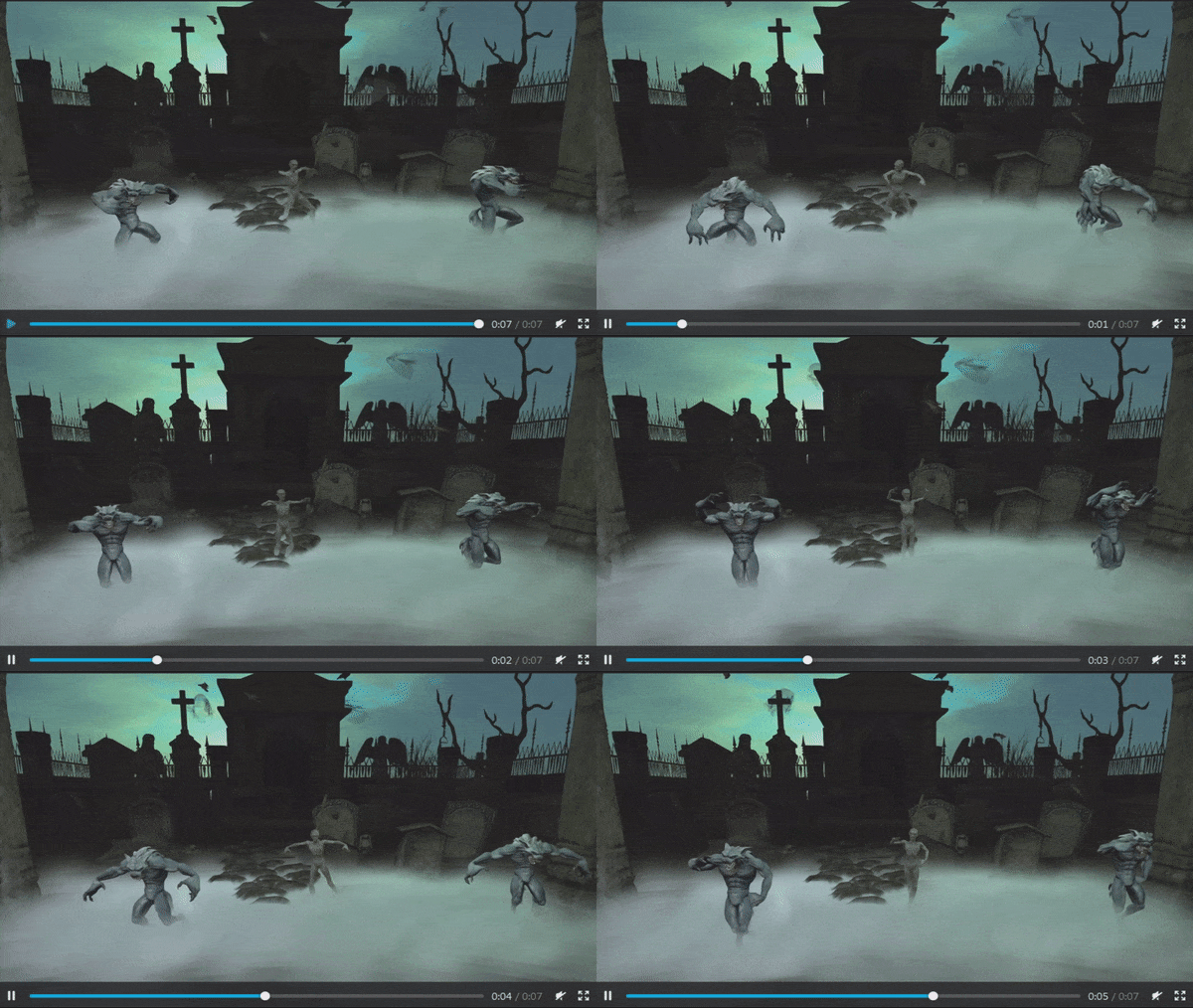


Lab blogs Animesh RC deployment

Animesh will make it a lot easier to have animals roaming in Second Life (as well as other things) compared to current methods of achieving the same results

On Wednesday, June 20th,2018, The Lab completed an initial deployment of Animesh to the Blue Steel release candidate server channel.

For those not up-to-speed with Animesh, the goal of this project is to provide a means of animating rigged mesh objects using the avatar skeleton, in whole or in part, to provide things like independently moveable pets / creatures, and animated scenery features via scripted animation. It involves both viewer and server-side changes.

As noted in the official announcement, Animesh has been in development for some time, with the Lab working closely with the content creator community to develop Animesh, with weekly (more-or-less) meetings being held as a part of the Content Creation User Group (CCUG) meetings.

It is important to note that with this deployment, Animesh is still very much in development, and there may well be further changes before it is fully released.

Animesh Halloween boogie, October 2017. Courtesy of Alexa Linden

Those wishing to try Animesh need to note the following:

  • The server-side support for Animesh is currently only available on the BlueSteel RC regions.
    • Server support for Animesh involves adding a new message and some new LSL functions – see below.
    • If you try to run Animesh objects on a non-Animesh region, you will encounter problems: a) content won’t look right because the server won’t be sending you the appropriate messages; and b) you’ll get script errors because the region doesn’t like the new LSL calls.
  • The Animesh project viewer is required to see Animesh creations correctly. At the time of writing this was at version 5.1.6.516525, dated June 18th, 2018.
    • Animesh content will not render correctly in viewers without the necessary Animesh code.

As Animesh is still in development, and given the caveats noted above, content creators are asked not to start offering any products that are no-mod or such on the marketplace or in-world. Products should wait until at least the Animesh viewer has reached release candidate status – or even has been formally released.

Similarly, TPVs are – as usual when it comes the the Lab’s project viewers – encouraged not to adopt the Animesh viewer code for release purposes until it reaches release candidate status.

Animesh Resources

You can find further information on Animesh via the following resources.

Furthermore, I provide regular updates on the Animesh project via my Content Creation User Group updates, so you can keep up with Animesh development through these.


2018 SL UG updates #24/2: CCUG meeting summary w/audio

MindPillars, a Scottish themed Sim; Inara Pey, May 2018, on FlickrMindPillars, a Scottish themed Simblog post

Updated on June 15th: to include planned RC channel for Animesh deployment – see notes below. 

The following notes are taken from the Content Creation User Group (CCUG) meeting, held on  Thursday, June 14th, 2018 at 13:00 SLT.  These meetings are chaired by Vir Linden, and agenda notes, etc, are usually available on the Content Creation User Group wiki page.

Note that the audio presented here may not be in the exact order of discussion during the meeting; as subjects were at times returned to following their initial discussion, I have attempted to bring together key points of discussion by topic / subject matter. Also, please note that audio drop-out when Vir is speaking appears to be an ongoing problem at his end.

Animesh

Project Summary

The goal of this project is to provide a means of animating rigged mesh objects using the avatar skeleton, in whole or in part, to provide things like independently moveable pets / creatures, and animated scenery features via scripted animation. It involves both viewer and server-side changes.

Resources

Current Status

It now appears that Animesh could be arriving on the server-side release channels on the main (SLS) grid as early as week #25 (week commencing Monday, June 18th, 2018). There are caveats to this: the status of issues with the viewer being one of them – there are certain issues the Lab is focused on, which they would ideally like to have some fix / workaround in place for prior to deploying the Animesh simulator code to Agni.

Update: At the TPVD meeting on Friday, June 15th, Oz Linden indicated that if the Animesh simulator code is deployed to an RC in week #25, it will most likely go to BlueSteel.

Current Viewer Issues

Encroachment / Position / Offsets: this is to ensure that the visual position of an Animesh object is not too far offset from its position as calculated by the simulator (e.g. using things like animation offsets to alter the visual position of all or part of an object). The fix for this is to force the bounding boxes for all joints and the meshes attached to them to remain within a specified distance – most likely 3 metres, although this is still TBC – from the location where the simulator has calculated the object should be.

This update should be in the next update to the Animesh project viewer, and will also utilise new infrastructure on the back-end to allow smarter tracking of the bounding boxes for rigged meshes. This be being done by tracking bounding boxes on a per joint basis, and then transforming them. While it can take a “noticeable” mount of time to do this, Vir’s belief is that it doesn’t unduly impact performance, although if it does become an issue, it may be re-thought.

Concerns were expressed that this would limit the scaling of Animesh creations. Vir states this shouldn’t be the case – the restriction is not ties to scale, but to position. So, for example, a dragon could still be 60 metres in length / height,  but the encroachment fix would mean where it appears in people’s viewers cannot be offset more than 10 metres from where the simulator calculates its actual position to be as a static mesh.

Z-Offset Height Setting: until now the z-offset height setting that can be specified when uploading a mesh to Second Life has been ignored when using meshes with it set to Animesh objects (the offset only works when the mesh is attached to and avatar).

It is hoped an update to fix this will be in the next project viewer update, which should appear before the server-side Animesh code arrives on an Agni RC channel.

Rigged Mesh Level of Detail / Bounding Box Issues: (BUG-214736) – Essentially, attachments on avatars swap their LOD models as if they were scaled to the overall avatar bounding box.

This is a long-standing issue which Graham and Vir Linden are working on, but a fix is unlikely to be available prior to Animesh arriving on Agni.

Broken Rotations Issues:

  • In one (BUG-139251), when some static mesh objects are converted to Animesh, the visual mesh is rotated through 90 degrees when seen in the Animesh viewer, but the physics mesh isn’t, leaving it perpendicular to the model. This is possibly an orientation issue, with the viewer expecting the mesh to be aligned to +x=forward – which not all mesh modelling tools follow.
  • The second problem is that when linking a series of objects into a single Animesh, then are visually located where the avatar skeleton supporting them is located, but the physics shapes remain in the original location of the objects prior to linking / converting.

The recommendation here (for the time being) is that Animesh objects should have a non-mesh root object, and associate any physics representation to that non-mesh root object.  This should hopefully eliminate the current issues and help ensure that any mesh being propelled via scripts in the root object will move in a predictable manner (.i.e. moves forward when driven forward by a script).

Other Issues

Additional bugs: the above are not the only bugs being looked at, but they are the ones causing the most concern due to the risk of behavioural issues / changes they might cause, together with perceived content breakage, when Animesh starts being deployed to the Main grid. Other issues, which are not seen as having so direct an impact will continue to be looked at ad hopefully resolved as Animesh is tested on the Main grid, together with any other issues which may come to light.

GLOD: there is concern that the global LOD values set by the mesh uploader when creators don’t specify their own custom LODs incorrectly encourages poor optimisation, by rewarding those so decrease the calculated LOD values with lower LI post-upload. The feeling is that the reverse should be true. It’s anticipated that Project ARCTan should help to address this.

Bakes On Mesh

Project Summary

Extending the current avatar baking service to allow wearable textures (skins, tattoos, clothing) to be applied directly to mesh bodies as well as system avatars. This involves server-side changes, including updating the baking service to support 1024×1024 textures, and may in time lead to a reduction in the complexity of mesh avatar bodies and heads.

This work does not include normal or specular map support, as these are not part of the existing baking service.

Resources

Current Status

A new Bakes on Mesh project viewer arrived on Thursday, June 14th. Version 5.1.6.516270 includes the new “universal” wearable types corresponding to the 5 new bake channels. These are:

  • LEFT_ARM_TATTOO – bakes to the mesh left arm.
  • LEFT_LEG_TATTOO – bakes to the mesh left leg.
  • AUX1_TATTOO – creator definable layer / channel.
  • AUX2_TATTOO – creator definable layer / channel.
  • AUX3_TATTOO – – creator definable layer / channel.

Note that none of these additional wearables can be applied to the system avatar mesh; which continues to use the original six bake channels.

It’s also not clear if alpha layers can mask these new channels at present. If not, that Vir agrees it is something that should be looked at.

Other points of note:

  • There are no plans to extend Bake on Mesh to allow the use of wearable on non-wearable objects. This is because Bakes on Mesh uses the avatar bake service, which is not geared to apply wearables to in-world objects sans an avatar shape.
  • There is no time frame for Bakes on Mesh deployment at the moment; the project is still in the process of being developed, tested and refined with the help of content creators.
  • There is no updated on any form of scripted control for Bakes on Mesh. It hasn’t been ruled out, but no work is currently being done for scripted support.

In Brief

  • Mesh uploader cost formula / calculations: there have been requests to offer a clearer explanation of mesh cost calculations through something like a clarified wiki page. In terms of Animesh, providing guidelines on potential cost is difficult, as the actual conversion of a mesh to an Animesh takes place post upload.
    • One suggestion to help estimate Animesh costs is to add an Animesh model type to the drop-down list of object types in the mesh uploader.
  • Bento .BVH animation issue: the .BVH format allows for custom joint names for animations in addition to the default joint names. One such custom schema is to prefix joint name with “avatar_”. However, it has recently come to light that while the use of “avatar_” on pre-Bento joints works, trying to upload animations using any of the Bento bones prefixed with “avatar_” results in either an error message on upload (the SL viewer) or the animations uploading, but then being ignored on playback (tested with Firestorm). A JIRA bug report has been requested for this.

2018 UG updates #22/2: CCUG meeting w/audio

Soul2Soul Med; Inara Pey, May 2018, on FlickrSoul2Soul Medblog post

The following notes are taken from the Content Creation User Group (CCUG) meeting, held on  Thursday, May 31st, 2018 at 13:00 SLT.  These meetings are chaired by Vir Linden, and agenda notes, etc, are usually available on the Content Creation User Group wiki page.

Animesh

Project Summary

The goal of this project is to provide a means of animating rigged mesh objects using the avatar skeleton, in whole or in part, to provide things like independently moveable pets / creatures, and animated scenery features via scripted animation. It involves both viewer and server-side changes.

Resources

Current Status

Server-side support should now be largely “done”. There remains one issue awaiting resolution. Once this has been cleared, discussions will start on wider deployment of the code – potentially Aditi first, then to an RC channel on Agni (the Main grid). Still no release date due to ongoing work on the viewer.

Rigged Mesh Level of Detail / Bounding Box Issues

(BUG-214736) – Essentially, attachments on avatars swap their LOD models as if they were scaled to the overall avatar bounding box.

A new approach to resolving this is being attempted which involves removing non-rigged mesh asset sizes from the rigged mesh bounding box.This will not involve changes to avatar scaling / height calculations. If it works, it should result in better bounding boxes for avatars and rigged mesh attachments in general, not just for Animesh. Currently, it is awaiting some back-end updates.

Avatar Limits and Cost Calculations

These were revised several weeks ago – see the link to Vir’s update in the resources list above – and are unlikely to change. At the previous CCUG meeting, there was some discussion over the streaming cost calculation for the Medium LOD, but again, this will not be changing.

Vir reminded people that the ARC calculation for Animesh is now related to the streaming cost calculation (as per the current project viewer – version 5.1.4.515420 at the time of writing). It therefore shouldn’t be subject to quite the same kinds of issue related to scale-based distortions as previously. It may also go through further tweaks.

On a broader note, costs (streaming, impacts, etc.), are going to be looked at as a part of a separate (to Animesh) project – Project ARCTan – see below.

Broken Rotations Issues

These comprise:

  • (BUG-139251), some static mesh objects are converted to Animesh, the visual mesh is rotated through 90 degrees when seen in the Animesh viewer, but the physics mesh isn’t, leaving it perpendicular to the model. This is possibly an orientation issue, with the viewer expecting the mesh to be aligned to +x=forward – which not all mesh modelling tools follow.
  • When linking a series of objects into a single Animesh, then are visually located where the avatar skeleton supporting them is located, but the physics shapes remain in the original location of the objects prior to linking / converting.

No updates on these were available at the meeting.

Joint Offset Constraint

Setting (either deliberately or accidentally) a bad joint offset with something like the mPelvis bound can result in undesired results. To prevent this, a 5m joint offset constraint was introduced in the project viewer. This has / will be now backed out as it has been seen as overly restrictive. An alternative solution will be sought, and Vir hopes that having a fix for the bounding box issue (above) will help in this.

Animesh and Attachments

There has been confusion over Animesh and attachments. In brief:

  • One one Animesh object can be attached to an avatar at a time.
  • Animesh objects, while they have a skeleton, do not support avatar-style attachments. Instead, additional objects (e.g. a collar for an Animesh puppy) should be made a part of the Animesh linkset, and then driven by the Animesh skeleton / scripted animations within the Animesh (although objects in n Animesh linkset could be animated by their own scripts / animations if required).
  • The above has been discussed at length in previous meetings, due to concerns as to how No Mod Animesh items could be made to work with different options (e.g. a puppy wearing different styles of collar).

Bakes On Mesh

Project Summary

Extending the current avatar baking service to allow wearable textures (skins, tattoos, clothing) to be applied directly to mesh bodies as well as system avatars. This involves server-side changes, including updating the baking service to support 1024×1024 textures, and may in time lead to a reduction in the complexity of mesh avatar bodies and heads.

This work does not include normal or specular map support, as these are not part of the existing baking service.

Resources

Additional Bake Channels

Anchor Linden has been working to adding five further channels to the Bake Service (left arm, left foot + three additional “general purpose” channels to be defined and used as required by creators). All of these had been intended to be extensions to the tattoo layer. However, in testing, it was found that feeding a wearable layer with these new channels to a viewer without the necessary support to use the channels, the viewer gets “unhappy”.

To avoid this, this Lab has opted to create a new wearable type which will know about these new bake channels. It will sit above the tattoo layer and below the clothing layers.  This should allow those wishing to make use of the new channels to do so without risk of impacting older viewers, which will simply ignore any new wearable layer they’ve not previously encountered. The flip side is, this extends the amount of work required to introduce a new wearable to the inventory service, in additional to the simulator, appearance service and viewer changes already required were the tattoo layer to be used.

A name for the layer has yet to be determined – but “universal” is under consideration – although Rider Linden (with tongue firmly in cheek) suggested “Bob”.

Scripting Support for Bakes On Mesh

No decision on whether this will be addressed, or if it is to be addressed, whether it will be a part of the initial release.

Continue reading “2018 UG updates #22/2: CCUG meeting w/audio”

2018 UG updates #21/2: Content Creator User Group

La Clef des Champs; Inara Pey, May 2018, on FlickrLa Clef des Champsblog post

The following notes are taken from the Content Creation User Group (CCUG) meeting, held on  Thursday, May 24th, 2018 at 13:00 SLT.  These meetings are chaired by Vir Linden, and agenda notes, etc, are usually available on the Content Creation User Group wiki page.

Animesh

Project Summary

The goal of this project is to provide a means of animating rigged mesh objects using the avatar skeleton, in whole or in part, to provide things like independently moveable pets / creatures, and animated scenery features via scripted animation. It involves both viewer and server-side changes.

Current Status

  • Work is continuing on moving towards a main (Agni) grid deployment of the server-side code to support Animesh.
  • Everything has been through QA, and there is a remaining issue with validating attachments. This is liable to require an additional fix.
  • It is likely that the simulator code will initially be deployed grid-wide on the beta (Aditi) grid for a shakedown period, prior to starting its deployment to the main grid through the usual process of RC deployments ahead of a full deployment.
  • There are still a number of issues that are TBD within the viewer:
    • Broken Rotations Issue: two potentially related problems.
      • In one (BUG-139251), when some static mesh objects are converted to Animesh, the visual mesh is rotated through 90 degrees when seen in the Animesh viewer, but the physics mesh isn’t, leaving it perpendicular to the model. This is possibly an orientation issue, with the viewer expecting the mesh to be aligned to +x=forward – which not all mesh modelling tools follow.
      • The second problem is that when linking a series of objects into a single Animesh, then are visually located where the avatar skeleton supporting them is located, but the physics shapes remain in the original location of the objects prior to linking / converting.
      • What is to be done about this still hasn’t been determined, although the Lab has been playing with playing the physics shape in the root of the object.
    • Rigged Mesh Level of Detail / Bounding Box Issues: (BUG-214736) – Essentially, attachments on avatars swap their LOD models as if they were scaled to the overall avatar bounding box. Graham linden has been working on some fixes for this which should improve accuracy and performance, but further work may be required. Once this has happened, there will be a further update to the project viewer.

Additional Animesh Discussions

  • Animesh Complexity: there is a further update to come to the Animesh complexity values (Advanced menu > Performance Tools > Show Avatar Complexity – applies to both avatars and Animesh objects in the project viewer). This should fix some inconsistencies in the reported values.
  • Animesh updated limits and cost formulas discussions:
    • Land Impact: streaming cost: some have questioned with some question with the 50% bounding on LODs could be more stringent. Vir’s view is that 50% is sufficient to allow for a broad range of capabilities among creators, and being more stringent could simply result in a greater addition to land impact, which could affect the use of Animesh. There is an argument that some models require 75% bounding between the high and medium models.
    • Triangle count limit: There have been requests for further changes to the triangle count limit (e.g. allowing land owners to somehow be able to change it). As the limit was raised to 100,000, it is unlikely to be changed again before Animesh is deployed, and the idea of land owners being able to adjust it is seen as potentially in inconsistencies in how Animesh works in different locations. If it is seen that there is a need to raise the tri count limit, it will be done globally.
    • Avatar attachments: due to performance concerns, the limit of only one Animesh attachment to an avatar at any given time is not going to be changed ahead of Animesh deployment, but might be revisited in the future.
  • Animesh ignores SL scale settings:  this is a result of how rigged meshes are handled – scaling doesn’t matter for worn mesh items, as other mechanisms are available for avatar scaling (e.g. the shape sliders, etc.). As these mechanisms aren’t available for Animesh in the initial release (e.g. there is no actual body shape associated with Animesh objects, ergo, no sliders), scaling is dependent upon custom joint positions.
    • Including more capabilities, such as possibly associating a body shape with an Animesh object, is seen as being a follow-on project to come some time after the initial release.

Bakes On Mesh

Project Summary

Extending the current avatar baking service to allow wearable textures (skins, tattoos, clothing) to be applied directly to mesh bodies as well as system avatars. This involves server-side changes, including updating the baking service to support 1024×1024 textures, and may in time lead to a reduction in the complexity of mesh avatar bodies and heads.

This work does not include normal or specular map support, as these are not part of the existing baking service.

Resources

Additional Bake Channels

Anchor Linden is continuing to work on adding five further channels to the Bake Service (left arm, left foot + three additional “general purpose” channels to be defined and used as required by creators) and the associated tattoo layer UI support to the viewer to allow them to be used.

This is a three-way set of updates, requiring changes to the appearance service, the simulator and the viewer. This, combined with concerns over maintaining backwards compatibility in the appearance service means that getting the work to a testable state is taking a little longer to achieve.

In the meantime, the changes to the appearance service seem to have caused a glitch which can make some avatars appear to be wear “black skirts” when seen on the Animesh test regions Aditi. This will hopefully be corrected soon.

In Brief

Transparency shadow casting from rigged items: there is an issue with rigged / static meshes using transparencies (blended or masked), which causes shadows cast by them to render incorrectly (shadow rendering conforms only to the geometry silhouette).

Graham Linden is now looking at the issue, however, the release of Animesh is not contingent on the basis of any fix, which will probably be part of the ongoing rendering updates Graham is working on.

Rigged / static meshes using transparencies (blended or masked) tend to cast an incorrect shadow

Imposter Clipping: imposter avatars can appear “clipped”. This appears to be related to the problem of not having a good real-time bounding box associated with rigged meshes (which can result in some meshes appearing clipped as well). This is being looked at, and the hope is that if a better means of defining the bounding box for rigged meshes can be found, it will resolve the importer issue. However, the release of things like Animesh are again not contingent on a fix for this issue being implemented.


2018 SL UG updates #20/2: Content Creator User Group w/audio

Bay of Dreams; Inara Pey, April 2018, on FlickrBay of Dreams – Blog post

The following notes are taken from the Content Creation User Group (CCUG) meeting, held on  Thursday, May 17th, 2018 at 13:00 SLT.  The meeting is chaired by Vir Linden, and agenda notes, etc, are usually available on the Content Creation User Group wiki page.

Audio extracts from the meeting are included, where relevant. Please note, however, that Vir’s microphone occasionally seemed to cut out while I was recording, so some of his comments may sound a little choppy.

Animesh

Project Summary

The goal of this project is to provide a means of animating rigged mesh objects using the avatar skeleton, in whole or in part, to provide things like independently moveable pets / creatures, and animated scenery features via scripted animation. It involves both viewer and server-side changes.

Project Viewer

The Animesh project viewer was updated on Tuesday, May 15th to version 5.1.4.515420. This update comprises:

  • Bug fixes, including improved handling of animation notifications which should result in fewer cases of animations failing to display for some Animesh objects.
  • New checks on when a skeleton is needed for a nominally Animesh object  – now one should be present only when the linkset contains at least one rigged mesh, and this should update correctly when link/unlink operations take place, or other state changes.
  • The ARC calculations for animesh objects has also been updated based on some feedback with the previous build.

Alongside of this there has been a simulator update in support of some of the changes in the viewer (e.g. with regard to animation notifications and updates). Also, to help with persistent across things like region crossings and region restarts, animation information is now stored in the state of the Animesh object itself, when it gets serialised. However, there are reports the animation data is lost on a SHIFT-copy action.

Server-Side Work

As well as the simulator updates for Animesh mentioned above, the Lab is continuing with QA work on server-side support for Animesh to prepare it for deployment to the main (Agni) grid. However, no ETA as yet for the server-side code.

Remaining Major Issues

Rigged Mesh Level of Detail / Bounding Box Issues:This has been the subject of several recent CCUG report in these pages, and is the subject of BUG-214736. Essentially, attachments on avatars swap their LOD models as if they were scaled to the overall avatar bounding box. For example, if an avatar bounding box is forced to 15 metres on a side, any rigged object worn by that avatar will swap LODs as if it were 15 metres in size, no matter how small, forcing viewers around it to use its highest LOD model unnecessarily.

Investigations had led to questions in the Lab of how to get things to behave correctly while recognising there may be broader performance issue that need to be addressed. So Graham Linden has been trying to make sense of what might be pulled into the current Animesh project to improve things and what might require a deeper dive into performance in general as a separate piece of work. So at present this remains in the category of “to be determined” in terms of moving to making Animesh available on the main grid.

Joint Offset Constraints: It’s been noted that setting (deliberately or accidentally) a bad joint offset with something like the mPelvis bound can result in undesired results (the cited example is an Animesh test bear on Aditi appearing to stand 75 metres off the ground when not animating). This has led the Lab to consider constraining he distance a joint can be offset to no more than 5 metres for Animesh objects. However, as this is recognised that doing so could break existing content, a more elaborate solution is still being investigated by the Lab.

Adjacent Regions and Animesh Animations: There is an issue where Animesh objects in adjacent regions fail to animate from a avatar’s perspective when someone logs-in. This is thought to be a handshaking / viewer update issue. Essentially, it can take up to a minute for adjacent regions to understand an agent (avatar) in another region can “see” objects within it, and needs to start sending animation updates to the viewer controlling that avatar.

90-degree Rotation Issue: It’s been noted that when converting some static mesh objects to Animesh, the visual mesh appears rotated through 90 degrees when seen in the Animesh viewer. However, the physics mesh doesn’t have the same rotation applied, leaving it perpendicular to the visible mesh – see BUG-139251.

This appears to be related to the fact that the viewer expects the mesh to be aligned to +x=forward – whereas mesh creation tools such as Blender and Maya don’t – by default – use the same orientation. As the issue only affects some mesh (and in theory could be corrected by setting the required rotation in mesh building tools), Vir asked the question if this is something that should be addressed in the viewer.

  • If this issue isn’t addressed in the viewer (which is where it manifests), it potentially means a good proportion of existing content which might otherwise be converted to Animesh will exhibit the same issue when associated with an avatar skeleton, possibly eliminating it from use as Animesh.
  • If the issue is to be addressed in the viewer, the problem is how to apply the logic to ensure mesh items which don’t exhibit the physics rotation issue don’t end up exhibiting the issue as a result of the fix being incorrectly applied.

Z-Axis offset un the Mesh Uploader: This currently doesn’t work when a  skeleton is applied to a mesh object.

Bakes On Mesh

Project Summary

Extending the current avatar baking service to allow wearable textures (skins, tattoos, clothing) to be applied directly to mesh bodies as well as system avatars. This involves server-side changes, including updating the baking service to support 1024×1024 textures, and may in time lead to a reduction in the complexity of mesh avatar bodies and heads.

This work does not include normal or specular map support, as these are not part of the existing baking service.

Resources

Additional Bake Channels

Anchor Linden is investigating adding further channels to the Bake Service in addition to those recently added, again specifically for use with Bakes on Meshes (they will not work with the system avatar). These will hopefully comprise:

  • Separate channels for the left arm and left (currently these are mirrored from the avatar’s right side) to allow for asymmetrical avatar options.
  • Three additional “general purpose” channels to be defined and used as required by creators.

These channels will eventually be surfaced as tattoo layers in the viewer, which will have an updated UI for creating new layers.

Injecting Texture Information into the Bake Stack

There has been a request to allow applier creators to use a scripted means to “inject” textures into the Bake Service via a script (see BUG-216137).

It has arisen out of concern that Bakes on Mesh a) won’t offer the same ease-of-use as HUD-based appliers many users are familiar with; b) it could make the majority of existing applier systems obsolete as mesh head / body creators move towards less complex “onion layer” designs, requiring applier makers to completely re-work all of their existing clothing options. Offering a means to provide Bakes on Mesh with a similar capability as applier systems and allow applier makers to more easily update their existing systems. However:

  • The proposed solution is a non-starter, as the Outfit system on which the Bake Service relies, has no notion of textures. Thus, offering a means to “inject” textures into the bake stack essentially creates a separate (and potentially conflicting) representation of the bake stack.
  • If it is seen that a more applier-like approach to Bakes on Mesh, any solution will form part of a follow-up project, rather than being part of the initial implementation.