The man whose novel helped inspire Second Life takes a Magic Leap

It has been announced that science-fiction author Neal Stephenson has become the latest high-profile individual to join the ranks of Magic Leap, the still-mysterious company that seems to be doing something highly innovative with augmented reality – and perhaps virtual reality as well.

Stephenson, who wrote Snow Crash, the novel which first coined the term “metaverse” and is often referred to as one of the influences behind the development of Second Life, has accepted the position of “Chief Futurist” at Magic Leap, in news being broken by the likes of Wired and The Verge.

Neal Stephenson, Magic Leap's new
Neal Stephenson, Magic Leap’s new “Chief Futurist” (image: Bob Lee via Flickr)

Writing in a blog post for Magic Leap, Stephenson states he had been approached by the company months ago – and in a rather unique way:

A few months ago, two Irishmen, a Scot, and an American appeared on my doorstep with Orcrist, aka “Goblin-cleaver,” the ancient sword forged during the First Age of Middle Earth by the High Elves of Gondolin, later retrieved from a troll hoard by Thorin Oakenshield. It’s not every day that someone turns up at your house bearing a mythic sword, and so I did what anyone who has read a lot of fantasy novels would: I let them in and gave them beer. True to form, they invited me on a quest and asked me to sign a contract (well, an NDA actually).

The use of Orcrist in the offer is cleverly symbolic: one of the Board of Directors of Magic Leap is Sir Richard Taylor, founder and head of WETA Workshop, the company behind the models, costumes and special effects seen in the Lord of the Rings and Hobbit trilogies directed by Peter Jackson.

Precisely what Magic Leap is developing is something of a mystery, although as I’ve previously reported in these pages, what has been shown to the likes of Google, Legendary Pictures, Andreessen Horowitz and others led them to invest some $542 million into the company in October – and that on top of $50 million of investment at the start of the year.

What little is known about Magic Leap is that it is currently working on what it calls “cinematic reality”, which uses a headset which may eventually look something like a pair of sunglasses to overlay anything the wearer sees in the real world with 3D digital images that move and respond to the wearer’s own head an eye movements, and which appear to “interact” with the physical world around the wearer.

You'll believe a whale can fly - or that's perhaps Magic Leap's hope (among more practical things)
You’ll believe a whale can fly – or that’s perhaps Magic Leap’s hope (among more practical things)

Recently, Sean Hollister over at Gizmodo followed the lead set by Tom Simonite, a bureau chief at MIT Technology Review, in tracing down patents filed by Magic Leap in an attempt to find out more about what the company may actually be producing. As I again reported, their findings make fascinating reading for anyone interested in emerging AR and VR technologies – and in the history of Magic Leap, which up until the huge investment by Google et al, had been quietly flying under the radar for a number of years.

In that same report, I also covered the fact that what might be on of Magic Leap’s first major public demonstrations could be at the Manchester International Festival here in the UK in July 2015.

The Age of Starlight is a new film bringing together Oscar-winning director Kevin MacDonald, the visual effects team behind the 2013 George Clooney / Sandra Bullock blockbuster Gravity and science pundit and physicist Professor Brian Cox. The film will tell the story of the cosmos around us utilising Magic Leap technology, allowing audiences of up to 50 people at a time witness – and be immersed in – the unfolding majesty and mystery of the universe in what is billed as being a transformative, emotional experience.

The Age of Starlight: an immersive, transformative film using Magic Leap technology will be shown at the Manchester International Festival in the UK in 2015

It is apparently this transformative power within the Magic Leap technology that has attracted Neal Stephenson. Again, on the Magic Leap blog he states:

Here’s where you’re probably expecting the sales pitch about how mind-blowingly awesome the demo was. But it’s a little more interesting than that. Yes, I saw something on that optical table I had never seen before–something that only Magic Leap, as far as I know, is capable of doing. And it was pretty cool. But what fascinated me wasn’t what Magic Leap had done but rather what it was about to start doing.

Magic Leap is mustering an arsenal of techniques–some tried and true, others unbelievably advanced–to produce a synthesized light field that falls upon the retina in the same way as light reflected from real objects in your environment. Depth perception, in this system, isn’t just a trick played on the brain by showing it two slightly different images.

Magic Leap is not exclusively about games. It’s also going to be a great tool for readers, learners, scientists, and artists … What applies to games applies as well to other things of interest, such as making the world safe for books, doing new things with science and math visualization, and simply creating art for art’s sake.

We still don’t know precisely what Magic Leap will present or how it will work, and truth be told, there is an awful lot of hype and hyperbole surrounding the emerging new market for AR and VR it is hard at times to separate fact from fiction. But when the likes of Sir Richard Taylor and Thomas Tull (CEO of Legendary Pictures) pour their own money into a project, and it attracts names such as Brian Cox, Kevin MacDonald and now Neal Stephenson – you have to suspect something very special might well be sitting just over the horizon.

Related Links

Magic Leap: bringing augmented reality to film in 2015

The Age of Starlight Promotion picture
Magic Leap technology is to be “premiered” at a UK festival in 2015, in a special film / show entitled The Age of Starlight (image: Manchester International Festival)

Professor Brian Cox may not be a familiar name to everyone, but in the UK and for those with an eye for science on television, he has become something of England’s answer to Neil deGrasse Tyson.

Professor Brian Cox
Professor Brian Cox

Cox, who played keyboards in the pop group D:Ream whilst studying physics at the University of Manchester in the 1990s, started his television career in 2005, appearing on the BBC’s science and philosophy series, Horizon.

Since then, he has fronted a range of science programmes and series, as well as appearing on chats shows on both sides of the Atlantic. He’s even  had a guest starring role in the adventures of the very master of time and space itself, Doctor Who.

Now, the BBC reports, he will be presenting in a cutting edge show / film (which he is also scripting) entitled The Age of Starlight, telling the story of the universe, intended to be one of the focal events of the 2015 Manchester International Festival. The production will also feature visual effects by Framestore, the team that won an Oscar for their work on the 2013 George Clooney / Sandra Bullock sci-fi vehicle Gravity, and will be directed by Kevin MacDonald whose films include the Oscar-winning Last King of Scotland and One Day in September and the BAFTA-winning Touching the Void.

But what makes The Age of Starlight particularly interesting is that it will utilise augment reality technology being developed by Magic Leap, the company that hit the headlines in October 2014, when it received $542 million in funding from a broad range of investors.

For those of you who missed it, Magic Leap is the company behind a headset that uses augmented reality to combine realistic computer graphics with everything the wearer sees in real time, in what the company calls “cinematic reality”. The results can be startling, going on the available promotional material: tiny elephants in the palms of your hands, dragons flying among flocks of birds,  yellow submarines sailing through streets, humpback whales floating over crowded beaches, and more.

One of the Magic Leap promotional images: a yellow submarine apparently floats down a street the Magic Leap wearer is walking along
Magic Leap merges realistic computer graphics with everything the user sees in the real world, in what the company calls “cinematic reality”.

However, beyond the stunning promotional images and video, the company has publicly revealed very little about what it is up to. But what they have shown behind closed doors has been enough to get John Markoff from the New York times very excited, and has been sufficient to get Google to lead that US$542 million (£346 million) round of investment in October, which itself came on top of an initial $50 million of funding earlier in 2014.

Given all the apparent mystery surrounding Magic Leap, Sean Hollister over at Gizmodo, decided to spend a little time digging around trying to find out more on what Magic Leap is all about.

In his article, Hollister starts out by framing something of the company’s history, revealing that Magic Leap has been chipping away at things for quite a while. In a fascinating track through the company’s history, he references their 2011 collaboration with Weta Workshop on something called The Hour Blue, as reported by Dice (see the video, below). This still appears to be around today, although exactly what it is, isn’t clear. This collaboration may have been the reason why Weta’s co-founder, Richard Taylor, opted to make a personal investment in Magic Leap during the $50 million round of funding and now sits on the board of directors.

Making augmented reality of the kind Magic Leap is trying to achieve is a significant challenge, as Hollister explains:

If you’re looking at the real world, your eyes are focusing at a variety of different distances, not necessarily on a tiny piece of glass right in front of your face. The real world also reflects a lot of light into your eyes, which is why the images from heads-up displays like Google Glass appear transparent and ghostly. Because you need to see the real world, you obviously can’t have a projector covering the front of the glasses: that light has to be bounced in from the side, which generally results in a narrow field of view.

And of course, you need some way to track your head and your surroundings so that CG objects appear to occupy a real place in the world, instead of looking like a flat image— which, sadly, is how many existing augmented reality specs do it.

Given this, Hollister reasoned, the best way to understand what the company might actually be developing is to take a look at the patents they have filed and which address such challenges. In taking this line, he’s actually following the lead set by Tom Simonite, a bureau chief at MIT Technology Review.

Continue reading “Magic Leap: bringing augmented reality to film in 2015”

Unbelievable moments (things seen while waiting for a bus)

On Thursday, October 23rd, I wrote a piece about Magic Leap, and their augmented reality project that has garnered some US$600 million in investment since February 2014, and which drew the likes of Google and Legendary Pictures to the “B” round of funding that raised some US$542 million.

I’m not alone in pointing to Magic Leap and the fact that no-one outside a select few know what it is, precisely. Nalates Urriah has blogged on the subject, referencing a French video describing a Pepsi Max UK promotional stunt pulled earlier in 2014, as possibly indicative of the idea behind Magic Leap.

I remember seeing the video, filmed in London’s New Oxford Street, when it first aired in March 2014. While it is likely pretty well removed from anything Magic Leap are doing, it serves as an illustration of overlaying digital media on the real world. It’s also fun to watch, so I thought I’d embed the original here. Enjoy!

castAR gets a Mountain View as the developer kits appear

The new Deve Kit version of castAR
The new Dev Kit version of castAR (image via Engadget)

I’ve been following the work of Technical Illusions, the creators of the castAR projected augmented reality headset with a VR capability, for some time now, although things have been quiet on the news front for a while. However, that’s starting to change.

The first item of news is that the company in the process of moving its operations from Seattle, Washington, to Mountain View, California.

Henkel-Wallace
David Henkel-Wallace – castAR’s recently appointed CEO (image: Technical Illusions)

The move is being overseen by the company’s new CEO, David Henkel-Wallace, who joined the company in June 2014. The move is in part to try to drive-up the company’s ability to hire hardware talent – they’ve found it hard to get hardware specialists in Seattle, where software rules the roost. It also puts them in the middle of “Nerdvana” – as Co-founder Jeri Ellsworth puts it, which could do much to raise their visibility in terms of inward investment opportunities.

As it is, the company numbers around a dozen full-time employees, including Henkel-Wallace, founders Ellsworth and Rick Johnson and CFO Paul Denton. Both Denton and Henkel-Wallace have considerable experience in building-up start-ups. There’s also Toby the cat, also listed as co-founder, and fulfilling the role of Senior Cat, with responsibilities for eating, sleeping, purring and lap-sitting.

The other major news for the company is that a year after their Kickstarter campaign, their initial developer kits are now ready, and will soon be shipping to those people who pre-ordered kit through the campaign. The new headsets have also been on show to the likes of Engadget and Venture Beat’s Gamesbeat, where Ellsworth talked to Dean Takahashi.

Ellsworth is the first to admit the new headsets are still some way short of a production-ready version, but they’ve still come a long way from even the 2nd prototype versions seen just seven  months ago.

castAR - from pre-prototype (top) in early 2014 to the developer version of the headset (bottom), October 2014
castAR – from pre-prototype (top) in early 2014 to the developer version of the headset (bottom), October 2014 (images via Engadget)

The revised developer headset weighs-in at some 140 grams, and the company is aiming to get this down to around 80 grams in the production version. Included in that are two 120 Hz cameras with 135 degrees tracking, and 1,000 Hz gyro. The optics, now supplied by a Japanese company, deliver a resolution of 2,560-by-720, with every pixel addressable and capable of being resolved at a distances of between half a metre and 2 metres when using the retro-reflective system.

The headset is admittedly still nerdy-looking, resembling a pair of heavily framed sunglasses with a bulky silver mounting for the LEDs and cameras on top. However, Technical Illusions state that they opted to make the headset somewhat on the big / clunky side, as they weren’t sure how well all the tech would fit into it. They’re now confident that the package can be shrunk down to something which not only meets their target weight, but which is also more pleasing to the eye and closer to their conceptual look for production versions.

As well as the headset, the other major components of the system  – the interactive wand, the retro-reflective surface and the VR clip-on – have all been refined and improved. Work is still ongoing with the wand, which allows a user to manipulate virtual items projected by the headset onto the retro-reflective surface with “sub-millimetre accuracy”. Kits, when shipped, will also include Technical Illusions’s own game, mARbles, designed to demonstrate the gameplay capability of the system to developers.

mARbles has been designed by the castAR team to demonstrate the potential of project AR games to developers
mARbles is a “Marble Madness”-style game which can be played individually or by two r more players. It is shipping with the castAR dev kits (image: Technical Illusions)

So what is the market for the castAR? Ellsworth believes that games “will be king for a while”, and admits to looking forward to seeing flight simulators that use the castAR projection system, although she also notes other potential uses when talking to GamesBeat’s Takahashi.

A lot of people are going to get excited about tabletop collaborative experiences, where multiple people sit around a table and work in the same physical space. All the game characters are in the same space. We have a lot of companies approaching us that want to use it for visualization – architecture, things like that, where you can sit around and table and work in the same space.

Nor do users necessarily need to be in the same physical space, in order to engage with one another, as the company has demonstrated in a number of its videos.

In terms of practical applications, Technical Illusions have been working with medical experts to see how the castAR system might be used alongside MRI scans, the castAR system being use to build 3D holograms of scanned patients which can be examined by doctors and / or surgeons, helping them to build a more complete understanding of the patient’s condition.

The conceptualised castAR production headset and VR clip-on system (image: Technical Illusions)

How successful castAR is likely to be is hard to judge; the world is awash with excitement over VR that all things AR have been largely sidelined. Even the involvement of Google (and others) in Magic Wand hasn’t really done much to change that.

castAR is also somewhat different to other AR systems seen so far, potentially making it an oddball in the eyes of some media, although its potential to enter into the VR sphere through the VR clip-on may serve to generate wider interest. How big a footprint castAR might actually make in the VR world is hard to judge; a key here might be in whether it can be made compatible with games being specifically developed for Rift-type hardware.

So far, the company has managed to achieve a lot while remaining relatively low-profile. Their emphasis for the foreseeable future is on building relationship with developers and getting content integrated into the system as the hardware itself continues to mature towards the desired consumer format.

Even so, if the company is to make its mark, it is liable to need the support of investors – and the move to Mountain View is, as noted by Technical Illusions themselves, perhaps as much about that as putting them more readily at the hub of available expertise. As such, it’ll be interesting to see where the move leads.

Related Links

Magic Leap: the elephant (or dragon, or…) in your room (or street, or…)

You'll believe a whale can fly - or that's perhaps Magic Leap's hope (among more practical things)
You’ll believe a whale can fly – or that’s Magic Leap’s hope (among more practical things)

Augmented Reality took a shot in the arm this week with the new that Google is at the forefront of some US$542 million investment in technology company Magic Leap. What’s more, not only is the coming putting the money forward directly, rather than through their investment arm, Google Ventures (which has previously put money into things like Philip Rosedale’s High Fidelity, alongside of investment house True Ventures), but two senior executives from Google will be joining the Magic Leap board. These are Sundar Pichai, Android and Chrome leader, and Don Harrison, Google’s corporate development vice-president.

The funding round comes on top of an initial round of investment in February 2014, which drew some US$50 million to the company.

But who or what is Magic Leap? According to the company’s website, it is essentially an augmented reality system which uses a “Dynamic Digitized Lightfield Signal”, although they note we can call it “Digital Lightfield™”, capable of merging realistic computer graphics with everything the user sees in the real world. This appears to be something of a merging of both VR and AR (with the emphasis on the latter), to create an immersive whole. The system doesn’t use the Oculus Rift, but apparently uses a headset system possibly akin to, say, the castAR system or perhaps Google Glass; the latter of which might explain Google’s interest – or it might not.

However, no-one knows precisely what Magic Leap is or how it works, because there haven’t been any public demonstrations of the system, nor have any images of the hardware been released. And while trendy terms like “Digital Lightfield™” are used on the equally trendy website, there is little to tell what is going on.

So far all that has been released are a series of pretty stunning images and videos – witness the video above, or the images top and centre in this article. However, that’s not so say the company don’t have something to get investors excited.

“It was incredibly natural and almost jarring — you’re in the room, and there’s a dragon flying around, it’s jaw-dropping and I couldn’t get the smile off of my face,” Thomas Tull, CEO of Legendary Entertainment (aka Legendary Pictures) told the Wall Street Journal. Images, projected into the wearer’s eyes, can even be made to appear to pass in front of or behind real-world objects. Tull was so impressed by what he saw, he not only had Legendary Pictures to invest in Magic Leap, he also made a personal investment as well.

Nor are Legendary Pictures and Google alone. Other investors in the funding round include Qualcomm, Kleiner Perkins, Andreessen Horowitz, Vulcan Capital, Obvious Ventures and Caufield & Byers. Qualcomm’s executive chairman, Paul Jacobs, is also joining Magic Leap’s board, and will sit alongside Google’s Don Harrison and an observer.

One of the Magic Leap promotional images: a yellow submarine apparently floats down a street the Magic Leap wearer is walking along
Another Magic Leap promotional image: a yellow submarine apparently floats down a street the Magic Leap wearer is walking along

Such a broad spread of investment potential speaks to the vision held by Magic Leap’s CEO, Rony Abovitz, who wants the company to become “a creative hub for gamers, game designers, writers, coders, musicians, filmmakers, and artists.”

The potential for something like Magic Leap in films is clear; imagine sitting down in a movie theatre, donning a pair of glasses perhaps not too dissimilar to the current 3D glasses provided at theatres, and then seeing a film where events can become a shared experience as they extend into the audience…

That may well be why co-founder of Weta Workshop, the SFx company behind the visual effects for Peter Jackson’s Lord of the Rings and The Hobbit trilogies (among others), Richard Taylor, was also drawn to the project. He participated in the first round of funding for Magic Leap, and now sits on the company’s board of directors.

Weta Workshop co-founder Richard Taylor: Magic Leap investor and board member (image via Stuff)

“What Rony and the Magic Leap team have created is nothing short of remarkable and will forever change the way we interact with images and information,” Taylor said at the time of his investment.

“The wearable technology they have developed is revolutionary in its ability to create amazingly immersive and fantastical experiences. This goal alone would be a Herculean endeavor for any development group, but the fact that the Magic Leap team is driven by the mantra of also delivering devices that complement human physiology is extraordinary,”

Bing Gordon, a partner at Kleiner Perkins Caufield & Byers, and a former executive at EA Games sees a huge the potential for Magic Leap. Commenting on how the system is better coordinated with how the human eye and brain process images, making the computer graphics feel, and move, more naturally, he told the New York Times that Magic Leap could help drive augmented reality to outstrip mobile devices in terms of popularity in its possible range of uses.

It would seem that Google is looking more broadly at the potential of the technology as well, rather than button-holing it for any particular use or in combination with any particular product (Glass itself has been somewhat low-key this year, and was all but absent at the corporation’s Google i/o in July). Many commentators believe that Google’s investment, coming as it does from the company, rather than its investment arm, is a strategic move, with Google willing to see how the Magic Leap technology matures. Abovitz has gone a little further on matters, stating that Glass and Magic Leap use different approaches and will not be merged.

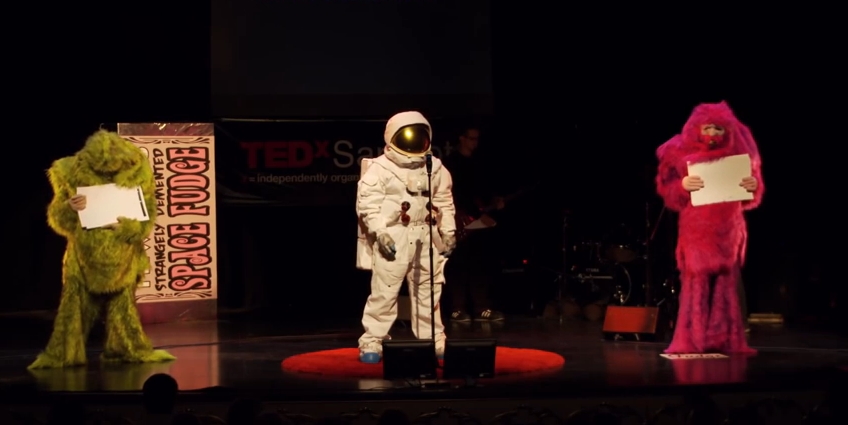
Rony Abovitz (in the space suit) and friends appearing at TEDx Sarasota event in December 2012 - still generating a "Wut?" response in many people today
Rony Abovitz (in the space suit) and friends appearing at TEDx Sarasota in December 2012 – still generating a “Wut?” response in many people today

Abovitz himself cuts something of an unusual figure – as anyone who witnesses his appearance at the TEDx Sarasota’s inaugural conference is liable to agree. The Magic Leap website is equally somewhat offbeat, indicating that the Magic Leap team comprises (among others) “rocket scientists”, “software ninjas”, “computing hobbits”, and “psychedelic physicists”.  however, it might not be wise to underestimate him. Abovitz also founded MAKO Surgical, producing surgical robotic arm assistance platforms, a company he took from start-up in 2004 to being named, in 2011, the fastest growing technology company on Deloitte’s Technology Fast 500.. In 2013, he orchestrated the sale of MAKO to Stryker Medical in a US$1.65 billion deal.

“Magic Leap is going beyond the current perception of mobile computing, augmented reality and virtual reality,” Abovitz said in a company statement following the funding round. “We are transcending all three, and will revolutionize the way people communicate, purchase, learn, share and play.”

Related Links

Got a question about the VR metaverse? Put it to the experts!

SVVR

The first Silicon Valley VR (SVVR) Conference and Expo will take place on Monday 19th May and Tuesday 20th May 2014, at the Computer History Museum, Mountain View, California.

The conference will bring together a host of experts in the VR and in virtual environments, including the likes of Palmer Luckey (Oculus VR), Philip Rosedale, Ebbe Altberg, David Holtz (Leap Motion), Ben Lang (Road to VR), Jan Goetgeluk (Virtuix) and many more – see the list of speakers and panelists on the conference website – as well as including exhibits and demos from some of the top names in the field.

Both the Drax Files Radio Hour and New World Notes have secured discounts of $100 per person on the two-day registration for those who are able to attend. Simply enter either code “drax2014″ or “nwn2014” when registering to claim your discount.

But even if you can’t attend, you can still be involved. Here’s how.

As a part of the conference events, Draxtor Despres of The Drax Files fame will be moderating a special panel, Creating the VR Metaverse. featuring Ebbe Altberg (Linden Lab), Philip Rosedale (High Fidelity), Stefano Corazza (Mixamo), Tony Parisi (Vizi).

Creating the VR metaverse
(l to r): Ebbe Altberg, Philip Rosedale, Stefano Corazza and Tony Parisi. Ready to answer questions on “Creating the VR Metaverse”.

Together, they’ll be considering topics such as:

  • One global metaverse or many?
  • Identity and privacy
  • Virtual World Governance: democracies, the greek god model, or benevolent dictators
  • Intellectual property and legal jurisdictions
  • Avatar portability and standards

If you have a question you’d like to put to this panel during the course of the proceedings, then please leave it in the comments following this article, and it may be selected by Drax to be asked during the course of the discussion.

Perhaps your question relates to one of the topics listed above, or perhaps you’re wondering if the idea of a just a “VR metaverse” is too narrow, and any future metaverse should also embrace augmented reality (AR) as well; or perhaps you’re wondering why and how any new metaverse might enjoy wider adoption in the world at large than we’ve seen with the likes of SL and OpenSim; or perhaps … Well, you get the idea.

Panel moderator: Draxtor Drepres
Panel moderator: Draxtor Despres

You can address your question to an individual member of the panel or to all of them or any combination in between. All that’s required is that your question is pertinent to the panel’s theme, creating the VR  metaverse, is polite, and is suitable for the forum in which it is to be asked.

Obviously, and depending upon the number received, not every question submitted will necessarily be asked (as questions will also be taken from the live audience) – but if your question is liable to get the panel thinking or generate some interesting / thought-provoking replies, then it may well get selected. Just make sure you have provided it in the comments below no later than 20:00 on Monday May 19th.

Related Links