Space Sunday: ISS, a lunar time zone and an aurora

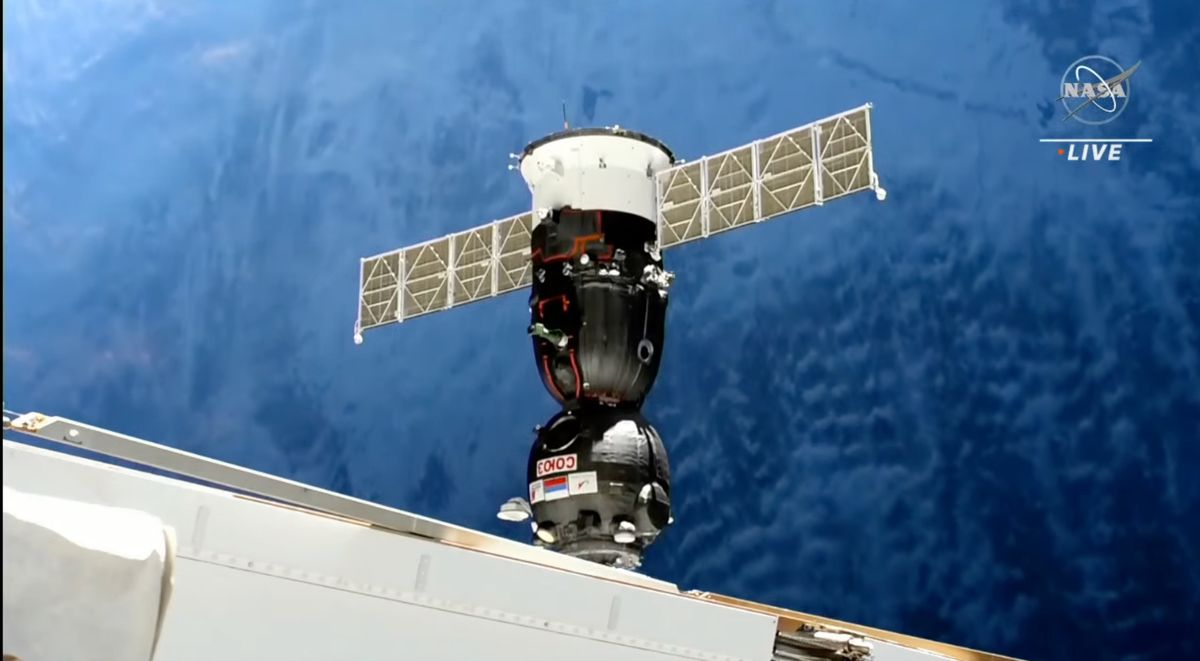
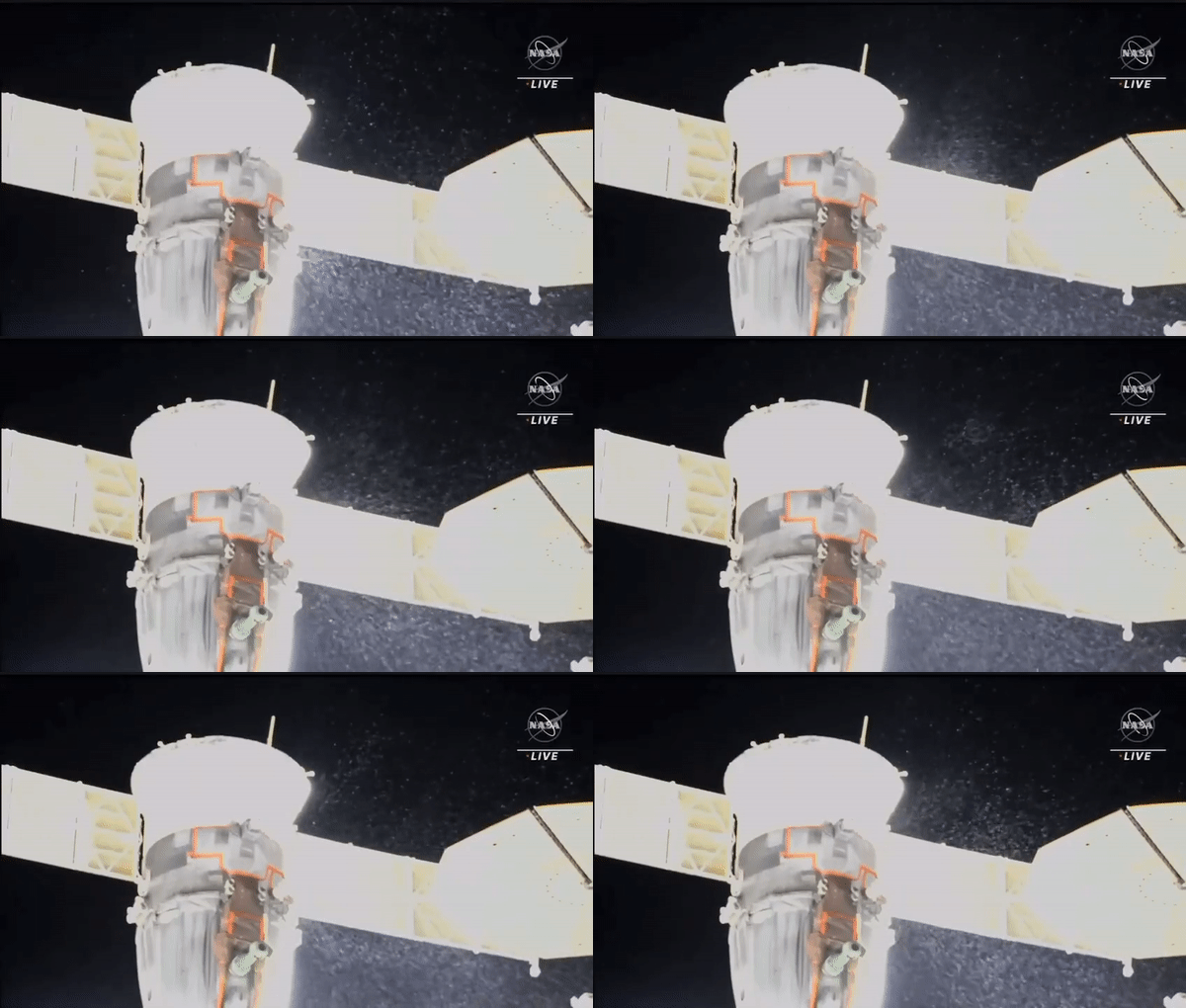
Russia’s uncrewed Soyuz MS-23 spacecraft approaches the International Space Station for docking on Feb. 25, 2023. The round forward section of the vehicle is the orbital crew module, discarded before re-entry; the bell-shaped centre element is the Earth return capsule, and the aft end with the solar arrays provides power and propulsion, but is discarded before re-entry. Credit: NASA TV

Russia’s uncrewed Soyuz MS-23 launched for the International space station on February 24th, 2023, on its way to replace the Soyuz MS-22 vehicle struck by a major coolant leak in December 2022, leaving it incapable of returning crew members Sergey Prokopyev, Dmitri Petelin and Frank Rubio to Earth as planned at the end of their 6-month rotation.

Due to the lack of any return capability, NASA and Roscosmos had worked on an emergency scenario whereby the Soyuz seat for Rubio had been transferred to Crew Dragon Endurance to allow his return with the 4-person members of NASA’s Crew 5 in the event of an emergency evacuation being called for ahead of MS-23’s arrival; the theory being that this would reduce the heat load in the Soyuz return capsule, allowing Prokopyev and Petelin to survive a return to Earth in that vehicle.

Having arrived at the ISS on February 25th, the crew started work in off-loading the ~430 kg of cargo MS-23 carried to the ISS and then moving the flight seats for the MS-22 crew into the newly-arrived Soyuz. It is not clear when MS-22 will be undocked from the ISS to attempt an automated return to Earth; however, its crew will now spend almost a year in space, as MS-23 will not make a return to Earth until September 2023, giving Roscosmos time to completely reshuffle crew rotations.

Crew Dragon Endeavour is lifted off of Pad 39-A at Kennedy Space Centre, Florida by a SpaceX Falcon 9 at the start of the Crew 6 mission, March 2nd, 2023. Credit: Jordan Sirokie

In the meantime, NASA’s Crew 6 mission launched from Kennedy Space Centre on March 2nd, aboard SpaceX Crew Dragon Endeavour delivering NASA astronauts Stephen Bowen and Warren Hoburg, cosmonaut Andrey Fedyaev and Emirati astronaut Sultan Alneyadi to the space station on March 3rd, after a one-hour delay in docking whilst a faulty sensor on the docking system was corrected.

Bowen is due to take over the role of ISS commander from Prokopyev, marking the start of NASA Crew Rotation 69. Following handover, the Crew 5 mission, comprising NASA astronauts Nicola Mann and Josh Cassada, together with JAXA astronaut Koichi Wakata and cosmonaut Anna Kikina (the first Russian to fly a US commercial crew programme flight, and the first Russian to fly on a US spacecraft since 2002) will depart the ISS aboard Endurance for Earth, possibly around March 8th.

The NASA Crew 6 / Expedition 69 crew (in the blue jumpsuits) of (l to r) Sultan Alneyadi, Stephen Bowen, Andrey Fedyaev and Warren Hoburg, join the current ISS crew of (l to r foreground) Josh Cassada, Koichi Wakata and Frank Rubio, together with (l to r in the rear), Dmitri Petelin, Sergey Prokopyev, Anna Kikina  and Nicole Mann. Credit: NASA TV 

Crew 6 almost marks the last flight of Crew Dragon under the initial contract between NASA and SpaceX which pegged launch fees at US $220 million / US$55 million per seat.  From the August Crew 7 launch through until Crew 14 (~2028), SpaceX Crew Dragon flights will average US $288 million / US $72 million per seat.

Giving the Moon its Own Time Zone

A human return to the Moon and the potential for establishing a permanent presence there involves many things. Most of the time, efforts are focused on the technologies required: launch and landing systems, communications system, life support, etc. However, one thing people likely do not consider is the matter of how time will be kept.

Until now, missions to the Moon have operated on a time frame based on their country of origin, with their onboard chronometers synchronised with terrestrial time. However, this will not work going forward, when there will be multiple missions – crewed and robotic – operating on and around the Moon.

To facilitate these missions, NASA and the European Space Agency (ESA) are developing new orbital services such as the Lunar Communications Relay and Navigation System and Moonlight, both of which might be thought of a combination of communications as GPS data services such as the US GPS and European Galileo systems.

The latter have their own timing systems, but they possess offsets relative to one another of just a few billionths of a second, allowing them to operate on concert. In particular, they are fixed to the Universal Coordinated Time (UTC) global standard, which is also used by the internet and aviation, as well as scientific experiments that require highly precise time measurements. This allows both networks to remain fully in synch with one another and with ground-based units.

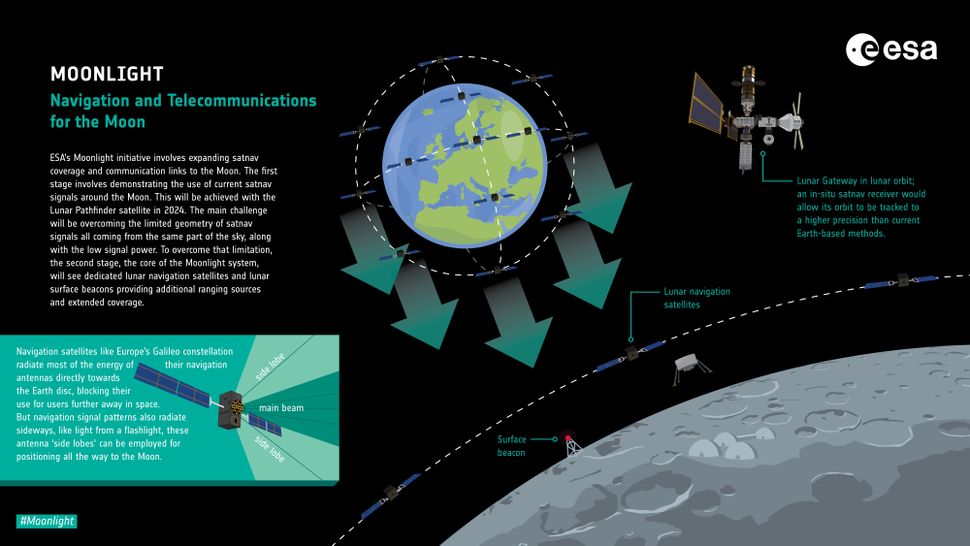
ESA’s Moonlight initiative plans to expand satellite-navigation coverage and communication links to the moon. Credit: ESA / K Oldenburg

Having a universal time standard for the Moon and cislunar space is important because clocks run slower on the Moon’s surface than on Earth by 56 millionths of a second per terrestrial day, whilst clocks placed in different orbits around the Moon will run at different rates to one another and those on the lunar surface. Over time, this can result in communications and data errors to be introduced, so having a singular reference point – time zone – unique to lunar operations is essential for such time-keeping and allowing for things like accurate navigation across the surface of the Moon and when in orbit around it.

To this end, and following meetings hosted by ESTEC, the European Space Research and Technology Centre, space organisations such as NASA, ESA and JAXA, have agreed to develop LunaNet. Based on the core concepts of GPS and Galileo, LunaNet is intended to provide a set of mutually agreed-upon standards, protocols and interface requirements for inter-operability between multiple space and surface units operating around on the Moon, all utilising the same time standard.

Exactly how this standard will be defined and will be responsible for maintaining it or what it should be called has yet to be determined. UTC, for example, is not maintained by any one nation, but by the intergovernmental International Bureau of Weights and Measures (IBWN) based in Paris, France. One suggested name for the new time zone is “selenocentric reference frame” (SRF), which doesn’t exactly roll off the tongue. It has also yet to be decided whether or not it should be synchronised with time zone on Earth. However, as a necessary requirement, developing and defining it could help with future deep-space missions.

UK Treated to Almost Nationwide Auroral Display

On February 24th and again of February 25th, the Sun gave off a pair of coronal mass ejections (CMEs) – massive eruptions of material throwing billions of tonnes of energetic material from the corona and free of the Sun’s gravity well. CMEs are a common event and can move in any direction relative to the Sun. As it so happened, this pair fired Earthward, travelling at around 3 million km/h, each arriving at a time when they were ideal viewing in the evening skies over the UK.

February 26th, 2023 auroral display seen from Hopeman Beach, Scotland. Credit: Alan Tough

After a journey of 150 million km, the material from the first CME slammed into the Earth’s magnetosphere over an UK just settling down for a quiet evening under clear skies on Sunday, February 26th. The result was a sizeable geomagnetic storm in which electrons in the magnetosphere were accelerated into the atmosphere by the blunt force of the CME material, sparking intense auroral displays which rapidly spread far further south than is usually the case, giving people across Britain with a glorious display.

Twenty-four hours later, the second CME struck, this time coinciding with lunchtime in the UK and largely overcast skies. However, such was the nature of the resultant geomagnetic disturbance, coming hard on the heels of the first, resulted in a second extensive auroral display which was still visible  in the evening across many parts of the UK as the skies darkened – and the weather cleared again.

Continue reading “Space Sunday: ISS, a lunar time zone and an aurora”

Space Sunday: asteroid impacts; ISS update

International work on near-Earth asteroid detection systems is again ramping up as, coincidentally, a very small asteroid caused a stir in northern Europe and the UK.

2023 CX1 (originally known as Star2667 prior to its impact) was broadly similar in nature to the type of object such systems would attempt to seek out, in that it was entirely unknown to astronomers the world over until a mere seven hours before it entered Earth’s atmosphere on February 13th, 2023. Fortunately, it was small enough and light enough – estimated to be around 1 metre across its largest dimension and weighing about 1 kilogramme – to pose no direct threat, although its demise was seen from France, the southern UK, Belgium, The Netherlands and northern Spain.

Thus far, over 30,600 asteroids and comets of various classes have been identified as having some risk of striking Earth’s atmosphere, with around 8% know to be of a size (+100m across) large enough to result in significant regional damage should it to so. However, even asteroids and comet fragments of just 20-40m across could cause considerable damage / loss of life were one to explode in the atmosphere over a population centre, whilst the total number of potential threats remains unknown.

A major problem in identifying these objects from Earth’s surface using visual or infra-red means is that the Sun tends to sharply limit where and when we can look for them, whilst radar has to be able to work around 150,000 satellites and all debris and junk we have put in orbit (excluding military satellites and “constellations” of small satellites such as SpaceX Starlink and OneWeb).

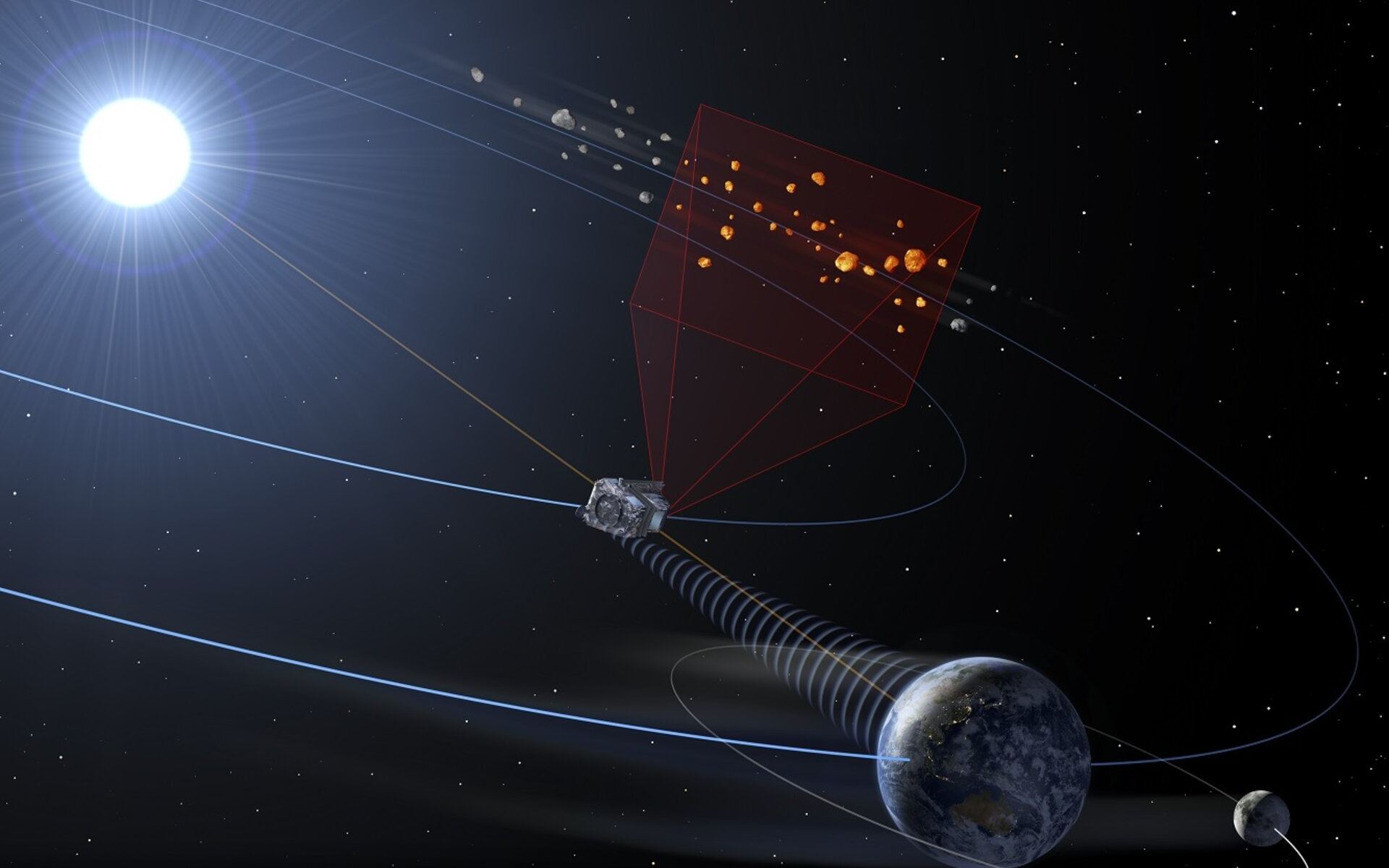
To bypass such problems, the European Space Agency plans to deploy NEOMIR, the Near-Earth Object Mission in the Infra-Red, a spacecraft carrying a compact telescope and placed at the L1 Lagrange point between Earth and the Sun (where the gravitational attraction of the two essentially “cancel each other out”, making it easier for a craft occupying the region to maintain its position). From here, Earth and the space around it would be in perpetual sunlight and the Sun would be “behind” the satellite, meaning that any objects in orbit around Earth or passing close to it will also be warmed by the Sun (and so visible in the infra-red), whilst sunlight would not be able to “blind” the satellite’s ability to see them.

An artist’s impression of NEOMIR occupying the Sun-Earth L1 position as it observe the space around Earth for potential near-Earth asteroids which may pose a threat. Credit: ESA

The half-metre telescope carried by NEOMIR will be able to identify asteroids as small as 20m in size, and would generally be able to provide a minimum of 3 weeks notice of a potential impact with Earth’s atmosphere for objects of that size (although under very specific edge-cases the warning could be as little as 3 days), with significantly longer periods of warning for larger objects.

Currently, NEOMIR is in the design review phase, and if all goes well, it will be launched in 2030. In doing so, it will help plug a “gap” in plans to address the threat of NEO collisions with Earth: NASA’s NEO Surveyor mission, planned for launch in 2026, will also operate from the L1 position – but is only designed to spot and track objects in excess of 140m in diameter. Thus, NEOMIR and NEO Surveyor will between them provide more complete coverage.

At the same time as an update on NEOMIR’s development was made, China announced construction of its Earth-based Fuyan (“faceted eye”, but generally referred to as the “China Compound Eye”) radar system for detecting potential asteroid threats is entering a new phase of development.

The first phase of the system – comprising four purpose-built 16m diameter radar dishes – was completed in December 2022 within the Chongqing district of south-west China. Since then, the system has been pinging signals off of the Moon to verify the  system and its key technologies.

Two of the Fuyan 16m radar dishes on test in China, December 2022. Credit: CGTN

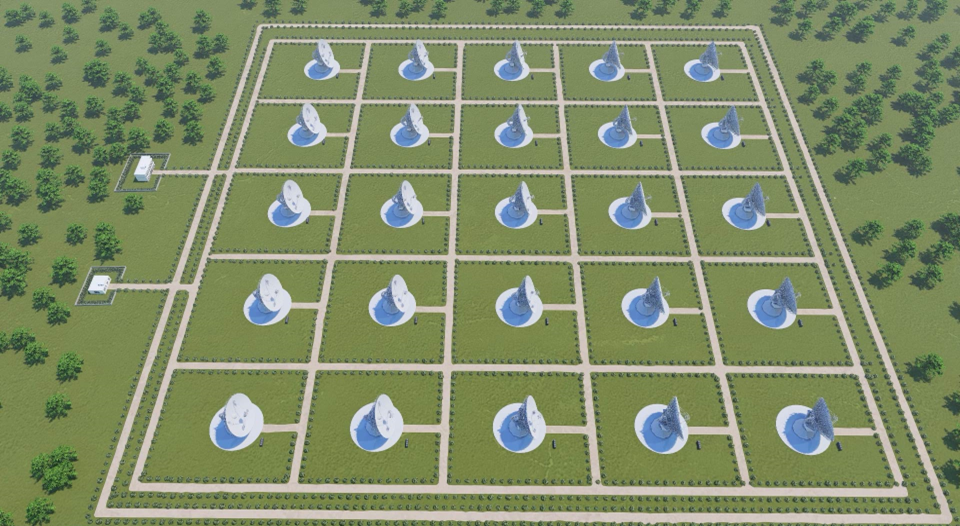
The new phase of work will see the construction of 25 radar dishes of 30m diameter, arranged in a grid. When they enter service in 2025, they will work in concert to try to detect asteroids from around 20-30m across at distances of up to 10 million km from Earth, determining their orbit, composition, rotational speed, and calculate possible deflections required to ensure any on a collision course with Earth do not actually strike the atmosphere.

As this second phase of Fuyan is commissioned, a third phase of the network will be constructed to extend detection range out to 150 million km beyond Earth. At the same time, China is planning to run its own asteroid deflection test similar to the NASA Double Asteroid Redirection Test mission, although the precise timeline for this mission is not clear.

An artist’s impression of the Fuyan grid of 25 radar units due to commence operations in 2025. Credit: CGTN

In the meantime, 2023 CX1 was of the common type of near-Earth asteroids to regularly strike Earth’s atmosphere (at the rate of one impact every other week). It was discovered by Hungarian astronomer Krisztián Sárneczky, at Konkoly Observatory’s Piszkéstető Station within the Mátra Mountains, less than 7 hours before impact.

At the time of its discovery it was 233,000 km from Earth (some 60% of the average distance between Earth and the Moon), and travelling at a velocity 9 km per second. It took Sárneczky a further hour to confirm it would collide with Earth, marking 2023 CX1 as only the 7th asteroid determined to be on a collision with Earth prior to its actual impact.

A graphic showing data on dangerous asteroids as of 2020. Credit: ESA Planetary Defence Office

The object – at that time still designated Star2667 – was tracked by multiple centres following Sárneczky’s initial alert, allowing for its potential entry into and passage through the upper atmosphere to be identified as being along the line of the English Channel, close to the coast of Normandy. It was successfully tracked until it entered Earth’s shadow at around 02:50 UTC on February 13th, just 9 minutes before it entered the upper atmosphere

As both the media and public were alerted to the asteroid’s approach, it’s demise was caught on camera from both sides of the English channel. It entered the atmosphere at 14.5 km/s at an inclination 40–50° relative to the vertical. As atmospheric drag increased, it started to burn up at an altitude of 89 km, becoming a visible meteor. At 29 km altitude it started to fragment, completely breaking apart at 28 km altitude as a bright flash as its fragments vaporised, finally vanishing from view at 20 km altitude, although meteorites fell to Earth in a strewn field spanning Dieppe to Doudeville on the French coast, sparking a hunt for fragments to enable characterisation of the object.

At the time of flash-fragmentation, the object released sufficient kinetic energy to generate a shock wave which was heard by people along the French coast closest to the path of the meteor and recorded by French seismographs.

Following its impact, study of 2023 CX1 s orbital track revealed it to be an Apollo-type asteroid, crossing the orbits of Earth and Mars whilst orbiting the Sun at an average distance of 1.63 AU with a period 2.08 years. It last reached perihelion on 13th February 2021, ad would have done so again on March 15th, 2023 had it not swung into a collision path with Earth in the interim.

Continue reading “Space Sunday: asteroid impacts; ISS update”

Space Sunday: rockets, moons, leaks and a ring

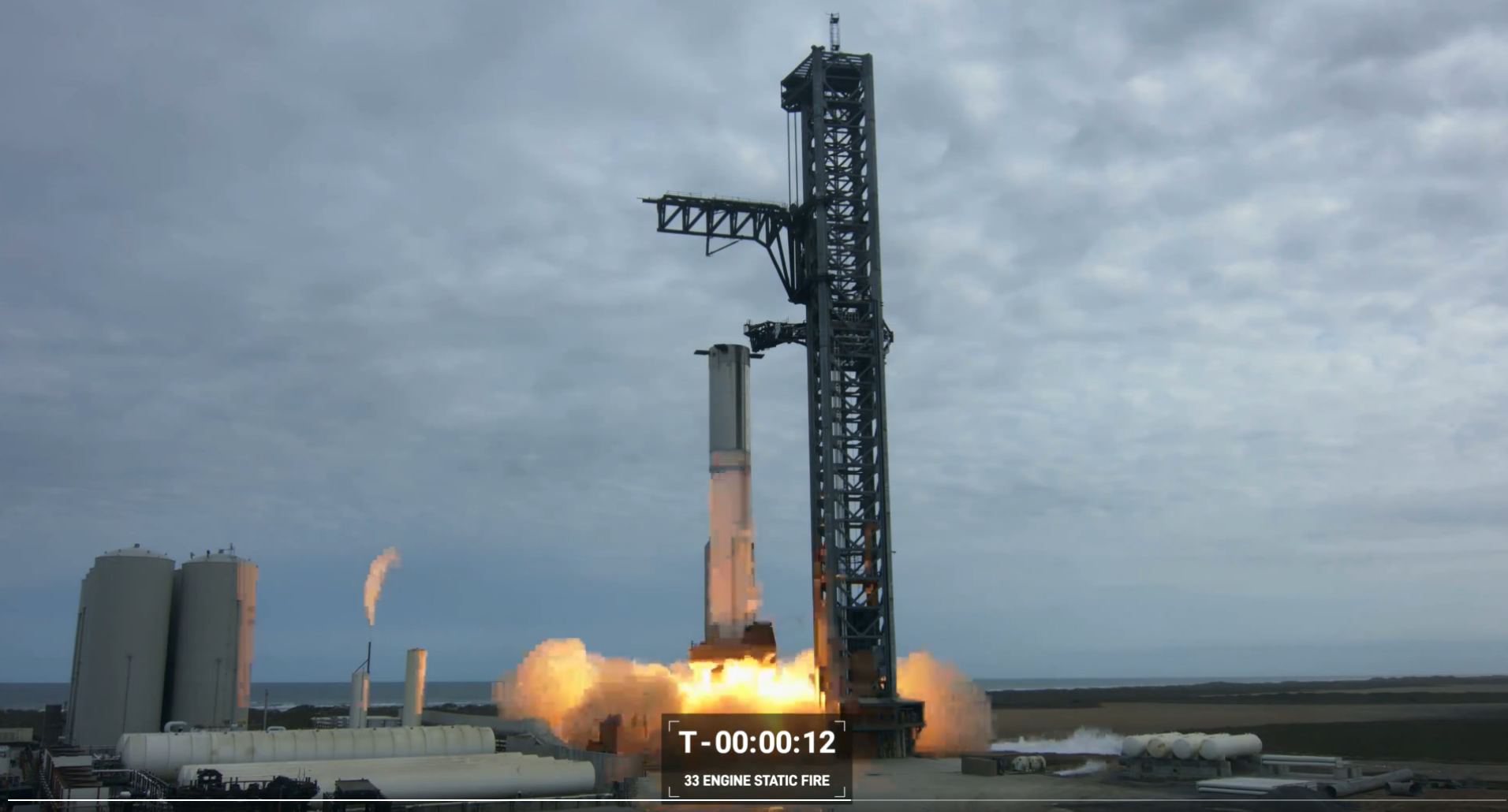
The moment of ignition: 31 Raptor motors ignite: Booster 7 during its full static fire test, February 9th, 2023. Credit: SpaceX

SpaceX has completed the largest static fire test for this Starship / Super Heavy launch system, with the 70-metre tall Booster 7 – expected to be part of the first orbital launch attempt – completing a “full duration” 5-7-second test of 31 of its 33 Raptor 2 engines.

The test was made on Thursday, February 9th, amidst on-going work at the orbital launch facilities at the company’s Boca Chica, Texas Starbase site. It had been intended to be full 33-engine test, but one engine was “turned off” during a pause in the countdown at the T -40 second mark, presumably due to an issue being detected, and a second automatically shut down at, or immediately following, ignition.

Even so, the burn was enough for the SpaceX CEO to proclaim the 31 firing engines developed sufficient thrust that, if sustained throughout an 8-minute ascent, it would be enough for Super Heavy to push a fully laden Starship to an altitude where it could reach orbit under the thrust of its six engines.

Ignition came at 21:13:53 UTC, after a partial filling of the booster’s liquid methane and liquid oxygen tanks – Starship 24 had already been destacked from the booster earlier in the month, leaving just the booster on the launch table. Everything appeared to go well, with SpaceX afterwards reporting the engines reached a peak thrust of 7,900 tonnes, or almost twice that generated by the Space Launch System Block 1/1A launcher, and 3,000 tonnes more than the Block 2 SLS cargo launcher.

However, such comparisons need to be put into context: Super Heavy must lift 1200+ tonnes of Starship to low-earth orbit (LEO), carrying 100 tonnes of cargo. SLS is already capable of lifting 95 tonnes of payload to LEO if required, which will increase to 105 tonnes and then 130 tonnes. It is also capable of delivering 27 tonnes to cislunar space, which will increase up to 46 tonnes. The flipside is that Starship and its booster are fully reusable, lowering launch costs; SLS is not. Also, if the booster is not re-used, they Starship could in theory life up to 250 tonnes to LEO; conversely, SLS can reach cislunar space, whereas Starship cannot, not without a complex series of on-orbit refuelling operations.

The test came after extensive work had been carried out at the launch facility after the first two Super Heavy static fire tests (with 7 and 14 Raptor motors respectively) literally stripped the concrete from the base of the launch stand, peppering the launch mount and its surroundings with high velocity cement debris and necessitating extensive repairs to the site.

The problem was one of basic engineering (and frankly, something SpaceX should have considered): the launch table legs and apron underneath the rocket are coated in concrete. A key ingredient of concrete is water, some of which is retained in the concrete as pockets of moisture. Heat concrete to 600°C or more, that moisture flash vaporises into expanding gases, causing the concrete to violently explode.

As I’ve previously noted, this risk is usually negated by the inclusion of a water deluge system which delivers thousands of litres of water to a launch facility, serving a dual purpose: it both absorbs the enormous heat generated by multiple rocket motors by flashing into stream by the force of that exhaust, and it also absorbs the sound waves generated by the motors, further preventing that sound being deflected back up against the rocket and potentially damaging it at launch.

Following the 14-engine test, SpaceX replaced the concrete at the launch facilities with a type designed to withstand very high temperatures. At the time of writing, it is not clear how well this mix withstood the engine test, however the test came at a time when SpaceX is – belatedly – attempting to install a water deluge system to work alongside the existing (and minimal) sound suppression system already part of the launch table.

Tanks for a water deluge system arrive at Starbase Boca Chica via barge. Credit: RGV Aerial Photography
Many – including the SpaceX CEO – are proclaiming the way is now clear for an orbital launch attempt to be made in March. However, this actually depends on a number of factors – the most key of which is whether or not the FAA is satisfied that SpaceX has done / is doing enough to ensure its compliance with all 75 remedial actions specified in its Programmatic Environmental Assessment (PEA).

NASA Tests Upgraded RS-25 Motor

The SpaceX static fire test overshadowed NASA’s test of its updated RS-25 engine for the Space Launch System.

The initial four SLS launches utilise a total of 16 refurbished RS-25 motors originally used with the space shuttle system and referenced as the RS-25D. However, beyond Artemis 4, NASA will be switching to a version of the RS-25 which has been extensively updated. Called the RS-25E, it will deliver 30% more thrust; allowing SLS achieve the upper end of its payload capabilities noted above.

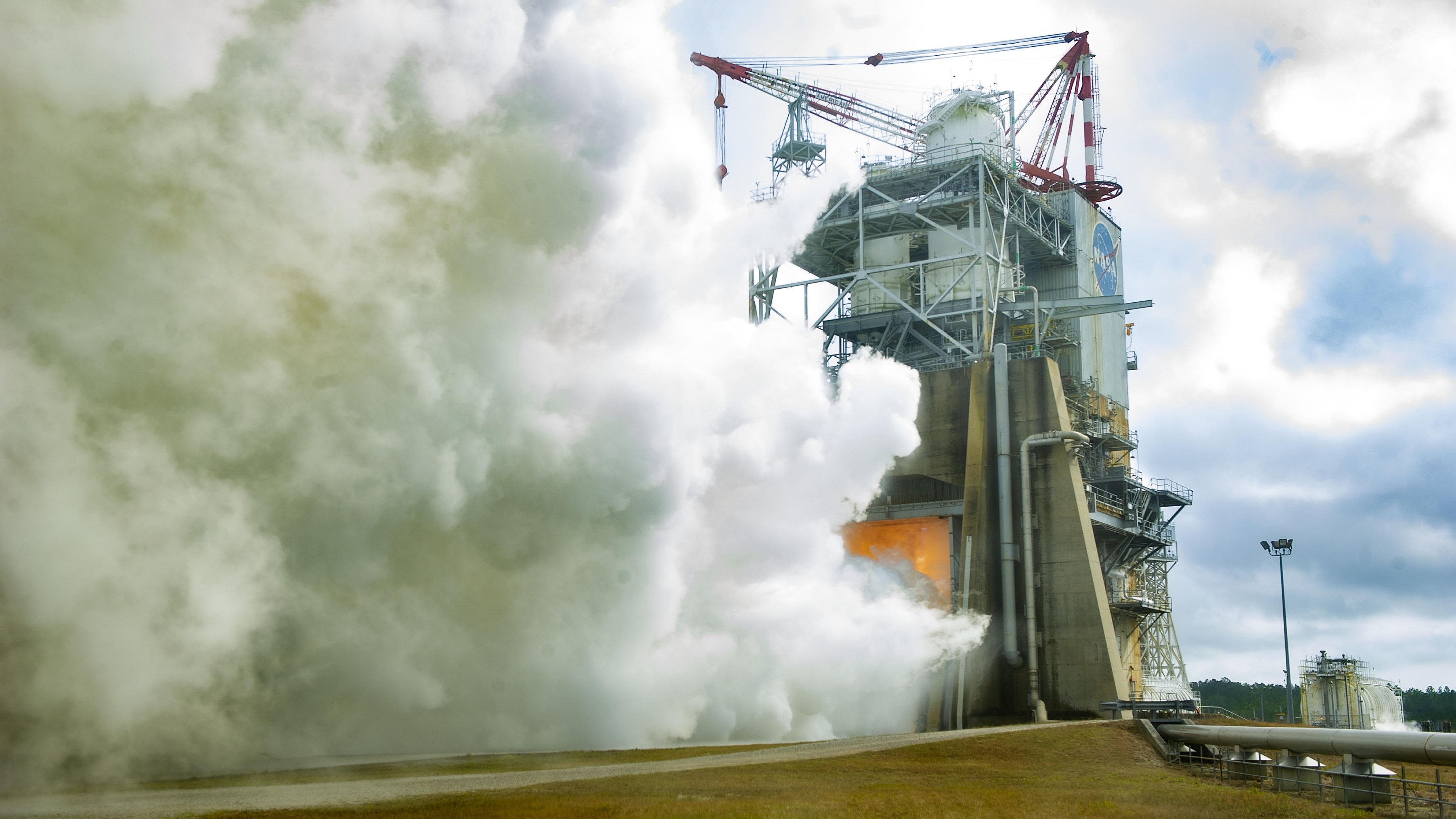
The test, which took place at NASA’s Stennis Space Centre in Mississippi, saw a test stand mounted RS-25E motor fire at 111% of its rated thrust for a total of 8.5 minutes – the amount of time the engines would be used in an actual launch.

A single RS-25E under 1!1% of rated thrust during testing at Stennis Space Centre. The great cloud to the left of the test stand is, in part, steam generated from the engine exhaust striking water from the deluge system Credit: NASA

The RS-25E will commence operations with the Artemis 5 mission in 2028. They will operate alongside the new Exploration Upper Stage (EUS) which will also help raise the SLS system’s performance. EUS itself will entire service with Artemis 4.

Image of the Week

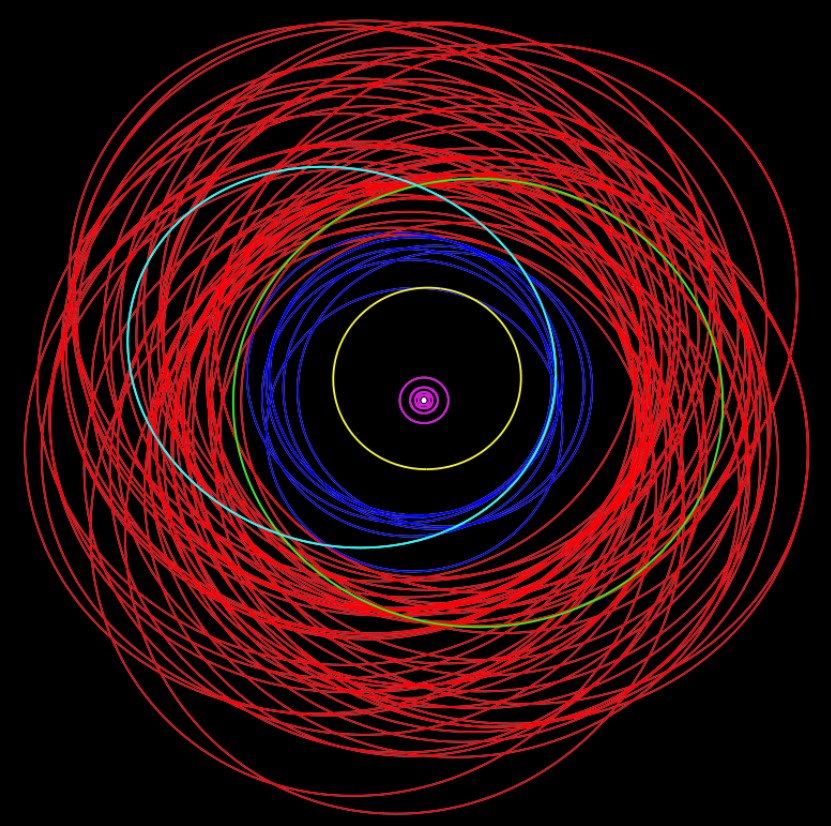
The image below is a computer-generated top-down view of Jupiter and the orbits of its (currently) 92 moons. At the centre of the image is Jupiter and (purple) the orbits of its four most famous Galilean moons – Io, Europa, Ganymede and Callisto. Beyond them, predominantly shown in red, are the remaining 88 moons.

A computer model of the moons of Jupiter in their orbits, with the planet at the centre, as seen from overhead. Credit: Scott Sheppard

Until recently, Saturn held the record for the greatest number of moons (82), the majority of which (43) have been discovered by a team led by astronomer Scott Sheppard. However, Sheppard’s team have also been busy over the years seeking moons orbiting Jupiter – racking up and impressive 70, including the most recent batch of 12 which handed the moon record back to the largest planet in the solar system.

The newest moons were discovered over a period of observations by Sheppard and his team using a number of observatories around the world across 2021 and 2022. They range in size from 1 to 3.2 km across. Most have very large orbits, with nine having periods of more than 550 days. None have been named as yet, as all are awaiting further independent verification.

Continue reading “Space Sunday: rockets, moons, leaks and a ring”

Space Sunday: propulsion, planets and pictures

An artist’s impression of a lunar base using the micro nuclear reactor (NMR) currently being developed by Rolls Royce. Three of the reactors can be seen in the right foreground, casting palm tree like shadows (the “palm frond” shadows are actually the reactors’ radiator panels). Three more of the reactors can be seen in the centre of the image. See below for more. Credit: Rolls Royce Aerospace

In my previous Space Sunday, I covered some of the renewed interest in nuclear propulsion for space missions – and it certainly is a hot topic (no pun intended). Just 24 hours after that article was published, NASA and the US Defense Advanced Research Projects Agency (DARPA) announced they had signed an interagency agreement to develop a nuclear-thermal propulsion (NTP) concept.

Referred to as the Demonstration Rocket for Agile Cislunar Operations (DRACO), the three-phase programme will look to develop and enhance an NTP propulsion system capable of operating between Earth and the Moon and eventually Earth and Mars, potentially enabling fast transit times to the latter measured in weeks rather than months. Nor is this simply a computer modelling exercise: the agencies plan to fly a demonstrator of the propulsion unit in early 2027.

As I noted in my previous piece, NTP uses a nuclear reactor to heat liquid hydrogen (LH2) propellant, turning it into ionized hydrogen gas (plasma) channelled through engine bells similar to those seen in chemical rockets to generate thrust. As I also noted, NTP for space vehicle propulsion is not new; both the US and the former Soviet Union both pursued NTP projects in the early days of the space race – most notably for the US with the Nuclear Engine for Rocket Vehicle Application (NERVA) project, successfully tested on the ground in 1963/64.

A conceptual rendering the DARPA-NASA nuclear thermal propulsion (NTP) test vehicle the agencies hope to fly in 2027. Credit: DARPA

Per the agreement, NASA’s Space Technology Mission Directorate (STMD) will lead the technical development of the nuclear thermal engine, which will be integrated into a vehicle built by DARPA, with that agency leading the overall programme as the contracting authority. Both agencies will collaborate on the overall design of the engine.

DARPA and NASA have a long history of fruitful collaboration in advancing technologies for our respective goals, from the Saturn V rocket that took humans to the Moon for the first time to robotic servicing and refuelling of satellites. The space domain is critical to modern commerce, scientific discovery, and national security. The ability to accomplish leap-ahead advances in space technology through the DRACO nuclear thermal rocket program will be essential for more efficiently and quickly transporting material to the Moon and eventually, people to Mars.

– DARPA director Dr. Stefanie Tompkins

Meanwhile, on January 27th, 2023, the UK’s famed Rolls Royce teased details of its own foray into the space-based nuclear power / propulsion systems: the micro-nuclear reactor (MNR), an extremely robust, self-contained nuclear fission plant which could be used to supply power to bases on the Moon or Mars, or used as a core element in vehicle propulsion systems either individually or as multiple units to provide both thrust and system redundancy, if required.

Images suggest the Rolls Royce MNR is roughly 3 metres in length (excluding the heat radiators). Credit: Rolls Royce

Development of the MNR started as a result of a 2021 agreement between the United Kingdom Space Agency (UKSA) and Rolls Royce (RR) to study future nuclear power options in space exploration. However, the design for the unit builds on RR’s decades-long expertise in developing power plants for the Royal Navy’s nuclear submarine squadrons and, more particularly a project the company has been developing since 2015 to develop and build small modular reactor (SNRs) to meet the UK’s energy needs (SNRs are self-contained, less complex and lower cost alternative to current nuclear reactors).

Precise details of the size of the unit and its output have not been revealed, although images released by RR suggest a single MNR is around 3 metres in length. In discussing the system, the company indicated its designs have reached a point where it plans to have a full-scale demonstrator / prototype running by 2028.

The MNR forms a part of a broader space strategy from Rolls Royce, which also includes systems for high Mach propulsion systems (e.g. ramjets) which could be combined with rocket propulsion to reach orbit, and a new generation of radioisotope thermal generators (RTGs) for power generation on robotic explorer craft and surface system on the Moon and Mars. The overall aim of the strategy is to offer space agencies and the private sector the ability to easily integrate selected elements of RR’s product offerings into their space projects and programmes.

A rendering of a crew-carrying vehicle entering Mars orbit and using a series of Rolls Royce MNRs (outlined in blue) as a part of its propulsion and power system. Credit: Rolls Royce

Returning to NASA, as well as considering the nuclear option, the US agency has been researching the next generation of rocket engines – the rotating detonation rocket engine (RDRE) – and on January 24th, carried out a series of sustained ground tests of a prototype unit.

In a conventional rocket motor, fuel is expended by deflagration combustion – fuel and oxidiser are burnt to produce an energetic gas flow which is then directed through exhaust bells to generate subsonic thrust. With rotating detonation, fuel and oxidiser are injected into a circular channel (annulus). An igniter within the annulus then detonates the initial incoming mix, generating a shockwave which travels around the channel, returning to the point of injection.

At this point, more fuel is injected into the channel to be detonated by the existing shockwave. This increases the shockwave’s speed and force, and the cycle repeats over and over, the shockwave accelerating to supersonic speed, generating high pressures which can be constantly be directed out of the channel to form thrust through an exhaust system even as the shockwave maintains its momentum within the channel.

Whilst this may sound complicated, the upshot is that rotating detonation engines (RDREs) theoretically generate around 25% more thrust than conventional rocket motors, which directly translates to greater delta-V being imparted to vehicles departing Earth, so reducing flight times to the Moon and Mars and elsewhere in the solar system. RDEs could also be inherently less complex than subsonic brethren, reducing the mass of a launch vehicle’s propulsion system.

However, there are drawbacks; for example, the very nature of containing the growing force of the shockwave puts an RDRE under tremendous stress and they have been known to explode. They are also incredibly noisy when built at scale.

Both Russia and Japan have experimented with RDRE technology; in 2018, former Roscosmos chief Dmitry Rogozin claimed Russia had successfully developed the first phase of a 2-tonne class of liquid-fuelled RDRE, although this has yet to be substantiated. In 2021, Japan successfully tested a small-scale (112.4 lbf) RDRE in space, using it to propel the upper stage of a sounding rocket.

The NASA test, carried out at the Marshall Space Flight Centre, Alabama, is the first verified test of a full-scale RDRE. The demonstrator motor operated for a total of 10 minutes, reaching peak thrusts of some 4,000 lbf. This is fairly lightweight by rocket standards, but the aim of the test was not just to generate thrust, but to test the engine’s ability to withstand multiple firings and confirm that a copper alloy referred to as GRCop-42 developed by NASA specifically for use in RDRE engines, was up to the task of reducing the stress on the motor by more efficiently carrying the heat generated by the shockwave away from the annulus structure.

While tests with this motor will continue, NASA is now also moving to the construction of a large unit capable of a sustained 10,000 lbf – the same as mid-range rocket motors – to better understand the potential for RDREs to out-perform “traditional” rocket motors. If successful, it could pave the way for RDRE motors capable of match the output of large-scale engines like the RS-25 used by the Space Launch System (SLS) rocket (418,000 lbf).

Continue reading “Space Sunday: propulsion, planets and pictures”

Space Sunday: Exoplanets and updates

Newly discovered Earth-size planet TOI 700 e orbits within the habitable zone of its star in this illustration. Its Earth-size sibling, TOI 700 d, can be seen in the distance. Credit: NASA/JPL-Caltech/Robert Hurt

Since its launch in April 2018, TESS, the Transiting Exoplanet Survey Satellite, has located 5,969 candidate exoplanets within the immediate (cosmically speaking) neighbourhood of our solar system. Of these, 268 have been confirmed as actual planets – although 1,720 have been dismissed as false positives.

Three of the positives were located orbiting a red dwarf star called TOI 700, some 100 light-years away and within the constellation Dorado, one of which sits within the star’s habitable zone where liquid water might exist on the surface.

And now a fourth has been added to the tally, with the confirmed discovery of TOI 700-e, another planet within the star’s habitable zone. Like TOI 700-d, the other planet within the star’s habitable zone, it is roughly Earth-sized – around 95% the size of Earth, marking it as slightly smaller than TOI 700-d, which is 1.1 times the side of Earth.

This is one of only a few systems with multiple, small, habitable-zone planets that we know of. That makes the TOI 700 system an exciting prospect for additional follow-up. Planet e is about 10% smaller than planet d, so the system also shows how additional TESS observations help us find smaller and smaller worlds.

– Emily Gilbert, NASA’s Jet Propulsion Laboratory

TOI 700-d was actually the first Earth-sized planet TESS located within the habitable zone of s star, and wobbles in its orbit, and those of the other two planets TOI 700-b and TOI 700-c, led Gilbert and her team to task TESS with a re-visit to the system in the belief another planet might be hidden within it, hence the discovery of TOI 700-e.

All of the planets are likely tidally locked to their star – always keeping the same side facing it as they make their orbits. This makes the chances of them supporting life complicated, as one side is always exposed to the heat of the star, and the other to the freezing cold of space. Between them, along the terminator, they may have more temperate regions, but assuming the planets have an atmosphere, the temperate regions could be ravaged by storms where warm and cold fronts continuous meet.  All four planets have short orbital periods – 10 days for the innermost planet 700-b to just over 37 days for the newly-discovered 700-e. Planets b, d, and e are likely rocky, while planet c is likely more similar to Neptune.

The term habitable zone also deserves some expansion, as it actually covers two overlapping zones around a star, the optimistic habitable zone (OHZ) and the conservative habitable zone (CHZ). The former is a region around a star where water may have existed at some point in the planet’s history; the CHZ is a more tightly-constrained region where scientists hypothesize liquid surface water might have existed for most of a planet’s history and it may have developed a more Earth-like atmosphere. TOI 700-e is in the optimistic habitable zone for its star.

That said, determining the habitability of solid rocky planets within the OHZ / CHZ of a star is impossible at our stage of exoplanet science. Simply put, they are fat too small to be seen well enough to make firm conclusions. All scientists can say is that a planet might be potentially habitable and then explain their detailed findings. In the case of TOI 700-e, the science team notes:

With a radius of 0.953 Earth radii, TOI-700-e is likely a rocky planet with a probability of 87%, [and a] timescale for tidal locking of to be on order a few million years. Given the age of the system, it is likely that the planet is in a locked-in synchronous or pseudo-synchronous rotation.

– Emily Gilbert, NASA’s Jet Propulsion Laboratory

One interesting aspect of the TOI 700 system is that while the star in an M-type red dwarf, a spectral type known for violent, powerful flares which could play havoc with the atmosphere and environment of the planets orbiting it. However, TOI 700 is older and more quiescent than its siblings and so perhaps less violent towards its children. Given this, and the fact it is a multi-planet system with two Earth-sized planets sitting within it OHZ, it forms a counterpoint to TRAPPIST-1, a younger, more aggressive M-class star with seven Earth-sized planets orbiting them, four of them within its own OHZ. Studies of both systems offers the potential for extended comparative study, potentially helping scientists better understanding of exoplanet systems form and M-type stars (the most numerous type of star in the galaxy), and how the planets within them retain (or lose) their atmospheres.

The discovery of TOI 700-e is a further demonstration on how the search for exoplanets is progressing. Prior to the launch of the long-running Kepler Space Telescope, only a handful of exoplanets had been discovered, and the number is now over 5,000, with discoveries in recent years revealing more and more Earth-sized worlds and multi-planet systems.

While the number of confirmed planets is small, TESS is adding to that total, and out ability to understand such worlds is gaining a boost thanks the James Webb Space Telescope (JWST). The instruments on the telescope are designed to study exoplanet atmospheres and use spectroscopy to determine their compositions. In fact, this work has already started with the planet Bocaprins (WASP 39b), a “hot Jupiter” planet 700 light years way, with JWST confirming its atmosphere contains sodium, potassium, carbon dioxide, carbon monoxide, water vapour and most significantly, sulphur dioxide.

The James Webb Space Telescope could both assist in the discovery of exoplanets and in analysing their atmospheres. Credit: NASA

The last is important both because it is the first time scientists have found this molecule anywhere outside of our Solar System, confirming photochemical reactions can take place in the atmospheres of exoplanets, and confirms JWST can detect such photochemical reactions within planetary atmospheres over vast distances – .something which could be an important factor in determining what interactions might be taking place in the atmospheres of many exoplanets.

As such, exoplanet science is maturing rapidly.

Soyuz MS-22 Update

Russia has confirmed it will launch Soyuz MS-23 to the International Space Station in an uncrewed mode to replace the Soyuz MS-22 vehicle which suffered a major coolant leak in December 2022, following what is theorised a piece of dust striking the external radiator at a speed of 7 km/s.

Following the accident, a number of western experts suggested the Soyuz vehicle would be incapable of maintaining a safe temperature in the crew cabin during a return to Earth. After a month-long review of the situation, including examining options for a space-based repair, the Russian space agency Roscosmos has reached the same conclusion.

Video of the Soyuz MS-22 coolant leak, December 14th 2022. Credit: NASA

Soyuz MS-23 will therefore launch on or around February 20th in an automated configuration to provide the means for cosmonauts Sergey Prokopyev and Dmitri Petelin and NASA astronaut Franco Rubio to return to Earth at a later date – exactly when that will be is unclear; as a result of needing to use MS-23 as a replacement vehicle, crew rotations on the Russian side of things will be disrupted, and so Roscomos expects the MS-22 crew to extend their stay on the station by “several months”.

However, the February launch for MS-23 still means that should an emergency evacuation of the station be required in the next month, the crew of MS-22 would be without a ride home. To cover this, it has been suggested at least one MS-22 crew member (likely Rubio) could return on Crew Dragon 5 with the four astronauts it flew to the ISS in October 2022, and remaining MS-22use that vehicle -the thinking at Roscosmos being that with a smaller crew, the damaged cooling system on the Soyuz wouldn’t be so strained and could maintain “safe” temperatures within the vehicle.

Once MS-23 has docked at the station, MS-22 will be prepared for an automated return to Earth, where the investigation into the coolant loss will continue.

Repairs to the damaged vehicle were ruled out due to the difficulties involved in any spacewalk to do so – not the least of which was the risk of ammonia contaminating the spacesuits used and then being brought back into the ISS in high enough concentrations that it might pose a serious health risk if inhaled by any of the crew.

Continue reading “Space Sunday: Exoplanets and updates”

Space Sunday: China’s plans, Hubble and Soyuz

An artist’s rendering of the Tiangong space station is it is at present. but showing a Shenzhou crew vehicle attached to the nadir port of the main docking hub. Any additional core module will be attached to the axial port of the hub (and so would extend to the left of this image). Credit: CCTV

China continues to grow and expand its astronomy and space aspirations. In a series of announcements, the country has indicated its aims for Earth-based astronomy, the expansion of its space station, international co-operation and more on it plans for a presence on the Moon.

With the Tiangong station only having recently been “completed” in terms of its pressurised modules with the arrival of the Mengtian science module in October, China had originally indicated that the only remaining module awaiting delivery to the station was the Xuntian space telescope, capable of docking with the station for maintenance, but designed to operate as a free-flying automated platform to be launched in 2023.

However, Wang Xiang, director of space station systems at the China Academy of Space Technology (CAST), has indicated China is considering adding a second “core” module to Tiangong. If this goes ahead, it will be mated to the axial port of the current docking hub at the forward end of the Tinahe-1 module.

According to Wang, the new module will provide a larger and more comfortable living environment for crews, and would include its own docking hub capable of supporting two further modules as well as accepting vehicles docking at its the axial port. This would allow the station to double in size and support larger crew numbers, as well as allowing it to operate for considerably longer than the planned 10-year time frame.

A breakdown of the current Tiangong space station modules and supporting vehicles. Credit: Shujianyang (via Wikipedia)

In addition, CAST has announced China is working with Saudi Arabia, the United Arab Emirates and other Gulf states to reach partnership agreements which could see these states working alongside China aboard Tiangong, developing a human presence on the Moon and in deep-space astronomy and robotic exploration.

Among other aspects of the agreement is the potential to establish a China-GCC (Gulf Cooperating Council – comprising Saudi Arabia, Qatar, UAE, Bahrain, Oman, and Kuwait) joint centre for lunar exploration, which would also oversee the selection and training of tiakonauts from GCC member states.

In terms of the latter, China is keen to gain international partners in its vision for lunar exploration in order to match the Artemis Accords. The latter is a set of a non-binding agreements that (to date) has seen 23 nations agree to support the US-led return to the Moon with personnel, materiel and scientific endeavours.

China’s lunar aspirations are seen by some as potentially kicking-off a new “space race”, given both it and the United States have identified the Moon’s south polar regions as the most likely location for establishing bases, given the relative accessibility of water ice within craters there. Whether this proves to be the case remains to be seen; certainly, there is a degree of chaffing within China at being excluded from all international space efforts involving the United States; however, the country has been developing its own approach to space exploration for decades without feeling the need to be seen as directly competing with the US in a manner akin to the US / Soviet space race.

A computer generated model of the interior of the EAST observatory showing the competed 8-metre primary mirror on its focusing support mechanism (in deep blue) and the secondary mirror supports (red) complete with the secondary mirror housing at the top (brown). Credit: Peking University

With regards to astronomy, China is also looking to build its own version of the James Webb Space Telescope (JWST), with the first phase of the observatory being operational by 2024, and the completed facility operational by around 2030.

The project is to be led by the Peking University, but rather than being launched into space, this observatory will be Earth-based. Referred to as the  Expanding Aperture Segmented Telescope (EAST), the observatory will have a primary mirror similar to that of JWST, a 6-metre diameter made up of 18 individual hexagonal mirrors which work both individually and collectively to focus the light they gather into the secondary mirror for transfer back into the telescope and its instruments.

The site for the observatory is Saishiteng Mountain within the Qinghai Province on the Tibetan plateau, 4.2 kilometres above sea-level, well above the majority of the denser atmosphere, making it much easier for the telescope to also compensate for the distorting influence of that atmosphere.

But that’s not all; as an Earth-based telescope, EAST will be constructed in two phases. Once the 6-metre primary mirror system has been completed, and as funding allows, the addition of a further 18 mirror segments, increasing the mirror’s diameter to almost 8 metres; 1/3 as big again as JWST.

A drawing showing the initial 6, primary mirror design (to be completed by the end of 2024) and the planned expansion to an 8-metre mirror (r). Note the black hexagon marks the focusing port / tertiary mirror which carries light gather by the primary and scondary mirrors down to the instruments. Credit: Peking University

The cost estimate for the first phase of the observatory’s construction has been put at a mere US $69 million, with the expansion work – to be completed by 2030, as noted, to cost around a further US $20 million, compared to JWST’s estimated US $9 billion construction cost – although in fairness, EAST is an optical, rather than infra-red telescope, and so doesn’t require the need to operate at extremely lower temperatures, making it a lot less complex. When completed, EAST will be the largest optical telescope in the eastern hemisphere.

NASA Issues RFI Regarding Hubble Reboost

Since its launch in to a 540 km orbit above Earth in 1990, the Hubble Space Telescope (HST) has required regular “reboosting” as drag caused by friction contact with the tenuous upper atmosphere caused its orbit to decay. Up until 2009, these operations were completed by the US space shuttle as a part of scheduled HST servicing missions, with the very last mission serving to push HST to its highest orbit in anticipation of the shuttle being retired from active duty in 2011.

However, since then, atmospheric drag has reduced its orbit by some 60 km, and unless countered, it will force NASA to de-orbit HST in 2029/30 to ensure it burns-up safely and any surviving debris falls into the Pacific Ocean. By contrast, a re-boost mission could extend Hubble’s operational life by another 20 years.

In September 2022, NASA joined a study involving SpaceX and the Polaris group examining the feasibility of using a Crew Dragon vehicle in a servicing / reboost mission to the Hubble Space Telescope (HST). This work has now been expanded into a request for information on possible reboost mission options. Credit: NASA

To this end, in September 2022, SpaceX and billionaire Jared Isaacman – who has already funded one private mission to space using a Crew Dragon vehicle (Inspiration4) and is currently planning a further series of flights under the Polaris mission banner – started work on an unofficial mission outline to  rendezvous with HST and then boost its orbit. NASA then joined in these discussions on a non-exclusive basis or commitment to manage any reboost mission.

On December 22nd,  NASA issued a formal request for information (RFI) based on those discussions and exercising their non-exclusive nature to invite any interested parties to propose how a reboost mission might be completed, whether or not it expressly uses SpaceX hardware or some other, likely automated, booster vehicle. The RFI period is short, closing on January 24th, 2023, and the information gathered from respondents will be assessed over a further 6-month period and alongside the SpaceX / Polaris study to determine the best means of carrying out such a mission.

In this, there are both challenges and opportunities: HST is primarily designed to be serviced by shuttle, so by default it does have the capability to dock with the likes of SpaceX Dragon or other craft without the risk of damage. However, during the 2009 servicing mission, it was equipped with a Soft Capture Mechanism (SCM), a device primarily designed to allow a small automated vehicle attach itself to Hubble as part of a de-orbit mission. But with a suitable adapter, it might be used by a vehicle the size of Dragon to safely mate with HST and then ease it to a higher orbit.

Soyuz MS-22 Leak Update

The Russian space agency, Roscosmos, has stated it will conclude its investigation in to the status of Soyuz MS-22 towards the end of January 2023.

As I’ve reported in recent Space Sunday updates, the vehicle was used to carry cosmonauts Sergey Prokopyev and Dmitry Petelin and NASA astronaut Francisco Rubio up to the ISS in September 2022, where it has been docked ever since. However, on December 14th, 2022, the vehicle suffered an extensive ammonia coolant leak, potentially crippling it.

The exact cause of the leak has yet to be determined, although Roscosmos remains convinced it was the result of either meteor dust or a tiny piece of space debris impacting the Soyuz coolant radiator, puncturing it. However, their focus has not been on determining the cause of the leak, but in trying to determine whether or not the vehicle is capable of returning the three crew to Earth safely, or if a replacement vehicle will be required.

Video of the Soyuz MS-22 coolant leak, December 14th 2022. Credit: NASA

As I noted in my previous Space Sunday update, should Roscosmos decide a replacement vehicle is required to return Prokopyev, Petelin  and Rubio to Earth, it will likely be Soyuz MS-23, which would be launched in February 2023 to make an automated rendezvous with the space station. However, it is now being reported that NASA has also contacted SpaceX to assess the feasibility of using Crew Dragon to return some or all of the MS-22 crew to Earth.

In this, it is unclear as to precisely what NASA has requested of SpaceX, and neither party is commenting. One theory is that the request is to determine whether the current Crew Dragon vehicle currently docked at ISS could carry additional personnel to Earth, if required. Another is NASA wishes to access the potential of launching an uncrewed Dragon to the station as a means to act as an emergency back-up for evacuation of the station – should it be required – prior to MS-23 being available to launch.

Both options are long-shots; getting Crew Dragon vehicle and its Falcon 9 rocket ready for launch in advance of MS-23 – a mission already in preparation, regardless of whether it flies with its planned crewed or uncrewed – is not an easy task. Further Dragon isn’t equipped to handle Russian space suits, the kind used by Prokopyev, Petelin  and Rubio. As such, to even consider Crew Dragon as temporary lifeboat  – much less a replacement for MS-23 to bring the three crew back to Earth – would require not small modification to its support systems. Similarly, while the Crew 5 vehicle might be able to return one or two of the MS-22 crew to Earth should it be necessary to do so, there is also the no insignificant matter of getting its life support systems to work with the Russian space suits.

One particular area of concern is that a number of experts outside of NASA / Roscosmos have opined that whatever Roscosmos may announce at the end of January, MS-22 is unlikely to be safe to bring its crew home. Therefore, should Roscosmos opt to do so, NASA might opt to look to other means to return astronaut Rubio to Earth as a matter of safety.