Space Sunday, of planets, signs of life, and an award

Comparing the large dwarf planets with Earth and the Moon. Credit: unknown

As I noted back in July 2024, classifying just what “is” and “is not” a “planet” is something of a minefield, with the entire debate going back to the 1800s. However, what really ignited the modern debate was – ironically – the search for the so-called “Planet 9” (or “Planet X” as it was then known), a body believed to be somewhere between 2 and 4 times the size of Earth and around 5 times its mass (see: Space Sunday: of “planet” and planets).

That hunt lead to the discovery of numerous bodies far out in the solar system’s Kuiper Belt which share similar characteristics to Pluto (size, mass, albedo, etc), such as Eris (which has at least one moon) Makemake, Haumea (which has two moons), Sedna, Gonggong and Quaoar (surrounded by its own ring of matter), all of which, like Pluto, appear to have reach a hydrostatic equilibrium (aka “nearly round shape”).

Is it a dwarf planet? A TNO? A Plutoid? This Euler diagram, used by the  IAU Executive Committee, demonstrates the complexity in trying to classify objects within the solar system. Credit: Holf Weiher

The discovery of this tiny worlds led to an increasing risk that the more we looked into the solar system, so the number of planets would require updating, causing confusion. So, in 2006, the IAU sought to address the issue by drawing up a definition of the term “planet” which would enable all these little planet-like bodies to be acknowledged without upsetting things too much. In the process, Pluto was relegated to the status of “dwarf planet”, in keeping with the likes of Ceres in the inner solar system, Eris, Makemake et al. This make sense – but that’s not to say it didn’t cause considerable upset.

The definition was also flawed from the outset in a couple of ways. Firstly, if taken strictly, the criteria the IAU had chosen meant that Saturn Jupiter, Mars and Earth were actually not planets, because all of them have not “cleared the neighbourhood around [their] orbit[s]”: all of them have gatherings of asteroids skipping around the Sun in the same orbit (notably some 10,000 for Earth and 100,000 for Jupiter).

Secondly, that body has to be “in orbit around the Sun” pretty much rules out calling called planet-like bodies orbiting other stars “planets”; something which given all the exoplanet discoveries by Kepler and TESS et al has become something of a bite in the bum for the IAU. As a result, the “pro-Pluto is a planet” brigade have felt justified in continuing their calls for Pluto to regain its planetary status.

Several attempts have been made to try to rectify matters in a way that enables the IAU to keep dwarf planets as a recognised class of object (including Pluto) and which addresses the issues of things like exoplanets. The most recent attempt to refine the IAU’s definition took place in August 2024, at the 32nd IAU General Assembly, when a proposal offering a new set of criteria was put forward in order for a celestial body to be defined as a planet.

Unfortunately, the proposal rang headlong into yet more objections. The “Pluto is a planet” die-hards complained the new proposal was slanted against Pluto because it only considered mass, and not mass and hydrostatic equilibrium, while others got pedantic over the fact that while the proposal allowed for exoplanets, it excluded “rogue” planets – those no longer bound to their star of origin but wandering through the Galaxy on their own – from being called “planets”. Impasse ensued, and the proposal failed.

In the meantime, astronomers continue to discover distant bodies that might be classified as dwarf planets, naturally strengthening that term as a classification of star system bodies. This last week saw confirmation that another is wandering around the Sun – and a very lonely one at that.

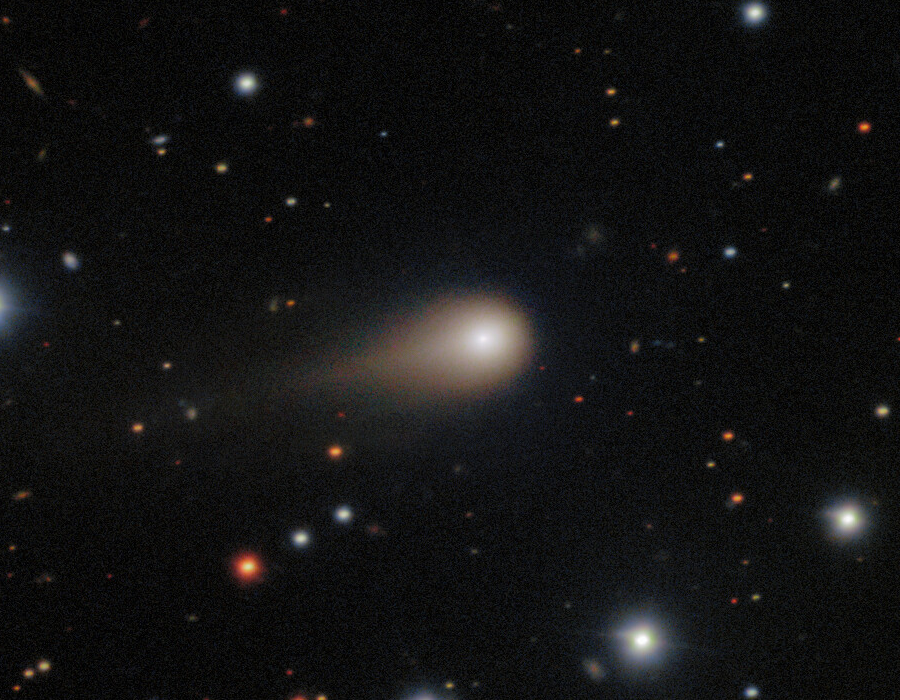
Called 2017 OF201 (the 2017 indicating it was first spotted in that year), it sits well within the size domain specified for dwarf planets, being an estimated 500-850 metres across, and may have achieved hydrostatic equilibrium (although at this point in time that is not certain). Referred to as an Extreme Trans-Neptunian Object (ETNO, a term which can be applied to dwarf planets and asteroids ), it orbits the Sun once every 25,000 years, coming to 45 AU at perihelion before receding to 1,700 AU at aphelion (an AU – or astronomical unit – being the average distance between Earth and the Sun).

As well as strengthening the classification of dwarf planets (and keeping Pluto identified as such), 2017 OF201 potentially adds weight to the argument against “Planet 9”, the original cause for the last 20 years of arguing over Pluto’s status.

2017 OF201 imaged by the Canada–France–Hawaii Telescope on 31 August 2011

To explain. Many of ETNOs and Trans-Neptunian Objects (TNOs) occupy very similar orbits to one another, as if they’ve somehow been clustered together. For example, Sedna has a number of other TNOs in orbits which closely match its own, leading the group as a whole to be referenced informally as “sednoids”. Among “Planet 9” proponents, this is taken as evidence for its existence, the argument being that only the influence of a large planetary body far out beyond Neptune could shepherd these ETNOs and TNOs into clusters of similar orbits.

However, by extension, this also means that 2017 OF201 – together with 2013 SY99 and 2019-EU5 should have also fallen to the same influence – but none of them have, orbiting the Sun quite independently of any clusters. This potentially suggests that rather than any mysterious planet hiding way out in the solar system and causing the clustering of groups of TNO orbits, such grouping are the result of the passing influence of Neptune’s gravity well, together with the ever-present galactic tide.

Thus, the news concerning 2017 OF201 confirmation as a Sun-orbiting, dwarf planet-sized ETNO both ups the ante for Pluto remaining a dwarf planet and simultaneously potentially negating the existence of “Planet 9”.

Jupiter: Only Half the Size it Once Was?

Definitions and classifications aside, Jupiter is undoubtedly the planetary king of the solar system. It has a mass more than 2.5 times the total mass of all the other planetary bodies in the solar system (but is still only one-thousandth the mass of the Sun!) and has a volume 1,321 times that of Earth. It is also believed to have been the first planet to form in the solar system; possibly as little as one million years after the Sun itself was born, with Saturn following it shortly thereafter.

Jupiter is an important planet not just because of its dominance and age, but because of the role it and Saturn played in the overall formation of the solar system, although much of this is subject to contention. The primary concept of Jupiter’s and Saturn’s voyage through the solar is referenced as the “grand tack hypothesis“, on account of the two giants migrating through the solar system in the first few millions of years after they form.

Jupiter as it is today, as seen by the Hubble Space Telescope. Not long after its formation, it might have been twice its current size. Note the black dot to the left of the image is the shadow Io, the innermost of Jupiter’s large moons. Io itself is outside of the frame. Credit: NASA/JPL / University of Arizona

Under this theory, Jupiter formed around 3.5 AU from the Sun, rapidly accreting a solid core and gaining mass to a point where it reach around 20 times Earth’s mass (although Earth would not form for another 45-50 million years). At this point, it’s mass and size (and those of Saturn) were such that they entered into a complex series of interactions with one another and the Sun, with both migrating towards the Sun, likely destroying a number of smaller proto-planets (all of them larger than Earth) along the way. At some point, these interactions reversed, and both infant planet started migrating away from the Sun again, clearing the way for the remnants of the smaller proto-planets they’d wrecked to gradually accrete to form what we now know to be the inner planets, as Jupiter and Saturn continued outwards to what are now their present orbits.

Believed to have occurred over between 4 to 6 million years, the “grand tack hypothesis” is contentious, as noted, and there are alternate theories concerning Jupiter’s formation and the early history of the solar system. Because of this, astronomers Konstantin Batygin (who, coincidentally, is one of the proponents of the “Planet 9” theory) and Fred C. Adams used complex computer modelling to try to better understand Jupiter’s formation and early history, in order to try to better determine how it may have behaved and affected the earliest years of the solar system’s formation.

In order to do this, and not be swayed by any existing assumptions concerning Jupiter’s formation, they decided to try to model Jupiter’s size during the first few million years after its accretion started. They did this using the orbital dynamics of Jupiter’s moons  – notably Amalthea and Thebe, together with Io, Jupiter’s innermost large moon – and the conservation of the planet’s angular momentum, as these are all quantities that are directly measurable.

Taken as a whole, their modelling appears to show a clear snapshot of Jupiter at the moment the surrounding solar nebula evaporated, a pivotal transition point when the building materials for planet formation disappeared and the primordial architecture of the solar system was locked in. Specifically, it reveals Jupiter grew far more rapidly and to a much larger size than we see today, being around twice its current size and with a magnetic field more than 50 times greater than it now is and a volume 2,000 times greater than present-day Earth.

Having such a precise model now potentially allows astronomers to better determine exactly what went on during those first few million years of planetary formation, and what mechanisms were at work to give us the solar system we see today. This includes those mechanisms which caused Jupiter to shrink in size to its present size (simple heat loss? heat loss and other factors?) and calm its massive magnetic field, and the time span over which these events occurred.

Yeah. Finding Life is Hard

In March, I reported on a possible new means to discover evidence of biosigns on worlds orbiting other stars by looking for evidence of methyl halides in their atmospheres (see: Space Sunday: home again, a “good night”, and seeking biosigns). In that reported, I noted that astronomers had potentially found traces of another element associated with organics, dimethyl sulphide (DMS) , within the atmosphere of exoplanet K2-18b, a hycean (water) world.

This is the strongest evidence yet there is possibly life out there. I can realistically say that we can confirm this signal within one to two years. The amount we estimate of this gas in the atmosphere is thousands of times higher than what we have on Earth. So, if the association with life is real, then this planet will be teeming with life.

– Prof Nikku Madhusudhan, lead investigator into the study of the atmosphere of K2-18b and the apparent discovery of dimethyl sulphide.

Now in fairness, the team behind the discovery did note that it needed wider study and confirmation. Extraordinary claims requiring extraordinary proof and all that. And this is indeed what has happened since, and the findings tend to throw cold water (if you forgive the pun) on that potentially wet world 124 light-years away, having  dimethyl sulphide or its close relative, dimethyl disulfide (DMDS) in anywhere near detectable levels.

An illustration of what K2-18b may look like. Credit: NASA / ESA / CSA / Joseph Olmsted

The more recent findings come from a team at the University of Chicago led by Rafael Luque and Caroline Piaulet-Ghorayeb. Like Madhusudhan and his team at Cambridge University, the Chicago team used data on K2-18b gathered by the James Webb Space telescope (JWST). However, in a departure from the Cambridge team, Luque and his colleagues studied the data on the planet gathered by three separate instruments: the Fine Guidance Sensor and Near Infrared Imager and Slitless Spectrograph (FGS-NIRISS), the Near Infrared Spectrograph (NIRSpec) and the Mid-Infrared Instrument (MIRI) – the latter being the sole source of data used by the Cambridge team.

Combing the data from all three instruments helps ensure a consistent, planet-wide interpretation of K2-18b’s atmospheric spectrum, something that cannot be obtained simply by referencing the data from a single instrument. And in this case it appears that by only focusing on MIRI, the Cambridge team inferred a little too much in their study.

We reanalyzed the same JWST data used in the study published earlier this year, but in combination with other JWST observations of the same planet … We found that the stronger signal claimed in the 2025 observations is much weaker when all the data are combined. We never saw more than insignificant hints of either DMS or DMDS, and even these hints were not present in all data reductions.

Caroline Piaulet-Ghorayeb

Most particularly, the much broader set of spectrographic data gathered from the three instruments points to some of the results observed by Madhusudhan’s team could actually be produced entirely abiotically, without any DMS being present. The Chicago paper has yet to be peer-reviewed, but their methodology appears sufficient to roll back on any claims of organic activities taking place on K2-18b or within its atmosphere.

AAS Recognises Gene Kranz

The “original four” NASA Flight Directors. Back row, (l to r): Glynn Lunney and John Hodge. Bottom (l to r): Gene Kranz and Chris  Kraft. Credit: NASA

Eugene Francis “Gene” Kranz is a genuine NASA legend. He may never have flown in space, but he played a crucial role – along with the late Christopher C. Kraft (also see: Space Sunday: a legend, TESS and a rocket flight), John Hodge and Glynn Lunney (also see: Space Sunday: more from Mars and recalling a NASA legend) – in formulating how NASA runs it manned / crewed spaceflights out of their Mission Operations Control Centre, Houston.

He is particularly most well-known for his leadership of his White Team during the Apollo 11 Moon landing in 1969, and for leading the work to get the crew of Apollo 13 back to Earth safely when that mission faced disaster. As a result of the latter, Kranz and his entire White Team received the Presidential Medal of Freedom in 1970 as well as being immortalised in film and television (although the line “Failure is not an option” was not something Kranz ever said – he instead used it as the title for his 2000 autobiography; the quote was purely fiction and used in the 1995 Ron Howard film Apollo 13, which saw Ed Harris play Kranz).

His career at NASA ran from 1960 through 1994, during which he rose from Mission Control Procedures Officer to Director of Mission Operations. As a result, he has been the recipient of NASA’s own Distinguish Service Medal, Outstanding Leadership Medal and Exceptional Service Medal.

And he has now been similarly recognised by the American Astronautical Society, which on May 21st, 2025, named him the recipient of their 2024 Lifetime Achievement Award. Only presented every 10 years, the award recognises Kranz for his “exemplary leadership and a ‘must-never-fail’ style that ensured historic mission successes, empowered human space exploration, saved lives and inspired individuals around the world.”

The ceremony took place at the Johnson Space Centre, Houston, Texas, where Kranz was also able to revisit the place where he and his teams and colleagues made so much history: the Apollo Mission Operations Control Room (MOCR – pronounced Mo-kerr – NASA has to have an acronym for everything 🙂 ).

Gene Kranz, with his AAS Lifetime Achievement Award, seated at the restored console he occupied at the White Team Lead Flight Director, notably during the Apollo 11 and Apollo 13 missions. Credit: NASA

The latter had been recently restored as a direct result of a project initiated and driven by Kranz in 2017 in memory of Apollo and so many of his colleagues who have since passed away (the most recent, sadly, being Robert Edwin “Ed” Smylie whose team worked alongside Kranz’s White Team to make sure the Apollo 13 astronauts returned to Earth safely, and who passed away on April 21st, 2025). Fully deserving of the AAS award, Gene Kranz remains one of the stalwarts of NASA’s pioneering heydays.

Space Sunday: FRAM2, private missions, asteroids

Crew Dragon Resilience splashes down of the coast of California at the end of the 4-day FRAM2 mission. Credit: SpaceX

Previewed in my previous Space Sunday update, the FRAM2 mission lifted-off almost precisely on time from Kennedy Space Centre’s Launch Complex 39A at 01:46:50 UTC on April 1st, carrying the first humans to ever orbit the Earth in a low-Earth polar orbit.

The ascent to orbit, travelling south from the space centre, proceeded smoothly, the SpaceX Crew Dragon capsule and service module (“Trunk” in SpaceX parlance) entering a low Earth orbit with an apogee of 413 km and a perigee of 202 km some eight minutes after launch. The orbit, referred to as a polar retrograde, due to the fact the vehicle travelled first over the South Pole then around and over the North Pole, lay at an inclination of 90.01°, breaking the previous high inclination orbit record for a crewed space vehicle set by Vostok 6 in 1963.

Aboard the vehicle were Chinese-born, but Maltese citizen and crypto currency entrepreneur Chung Wang, who will be the mission’s commander and is a co-bankroller of the flight; Jannicke Mikkelsen, a Scottish-born Norwegian cinematographer and a pioneer of VR cinematography, 3D animation and augmented reality, who is the other co-bankroller for the flight; Eric Philips, a 62-year-old noted Australian polar explorer, who will be the first “fully” Australian national to fly in space, and Rabea Rogge, a German electrical engineer and robotic expert.

The 4-day mission comprised an extensive science programme, focusing on human health in space, growing food supplements on-orbit (oyster mushrooms) and investigating the Phenomena known as STEVE (see my last Space Sunday update) from orbit. The mission also included educational broadcasts to schools and a lot of social media-posted videos.

A video of Antarctica recorded by the FRAM2 crew. Seen in the footage is videographer Jannicke Mikkelsen, and the voice-over is from Eric Philips

To assist in observations and measurements, Resilience was fitted with the transparent Copula to replace the outer  airlock hatch and docking mechanism within the forward end of the capsule, affording the crew near-360º views of Earth once the vehicle’s protective nose cone had been opened.

The launch itself required a complete update of the Crew Dragon navigation software, originally written for lower 51º inclination orbits. This included a complete overhaul of the launch abort software for both capsule and launch vehicle. The latter was made necessary by the fact the ascent to orbit carried the vehicle over parts of South America, so any abort situation had to ensure that both booster and capsule would not return to Earth over land, and the capsule would be able to splashdown safely with the crew.

What really marked this mission, however, was the sheer transparency of operations; nothing in the video logs was pre-scripted or rehearsed; camera were rolling with conversations going on in the background – including conversations between crew members and SpaceX mission control about “known issue” with the space vehicle (not sure how significant – but being told that there is a “known issue” with a vehicle when you’re sitting in it in space might not be the most comforting thing to hear!), informal chit-chat during observations and an introduction to the fifth “crew member”, Tyler.

A compilation video of the mission, including shot through the inner hatch of the airlock showing Earth beyond the Copula. Note the inner hatch could also be opened to allow crew to enter the forward are and look out of the Cupola

While the mission had a lot of science goals – including testing a portable MRI unit, carrying out x-rays of the human body, studies into blood and bone health and glucose regulation in the body in micro-gravity – it has not stopped criticism being levelled at it, with some scientists stating the period spent in space being too short to yield practical results in some areas, and other aspects of the mission being labelled “a notch above a gimmick”.

For Chung, Mikkelsen and Philips in particular, however, the mission was as much personal as scientific: they have spent fair portions of their adult lives exploring the Polar regions, carrying out studies and research (the four all actually met during an expedition to Svalbard (leading them to nickname the mission “Svalbard 1”).

The first ever x-ray of a human hand taken in space (right) during tests of a small x-ray unit aboard the FRAM2 mission. The hand (with ring) was used in homage to the first ever x-ray of a human, captured by Wilhelm Conrad Röntgen (of his wife’s hand) in 1895 (l). Credits: Wilhelm Conrad Röntgen; FRAM2 / SpaceX

FRAM2 came to an end on April 4th, 2025, when, following an extended de-orbit, the combined vehicle re-entered the atmosphere and headed for a splashdown off the California coast where the SpaceX recovery ship was waiting for the vehicle. This marked the first splashdown for Crew Dragon off the west coast of the USA – although more will be following.

SpaceX has been criticised for the fact that during several missions returning crews from the International Space Station, the “Trunk” service module has in part survived re-entry, with elements coming down very close to populated areas. To avoid this, the company is moving crewed splashdowns to the west coast of the USA in order to ensure that should any parts of the Trunk survive re-entry they will splashdown in the Pacific Ocean.

As a test of this, the module used by Resilience remained attached to the vehicle for longer during the initial re-entry operations, in order to ensure that if any part of it did survive the heat of re-entry, the debris would fall to Earth over Point Nemo – the remotest part of the Pacific Ocean relative to human habitation, and referred to as the “spacecraft graveyard”.

A re-entry seared Resilience is lifted aboard the SpaceX recovery vessel in preparation for crew egress. Credit: SpaceX

Splashdown occurred at 19:28 UTC on April 4th, with the capsule and crew safely recovered to the SpaceX recovery vehicle for transport to the port of Los Angeles.

NASA Opens-Out Requirements for Private Missions to the ISS

NASA has announced it is seeking proposal for two further private astronaut missions (PAMs) to be conducted to the ISS – and for the first time, the requirement that such missions must be commanded by former NASA astronaut has been removed.

The agency is planning to pivot away from the International Space Station (ISS) operations as it nears its end-of-life (some of the Russian elements of the station are already well outside their “warranty” – that is, their intended lifespan), with the hope that the private sector will take over low-Earth orbit research and station operations. Currently, there are a number of proposals for doing so – perhaps most notably Axiom Space and the orbital Reef consortium led by Blue Origin and Sierra Space.

Axiom Space already has a contract with NASA to add its own modules to the ISS, starting in 2027 with the launch of the PPTM – Power, Propulsion and Transfer Module. This will then be joined by at least a second module, Hab-1, prior to the decommissioning of the ISS. These modules will then be detached from the ISS to become a free-floating hub to which Axiom will add further modules.

An artist’s impression of the Axiom space station as it will look when completed and free-flying. Credit: Axiom Space

To prepare for this, Axiom signed an agreement with NASA to fly four missions to the ISS between 2022 and 2025, with the option on a fifth. Three of these form the only fully private missions yet flown to the ISS, and all have been commanded by former NASA astronauts – Michael López-Alegría (Axiom AX-1 and Ax-3) and Peggy Whitson (Ax-2), with Whitson also set to command AX-4, currently targeting a May 2025 launch.

Under the new NASA PAM requirements, private missions are now required to be commanded by any astronaut who has served as a long-duration ISS crewmember (defined as 30 days or more in the ISS) and who has been involved in ISS operations in the last five years or else shows evidence of “current, active participation in similar, relevant spaceflight operations”. This therefore opens the door for missions to be commanded by Canadian, French, German, English, Japanese, etc., astronauts meeting the requirements to command missions by commercial providers.

The move to relax the requirements is to help remove the reliance on purely NASA-based experience to lead private sector missions into orbit and allow companies like Axiom, Blue Origin and – most notably, perhaps – Vast Space, who have a MOU with SpaceX to fly two PAM missions to the ISS but have yet to meet NASA’s requirements to do so, to start formulating their own requirements, gain expertise and build partnership and processes to assist in their efforts to establish on-orbit facilities.

The Blue Origin / Sierra Space-led Orbital Reef space station design, which will utilise the Boeing CST-100 Starliner for crew transfers, and the Sierra Space Dreamer Chaser spaceplane for cargo transfers. Credit: Blue Origin / Sierra Space / Boeing

The announcement by NASA is of potential import to the UK: Axiom have an agreement in place with SpaceX to fly a total of five Ax missions to the ISS. However, the fifth – provisionally aiming for 2026 – has yet to be crewed, and there have been discussion between Axiom and UK officials about the mission being an “all British” crew, comprising Tim Peake as mission commander, who flew the Expedition 46/47 rotations on the ISS, together with fellow UK European Astronaut Corps members  Meganne ChristianRosemary Coogan and Paralympic sprinter (and surgeon)  John McFall.

New Glenn Mishap Investigation Completed

The Federal Aviation Administration announced March 31st, 2025 that it has accepted the findings of an investigation led by Blue Origin following the loss of the first stage of the company’s New Glenn heavy lift launch vehicle during its maiden flight on January 16th, 2025 (see: Space Sunday: NG-1 and IFT-7).

While the overall goals of that mission were met, a secondary goal – recovering the rocket’s large first stage by landing it at sea board a landing vessel – failed, the booster stage falling back into the Atlantic Ocean. Whilst no debris was strewn across flight corridors or fell on populated areas (unlike recent SpaceX Starship launch attempts), the failure of the planned booster recovery, whilst always rated by Blue Origin as having a minimal chance of success on the very first flight of the rocket, meant the vehicle’s launch license was correctly suspended by the Federal Aviation Authority (FAA) until a full Mishap Investigation into the cause of the loss had been carried out by Blue Origin and the FAA had accepted the findings and remedial actions taken.

The investigation report was duly supplied in March 2025, and identified the booster’s inability to re-ignite its motors during descent as the cause of the loss. Whilst no precise cause(s) for this failure have been openly published, Blue Origin has indicated seven areas where remedial work has been undertaken on the vehicle’s flight systems, and the FAA now consider the investigation closed. As a result – subject to a final inspection of the changes made – the license suspension should be lifted before the end of April. In the meantime, Blue Origin has been given the all-clear to resume preparations for the next New Glenn launch.

The maiden flight of Blue Origin’s New Glenn rocket lifts-off from Launch Complex 36 at Cape Canaveral Space Force Station on January 16th, 2025. Credit: Blue Origin / USSF

All of this is in stark contrast to the handling of the last two SpaceX Starship launches (IFT-7 and IFT-8). Both resulted in the complete loss of the Starship upper stages well within Earth’s atmosphere, resulting in debris falling over the Greater Antilles (and some of it striking close to populated areas on the Turks and Caicos islands) together with a degree of disruption to commercial flights in the region. However, in the case of IFT-7, the FAA cleared the launch of IFT-8 before the Mishap Investigation was closed, and appears to be on course to do so in the case of IFT-8, with SpaceX already ramping-up for the next test article flight.

In the meantime, assuming the New Glenn license is renewed in April, the next launch for the vehicle could come as soon as “late spring 2025” (end of May). However, no payload for the flight has been specified, only that it will include a further attempt to return the first stage to an at-sea landing aboard Landing Platform Vessel 1 Jacklyn.

Some reports had suggested this next launch could comprise the Blue Moon Mark 1 lander – an automated vehicle capable of delivering up to 3 tonnes of payload to the surface of the Moon and intended to demonstrate / test technologies to be used in the company’s much larger Blue Moon Mark 2 lander, designed to deliver crews to the surface of the Moon. However, in discussing the launch path for New Glenn, Blue Origin CEO David Limp indicated that a launch of Blue Moon Mark 1 is unlikely to occur before late summer 2025 at the earliest.

2024 YR4 Seen At Last

As I noted in February 2025, 2024 YR4 is an Earth-crossing Apollo-type asteroid discovered on December 27th, 2024. It caused a bit of stir at the time, as there was a non-zero chance that as it pursued its own orbit around the Sun, in 2032 it could end up trying to occupy the space volume of space as taken-up by or own planet, with potentially disastrous and deadly results for anyone and anything caught directly under / within the air blast that would likely result from its destruction as it tore into our atmosphere.

Fortunately, continued observations of the asteroid – which passes across Earth’s orbit roughly once every 4 years – have shown the threat of any impact in 2032 are now very close to zero (although it does still exist on the tiniest of scales, together with a smaller chance of it hitting the Moon).

At the time of its discovery, 2024 YR4 was classified as a stony S-type or L-type asteroid, somewhere in the region of 50-60 metres across (roughly the same size as the fragment which caused the 1908 Tunguska event). That size estimate has now been confirmed, and what’s more, we now have our first (and admittedly fuzzy) images of the fragment, courtesy of the James Webb Space Telescope (JWST), and they reveal it to be a strange little bugger.

2024 YR4 imaged by JWST’s NIRCam on 8 March 2025. Credit: NASA/ESA

Imaged and scanned by the US Near-InfraRed Camera (NIRCam) and British-led European Mid-InfraRed Instrument (MIRI), 2024 YR4 is indeed some 60 metres across at its widest. It is also somewhat unlike similar asteroids in its spectral type, in that it has a high spin rate as it tumbles around the Sun and appears to be more a conglomeration rocks banded together, rather than a single chunk of rock.

Observations are continuing to ensure the 2032 rick of impact is completely eliminated and also to provide data to calculate impact risks beyond 2032, whilst the data obtained by JWST – which mark 2024 YR4 as the smallest object the observatory has every imaged from its L2 HALO orbit – are being used to help scientists to better characterise NEOs of a similar size and spectral type and more fully understand how they might react were one to strike our atmosphere.

Space Sunday: launches, mission and exoplanets

The Fram2 crew (l to r): Eric Philips, Rabea Rogge,Jannicke Mikkelsen and Chung Wang

If all goes according to schedule, a SpaceX Falcon 9 / Crew Dragon combination is due to lift-off from Kennedy Space Centre’s LC-39A on March 31st, 2025, carrying four private citizens into space for a 4-5 day mission.

Aboard Crew Dragon Resilience will be Chinese-born, but Maltese citizen and crypto currency entrepreneur Chung Wang, who will be the mission’s commander and is a co-bankroller of the flight; Jannicke Mikkelsen, a Scottish-born Norwegian cinematographer and a pioneer of VR cinematography, 3D animation and augmented reality, who is the other co-bankroller for the flight; Eric Philips, a 62-year-old noted Australian polar explorer, who will be the first “fully” Australian national to fly in space, and Rabea Rogge, a German electrical engineer and robotic expert.

What is particularly notable about this flight is that it will be the first time any human space mission will be launched into a high-inclination (90º) polar orbit at an altitude of some 420-425 km (giving it a 93-minute orbital period). The aim of the flight is to carry out research on the Earth’s poles and their space environment, hence its name: Fram2. This celebrates the ship used by (among other Norwegian polar explorers), Roald Amundsen. In fact, in a further tie to polar exploration, mission was originally due to be flown aboard Crew Dragon Endurance, named for Ernest Shackleton’s vessel, until scheduling issues meant the mission has to switch to using Resilience.

A STEVE over Little Bow Resort, Alberta, in August 2015. Credit: Elfiehall via Wikipedia

Given the time of year of the mission, flights over the North Pole and arctic will be carried out in daylight, allowing for direct observations of Arctic ice melt, whilst passage over Antarctica and the South Pole will be in darkness, during which times the crew hope to be able to more clearly study the phenomena known as STEVE.

According to data gathered by the European Space Agency (ESA), STEVEs are caused by a 25 km wide ribbon of hot plasma at an altitude of 450 km, with a temperature of 3,000 °C flowing at a speed of 6 km/s  (compared to 10 m/s outside the ribbon). They appear as a very narrow arc extending for hundreds or thousands of kilometres, aligned east–west, and  generally last for twenty minutes to an hour. STEVEs can appear in both southern and northern skies, and are a phenomenon with a quaintly curious history.

As an observable event, records on STEVEs go back at least as far at 1705 – but throughout that time, they have had always largely been dismissed as an off-shot of aurora because (until October 2024) one had never been observed in the absence of any aurora. However, this changed in 2016 thanks in part (and possibly inevitably) to social media.

It was in that year that a group of amateur aurora photographers in Alberta, Canada noticed the appearance of a nightly whilst observing aurora, and they started taking photographs of the events and posting them to Facebook, with one of them referring to the ribbon in his photos as “Steve”, in reference to the comic series (and film) Over the Hedge. The photographs rapidly went viral and sparked a lot of discussion as to what the ribbon might be.

In particular, the photos and discussions drew the attention of a couple of planetary physicists, one of whom connected the photos to the data gathered on the phenomenon by ESA, leading another – Robert Lysak – to come up with the backronym of STEVE, for Strong Thermal Emission Velocity Enhancement, which is the term now used to reference the ribbon scientifically. It is now hoped that that physical observations from orbit of STEVE events by the Fram2 crew will help further our understanding of the phenomenon.

In addition to this, the mission’s science programme includes the first attempt to grow mushrooms in space in an effort to further research into the ability to provide sustainable nutrition on space missions – something seen as key to missions to Mars.

The vacuum-packed oyster mushroom substrate that will be flown of Fram2 in an attempt to cultivate it into mushrooms. Credit: FOODiQ Global

While there have been successful efforts to grow foodstuffs on the International Space Station (ISS) such as red Russian kale, chilli peppers, dragoon lettuce, dwarf wheat, mustard, they have not been without their drawbacks. For one thing, even relatively small amounts of food cultivation require space and other resources quite out of keeping with the results: while a cubic metre of  growing space can generate a small crop of food in just 30-35 days, the amount produced tends to only be enough to help supplement a single meal (or perhaps two) for 7-8 people.

Mushrooms – in this case oyster mushrooms – potentially offer a more viable means of dietary supplement. They grow at a rapid pace (doubling in size every day), do not require an enormous amount of space, they have a rich nutrient profile and – when grown under UV lighting (as these will), they can produce the daily dose of vitamin D required by astronauts. They can also grow in inedible plant waste, do not require intensive cultivation in order to grow.

For Fram2, the plan is for the crew to prepare an oyster substrate in orbit, and then study its growth and fruiting process and then monitor the rate of the developing mushrooms, record their growth characteristics in microgravity and monitor for any unusual contamination. The fungi will then be returned to Earth for further studies, including whether or not the mushrooms are still safely edible and can deliver on their nutritional promise.

With a battery of human science objectives set for the mission – including testing a portable MRI unit, carrying out x-rays of the human body, studies into blood and bone health, and glucose regulation in the body in micro-gravity – Fram2 is set to be one of the most science-intensive short-during human space flight missions yet undertaken.

ISAR Spectrum Maiden Flight Ends with a Ka-Boom

Europe’s commercial launch companies are not having a lot of success.  In 2024, German company Rocket Factory Augsburg (RFA) hoped to be the first European commercial launcher to get a rocket to orbit from European soil (excluding Russia) with its RFA One vehicle. However, that hope ended in August 2024, when the first stage of the vehicle was lost after it exploded during a static fire engine test at the UK’s SaxaVord Spaceport (see: Commercial activities and a fly-by).

The Isar Spectrum rocket falling back towards Earth 30+ seconds after launch. Credit: Isar Aerospace

That loss in turn came on top of the 2023 failure of a (now defunct) Virgin Galactic airborne launch of the company’s LauncherOne from their carrier aircraft, Cosmic Girl, flying out of Spaceport Cornwall (aka Newquay Airport) – see: Space Sunday: Exoplanets and updates. Now, a further company has added to the list.

Thus, Germany’s Isar Aerospace had – with finger’s crossed – hoped to claim the crown by reaching orbit from the Andøya Spaceport in northern Norway, and albeit using a vehicle without any payload. The aim of the launch was intended to be a fully integrated test of the company’s two-stage Spectrum rocket and launch and flight systems to determine the vehicle’s readiness to commence payload carrying operations. Given this, the company did indicate actually reaching orbit would be a bonus.

Spectrum is designed to operate from multiple launch sites –notably Andøya, targeting Sun-synchronous (SSO) and polar orbits, and Guiana Space Centre (Spaceport Europe) for equatorial and medium inclination orbits. It is capable of lifting up to a metric tonne to low-Earth Orbit (LEO) and up to 700 kg to SSO. The first operational flight is expected to be out of the Guiana Space Centre, carrying seven small satellites, later in 2025.

The Spectrum rocket on the launch pad at Andøya, March 26th, 2025. Credit:  Isar Aerospace

The test flight – calling Going Full Spectrum – out of Andøya on March 30th, appeared to start off smoothly enough. The vehicle lifted-off cleanly at 10:30 UTC, the rocket and climbed away from the launch pad. But as the rocket commenced its programmed ascent roll at 18-seconds in the flight, attitude control was lost, the rocket pitching over onto its side.

At this point the webcast video froze, but the sound continued to play, and the rocket was heard exploding. Initial reports stated that the vehicle’s flight termination system (FTS) had been triggered. However, separate footage recorded from a cell phone and posted by Norwegian publication VG, showed the rocket falling horizontally to strike the waters close to the launch facilities and explode. Later video of the released to various organisations euphemistically referred to the vehicle’s fall and explosion as being in “a controlled manner”. That said, the flight did yield data.

Two more Spectrum rockets are currently being fabricated, but the company has yet to indicate whether either of these will be used for a further flight test or whether they will seek to go ahead with a payload launch.

China’s Planetary Exploration Roadmap

As I’ve noted in numerous past Space Sunday pieces, China is developing a multi-faceted robotic and human space exploration programme, with the latter focusing on Earth-orbital activities using the Tiangong space station (soon to be joined by a new crew-carrying space vehicle), then missions to the lunar South Polar Region commencing in the early 2030s, prior to progressing to human-to-Mars flights some time thereafter.

On the robotic front, China has already achieved a lot re: the Moon and Mars, and on March 26th, 2025, the country’s Deep Space Exploration Laboratory (DSEL), part of the China National Space Administration (CNSA), unveiled what appears to be a roadmap of upcoming missions, to the general public.  In a slide offered during a presentation, DSEL highlighted a number of goals, commencing with the already in-development Tianwen-3 Mars sample return mission. In all, the slide disclosed the following mission ideas:

  • ~2028 (launch): Tianwen-3 Mars Sample Return.
  • ~2029 (launch) Tianwen-4 Jupiter / Callisto orbiter mission investigating the potential habitability of the latter.
  • ~2030: Earth-based platform for simulating planetary environments and their habitability.
  • ~2033 (launch): Venus atmospheric sample return mission (utilising aerodynamic space vehicle).
  • ~2038 (launch): untended, automated Mars science outpost for long-term biology and environmental research (precursor to human missions).
  • ~2039 (launch): Neptune / Triton mission to investigate habitability of outer planets and water worlds.
The DSEL slide showing China’s roadmap for robotic / Earth-based missions. Credit: DSEL / CNSA

Also mentioned in the presentation was the Earth 2.0 Exoplanet Investigator – a TESS-like observatory for studying exoplanets, particularly those referred to a “exo-Earths” – planets of a size and location around their parent stars considered suitable for the potential development of life. Earth 2.0 (referred to as “ET” – geddit?) is currently due for a 2028 launch to operate at the Sun-Earth Lagrange point 2 (the same gravitationally-stable region of space on the far side of the Earth relative to the Sun in which the James Webb Space Telescope operates). Once there, it will attempt to continuously monitor 2 million stars within the Kepler mission star field in an attempt to locate more exoplanets.

To achieve this, ET will use a set of 6 28-cm aperture telescopes working in unison. Due to its location and optical capabilities, ET will be able to study large areas of our galaxy for extended periods, increasing its ability to both locate more planets and to do so across wider areas. In this respect, ET will not only try to detect “exo-Earths” but also characterise them – determine their size, atmospheric composition, potential for bearing liquid water, etc., working in collaboration with ground-based and other facilities. It further hoped that these studies will increase our understanding of the mechanisms at work in the formation of exoplanets, particularly given that the mechanisms observed without our own solar system do not necessarily seem to apply to all other planetary systems.

A conceptual diagram of China’s Earth-2, and how it will use both optical means in an attempt to locate and characterised “exo-Earths” and gravitational lensing to location rogue planets. Credit: CAS

In addition, ET is to be equipped with a 35 cm microlensing telescope it will use in an attempt to locate “rogue” (aka “wandering”) planets. These are planetary bodies no longer tied to orbiting a particular star, but instead wander freely in interstellar space.

As such planets do not lend themselves to detection via the transit method – regularly passing between the observer and their parent star, causing the brightness of the latter to dip relative to the observer – ET will focus its 35-cm telescope on around 30 million stars within the galactic bulge in an attempt to detect gravitational lensing effects caused by the passage of rogue planets somewhere between the observatory and the “cloud” of background stars.

In all, ET is slated for a 4-year primary mission once launched and operational – although clearly, it could run for much longer than this. It is also the only high-volume, in-depth mission with a specific focus on worlds with potential habitability slated for launch in the near future; whilst NASA is developing the Habitable Worlds Observatory (HWO), this is still very much at the conceptual stage, and unlikely to be ready for launch within the next 15-20 years.

Space Sunday: of launches and Earth’s Moon(s)

A Falcon 9 rocket carrying Crew Dragon Freedom and the two members of the Crew 9 / Expedition 72 mission to the ISS lifts-off from SLC-40, Canaveral Space Force Centre, September 282th, 2024. Credit: SpaceX

The long-awaiting NASA Expedition 72 / SpaceX Crew 9 mission launched for the International Space Station (ISS) on the 28th September, 2024, with some media still quite wrongly calling the launch a “rescue” mission.

The mission continues to be dubbed as such most likely because it is an attention-getting headline, after the recent farrago with the Crew flight Test (CFT) mission involving Boeing’s CST-100 Starliner. While the latter made a safe uncrewed return to Earth – albeit it with some additional thrusters issues and an unexpected software reboot – on September 9th (See: Space Sunday: Starliner home; New Glenn update), the vehicle’s crew of Barry “Butch” Wilmore and Sunita “Suni” Williams remained aboard the space station, allowing the media to continue to play the “astronauts stranded in space!” tune.

The Titan IVB/Centaur (Model 401) carrying the NASA/ESA Cassini/Huygens mission, on the pad at Launch Complex 40 within the (then) Cape Canaveral Air Station, October 13th, 1997, shortly before the mission’s launch Credit: NASA

Leaving aside the sensationalism of reporting, the Expedition 72 / Crew 9 mission is still something of a landmark mission for SpaceX, being the first time a crewed launch has ever taken place from Space launch Complex 40 at Canaveral Space Force Station, adjoining the Kennedy Space Centre. Referred to as SLC-40 (or “slick-40”) in US Air Force parlance when it was used by the military, from 1965 through 2007 been the launch point for payload missions using the Titan launch vehicle family.

In 2007 SpaceX leased the facility, and it has since become the highest-volume launch facility for the company’s Falcon 9 vehicles, hosting over 200 launches (the majority of these being non-direct revenue generating Starlink launches). Since 2023, SpaceX has been upgrading SLC-40 for launches of the Dragon capsule system, with the emphasis on cargo launches to the ISS, but also crewed launches once the necessary access, support and emergency escape systems, etc., had been integrated into the launch facility.

Crew 9 had originally been due to launch from Kennedy Space Centre’s Launch Complex 39A (LC-39A), until now the only facility available to SpaceX for launching crewed missions, and also the Falcon Heavy launch system. However, as the launch date for Crew 9 continued to be pushed back from mid-August through September, it risked conflicting with the launch of NASA’s Europa Clipper mission using Falcon Heavy, and which has to take place in October. So, to avoid scheduling issues, NASA and SpaceX agreed to move the Crew 9 launch over to SLC-40.

Crew 9, carrying NASA astronaut Nick Hague and cosmonaut Aleksandr Gorbunov lifted-off at 17:17 on September 28th, the launch having been delayed from this target date by Hurricane Helene. The flight proceeded smoothly, with the first stage of the rocket making a safe boost-back and landing some 8 minutes after launch, and the upper stage correctly delivering the Crew Dragon capsule Freedom to its initial orbit and the start of a 28-hour “chase” to rendezvous with the ISS, that latter being due at approximately 21:30 UTC on Sunday, September 29th.

However, whilst all has proceeded smoothly with the Crew Dragon vehicle, an anomaly with the Falcon 9’s  upper stage de-orbit burn meant it splashed down outside of its designated target area in the Pacific Ocean, prompting SpaceX to suspend Falcon 9 launches until the reason for the deviation to be investigating, per Federal Aviation Authority (FAA) requirements.

A shot from a camera on the upper stage of the Falcon 9 used to launch the Crew 9 mission, showing the Crew Dragon Freedom moving away following vehicle separation on reaching orbit. Credit: SpaceX via NASA TV

As to why Crew 9 is not a “rescue mission”, the explanation is simple: the mission is a part of NASA’s schedule of ISS crew rotations and not any specifically result of the issues pertaining to Boeing’s Starliner or the fact that Williams and Wilmore being “stranded in space”.  In fact, the two astronauts have always had the means to return to Earth, either using the Starliner vehicle or the SpaceX Crew 8 Dragon vehicle.

One of the temporary seats the ISS crew rigged within Crew Dragon Endeavour for use by Williams and Wilmore, had it been necessary for any evacuation of the ISS. Credit: NASA / Michael Barratt

The former was demonstrated in June 2024, when Wilmore and Williams and the rest of the ISS crew were ordered into their respective vehicles in readiness for a possible emergency Earth return due to the risk of the ISS being hit by debris from the break-up of a Russian satellite in an orbit which intersected that of the space station (see:  Space Sunday: of samples and sheltering).

The latter was shown following the return of the Crew 8 mission aboard Crew Dragon Endeavour, when the additional seated rigged within the vehicle’s pressurised cargo area for use by Williams and Wilmore, had a return to Earth been required prior to the arrival of the Crew 9 mission.

Which is not to say either option was either optimal or entirely safe; ergo, the need for an abundance of caution on NASA’s part, coupled with the need to disrupt crew rotations to the ISS as little as possible, the decision to fly Crew 9 with only 2 on board and thus “reserve” the remaining two seats for Wilmore and Williams made the most sense, both ensuring they had an assured flight home, and could complete the planned Expedition 72 crew rotation on ISS in place for astronauts Stephanie Wilson and Zena Cardman.

SpaceX and FAA

In the meantime, SpaceX has entered into an aggressive head-to-head with the Federal Aviation Authority over both launches of Falcon 9 and Falcon Heavy earlier in the year and overall SpaceX’s Starship operations out of Texas.

In short, the FAA is seeking to impose fines on SpaceX to the tune of US $633,009 due to SpaceX having failed to comply with the requirements of licenses issued for the launches of both Falcon 9 and Falcon Heavy, which the FAA states violated the launch licenses it granted for the them on the basis of changes SpaceX made to the launch operations. The changes, relating to a new control centre and propellant farm, were subject to license modifications for the respective launches, but the FAA state SpaceX submitted the requests for modifications too late for them to be properly processed.

In response to this, SpaceX claims it sought to have the licenses modified for the launches in question, but the FAA is at fault for failing to process the modifications in time for the launches to proceed as scheduled, and that as SpaceX judged the changes to not be safety issues, decided to go ahead with them nevertheless.

The Starship issues are equally complicated, with the FAA stating the license for to carry out any further Starship launches is being held-up on two main counts.

The first is that SpaceX is in violation of Texas state and federal requirements relating to the water deluge system used during Starship / Super Heavy launches out of Boca Chica. SpaceX dispute this – although they are also fighting US $148,378 in fines levied by the US Environmental Impact Agency for violations in the use of said system. The second is that SpaceX has failed to carry out required sonic boom analysis relating to its plans to return the Super Heavy booster to the launch facility for “capture” during the next Starship flight. Both of these are viewed by the FAA as “safety” issues SpaceX must address prior to any license being granted.

For its part, SpaceX and its CEO have aggressively hit back at the FAA, claiming the agency’s senior management is “lying”, and that FAA Administrator Mike Whitaker should be fired by Congress. In particular, with the SpaceX CEO stating the FAA is targeting SpaceX over “petty issues” relating to safety whilst “neglecting real safety issues at Boeing”. Whilst uncalled for, these comments came at a time when FAA Administrator Mike Whittaker was testifying to the House Transportation Committee in relation to Boeing’s ongoing aviation issues; as a result, Rep Kevin Kiley (R-Calif.) used the aviation-related hearing to accuse the FAA of “undue scrutiny” where SpaceX is concerned, and questioning whether the FAA treat SpaceX “equally” with Boeing.

Addressing the House Transportation Committee, FAA Administrator Mike Whitaker noted that the best way for SpaceX to “speed up” the launch licensing process would be to properly comply with the regulations. Credit: House Transportation Committee webcast

In reply, Whittaker agreed that companies should be held to the same standards of safety – and pointed out that in this respect, Boeing has both a safety management system (SMS) programme in place and (however unwillingly) operates a whistleblower programme as a part of their SMS. By contrast, and despite 20+ years of operations, SpaceX has consistently failed to implement either.

The comments around Boeing have also prompted some SpaceX fans to question why the FAA is so quick to “ground” SpaceX but has not done the same with Boeing’s Starliner. The answer to this is simple: the FAA has jurisdiction over all commercial launches from US soil, but is not responsible for licensing or overseeing US government launches or the spacecraft craft carried on these missions. As Starliner’s issues were purely spacecraft related, decisions relating to the vehicle’s safety fall under the remit of NASA, not the FAA.

How Many Natural Moons does Earth Have?

The above should be a simple question to answer – “one”. However, between now and November 27th, 2024 one could argue the answer should be “two”, thanks to the arrival of a tiny asteroid called 2024 PT5.

Measuring roughly 10 or 11 metres across, the asteroid is technically referred to as a near-Earth object (NEO) – an asteroid in an elliptical orbit close to the Sun and on a path that frequently cross Earth’s as we move around the Sun. Officially “discovered” (observed for the first time) on August 7th, 2024, it passes around the Sun just over once a terrestrial year, but at a low relative velocity when compared to Earth’s.

Thus, at 19:54 UTC on September 29th, it will pass just outside of Earth’s Hill Sphere at a velocity low enough for it to temporarily pass into a short-order orbit around Earth. However, because the asteroid will be just beyond the Hill Sphere at the time of “capture”, it will resume its passage around the Sun on November 25th, 2024, after 57 days passing around Earth and the Moon, not quite completing a full orbit. Sadly, during the encounter, it will be too small to observe with anything but the largest of optical telescopes.

This is actually not the first time our planet has – at least briefly – has had a “mini-Moon” – and such events might actually be relatively frequent; the last recorded event like this was in 2020, and that as more and more attention is focused on NEOs, it is possible that more and more might be found to make similar temporary orbits around Earth. One of the more interesting questions around 2024 PT5 is whether it started life as an asteroid or whether it might have originated on the Moon and was blasted out into space as part of a significant impact at some point in the Moon’s history. After this little loop, orbital calculations show that the next time it comes close enough to enter a temporary orbit in this manner will be in 2055.

And where did the Moon Come From?

For the last 40 years, the going theory for the origin of the Moon has been that it was formed from material resulting from a very large collision between Earth and another large body some 60 million years after the solar system formed.

The theory was a consensus decision reached by planetary scientists at a 1984 conference called to discuss findings from studies of the rocks returned by the Apollo mission and held in Hawai’i. The basis for the consensus was that chemical and isotopic analysis of the returned material showed that it was similar to the rock and soil on Earth: calcium-rich and basaltic in nature and was of a near-identical age to similar rocks found on Earth.

Professor Darren Williams, Penn State Behrend College, one of the co-authors of a new paper suggesting on the origins Earth’s Moon. Credit: Penn State Behrend / Penn State

However, according to planetary scientists from Penn State Behrend College, this might not be the whole story: there is a possibility the Moon might actually have actually formed elsewhere and was captured during a close encounter between the young Earth and a terrestrial binary.

In this theory, there were two objects in a binary orbit and orbiting the Sun in an orbit very similar to Earth, and most likely formed at around the same time (thus meaning their composition would be similar). Over time as the respective obits of the binary system and Earth came into proximity to one another, Earth’s gravity separated the binary, snagging one of the objects, which became our Moon.

As evidence of this, the researchers point to the Moon being more in line with the Sun than with Earth’s equator, suggesting it originated in solar orbit. They also note that such situations are not uncommon in the solar system – Neptune’s moon Triton, for example, is most likely a captured Kuiper Belt object. In addition, the team’s modelling show that a binary-exchange object of the Moon’s size and mass interacting with the Earth’s gravity would likely start in an elongated elliptical orbit as it is initially captured by the Earth, which overtime would become increasingly circularised to a point where it became tidally locked with Earth: always keeping the same face towards the planet. After this, tidal evolution would be reversed, causing the object to slowly start to move away from Earth once more.

Much of this matches the behaviour of the Moon, which is now roughly 382,400 kilometres from Earth and moving away at the rate of 3 centimetres a year. This might not sound like a lot, but it is far enough for the Moon to be entering what will, in the centuries ahead, become an increasing tug of war between Earth and the Sun for control of the Moon – one which the Sun will eventually win.

Even so, and as the researchers note, their work is not conclusive whilst raising new questions:

No one knows how the moon was formed. For the last four decades, we have had one possibility for how it got there. Now, we have two. This opens a treasure trove of new questions and opportunities for further study.

Professor Darren Williams, Penn State Behrend College

China Unveils Lunar Spacesuits

China has unveiled the new generation of its space suit intended for use in their upcoming lunar exploration programme.

The suit appears to be a further Feitian space suit developed for extravehicular activities aboard the Chinese space station; however it remains unnamed, with the China Manned Space Agency (CMSA) launching a competition to name the new suit.

An artist’s renderings of China’s new lunar spacesuit. Credit: CMSA

Unveiled at the third Spacesuit Technology Forum hosted by the China Astronaut Research and Training Centre, with the press release highlighting the red strips on the suits, stating they are inspired by the famous “flying apsaras” of Dunhuang art (upper arms), and rocket launch flames (legs). It is said to be equipped with a multifunctional integrated control panel that is easy to operate, cameras for recording close-up and long-distance scenes and made from protective materials that can effectively shield astronauts from the lunar thermal environment and lunar dust.

Alongside the presentation of the new suit, CMSA released a video promoting the new suit and featuring taikonauts Zhai Zhigang and Wang Yaping. Zhai made history in the Shenzhou-7 mission as China’s first person to conduct a spacewalk; he also flew Shenzhou-13 with Wang, who became China’s first female taikonaut to complete a tour of duty aboard the Tiangong space station. Their use as models for the new suit has spurred speculation that they might be part of China’s first crewed lunar landing  – although given the first landing will be before 2030, this is purely an assumption.

Space Sunday: exoplanets and atmospheres

An artist’s impression of one of the TRAPPIST-1 planets in the star’s habitable zone. Credit: unknown

Scientists have once again been turning their attention to the TRAPPIST-1 planetary system – this time to try to find evidence of technosignatures – artificial radio transmissions if you will – emanating from the system.

TRAPPIST-1 is a red dwarf star some 40 light years from Earth which had been previously known by the less exotic designation 2MASS J23062928-0502285. The name change came about in 2017, after extensive observations led by the Transiting Planets and Planetesimals Small Telescope (TRAPPIST) system revealed the star had no fewer than seven roughly Earth-sized planets orbiting it (see: Space update special: the 7-exoplanet system). The discoveries marked the star as a prime contender for the study of exoplanet systems, not only because of its proximity to our own Sun or the number of planets orbiting the star, but also because three of the seven planets lay within the star’s “Goldilocks zone” – the region where everything is kind-of “just right” for liquid water to exist and – perhaps – life to potentially take hold.

However, there have always been caveats around any idea of any of the planets harbouring liquid water, much less life, the most obvious being whether or not they have an atmosphere. One problem is that red dwarf stars tend to be rather violent little fellows in comparison to their size, prone to extreme solar events which could, over time, simply rip away the atmospheres of any planets orbiting. Another, more intrinsic problem is that a new study suggests that it might be harder to confirm whether or not the TRAPPIST-1 planets have any atmospheres because the means by which scientists have generally used to try and identified whether or not tidally locked exoplanets might have atmospheres could well be flawed – of which more in a moment.

True-colour illustration of the Sun (left) next to TRAPPIST-1 (right), both to scale relative to one another. TRAPPIST-1 is darker, redder, and smaller than the Sun, being slightly larger than Jupiter. Via: Wikipedia

The issue of TRAPPIST-1 ripping away an atmospheres its planets may have had is a mixed one: on the one side, all of the planets orbit their parent star very closely, with orbits completed in periods measure from just 2.4 terrestrial days to 18.9 terrestrial days; this puts them well inside the “zone of violence” for any stellar outbursts from the star. On the other, TRAPPIST-1 is old: estimates put it at around 7.6 billion years old, or more that 1.5 times the age of our Sun, and it might be a much as 10 billion years old. This age means that as red stars go, it is actually quite staid, and may have passed through it more violent phase of life sufficiently long ago for the atmosphere of the more distant planets orbiting it, including those in the habitable zone where life may be able to arise, to have survived and stabilised.

One of the most interesting aspects of the TRAPPIST-1 system is that, even though they are tidally locked, two of the planets within the star’s habitable zone TRAPPIST-1e and TRAPPIST-1f – could actually have relatively benign surface temperatures on their surfaces directly under the light of their star, with TRAPPIST-1e having temperatures reasonable close to mean daytime surface temperatures here on Earth and TRAPPIST-1f matching average daytime temperatures on Mars. Thus, if they do have dense enough atmospheres, both could potentially have liquid water oceans constantly warmed by their sun, and the regions in which those oceans exist could experience relatively temperate weather and climate conditions.

An illustration of the TRAPPIST-1 system scaled to match the inner solar system. Three of the TRAPPIST-1 planets – e, f, and g, sit within the tiny star’s habitable zone, where liquid water might exist on them. Credit: NASA

Since the discovery of the seven planets, there have been numerous studies into their potential to harbour atmospheres and much speculation about whether or not they might harbour life. However, the idea that any life on them might have reached a point of technological sophistication such that we might be able to detect it is – if we’re being honest – so remote as to be unlikely simply because of the many “ifs” surrounding it. However, that doesn’t mean we shouldn’t try to find out; for one thing, there is the intriguing fact that if any civilisation has arisen to a level  of technology similar to ours on any of the planets,  the relative proximity of the entire system means that it might have made the jump between them and achieved something of a multi-planet status.

Again, the chances of this being the case are really remote – but if it has happened, then there would likely be communications passing back and further the planets. Assuming that such communications are made via artificially modulated radio frequencies, we might be able to detect them from Earth. At least, this has been the thinking of a team of radio astronomers, and they’ve been putting the idea to the test using a natural phenomenon called planet-planet occultation (PPO). A PPO is when one planet comes between two others – in this case one of the TRAPPIST-1 planets and Earth.

The theory is that if the two alien words are communicating one to the other, then during a PPO, any radio signals from the planet furthest from Earth (planet “b” in the illustration below) direct at the occulting planet (planet “c”), would “spill over” their destination and eventually pass Earth, allowing us to detect them. Note this doe not mean picking up the communications themselves for any form of “translation” (not that that would be possible), but rather detecting evidence of artificially modulated radio frequencies that might indicate intelligent intent behind them.

An example of planet-planet occultation (PPO): as planets “b” and “c” pass around their star, “c” will periodically occult (pas in front of) “b” relative to Earth. When this happens, it might be possible it detect radio signals passing from “b” to “c” (if they exist. Credit: Tusay, et al

To this end, a team of radio astronomers the latter’s Allen Telescope Array (ATA), originally set-up by the SETI Institute and the University of California, Berkeley, to listen to the TRAPPIST-1 system and gathered some 28 hours of data across several potential PPO events involving different planets in the TRAPPIST-1 system. In doing so, they collected some 11,000 candidate signals coming from the general proximity of the TRAPPIST-1 system. These event were then further filtered down using computer modelling to some 2,000 potential signals that could be directly associated with 7 PPO events. These 2,000 signals were then analysed to determine if any were statistically unusual enough to suggest they might be of artificial origin – that is, potential radio transmission.

Sadly, the answer to this was “no”, which might sound like a lot of work for no result; but just imagine if the reverse had been true; further, now the concept of using PPO events in this manner has been tested, it lends itself for potential use with other multi-planet systems orbiting relatively nearby stars.

The Problem of Atmospheres

Now, to circle back to the question of atmospheres on tidally locked planets. As noted above, such planets always have one side permanently facing their parent star and the other always pointing away into space, as the rotation of the planet is precisely in sync with its orbital motion around the parent star. This means that – again as already noted – if there is any atmosphere on such a planet, it might result in some extremes of weather, particularly along the terminator between the two sides of the planet.

However, if the atmosphere is dense enough, then conditions on the planet might not only be capable of supporting liquid water, they might also result in stable atmospheric conditions, with less extreme shifts in climate between the two sides of the planet, and while the weather would still be strange, it would not necessarily be particularly violent; thus, such planets might be far more hospitable to life than might have once been thought. And herein lays a problem.

To explain: exoplanet atmospheres are next to impossible to directly observed from Earth or even from the likes of the James Webb Space Telescope (JWST). Instead, astronomers attempt to observe the spectra of an exoplanet, as this reveals the chemical composition of any atmosphere that might be surrounding it. But tidally-locked planets tend to be orbiting so close to their parent star that trying to obtain any atmospheric spectra is hard due to the interference of the star itself. Instead, a different technique is used.

Computer-generated rendering of how the tidally locked world TRAPPIST-1f might look when viewed from its star, assume it has an atmosphere that might support liquid water on its surface. Credit: NASA

As a tidally locked planet passes between Earth and its parent star it presents its dark side directly to us, allowing astronomers by dint of knowing the nature of the star itself, to calculate the temperature of the planet’s dark side. Then, as it moves around to the far side of the star relative to Earth, we get to measure its “light” side. Again, as the nature of the star and its light / temperature are “known”, it is possible to extrapolate out the likely temperature of the “light” side of the planet. With this done, the two temperatures can be compared, and if they are massively different, then – according to the thinking to date – viola! The planet has no atmosphere; but if the difference between the two is not drastically different, than it’s likely the planet has a nice, dense atmosphere.

Except a new study currently awaiting peer review points out a slight wrinkle in this approach. In it, researchers show that yes, while a dense atmosphere on a tidally-locked exoplanet would moderate the planet’s global temperatures and thus remove extremes, it could also result in the formation of upper atmosphere clouds across much of the dark side of the planet. Such clouds would have two outcomes: on the one hand, they would help retain heat within the atmosphere under them, keeping it much warmer than would otherwise be the case and making the entire planet potentially far more hospitable to life. On the other, they would “reflect” the coldness of the upper atmosphere such that when we attempt to measure the temperature of the planet’s dark side, we are actually measuring the temperature of the cold upper layers of the clouds, not the temperature of the atmosphere below them. This would result in the dark side temperatures appearing to be far lower than is actually the case, leading to the incorrect conclusion that the planet lack any atmosphere when this is not the case.

How clouds could make a planet appear airless. Credit: Powell, et al, Nightside Clouds on Tidally-locked Terrestrial Planets Mimic Atmosphere-Free Scenarios

What’s the impact of this? Well, allowing for the study to pass peer review – and the author’s note that more work in the area is required, it could mean that we have dismissed numerous smaller, solid exoplanets as being unsuitable for life because “they have no atmosphere” when in fact they could in fact do so. Thus, there might be more potentially life-supporting planets than previously considered.

Space Sunday: stellar companions and updates

Side-by-side comparison of Betelgeuse’s dimming, as seen by the SPHERE instrument on ESO’s Very Large Telescope prior to (left) and during (right) the “great dimming” of 2019/2020. Credit: ESO/M. Montargès et al.

Back in 2019 / 2020 the red giant star Betelgeuse caused considerable excitement among astronomers on account of it undergoing a period of exceptional dimming – far more than is customary, given it is a pulsating variable star – which fuelled speculation that what was being seen might be the precursor to the star having gone supernova some 643 years ago (that being the time it takes for light from it to reach us), and the dimming was actually the star going through the kind of collapse the comes before such a supernova explosion.

However, despite the rapid and unusual dimming witnessed over December 2019January 2020 and February 2020, by April 2020, the star  had returned to its normal levels of brightness, and by August of that year, astronomers thought that had an explanation for the unwarranted dimming: the star’s pulsating nature gives rise to clouds of energetic particles to be ejected, some of which form a illuminate cloud around the star whilst more cool and form a blotchy cloud too dim an cold to be detected by optical or infrared means, and which can result in the star dimming significantly in addition to any normal variations in its brightness as see from Earth.

“Betelgeuse is big. Really big. You just won’t believe how vastly hugely mind-bogglingly big it is. You might think it’s a long way to the Moon, but that’s just peanuts to Betelgeuse!” (with apologies to the estate of Douglas Adams). A diagram showing the approximate size of Betelgeuse compared to our solar system. Credit: unknown

Because of the “great dimming”, astronomers have continued to observe Betelgeuse and gather a lot more data about it, particularly with regards to trying to understand the drivers of the star’s Long Secondary Period (LSP) of variability. Stars like Betelgeuse tend to have overlapping periods of variability: the first tends to be a fairly short cycle of dimming and brightening. In the case of Betelgeuse, this cycle of dimming and brightening again lasts some 425 days.

This overlaps a much longer period of variability – the LSP – which in the case of Betelgeuse lasts somewhere in the region of 2,100 terrestrial days, or roughly 6 years. These periods, short and long, can occasionally synchronise so that both reach a period of maximum dimness or brightness. Originally, it had be thought that such a period of synchronicity had caused with the 2019/2020 “great dimming”, until data and observations showed otherwise. However, and more to the point, the actual mechanisms which cause LSPs for variable red giant stars is not well understood, and have been ascribed to several potential causes.

One of these is the potential for the red giant to have a smaller companion star, one very hard to observe due to the behaviour and brightness  of the red giant. Such is the conclusion reached in a new paper: A Buddy for Betelgeuse: Binarity as the Origin of the Long Secondary Period in α Orionis published via arxiv.org (and thus still subject to peer review). In it, researchers  Jared A. Goldberg, Meridith Joyce and László Molnár walk through all of the accepted explanations for LSPs among red giant stars as they might be applied to Betelgeuse, concluding that perhaps the most likely is that the red giant has a very low-mass (comparatively speaking) companion orbiting it at roughly 2.43 times the radius of Betelgeuse.

This puts the companion within the observable and illuminated dust cloud around Betelgeuse, potentially making the companion – referred to as α Ori B – exceptionally hard to observe, as it would be subsumed in the brightness of the surrounding dust and Betelgeuse’s own corona. further, it would be unlikely to form its own accretion disk, something which might otherwise aid its observation.

This December 2019 VLT VISIR image reveals the infrared light being emitted by the dust surrounding Betelgeuse. These clouds are formed when the star sheds its material back into space, while the black disk at the centre of the image obscures the star and its corona and inner dust cloud in order for VISIR to see the infra-red light of the dust clouds. An image of Betelgeuse is overlaid to scale at the centre of the disk. The disk also covers the area within which the proposed companion object might reside. Credit: ESO / P. Kervella / M. Montargès / Eric Pantin

In particular, the paper notes that such a low-mass companion orbiting at the calculated distance from the red giant would actually give rise to an LSP of some 2,000-2,100 days as seen from Earth.

The one wrinkle in the idea – as noted by the authors – is that the calculated mass for α Ori B is well in excess of the calculated potential mass for such theoretical binary companions as provided by established (and peer-reviewed) papers investigating possible causes for LSPs among variable red giants. As such, and given the unlikely ability to optically identify any companion to Betelgeuse, the paper’s authors outline upcoming periods when α Ori B might be particularly susceptible to detection via repeated targeted radio-interferometric observations, in the hope their theory might be proven or disproven.

But why is all this important? Well, notably because Betelgeuse, at around 10-12 million years of age, could have entered the period in which it might go supernova (such massive stars evolve and age much more quickly than main sequence stars like our on Sun). When it does so, even though it is over 640 light years away, it will shine in the night sky with a brightness equivalent to that of the half Moon for a period in excess of three months before it fades away; hence why the “great dimming” caused so much excitement.

An artist’s impression of how Betelgeuse might look in our night sky when it goes supernova. Via wikimedia

However, we could equally be as much as 100,000 years from such an event occurring. By understanding precisely what is going on around Betelgeuse, such as the presence of a cooler, darker dust cloud orbiting it affecting its brightness and as potentially found by the Hubble Space Telescope, or confirmation that the star has a smaller companion which plays a role in its cyclical brightening and dimming, astronomers are better available to judge whether or not any prolonged or unusual dimming of the star might indicate it has started collapsing in on itself and is heading for a supernova explosion – or are simply the result of expected and identified events unrelated to any such collapse.

New Shepard Aces Return to Flight Mission

Blue Origin took six people, including a NASA-funded researcher, on a New Shepard suborbital spaceflight on August 29th, the first such flight after issues have kept the system grounded almost continuously for two years.

The NS-26 flight carried its occupants to an altitude of 105.2 km, thus passing through the Kármán line, which is seen by some as the “boundary” between Earth and space at 100km above mean sea level. Interestingly, whilst named for Theodore von Kármán, the limit was not actually defined by him; instead, he calculated a theoretical altitude for aeroplane flight at 83.8 km (52.1miles) above mean sea level, which has led to 80 km (50 miles) also being regarded as the “boundary” between the denser atmosphere and space – however, some nations and organisations raised this to 100km based on calculations which showed that any satellite dropping to or below that altitude without any attempt to boost its orbit will see its trajectory decay before it can complete one more orbit.

The flight, which took off from Blue Origin’s Launch Site One in West Texas at 13:07 UTC, lasted 10 minutes and 8 seconds, the New Shepard booster safely landing some 7 minutes 18 seconds after launch, having separated from the capsule First Step, which continued upwards under ballistic flight. Aboard the flight were six people, including Robert Ferl, a University of Florida professor who conducted experiments on how gene expression in one type of plant changes when exposed to different phases of the the flight, including microgravity.

Also aboard was Karsen Kitchen, a 21-year-old University of North Carolina student, who became the youngest woman to cross the Kármán Line – but not necessarily the youngest woman to reach the edge of space; in August 2023, Eighteen-year-old Anastatia Mayers flew aboard Virgin Galactic 02 and passed through the 80-km “boundary” (also becoming one half of the first mother-daughter duo to reach the edge of space with her mother, Keisha Schahaff).

21-year-old student Karsen Kitchen exits the New Shephard capsule RSS First Step at the end of NS-26, and becoming the youngest woman thus far to cross the Kármán Line. Credit: Blue Origin

The remaining passengers on NS-26 comprised Nicolina Elrick, a philanthropist and entrepreneur; Ephraim Rabin, an American-Israeli businessman and philanthropist; Eugene Grin, who works in real estate and finance; and Eiman Jahangir, a cardiologist and Vanderbilt University associate professor (making a sponsored flight, rather than for research, his seat paid for via cryptocurrency group MoonDAO).

As noted, the flight came after almost two years New Shepard during which the vehicles barely flew. In September 2022 Blue Origin launched the first of 2 planned uncrewed flights – NS-23 – utilising the capsule RSS H.G. Wells carrying a science payload. During ascent, the booster’s main engine failed, triggering the capsule launch escape system. Whilst the capsule successfully escaped and made a safe landing under parachute, the booster was lost, resulting in the system being ground for investigation.

It was not until December 2023 that flights initially resume, again with a payload-carrying science mission. However, whilst successful, that flight was followed by crew-carrying NS-25 in May 2024. While no-one was injured, this flight suffered a partial deployment failure with one of the capsule’s three main parachutes, prompting a further grounding whilst the matter was investigated and remedial actions taken. NS-26 is thus the first flight since that investigation and subsequent work on the parachute systems had been completed.

New Shepard’s propulsion module makes a powered landing during the NS-26 mission on August 29th. Credit: Blue Origin webcast

For Ferl, the flight was a vindication of the value of sub-orbital flight to carry out research, despite their brevity. A long-time advocate of the use of sub-orbital crewed flights for carrying out packets of research , his work was funded by NASA’s Flight Opportunities programme and supported by the agency’s Biological and Physical Sciences Division, and marked him as the first NASA-funded researcher to go on such a flight.

Brief Updates

Polaris Dawn

The first all-private citizen spaceflight scheduled to include a spacewalk by two of the crew is currently “indefinitely” postponed – although that could now once again change fairly soon.

As I noted in my previous Space Sunday article, the mission, financed by billionaire Jared Issacman and to be carried out using a SpaceX Falcon 9 launcher and the Crew Dragon Resilience, had been scheduled for lift-off from Kennedy Space Centre at 07:38 UTC on the morning of August 27th. However, the launch was  scrubbed as a result of a helium leak being detected  in the quick disconnect umbilical (QDU) that connects the propellant feed lines to the launch vehicle. Helium is used to safely purge such systems of dangerous gases that might otherwise ignite. Ironically, helium leaks are a part of the issues which have plagued the Boeing Starliner at the ISS.

The Polaris Dawn crew are currently awaiting news on when their mission is likely to fly. Credit: Polaris Dawn

The launch was initially re-scheduled for August 28th, but this was then called off as a result of weather forecasts indicating conditions in the splashdown area for the capsule at the end of the mission would likely be unfavourable for a safe recovery and would probably remain so for several days. As the Crew Dragon will be carrying limited consumables for the crew and so cannot remain in orbit for an extended period, it is essential it is able to make a return to Earth and safe splashdown within n a limited time frame.

It was then postponed altogether later on August 28th after the longest-serving core stage of a Falcon 9, B1062 with 22 previous launches and landings to its credit, toppled over and exploded whilst attempting its 23rd landing – this one aboard the autonomous drone ship A Shortfall of Gravitas. The accident prompted the US Federation Aviation Administration to suspend the Falcon 9 launch license pending a mishap investigation. However, following a request from SpaceX, the license was reinstated on August 30th, allowing launches to resume whilst the FAA continues its investigation into B1062’s loss.

SpaceX has yet to indicate when the Polaris Dawn mission might launch, with much depending on other operational requirements both for SpaceX and at Kennedy Space Centre.

Starliner Update: One Down, Two Up

Again in my previous Space Sunday article, I updated on the Boeing Starliner situation and NASA’s decision not to have astronauts Barry “Butch” Wilmore and Sunita “Suni” Williams fly the beleaguered craft back to Earth. At that time, it had been decided to fly the next crewed flight – Crew 9 / Expedition 72 – to the International Space Station (ISS) with just two crew, leaving two seats on the Crew Dragon vehicle available to bring Williams and Witmore back to Earth at the end of that mission in February / March 2025.

Since then, NASA has confirmed that the two members of Expedition 72 who will launch on the Crew 9 flight will be NASA astronaut Tyler Nicklaus “Nick” Hague, and Roscosmos cosmonaut Aleksandr Vladimirovich Gorbunov. I’d previous pointed to Hague making the flight, but had pegged mission commander Zena Cardman as flying with him. However, in order to keep the seating agreement with Roscosmos (who provide seats to NASA on their Soyuz craft flying to the ISS in return for NASA reciprocating with their flights), rookie Gorbunov was first announced as flying the mission, with Hague taking over the Commander’s seat on the basis of experience – he has flown into space previously aboard Soyuz TM-12, whereas Crew 9 would be Cardman’s first flight, and NASA does not fly all-rookie crews.

A composite image of NASA’s Nick Hague (left) and Roscosmos’s Aleksandr Gorbunov in their SpaceX crew suits and helmets. The two will now form the Crew  9 Expedition 72 team flying to the International Space Station on or after September 24th.

In fact, Hague has had something of an exciting time in his NASA career: his very first launch was on Soyuz TM-10 (Expedition 57) in October 2018 – only for that mission to suffer a booster failure mid-ascent to orbit. This triggered the crew escape system, which pushed the capsule containing Hague and mission commander Aleksey Ovchinin clear of the booster prior to the later breaking up, and then make a safe return to Earth under the capsule’s parachutes.

Currently, Crew 9 is slated for launch no earlier that September 24th.

Prior to that, and somewhat sooner than may have been expected, Boeing will attempt to bring their Starliner capsule Calypso back to Earth safely on September 6th. The announcement was made on August 29th, Boeing having indicated earlier in the month that it would take “several weeks” to prepare and upload the required software to the vehicle. Under the plan, the craft to undock from the ISS at 22:04 UTC on Friday, September 6th, and then complete a 6-hour return to Earth, the capsule landing at White Sands Space Harbour in New Mexico at 04:03 UTC. If this schedule holds, the vehicle will have spent exactly 3 months at the ISS on what should have been a week-long flight.

Of particular concern during the return attempt will be the performance of the vehicle’s primary propulsion thrusters, mounted on the Starliner’s service module. These are required for the vehicle to manoeuvre accurately and complete critical de-orbit burns prior to the service module being jettisoned to leave the Calypso capsule free to re-enter the atmosphere and make its descent.

The Boeing CST-100 Starliner, comprising the capsule Calypso and it service module, is now set to depart the ISS on Friday, September 6th, under automated flight. Credit: NASA

Should the return be successful, it will enable engineers to carry out a complete assessment of the capsule and its systems to assess how it stood up to its unexpectedly extended stay at the ISS. However, determining what needs to be done to overcome the propulsion systems issues might take longer to resolve, as Boeing and Aerojet Rocketdyne (who built the thrusters systems on the service module) will only have data to work from – as the service module will be jettisoned to burn-up in the atmosphere, they will not be able to eyeball the faulty elements to determine more directly where root causes lay. Only after this work has been completed is it likely that Starliner will again carry a crew – although whether this is as part of an operational flight or as a second crew flight test (possibly completed at Boeing’s expense), remains to be seen.