Space Sunday: Ultima Thule and Chang’e 4

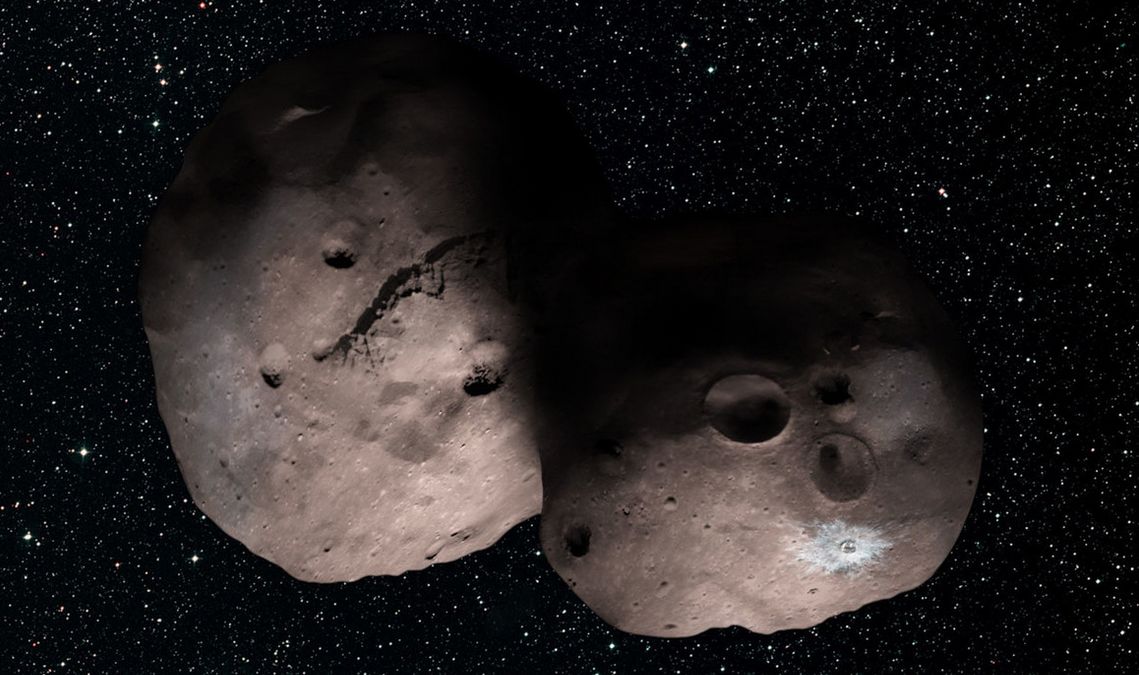
An artist’s impression of how the surface of Ultima Thule might look, based on the images and data returned by New Horizons thus far. Credit: NASA

We set a record. Never before has a spacecraft explored anything so far away. Think of it. We’re a billion miles farther than Pluto [and] Just like with Pluto, we could not be happier. What you’re seeing is the first contact binary ever explored by spacecraft: two completely separate objects that are now joined together.

– Alan Stern, New Horizons principal investigator

The astronomical year got off to a flying start on January 1st, 2019 when NASA’ New Horizons vehicle – the same craft that flew by Pluto and Charon and their attendant moons in 2015 – shot past (486958) 2014 MU69, a trans-Neptunian Object (TNO) residing in the Kuiper belt. A relatively tiny object, and dubbed Ultima Thule, it wasn’t even known about when the New Horizons mission launched in January 2006.

As I noted in my previous Space Sunday report, Kuiper Belt objects are of particular interest to planetary astronomers and scientists as they represent the oldest near-pristine material in the solar system, and so could contain many secrets, from how rocky planets formed through to the origins of life. Ultima Thule itself has been of particular interest because data gathered from the Hubble Space Telescope (HST) suggested it might be a binary object due to its apparent brightness fluctuating, suggesting two bodies orbiting one another. However, as New Horizons slipped into the final days leading up to the fly-by, it seemed to report no variance’s in the light reflected by the object.

The space craft reached its point of closest approach to Ultima Thule at 05:33 UT on the morning of January 1st, 2019. However, the nature of the approach, coupled with the huge distance between Earth and the vehicle meant that the first images and data wouldn’t be received for several hours after the probe has passed the object (it takes over 6 hours for radio signals to reach Earth from the vehicle), so at the time of closest approach, scientists and the public had to make do with the images received in the 24 hours preceding it.

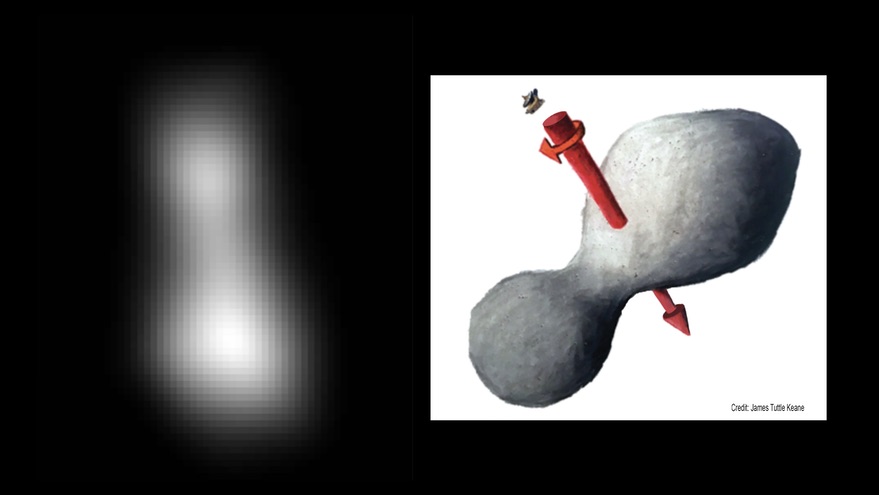
Left: a composite image of Ultima Thule taken by New Horizons on December 31st. 2018, at a distance of approx. 1.2 million km revealing the object to most likely be a “contact binary”. Right: a sketch showing the estimated rotation axis of the object relative to New Horizons, helping to explain when no variances in brightness were recorded ahead of the encounter. Credit: NASA / JHU APL / SwRI; James Tuttle Keane

These images, captured while New Horizons was still more than 1 million kilometres (635,000 mi) from Ultima Thule, were enough to confirm that, rather than being either a single elongated object (as suggested by the lack of variance in brightness the probe was recording) or two objects orbiting one another, Ultima Thule is in fact a “contact binary” – objects conjoined after gently colliding with one another, to form a shape initially referred to as a “bowling pin” (this latter changed to “dirty snowman” as clearer images were received). They also revealed why New Horizons wasn’t seeing any brightness variations: whereas Hubble was seeing Ultima Thule from more of an “end on” angle (like a bottle tumbling through the air towards you), New Horizons was approach it more-or-less along its axis of rotation (like standing in front of a slowly turning propeller), so it was always reflecting the same amount of light.

The initial images led members of the New Horizons mission team to call Ultima Thule the “first ever” contact binary object to be explored. However, this might be disputed; the nucleus of comet 67P/Churyumov–Gerasimenko, as seen by ESA’s Rosetta mission, as has two lobes connected by a narrow “neck” region which could mark it as a contact binary.

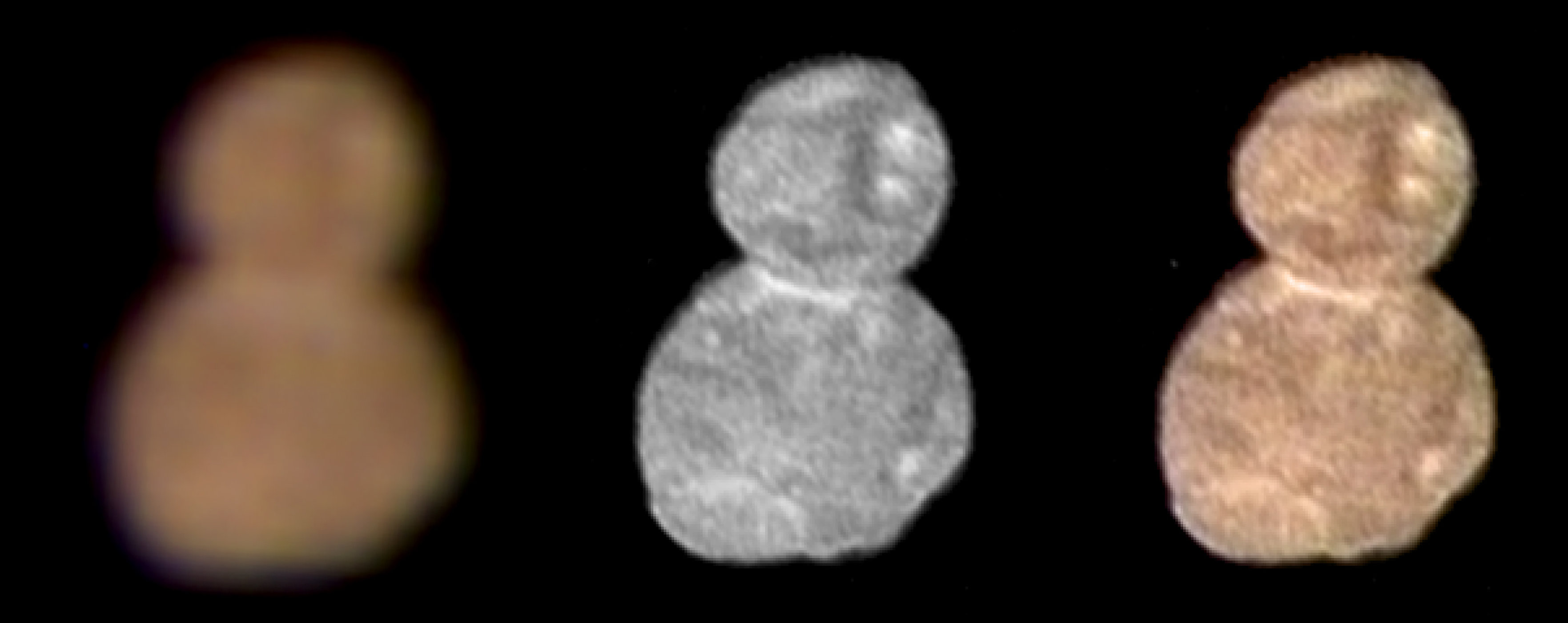
This first colour photo of Ultima Thule reveals its red colour as seen by New Horizons spacecraft from a distance of 137,000 km (85,000 mi), captured on January 1st, 2019, shortly ahead of the point of closest approach. From left to right: an enhanced colour image, a higher-resolution black and white image, and a composite combining both into a more detailed view. Credit: NASA / JHU APL / SwRI

Nevertheless, there is still something magical about the way the two lobes came together – as a member of the New Horizons team put it, the bump of them joining would have been so gentle, had it been caused by a car bumping your own, it wouldn’t result in any real damage. The lobes themselves are of unequal size; at 19 km (12 mi) across, the larger has been dubbed “Ultima”, while the smaller lobe has been dubbed “Thule”, and is 14 km (9 mi) across. Combined, these give the object an overall length of some 33 km (21 mi). That they came together so gently has already been seen as a confirmation of the pebble accretion theory of planetary formation.

The exterior of both lobes is probably a mix of water, methane and nitrogen ices, doubtless mixed with other elements  / minerals, and the reddish hue revealed in the colour images thus far returned is likely the result of the irradiation of ices on its surface – a process witnessed on Pluto. However, it will not until photographs taken much closer to the object – notably those at closest approach, a mere 3,500 km (2,200 mi) – are received in mid-February, that we’ll have a clear view of the object’s topography.

Following the fly-by, the images received by mission control were taken at distances between 137,000 km (85,000 mi) and 28,000 km (18,000 mi) from the object, and part of the initial data transfer. In all, some 7 Gb of data was gathered, but due to the complexities involved, it will take 20 months for all of it to be received on Earth. In fact, at the time this article was written, and due to the passage of the Sun between the spacecraft and Earth, data transfer has been suspended for five days (January 5th through 10th, 2019) to prevent data loss due to solar interference. Even so, the images that have been received have been enough to not only reveal some of Ultima Thule’s secrets, but to also create new mysteries about it.

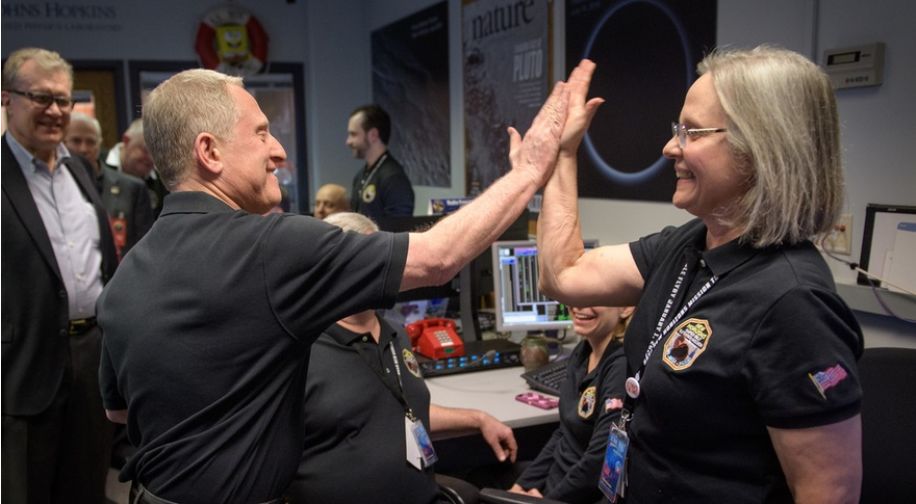
Alan Stern, the principal investigator for New Horizons, high-fives Alice Bowman, the mission operations manager at JHU APL, after controllers received a transmission from the spacecraft confirming a successful fly-by of Ultima Thule on January 1st, 2019. Credit: NASA / Bill Ingalls

One of these mysteries is that computer modelling suggests that given the way the two lobes came together, Ultima Thule should have a rate of spin to complete one revolution every 3 or 4 hours. However, data from New Horizons indicates it is spinning far slower: one revolution every 15 hours. So something must have slowed it down – the question is, what?

The most obvious explanation would be the gravitational influence of nearby objects – say two or three small moons orbiting Ultima Thule. However, due to the risk of collision, the space around Ultima Thule was surveyed well ahead of the fly-by, and astronomers are convinced there is nothing orbiting it either beyond 800 km (500 mi) or closer than 160 km (100 mi) – although that does leave a fairly large sphere of space between the two which may yet reveal one or more objects. More will be known on this in late January, when data on New Horizons’ own studies of the space around Ultima Thule should be received by mission control.

Continue reading “Space Sunday: Ultima Thule and Chang’e 4”

Space Sunday: seven minutes of terror and a round-up

Virgin Orbit
An artist’s impression of InSight on Mars. Credit: ETH Zurich

Mars is actually the most-studied planet in the solar system after Earth. In the last two decades alone, it has been under constant observation and study, yet we know very little about the Red Planet’s interior.

That should change from Monday, November 26th, 2018, when NASA’s latest mission to Mars, the Interior Exploration using Seismic Investigations, Geodesy and Heat Transport (InSight) lander touches down on Elysium Planitia.

The aim of the mission is to carry out a detailed examination of the Red Planet’s interior – its crust, mantle and core. Doing so can answer key questions about the early formation of the rocky planets in our inner solar system – Mercury, Venus, Earth, and Mars – more than 4 billion years ago. In addition, the data gathered may also help us to understand how rocky exoplanets orbiting other stars in our galaxy may have formed.

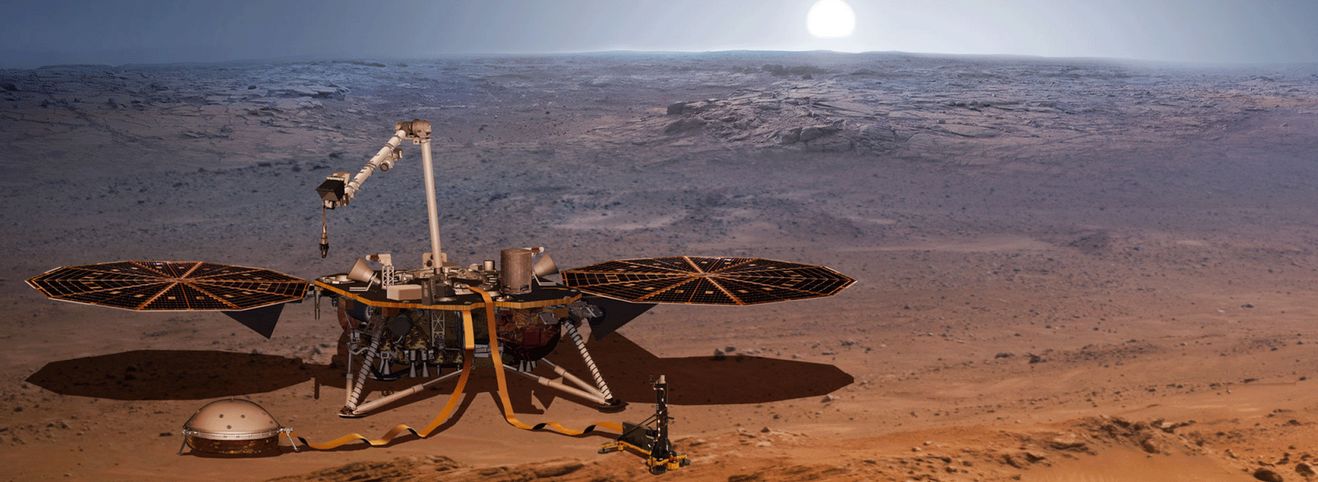
An artist’s impression of InSight on Mars, showing the SEIS package deployed. Credit: NASA / JPL

I’ve covered some of the more unique aspects of the mission in previous Space Sunday articles (see Insight on InSight, May 2018 and Mars Roundup, October 29th), including the use of two unique surface instruments, the Seismic Experiment for Interior Structure (SEIS) and HP3, the Heat Flow and Physical Properties Package to probe the planet’s interior. However, in order for the lander to use these, and its other instruments, it must conclude its 6-month journey to Mars with the Entry, Descent and Lander (EDL) phase – or as NASA mission engineers are calling it, 7 minutes of terror.

So-called since the 2012 landing of the Curiosity rover on Mars, it is known as such because by the time mission control receives the initial signals indicating the start of EDL, the Lander will be on the surface of Mars – in one piece or otherwise. These crucial seven minutes comprise (in the anticipated Earth Receive Time, when the signals are expected to reach NASA’s Jet Propulsion Laboratory):

  • 19:47 GMT: encased in its aeroshell, InSight will enter the upper reaches of Mars’ discernible atmosphere 114 km (77 mi) above the surface of planet at 19,800 km/h (12,300 mph) at a critical 12-degree angle of attack. Any less than this, and it could bounce back into space, any greater and the heat generated by atmospheric entry could overwhelm the heat protection (designed to withstand temperature up to 1,500oC / 2,700oF, which is reached  2 minutes into the entry sequence), and burn-up the lander.
  • 19:51 GMT: having been slowed to 1,400 km/h (860 mph) and at an altitude of 11 km (7 mi), the primary parachute is deployed. 15 seconds after this, the lower heat shield is jettisoned, and 10 second after that, the three landing legs are deployed.
  • 19:52 GMT: ground sensing radar activates to measure the distance to the ground.
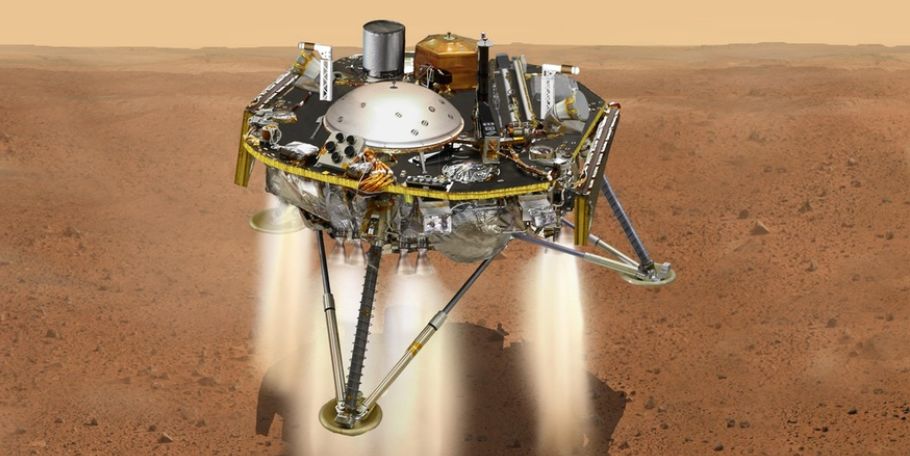
  • 19:53:25 GMT: the lander separates from it aeroshell and parachute and the landing motors start firing as the lander orients itself for touchdown.
  • 19:53:47 GMT: the motors reduce velocity from 27 km/h to 8 km/h (17 mph to 5 mph).
  • 19:54 GMT: InSight touches down, with the motors immediately shutting down to avoid “bouncing” or toppling.
Virgin Orbit
An artist’s impression of InSight touching-down on Mars under propulsive power. Credit: NASA

Depending on how systems check-out, the first image from InSight could be received by mission control about 8-10 minutes after landing – although equally, it could be received any time in the first 24 hours after landing. The Mars Odyssey orbiter should overfly the landing area at around 01:30 GMT on November 27th, and will hopefully be able to image InSight on the surface of Mars with its large, circular solar panels fully deployed – these will initially remain in their stowed  configuration for around 20 minutes following landing to allow the dust thrown up by the lander’s motors to disperse and settle so that it doesn’t interfere with their operation.

Once settled on Mars, the primary mission, designed to run for a full Martian year, will commence – although it will be one that could take time to unfold.

InSight is kind of a laid-back, slow-motion mission. It’s going to take us probably two to three months, at least, to get our instruments down, and it could be early next spring before our principal instruments started returning data.

– InSight principal investigator Bruce Banerdt

As well as direct transmissions during EDL, NASA hopes to get real-time telemetry of the landing from a pair of cubesats, called Mars Cube One (MarCO), that launched as secondary payloads with InSight in May, and which will fly past Mars during the landing.

For those who wish to follow it, the InSight landing will be broadcast on a number of NASA on-line resources available.

Continue reading “Space Sunday: seven minutes of terror and a round-up”

Space Sunday: exoplanets ‘Oumuamua and rockets

An artist’s impression of the surface of Barnard’s Star b. Credit ESO-M. Kornmesser. Credit ESO-M. Kornmesser

Another of our Sun’s closest neighbours has been found to be home to a “super-Earth” scale planet.

Barnard’s Star, named after American astronomer Edward Emerson Barnard, is a low-mass M-class red dwarf star. As I’ve noted in previous discussions of exoplanets, red dwarf stars are the most common type of star in our galaxy, believed to account for around 70% of all stars. They can be quite volatile in nature and prone stellar flares, meaning any planets in close proximity to them are unlikely to be very habitable.

But Barnard’s Star is somewhat unusual; while it is estimated to be between two and three times older than the Sun, it has a relatively low level of activity. It also has the fastest radial (side-to-side) motion of any visible star in the night sky – something that might indicate the presence of a large planet orbiting it, causing it to wobble in its spin.

Over the years, astronomer have attempted to use the star’s radial motion to try to establish if it is the result of a planet, and in 2015, instruments used by the European Southern Observatory and the Keck Observatory suggested there could be a very large planet with an orbital period of about 230 days.

More recently, the Red Dots and CARMENES campaigns, which were responsible for the discovery of a planet orbiting our nearest stellar neighbour, Proxima B (see here for more), reviewed the data gathered from multiple sources that have studied Barnard’s Star in an attempt to ascertain whether there is one or more planets orbiting Barnard’s Star.

An artist’s impression of Barnard’s Star planet under the orange tinted light from the star. Credit: IEEC/Science-Wave – Guillem Ramisa

For the analysis we used observations from seven different instruments, spanning 20 years, making this one of the largest and most extensive datasets ever used for precise radial velocity studies. The combination of all data led to a total of 771 measurements.

– Ignasi Ribas, director of the Monstec Astronomical Observatory, and study lead

The results of this work appear to confirm that there is a planet – referred to as Barnard’s Star b – is orbiting the star roughly one every 233 terrestrial days. It has a mass of at least 3.2 times that of Earth, putting it if the category of either a “super-Earth” or a “mini-Neptune”. It is some 0.4 AU (0.4 times the distance between the Earth and the Sun) from its parent.

Because of Barnard’s Star low mass and brightness, the planet only receives about 2% of the energy that the Earth receives from the Sun. This puts it at, or beyond the star’s frost line, where volatile compounds like water, carbon dioxide, ammonia and methane condense into solid ice. As a result, the planet likely has a surface temperature in the region of -170oC, making it inhospitable to life as we know it – although if the planet has an atmosphere, its surface temperature could be higher.

This is the first time an exoplanet has been discovered using the radial velocity method. The most common method of detection is the transit method, monitoring the period dimming of a star’s brightness as seen from Earth to determine whether a planet might be orbiting it, but such is Barnard’s Star’s dimness, this has never really been and option.

Further observations are required to completely confirm the planet’s presence, but those involved in the study – including ESO – have a high degree of confidence it will be confirmed, and observations by a number of observatories around the globe are already underway.

After a very careful analysis, we are over 99 per cent confident that the planet is there, since this is the model that best fits our observations. However, we must remain cautious and collect more data to nail the case in the future … we’ll continue to observe this fast-moving star to exclude possible, but improbable, natural variations of the stellar brightness which could masquerade as a planet.

– Ignasi Ribas

Such is the proximity of Barnard’s Star to Earth, the new planet is potentially an excellent candidate for direct imaging using the next-generation instruments both on the ground and in space – such as with NASA’s James Webb Space Telescope (JWST), scheduled for launch in 2021) or Wide Field InfraRed Survey Telescope (WFIRST), which if not threatened with further cancellation, should be launched in the mid-2020s, and the European Space Agency’s Gaia mission.

‘Oumuamua Update

In my previous Space Sunday article, I wrote about our interstellar visitor, ‘Oumuamua (officially 1I/2017 U1), which was observed passing around the Sun a year ago, and the (unlikely) potential it is some form of extra-terrestrial probe.

On November 14th, 2018, NASA issued an update on the most recent findings from data obtained on the cigar-shaped object by the Spitzer infra-red telescope.

An artist’s impression of 1I/2017 U1 (or `Oumuamua), which was first seen by the Pan-STARRS 1 telescope in Hawaii on October 19th, 2017, and subsequently studied by a number of telescopes around the world, including the VLT of the European Southern Observatory (ESO) Credit: ESO / M. Kornmesser

The new report, released via NASA’s Jet Propulsion Laboratory, indicates ‘Oumuamua is off-gassing volatiles, something those proposing the alien probe idea thought to be unlikely. This off-gassing likely imparted the odd tumbling motion exhibited by ‘Oumuamua . Spitzer’s observations also confirmed that the object is highly reflective – around 10 times more reflective than the comets that reside in our solar system—a surprising result, according to the paper’s authors.

Comets orbiting the Sun spend a good deal of their time gathering dust suspended in the interplanetary medium, covering them in a layer of “dirt”. As they approach the Sun, they undergo heating, causing volatiles  – often frozen water – to start venting, “cleaning” parts of the comet’s surface and raising its reflectivity. As ‘Oumuamua, has been in the depths of interstellar space for millennia and far from any star system that could contain enough dust and material to refresh its surface, it is possible that the off-gassing confirmed by Spitzer exposed far more of its underlying ice. This, coupled with some of the icy volatiles it vented falling back onto its surface (again as can happen with solar system comets) may have resulted in the object’s higher than expected albedo.

Taken with other observations of ‘Oumuamua, the Spitzer data tends to further discount the idea that it is of artificial origin.

Continue reading “Space Sunday: exoplanets ‘Oumuamua and rockets”

Space Sunday: ‘Oumuamua, BFS and Tianhe-1

An artist’s impression of 1I/2017 U1 (or `Oumuamua), which was first seen by the Pan-STARRS 1 telescope in Hawaii on October 19th, 2017, and subsequently studied by a number of telescopes around the wrold, including the VLT of the European Southern Observatory (ESO) Credit: ESO / M. Kornmesser

On October 19th, 2017, the Panoramic Survey Telescope and Rapid Response System-1 (Pan-STARRS-1) in Hawaii announced the first-ever detection of an interstellar asteroid, named 1I/2017 U1 (aka. ‘Oumuamua).

In the months that followed, multiple additional observations were conducted that allowed astronomers to get a better idea of its size and shape, revealing it to be strangely cigar-shaped, roughly 400 metres (1312 ft) in length and approximately 40-50 metres (130-162.5 ft) in height and width, tumbling through space. These observations also showed it may be composed of dense metal-rich rock, and that it had the characteristics of both a comet and an asteroid.

However, the report on ‘Oumuamua (roughly translated as “scout”, ou being Hawaiian for “reach out for” and mua meaning “first, in advance of” – which is repeated for emphasis) that captured public imagination is the idea that the object may have been an interstellar probe.

At the heart of this idea is the fact that ‘Oumuamua accelerated away from the Sun faster than would have been the case of it receiving a “gravity assist” in swinging around our star. Initially, it was suggested that the additional acceleration was the result of the off-gassing of volatiles  – frozen water, etc., that had been heated during ‘Oumuamua’s close swing around the Sun. However, no such off-gassing had been observed when the object was closer to the Sun, which would have been expected.

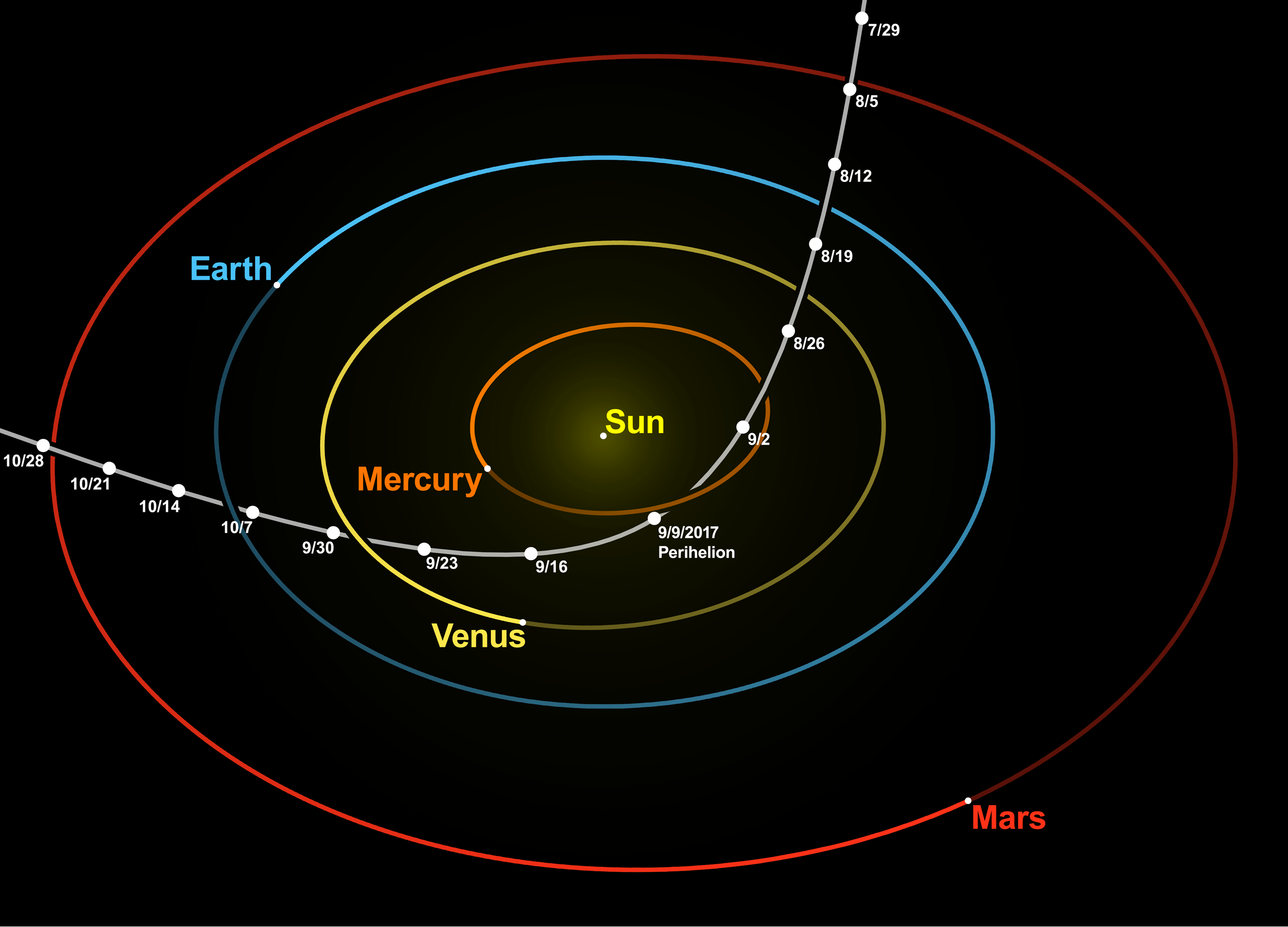
‘Oumuamua’s passage around the Sun in 2017. Credit: Tom Ruen, via wikipedia

In June 2018, an alternative explanation for the acceleration was posited: that it was the result of solar pressure being exerted on the object.

However, at the end of October 2018, Shmuel Bialy, a post-doctoral researcher at the CfA’s Institute for Theory and Computation (ITC) and Prof. Abraham Loeb, the Frank B. Baird Jr. Professor of Science at Harvard University, went one stage further. They proposed that while ‘Oumuamua might well be natural in origin – it could also be the object is in fact an alien probe, intentionally sent to our solar system and which uses a light sail (or what we’d call a solar sail were it to be used with a probe sent from Earth to explore out solar system) for propulsion.

Currently there is an unexplained phenomena, namely, the excess acceleration of ‘Oumuamua, which we show may be explained by the force of radiation pressure from the Sun. We explain the excess acceleration of `Oumuamua away from the Sun as the result of the force that the Sunlight exerts on its surface. For this force to explain measured excess acceleration, the object needs to be extremely thin, of order a fraction of a millimetre in thickness but tens of meters in size. This makes the object lightweight for its surface area and allows it to act as a light-sail. Its origin could be either natural (in the interstellar medium or proto-planetary disks) or artificial (as a probe sent for a reconnaissance mission into the inner region of the Solar System).

– E-mail from Baily and Loeb on their paper concerning ‘Oumuamua

Their views were circulated to various news outlets via e-mail and cause something of a stir in the first week or so of November.

Loeb has actually been an advocate of ‘Oumuamua being of intelligent origin since it was first discovered. He was one of the first to call for radio telescopes to listen to it across a range of frequencies for any signs of transmissions from it. When the SETI Institute‘s Allen Telescope Array did so without success, he pushed for the Green Bank Telescope in West Virginia to listen for radio emissions – which it did for a 6-day period December 2017, again without success

As no signals were found to be emanating from the object, rather than drop the idea of it being artificial, Loeb has put forward the ideas that it has either malfunctioned, or it is active, and we simply can’t detect the fact that it is. He’s even suggested that given Pan-STARS only managed to spot the object after it has passed perihelion, could mean that it is only “one of many” such probes sent our way, and we’ve missed the others.

Bialy has been a little more cautious with things, pointing out the paper is “high speculative”. But the fact is, the paper does come across more of an attempt to substantiate a belief (that ‘Oumuamua is of artificial origin) than anything else, and in doing so, it does ignore certain data and makes some sweeping assumptions.

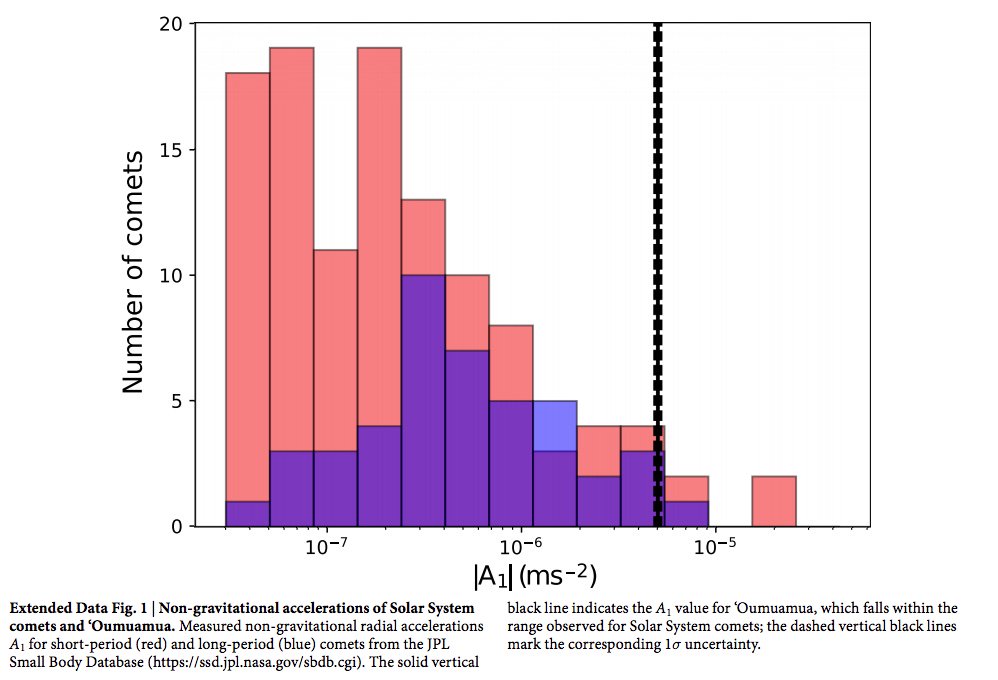
For example, the paper tends to dismiss the idea that ‘Oumuamua’s unexpected acceleration was consistent with a push from solar radiation pressure. However, Michele Bannister, a planetary astronomer from New Zealand and one of many to push back against the “ET probe” idea via Twitter, used a graphic that shows the acceleration exhibited by ‘Oumuamua’s is entirely in keeping with similar non-gravitational accelerations seen with comets within the solar system.

via Michele Bannister

Continue reading “Space Sunday: ‘Oumuamua, BFS and Tianhe-1”

Space Sunday: farewell and welcome back

One of the last images of Ceres returned by the Dawn mission which was officially declared ended on November 1st, 2018. Note the bright carbonate mineral deposits in Occator Crater to the right of the image. Credit: NASA/JPL

Two important space missions came to an end at the end of October 2018. The Kepler observatory, which spent nine years in deep space collecting data that detected thousands of planets orbiting stars outside our solar system; and the Dawn spacecraft, which spent 11 years orbiting and studying the main asteroid belt’s two largest objects, Vesta and Ceres.

Concerns had been growing for months over Kepler’s ability to continue working as a result of dwindling on-board propellant supplies, as the space observatory has had to use it thrusters a lot more than originally planned, following the failure of some of its pointing gyroscopes several years ago. Similarly, the end of the Dawn mission had been signed as a result of that vehicle also running low on orientation propellants.

Launched in 2007, Dawn was the first spacecraft to orbit a body between Mars and Jupiter, and the first to orbit more than one deep-space destination. From 2011 to 2012, the spacecraft studied the asteroid Vesta before pulling off an unprecedented manoeuvre by leaving orbit and travelling to the dwarf planet Ceres, which it observed for over 3.5 years. Even with the mission now officially over, Dawn will remain in a stable orbit around Ceres for decades, while among its many findings, Dawn helped scientists discover organics on Ceres and evidence that dwarf planets could have hosted oceans over a significant part of their history—and possibly still do.

Both missions were extended past their originally anticipated lifetime because of the innovative work of their engineers and scientists. In 2016, Dawn’s mission at Ceres was extended. In 2017, its mission at Ceres was extended again to study the dwarf planet from altitudes as low as 35 km (22 mi) above the surface, with the main goal of understanding the evolution of this dwarf planet.

Dawn depleted its hydrazine propellant on October 31st, 2018 while still actively engaged in studying Ceres. Without it, the vehicle could not keep its solar panels oriented towards the Sun in order to provide energy to its battery systems, resulting in a complete loss of contact with Earth. Attempts were made to re-establish communications through NASA’s Deep Space Network, but the loss of propellants had been expected, and the US space agency officially announced the mission as concluded on November 1st, 2018.

Ceres’ lonely mountain, Ahuna Mons, seen in a simulated perspective view with the elevation has been exaggerated by a factor of two. The view was made using enhanced-colour images from NASA’s Dawn mission. Credit: NASA/JPL

Among the more surprising discoveries Dawn made was the fact that small bodies in the solar system like Vesta and Ceres are more diverse in nature that had even been thought. Dawn also revealed that geological activity on Ceres had once been sufficient to raise a massive 5 km (3 mi) high cryovolcano, Ahuna Mons (or informally, The Lonely Mountain), and to create more than 300 bright features, called faculae. On Earth, these bright deposits of carbonate minerals are associated with water, suggesting Ceres may have, or had, a liquid water interior. The brightest of these deposits, in Occator Crater is also the largest deposit of carbonate minerals found beyond Earth.

Such is the amount of data returned by Dawn, analysing it all will still take several more years, as noted by the mission’s Principal Investigator, Carol Raymond:

In many ways, Dawn’s legacy is just beginning. Dawn’s data sets will be deeply mined by scientists working on how planets grow and differentiate, and when and where life could have formed in our solar system. Ceres and Vesta are important to the study of distant planetary systems, too, as they provide a glimpse of the conditions that may exist around young stars.

Kepler, meanwhile, was launched in 2009 and completed its primary mission in 2012, leading to the first mission extension. Then, in 2013, a second gyroscope failure left the observatory unable to continue in its primary operating mode. Instead, engineers found a way to use both solar pressure and the observatory’s manoeuvring jets to keep it pointing in a desired direction. This allowed a new mission, dubbed K2, to commence in 2014. It has been running ever since, gathering science from 19 different patches of sky with populations of stars, galaxies and solar system objects.

Kepler was officially retired on October 30th, 2018. For most of the year it had been showing signs of running out of propellants, and without them, it would be unable to maintain the correct orientation to either continue observations or turn itself to communicate with Earth.

As NASA’s first planet-hunting mission, Kepler has wildly exceeded all our expectations and paved the way for our exploration and search for life in the solar system and beyond. Not only did it show us how many planets could be out there, it sparked an entirely new and robust field of research that has taken the science community by storm. Its discoveries have shed a new light on our place in the universe, and illuminated the tantalizing mysteries and possibilities among the stars.

– NASA’s official announcement on Kepler’s retirement

Kepler by the numbers. Credit: NASA

Continue reading “Space Sunday: farewell and welcome back”

Space Sunday: of Soyuz aborts and telescopes

Cosmonaut Alexey Ovchinin (l) and astronaut Nick Hague (r) prior to their flight aboard Soyuz MS-10 – a flight that was a lot shorter and a little more exciting than either man anticipated. Credit: Roscosmos

On Thursday, October 11th, 2018, the Soyuz MS-10 spacecraft carrying two crew – American astronaut Nick Hague and Russian cosmonaut Alexey Ovchinin to the International Space Station (ISS) suffered a core second stage failure, triggering an emergency launch abort. Both Hague and Ovchinin survived the ordeal – although the way some of the media were reporting things, one might have thought they were hoping otherwise.

Soyuz utilises a R7 booster family of launch vehicle. This comprises a single-engined core element (confusingly called the 2nd stage, surrounded by 4 liquid-fuelled strap-on boosters referred to as the first stage. Each of these also has a single motor with, like the core stage, four combustion chambers. At launch, all five elements are fired, with the four strap-on boosters running for around 2 minutes. Then, with their fuel expended, they are jettisoned.

The view from the ground as Soyuz MS-10 starts its flight, October 11th, 2018. Credit: NASA TV

It is at this point – 2 minutes into the vehicle’s ascent from the Baikonaur Cosmodrome, Kazakhstan, that things went awry,  and gave observers watching from the ground the first indication of trouble – telemetry being relaid to mission control in Star City, near Moscow give little indication of a problem, causing commentators there to keep to their prepared scripts even as the drama unfolded.

Due to the way they fall clear of the core stage, the four strap-on boosters perform a controlled tumble with their exhaust plumes still visible. Seen from the ground, this forms distinctive and almost symmetrical pattern around the core stage called the “Korolev Cross” in honour of the father of modern Soviet / Russian space flight, Sergei Korolev, who also designed the original R7 rockets.

On this occasion, however, following separation, a decidedly asymmetrical Korolev Cross briefly formed, before the sky around the rocket became spotted with debris as if something had broken up.  At the same time, video of the cabin in the Soyuz vehicle’s decent module, where the crew sit during both ascent to orbit and their return to earth, showed Ovchinin  and Hague suddenly experiencing a brief period of weightlessness, almost as if thrust from the vehicle’s second stage had ceased, before they were pushed back into their seats and the plush toy suspended in front of the camera (used as a very rough-and ready G-force indicator) suggested a rapid acceleration.

This sudden acceleration was the result of the launch escape system kicking-in, separating the payload shroud containing the upper two modules of the Soyuz from the failing rocket. The manoeuvre recorded a 6.7 G acceleration right when the crew would have been expecting a 1.5G climb up to orbit as a result of jettisoning the spent strap-on boosters.

Once clear of the rocket, the fairing deployed a set of aerodynamic breaking flaps, slowing it to allow the Soyuz descent module to detach. The normal parachute and retro rockets where then used to bring the capsule back to Earth and execute a safe landing.

The distinctive “Korolev Cross” of booster separation see with R7 launches (l), and how it looked with Soyuz MS-10 (r). The first visual indications from the ground that something had gone wrong. Credits: NASA TV

Precisely what caused the failure has yet to be determined. As well as recovering the two crew safely and returning them to Baikonour unharmed, teams have also been busy recovering parts of the failure rocket, and Roscosmos believe they’ll be in a position to use the parts so far recovered together with telemetry from the vehicle’s ascent to provide a preliminary report on the failure within a week.

In the meantime, space experts have been examining video footage of the launch, and it would appear some form of malfunction during the separation of one of the four strap-on boosters may have caused it to actually collide with the core rocket. In his analysis of the flight, Scott Manley points to both the asymmetrical pattern of debris from the booster separation and what appears to be a radical slewing in the exhaust plume of the core stage as evidence there was some form of collision.

A remarkable shot of Soyuz MS-10 captured by ESA astronaut Alexander Gerst from the ISS. Credit: A. Gerst / ESA / NASA

Some confusion also exists over what actually happened during the abort sequence. Like Apollo crewed rockets, Soyuz has a tower-like escape system at its top. In an emergency, rockets mounted in the tower fire, pulling the crew module clear with a brief acceleration of about 14 G. As the reported acceleration with MS-10 was less than this, there was speculation the escape system hadn’t been used.

However, the Russian escape system, called the Sistema Avariynogo Spaseniya (SAS), unlike American systems, has two sets of motors: those in the tower, and a set of lower-thrust motors mounted directly on the payload fairing, and capable of around 7 G acceleration – the reported speed of the Soyuz on separation. It’s theorised it was these motors that pulled the Soyuz clear, the vehicle not having reached a velocity warranting the use of the tower rockets in order to pull the Soyuz clear.

Left: the Soyuz escape system (SAS) and how it works. The system uses two sets of motors which can be used together or independently of one another to pull the upper section of the payload fairing and the Soyuz clear of a malfunctioning rocket. The Soyuz descent module can then jettison, using its parachute and landing motors to return to Earth. Right: The SAS motor tower (boxed) with four rockets, and the second set of 4 RDG rockets mounted on the payload fairing (ringed). Credits: assorted.

Continue reading “Space Sunday: of Soyuz aborts and telescopes”