Space Sunday: lunar landers, asteroids and more

A GSLV Mk III lifts-off with the Chandrayaan-2 mission from India’s Satish Dhawan Space Centre, Sriharikota, 09:13 UTC, Monday, July 22nd, 2019. Credit ISRO

The Indian Space Research Organisation (ISRO) successfully launched its Chandrayaan-2 mission to the lunar south pole on Monday, July 22nd, after suffering a week’s day to the schedule. This is an ambitious mission that aims to be the first to land in the Moon’s South Polar region, comprising three parts: an orbiter, a lander and a rover.

Although launched atop India’s most powerful rocket, the GSLV Mk III, the mass of the mission means it cannot take a direct route to Mars, as the upper stage isn’t powerful enough for the mass. Instead, Chandrayaan-2 was placed into an extended 170km x 39,120 km (105 mi x 24,300 mi) elliptical orbit around the earth. For the next month, the orbiter will gradually raise this obit until it reaches a point where lunar gravity becomes dominant, allowing Chandrayaan-2 to transfer into a similarly extended lunar orbit before easing its way down to a 100 km (60 mi) circular polar orbit around the Moon, which it is scheduled to achieve seen days after translating into its initial lunar orbit.

How Chandrayaan-2 will reach the Moon and its operational orbit. Credit: ISRO

During this period, the combined vehicle will carry out multiple surveys of the Moon’s survey, focusing on the South Pole. It will also release the 1.47-tonne Vikram lander (named for Vikram Sarabhai, regarded as the father of the Indian space programme) which will make a soft decent to the lunar surface, which will take several days prior to making a soft landing.

The orbiter vehicle is designed to operate for a year in its polar orbit for one year. It carries a science suite of eight systems, including the Terrain Mapping Camera (TMC), which will produce a 3D map for studying lunar mineralogy and geology, an X-ray spectrometer, solar X-ray monitor, imaging spectrometer and a high-resolution camera.

The Vikram lander, with four science payloads, will communicate both directly with Earth and the orbiter. It will also facilitate communications with the Pragyan rover, which will be deployed within hours of the self-guiding lander touching down. Between them, the lander and rover carry 5 further science experiments and both are expected to operate for around 14 days.

Testing the deployment of the Pragyan rover from the Vikram lander. Credit: ISRO

Craters in the South Polar region lie in permanent shadow and experience some of the coldest temperatures in the solar system and NASA’s Lunar Reconnaissance Orbiter (LRO) has revealed they contain frozen water within them, water likely unchanged since the early days of the Solar System, and thus could hold clues to the history of the Solar System – hence the interest in visiting the region and learning more. The frozen water is also of interest to engineers as it could be extracted to provide water for lunar base; water that could be used for drinking, or growing plants and could also me split to produce oxygen and hydrogen  – essential fuel stocks.

The Chandrayaan-2 mission marks a significant step forward for India’s space ambitions; assuming the Vikram lander is successful, the country will become only the forth nation to land on the Moon after the United States, Russia and China. As a part of its expanding activities in space, the country hopes to fly it first astronauts into space in 2022 and have an operational space station by the end of the 2020s.

2019 OK

No, I’m not making a statement about the year – that’s the name of a chunk of space rock measuring 57 to 130m (187 to 42ft) across that passed by Earth at a distance of around 73,000 km (45,000 mi), putting it “uncomfortably close” to the planet. What’s more, we barely released it was there: 2019 OK was positively identified by the Southern Observatory for Near Earth Asteroids Research (SONEAR), just a couple of days prior to is passage past Earth, and was confirmed by the ASAS-SN telescope network in Ohio, leaving just hours for an announcement of its passage to be made.

Since then, the asteroid’s orbit has been tracked – forward and back (which revealed it had been previously spotted by observatories, but its small size and low magnitude meant its significance wasn’t realised). These observations confirmed 2019 OK is a reactively short-period object, orbiting the Sun every 2.7 years. It passes well beyond Mars before swinging  back in and round the Sun, crossing the Earth’s orbit as it does so. However, while it may pass close to Earth on occasion, it’s highly unlikely it will ever strike us.

Credit: NASA

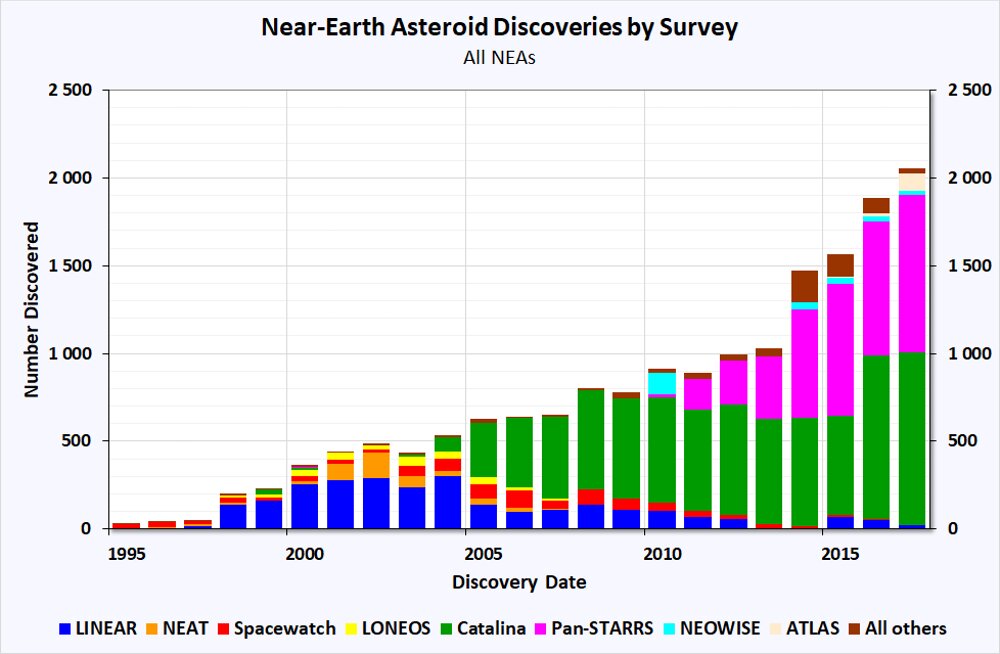
It does, however, remind us that near-Earth objects (NEOs) are common enough to be of concern; 2,000 were added to the list 2017 alone. The size of 2019 OK reminds us that there are more than enough of them to be of a significant enough size to pose a genuine threat.

In 2013, an asteroid measuring just 20m across entered the atmosphere to be ripped apart  at an altitude of around 30 km above the Russian town of Chelyabinsk. The resultant resulting shock wave shattered glass down below and injured more than 1,000 people. 2019 OK is at a minimum 2.5 times larger than the Chelyabinsk object – and possibly as much as 10 times larger, putting it in the same class of object that caused the Tunguska event of 1908, when 2,000 sq km (770 sq mi) of Siberian forest was flattened by an air blast of 30 megatons as a result of a comet fragment breaking up in the atmosphere.

Hence why observatories such as SONEAR, ASAS-SN telescope network, the Catalina Sky Survey, Pan-STARRS, and ATLAS and others attempt to track and catalogue NEOs. The more of them we can located and establish their orbits, the more clearly we can identify real threats  – and have (hopefully) a lead time long enough to take action against them.

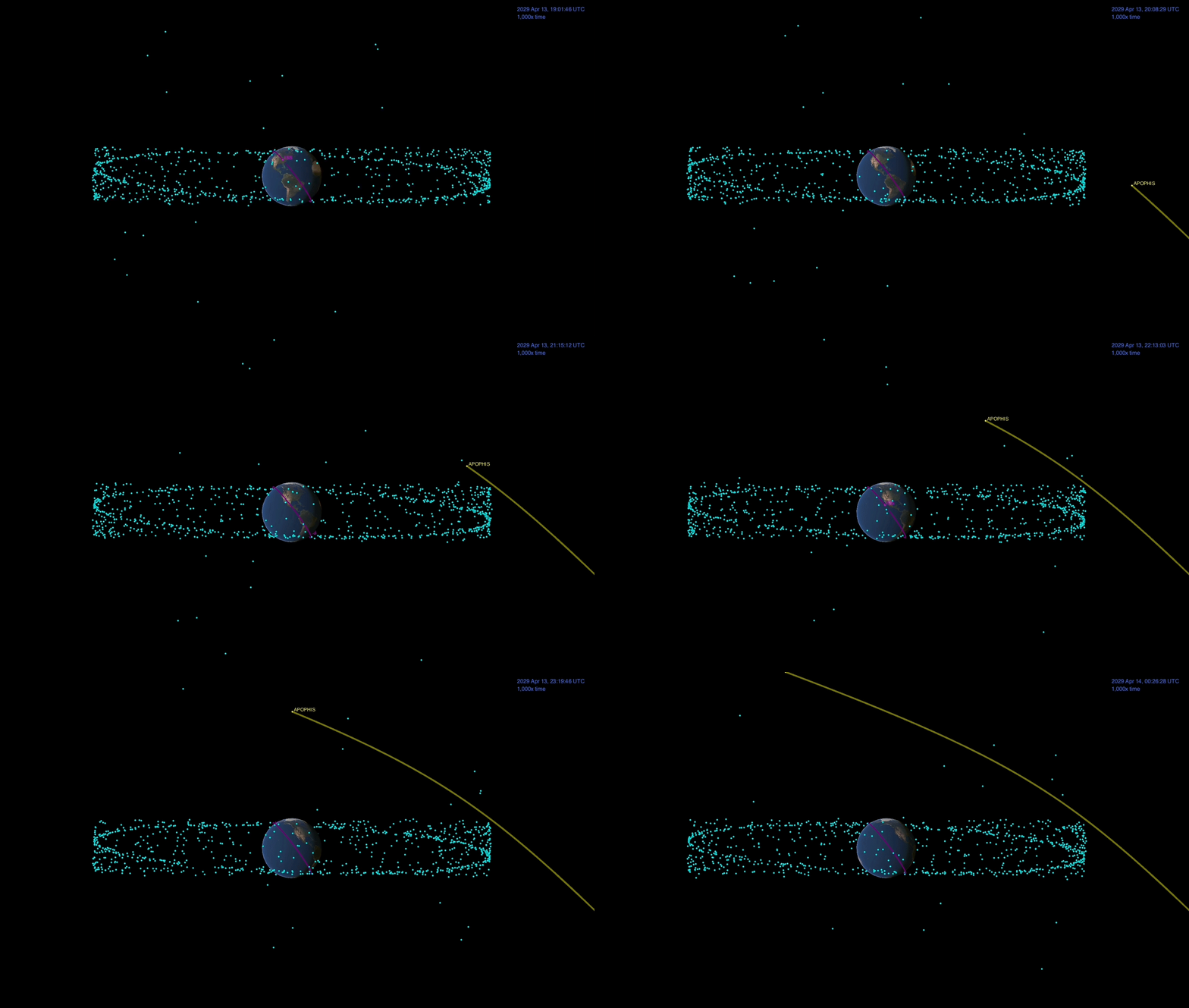
A computer model show the passage of 99942 Apophis on April 13th, 2029. The blue dots represent satellites in orbit around Earth and the pink line the orbit of the International Space Station. Credit: NASA JPL

Oh, and if you thought 2019 OK was big, consider 99942 Apophis. It’s around 400-450m across, and will swing by Earth at a distance of just 31,000 km on  – wait for it – Friday, April 13th, 2029 (so get ready for a lot of apocalyptic predictions in the months leading up to that date!).

Continue reading “Space Sunday: lunar landers, asteroids and more”

Space Sunday: rockets, exoplanets and alien oceans

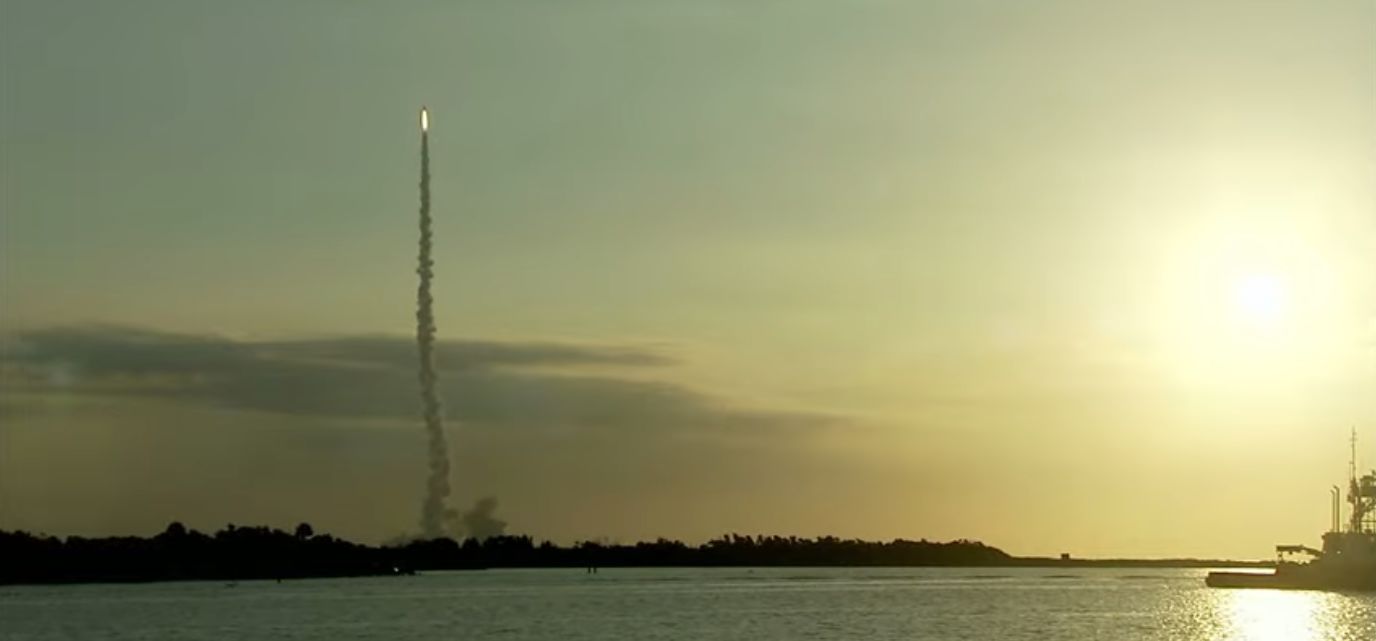
rion AA2, July 2nd 2019The Orion test article lifts-off from Space Launch Complex 46 at Cape Canaveral Air Force Station at the start of Ascent Abort-2, July 2nd 2019. Credit: NASA

NASA’s Orion Multi-Purpose Crew Vehicle passed a significant test on its way to its first crewed launch (due in 2022) on July 2nd, 2019, as it completed a flight test of the capsule’s launch abort system (LAS).

The LAS is a system designed to pull a crewed capsule clear of a malfunctioning rocket during an ascent to orbit, hopefully saving their lives in the process. As such, it is a significant system that must be tested and cleared for use before crewed flights can commence with a new launch vehicle.

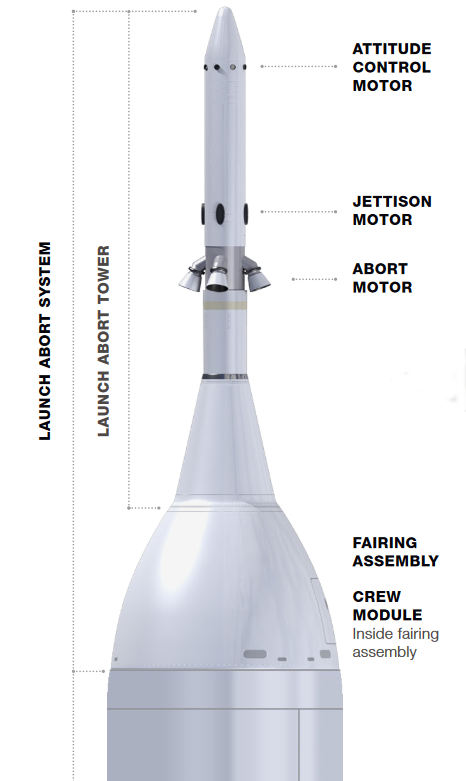
For the Space Launch System (SLS), NASA is following its traditional approach, with the LAS designed to “pull” a crew capsule clear of launch vehicle. It does this by placing a special fairing over the capsule that has a tower extending from its top, fitted with three motors. This has always been the traditional approach to US LAS systems – by contrast, Russian LAS systems generally sit below the capsule and are design to “push” it away from a malfunctioning rocket.

The Orion / SLS launch abort system (LAS). Credit: NASA

The July 2nd test – called the Ascent Abort-2 (AA-2) mission – was a critical test flight, designed to test the LAS at the point in an ascent to orbit when the Orion / SLS combination will be subjected to the highest aerodynamic stresses – the so-called period of “Max-Q” – that occurs during a rapid ascent into space.

To achieve this, NASA mounted an Orion structural test article – basically an Orion capsule sans its flight systems – contained within a LAS fairing onto the motor stage of an MX Peacekeeper ICBM, and launched it into the Florida skies in a early morning ascent designed to last some 55 seconds.

In that time, the rocket was expected to reach an altitude of 9.5 kilometres (31,000 ft) and a speed of Mach 1.3, at which point the abort sequence would trigger.

As it turned out, the MX rocket motor ran “hot”, accelerating a little faster than anticipated, so reaching its assigned separation altitude 5 seconds early. Nevertheless, the abort sequence initiated correctly, and the powerful abort motors on the LAS fired, generating 181,400 kg of thrust, hauling the Orion free of the ascent motor unit.

Once a clear separation from the still ascending motor stage had been achieved, the attitude control motors at the very top of the LAS fired, flipping it and Orion over. The middle jettison motor then fired, separating the LAS from the Orion.

During an actual abort sequence, the Orion would then re-orient itself so it would be falling heat shield first, allowing its parachutes to be deployed in preparation for a splashdown. However, for the AA-2 flight, the test article did not carry a parachute system. Instead, and like the LAS, the capsule was allowed to fall back into the Atlantic, hitting it at an estimated 480 km/h (300 mph) and breaking up. Just before it did so, however, it ejected 12 bright orange data recorders not unlike those so-called “black boxes” used by aircraft. These contained critical data recorded during the 3 minute 11 second flight, and which will be assessed post-mission to confirm everything did go an planned.

That was a spectacular test we all witnessed this morning. It was really special for the programme; a really big step forward to us. It was a really great day all around – weather and the vehicle. One of the most important parts of the test was to see how the attitude control motor performed. The internal motor pressure was rock solid, straight line and it had excellent control characteristics. Everything we’ve seen so far looks great.

– Mark Kirasich, NASA’s Orion Programme Manager

Orion AA2, July 2nd 2019The Orion test article climbs into the early morning sky over Cape Canaveral Air Force Station at the start of Ascent Abort-2, July 2nd 2019. Credit: NASA

The US has never has to use the LAS on an actual mission. However, there is no guarantee this will always be the case, and circumstances where a LAS must be used are not unkown – as the Soyuz M-10 mission in October 2018 demonstrated (see Space Sunday: of Soyuz aborts and telescopes). Therefore, passing this test was critical if  Orion and SLS are to achieve the flight goals required for NASA’s programme – Project Artemis – to return humans to the surface of the Moon.

Half-Planet, Half-Star

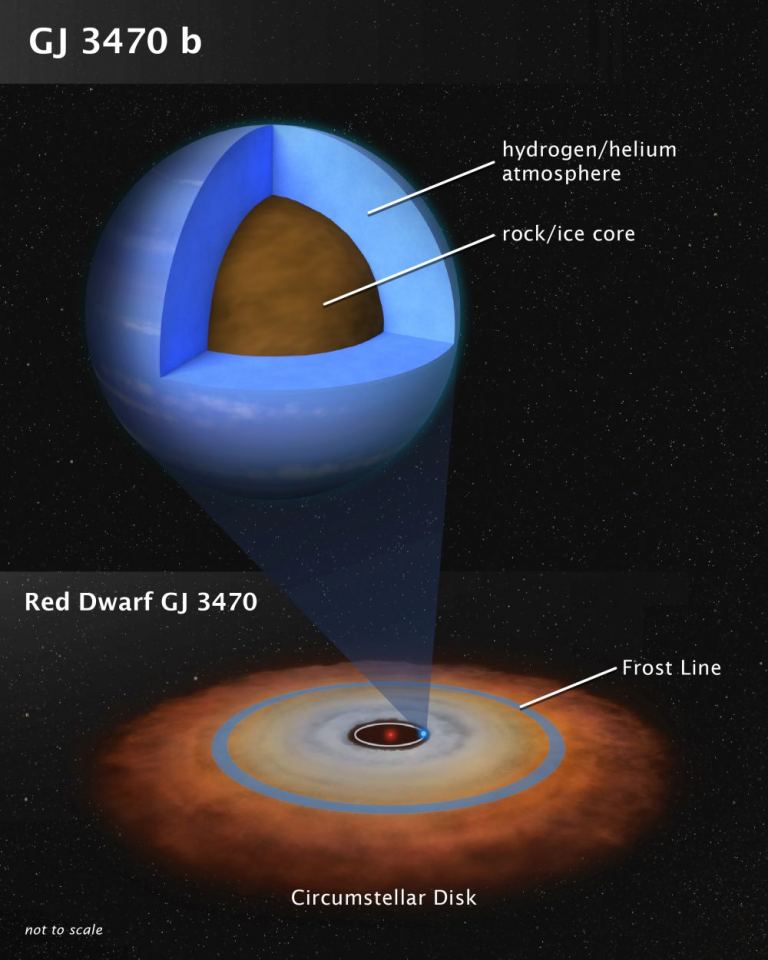
Discovered in 2012, GJ3470b is a “mini-Neptune” planet orbiting a red dwarf star called Gliese 3470, 100 light years from our Sun. Occupying an orbit some 6 million km (3.7 million mi – roughly one-tenth of the distance between the Sun and Mercury) from its parent, the planet has a mass of around 12.6 Earths.

None of this is particularly unusual; as I’ve noted in past Space Sunday articles, M-type stars are the most common type of star in the galaxy, and mini-Neptune type planets account for around 80% of the exoplanets discovered to date. Nevertheless, recent studies have revealed GJ3470b to be a very unique world.

GJ3470b, its atmospheric composition, and its relative location to its parent star. Credit: NASA, ESA, and L. Hustak (STScI)

The presence of an atmosphere around the planet was detected fairly soon after its discovery and prompted astronomers to take a prolonged look at it. To do this, they combined the Hubble and Spitzer space telescopes to examine the planet’s atmosphere for a total of 20 transits in front of its parent star.

These observations, using the light of the star passing through the planet’s atmosphere during the transits, allowed the astronomers to gather data on the composition of GJ3470b’s atmosphere. What was discovered came as a huge surprise.

It has been expected that the observations would reveal an atmosphere somewhat similar to Neptune’s, but such was the depth to which they could measure, it quickly became clear that GJ3470b has an almost pristine atmosphere of hydrogen and helium surrounding a large solid core.

The presence of hydrogen and helium may not sound too unusual – after all, the four gas giants of our solar system have atmospheres largely made up of those two gases. However, they also have amounts of other, heavier elements – methane, nitrogen, oxygen, ammonia, acetylene, ethane, propane, phosphine, etc., – none of which showed up in any of the spectral analyses performed by Hubble and Spitzer. This makes GJ3470b’s  atmosphere closer in nature to that of the Sun or a star than it does to a planet, leading to it being dubbed “half-planet / half-star” in some quarters, and making it the most unique exoplanet yet discovered.

Continue reading “Space Sunday: rockets, exoplanets and alien oceans”

Space Sunday: alien worlds, telescopes and lightsails

An artist’s impression of the Teegarden’s Star planetary system might look like when observing it from the “far side” relative to our own Sun (shown in the background and inset). Credit: University of Göttingen

Two Earth-sized planets have been found orbiting a star 12.5 light-years from our own, adding to the catalogue of exoplanets located in our own cosmic back yard.

The star in question is Teegarden’s Star, a M-type red dwarf, the most common type of star in our galaxy, and therefore the most frequent type found to have planets and planetary systems. However, Teegarden’s Star is a little different to other red dwarfs we’ve observed with or without planets. For a start, despite being only a short cosmic stone’s throw from Earth, it is incredibly dim – so dim that we didn’t even notice it until 2003. Not that that in itself is usual, it’s believed that the space around us for a distance of about 20 light years could have many dim red dwarf stars hiding within it, simply because this region of our galaxy seems to have a much lower density of such stars than we see elsewhere.

What makes Teegarden’s Star odd in this respect is that it wasn’t found as a result of a search for such nearby dim red dwarfs, but because astronomers tripped over it whilst reviewing data originally gathered in the 1990s by the Near-Earth Asteroid Tracking (NEAT) project. In fact, the star is actually named for the head of the review team, Bonnard J. Teegarden, an astrophysicist at NASA‘s Goddard Space Flight Centre. The star is also somewhat unusual in that it has a large proper motion (approximately 5 arcseconds per year), marking it as one of seven stars with such large proper motions currently known.

Observations of the star made in 2010 by the Red Optical Planet Survey (ROPS) suggested the star might have at least one planet orbiting it, but the data was insufficient to draw a definitive conclusion. However, in June 2019, and after three years of verifying their data, scientists conducting the CARMENES survey at the Calar Alto Observatory announced evidence of two Earth-mass exoplanets orbiting the star within its habitable zone.

A star and its planet moving around a common centre of mass. Credit: wikipedia / “Zhatt”

The planets were detected using the radial velocity method (aka Doppler spectroscopy), also informally referred to as the “wobble method”. Putting it simply, a star with planets doesn’t simply spin on its axis with the planets whizzing around it. Rather, the mass of the planet(s) works against the mass of the star, creating a common centre of mass which, although still inside the star, is sufficiently removed from its own centre to cause the star to effectively rolls around it (see the image on the right).

This means that when seen from Earth, there are times when the star can seem as if it is moving “away” from our telescopes, signified by its light shifting to the red end of the spectrum. Equally, there are other times when it appears to be moving “towards” us, signified by its light shifting to the blue end of the spectrum. It is by observing and measuring this visible Doppler shift that tells us there are planets present. In all, this method of stellar observation has accounted for almost one-third of all exoplanets found to date.

The key point with this method of observation is not only does it allow astronomers to locate planets orbiting other stars, it actually allows maths to be applied, allowing the number of potential planets to be discerned, their distance from their parent star and important factors such as their probable mass, which in turn allows their likely size and composition to be estimated.

In the case of Teegarden’s Star, the data indicates the two planets orbiting the star – called Teegarden’s b and Teegarden’s c respectively – have a mass of around 1.05 and 1.1 that of Earth each, suggesting they are probably around the same size as one another and comparable to Earth in size. Teegarden’s b, the innermost planet, orbits its parent every 4.9 terrestrial days, and Teegarden’s c every 11.4 terrestrial days.

An artist’s impression of the Teegarden’s Star system, as seen from “above”. Credit: University of Göttingen

The combined mass of these planets, coupled with the amount of Doppler shift exhibited by Teegarden’s Star has led to some speculation there may be other, larger planets orbiting much further out from the star. Such planets would be hard to locate because Teegarden’s Star is so dim when observed from Earth, astronomers cannot rely on the transit method  – where large planets passing in front of their parent star can cause regular dips in its apparent brightness – to identify their existence.

However, what is particularly interesting about Teegarden’s b and c is their location relative to their parent, and the nature of Teegarden’s Star itself. The latter is a particularly cool and low-mass red dwarf, with just one-tenth of the Sun’s mass and a surface temperature of 2,700°C (4890°F). This means that at their respective distances, both planets are within the star’s habitable zone – and may well have atmospheres.

The two planets resemble the inner planets of our solar system. They are only slightly heavier than Earth and are located in the so-called habitable zone, where water can be present in liquid form.

– Mathias Zechmeister, University of Göttingen, Teegarden planetary team lead

This latter point  – the existence of atmospheres around both planets – has yet to be proven. As noted previously in these articles, M-type stars are actually not nice places; when active (and Teegarden does seem to be well past its active stage) in their youth, they can be prone to violent irradiative outbursts which could both strip away the atmospheres of any planets orbiting them over time and irradiate the planets’ surfaces. And even if  the planets do have atmospheres, their close proximity to their parent likely means they are both tidally locked with their same face towards it. This is liable to make them pretty inhospitable places and potentially prone to extremes of weather.

But there is one other interesting point to note here. While Teegarden’s Star may well be dim to the point of being practically invisible when viewed from Earth, the same isn’t true the other way around: our Sun would be a bright star in the skies over Teegarden’s b and c. What’s more, the angle of our solar system to those worlds (practically edge-on) means that if we were to imagine one of them having an intelligent, scientific race, they could easily detect the planets orbiting our Sun using the transit method of observation, and could probably deduce up to three of the innermost planets might be capable of supporting life.

Continue reading “Space Sunday: alien worlds, telescopes and lightsails”

Space Sunday: Europa, a Starshade and ambitions

Arthur C. Clarke’s fictional warning from 2010: Odyssey Two, given with regards to Europa. Now we may have a further reason to send a mission to probe the ocean beneath the moon’s icy crust. Credit: NASA / I. Pey

The words in the image above form part of the conclusion to Arthur C. Clarke’s 2010: Odyssey Two, the sequel to Stanley Kubrick’s collaboration with Clarke, 2001: A Space Odyssey, and itself made into a film by Peter Hyams. They come as the alien force responsible for the strange monoliths that triggered the events of 2001: A Space Odyssey cause the gravitational collapse of Jupiter, generating sufficient compression to start nuclear fusion, turning it into a mini-sun.

The actions were taken due to primitive life being found in the waters under Europa’s crust of ice; life trapped in an evolutionary cul-de-sac unless Europa received greater sunlight to melt the ice, evaporate some of the sea to expose landmasses and allow its burgeoning life the opportunity to grow and evolve. The words were issued to prevent humanity interfering in this process.

While there is no sign of aliens, monoliths, or anything like it around Jupiter, we do know there is a vast salty ocean under Europa’s ice, potentially 100 km (62.5 mi) deep and kept liquid as a result of the gravitational forces of Jupiter and other Galilean moons causing Europa to “flex” and generate heat deep within itself – and that ocean could be the home of life.

Europa’s internal structure, showing the subsurface ocean which could be up to 100 km (62.5 mi) deep. Credit: NASA

It had generally been thought that the salt in Europa’s ocean was likely magnesium chloride. Now a new study indicates that the salt could well be sodium chloride – the same salt present in our own oceans.  This has important implications for the potential existence of life in Europa’s hidden depths.

Scientists believe that hydrothermal circulation within the ocean, mostly likely driven by hydrothermal vents created on the ocean floor as a result of Europa’s “flexing”, might naturally enrich the ocean in sodium chloride. On Earth, hydrothermal vents have been shown to support life around them, which utilises the minerals and heat from the vent. Much the same could be occurring on Europa.

NASA has had many plans for missions to explore Europa’s ocean. Thus far, none have got beyond the the planning phase. Credit: NASA

Identifying the presence of sodium chloride has been a long time coming. Europa is tidily-locked with Jupiter, meaning it always keeps the same side pointed toward the planet. As a result, studies of the moon have been focused on its far side relative to Jupiter, as this side of the moon reveals much of the complex and continuing interaction taking place between Jupiter, Europa, and Jupiter’s innermost moon, Io, which results in sulphur from Io to be deposited on Europa.

Mixed in with these sulphur deposits are traces of magnesium chloride, which led researchers to believe it had been ejected from the moon’s ocean through the cracks and breaks that occur in Europa’s icy shell as a result of the internal “flexing”. However, when reviewing recent data obtained from the Keck Observatory, the team responsible for the new study found something odd. The data – gathered in infra-red – included the “side” of Europa facing along the path of its orbit around Jupiter – a face largely free from sulphur deposits from Io, although it is still stained yellow.

It had been assumed that this discolouration was due to more magnesium chloride being ejected from within Europa. But magnesium chloride is visible in the infra-red – and the Keck data didn’t reveal any such infra-red signature associated with the discolouration. So what might be causing them?

One of the study’s authors, Kevin Hand of NASA’s Jet Propulsion Laboratory, realised that sodium chloride is “invisible” under infra-red – but it can change colour when irradiated. Carrying out tests on ocean salts, he found they did turn yellow under visible light when irradiated. He then analysed the yellow in the salt and the yellow on Europa imaged by Hubble – and found the two exhibited exactly the same absorption line in the visible spectrum.

A pair of composite images of Europa. On the left, as seen in natural light; on the right the same image that has been colour enhanced. They show, on the right, the “far side” of Europa relative to Jupiter, the rust colour the result of sulphur ejected from Jupiter’s inner moon Io being deposited on Europa by Jupiter’s radiation belts, and which show evidence of magnesium chloride. On the left, the yellow staining, originally thought to be the result of further magnesium chloride deposits from within the moon – but which now have been shown to be sodium chloride – the same salt as found in our own oceans. Credit: NASA/JPL / University of Arizona

We’ve had the capacity to do this analysis with the Hubble Space Telescope for the past 20 years. It’s just that nobody thought to look.

Mike Brown, Professor of Planetary Astronomy at Caltech, and study co-author

This is the clearest evidence yet as to the nature of Europa’s ocean and its similarity to our own, life-supporting ocean. However, it’s not absolute proof: the sodium chloride might be indicative of salt deposited in Europa’s icy crust from long ago, rather than evidence of it being contained with the moon’s oceans. However – and despite the fictional warning from Clarke’s novel – the study ups the need for us to send a mission to Europa that is capable of penetrating its icy surface and directly studying the ocean beneath ice, both for signs of possible life, and better understand the processes that might be occurring within its depths.

Starshade: The Quest to See Exoplanets

Over the last few decades, astronomers have discovered over 4,000 exoplanets orbiting other stars, leading to wide-ranging debates as to the suitability of such worlds supporting life. One of the ways we could better make such a determination would be through direct analysis of their atmospheres. The problem here is that given the distances involved, the atmospheres of exoplanets are effectively masked from observation from Earth by the glare of their parent star.

Plans are in hand to achieve this. When the WFIRST telescope is launched in the mid-2020s – assuming it continues to survive attempts by the White House to delay or cancel it – it will carry an instrument called the stellar coronagraph. This will effectively block the light of a star from reaching the telescope’s imaging systems, allowing it to see the atmospheres of planets roughly the size of Saturn or Jupiter or larger. But to see the atmospheres of smaller exoplanets  – the size of the majority so far discovered – an alternative its required. Enter Starshade.

Also called the New World Project, Starshade has been in development since 2005 – although it has yet to gain formal mission status. In essence, it proposes the deployment of a purpose-built space telescope and an “occulter” – a massive deployable, adjustable shade, 26 metres (85 ft) in diameter.

Starshade proposes using a large “occulter” (left) to block the light of distant stars so that a telescope (right) to study the atmospheres of planets orbiting the star. Note this image shows the shade unfurling following its deployment from its carrier vehicle, which also includes the originally-proposed telescope (seen at the right-hand end of the vehicle). once separated, the telescope vehicle would move away from the starshade before turning to align the telescope with it. Credit: NASA, 2014

The idea is that, placed between the telescope and a star with known exoplanets, the shade would block the star’s light – but allow the light from the planets be received by the telescope, allow it to be spectrographically analysed. This would allow scientists to understand the nature and composition of any atmospheres these planets might have, and thus determine their possible suitability for life.

One of the stumbling blocks for the proposal has been cost: developing and launching both a purpose-built telescope and occulter has been put at US $3 billion. However, were Starshade to be used with an already budgeted telescope – say WFIRST – that cost comes down to just US $750 million. Thus, the most recent studies related to the project have been focused on achieving this. In doing so, they’ve raised a significant technical issue: alignment.

Continue reading “Space Sunday: Europa, a Starshade and ambitions”

Space Sunday: ExoMars, a magic movie and a “forbidden planet”

A model of the ExoMars rover, Rosalind Franklin, in the ROCC Mars Yard. Credit: ESA

When it comes to Mars rover missions, eyes tend to be firmly on NASA’s Mars Science Laboratory Curiosity vehicle and the upcoming Mars 2020 rover.

However, if all goes according to plan, come 2021, Curosity and Mars 2020 will have a smaller European cousin trundling around Mars with them, thanks to the arrival of ExoMars rover Rosalind Franklin. While the rover isn’t due to be launched for just over 12 months, the European Space Agency (ESA) take two further steps towards the mission in June 2019.

At the start of the month, ESA inaugurated the Rover Operations Control Centre (ROCC) in Turin, Italy. Designed to be the hub that orchestrates all operational elements supporting Rosalind Franklin once it has been delivered to the surface of Mars by its Russian-built landing platform, ROCC is one of the most advanced mission operations centres in the world.

This is the crucial place on Earth from where we will listen to the rover’s instruments, see what she sees and send commands to direct the search for evidence of life on and under the surface.

– Jan Wörner, ESA’s Director General

As well as providing communications with the rover, data processing, and science and engineering support, the ROCC boasts one of the largest “Mars Yard” sandboxes currently available. Filled with 140 tonnes of Martian analogue soil, it offer a range of simulated terrains similar to those the rover might encounter within its proposed landing site. Such simulation capabilities will allow Earth-based teams to carry out a wide range of activities  using the rover’s Earth-bound twin before committing to particular courses of action, or to help assist the rover should it get into difficulties on Mars.

Use of such environments is not new; NASA uses an assortment of indoor and outdoor Mars Yards to help support their static and rover surface operations on Mars. However, the ROCC Mars Yard is somewhat unique in its capabilities.

For example, as ExoMars has a drilling system designed to reach up to 2 metres (6 ft) below the Martian surface, the ROCC Mars Yard includes a “well” that allows rover operators to exercise the full sequence of collecting Martian samples from well below the Martian surface. This well can be filled with different types / densities of material, so if the Rosalind Franklin gets into difficulties in operating its drill, engineers can attempt to replicate the exact conditions and work out how best to resolve problems.

The “well” in the ROCC Mars Yard, as seen from underneath, allowing the ExoMars rover mission team rehearse the full range of sample gathering operations. Credit: ESA

And while it is not part of the main Mars Yard, ROCC rover operations will be assisted by a second simulation centre in Zurich, Switzerland. This 64-metre square platform can be filled with 20 tonnes of simulated Martian surface materials and inclined up to 30-degrees. Engineers can then use another rover analogue to see how the rover might – or might not – be able to negotiate slopes.

For example, what might happen if the Rosalind Franklin tries to ascend / descend a slope covered in loose material? What are the risks of soil slippage that might result in a loss of the rover’s ability to steer itself? What are the risks of the surface material shifting sufficiently enough that the rover might topple over? What’s the best way to tackle the incline? The test rig in Zurich is intended to answer questions like these ahead of committing the Mars rover to a course of action. In fact, it has already played a crucial role in helping to develop the rover’s unique wheels.

Both the Mars Yard and the Zurich facility will be used throughout the rover’s surface mission on Mars, right from the initial deployment of the rover from its Russian landing platform (called Kazachok, meaning “little Cossack”).

With the Mars yard next to mission control, operators can gain experience working with autonomous navigation and see the whole picture when it comes to operating a rover on Mars. Besides training and operations, this fit-for-purpose centre is ideal for trouble shooting.

– Luc Joudrier, ExoMars Rover Operations Manager

The Mars Yard can also simulate the normal daytime lighting conditions on Mars. Credit: ESA

June will see the new centre commence a series of full-scale simulations designed to help staff familiarise themselves the centre’s capabilities before commencing full-scale rehearsals for  the rover’s arrival on Mars in March 2021.

Meanwhile, in the UK – which carries responsibility for assembling the rover – Rosalind Franklin is coming together. The drill and a key set of scientific instruments—the Analytical Laboratory Drawer—have both been declared fit for Mars and integrated into the rover’s body. Next up is the rover’s eyes – the panoramic camera systems. Once integration in the UK has been completed, the rover will be transported to Toulouse, France, where it will be put through a range of tests to simulate its time in space en route to Mars and the conditions its systems will be exposed to on the surface of Mars.

The targeted landing site for Rosalind Franklin is Oxia Planum, a region that preserves a rich record of geological history from the planet’s wetter past. With an elevation more than 3000 m below the Martian mean, it contains one of the largest exposures of clay-bearing rocks that are around 3.9 billion years old. The site sits in an area of valley systems with the exposed rocks exhibiting different compositions, indicating a variety of deposition and wetting environments, marking it as an ideal candidate for the rover to achieve its mission goals.

Continue reading “Space Sunday: ExoMars, a magic movie and a “forbidden planet””

Space Sunday: Venus, Pluto, and a mini round-up

This cylindrical map of Venus reveals the planet’s hostile surface beneath the clouds, a place of volcanoes and vast volcanic plains with few impact craters. The latter demonstrates both how volcanism has played a roll in “smoothing over” the surface of Venus in the past, and how effectively the dense atmosphere acts as a shield in burning-up incoming space debris. Credit: NASA

Once regarded as a planet that may harbour life, Venus – as we know it today – is a hellish place. Cursed with a runaway greenhouse effect, the surface temperatures (averaging 735 Kelvin or 462°C / 863°F) are hot enough to melt lead and mark it was the hottest planetary body in the solar system. The atmosphere is both a toxic cauldron so dense that it exerts a surface pressure 92 times greater than our own – the equivalent of being 900 m (3,000 ft) under water on Earth.

Venus is also unusual in other ways: it has a retrograde rotation (it spins on its axis in the opposite direction to Earth and most of the other planets), and it takes 243 terrestrial days to complete one rotation but only takes 224.7 days to complete an orbit of the Sun, making a “day” on Venus longer than a year.

Despite its hostile conditions, it has long been believed that Venus was at one time in its ancient past a far more hospitable world, potentially warm a wet, and spinning a lot faster on its axis (quite possibly in the same direction as the Earth spins). However, at some point  – so the accepted theories go – Venus experienced a massive impact, one sufficient enough to slow – and even reverse – its rotation and which also left it the broiling, hostile world we know today.

An artist’s impression of how Venus might have appeared some 2.5 – 3 billion years ago, at a time when a globe-spanning ocean might have started to affect the planet’s rotation, slowing it and eventually giving rise to the planet’s runaway greenhouse effect. Credit: NASA

However, a new study involving the University of Bangor, Wales, the University of Washington and NASA, suggests not only did Venus once had a liquid water ocean, but that ocean may have actually been the catalyst that brought about the planet’s dramatic change.

To put it simply, tides act as a brake on a planet’s rotation because of the friction generated between tidal currents and the sea floor. On Earth, this results in the length of a day being shortened by about 20 seconds every million years. Given this. the team responsible for the  study investigated how such interactions might impact Venus. Using a numerical tidal model, the accepted belief that Venus once had a world-girdling ocean, and applying it to planetary rotational periods ranging from 243 to 64 sidereal Earth days, they calculated the tidal dissipation rates and associated tidal torque that would result from each variation in ocean depth and rotational period. Their work revealed that ocean tides on Venus would likely have been enough to slow the planet’s rotation it down by up to 72 terrestrial days every million years.

This might not sound a lot, but of the course of around 10-50 million years, it would have been enough to slow Venus’s rotation and bring it to how we see it today. In turn, this slowing of rotation would have accelerated the evaporation of an ocean waters on the sunward facing side of the planet, both increasing the atmospheric density and trapping more heat within the atmosphere, accelerating the planet’s greenhouse effect, in turn increasing the rate of ocean evaporation in what would have been a closed cycle. Add to that the planet’s known volcanism, and the team estimate that it would have taken around 100-120 million years to turn Venus into the planet we see today.

This work shows how important tides can be to remodel the rotation of a planet, even if that ocean only exists for a few 100 million years, and how key the tides are for making a planet habitable.

– study co-lead Dr. Mattias Green, University of Bangor

The study findings have potentially important implications for the study of extra solar planets, where many “Venus-like” worlds have already been found. From this work, astronomers have a model that could be applied to exoplanets located near the inner edge of their circumstellar habitable zones, helping to determine whether they might have at some point potentially have had liquid water oceans, and how those oceans may have affected their development.

Fly Your Name to Mars

Mid July through August 2020 will see NASA’s next rover mission launched to Mars, and as with a lot of their recent exploratory missions, NASA is giving members of the public the opportunity to have their names flown with the vehicle.

Between now and September 30th, 2019, NASA is inviting one million members of the public to submit their names and postal codes to Send Your Name (Mars 2020). These names will then be laser-etched onto a little chip roughly the size of a penny that will be mounted on the rover and carried to Mars. In return, successful applicants obtain a “boarding pass” similar to the one shown below, indicating their name will be flown on the mission.

My Mars 2020 boarding pass

The Mars 2020 rover is based on the same chassis and power system as used by the Mars Science Laboratory Curiosity rover. It will also use the same type of landing system, featuring a rocket-powered “skycrane” that will hover a few metres above the surface of Mars and then winch the rover down to the surface. However – and for the first time in the history of planetary exploration – Mars 2020 will have the ability to accurately re-target its landing point prior to committing to lower the rover, thus allowing it to avoid last-minute obstructions that might otherwise damage the rover or put it at risk.

Core to this capability is a instrument called the Lander Vision System (LVS), which has been undergoing tests in California’s Death Valley attached to a helicopter. LVS is designed to gather data on the terrain the lander is descending towards, analyse it to identify potential hazards and then feed the information to a guidance system called Terrain-Relative Navigation (TRN), which can then steer the landing system away from hazards, allowing the skycrane to winch the rover to the ground in a (hopefully) a safe location.

The Mars 2020 rover’s LVS under test in Death Valley, California, mounted on the front of a helicopter. Credit: NASA/JPL

Mars 2020 is due to be launched between July 17th and August 5th 2020 to arrive on Mars at Jezero Crater on February 18th, 2021.

Continue reading “Space Sunday: Venus, Pluto, and a mini round-up”