Space Sunday: telescopes, lunar plans and Voyager 2

An artist’s impression of the CHEOPS observatory. Credit: ESA

On January 29th, 2020, the latest mission to study planets beyond our own solar system opened its eye to take a first look, in what is the start of a 3.5-year-mission to examine stars with known exoplanets.

The CHaracterising ExOPlanets Satellite (CHEOPS) a joint European / Swiss mission, was launched on December 18th, 2019 by a Soyuz-Fregat from Guiana Space Centre in Kourou, French Guiana, together with a number of other payloads. It forms the first of ESA’s new S-Class (Small Class) missions, capped at a maximum budget of €50 million apiece. It’s a small mission not just in terms of cost, but also in its physical size: CHEOPS measures just 1.5 metres on a side. Following launch, it entered a 700 km Sun-synchronous polar orbit.

The completed CHEOPS prior to being shipped for launch. The telescope cover is the circular gold element. Credit: ESA

Once there, initial testing of the satellite commenced. These first confirmed that communications between it and mission control were all working correctly. Once these had been thoroughly tested, the command was sent to boot-up the primary computer system so it could be run through a series of diagnostics before the primary science components were initialised. These tests also included the vehicle’s temperature control systems and the primary elements of the main telescope system – a 30 cm  optical Ritchey–Chrétien telescope.

CHEOPS launched on December 18th atop a Soyuz Feegat rocket from Guiana Space Centre in Kourou

These initial commissioning tests culminated in the opening of the telescope’s primary baffle – otherwise known as its lens cap. This was the most critical aspect of the initial commissioning – if the the baffle failed to hinge open, the telescope would be unable to observe its target stars.

Fortunately, the opening went as planned, allowing the final set of tests to commence. Over the next couple of months, these will see CHEOPS take hundreds of images of stars – some with exoplanets, some without, in order to examine the measurement accuracy of the telescope systems under different conditions, and confirm its operating envelope. At the same time, this period of testing will also allow this mission team to further integrate all aspects of ground operations. Again, if all goes according to plan, some of this first light images will be released by the CHEOPS science team, and the end of the tests will see the telescope commence its primary operations.

While thousands of exoplanets have been discovered, few of them have been accurately characterised in terms of both mass and diameter. This limits our ability to fully assess their bulk density, which is needed to provide clues to there composition and their possible formation history.So to help us gain better data, CHEOPS will accurately measure the size of known transiting exoplanets orbiting bright and nearby stars. These are planets that cause dips in the brightness of their parent stars as they pass between the star and Earth.

By targeting known systems, we know exactly where to look in the sky and when in order to capture exoplanet transits very efficiently. This makes it possible for CHEOPS to return to each star on multiple occasions around the time of transit and record numerous transits, thus increasing the precision of our measurements and enabling us to perform a first-step characterisation of small planets.

– Willy Benz, CHEOPS principal investigator

The transit method offer a “direct” means of detecting exoplanets, but it is not the only option open to us. A second method, generally referred to as the radial velocity method, or Doppler spectroscopy, can detect planets “indirectly”, by directing the doppler shifted “wobble” in a star’s motion. Around 30% of all exoplanets have been detected by this method, but it can be somewhat less informative than the transit method. This being the case, another aspect of the telescope’s mission will be looking at stars where orbiting planets have been detected via the radial velocity method in an attempt to detect the planets by the more direct transit method and again, by repeated observations, allow scientists to start to characterised them.

As a whole, CHEOPS will be particularly focused on exoplanets characterised as “super-Earths” – those thought to be between Earth and Neptune in size, many of which may well be solid in nature. While it will be able to characterise these exoplanets with a new level of precision, its work will pave the ways for follow-up observations in the future by telescopes like the James Webb Space Telescope (JWST – operating in the infra-red), and by large ground-based telescopes like the 40m Extremely Large Telescope currently under construction, allowing them to both refine the CHEOPS data and add to it.

Continue reading “Space Sunday: telescopes, lunar plans and Voyager 2”

Space Sunday: a farewell to Spitzer, capsules, stars and space planes

A composite image of NASA’s Spitzer Space Telescope. Credit: NASA

The end of January 2020 brings with it the end of a 16-year mission to explore the galaxy in the infra-red, as the Spitzer Space Telescope (SST) is shut down.

Launched in 2003, Spitzer was one of NASA’s four Great Observatories, following in the footsteps of the Hubble Space Telescope and the Chandra X-ray Observatory. Its infra-red vision has allowed Spitzer to peer through the dusty reaches of the cosmos to witness stellar nurseries, provide insight into the deaths of stars and the very formation of the universe, and increase our understanding of the structure of galaxies and the nature of black holes.

Spitzer operated as planned for 5.5 years – three years longer than its initial primary mission – until a lack of coolant prevented the telescope from operating within its planned low temperature range. A switch to a warmer operating mode allowed the telescope’s mission to be extended another 10.5 years, albeit it with only two of its sciences instruments able to function in the higher temperature range.

NASA’s four space-based Great Observatories. Credit: NASA

The official reason for ending the mission, even though the two remaining IRAC instruments remain operational, is issues of balancing operational requirements with those of power generation and communications. Spitzer occupies a similar orbit to Earth but is moving more slowly; as the gap between them widens, so to does the triangle formed by the Sun, Earth and the telescope, and it has now reached a point where in is impossible for the telescope to maintain both line-of-sight communications with Earth and keep its solar panels pointing to the Sun to generate power. Add to this the need to orient the telescope to observe study targets, and operating the telescope has become an increasingly complex and fuel-costly dance.

In 2017, NASA attempted to spin-off the telescope’s operations and management to academic institutions in 2017, but was unsuccessful. So, on January 29th, Spitzer will transmit to Earth the last of the data it has gathered, then on January 30th, it will be put into a hibernation mode, oriented in a permanent “sun-coning attitude”. In theory, it would be possible to recover the telescope from this state at some point in the future, except for the fact that the custom ground system for operating Spitzer is to be dismantled after the telescope has been shut down.

Overall, the cost of the Spitzer mission from launch to this final close-out will have been US $1.3 billion, a modest price for the wealth of data the mission has returned to Earth: over 8,700 scientific papers related to Spitzer’s discoveries and data have been published. However, the shut down will effectively bring space-based infra-red observations of the galaxy around us to an end – at least until the James Webb Space Telescope commences operations. This is expected to launch in 2021.

The telescope has made many discoveries beyond the imaginations of its designers, such as planets outside our solar system, called exoplanets, and galaxies that formed close to the beginning of the universe. We have a lot of new questions to ask about the universe because of Spitzer. It’s very gratifying to know there’s such a powerful set of capabilities coming along to follow up on what we’ve been able to start with Spitzer.

– Michael Werner, Spitzer project scientist, NASA Jet Propulsion Laboratory

China Prepares to Test Launch Its Next Generation Crew Vehicle

In 2018, I first wrote about China’s upcoming “next generation” crewed space vehicle that will eventually replace the Soyuz-derived Shenzhou craft. Since then, work has been proceeding with the design, with structural test articles being rigorously tested together with the vehicle’s parachute and landing systems, while the first flight-ready unit has also been under development and assembly.

The first of China’s next generation crew capsules being mated to its Service Module. Credit: CAST

The new craft mirrors both the the Apollo Command and and Service Module approach to crewed space systems and Boeing’s CST-100 Starliner. Like the former, it comprises a conical crew capsule supported in space be a cylindrical Service Module equipped with a single large motor and designed to provide the capsule with power and life support whilst in space. The Service Module is also thought to offer two variants: a small version for operations in Earth orbit, and a larger unit to help support missions further afield – such as to the Moon.

Like Boeing’s Starliner, the capsule is designed to carry up to 6 crew, or a combination of crew and cargo, and can be re-used up to 10 times. At the end of each flight, it will make a dry land touchdown using both parachutes and air bags.

The 14-tonne (l) and 20-tonne next generation Chinese crewed vehicles – remarkably similar to Boeing’s CST-100 Starliner. Credit: Beijing Institute of Space Mechanics and Electronics

On January 20th, the flight test vehicle arrived at China’s Wenchang Satellite Launch Centre on Hainan island in the South China Sea. It will be integrated with a Long March 5B launch vehicle – currently China’s most powerful booster – ready to for an uncrewed flight that will carry it some 8,000km from Earth before returning and making a soft landing. This first flight could take place as early as April 2020.

The vehicle has yet to be given an official name, and no date has been given for its possible entry into service. However, it is seen as a key component in China’s upcoming new space station – construction of which may also start this year – and in their human Moon exploration programme.

Continue reading “Space Sunday: a farewell to Spitzer, capsules, stars and space planes”

Space Sunday: commercial crew test flights & exoplanets

An artist’s impression of the SpaceX Crew Dragon IFA test as the SuperDraco pushes the Crew Dragon away from a malfunctioning launch vehicle. Crew: NASA / Mack Crawford

Sunday, January 19th, 2020 saw SpaceX complete a major test that should help bring their Crew Dragon vehicle much closer to the point where it can commence carrying crews to / from the the International Space Station (ISS).

The test, referred to as a in-flight abort (IFA) test saw an uncrewed Crew Dragon vehicle launched from Launch Pad 39A at Kennedy Space Centre atop a Falcon 9 rocket in what was primarily a test of the vehicle’s launch abort system, is designed to push the capsule and its crew clear of a malfunctioning launch vehicle. However, the flight also served as an opportunity to test a further update to the vehicle’s descent parachute system (marking the first time this particular type of parachute had been used on a flight) and for SpaceX to further refine its crew recovery procedures for meeting returning Crew Dragon vehicles.

All the early indicators from the test are that everything ran as expected. Following lift-off and ascent, and at 84 seconds into the flight and an altitude of around 19 km, the first stage engine cut-off triggered the simulated malfunction, causing the abort system to release the clamps attaching the Crew Dragon to the dummy upper stage of the Falcon 9, the SuperDraco engines simultaneously firing, each one generating some 16,000 lbs of thrust. These immediately powered the Crew Dragon clear of the booster, travelling at a speed of over Mach 2, just as they would when trying to get a crew away from a malfunctioning rocket during an operational launch.

The moment of lift-off: the thrice-used Falcon 9 booster with a dummy upper stage topped by the Crew Dragon test vehicle, rises from Pad 39A. Credit: NASA

With the capsule detached, the Falcon 9 continued its own ballistic flight upwards, but the open end of dummy upper stage effectively functioned like a large, open-mouthed air brake, putting huge stresses on the vehicle. These caused the booster to break up, the remaining fuel on-board igniting in an explosion the test team had been expecting.

The SuperDraco motors fired for just 10 seconds. However, this was more than enough to put the craft on its own ballistic trajectory, allowing it to reach a peak altitude of around 40 km three minutes into the flight. Shortly ahead of reaching that point, the service module – referred to as the trunk, and designed to provide power and life support to the vehicle –  was jettisoned. Then as the capsule reached the zenith of its flight, the smaller Draco manoeuvring motors fired, stabilising it as it started its descent back towards Earth, enabling the drogue parachutes to deploy.

This pair of small parachutes allowed the vehicle to properly orient itself and act as a trigger for the release of the four main parachutes – as the drogues are jettisoned, they pulled clear a hatch covering the main parachute bay, just below the docking port that forms the nose of the Crew Dragon, allowing them to deploy, slowing the craft and bringing it down to a safe splashdown.

2:24 into the flight and the service module trunk is jettisoned from the Crew Dragon. Credit: SpaceX / NASA

For crew recovery operations, SpaceX make use of two specially-equipped ships, GO Searcher and Go Navigator. Originally leased by the company from Guice Offshore (hence the GO in the name) for use in the recovery of Falcon Payload fairings, Go Searcher was extensively refitted in 2018 to manage recovery operations for Crew Dragon, gaining a new radar system for tracking incoming Crew Dragon vehicles, a new crew recovery area and medical facility for post-flight check-ups of returning crew, and an upper deck helipad for emergency medivac. Go Navigator completed a similar refit in 2019.

Ahead of the test flight, GO Searcher departed SpaceX’s facilities at Port Canaveral, and took up a loitering position on the edge of the expected splashdown zone some 30 km off the coast of Florida. Following splashdown, teams aboard rigid-hulled inflatable boats (RHIBs) raced to the capsule to start the work of safing the craft and securing it ready for recovery. During normal flight recovery work, the recovery vessel and its crew will additionally have the services of Air Force Detachment-3 to call on, an emergency team of divers and personnel trained for astronaut recovery operations. For this flight, once the capsule has been recovered the the GO Searcher’s stern deck, it will be returned to SpaceX’s facilities along with the recovered parachutes for study.

While the initial response ot the flight has been positive, post-flight review is expected to take several weeks, and NASA has pointed out that there are still a number of additional tests that need to be completed ahead of crewed flights.

The GO Searcher, of of the crew recovery ships now operated by SpaceX, undergoing sea trails following her 2018 sea trials. the ship was used to to recover the IFA Crew Dragon capsule. Credit: NASA

There are some additional system-level tests of the spacecraft’s upgraded parachutes still needed to be completed, as well as other reviews of the spacecraft. [But] stepping through that [abort test] together and making sure that we’ve dotted all the i’s and crossed the t’s before our crew demonstration flight is very, very, important We’ve got work to do, but, honestly, getting this test behind us is a huge milestone.

– NASA Commercial Crew Programme manager, Kathy Lueders

As such, no date has been confirmed for the first crewed flight – officially called Demo-2, and which will see a 2-man crew fly a Crew Dragon to the ISS, where it will remains for approximately two weeks before they return to Earth. However, should the post-flight IFA test analysis prove positive, speculation is the Demo-2 flight could be staged as early as March, with “operational” flights starting later in 2020. In the meantime, the test flight can be followed in the video below, which has a start time set to just before the Falcon 9 ignites its main engine.

Continue reading “Space Sunday: commercial crew test flights & exoplanets”

Space Sunday: stars, a rover, a planet and a round-up

A Cataclysmic variable star, with the large main sequence “donor” star to the left, and the white dwarf “primary” taking mass from it, on the right. Credit: Mark A. Garlick

At the end of 2019, I wrote about the speculation around Betelgeuse and its recent behaviour (see: Space Sunday: a look at Betelgeuse). However, when it comes to a star going nova or supernova, there is a candidate out there that will more than likely do so before the end of this century.

V Sagittae, a variable star in the constellation Sagitta that is actually a binary system some 1100 light years away. In particular, it is in a class of stars called cataclysmic variables (CVs). These comprise a large, ordinary star orbiting a much smaller white dwarf at a distance where the white dwarf (referred to as the primary) distorts the larger (called the donor), drawing off mass to form an accretion disk around itself.

Usually, material at the inner edge of this disk heats as a result of both increasing density and proximity to the primary, causing dwarf nova outbursts, resulting in the pair to suddenly brighten. In some cases the material drawn into the primary can trigger a nova explosion or even a Type Ia supernova explosion, which would completely destroy the white dwarf.

Sagitta (the Arrow) is a constellation on the edge of the “Summer Triangle” defined by Vega (in Lyra), Deneb (in Cygnus), and Altair (in Aquila). The Arrow consists of five stars in an arrow-shape, pointing right at V Sge. Image Credit: Schaefer et al 2019.

However, the V Sagittae is amongst the most extreme group of CV stars, with the donor star almost 4 times as massive as its companion, and an extremely hot star. The material being drawn off of it is correspondingly hot (around 12,000ºK), and on contact with the white dwarf is either being accreted, building up the white dwarf’s mass and heat, or violently accelerated away in an extreme solar wind. This wind irradiates the inner hemisphere of the donor, further heating it, fuelling a circle of activity that is seeing mass transferred between the two at an ever-faster rate.

Checks back through archival images show the binary has been steadily brightening for around a century – and the rate of brightening has been accelerating. The net result of this is that astronomers believe V Sagittae is now in the closing decades of this life: over the next several decades, it will continue to brighten and the mass transfer accelerate further. Around the 2080s this will reach a point where the donor will spiral into the primary, triggering a catastrophic nova – one so powerful it could, with the assistance of the extreme solar wind, border on a supernova event.

Astronomers studying the system are so confident of their findings, they are prepared to to put a year on when the collision and subsequent explosion will occur: 2083 ±16 years.

When it happens, the normally faint V Sagittae will be between Venus and Sirius in brightness – not as bright as any supernova from Betelgeuse by any means, but it will be bright enough for even casual observers of the night sky to notice it – although it will be somewhat short-lived as a “new star”; after a month or so, it will dim down once more. The explosion itself will totally destroy whatever was left of the donor star at the time it occurred, with the primary likely converted into a red giant with a core of degenerate electron matter, surrounded by a hydrogen burning shell in turn layer surrounded by a vast halo of mostly hydrogen.

Happy Anniversary Yutu-2 and Chang’e 4

China greeted the New Year with some impressive lunar milestones. January 3rd, 2020 the Chang’e 4 mission to the lunar far side achieved its first anniversary of surface operations, while its Yutu-2 mini-rover completed its 13th lunar day of science operations.

Yutu-2 in particular has proven impressive. Designed to have a primary mission of 90 days, it has survived a full year of operations, which include the little rover having to put itself to sleep for 14 out of the 28 days of a lunar day in order to survive the cold lunar night, and it is still going strong. In that time, it has travelled 357.7m, the longest distance travelled by any vehicle on the lunar surface.

January 3rd, 2019: a shot of the Yutu 2 rover’s wheels ahead of the rover being commanded to roll off the Chang’e 4 lander (l) and as it slowly drives away from the lander (r). Credit: China National Space Administration via Xinhua News Agency

In during so, the rover has revealed a great deal about the composition of lunar soil – regolith – within the South Pole Aitken-Basin, including about materials that are believed to have originated from deep inside the lunar mantle. This has helped scientists understand more about the composition, formation, and evolution of the Earth-Moon system. It’s anticipated that Yutu-2 will continue these  explorations, helping to better understand the Moon’s composition and locate accessible resources that might be used in establishing and operating a permanent lunar base.

Chang’e 4 is part of a broader Chinese Lunar Exploration Programme, which includes the Chang’e 5 sample return mission scheduled for launch towards the end of 2020. It will be followed by a second sample return mission in 2024, (Chang’e 6), while Chang’e 7 will continue and extend the work of Chang’e 4, and Chang’e 8, scheduled for a 2027 launch, will test technologies and lay the groundwork for a crewed mission.

Continue reading “Space Sunday: stars, a rover, a planet and a round-up”

Space Sunday: things to watch for in 2020

An artist’s impression of ESA Solar Orbiter over the Sun. Credit: ESA

2020 is promising to be a busy year for space flight and astronomy, so I’m liable to have an even harder time sifting through all that is going on when trying to cover some of the more interesting / unusual events and missions taking place. So for the first Space Sunday of the year, I thought I’d look at some of the more notable events for the year; I can’t promise to cover all of them as the year progresses, but I’m aiming to get to as many as I can!

Spaceflight

Apollo 13

April 1970 marks the 50th anniversary of Apollo 13, probably the second most famous of the Apollo lunar missions on account of what went wrong and the eventual successful return to Earth of the 3-man crew of James Lovell, Jack Swigert and Fred Haise. Apollo 13 was the only Apollo mission to take place in 1970, and I’ll be covering the mission nearer its anniversary.

ISS: 2020 Years of Continuous Human Presence

November 2020 will mark the 20th anniversary of a continuous human presence aboard the International Space Station (ISS).

While there had been five Space Shuttle flights to the ISS between 1998 and 2000, none constituted a continuous human presence at the station. However, on November 2nd 2019, two days after launching from the historic Gagarin Start launch pad (used to launch the first human in space / to orbit the Earth, Yuri Gagarin) at Baikonur Cosmodrome in Kazakhstan, the 3-man crew of Expedition 1, transferred from their Soyuz TM-3 vehicle to the ISS to start a 136-day stay at the station.

The crew that marked the start of a permanent human presence in space aboard the ISS: Expedition 1 crew William Shepherd (c), Flight Engineer Sergei K. Krikalev (l, later commander of Expedition 11), and Soyuz Commander Yuri P. Gidzenko (r)

The crew of NASA astronaut (and mission commander) William Shepherd, and cosmonauts Yuri Gidzenko and Sergei K. Krikalev were not alone during their stay, being joined by the crews of space shuttles Endeavour (STS-97) and Atlantis (STS-98) during missions to further the assembly of the station. The Expedition 1 crew eventually departed the ISS on March 18th, 2001, aboard the shuttle Discovery, which had arrived on March 10th, both as a part of the assembly operations and to deliver the Expedition 2 crew who replaced Shepherd, Gidzenko and Krikalev.

Since then, there have been 61 Expedition crew rotations, with the total number of crew on the ISS at any one time varying from between three and six people (allowing for overlaps between individual Expeditions), with some individual astronauts and cosmonauts participating in more than one rotation.

Commercial Crew Flights

The year should also mark the resumption of crewed flights between US soil and the ISS for the first time since the space shuttle ceased operations in 2011. Crews are due to start flying to the station around mid-2020 using the SpaceX Crew Dragon vehicle (which has already completed a successful uncrewed flight to/from the ISS), and the Boeing CST-100 Starliner (which was unable to rendezvous with the ISS during its first orbital flight).

SpaceX Crew Dragon (l) and the Boeing CST-100 Starliner: crewed lights to the International Space Station in 2020. Credit: SpaceX / Boeing

No formal dates have been given on when Crew Dragon and Starliner will start routine to the ISS, both both are expected to complete one crewed “test flight” in “early” 2020 before transitioning into “operational” flights, with the Boeing test flight possibly lasting a full 6-month crew rotation.

For SpaceX, there is one remaining critical flight test that must be completed prior to any crewed flights. This will be a flight test of the Crew Dragon’s launch abort system, and is due to take place on or just after January 11th, 2020.

NASA Artemis 1

Formerly known as Exploration Mission-1 (EM-1), NASA’s Artemis-1 mission is being targeted for a late 2020 launch as a part of the US space agency’s goal to return humans to the surface of the Moon, possibly by 2024. This mission will be the first flight of NASA’s new super booster, the Space Launch System (SLS), which will be used to send an uncrewed Orion Multi-Purpose Crew Vehicle on an extended 3-week trip to cislunar space, including a week actually orbiting the Moon, before making a return to Earth.

Before the mission can take place, there are a number of critical tests the SLS system must undergo before it can be declared ready for launch, including a major engine firing test for its first stage engines. As such, whether or not Artemis-1 takes place depends on the outcome of these tests.

Space Tourism

It is anticipated that both Virgin Galactic and Blue Origin will commence sub-orbital flights into space for fare-paying tourists before the end of 2020. Neither company have formally committed to dates for their first flights, but Virgin Galactic has already commenced providing training and pre-flight health and diet advice for the first of the estimated 2,500 people who have made at least a significant down payment of their tickets.

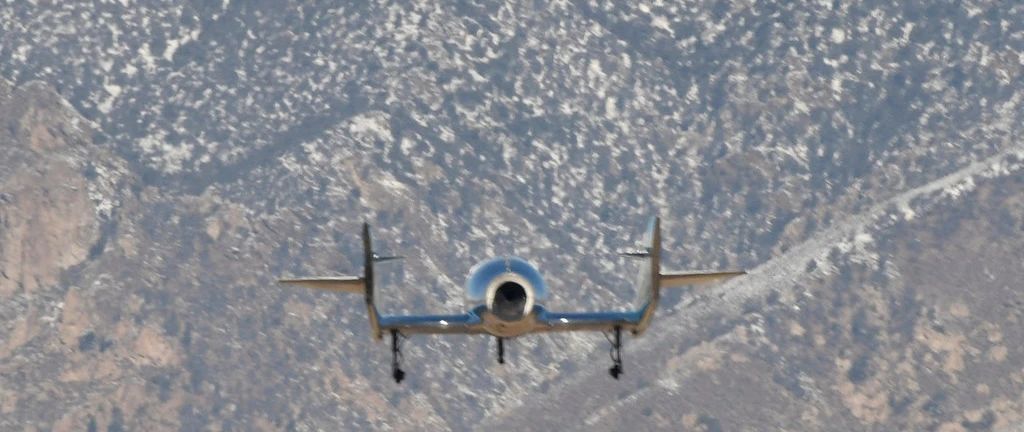
An unusual view of Virgin Galactic’s VSS Unity about to land at the Mojave Air and Space Port in California in February 2019. Credit: Gene Blevins / Reuters

Blue Origin, meanwhile, have been ramping up their New Shephard booster / capsule launches with a series of uncrewed science and test flight in readiness for also flying their own crews and passengers.

Mars Opposition

Mid-2020 will see Mars and Earth make a relatively “close” approach to one another – something that happens every 26 months -, marking it as the most advantageous time to launch missions to the red planet. So the year should see four individual missions launched, involving multiple countries.

NASA Mars 2020: NASA’s latest (and still-to-be-named) Mars rover vehicle is due to be launched on July 17th. Of the same class of large, nuclear-powered rover as Curiosity, Mars 2020 is due to land in Jezero Crater on February 18th, 2021. However, while similar to Curiosity, the Mars 2020 rover has a very different mission – to seek out direct evidence of past life on Mars, and has very different capabilities.

An artist’s impression of the Mars 2020 rover. note the revised instrument package on the rover’s arm. Credit: NASA

In particular, the rover has a completely new instrument system on its robot arm, and will be capable of depositing sealed sample containers on the surface of Mars, which will be collected and returned to Earth by a proposed future mission. In addition, it will carry the first vehicle designed to fly on Mars in the form of a small helicopter drone.

Continue reading “Space Sunday: things to watch for in 2020”

Space Sunday: a look at Betelgeuse

Astro photographer Alan Dyer captured this image of Orion on December 21st, 2019. Betelgeuse (top left) appears to be the same brightness as Bellatrix (top right). Normally, Betelgeuse is the 10th brightest star in our sky and Bellatrix the 27th. Credit: A Dyer

The constellation of Orion is one of the most familiar in the night skies. It is marked by a number of notable features, containing as it does three of the brighter stars in our night sky: Rigel: the 6th brightest star visible from Earth, and serving as Orion’s left foot; Betelgeuse, the 10th brightest, and serving as Orion’s right shoulder (so diagonally opposite Rigel); Bellatrix, the 26th brightest star in our sky, and sits at Orion’s left shoulder; and three  galaxies – the Orion Nebula, the Messier 43 nebula, the Running Man Nebula – all of which can be found in Orion’s “sword”.

Orion  – or more particularly – Betelgeuse – has been occupying a lot of the astronomy-related news cycles of late, with speculation that we might be witnessing the star’s potential move towards a cataclysmic supernova event.

Before I get down to the nitty-gritty of why Betelgeuse has astronomers all a-twitter (quite literally, given the amount of Twitter chat on the subject), some details about the star. Classified a M1-2 red supergiant, Betelgeuse has a very distinctive orange-red colouration that can again be seen with the naked eye. However, it’s exact size is hard to determine, because it is both a semiregular variable star, meaning the brightens and dims on a semi-regular basis as it physically pulses in size, and because it is surrounded by a light emitting circumstellar envelope composed of matter it has ejected.

This means calculations over the years have given many different estimates of the star’s size, suggesting it is roughly 2.7 to 8.9 AU in diameter (1 AU = the average distance between the Earth and the Sun). This means that were the centre of Betelgeuse to be placed at the exact centre of the Sun, then its “surface” would be at least out amidst the asteroid belt between Mars and Jupiter, or lie somewhere between Jupiter and Saturn!

A diagram showing the approximate size of Betelgeuse compared to our solar system. Credit: unknown

That Betelgeuse is pulsating and has a cloud of material around it, also makes it difficult to pin down its precise distance from us. However, the most recent estimates suggest it is most likely around 643 light years from Earth, with a possible variation of around +/- 146 light years.

Red giant stars are of a type that have a comparatively short life, averaging 10-20 million years, depending on how fast they spin (compared to our Sun’s anticipated 9-10 billion years lifespan), with Betelgeuse thought to have a fast spin and an estimated age of about 8.5 million years, putting it close to its end of life, which tends to be a violent affair with stars of this size.

This is because these stars burn through their reserves of fuel at a high speed, although a temperature lower than typically found with Sun-type stars. Eventually, they reach a point where the temperatures generated by the nuclear process is insufficient to overcome the huge gravity created by their size, and they suddenly and violently collapse, compressing to a point where the pressure is so great, they explode outwards even more violently, tearing away most of their mass in an expanding cloud of hot gas called a nebula, leaving behind a tiny, dense core – or even a black hole.

However, while this final collapse and explosion takes place suddenly, the period leading up to it can be marked by observable changes in a star – and this is the reason for the excitement around Betelgeuse.

Comparison chart showing Jupiter, Wolf 359 – a red dwarf star (often featured in this column) – and the Sun, compared in size to other well-known stars in our galaxy, including Betelgeuse and the biggest stars so far discovered. Credit: unknown

Over the last 20+ years Betelgeuse’s radius has shrunk by 15%. While this has not massively altered the star’s brightness over that time, it is still an astonishing amount of mass to lose over so short a period. More recently, however, there has been a further change in the star that has caused excitement: since mid-October 2019, Betelgeuse has gone through a stunning drop in its apparent magnitude – or brightness as seen from Earth’s location – dropping from being the 10th brightest object in our night sky to around the 27th, bringing with it a complete change in Orion’s appearance in our skies.

This sudden drop in brightness has been seen by some as a possible indicator that Betelgeuse may have gone supernova, and we’re now waiting for the light of the actual explosion to reach us. Such has been the interest, reference has been made to monitoring neutrino detectors for the first signs of an explosion. This is because whereas photons have to escape a star’s collapse, neutrinos don’t, and so will reach us ahead of any visible light; so a sudden increase in the number of them detected coming from the region of the sky occupied by Betelgeuse could be indicative of it having exploded.

The clearest image we have of Betelgeuse, captured by the European Southern Observatory’s Atacama Large Millimetre/sub-millimetre Array (ALMA). Credit: ESO / NAOJ/NRAO / E. O’Gorman / P. Kervella.

Continue reading “Space Sunday: a look at Betelgeuse”