Space Sunday: moving a mole and Planet Nine

InSight’s scoop gently presses against the top of the “mole” of the HP³ experiment, ready to gently push it down into the Martian regolith. Image Credit: NASA/JPL

NASA and its partner, the German Aerospace Centre (DLR) finally have some good news about the Heat Flow and Physical Properties Package, or HP³, carried to Mars by the InSight Lander: they’ve made some progress towards perhaps getting moving again.

As I’ve noted in past Space Sunday articles, the experiment has been a source of consternation for scientists and engineers since InSight arrived on Mars in November 2018. Following the landing, HP³ was one of two experiment packages deployed directly onto the surface of Mars by the lander’s robot arm. One of the key elements of the experiment is the “mole”, a self-propelled device designed to drive its way some 5m into the Martian crust, pulling a tether of sensors behind it to measure the heat coming from the interior of Mars.

After a good start, the probe came to a halt with around 50% of its length embedded in the soil. At first it was thought it had hit solid bedrock preventing further motion; then it was thought that the mole was gaining insufficient traction from the hole walls, on account of the fine grain nature of the material it was trying to move through. That was in February 2019.

The InSight lander was commanded to deploy the HP3 drill system on February 12th, 2019. Credit: NASA/JPL

Since then, scientists and engineers have been trying to figure out what happened, and how to get the mole moving again – because of the delicate nature of the sensor tether, the HP³ experiment couldn’t simply be picked up and moved to another location and the process started over. instead, various attempts were made to try to giving the mole material so it might gain traction.

Most of these revolved around using the scoop at the end of the lander’s robot arm to part-fill / part compress the hole created by the mole, the theory being that loose regolith would gather around the head of the mole and help it regain the necessary fiction to drive itself forward once more. Initially, some small success was had – until the mole abruptly “bounced” almost completely back out of the hole.

Further attempts were made to compress the ground around the hole, but all forward motion remained stalled, leading scientists to believe the mole had struck a layer of “duricrust” – a hard layer formed as a near the surface of soil as result of an accumulation of soluable materials deposited by mineral-bearing waters that later leech / evaporate away. These layers can vary between just a few millimetres to several metres in thickness, and are particularly common to sedimentary rock, which itself has been shown to be common on Mars.

The rub for the InSight mission is that if it is a layer of duricrust beneath the lander, it is impossible to tell just how thick it might be.

This images shows how difficult “pushing” the mole would be. The scoop (upper right) had a very small surface area at the end of the mole with which it could safely make contact, shown circled, without potentially damaging the tether harness. Credit; DLR

Earlier this year it was decided to use the scoop on the robot arm more directly, positioning it over the exposed end of the mole and applying pressure in the hope it could push the mole gently down into the ground in a series of moves that would allow the mole to get to a point were it could resume driving itself into the ground.

However, this approach has not been not without risk. The end of the mole has a “harness” – a connector for the tether, so the scoop has to be precisely positioned and any sort of pressure applied very gently and carefully to avoid any risk of slippage that might result in damage to the tether and / or harness and render its ability to gather data and information from the probe useless.

However, on June 3rd, NASA announced that a series of gentle pushes had resulted in the mole being completely below the surface, and with no apparent damage to the tether or harness. However, whether or not this means the mole is able to proceed under is own self-proplusion is unclear, as NASA noted in their tweet.

In all, the tip of the mole is now some 3m below the Martian surface. That’s deep enough for it to start registering heat flow, but to be effective, the mole still needs to drive itself down the full 5 metres. It is only at this depth that the mole and sensors can correctly start to measure the sub-surface geothermal gradient, and thermal conductivity, the two pieces of information required by scientists to obtain the heat flow from deeper in the planet. By studying the thermal processes in the interior of the planet, scientists can learn a lot about the history of Mars, and how it formed. They may also gain insights into how other rocky bodies formed.

Attempts have yet to be made to see if the mole can move under its own spring-driven propulsion, but for now NASA and DLR are rightly treating the current status of the probe as a victory. The tether harness at the end of the mole is undamaged, so if the mole can resume progress under its own power, there’s not reason why it shouldn’t start recording information.

Continue reading “Space Sunday: moving a mole and Planet Nine”

Space Sunday 30 years with HST; planets in lockstep

Hubble’s 30th anniversary image: a colour-enhanced view “Cosmic Reef” showing two nebulae – star forming regions – the blue NGC2020 (actually material ejected from a single, massive star 200,000 times brighter than our own), and the red NGC 2014. Both are part of the Large Magellanic Cloud, a satellite galaxy to ours, 163,000 light-years away. The clarity of the image reveals the star-forming region of HGC 2014 in stunning detail, and offers testament to the deep field imaging capabilities of the Hubble Space Telescope. Credit: NASA / ESA.

On April 24th, 1990, the Space Shuttle Discovery thundered into a spring Florida sky on one of the most important missions of the entire space shuttle programme: the launch of the Hubble Space Telescope (HST), one of the four great orbital observatories placed in orbit in the closing years of the 20th century.

At the time of its launch, the telescope probably didn’t surface to any great degree in the broader public consciousness, although in the 30 years it has been in operation it has become if not a household name, then certainly one most people will recognise, even when abbreviated down to just “Hubble”.

April 24th, 1990: space shuttle Discovery rises from Lunch Complex 39B at Kennedy Space Centre, carrying aloft the Hubble Space Telescope. In the foreground can be seen the external tank and a solid rocket booster attached to the shuttle Columbia, sitting on pad 39A, as it awaits its own launch date. Credit: NASA

As I noted when marking 25 years of HST operations, Hubble’s roots go well back in history  –  to 1946, in fact;  while the whole idea of putting a telescope above the distorting effects of the Earth’s atmosphere can be traced back as far as the early 1920s. A joint NASA / European Space Agency operation, HST faced many challenges along the road to commencing operations: it’s low Earth orbit – vital for it to be within reach of servicing astronauts – meant it had to face bot extremes of temperature as it orbited the Earth, passing in and out of sunlight, and it would also have to contend with a slow but inexorable atmospheric draft, so would have to be periodically boosted in its altitude.

However, these issues paled into insignificance after HST was launched, when the commissioning process revealed something was badly wrong with the telescope’s optics, resulting in badly blurred images being returned to Earth. The problem was traced back to an error in the production of the 2.4m primary mirror – one side of which has been ground an etra 2.2 nanometres (a nanometre being one billionth of a metre) compared to the other, leaving it “out of shape”. Small as the error was, it was enough to prevent Hubble focusing correctly, leading to the blurred images  –  and the entire programme being seen as a huge white elephant around the world, despite HST completing some excellent science between 1990 and 1993.

Before and after: on the left, an image of the spiral galaxy M100 taken on on November 27th, 1993, without the corrective optics and camera system. On the right, M100 imaged by Hubble on December 31st, 1993, after the installation of the corrective optics and camera system

Again, as I reported five years ago, the optical error lead to a “Hubble rescue mission” in 1993, when the crew of the space shuttle Endeavour arrived to give HST corrective optics called COSTAR and an updated imaging system, the Wide Field and Planetary Camera (WF/PC). Together these effectively gave HST a corrective set of glasses that overcame the flaw in the primary mirror. In doing so, they assured Hubble’s place in history, as they allowed the telescope to exceed all expectations in its imaging capabilities, turning into into perhaps the most successful astronomical / science instrument of modern times.

When launched, HST could see both in the visible light and in the ultraviolet (the region in which it saw outstanding results even before the operation to correct its “eyesight”). In 1997, during another servicing mission which saw the Discovery return to the telescope it had launched and deployed, HST was given a set of infra-red eyes as well. These allowed it to see farther into space (and thus further back in time) than we’d been able to do previously, and they allowed Hubble to peer into the the dusty regions of the galaxy where stars are born, opening their secrets.

A HST image released on April 6th 2020 showing the barred spiral galaxy NGC 2273, some 95 million light years from our own. It is unusual because it comprises two arms extending from a central bar made up of densely-packed stars, gas, and dust, and which conceal a second set of spiral arms within them, giving the galaxy two pairs of curved arms. Credit: NASA / ESA

Together, Hubble’s various eyes and its science instruments – and the men and women supporting HST operations here on Earth – have given us the ability to look back towards the very faintest – and earliest – light in the cosmos, study star clusters, look for planetary systems around other stars, increase our understanding of our own galaxy, look upon and study our galactic neighbours, help to verify Einstein’s theories of the universe, and do so much more.

Before Hubble, we knew essentially nothing about galaxies in the first half of the life of the universe. That’s the first 7 billion years of the universe’s 13.8-billion-year life. Now Hubble, through remarkable surveys like HXDF [Hubble Extreme Deep Field] capability, has probed into the era of the first galaxies. Through this type of work, Hubble has discovered galaxies like GN-z11, the most distant discovered by Hubble. Just 400 million years after the Big Bang, Hubble is looking back through 97% of all time to see it, far outstripping what can be done with the biggest telescopes on the ground.

– Garth Illingworth, HST project scientist

The Hubble Space Telescope with the aperture door open to allow light into the optics, as seen from the space shuttle Columbia during the 2002 servicing mission

Hubble is a truly unique platform in this regard. Despite issues over the years such as with its various flywheels (the gyroscopes designed to hold it in place whilst it is capturing images), it can remain rock-steady for extended periods with no more than 0.007 arcseconds of deviation. To put this into context, that’s the equivalent to someone standing at the top of The Shard in London and keeping the beam of a laser pointer focused on a penny taped to the side of the Eiffel Tower in Paris, for 24 hours without wavering.

HST’s science mission is so broad, it occupies the working days of literally thousands of people around the globe. Dedicated teams manage the programme for both NASA and ESA, with the Space Telescope Science Institute (STScI) located at the Johns Hopkins University Homewood Campus in Baltimore being the primary operations centre, supported by the European Space Astronomy Centre (ESAC), Spain, both of which will manage operations with the James Web Space Telescope when it is launched. Beyond these teams, scientists and astronomers around the globe can request time using HST and its instruments for their projects and observations, all of which makes the telescope one of the most used globally.

A visible light image of Jupiter captured by Hubble composited with an ultraviolet image of the planet’s northern aurora. Credit: NASA / ESA

Many of those currently working with Hubble share a unique link to it: they have either grown up with it as a part of their lives, learning about it at school and through astronomy and science lessons, or they been with Hubble since its launch, and have lived their entire careers with it.

Hubble has changed the landscape of astronomy and astrophysics,. It has far exceeded its early goals — no other science facility has ever made such a range of fundamental discoveries. It’s been a privilege to be associated with this effort that has become embedded in the culture of our time.

– Colin Norman, HST manger and senior manager, STScI (1990-2020)

Continue reading “Space Sunday 30 years with HST; planets in lockstep”

Space Sunday: an exoplanet, a star and an asteroid

An artist’s impression of Kepler-1649c (foreground) – an Earth-type world that might be Earth-like in some respects, and its parent star, Kepler-1649, with it’s companion planet, Kepler-1649-b visible beyond the star. Credit: NASA/Ames Research Centre/Daniel Rutter

The Kepler Space Telescope might be shut down, but the work of analysing the data it gathered on possible exoplanets continues, and an international team of scientists reviewing some of the earliest data from the mission have confiemd what had been thought of as a “false positive” is in fact an Earth-size exoplanet orbiting within its star’s habitable zone, the area around a star where a rocky planet could support liquid water.

The planet, Kepler-1649c orbits its small red dwarf star some 300 light years from Earth. It is so close to its parent, that its year is the equivalent to 19.5 Earth days. It is actually the second planet to have been found orbiting the star, hence the “c” designation in its name, and the system as a whole contains a series of points of interest for astronomers that make it particularly intriguing.

The first is that the data Kepler gathered on the planet suggest it is one of the closest in terms of size to Earth so far discovered, being just 1.06 times larger. The second is that its parent, Kepler-1649, is a class-M red dwarf with relatively low luminosity, so that despite it’s close proximity, that planet receives around 75% of the sunlight Earth receives from Sol. so it is entirely possible that if it has an atmosphere, conditions on it surface might be somewhat similar to our own in terms of average temperatures and with regards to surface water.

However, whether the planet does have an atmosphere has yet to be determined. As I’ve previously noted in this column, red dwarf stars are so small they rely on convection as the main form of energy transport to the surface, and this can give rise to violent solar outbursts which over time can rip away a nearby planet’s atmosphere. There’s also the question of how stable any atmosphere might be. Again, its close proximity to its parent means it is liable to be tidally locked, always keeping the same face towards its star. This is liable to make any atmosphere the planet does have could be exceptionally turbulent and prone to storms along the terminator dividing the light and dark halves.

An Artist’s impression of Kepler-1649c compared to Earth. Credit: NASA/Ames Research Centre/Daniel Rutter

However, Kepler-1649 has thus far shown itself to be one of the more stable M-class stars that has been observed over the years from Earth – which means it may well still possess a temperate atmosphere. If this is so, the combination of size and atmosphere then of all the red dwarf orbiting exoplanets thus far discovered, Kepler-1649c could be closer to Earth than most so far discovered.

An additional intrigue with the Kepler-1649 system is that the two planets share an unusual orbit resonance: for every nine times Kepler-1649c orbits its parent, the inner planet, Kepler-16949b, orbits almost exactly four times, giving a 9:4 ratio. This indicates the system is extremely stable, likely to survive for a long time.

9:4 is also something of a unique ratio; usually resonances take the form of ratios like 2:1 or 3:2. As such, it is thought that the Kepler’s system’s resonance might be indicative of a third planet between Keplert-1649b and Kelper-1649c, which would give the system a more regular pairing of 3:2 resonances between the middle and inner planets and the middle and outer planets. However, the existence of any third planet has yet to be confirmed.

An artist’s impression of the view of the surface of Kepler-1649c, should t have a water-rich atmosphere, with the crescent Kepler-1649b also in the sky. NASA/Ames Research Centre/Daniel Rutter

In the meantime, the discovery of Kepler-1649c adds significantly to our understanding on exoplanets around M-class stars.

The more data we get, the more signs we see pointing to the notion that potentially habitable and Earth-size exoplanets are common around these kinds of stars. With red dwarfs almost everywhere around our galaxy, and these small, potentially habitable and rocky planets around them, the chance one of them isn’t too different than our Earth looks a bit brighter.

– Andrew Vanderburg, co-author of a paper on Kepler-1649c exoplanet

Curiosity: A New Level of Remote Working

As the SARS-CoV-2 virus continues to prevent us from working normally, members of NASA’s Mars Science Laboratory Curiosity team have revealed how they’ve been continuing with normal operations since the Jet Propulsion Laboratory (JPL) shut down operations in February 2020.

Of course, in some respects the rover team has always been working remotely from their “office”, the rover never being at least 56 million km from Earth. However, the shut-down of NASA facilities ordered by Administrator Jim Bridenstine brought additional challenges to operating a rover so far away – and I’m not talking about distractions caused by the need to feed the cats or take the dog for a walk, being reliant on e-mail and video conferencing, etc.

Curiosity: a “selfie” taken in late 2016. Credit: NASA/JPL

Take driving the rover, for example. This requires a complex process of scanning the rover’s surroundings to build up a complete view of the rover’s environment, having the means to view this in 3D and to compare it to high-resolution images of the rover’s surroundings captured from orbit, then mapping a potential route that avoids any aspects of the landscape that present a risk to the rover whilst also encompassing points of interest, converting the commands into software code, testing it, and finally transmitting it to the rover for execution. Similarly, manoeuvring and using the rover’s robot arm requires precision and care, rehearsal and coding.

Much of this work requires high-powered computers. Analysing potential route from images, for example, requires not only high-resolution image processing, but also high-end gaming PCs and 3D headsets to give a greater depth of field and better visualisation of contours of the landscape and rocks. A similar approach is used to manoeuvring and manipulating the robot arm. The problem is, not all of the systems required to achieve all of this could easily be transitioned from JPL’s facilities to home use. Teams are, for example, restricted to using laptops, rather than gaming PCs; they’ve therefore had to swap from using specialised 3D headsets that rapidly shift between left- and right-eye views to better reveal the contours of the landscape, and instead rely ordinary anaglyph glasses to achieve the same ends.

Members of the Curiosity drive team recorded images of themselves of March 20th, 2020 the day they successfully completed transmitting their first remotely-generated set of commands to the rover. Credit: NASA/JPL

Space Sunday: crunches, telescopes and ambitions

Starship SN3 tank section sits as a crumpled mess after the pressurisation test failure. Credit: SpaceX

I’ve covered the development and plans SpaceX have for their mighty Starship vehicle – designed to be capable of lifting up to 100 tonnes of cargo, or 100 people to the Moon or Mars – and its equally massive reusable booster on numerous occasions. For the last 12+ months, the company has been engaged in fabricating a series of prototype / test versions of the Starship vehicle, some of which are (or were) intended for actual flight testing. But it has been far from plain sailing for the company.

The first vehicle in the series, called simply “Starship Mark 1”, and built at the company’s Boca Chica test facilities in southern Texas, underwent a series of tank pressurisation tests that were initially positive, at least up until a full pressure test – mimicking the pressure the vehicle’s tanks would be under when fully fuelled and awaiting launch – on November 20th, 2019. SpaceX CEO Elon Musk anticipated this test might end in failure – and it did, the fuel tank bulkheads suffering a catastrophic failure.

Sections of the Starship SN3 unveiled on March 26th, 2020. Note the black cylinders of the deployable landing legs on the section on the right. Credit: SpaceX

A second prototype, Starship SN1, had a series of refinements built into the tank bulkheads and was subjected to a similar test on February 28th, 2020. This time, the bulkheads survived, but a failure occurred with a “thrust puck” at the base of the tank that takes the load from the vehicle’s Raptor engines, again resulting in the loss of the vehicle. As a result, the third prototype, SN2 was modified and then stripped back just to its tanks so that a further test of the “thrust puck” weld on March 3rd – which it passed successfully.

The adjustments were then made to the next prototype: SN3, a vehicle intended to start flight tests. The sections of SN3 were revealed on March 26th, 2020, after which the main tank section was moved to a test stand where it would also undergo a series of pressurisation tests, culminating a full pressurisation using liquid nitrogen to simulate a fuel load at typical launch temperatures. This took place on April 2nd (CST) / April 3rd (UK / CET), and once again ended in failure and the loss of the tank section.

Video recorded by NASASpaceflight.com (not an official NASA site) shows the tank under pressure and venting gas (as expected) before the upper portion initially buckles before completely collapsing.

Immediately following the test, Musk indicated via Twitter the the loss of the section may have been a result of the test being incorrectly configured, rather than a failure with the vehicle itself – although analysis of the data is continuing.

A significant difference between the SN3 vehicle and the prototypes that came before it was the inclusion of deployable landing legs, included in the vehicle to allow it to undertake the system’s first, low-altitude “hops”. SpaceX had already applied to the Federal Aviation Administration (FAA) for permission to complete a static fire of the vehicle’s raptor engine – a required precursor for any test flights – and the FAA had in turn issued a notification to airmen to remain clear of the airspace around the Boca Chica test area between April 6th to 8th, a move consistent with an engine static fire test, which the failed pressurisation test was in turn something of a precursor.

Artist impressions of Starship. On the left, the crewed and cargo variants, on the right a typical large payload deployment. Credit: SpaceX Starship User Guide

It’s not clear how the incident with SN3 affects Starship testing; a further test vehicle, Starship SN4 is under construction specifically to complete higher-altitude flight tests before SN5 undertakes flights in excess of 20km altitude. Whether this SN4 will now be used for the low altitude hops and SN5 and SN6 for the higher flights, or the range of flights for SN4 is extended to cover both low and intermediate altitude tests remains to be seen. All the company has indicated is that the failures encountered so far shouldn’t deflect them too much in their aspirational goals of a lunar vicinity flight in 2022 and a Mars flight in 2024. In respect of these, in March 2020, SpaceX issued payload and crew guidelines for customer wishing to launch cargoes to orbit – a further option for the Starship / Super Heavy booster combination being cargo flights and payload deployments, replacing the company’s Falcon 9 and Falcon Heavy boosters.

James Web Unfurls its Telescope for the First Time

NASA’s next great observatory, the James Webb Space Telescope, has fully deployed its primary mirror under test conditions for the first time, marking another milestone on its journey to space.

The giant mirror, 6.5 metres across, is so large, it must be folded and stowed during launch, requiring it to be carefully deployed while on-route to its final L2 halo orbit beyond the Moon – which will take it around 14 days to initially reach, and another 14 to settle into.

Prior to the SARS-CoV-2 situation caused NASA to suspend work on the telescope, it was hooked-up to a gravity / mass compensating rig – needed to support the weight of the two deployable “sides” of the mirror as well as the mass of the central section – allowing the mirror’s deployment motors to be spun up and the entire mirror assembly put through its actual deployment routine.

JWST deployment. Credit: NASA

The test was one of the final large-scale crucial test of JWST’s key systems. Integration testing of the telescope’s systems and those of it’s “bus” that includes the sun shield were completed in early 2019, while a test deployment of the complex and delicate sun shield “sandwich” – vital to keeping the telescope cool and allowing it to “see” in the glare of the sun – was successfully in October 2019.

Even so, the project has several more hurdles to clear before its actual launch date can be confirmed without risk of further significant delays, and such confirmation will not be given until after the coronavirus situation is no longer impacting the project, and a further review of its overall status completed.

Space Sunday: A pale blue dot, and more on Betelgeuse

A pale blue dot: Earth – the bright dot just right-of-centre – as seen from a distance of 6 billion km (40.5 AU). Credit: NASA / Kevin Gill et al

Thirty years ago, in February 1990, the Voyager 1 space craft had completed its primary mission and was about to shut down its imaging system. However, before it did so, and in response to lobbying from the late Carl Sagan, celebrated astronomer, teacher, broadcaster, writer, futurist and member of the Voyager programme’s imaging team, mission managers order the spacecraft to turn its imaging system back towards Earth to take a final photograph of its former home.

Captured on February 14th, 1990, the image revealed Earth as little more than a tiny blue pixel caught in a  streak of sunlight falling across the camera’s lens. Sagan immediately dubbed the image Pale Blue Dot, and it became his – and Voyager 1’s – Valentine’s Day gift to all of humanity; a last goodbye from the probe taken at a distance of 6 billion km (40.5 AU); 34 minutes later, its camera system was permanently powered down to conserve the vehicle’s power generation system.

From the moment it was published, the image became iconic: a representation of the sum total of humanity, something Sagan recognised at a time when the Cold War still dominated world politics.

Look again at that dot. That’s here. That’s home. That’s us. On it everyone you love, everyone you know, everyone you ever heard of, every human being who ever was, lived out their lives. The aggregate of our joy and suffering, thousands of confident religions, ideologies, and economic doctrines, every hunter and forager, every hero and coward, every creator and destroyer of civilisation, every king and peasant, every young couple in love, every mother and father, hopeful child, inventor and explorer, every teacher of morals, every corrupt politician, every ‘superstar,’ every ‘supreme leader,’ every saint and sinner in the history of our species lived there–on a mote of dust suspended in a sunbeam.

…It has been said that astronomy is a humbling and character-building experience. There is perhaps no better demonstration of the folly of human conceits than this distant image of our tiny world. To me, it underscores our responsibility to deal more kindly with one another, and to preserve and cherish the pale blue dot, the only home we’ve ever known.

– Carl Sagan, Pale Blue Dot, 1994

To mark the 30th anniversary of the original image, NASA issued a newly enhanced version of the image, carefully processed by a team led by software engineer and imagining specialist, Kevin M. Gill, seen at the top of this article. It once again reveals just how small and lonely our world really is. And while the Cold War has long since past, in this age of global warming and climate change, this new image of that tiny, pale blue dot and Sagan’s words remain as powerful a reminder of our fragile place in the Cosmos as they did more than two decades ago.

Betelgeuse: Extent of Dimming Revealed

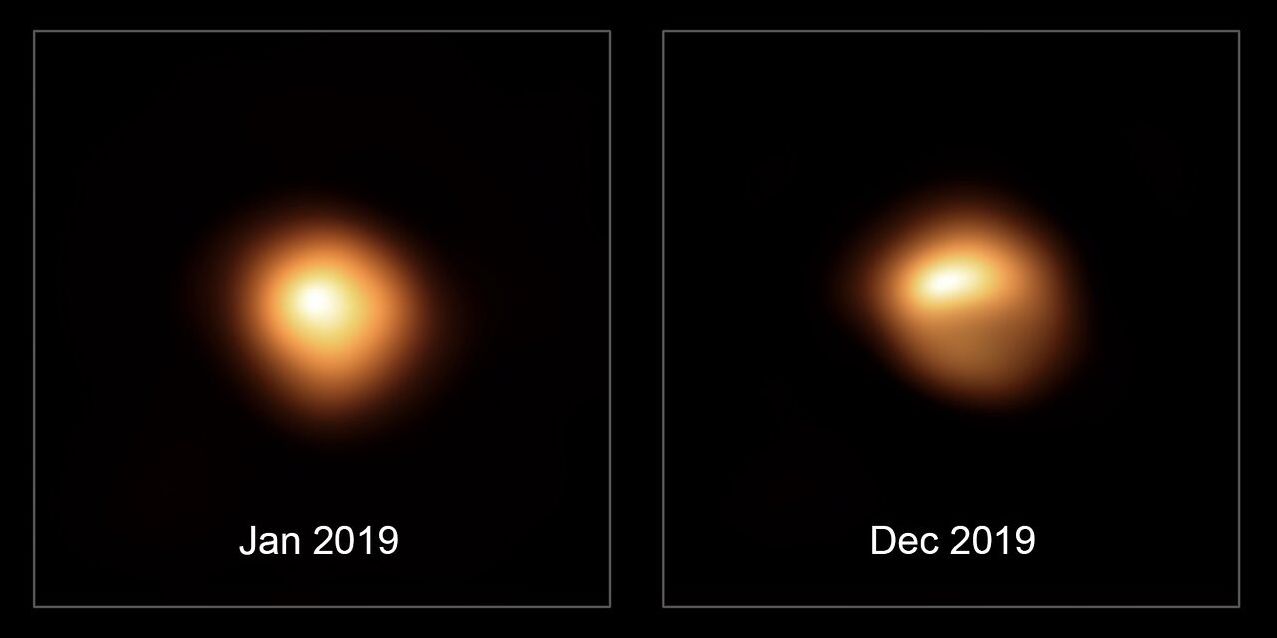
I’ve previously written about the dimming of Betelgeuseas seen from Earth on a couple of occasions over the past few months (see: Space Sunday: a look at Betelgeuse (December 2019) and A farewell to Spitzer, capsules, stars and space planes (January 2020)). Now two images and a video have been released to show just how startling the apparent changes in the star have been over the course of a year.

As an irregular – and massive – variable star, Betelgeuse goes through cycles of dimming and brightening over time. However, what has occurred over the course of the past year is without precedent in the 125-year history of observations marking the star’s behaviour.

Overall, Betelgeuse’s apparently magnitude (brightness as seen from Earth) has fallen by a factor of 2.5 (or roughly 25-30%). This has prompted speculation that the star may have exploded into a supernova – its eventual fate – and we are currently seeing the light, which takes approximately 643 years to reach us, from the run-up to that cataclysmic event. While most astronomers do not believe this to be the case, the two images do present a stunning spectacle of a star in flux.

Side-by-side comparison of Betelgeuse’s dimming, as seen by the SPHERE instrument on ESO’s Very Large Telescope. Credit: ESO/M. Montargès et al.

The images were captured by the Spectro-Polarimetric High-contrast Exoplanet REsearch (SPHERE) instrument attached to the Very Large Telescope (VLT, currently the most advanced visible light telescope in the world) operated by the European Southern Observatory Captured in January and December 2019, they not only show just how much  Betelgeuse has dimmed in that time, but also how it seems to have changed its shape.

Again, such changes of shape aren’t unusual for a pulsating variable star like Betelgeuse. The surface of such a star tends to be made up of giant convective cells that move, shrink and swell. However, while these pulses – referred to as stellar activity – have likely been responsible for past changes in Betelgeuse’s shape observed from Earth, they have never been anywhere as extreme as those indicated by SPHERE – although it has been acknowledged that they could also be exaggerated by a cloud of dust ejected by the star long enough ago to have cooled, and is now partially obscuring our view of Betelgeuse.

Continue reading “Space Sunday: A pale blue dot, and more on Betelgeuse”

Space Sunday: solar studies and rocket tests

An artist’s impression of ESA Solar Orbiter over the Sun. Credit: ESA

At 04:03 UTC  on Monday, February 10th (23:03 EDT, USA), the European Space Agency’s Solar Orbiter is due to be launched atop a United Launch Alliance Atlas V from Cape Canaveral Air Force Station, Florida. Referred to as SolO, the mission is intended to perform detailed measurements of the inner heliosphere and nascent solar wind, and perform close observations of the polar regions of the Sun, which is difficult to do from Earth, in order to gain a much deeper understanding of the processes at work within and around the Sun that create the heliosphere and which give rise to space weather.

The launch will mark the start of a three 3-year journey that will use a fly-by of Earth and three of Venus to use their gravities to help shift the satellite into a polar orbit around the Sun. Once there, and at an average distance of some 41.6 million km, SolO will move at the same speed at which the Sun’s atmosphere rotates, allowing it to study specific regions of the solar atmosphere beyond the reach of NASA’s Parker Solar Probe and Earth observatories for long periods of time.

ESA’s Solar Orbiter, built by Airbus UK within its clean room assembly area. The large flat panel to the left is the craft’s Sun shield. Credit: ESA

Our understanding of space weather, its origin on the Sun, and its progression and threat to Earth, comes with critical gaps; the hope is by studying the the polar regions of the Sun’s heliosphere, scientists hope they can fill in some of these gaps. The outflow of this plasma interacts with the Earth’s magnetic field and can have a range of potential effects, including overloading transformers and causing power cuts, disrupting communications and can potentially damage satellites. Further, the disruption of the Earth’s magnetic fields can affect the ability of whales and some species of bird to navigate.

We don’t fully understand how space weather originates on the sun. In fact, events on the sun are very hard to predict right now, though they are observable after the fact. We can’t predict them with the accuracy that we really need. We hope that the connections that we’ll be making with Solar Orbiter will lay more of the groundwork needed to build a system that is able to predict space weather accurately.

– Jim Raines, an associate research scientist in climate and
space sciences engineering

Specific questions scientists hope SolO will help answer include:

  • How and where do the solar wind plasma and magnetic field originate in the corona?
  • How do solar transients drive heliospheric variability?
  • How do solar eruptions produce energetic particle radiation that fills the heliosphere?
  • How does the solar dynamo work and drive connections between the Sun and the heliosphere?

To do this, the satellite is equipped with a suite of 10 instruments, some of which will be used to track active solar regions that might explode into a coronal mass ejections (CMEs), a major driver of space weather. When a CME occurs, SolO will be able to track it and use other instruments to be able to break down the composition of the energetic outflow (and that of the outflowing solar wind in general).

Knowing the composition of this outflow should help determine where energy is being deposited and fed into the solar wind from eruptions on the Sun, and how particles are accelerated in the heliosphere – the bubble of space where the Sun is the dominant influence, protecting us from galactic cosmic radiation.

The Solar Orbiter mission. Credit: ESA

Combined with the work of the Parker Solar Probe, launched in August 2018 (see: Space Sunday: to touch the face of the Sun) and which gathers data from within the Sun’s corona, and observations from Earth-based observatories such as the Daniel K. Inouye Solar Telescope (DKIST), Solar Orbiter’s data should dramatically increase our understanding of the processes at work within and around the Sun.

Like the Parker Solar Probe, SolO will operate so close to the Sun it requires special protection – in this case a solar shield that will face temperatures averaging 5,000º C on one side, while keeping the vehicle and its equipment a cool 50º C less than a metre away on the other side. This shield is a complex “sandwich” starting with a Sun-facing series of titanium foil layers designed to reflect as much heat away from the craft as possible. Closest to the vehicle is a aluminium “radiator” that is designed to regulate the heat generated by the craft and its instruments. Between the two is a 25-cm gap containing a series of titanium “stars” connecting them into a single whole. This gap creates a heat convection flow, with the heat absorbed by the titanium layers venting through it, drawing the heat from the radiator with it, allowing Solar Orbiter to both expect excess solar heating and present itself from overheating.

SolO’s primary mission is due to last 7 years, and those wishing to see the launch can watch it livestreamed across a number of platforms, including You Tube.

Continue reading “Space Sunday: solar studies and rocket tests”