Commemorating a tsunami through art in Second Life

(now) Ten Years After, March 2021 – Tsukioka Yoshitoshi: One Hundred Aspects of the Moon

Ten years ago, on March 11th 2011, the fourth most powerful earthquake in the world since modern record-keeping began in 1900, took place off the coast of Japan. The epicentre of the magnitude 9.0–9.1 megathrust ‘quake lay some 72 kilometres east of the Oshika Peninsula of Honshu, at a depth of around 32 km below the surface of the ocean. It caused an upthrust of between 6 to 8 metres that gave rise to a massively powerful tsunami.

The wave front of this tsunami struck the northern islands of Japan at speeds of up to 700 km/h and a maximum wave height of 39 metres (Omoe peninsula, Miyako City). It travelled inland up to 10 km, creating widespread devastation and caused the Fukushima Daiichi nuclear accidents. As of 2019, the death toll as a direct result of the tsunami was put at 15,899, most killed as a result of drowning. A further 6,157 were injured and 2,529 remain missing.

(now) Ten Years After, March 2021 – Tsukioka Yoshitoshi: One Hundred Aspects of the Moon

In the aftermath, national and international relief efforts were launched, and people around the world sought to help those affected by the disaster through a wide variety of fund-raising efforts. In Second Life, Curator, who was still relatively new to the platform at the time, put together a special art exhibition with funds going to a number of charities dedicated to recovery efforts.

Entitled One Year After, the exhibition featured the paintings of Tsukioka Yoshitoshi and Katsushika Hokusai, two of Japan’s foremost exponents of the ukiyo-e genre of woodblock printing and painting. Yoshitoshi’s career spanned the end of the Edo period of Japan and the rise of modern Japan following the Meiji Restoration, and he was the last great master of ukiyo-e. In particular, the exhibition featured his major series One Hundred Aspects of the Moon. Hokusai preceded Yoshitoshi (their lives overlapping by just ten years), and he was largely responsible for transforming ukiyo-e as an art form, with his greatest work being 36 Views of Mt. Fuji.

(now) Ten Years After, March 2021 – Tsukioka Yoshitoshi: One Hundred Aspects of the Moon

To mark the 10th anniversary of the Tōhoku earthquake and its tsunami, Curator once again offers one Year After for people to appreciate. Hosted at the gallery space above Bagheera Kristan’s Bohemian Underground store, it also has the alternate title of (now) Ten Years After to mark the tenth anniversary of the tsunami. And if you’ve never encountered either Yoshitoshi’s or Hokusai’s work before, I highly recommend paying a visit.

Ukiyo-e first rose to prominent in the late 1670s and continued to flourish through until the Meiji Restoration saw it enter a sharp decline in the rush towards modernisation. As an art form, it initially focused on portraiture featuring courtesans, geishas and kabuki actors. However, Hokusai, however, broadens the genre to include landscapes, plants, and animals, a broader expressionism Yoshitoshi would embrace.

(now) Ten Years After, March 2021 – Tsukioka Yoshitoshi: One Hundred Aspects of the Moon

There is particular relevance in using Yoshitoshi’s One Hundred Aspects of the Moon to commemorate the tsunami.  While he was fascinated by all that was happening as a result of Japan opening its doors to the rest of the world, Yoshitoshi became concerned with the loss of many aspects of traditional Japanese culture, so much so that towards the end of his life he turned more towards Ukiyo-e, using it as a means to comment on the passing of Japan’s traditional ways in its headlong rush to modernise.

Thus, One Hundred Aspects of the Moon as presented here provides a poignant means of commemorating both the washing away of translational Japanese ways in the tide of change witnessed by Yoshitoshi, and the loss of life caused by the tsunami.

(now) Ten Years After, March 2021 – Katsushika Hokusai: 36 Views of Mt. Fuji

Each image in One Hundred Aspects depicts figures from Japanese and Chinese legend, history, literature, folklore and theatre captured at a moment in time, often in a poetic dialogue with the Moon. The presence of the Moon additionally references the role it played in the pre-industrialised Japanese calendar, when specific events on both a national and personal level being marked by the lunar phases. In this, the choice of this collection for the exhibition adds a further layer of meaning, marking as it does an event and point in time that affected some many lives and a nation as a whole.

Similarly, Hokusai’s 36 Views of Mt. Fuji has a certain poignancy in the context of commemorating the tsunami. It’s a series in which several of the images embody Japan’s long relationship with the seas around it – the most famous being The Great Wave off Kanagawa, depicting a large rogue wave about to overwhelm three boats. They also, as the title of the collection suggests, feature images feature Mount Fiji – the enduring symbol of the nation, the people and the spirit of Japan throughout the ages.

(now) Ten Years After, March 2021 – Katsushika Hokusai: 36 Views of Mt. Fuji

Although some of the pieces are slightly blurred as a result of the reproduction process, these are genuinely engaging copies of an evocative series. Each piece has a a richness of narrative to it and a deep sense of history, and those that you find attractive enough can be purchased for L$100 each.

SLurl Details

The art of Isabel Hermano in Second Life

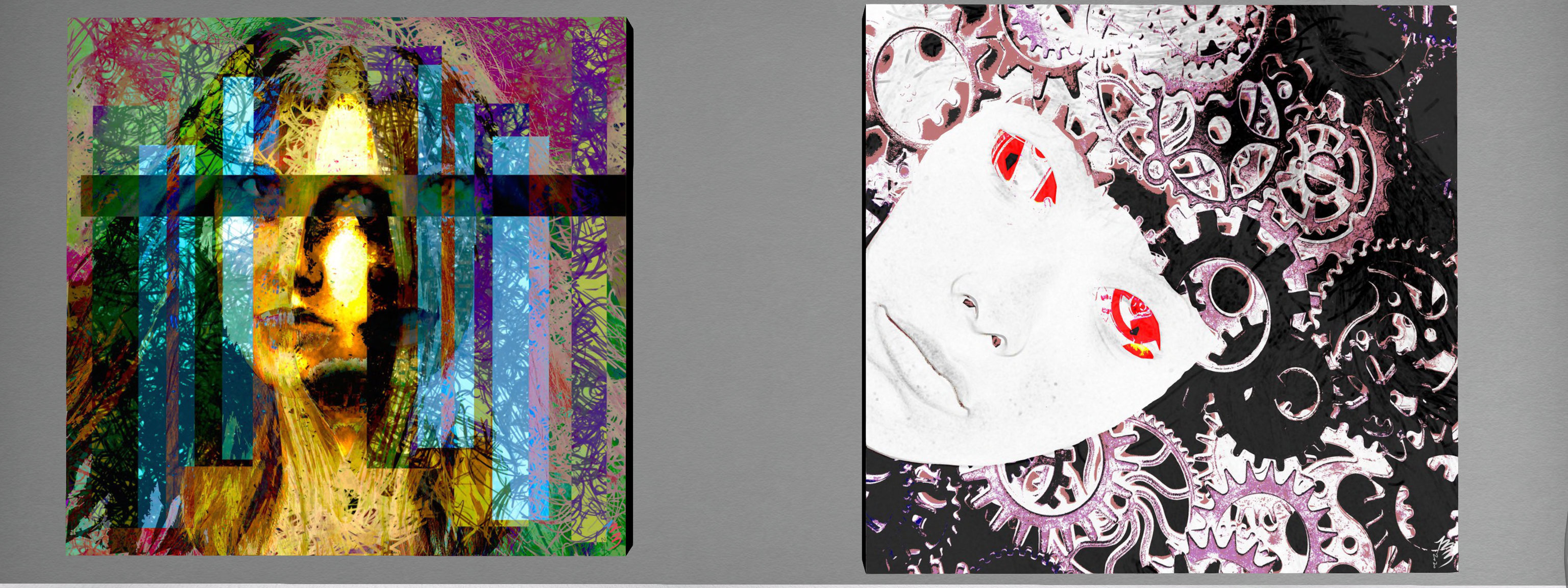
Janus II Gallery: Isabel Hermano – Living in a Steampunk World

I did not intend to write about another exhibition at Chuck Clip’s Sinful Retreat so quickly after my last arts write-up (see: Sheba’s mystical art in Second Life). however, after witnessing Isabel Hermano’s exhibition at the Janus II Gallery in the region, I could not help but put fingers to keyboard.

Given the breadth of her work that is on display, I’m rather surprised to admit that’s I’ve not previously documented Isabel’s art, as her digital images are truly  captivating to the eye.

Janus II Gallery: Isabel Hermano – Living in a Steampunk World

Although entitled Living in a Steampunk World, the pieces offered through this exhibition feature much more than the style of retro-futuristic images we might normally associate with the idea of “steampunk”; while such elements  – the ideas of Victoriana, corsets, goggles, exotic mechanicals – present in several of the images, so to does the exhibition cast a wider net, capturing retro-modern elements, touches of Fritz Lang and Buck Rogers, hints of childhood, even a glimpse of contemporary science fiction.

This wider casting of the net doesn’t invalidate the title of the exhibition – rather, it enhances it, and offers a new twist.

Take Tinman, with its the image of C3-PO for example: whilst his appearance might bring to mind thoughts of a technologically advanced, spacefaring civilisation far beyond that of our own, his appearance as a “tin man” is not actually that far removed from the ideas of steampunk mechanoids.

Isabel notes that she likes to use bold colours  on account of the depth of passion they suggest, and that use of colour is clearly shown here – and I would argue that its presence in these pieces adds a further dimension to their narrative. And make no mistake, these are pieces rich in their ability frame moments and ideas that capture the eye and transport the imagination in the most marvellous of ways, whether or not the idea of steampunk are central to the journey.

For me, this sense of narrative is particularly strong with Radio City Music Hall, and The Sisters. These are also two pieces that may not immediately appear to be particularly “steampunk” in nature. The first brings to mind the era of Marlowe and hard-boiled detectives, whilst the latter richly mixes ideas. With the three female characters, there is a clear reference to Fritz Lang and Metropolis, whilst the airship above them both suggests steampunk airship – but set against a cosmic backdrop of a nebula cloud, it also carries that Buck Rogers vibe mentioned above.

Janus II Gallery: Isabel Hermano – Living in a Steampunk World

Theses are also pieces that are rich in motif and symbol – the use of animals in several of the more “steampunky” pictures, the juxtaposition of modern technology with suggestions of the Victorian era, mechanical octopuses, and so on that can lead the imagination onwards in it journey – and the eye to the richness of detail within each of these pieces.

Open through until early April, Living in a Steampunk World is a captivating exhibition of digital art.

SLurl Details

Sheba’s mystical art in Second Life

Janus III Gallery: Sheba Blitz – Into the Mystic

When Sheba Blitz first arrived in Second Life, it was without any preconceived ideas about displaying her work.  However, after encountering the vibrant arts communities that exist across the platform she decided to give exhibiting her work a try – and I, for one am glad that she did.

Hailing from Australia, Sheba has studied art in a variety of styles over the years, gaining several diplomas in the process. However, throughout her time as an artist, she has found focus in painting mandalas – which she does so quite exquisitely.

Janus III Gallery: Sheba Blitz – Into the Mystic

For those unfamiliar with it, the mandala (literally meaning “circle” in Sanskrit) is a symbol with very deep religious, spiritual and even political meaning. It may be employed in spiritual guidance, focusing the attention of practitioners and adepts, as a means of establishing a sacred space and as an aid to meditation and trance induction. Mandalas are particularly used in Hinduism, Buddhism, Jainism and Shintoism. They also have new age symbolism, and were regarded by Jung as a means to explore “the fourfold nature of the psyche”.

I first encountered Sheba’s work five years ago and was immediately captivated. Specialising in painting quarternity mandalas, she works with gouache, acrylics and metallic paints on either canvas or paper, drawing on sources such as music, books, astrology and tarot symbolism as her inspiration. The finished pieces are all intricately beautiful, endlessly geometric, generally perfectly symmetric, and rich in symbolism.

Janus III Gallery: Sheba Blitz – Into the Mystic

All of this creative, spiritual beauty can currently be seen at the Janus III Gallery on Chuck Clip’s Sinful Retreat, where Sheba is exhibiting a selection of her work entitled Into the Mystic.

Across the two floors of the gallery one can find the most meticulous pieces of art that are utterly captivating.

Whenever I witness Sheba’s art and and consider the work that went into each piece, I cannot help but be put in mind of dul-tson-kyil-khor (mandala of coloured powders) in Tibetan Vajrayana Buddhism. Like those painstakingly constructed sand paintings, there is an inherent balance within Sheba’s paintings in terms of symmetry and harmony that lifts the spirit whilst also speak to the depth of focus on the part of the artist.

Like the work of Tibetan monks, Sheba’s art is rich in iconography that combines geometric shapes and spiritual symbols.

However, unlike the Tibetan sand painting, which is intentionally impermanent, each piece ritualistically destroyed and used as an offering to water and life once the meditation of its creation is complete, Sheba’s art endures well beyond its creation. In this, while sand painting might speak to the impermanence of life and the cycle of creation, Sheba’s art reflects the enduring nature and balance of the cosmos around us.

Janus III Gallery: Sheba Blitz – Into the Mystic

This is art for which images on a page simply do not do justice. Each piece is so rich in form and intricate in detail, Sheba’s work deserves to be seen and appreciated first hand whether you are drawn to the spiritual symbolism of the mandala or simply drawn to art for its beauty and geometry So do take time to drop into the Janus III Gallery before this exhibition ends later in the month.

SLurl Details

Bamboo’s Blue Snow in Second Life

Kondor Art Centre: Bamboo Barnes – Blue Snow

Blue Snow is the title Bamboo Barnes has given to her most recent exhibition, which opened at the Kondor Centre Art Gallery (curated by Hermes Kondor) on February 27th. I’m not sure of the origins for the title, but that hardly matters given the theme of the exhibition and the nature of Bamboo’s art.

Bamboo is a self-taught digital artist who started producing her work using Second Life in the form of avatar studies and images of other people’s art installations. In 2013 she started producing original pieces, and in the eight years since, she has developed a unique and striking style that has not only been exhibited in virtual spaces but also in the physical world.

Kondor Art Centre: Bamboo Barnes – Blue Snow

For this exhibition, Bamboo plumbs personal depths, exploring her growing understanding of art as a means of expression and her development as an artist.

In her introduction to the exhibit she notes that “Art is never finished, just abandoned”, a statement that might at first seem a little confusing, as clearly, many pieces of art do stand as finished items – hence why we can see them in galleries and museums, reproduced, sold, hanging on our walls at home, and so on.

Kondor Art Centre: Bamboo Barnes – Blue Snow

However the capitalisation of “Art” is important: signifying that rather than referencing any singular piece of art, Bamboo is referring to the medium in all its forms, be it painting, photography, sculpture, models, the written and / or spoken word and so on; recognising that it is always evolving, and that artists can change genre, format and style, taking on some and abandoning others as they find new or different ways to express themselves.

As is usual with Bamboo, all of the pieces offered within Blue Snow are endlessly vibrant, both in terms of the colours used and the degree of life they each exude. There is a strength about each one that captivates the eye and challenges the imagination, offering stories that might – when considering the central theme of the exhibition – enfold thoughts of the artist and her relationship with her work as well as revolving around our own perceptions of who we are and where we might be going.

Kondor Art Centre: Bamboo Barnes – Blue Snow

Richly engaging, Blue Snow is another superb exhibition from one of SL’s leading digital artists.

SLurl Details

Vanessa’s Vignettes of Calas Galadhon in Second Life

Camel Art Gallery: VanessaJane – Vignettes of Calas Galadhon

Currently open at the Carmel Art Gallery, curated by Martha McFarren (Martha Damballar), is a cosy exhibition by Vanessa Jane (Vanessajane66), entitled Vignettes of Calas Galadhon – A Journey to the Spirit of Place.

As one might gather from the title, the subject of the exhibition is the Calas Galadhon estate, thirteen regions of fabulous open landscape that form a public park operated for all Second Life residents by Tymus Tenk and Truck Meredith and their dedicated team.

Camel Art Gallery: VanessaJane – Vignettes of Calas Galadhon

Now in operation for more than a decade (December 2021 actually marks the estate’s 12th anniversary), Calas Galadhon is one of the genuine gems in Second Life’s crown, and a place one can never tire of seeing. While its form may have changed over the years as it has grown (and occasionally shrunk), it has remained a place of endearing beauty; its regions both demonstrate the power of creativity in Second Life and the true magic of the platform’s ability to offer living, breathing spaces we can escape to and enjoy.

Rich in open landscapes and waters that can be explored on foot or horseback or boat, or flown over in a hot air balloon, the park contains many places large and small to discover, and is home to regular and seasonal events. While through its contiguous vistas, it offers a breathtaking sense of space and natural depth that is genuinely stunning to the eye. In this, it stands equal to any national park we might choose to visit – but with the added benefit that the freedom and magic are just keystrokes, not hours, away, and can be instantly enjoyed whenever we choose.

Camel Art Gallery: VanessaJane – Vignettes of Calas Galadhon

It is this sense of place that Vanessa has sought to capture in the pieces offered through her exhibition. Within the fourteen images presented in the gallery space, she reveals both the estate’s essential natural beauty and the hints of otherworldliness that is very much a part of its magic (and which is reflected in their names, drawn as they are from Tolkien’s mythology).

Offered with an artful touch of post-processing Vanessa presents these pieces as if seen through the eyes of a painter. Each one individually and uniquely captures an aspect of the park’s landscape, offering a hint of story for the observer to unfold. They are also collectively part of a whole, their individual stories coming together to offer an anthology of images that reveal the living spirit contained with the Calas regions.

Camel Art Gallery: VanessaJane – Vignettes of Calas Galadhon

Set within a space that Vanessa has also dressed in a manner that reflects the park’s glades and grasslands, Vignettes of Calas Galadhon – A Journey to the Spirit of Place richly illustrates the enduring beauty of Calas Galadhon and the manner in which it can capture the hearts and eyes of those who visit. As such, it is the perfect way by which those familiar with the park might recapture specific memories of their times within it, while for those who have yet to wander the park’s regions, the exhibition presents the ideal means to whet appetites and prepare the eye for all that might be revealed when exploring the regions themselves.

SLurl Details

Cica’s Stars in Second Life

Cica Ghost; Stars

Thursday March 4th saw the opening of Stars by Cica Ghost. Occupying a Homestead region, Stars is once again an interactive setting that makes for fun exploration.

Caught under a blanket of starfish-like stars (make sure you have your viewer set to use the Shared Environment), the setting has something of a Steampunk feel to it in general appearance, incorporating many echoes of Cica’s past installations waiting for those who are familiar with her work.

Cica Ghost, Stars

The town is laid out in something of a grid, with the landing point pretty much at its centre. laid out around it are squares and road and assorted buildings, some of which stand as a frame for the setting, other of which can be entered into and explored, or offer places to sit and chat.

Some of these houses resemble the tall slender houses found in the likes of Burlap and Sunny Day, or echo the look of those seen within Bridge and Donkeys or seen painted in Rocks and Drawn Town. Among these are fish and seas creatures, some hanging from pipes or forming strange wheeled sculptures and vehicles or sitting at rooftop decoration;  whilst very different in tone, these nevertheless tickle fond memories of Under the Sea, while echoes of places like Little Town and more also await discovery.

Cica Ghost, Stars

Which is not to say Stars is not a unique environment – it very much is; but these little touches, which include Cica’s stick man on his bicycle still fighting the wind and the rabbits from from Burlap forming a part of the town’s puppet theatre and the keys on the wall of the house interior, add depth to the setting that can be very personal to those who have followed Cica’s work.

This is a place that introduces new characters as well, notably in the form of the wheeled, tin hatted robots rolling back and forth on their single wheel, or offering music to dance to under the stars. And throughout the entire setting are places for visitors to dance or sit or ride (from swings to vehicles) and simply have fun together. And when exploring, do be sure to check the terrain covering – it offers some  art of its own.

Cica Ghost, Stars

Rounded with a quote by Charles A. Beard (or Ralph Waldo Emerson, depending on your choice of attribution, together with Martin Luther King Jr., and others in a slightly altered form), Stars is another richly engaging place to explore – do be sure to have the local stream enabled when exploring! And should you find them as engaging as I did, Cica’s robots at their friends can be purchased from the store in one corner of the region.

SLurl Details

  • Stars (Meropis, rated Moderate)