Annabel Lee in Second Life

DaphneArts: Annabel Lee

Angelika Corral and SheldonBR, curators of DaphneArts, have something of an affinity with the work of Edgar Allen Poe. In 2017 they hosted an exhibition of art marking 208th anniversary of his birth, and they have also produced works of their own focused on Poe, notably Dream Within A Dream, based on Poe’s poem A Dream Within A Dream, and a static installation modelled on Fall of the House of Usher.

Dream Within A Dream formed the leaping-off point for a series of immersive installations they have produced (and which has most recently encompassed the works of John Donne – see No man is an island). Now, and with an official public opening on September 2nd, 2019, they have returned once more to Poe, with a new immersive installation Annabel Lee, based on Poe’s poem of the same name.

Annabel Lee was the last poem Poe composed; it explores the themes of death, love and the hereafter – all common these for Poe – wrapped within a “ballad” about the death of a beautiful woman. Within it, the narrator recounts his love for the woman – Annabel Lee – which began many years ago in a “kingdom by the sea”. He believes their love was so intense, the angels themselves became envious to the extent they caused her death. Nevertheless, he believes that the love they shared was so deep, neither angels nor the grave can constrain it, and that their souls remain entwined. And so it is, each night he dreams of her, as he lies beside her tomb.

DaphneArts: Annabel Lee

Like so many of Poe’s poems, Annabel Lee is complex as much as it is dark. There is something of an autobiographical element to it, another facet oft present in Poe’s work. He himself fell in love with his cousin, Virginia Clemm, and in the words of the poem – “she was a child” – being just thirteen when Poe married her, and she died just two years prior to the poem being written. Thus there is an element that in writing about the loss of “Annabel Lee”, Poe is perhaps drawing on personal experience.

In keeping with these immersive environments designed by Sheldon and Angelika, a visit commences in a sky box, where visitors are given an interactive HUD as a temporary attachment, and which should be accepted (it will be automatically be attached, and should detach on leaving – if not, just click the Stop button, when displayed). The skybox also includes instructions on setting your viewer’s environment (if you are using Firestorm, then the local windlight should apply via that viewer’s parcel windlight support). Once the viewer is set in accordance with the recommendations, visitors are free to take the teleport board to the ground level and the installation itself.
DaphneArts: Annabel Lee

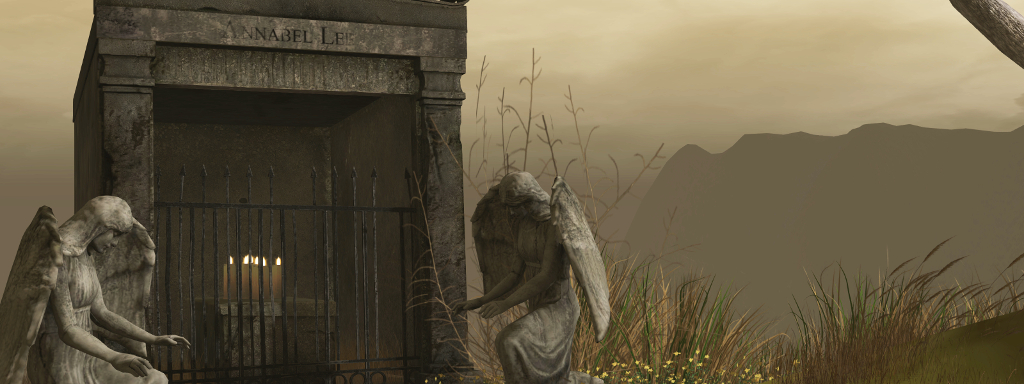
The ground level presents the poem through what Sheldon and Angelika call “Magical Realism” – the use of sounds, visuals and the spoken word (in this case, Angelika reading the poem) – to evoke a sense that the visitor is immersed within its unfolding story. It’s a technique that might also be described as “immersive literary allegory”: a visual setting that both directly frames the telling of the poem’s story (the “kingdom by the sea”) and the passing of Annabel Lee (shown through the presence of her tomb), whilst also offering cues to the deep story of love and loss.

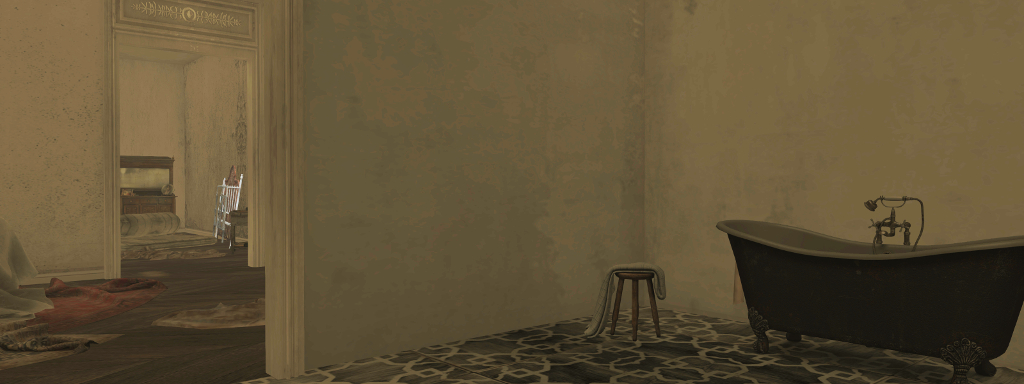
This latter aspect is shown through the use of elements such as the candles (a clear symbol associated with death) and the path they mark (representing the path we follow through life to its eventual end, which is in turn symbolised by the tomb), and by the house. The latter (perhaps best explored after hearing the poem throughout), shows signs of past habitation with rooms and furniture slowly mouldering. However, these are themselves more broadly representative of the memories of love and life shared but which have come to an end; the memories we fight to hold on to after the passing of a loved one, but which inevitably age and fade with the passing of time.
DaphneArts: Annabel Lee

So it is that this is a deeply atmospheric and evocative setting; one that should be experienced rather than described. It sets Annabel Lee, the poem, almost as fairytale without in any way destroying or distorting the emotional span of the original.

SLurl Detail

The Stolen Child in Second Life

The Itakos Project, The Stolen Child – CybeleMoon

CybeleMoon (Hana Hoobinoo) is renowned for her fabulous mixed-media art. It carries within it a richness of tone, a mixing and balance of light and shade, a depth of symbolism and – most poignantly – a wonderful framing of narrative that makes any exhibition of her work in Second Life utterly unmissable.

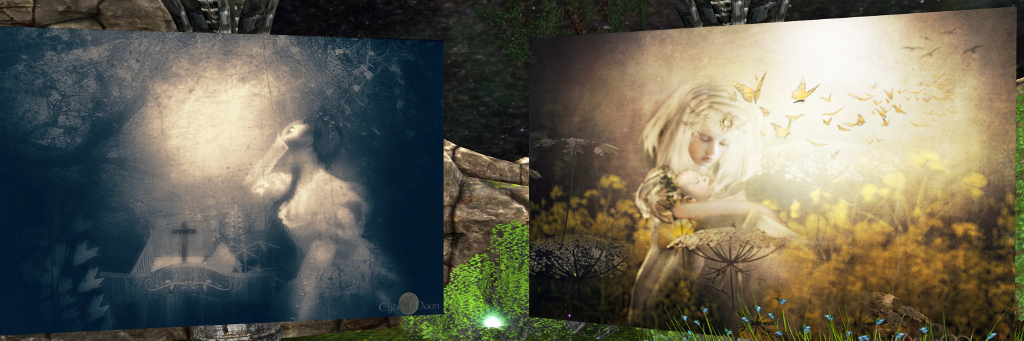
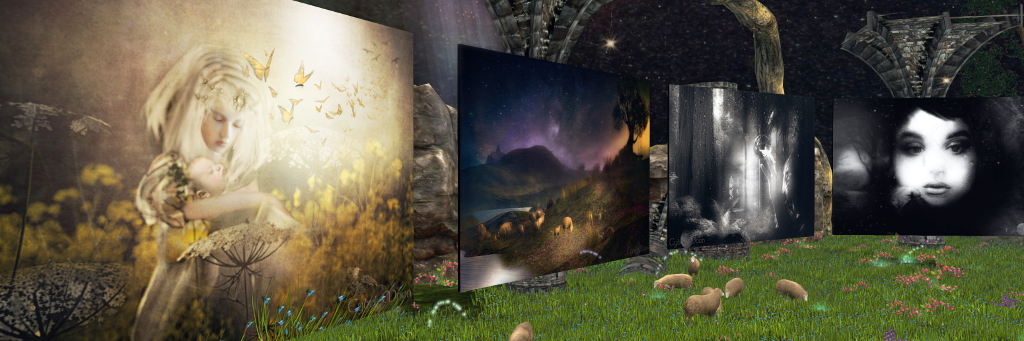
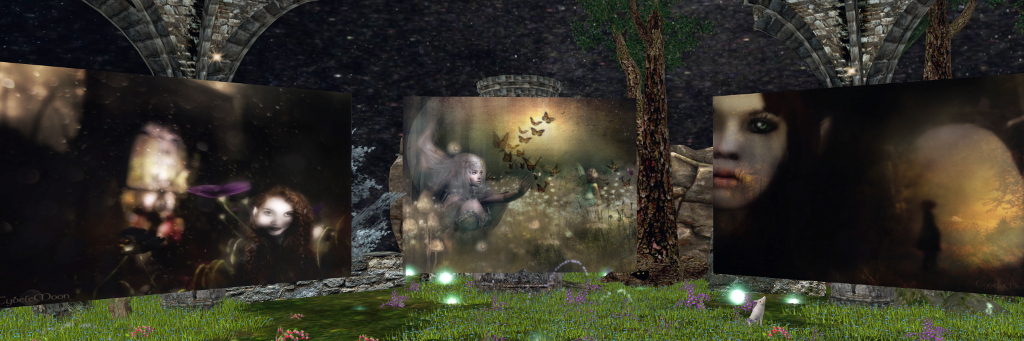
All of this richness, depth and framing is on display in full force at The Itakos Project, curated by Akin Alonzo, where Cybele presents The Stolen Child, a series of 15 images presented within a glade-like setting caught in the enfolding arms of ancient ruins, which has been specially built for the exhibit by Akim. Reached via the teleport door in the main foyer of the gallery, this setting is not merely a backdrop for Cybele’s art, it is part of the overall theme of the exhibition, designed through its form and lighting to increase the feeling of immersion in in the story the exhibition presents.

The Itakos Project, The Stolen Child – CybeleMoon

This story is not offered as a linear tale; rather, there is a central strand of theme running through both setting and images. This strand leads us through Cybele’s images, linking them indirectly and without necessary order (although one is suggested, somewhat by the circular placement of the pieces) as they form windows, if you will, into the underlying proposition of the exhibition; a proposition a proposition Cybele explains thus:

Fairies are not benevolent creatures at all, attracted by the strength and vitality of mankind, they kidnap children and especially newborns, or seduce (for the purpose of kidnapping) beautiful girls and boys.

She continues by noting the myth of the fairy lies routed in a times past need to rationalise the death of a child, be it at birth or with a short span of months or years thereafter: that the fairies had stolen the child away from a otherwise sad destiny. Within this weaving of fable, there was also menace: children with autism, depression, or other mental health issues were at times considered to have lost their souls as a result of eating fairy food.

The Itakos Project, The Stolen Child – CybeleMoon

Thus through Cybele’s art were are presented with a series of poignant scene sit within the framework of the dome of a night’s sky – the time when fairies might be abroad more than during the hours of daylight – and within a symbolic ring of ancient walls and arches. The latter carries with it a echo of the fairy ring of mushrooms that act as doorways to the fairy realms, or the idea of the faery castle hidden from mortal eyes by the form of a hill, and into which abducted children might be taken should they not take care.

That central strand running through the images – and the exhibition as a whole – takes the form of The Stolen Child, written in 1886 by by William Butler Yeats, who was also captivated by the entire mythology of faeries in Irish mythology. Through the words of his poem, we witness the bewitching song of the faerie folk, calling to children, tempting them away…

Come away, O human child!
To the waters and the wild
With a faery, hand in hand,
For the world’s more full of weeping than you can understand.

The Itakos Project, The Stolen Child – CybeleMoon

Cybele takes lines and words contained within the poem as titles for each of her pieces. Thus, each image forms that window I mentioned above, a glimpse into a scene, one that is often double-edged. On the one hand, it may seem innocent and rich in joy or tranquillity: young folk running through a meadow; a view across rolling hills at twilight while sheep graze; the innocence of blowing into a dandelion. On the other, the titles of the pieces hint at the darker element of fae intent: the stealing away of children, of leaving mothers bereft, to deny the young that chance to see sheep grazing at twilight or know the comforts of home and hearth, their young lives having been swept away with the promise of dances by moonlight in places forbidden by their ever-anxious parents.

To further accompany the exhibition, Cybele also provides a short story, together with additional images, that can be found on her (always enchanting) website. Also presented with the story and images is an audio recording of the marvellous Loreena McKennitt, who put the words of The Stolen Child to music. I’ll leave you with a video of the song from one of Ms. McKennitt’s live performances, and the note that this is a truly engaging and evocative exhibition; rich in narrative and atmosphere, and absolutely not to be missed.

SLurl Details

  • The Itakos Project (ATL, rated Moderate) – remember to take the teleport door in the gallery’s foyer to reach the exhibition!

Portraits and narratives in Second Life

The Itakos Project: Soul Portrait Collection Summer Black & White Edition – Saveria Rossini

The Itakos Project, operated and curated by Akim Alonzo, has undergone an expansion since my last visit (see: Soul Portraits in Second Life), with a new halls  – the Blue Pavilion – and an extension to the Black Pavilion, as well as a new platform gallery that will officially be opening a new exhibition on August 30th.

The Blue Pavilion sees a follow-on to Soul Portraits linked to above, with Soul Portrait Collection: Summer Black & White Edition. As with the first edition this features images from selected photographers who have submitted their work to the Itakos Project Flickr group. However, as the title implies, this selection features black-and-white images, and which had been submitted by Angelina Corral, Aver Osk, Aimee Cristole, Carolyn Diesel, Gabi Ka, Edie Horngold, Latia Lavecchia, -K- Lynagh, Ktsyakumi Izabela Navarathna, Saveria  Rossini and Sunset Theas.

The Itakos Project: Soul Portrait Collection Summer Black & White Edition – Sunset Theas

Further, and in difference to the first edition, the images here are not restricted to head-and-shoulder images; they instead offer broader perspectives – full body shots, those with more of a background in view, and so on.

This, to me, adds a further depth to this black & white edition; the range of images helps to keep things fresh as one moves through the hall, while the broader perspectives evident in some of the images offer a broader canvas on which the imagine can write its own story to accompany each image. Which is not to say those that do offer more direct facial studies are any the less fascinating; quite the reverse in fact. All of the pieces offered here are remarkable for their depth and ability to stir the imagination into framing a story around them.

The extended Black Pavilion offers the second of two exhibitions by Akim that are currently on display at the gallery (the other being The Matrix, which I reviewed here). And I confess from the start that Akim is fast becoming one of my favourite artists in Second Life.

The Itakos Project: Portraits And Some Other Circumstances – Akim Alonzo

In Portraits and some Other Circumstances he presents a series of colour and black and white female avatar studies. Originally displayed in June 2019, the collection has been expanded by Akim, and includes direct portrait studies and a series of “other circumstances”, which present more sensual studies (that feature nudity, and so should be considered NSFW).

These are pieces that again offer scenes suggestive of wider stories. In this, some offer direct hooks to a possible narrative – such as The Model was Impressed by the Old Camera, which places a faceless, naked subject alongside a camera and adds a very subtle twist of double entendre via the title. Others are more subtle, such as Imagine (Looking away), with its suggestion of the things around us we might so easily miss – or the suggestion of things we are never intended to see, but are nevertheless with us – such as angels who watch over us. Throughout all of these pieces there is a subtle use of pose, eye positioning, model placement soft focus, and so on, that gently draw us into each image, asking us not so much to view it, but explore it and consider what might lie beyond each frame.

The Itakos Project: Portraits And Some Other Circumstances – Akim Alonzo

Within the White Pavilion, visitors can find The Edgy World of M, featuring a collection by Maloe Vansant.

In this collection Maloe offers a series of pieces – most of them, I believe, self-studies – designed to tell us about “an unusual and hidden side of her imaginary world.” Most of them are a mix of dark juxtaposed with vivid, rich colour in what is both a powerful contrast and naturally symbiotic balance.

The Itakos Project: The Edgy World of M – Maloe Vansant

This contrast / symbiosis seems to also reflect an underlying narrative with these pictures – each of which might be considered a passage lifted from a story – the colour perhaps representing the “normality” of a life as it is presented to others – a mask if you will; and the black representing what lies hidden behind those same masks of normality: the hidden desires and thoughts – some of which may themselves be dark in nature (the the references to death and the horrors of removing masks).

These various elements come together quite dramatically, drawing us into that edgy world of M, a place that is rich in tone, theme, and image, and which is also at its heart, both personal (on at least two levels – Maloe’s and the observer’s) and intensely primal.

The Itakos Project: The Edgy World of M – Maloe Vansant

Also on display at the time of writing is Simply Dreaming, a further remarkable collection of art by Awesome Fallen, and which I wrote about in April 2019.

SLurl Details

Kimeu’s Hot Summer in Second Life

Diotima Art Gallery – Kimeu Korg

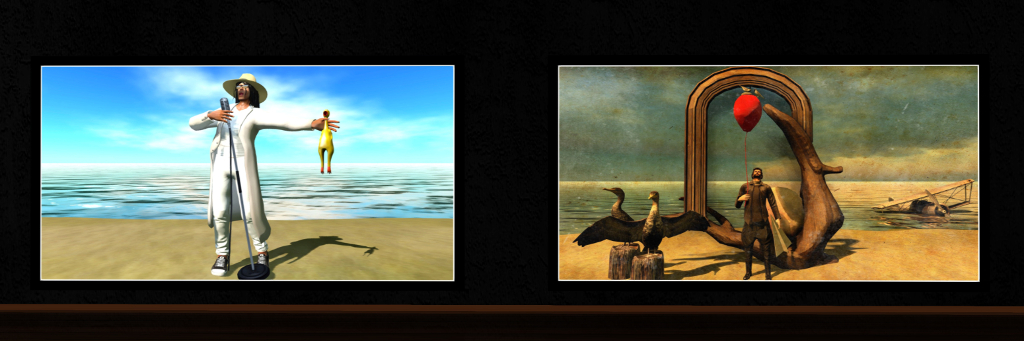
Currently on display at Diotima Art Gallery curated by Redi (Red Bikcin), is Hot Summer, an exhibition of art by Kimeu Korg. As the title suggests, it features images – fifteen in total – depicting summertime scenes; or which are for the most part summertime scenes!

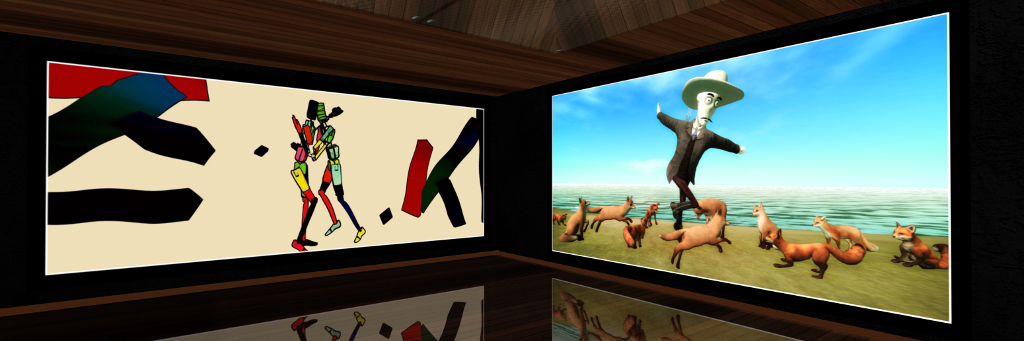
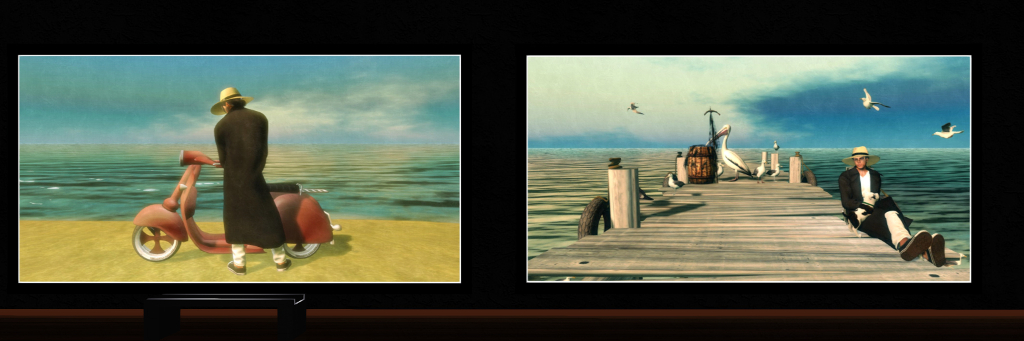
I admit to being something of a fan of Kimeu’s art, as he has a wonderful sense of whimsy and also an eye for creating thought-provoking images that can draw upon the abstract and / or the absurd or comical to pull the observer into them. Some of this talent is on display within the pieces presented here, although most are perhaps more “traditional” in nature – albeit with various motifs that also make Kimeu’s work so attractive.

Diotima Art Gallery – Kimeu Korg

The more comical can be seen in the likes of (13), located on the the right of the entry hall of the gallery. It features Kimeu standing on a beach in white, singing lustfully, a microphone in one hand and a rubber chicken held outstretched in the other, it’s beak agape as if singing in accompaniment.  Set against a calm sea and sandy foreground – two of the aforementioned motifs that can be found as a theme to many of the pieces here – it cannot fail to raise a smile.

Whimsy is evident front-and centre in some of these pieces – notably in the likes of (8), found in the far corner (relative to the entrance) of the L-shaped gallery, but also far more gently, such as with (4), which at a first casual glance might appear to be an ordinary image of a man standing on that sandy shoreline and looking out over sunny waters to where Orca-like fins rise above the waves, a dog and puppy – until you take a second look, and realise the “dog” and “puppy” are in fact a seal and her pup.

Diotima Art Gallery – Kimeu Korg

Finished as paintings – both oil and watercolour in looks – and also as coloured drawings, Kimeu’s pictures always have a life of their own that is unique within Second Life, something that also increases the appeal of seeing them exhibited, and this collection is no exception. It will remain open through to the end of Thursday, September 5th, and a visit is strongly recommended.

SLurl Details

Monochrome portraits and landscapes in Second Life

Kultivate The Edge, August 2019

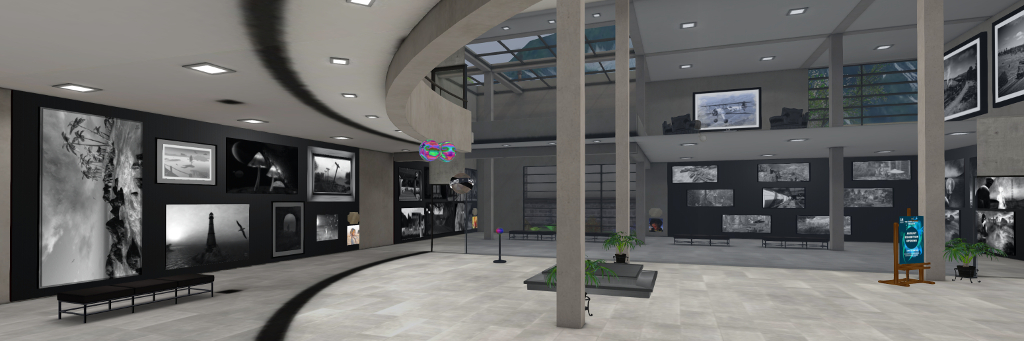
Now open at Kultivate Magazine’s The Edge Gallery is the August-September exhibition of black-and-white / monochrome art and photography.

The featured artists for the exhibition are Tatjab, MTH63, Wintergeist, Chic Aeon, Belua Broadfoot, Illrya Chardin, Sophie Congrego, Roxaane Fyanucci, Euridice Qork, and someone called Inara Pey, who is really just along for the ride. The artists offer a rich mix of portraiture and landscape images in their selections, as well as a mix of styles that make for an engaging exhibition.

Kultivate The Edge, August 2019 – Tatjab

While the range of images is both deep and broad, I admit to finding myself repeatedly gravitating towards two of the artists in particular. The first is Tatjab – also known as tattoo artist (hence his SL and Twitter handle of “Tatjab”), painter, and pencil portrait artist, Jesse Boren. Located on the upper mezzanine level of the gallery and facing the entrance, he presents fourteen pencil portraits taken from the physical world that are utterly stunning.

Ranging from fantasy pieces (such as portraits of Cthulhu) through personal pieces (Blaze, Leland and Pam’s Grandpa, for example) to those of famous individuals such as Barrack Obama, Sir Anthony Hopkins (as Hannibal Lecter) and Clint Eastwood (as Josey Wales), these are truly marvellous pieces, one and all; the manner in which the very essence and life force of Hopkins, Eastwood (a picture I could barely take my eyes off of!) and guitarist Justin Furstienfled has been captured is just amazing – as is true of all the other pieces Tatjab offers here.

The Edge, August 2019 – Euridice Qork

Just to the left of Tatjab’s area in the gallery are nine pieces by Euridice Qork. All are avatar portraits and studies, but again I found myself repeatedly drawn to them because each and every one is powerfully evocative in its own very individual way. Within them all, one can find a sense of the subject’s self or can feel an emotional response or been drawn to thinking about a certain era – or perhaps all three, and more.

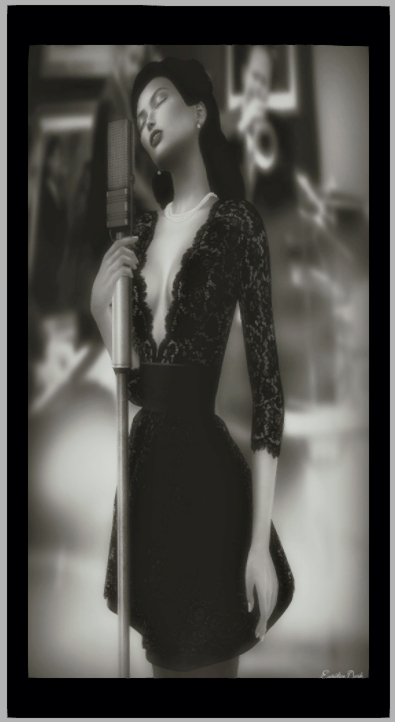
Take, for example the rightmost image of the woman at the microphone. While her style of dress might be a little more risqué than would likely have been the case at the time, the pose, the soft-focus background, the poise of the fingers of her left hand – all evoke a sense of 1940-1950s America, and a time when both jazz groups and big bands fronted by a vocalist where the means of a Saturday evening’s entertainment. Indeed, each time I look at this particular image, I cannot help but hear the words of Blue Moon, accompanied by a lone trumpet playing in the background.

Two other artists exhibiting here to and to whom I was drawn are Chic Aeon and MTH63 each  of whom can be found on the lower floor of the gallery.

Chic opts for a series of close-up images of items in-world. In this, I found the images to carry an echo of a technique that has become a signature of Melusina Parkin, and which I find particularly engaging: close-ups that suggest they are part of a large scene or story. In their presentation, be they focused on suitcases stacked one upon another or an oar in an aged and damaged rowing boat or the partially open drawers of a dresser, they drawer us to them, encouraging us into them in an attempt to peek beyond their borders, so to speak, and discern the wider story that may be just out of sight.

MTH63 offers a series of images of locations within Second Life, but rather than present them as “simple” monochrome pieces, he offers all but one of them as “negatives”, or perhaps reverse processed images (as used in the motion picture industry). Thus we’re presented with five unique views of settings within Second Life, with the one “positive” image sitting within them as the focal “glue” to MTH63’s “album”.

Kultivate The Edge, August 2019 – Chic Aeon (l) and MTH63

Truth be told, all of the artists featured in this exhibition offer a unique perspective on SL photography, be their work focused on avatars or landscapes or a mix of the two. The only potential exception is yours truly – and I say this not out of any sense of false modesty or to seek praise, but simply because I do not consider myself an artist. My images are purely intended for illustrative purposes within this blog; they are not posed, nor do they share depth of creative nuance evident in the other images, be it with framing, lighting, post-processing, and so on. As such, I count myself fortunate to be included  in an exhibition where there are some genuinely breath-taking pieces.

Slurl Details

Life and moods at Vibes Gallery in Second Life

Vibes Gallery: Paola Mills

Vibes Gallery, curated by Eviana Robbiani, is currently home to an untitled exhibition featuring Sunset Theas, Paola Mills, Lyack Glenwalker, Megan Prumier, and Aurora Donner. Given some of the images involve nudity, it should perhaps be considered an exhibition that is NSFW.

Immediately inside the entrance to the gallery is a quartet of images by Sunset Theas that follow a theme of their own, perhaps best described as condensing the seven stages of life into four evocative monochrome images, entitled, Embryonic, Birth, Life and Death. As the titles imply, each captures a moment in time and life.

Vibes Gallery: Sunset Theas

The use of monochrome, soft focus and life and shadow serve to make each of these pieces an intriguing study that fully captures the essence of their titles. Take Embryonic, for example. The use of depth of field and the off-centre capture are so suggestive of an ultrasound scan, with just enough form and substance for us to understand what we are seeing.

And so the images progress: Birth using light and shadow and a huddled form that offers the idea of a babe is dark swaddling; Life offers a image of the full vitality of a person in their prime, the use of a mask preventing us from being drawn into studying the model, but considering that broader idea of life. Then depth, with it simple setting, soft focus and back view of a naked body without adornment of clothing or within the setting is simply glorious – if such a term can be used – in its presentation of the body’s emptiness in death.

Vibes Gallery: Megan Prumier

At the far end of the gallery space are four images by Megan Prumier that again offer a theme; this one using reflections in the form of overlaid images of the female body. Each displays a considered use of technique that makes the nudity within the images secondary to their narrative. Take Warm Shivers, for example; the marvellous placement of the image, one copy superimposed over the other wonderfully suggests both someone feeling the cold in their nudity whilst at the same time presenting the idea of receiving warm comfort from someone close.

Between these two groups lie another set of four images by Paola Mills, and two pairs of images by  Lyack Glenwalker and Aurora Donner. I admit to being unfamiliar with the latter two, but again, on the strength of the two images presented here, Lyack has a talent for producing images rich in narrative. Certainly, his images reflect the stories inherent in the four pieces offered by Paola, while Aurora’s pair of studies round-out the exhibition nicely.

Vibes Gallery: Lyack Glenwalker

SLurl Details