No Man Is An Island in Second Life

DaphneArts: No Man Is An Island

No man is an island is the opening line from a poem by English poet and cleric John Donne which perhaps is more often referenced via quotations of its final lines,  And therefore never send to know for whom the bell tolls; It tolls for thee.

However, this poem actually originated as a passage  of greater length and written in prose as Meditation 17, from Donne’s Devotions Upon Emergent Occasions. Originally written in late 1623 (and published the following year), Devotions was written whilst Donne was recovering from a but unknown illness (possibly relapsing fever or typhus), and forms a reflection of death, rebirth and the Elizabethan concept of sickness as a visit from God, reflecting sinfulness, with each of the 23 devotions within it a meditation on a single day of Donne’s illness.
DaphneArts: No Man Is An Island

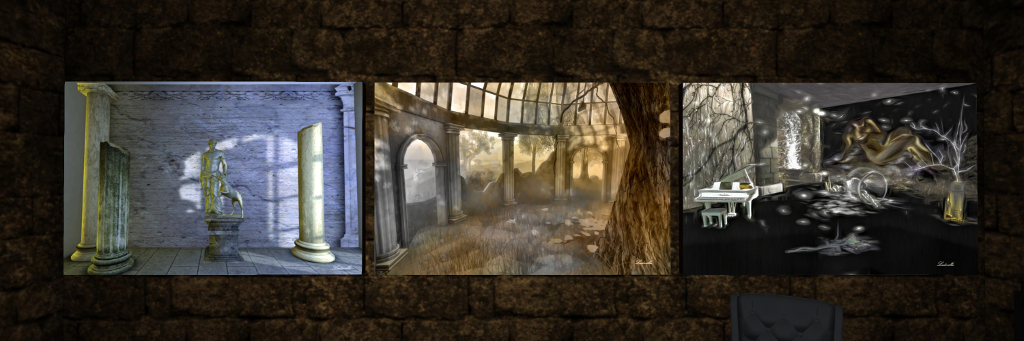
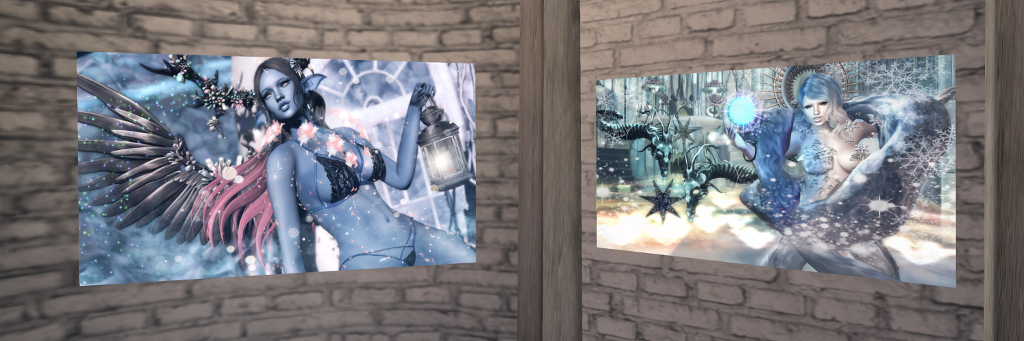
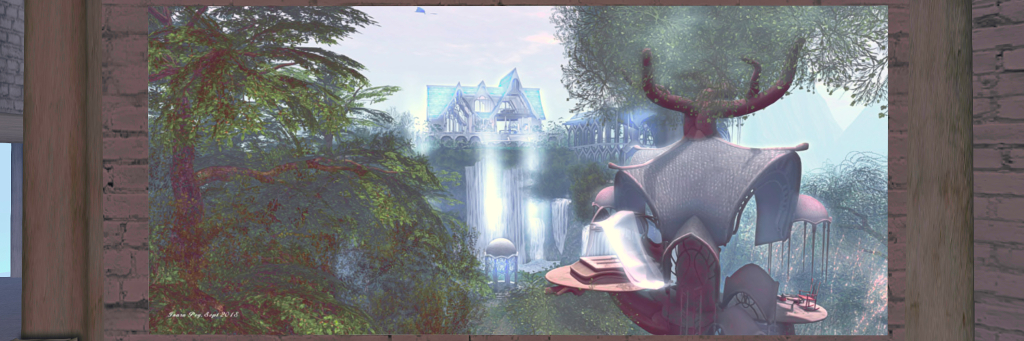
I mention this because No Man Is An Island is also the title of the latest immersive installation by Angelika Corral and Sheldon Bergman, artist curators of DaphneArts, with the installation itself marking the reopening of the gallery at a new location in Second Life.

Taking its lead from Devotions, the installation offers the opportunity to reflect on Donne’s words as they came to be written in the poem, using a visual setting, music and the spoken word. Full instructions are provided at the landing point – and if you are using the Firestorm viewer, then you should automatically receive the required windlight environment setting. You should also accept the HUD that is offered on arrival. This will attach itself to your world view to present you with a “letterboxed” style view of your surrounding. If, by chance, you’re not using Firestorm and / or the HUD doesn’t attach (or you accidentally reject its request to attach), instructions and an option to obtain the HUD can be found on the wall of the arrival area.
DaphneArts: No Man Is An Island

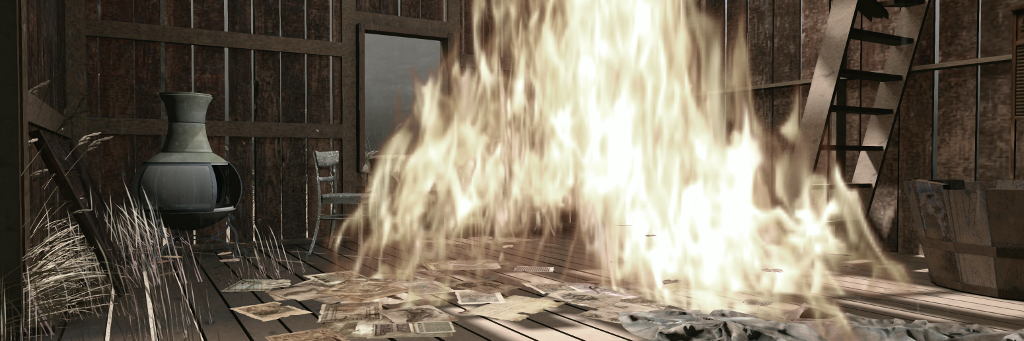
The main setting for the installation and the poem’s recital is very atmospheric – and made more so by the music (played as local sounds, not via any audio stream). Across a windswept stretch of sand stands the silhouette of a lighthouse drawn against the heavy sky, a hut below it lit from within.  A candle-lit bridge, with more candles scattered over sand and rocks despite the rain, beckon you forward to hut and lighthouse.

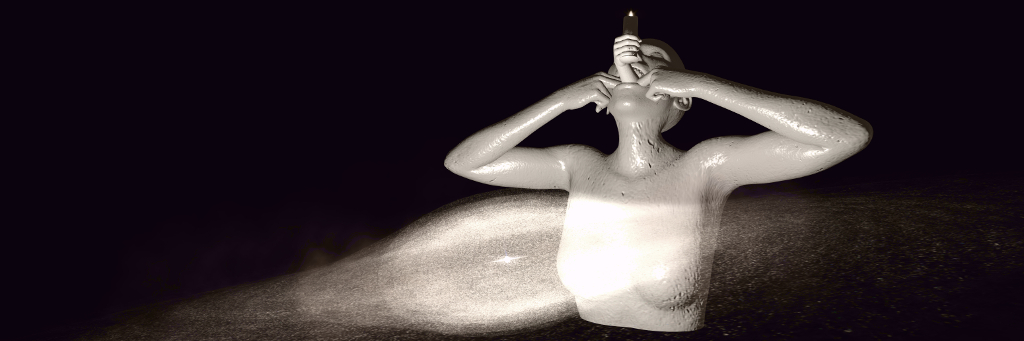
As you approach the hut, the light from within is revealed as a fire, burning brightly in the single room and consuming pages of manuscripts together with a shroud-like blanket. More candles  light the way up the lighthouse and its single door. Inside lies the opportunity to listen to a recital of the poem, and contemplate the sculptures that sit within the lighthouse walls.

DaphneArts: No Man Is An Island

Perhaps disarmingly simple in appearance, No Man Is An Island is actually nuanced and layered in presentation. Within Meditation 17, Donne is considering the nature of death (his own), and its impact (on him, if it is fact claiming another and not him), noting:

No man is an Iland, intire of it selfe; every man is a peece of the Continent, a part of the maine; if a Clod bee washed away by the Sea, Europe is the lesse …. any mans death diminishes me, because I am involved in Mankinde;  

Thus, within the hut with have the fire and the burning of manuscripts, many of the pages painstakingly written and illustrated by hand. They represent the idea that a loss does not just impact the one or the few, but lessens the whole; in their burning, the pages are not just lost to whomever set them ablaze, but are lost also to all who might otherwise have read them. Similarly, the blanket with its edge caught within the flames might be taken as a death shroud, symbolising, Donne’s view that any mans death diminishes me, because I am involved in Mankinde
DaphneArts: No Man Is An Island

In addition, the presence of the lighthouse offers reference to life and death, presenting a balance of views that reflects Donne’s thoughts. On the one hand, it was once perhaps the loneliest job on Earth, undertaken in isolation, would his passing of a lighthouse keeper really be missed by the world? But on the other, the role by its very nature was to protect the lives of those at sea, steering them away from the risk of death through the loss of the vessel beneath them – so yes, the loss of a lighthouse man could be sorely missed by the rest of us.

Other references are more obvious – the island-like setting, the rain (the curtained veil of death) – even our place in the cosmos (or what Donne might have regarded as God) is brought into focus, both visually and through the eternal questions repeatedly asked at the landing point.

SLurl Detail

Chalkboards and photographs in Second Life

Lyric Art Gallery: SecondHandTutti

Officially opening at 10:30 SLT on Saturday, March 2nd, 2019 at the Lyric Art Gallery is the latest edition of the Visual Feast exhibitions, featuring the work of two artists: SecondHandTutti and the gallery’s co-curator, Michiel Bechir. Between them, they offer two very different – but equally captivating – exhibits.

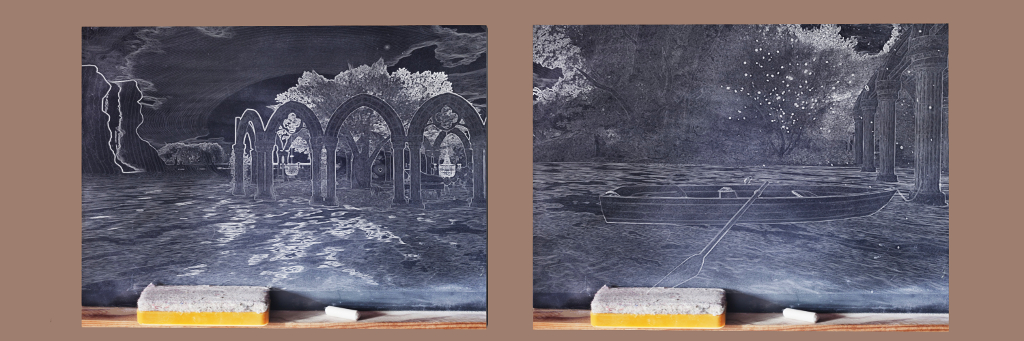
On the ground floor of the gallery is SecondHandTutti’s #26 Chalkboard Dolls, which – contrary to the title is actually 17 pieces of art comprising 14 wall mounted images and three 3D pieces. They are, however, all drawn together by the chalkboard theme.

Lyric Art Gallery: SecondHandTutti

The 14 images, all clearly taken in Second Life have been beautifully rendered to present a series of chalkboard drawings. Each is offered as if freshly drawn, the chalk resting on the board’s shelf alongside an easer. It’s a fascinating way by which to capture Second Life and the degree to which each image genuinely appears to have been hand-drawn on a board is mesmerizing. Granted, on one or two you have to get the camera in close to fully appreciate the detail, but the effort is more than worthwhile.

The three 3D pieces utilise chalkboards to display their names. They are uniquely abstracted studies of figures created with prims, rather than the more common mesh. This gives them a rawness of line that is as eye-catching as the images surrounding them, and  – in the case of Dancer perhaps offers an added sense of tribalism to the figure and the dance.

Lyric Art Gallery: Michiel Bechir

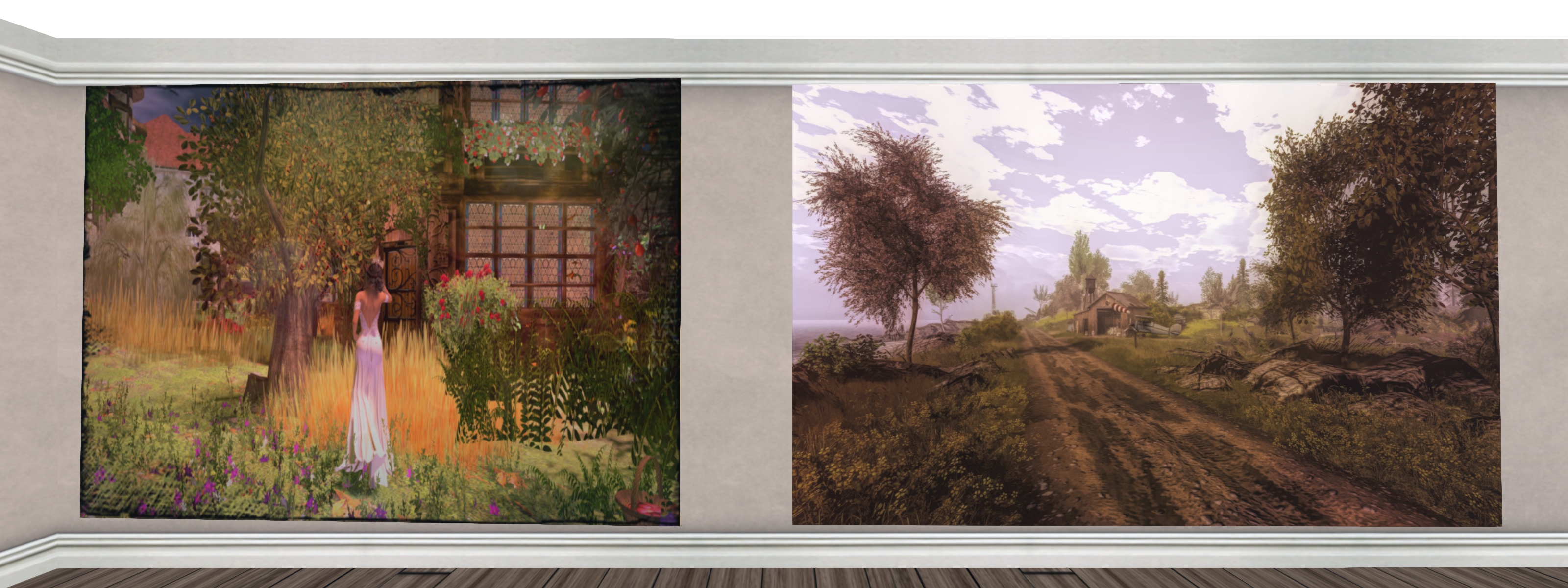
Located on the upper floor of the gallery, Michiel’s exhibit presents 17 of his photographs taken around second Life, either mounted on the walls or on easels. His work has always had a richness to it, whether presented as a gently post-processed photograph, or more broadly edited to give the feel of a painting, and the selection offered at the Lyric presents both approaches for visitor to admire.

As a seasoned SL traveller, one of the things I enjoy with landscape photography that has been captured in-world is trying to identify the locations without cheating by referencing the Edit floater or hovering the mouse over a picture in the hopes of seeing a name. Sometimes the images feature aspects of a region that are so iconic, it is relatively easy to do so: the airstrip at Wild Edge, for example, or the wind turbines at La Digue Du Braek, or the beauty of the Gulf of Lune – all of which can be found in this selection. But sometimes, the setting can be captured in a more subtle manner – and thus I was delighted to spot images taken and Scribbled Hearts and Kekeland, two destinations to which I have in the past made numerous visits.

Lyric Art Gallery: Michiel Bechir

Two excellent selections of art, and I recommend them as being well worth a visit.

SLurl Details

A further ensemble at La Maison d’Aneli

La Maison d’Aneli: Kiana Jarman

La Maison d’Aneli, curated by Aneli Abeyante, has opened its doors on its March ensemble exhibition, and once again presents the work of six very different artists, all of whom offer unique perspectives and styles.

As I didn’t manage to make a return visit to cover three of the artists in the February exhibition (the three I did write about can be found in Art and artists at La Maison d’Aneli), I’ll attempt to give a thumbnail look at all six appearing through to late March.

La Maison d’Aneli: Serena Parisi

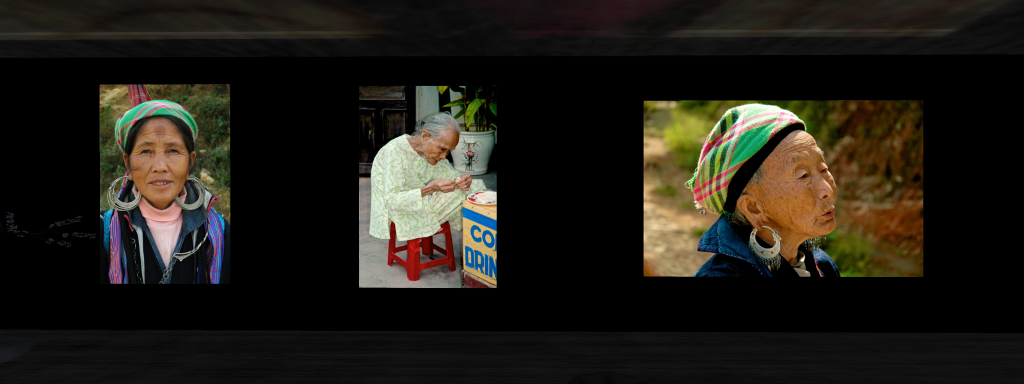
Serena Parisi is a long-time Second Life photographer and explorer, who also appears to be well-travelled in the physical world, as the selection of her photography offered here more than demonstrates, and as she explains. “This exhibition is about my trip to Vietnam. Between smiles, laughs and emotions, my encounters with the population in an explosion of colour that characterises this country.”

Thus, across the upper level of the gallery space, and on the mezzanine above it, Serena offers 17 images of the people of Vietnam, the majority in colour  – although I did find the four presented in monochrome quite captivating. Focused on the women and children of the country, they offer fascinating portraits of work and play, happiness and, in some, that understandable wariness of having a camera pointed at you by a stranger. Tightly focused, they portray living individuals but, at the same time reveal a lot about the lifestyle of many Vietnamese people.

La Maison d’Aneli: jeaneos7

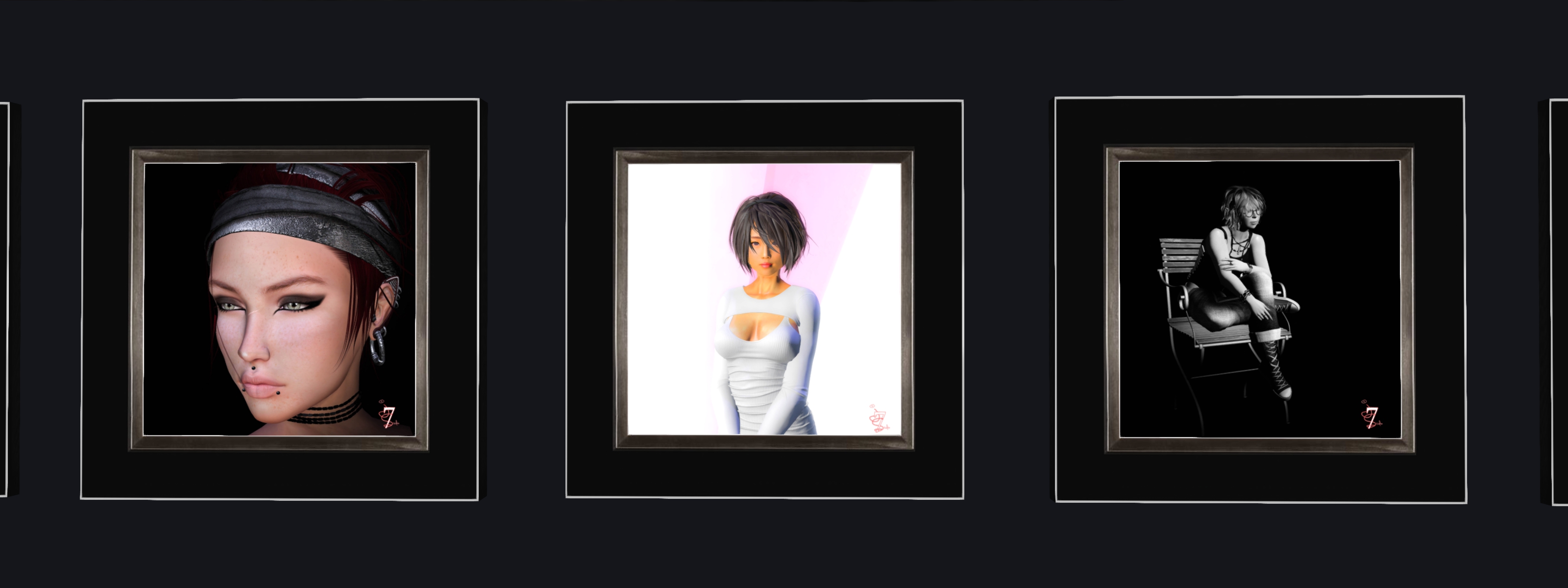
Across the lobby area on the same level, and also split between floor and mezzanine is an exhibition of avatar studies by Jean (jeaneos7), who also hails from France. The pieces here both collectively contrast and compliment Serena’s work. Contrast, simply because they are avatar studies, rather than physical world studies, and compliment in that they are also largely tightly focused on the subject such that we are drawn into the lives portrayed, even without the aid of the backdrop that some of the images additionally offer.

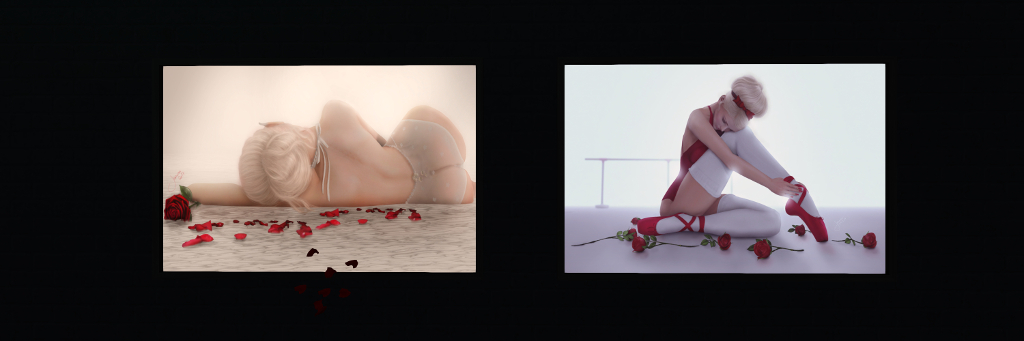
Avatars are also the focus of Kiana Jarman’s selection of work, located on the floor and mezzanine of the gallery’s lower level. She notes that, “Photography is like writing with light, making music with shades.” This is aptly demonstrated within many of her images; while they are focused on avatars, they provide a broader setting, offering a rich canvas on which a story or song might be written. I confess that I found some of her pieces vibrant with life and/or playfulness, and other so rich in tone and narrative, that my eye and camera were constantly drawn back to them.

La Maison d’Aneli: Kiana Jarman

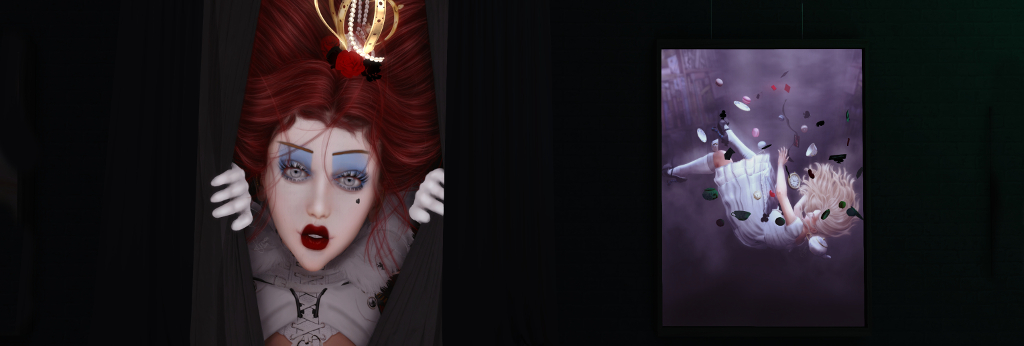
Pointing out particular images in this respect is hard, and none of the pieces are titled. However, to the right of Kiana’s biography giver are two truly marvellous pieces, one above the other, that respectively offer a wonderful depth of narrative and capture the pure vitality of adventurous living. Further around the mezzanine, the sense of fun is reflected through a Queen Of Hearts like figure peering through curtains, while the elegance and beauty of the human body as reflected in the avatar is perfectly frame in the two images I’ve chosen to use as the banner image for this article.

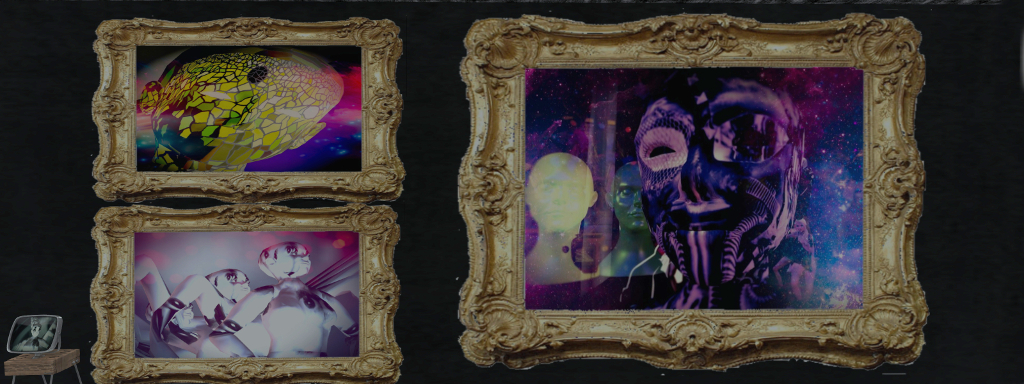
Also on the lower level of the gallery is a mixed media presentation by Rofina Bronet, that presents her work both as an artist and as a machinima maker. This is the most eclectic of the selections presented within this exhibition, with the artwork split between expressive, almost abstract pieces, and those focused on specific avatar subjects: Bryn Oh and  Paris Obscur (JonathanDimitri Soderstrom). As well as the large images mounted on the gallery’s walls, Rofina has provided small view screens which, when clicked, will page through the images as well. To see the machinima offered as a part of the selection, make sure you have media streaming enabled in your viewer.

La Maison d’Aneli: Rofina Bronet

Rounding out this exhibition, and located in the end halls of both the upper and lower gallery spaces are displays be Reycharles and Oema.

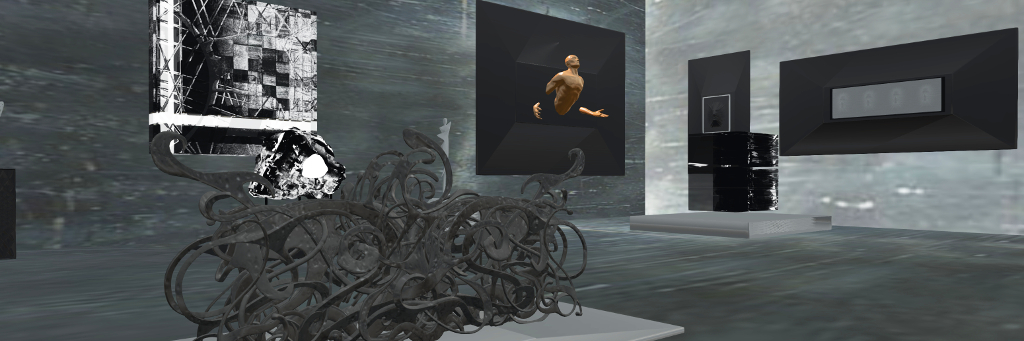
The former presents a mix of his 2D and 3D art, the majority of which is wonderfully abstracted. While he often works with colour, manipulating it experimentally and seeing where it leads, the pieces Reycharles presents here are largely monochrome in tone. There is a wonderful feeling of some of the pieces – both 3D and 2D – having been extruded rather than being intentionly drawn / painted / formed; an organic feel that is itself utterly fascinating.

La Maison d’Aneli: Reycharles

Artist and blogger Oema, located on the lower level of the gallery, presents 14 pieces running from landscapes to avatar studies to original paintings.

I’ve always admired her work for its sense of fantasy / dream, and many of the pieces within this selection demonstrate this to the full. However, it is the studies to the right of the hall as you enter it that utterly captivated me. Each of them holds a unique beauty within what are very different styles when viewed one to the next. Each also – as with all of Oema’s work, is rich in both detail and expression of story.

La Maison d’Aneli: Oema

Taken together this is a richly diverse exhibition that is nevertheless drawn together by incidental, rather than deliberate themes, and which will be available through until late March.

SLurl Details

An art ensemble at * THE EDGE * Digital Renaissance Project

THE EDGE Art Gallery: Mirabelle Beidermann

Currently open at THE EDGE Art Gallery, curated by Ladmilla, is an ensemble exhibition of Second Life and digital art entitled All the Colours of Monochrome, featuring the work of Kapaan, Loegan (Loegan Magic), Patrick (PatrickofIreland), Rachel Magic, Trish (trishasrose) Vinicio Armin and Cybele Moon (Hannahoobinoo), together with a special exhibition entitled Tribute to Surrealism by Mirabelle Biedermann (mirabelle sweetwater).

The gallery itself is an intriguing setting, the exhibition spaces split between a medieval style church and a large castle. A medieval house offers a further annex for displaying art, but for this exhibition, it was empty.

THE EDGE Art Gallery: Venicio Armin

Mirabelle’s Tribute to Surrealism is located in two rooms within the church. A Second Life photographer since 2011, Mirabelle notes that her interest in surrealism is something of a recent turn for her. she started by interpreting some of the more notable works by René Magritte – a point most clearly demonstrated with Son of No One, reflecting as it does Magritte’s Son of Man – before she moved to developing her own style and images, which is also reflected in the pieces offered here.

Also to be found in the church are exhibits featuring the work of Patrick Ireland, who displays four marvellous monochrome pieces in a suitably monochrome setting; Cybele Moon, who has more of her narrative-rich images on one of the church’s two  upper galleries, the other being taken by the art of Venicio Armin. I confess to not having witnessed (at least, not that I can remember) his work, but I was immediately drawn to it; there is an evocative strength to his work that is entirely captivating.

THE EDGE Art Gallery: Ladmilla

Rounding out the exhibit in the church is a selection of Ladmilla’s art, more of which can be found in the main rooms within the castle setting. Like Venicio, Ladmilla focuses on landscape pieces, and her work is beautifully lit and rich in colour and tone. Above the main halls of the castle – and indeed below them – on both the parapet walks of the curtain walls and within the narrow passages within the walls, visitors can find the work of Loegan, Rachel, Kapaan and Trish.

Each presents a unique and eye-catching style, but again, I found myself drawn to the more monochrome work of Kapaan. His seven images are presented in two groups, each with its own story to tell, and both drawn together by the setting in which they are offered.

THE EDGE Art Gallery: Kapaan

As an ensemble exhibition, All the Colours of Monochrome offers a rich mix of style and images, and the title cleverly reflects the presentation of both monochrome and colour images. This makes for an engaging visit.

SLurl Details

Entering Kerupa’s Hydrosphere at Nitroglobus

Nitroglobus Roof Gallery: Kerupa Flow

Open through the rest of February and into March at Nitroglobus Roof Gallery, curated by Dido Haas, is Hydrosphere by Kerupa Flow.

The name is a reflection of Kerupa’s fascination with water, which has been – as she notes – a major theme in her art for a long time.

Creatures can not live without water, everyone knows. However, we forget what water is. Water is infinite, it’s a huge force beyond humanity, which enables us to stay alive …. but it also can destroy us.

– Kerupa Flow, introducing Hydrosphere

Nitroglobus Roof Gallery: Kerupa Flow

This description might suggest the art on offer comprises images with a water theme – and so they do; but not in the manner one might expect. These are images that reflect our complex relationship with water, richly personifying it. In one sculpture, it is celebrated as the place from which complex life evolved, the mother of all that life on Earth has become. In another it appears as a whirlpool drawing a body in to it, a reminder that it can be a destroyer of life; the most powerful demonstration of nature’s power, as Kerupa again notes.

The earthquake and tsunami disasters that occurred in 2011 in Japan were exactly the power of the earth itself. The way the tsunami moved over a long distance with the overwhelming power until it stopped inland, is a terror that can not be forgotten.

– Kerupa Flow, introducing Hydrosphere

Nitroglobus Roof Gallery: Kerupa Flow

The images present many facets of our relationship to water, a relationship which is so complex, it is easy to arrive at more than one interpretation for some of them. Take the second sculpture mentioned above, Minawa. On the one hand there is that sense of water’s power to kill, but it also perhaps personifies that origin of life also mentioned above – and even that of birth; that is, rather than being pulled into the whirlpool, the figure within the piece is coming forth.

The theme of birth might also be evident which might be seen in Twilight dreams. On the one hand, this piece might serve as a reminder of the soothing influence the sound of the ebb and flow of water can have on us, encouraging rest and dreams. On the other there is a suggestion of the womb, and the security it represents.

Nitroglobus Roof Gallery: Kerupa Flow

Elsewhere in the collection, the nature of water is more directly personified, through Merman – Voice of the Sea, for example, or the marvellously animate Water of the Erebus.  In this latter piece is another marvellous intertwining of ideas: water is given a face – but not just any face. It belongs to the primordial deity personifying darkness, a child of Chaos – a further referencing to natures raw power through water and the seas around us.

All told, Hydrosphere is another fascinating exhibit at Nitroglobus, rich in context and narrative (I’ve not even mentioned Water Dragon and how it would appear to have a tie with Kerupa herself – but I’ll leave you to read her byline for the exhibition and draw your conclusions on this 🙂 . All I will say is that, as always, this is not an exhibit to be missed.

SLurl Details

Visiting Lost Unicorn Gallery in Second Life

The Lost Unicorn Gallery

The Lost Unicorn Gallery, curated by Natalie (Natalie Montagne)  forms a part of a trio of regions I visited in September 2018 (see Within a Lost Unicorn Forest in Second Life and Opening a Storybook in Second Life). As I noted in those articles, all three regions are utterly magnificent in design, with The Lost Unicorn Gallery offering one of the most stunning settings in which art can be exhibited – as any view from outside the gallery will more than demonstrate.

I was drawn back to the gallery for three reasons: the first is that Natalie routinely hosts engaging ensemble exhibitions of art; the second is that the featured artist for February 2019 is Cybele Moon (Hana Hoobinoo); and the third is purely personal: as a part of the current ensemble exhibition, Natalie has selected some of my own images.

The Lost Unicorn Gallery: Cybele Moon

Cybele Moon’s work really needs no introduction to regular readers of this blog. Her art is beautifully ethereal and rich in narrative. This is fully exemplified with Forests Were Made For the Hunter of Dreams. Located on the main floor of the gallery, this is an extensive exhibition of Cybele’s photography and art, each piece offered and ready to tell a story of its own. However, for those who prefer, Cybele offers a touch panel which will supply a short story snippet to accompany each piece.

Also to be found on the ground floor of the gallery are avatar studies by Razor Cure (sch511), and Aquatic Arugula (Sugarfairy88), who offer very contrasting styles. Razor is additionally the first prize winner of a recent photography competition held within the regions, his entry with the other prize winners also being displayed on the ground floor of the gallery.

The Lost Unicorn Gallery: Sugarfairy88

On the upper floors of the gallery is a veritable host of artists: Lia Swahn, Gassamer Star, Luke Henuskai, Meriluu, Pan Aeon, Poly Elan, Awesome Fallen, SelenLily Galicia, Efinyn Jinx, Iruki Levee, Babydoll Tracy Colt, Antarctica Slade, Pretty Rexen, Aleriah, Roxi Firanelli, Duchess Flux, and myself.

The majority of the images from these artists are focused on avatar studies, the only major exception being my pieces, which Natalie gathered from my visits to Lost Unicorn Forest and Storybook. My sincere thanks go to her for including me in such august company; I’m both flattered and honoured.

The Lost Unicorn Gallery: Inara Pey

For those who enjoy photography competitions, the Lost Unicorn Gallery is currently hold another with the theme of Lord of the Rings.

Participants are invited to submit up to two images (raw or post-processed) representing any part of the Lord of the Rings novels (The Fellowship of the Ring, The Two Towers and The Return of the King). Submissions should be made to the Lord of the Rings Flickr Group and labelled “Contest Entry”, no later than March 3rd, 2019. A L$9,000 prize pool is on offer, with L$5,000 to the first place entry. Full details on entry can be found via the contest information givers at the gallery.

SLurl Details