Space Sunday: water, water everywhere

NASA’s Mars Curiosity rover celebrated its two-thousandth Martian day, or Sol, on the Red Planet on March 22nd, 2018. In celebration, NASA issued a new photo-mosaic of images captured by the rover in January 2018, which have been processed to provide a offers a preview of what comes next.

Looming over the image is Mount Sharp, the mound Curiosity has been climbing since September 2014. In the centre of the image is the rover’s next big, scientific target: an area scientists have studied from orbit and have determined contains clay minerals.

Clay minerals requires water to form. Curiosity has already revealed that the lower layers of Mount Sharp formed within lakes that once spanned Gale Crater’s floor. The area the rover is about to survey could offer additional insight into the presence of water in the region, how long it may have persisted, and whether the ancient environment may have been suitable for life.

Key to examining the area will be the rover’s drill mechanism, which the science team hope will be able to draw samples pulled from the clay-bearing rocks so their composition can be determined. As I recently reported, a new process for obtaining samples via the drill and getting them to the rover’s on-board science suite was recently tested to overcome a long-term issue with the drill feed mechanism, and the approach is being refined on Earth in preparation for the excursion into the clay region.

The 2,000 Sol celebration mosaic, published on March 22nd. It is made up of dozens of images captured by the rover’s Mastcam on Sol 1931 back in January. The mount of “Mount Sharp” (Aeolis Mons) dominates the mosaic, while the area outlined in white marks the region of clay minerals the rover is going to explore in the weeks and months ahead. The image has been white-balanced to match Earth normal lighting. Credit: NASA/JPL / MSSS

In the meantime, a new study seeking to explain how Mars’ putative oceans came and went over the last 4 billion years implies that the oceans formed several hundred million years earlier than previously thought, and were not as deep as had been assumed. In particular, it links the existence of oceans early in Mars history to the rise of the massive Tharsis volcanoes on Mars and highlights the key role they may have played in the ancient oceans of the Red Planet.

A common objection to Mars ever having oceans of liquid water is that estimates of the size of the oceans doesn’t marry-up with estimates of how much water is retained within the planet’s polar caps, how much could be hidden today as permafrost underground, and how much could have escaped into space. In the new study, from the University of California, Berkeley, it is proposed that Mars’ oceans first formed before, or at the same time as, the massive volcanoes of the Tharsis bulge, 3.7 billion years ago, rather than after them.

“The assumption was that Tharsis formed quickly and early, rather than gradually, and that the oceans came later,” Michael Manga, professor of earth and planetary science and senior author of the study, said. “We’re saying that the oceans pre-date and accompany the lava outpourings that made Tharsis.”

This would mean that the plains that cover most of the northern hemisphere, which are the presumed to be an ancient seabed, would have extended into the area later deformed as the Tharsis Ridge expanded, and lava flows cut into the plains. Thus, the initial oceans on the planet would have been more widespread – but shallower – than originally thought, providing a smaller overall volume of water.

The early ocean known as Arabia (left, blue) would have looked like this when it formed 4 billion years ago on Mars, while the Deuteronilus ocean, about 3.6 billion years old, had a smaller shoreline. Both coexisted with the massive volcanic province Tharsis, located on the unseen side of the planet, which may have helped support the existence of liquid water. The water is now gone, perhaps frozen underground and partially lost to space, while the ancient seabed is known as the northern plains. Credit: Robert Citron images, UC Berkeley

The model also counters another argument against oceans: that the proposed shorelines are very irregular, varying in height by as much as a kilometre, when they should be level, like shorelines on Earth. However, this irregularity could be explained if the first ocean, called Arabia, started forming about 4 billion years ago and existed, if intermittently, during as much as the first 20% of Tharsis’s growth. The growing volcanoes would have depressed the land and deformed the shoreline over time, leading to the irregular heights seen today. This would also apply to the subsequent ocean, called Deuteronilus, if it formed during the last 17% of Tharsis’s growth, about 3.6 billion years ago.

Tharsis, now a 5,000-km-wide eruptive complex, contains some of the biggest volcanoes in the solar system and dominates the topography of Mars. Its bulk creates a bulge on the opposite side of the planet (the Elysium volcanic complex), and the canyon system of Valles Marineris in between. This explains why estimates of the volume of water the northern plains could hold based on today’s topography are twice what the new study estimates based on the topography 4 billion years ago.

This new theory has two further points in its favour. Firstly, it can account for the valley networks (cut by flowing water) that appeared around the same time.Secondly, both Arabia and Deuteronilus would have existed at a time when the Tharsis volcanoes and those of Elysium would have been active, throwing greenhouse gases into the Martian atmosphere, warming it and increasing its density.

The authors of the study admit it is just a hypothesis at this point in time, and Manga invites others to follow-up on it. “Scientists can do more precise dating of Tharsis and the shorelines to see if it holds up.”

Too Much Water To Be Habitable?

The latest study to be published concerning TRAPPIST-1, the 7-exoplanet star system 39 light-years from our Sun, suggests the exoplanets may be too wet to have ever supported life – which might sound a little surprising. It also suggests the planets have migrated closer to their planet red dwarf star since their formation.

The study was led by Cayman T. Unterborn, a geologist with the School of Earth and Space Exploration (SESE), and used data from prior surveys that attempted to place constraints on the mass and diameter of the TRAPPIST-1 planets in order to calculate their densities, one of which I mentioned in January 2018.

Artist’s concept showing what each of the TRAPPIST-1 planets may look like. Credit: NASA

Using this data as a starting point, the team constructed mass-radius-composition models to determine the volatile contents of each of the TRAPPIST-1 planets. They found the 7 planets are light for rocky bodies, suggesting a high content of volatile elements. On similar low-density worlds, this volatile component is usually thought to be atmospheric gases. However the TRAPPIST-1 planets are too small in mass to hold onto enough gas to make up the density deficit.

Because of this, Unterborn and his teams determined that the low-density component of the seven planets was most likely water. To determine just how much water, the team used ExoPlex, software for calculating interior structure and mineralogy and mass-radius relationships for exoplanets. This allowed the researchers to combine all of the available information about the TRAPPIST-1 system.

The results revealed that all of the TRAPPIST-1 planets have high percentages of water by mass: 15% for the two inner worlds, b and c, rising to more than 50% for the outer planets, f and g. To put this into context, Earth has just 0.02% water by mass. Thus, the TRAPPIST-1 planets have the equivalent of hundreds of Earth-sized oceans trapped within their volumes. Had this water been liquid at any point in the past, or simply frozen ice enveloping the surfaces of them, it would likely to have been far too much to support life, as Natalie R. Hinkel, an astrophysicists from Vanderbilt University, Nashville, explained:

We typically think having liquid water on a planet as a way to start life, since life, as we know it on Earth, is composed mostly of water and requires it to live. However, a planet that is a water world, or one that doesn’t have any surface above the water, does not have the important geochemical or elemental cycles that are absolutely necessary for life.

In addition, the study also suggests that all seven planets in the system most likely formed father away from their star and migrated inward over time – something which has been noted with other exoplanet systems. In the case of TRAPPIST-1, the planets are distributed either close to, or within, the star’s “ice line”. This is a boundary where, within which, ice on planets tends to melt and either form oceans (if sufficient atmosphere is present) or vaporise. Beyond this line, water will take the form of ice and can be accreted to form planets.

An artist’s impression of the sky from the outermost of the three TRAPPIST exoplanets in the star’s habitable zone.

Given the relative positions of the outer planets to their star’s ice line, the research team determined all seven of TRAPPIST-1’s planets must have formed beyond the ice line, but over the aeons migrated inwards, with the inner planets losing much of their water content through their surface ice vaporising – but leaving a high volume of water still being retained within their rocky crusts.

Working out how far – and when – the planets might have formed is made more complicated by the fact that M-type red dwarf stars like TRAPPIST-1 burn brighter and hotter early in their lives before cooling and dimming – so its “ice line” would have contracted inwards as well.  Based on how long it takes for rocky planets to form, the team estimated that the planets must have originally been twice as far from their star as they are now.

Overall, the study leans weight to the view that TRAPPIST-1 worlds are unlikely to be habitable. Early on, as Natalie Hinkel noted above, they may well have been ice or water covered, but lacking the geochemical and elemental cycles essential for life. Any period in which surface conditions might have been more favourable for life on the inner planets as their ice melted would likely have been comparatively short as a result of the star’s solar activity stripping most of their atmospheres away.

Kepler Observatory Nears End of Life

To date, around 3,743 exoplanets have been discovered in our galaxy – 2,649 of them by the Kepler Space Observatory, but we’re now approaching the end of life for this veritable planet hunter.

Launched in 2009, Kepler occupies an Earth-trailing heliocentric orbit, from which it has sought out exoplanets using the transit method – monitoring a star over a period of time for periodic dips in brightness caused by a planet transiting (passing in front of) the star.

In 2012 and 2013, the observatory suffered failures and issues with two of the observatory’s four reaction wheels used to hold it steady while observing distant stars. As a result, a new mission profile, K2 Second Light, was developed in order to compensate for the issues. Unfortunately this required the observatory to use small amounts of its propellant reserves to help hold it steady during operations – and those fuel reserves are almost expended.

Mission engineers are uncertain as to precisely when the observatory’s fuel will run out, other than it will likely happen in the next several months.  The hope is that there is still enough time to gather as much data a possible from the current observation campaign.

For the first four years of its primary mission, the space telescope observed a set star field located in the constellation Cygnus Since 2014, Kepler has been collecting data on its second mission, observing fields on the plane of the ecliptic of our galaxy. Credit: NASA / Wendy Stenzel

“Without a gas gauge, we have been monitoring the spacecraft for warning signs of low fuel— such as a drop in the fuel tank’s pressure and changes in the performance of the thrusters,” Charlie Sobeck, a system engineer for the Kepler space telescope mission, explained. “But in the end, we only have an estimate – not precise knowledge.”

The end of Kepler’s mission does not mark the end of the search for Exoplanets from space. April 2018 will see the launch of  the Transiting Exoplanet Survey Satellite (TESS), will conduct transit surveys on a large scale, and in 2019 the James Webb Space Telescope (JWST) will also have part of its mission devoted to the hunt for exoplanets. Both will help build on Kepler’s legacy.
Space Sunday: rockets, exoplanets landers and asteroids

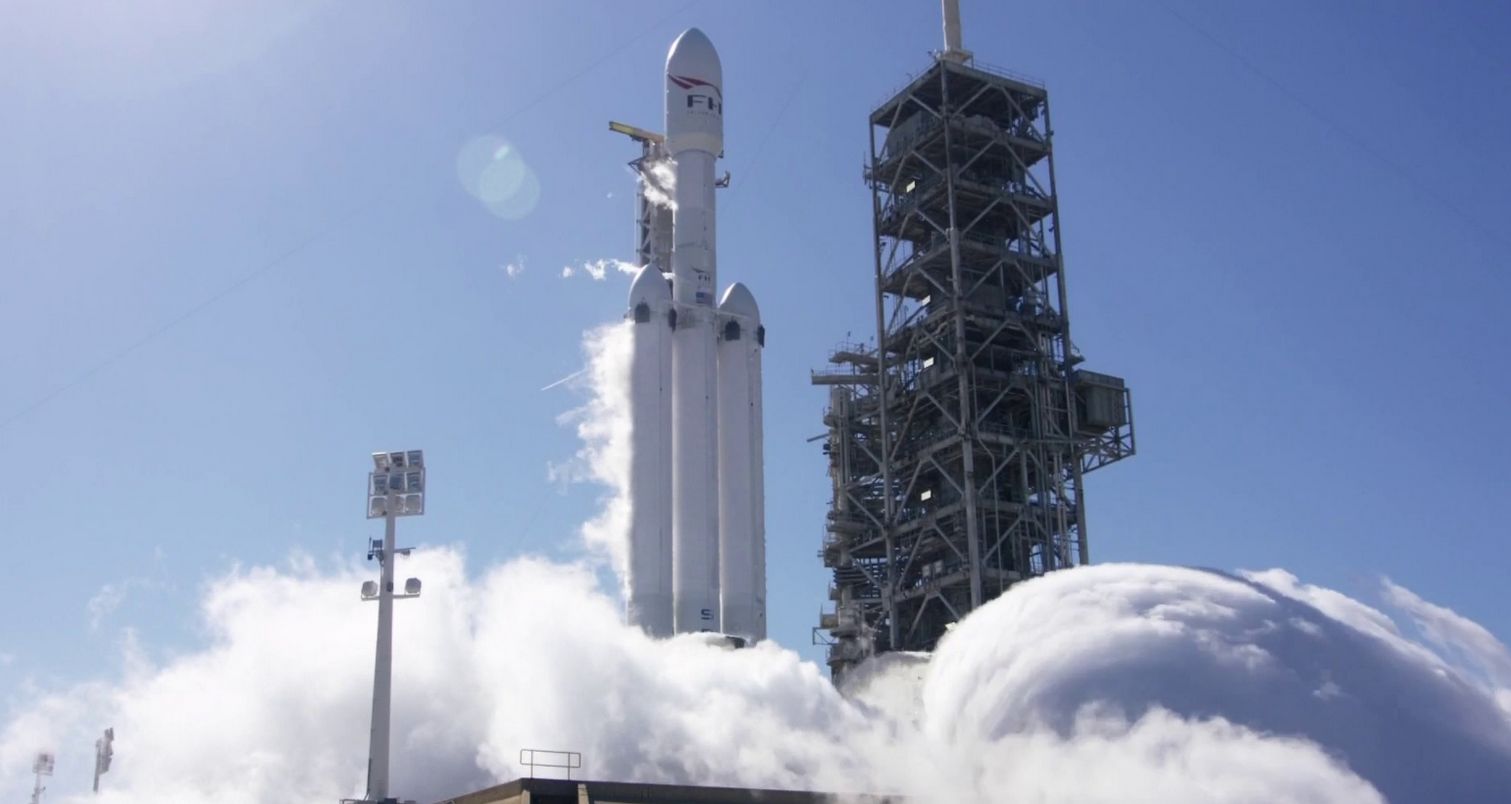
Fire in the hole! the Falcon Heavy’s 27 Merlin engines are test-fired on Pad 39A at NASA’s Kennedy Space Centre, January 24th, 2018. Credit: SpaceX

SpaceX faces a busy couple of weeks for the end of January and the start of February 2018. On Tuesday, January 30th, the company is set to launch Luxembourg’s SES-16/GovSat 1 mission on a Falcon 9 rocket from Launch Complex 40 at Canaveral Air Force Station on Florida’s coast. As is frequently the case with SpaceX missions, an attempt will be made to return the booster’s first stage to a safe landing  – this time at sea, aboard the Autonomous Spaceport Drone Ship Of Course I Still Love You in the Atlantic Ocean.

Then, if all goes according to plan, on Tuesday, February 6th, SpaceX will conduct the first launch of the Falcon Heavy booster which should be a spectacular event. As I’ve previously noted in these updates, Falcon Heavy is set – for a time at least – to be the world’s most powerful launch vehicle by a factor of around 2, and capable of lifting up to 54 tonnes to low Earth orbit, and of sending payloads to the Moon or Mars. The core of the rocket comprises three Falcon 9 first stages strapped side-by-side, two of which have previously flown missions.

For its first flight, the Falcon Heavy is set to send an unusual payload into space: a Tesla Roadster owned by Tesla and SpaceX CEO Elon Musk. It’s part of a tradition with SpaceX: mark a maiden flight with an unusual payload; the first launch of a Dragon capsule, for example, featured a giant wheel of cheese. If all goes according to plan, SpaceX hope to recover all three of the core stages by flying them back for touch downs; two of them on land, and one at sea using an Autonomous Spaceport Drone Ship.

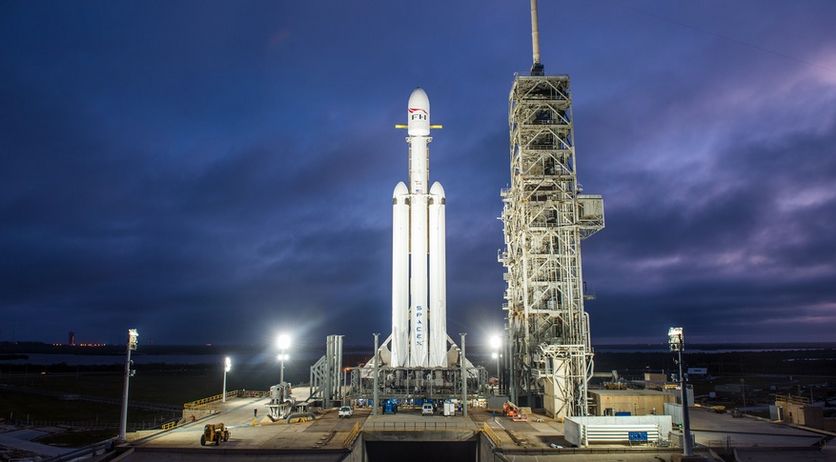
The Falcon Heavy is raised to a vertical position on December 28th, 2017 in a launch pad “fit test”. Credit: SpaceX

As part of the preparations for any Falcon launch, SpaceX conduct a static fire test of the rocket’s main engines.For the Falcon Heavy, this took place on January 27th, 2018. These tests have come in for criticism from some quarters as a high-rick operation. However, to date, SpaceX has not suffered a single loss as part of such a test, although in September 2016, a Falcon 9 and its payload were lost while the vehicle was being fuelled in preparation for such a test. For the Falcon 9, the test involves firing the 9 Merlin main engines for between 3 and 7 seconds; with the Falcon Heavy test, and possibly to obtain additional vibration and stress data ahead of the launch, all 27 engines were fired for a total of 12 seconds – almost twice as long as the longest test of a Falcon 9.

Assuming the launch is successful, it will pave the wave for Falcon Heavy being declared operational. The second launch will most likely carried a Saudi Arabian communications satellite into orbit, and the third flight of the Heavy undertake the launch of multiple satellites. All three launches will be watched closely by the US Air Force, who are considering using the Falcon Heavy as a potential launch vehicle alongside the Falcon 9, which was added to the military launch manifest in 2016.

TRAPPIST-1: Further Look At Habitability

Since the confirmation of its discovery in February 2017 (read more here), the 7-exoplanet system of TRAPPIST-1 one has been the subject of much debate as to whether or not anyone of the planets might be habitable – as in, have suitable conditions in which life might arise.

As I’ve previously reported, while some of the seven planets sit within their parent star’s habitable zone where liquid water might exist, there are some negative aspects to any of the Earth-sized worlds harbouring life or having the right conditions for life. In particular, their parent star is a super cool red dwarf with all internal action entirely convective in nature. Such stars tend to have violent outbursts, so all seven planets are likely subject to sufficient irradiation in the X-ray and extreme ultraviolet wavelengths to significantly alter their atmospheres and rendering them unsuitable for life. Further, all seven are tidally locked, meaning they always keep the same face towards their parent star. This will inevitably give rise to extreme conditions, with one side of each world bathed in perpetual daylight and the other in perpetual, freezing darkness, resulting in atmospheric convection currents moving air and weather systems / storms between the two.

Artist’s concept showing what each of the TRAPPIST-1 planets may look like. A new study suggests TRAPPIST-1d and 1e might be the most potentially habitable. Credit: NASA

However, on the positive side, TRAPPIST-1 is sufficiently small and cool that, despite their proximity to it, the sunward faces of the planets won’t be as super-heated as might otherwise be the case. This also means that the extremes of temperature between the lit and dark sides of the planets aren’t so broad, reducing the severity of any storms some of them might experience. Now a team of researchers have identified the more likely planets within the seven which might have conditions conducive for life.

This involved certain assumptions being made, such as all the planets being composed of water ice, rock, and iron, and – given some of the data concerning the planets, such as their radii and masses, are not well-known – a range of computer models having to be built.

In putting everything together, the team concluded that TRAPPIST -1d and TRAPPIST-1e might prove to be the most habitable, with TRAPPIST 1d potentially being covered by a global ocean of water. The study also suggests that TRAPPIST-1b and 1c have have partially molten rock mantles, and are likely to be heavily volcanic in nature.

In publishing their work, the team are reasonably confident of their findings, but note that improved estimates of the masses of each planet can help determine whether each of the planets has a significant amount of water, allowing better overall estimates of their compositions to be made.

Continue reading “Space Sunday: rockets, exoplanets landers and asteroids”

Space Sunday: of atmospheres, reusable rockets and Trojans

Artist’s concept showing what each of the TRAPPIST-1 planets may look like, based on available data about their sizes, masses and orbital distances. Credit: NASA

Back in February 2017, I covered the news about seven Earth-sized planets found in orbit around the super-cool red dwarf star TRAPPIST-1, roughly 40 light years away (see here and here for more).

While three of the planets lie within their parent star’s “habitable zone”, and so might have both an atmosphere and liquid water on their surfaces, I mentioned in both of those articles that the planets may still not be particularly habitable for life for a number of reasons, one of which is TRAPPIST-1 itself. As I noted in a previous article:

The nature of their parent star, a super cool red dwarf with all internal action entirely convective in nature, means that all seven planets are likely subject to sufficient irradiation in the X-ray and extreme ultraviolet wavelengths to significantly alter their atmospheres, potentially rendering them unsuitable for life.

A new study of TRAPPIST-1 now appears to show that it is a particularly active and violent little star.

Utilising data gathered on it by the Kepler Space Telescope, a team at the Konkoly Observatory, Hungary, lead by astronomer Krisztián Vida, have identified 42 strong solar flares occurring with TRAPPIST-1 over a period of just 80 days. Five of these events were multi-peaked, and the average time between flares was only 28 hours.

The most violent of the outbursts correlated to the most powerful flare observed on our Sun: the Carrington Event of 1859.

This was an enormously powerful solar storm, in which a coronal mass ejection struck Earth’s magnetosphere, causing auroras as far south as the Caribbean, and which resulted in chaos in telegraph systems around the world, with some operators receiving electric shocks through their handsets and telegraph pylons throwing sparks. Such was the power of the event, telegraph messages could be sent and received even with the power supplies to telegraphic equipment turned off.

The TRAPPIST-1 planets are far closer to their parent than the Earth is to the Sun, so events on an equivalent scale to the Carrington Event would hit the seven planets with a force hundreds or even thousands of times greater than Earth experienced in 1859. This, coupled with the general frequency of TRAPPIST-1 flares would most likely destroy any stability in a planet’s  atmosphere, making it extremely difficult for life to develop. And that’s assuming any of the planets orbiting TRAPPIST-1 have atmospheres.

Repeated strikes from solar flares can, over time, strip away a planet’s atmosphere. Again, given the proximity of the TRAPPIST planets to their parent, and the frequency of the stellar outburst exhibited by the star, it would seem likely that rather than being unstable, any atmosphere which may have once formed around any one of the seven planets has long since been stripped away, leaving the as barren, exposed lumps of rock.

SpaceX Successfully Flies Refurnish Falcon 9 First Stage & Announces Falcon Heavy Hopes

In April 2016 SpaceX made the first successful recovery of the first stage of a Falcon 9 launch system. Used to lift the SpaceX Dragon CRS-8 resupply mission capsule from the launchpad up towards orbit and a rendezvous with the International Space Station (ISS), the first stage of the rocket successfully touched-down vertically on the autonomous spaceport drone ship Of Course I Still Love You, 300 km (190 mi) from the Florida coastline just nine minutes after lift-off. In doing so, it achieved a long-sought-after milestone for the SpaceX reusable launch system development programme.

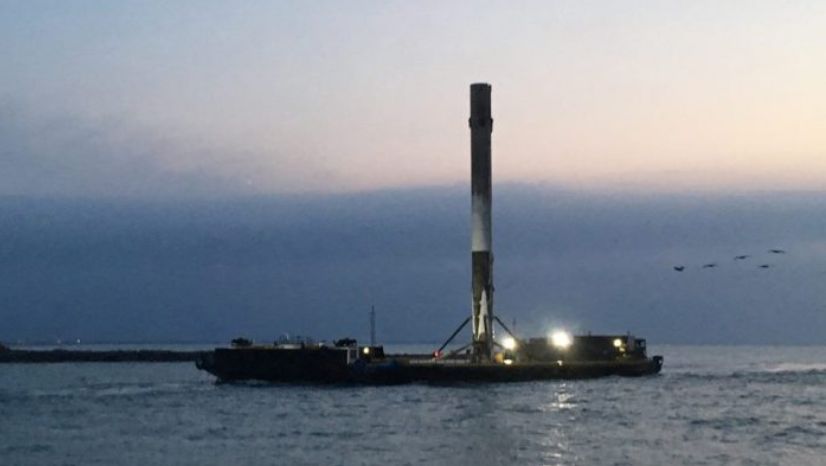
The world’s first reflown rocket booster, a SpaceX Falcon 9 first stage, is towed back into Port Canaveral, serving the Kennedy Space Centre, just before sunrise on securely mounted on the autonomous landing barge Of Course I Still Love You, on which it landed less than 10 minutes after a successful launch on March 30th, 2017. Credit: Ken Kremer/Kenkremer.com

On March 30th, 2017 that booster made its second successful launch and recovery, boosting the SES-10 telecommunications satellite  on its way towards orbit, before completing a successful boost-back to Earth, where it again landed on the waiting  Of Course I Still Love You.

“This is a huge revolution in spaceflight,” billionaire SpaceX CEO and Chief Designer Elon Musk told reporters at the post launch briefing at the Kennedy Space Centre press site, barely an hour after lift-off.The ability to re-use booster in this way could dramatically cut the cost of launch operations, removing the need for a brand-new rocket to be built and then disposed of with each launch – and lowering the cost of operations will not only make SpaceX vastly more competitive on pricing compared to rivals, it is also key to the company’s longer-term goals such as human missions to Mars.

The first flight of the SpaceX Falcon Heavy, may see the company attempt to recover the three first stage boosters and the upper stage of the vehicle, marking it as fully reuseable

Following the re-launch and recovery of the “used” Falcon 9 booster, Musk provided further details on the upcoming launch of his new super-booster, the Falcon 9 Heavy.

This vehicle comprises 3 Falcon 9 First stages  – one acting as the “core” to the rocket and two as “strap-on” boosters. It’s long been known that SpaceX plans to recover all three boosters following each Falcon Heavy launch. However, given the complexities involved in the first flight of a launch system, it hadn’t been entirely clear if attempts would be made to recover the boosters when Falcon Heavy flies for the first time in summer 2017.

But speaking at the SES-10 post-launch press conference, Musk confirmed that SpaceX would indeed try to recover all three boosters used be the vehicle, two of which will be refurbished Falcon 9s used on previous missions.

Landing three boosters requires considerable planning: SpaceX only has two landing options at Florida right now: the drone ship Of Course I Still Love You (the other, Just Read The Instructions, is currently based in California to support SpaceX operations out of Vandenberg Air Force Base), and their landing facility at Cape Canaveral Air Force Station. Thus, the launch will involve some aerial ballet, as Musk explained:

It will be exciting mission, one way or another. Hopefully in a good direction. The two side boosters will come back and do sort of a synchronized aerial ballet and land … That’ll be pretty exciting to see two come in simultaneously, and the centre core will land downrange on the drone ship.

A few days after this, he upped the ante further, announcing the flight will also attempt something never tried before – the recovery of the rocket’s upper stage as well. If successful – although even Musk believes the odds of recovering the upper stage on the first attempt to do so are slim – it will signal that his  dream of a fully reusable launch vehicle: first stage, payload fairings, and second stage, has come to fruition.

Continue reading “Space Sunday: of atmospheres, reusable rockets and Trojans”

Space Sunday: TRAPPIST-1, planet 9 and Europa

An artist's impression of the seven TRAPPIST planets, with -1b lower left and -1h lower right. The three planets in the star's habitable zone, -!e, -1f and -1g are the right-hand three in the top row. Credit: NASA
An artist’s impression of the seven TRAPPIST planets, with -1b lower left and -1h lower right. The three planets in the star’s habitable zone, -!e, -1f and -1g are the right-hand three in the top row. Credit: NASA

I recently wrote a space update special on the TRAPPIST-1 star system with its seven roughly Earth-sized planets. Since then, there has been speculation about whether any of them might support life, and what conditions for life might be like.

Whether life may have arisen on any of the worlds is tough question to answer. Three of the seven lie within the “habitable zone” where liquid water might exist (TRAPPIST-1e, -1f and -1g) – which is a positive for life as we know it. But for that liquid water to remain liquid, the planets must have an atmosphere. Currently, only TRAPPIST-1b and -1c have, through spectral analysis, been shown to harbour atmospheres, but these seem to be limited in scope, and could range from a water vapour rich atmosphere through to an environment similar to that of Venus.

On the negative side of the equation, the nature of their parent star, a super cool red dwarf with all internal action entirely convective in nature, means that all seven planets are likely subject to sufficient irradiation in the X-ray and extreme ultraviolet wavelengths to significantly alter their atmospheres, potentially rendering them unsuitable for life. Further, all seven are tidally locked, meaning they always keep the same face towards their parent star. This will inevitably give rise to extreme conditions, with one side of each world bathed in perpetual daylight and the other in perpetual, freezing darkness, resulting in extreme atmospheric movements and likely harsh weather.

Comparing the TRAPPIST-1 system with the solar system. Credit: European Southern Observatory / O. Furtak

Daylight on the planets would also be very different. Although one side of these worlds be forever in daytime, and despite the relative proximity with which they orbit their parent star, days on their surfaces would never be much brighter than sunset here on Earth, both in terms of colour and light intensity. This is because most of the light emitted by TRAPPIST-1 is radiated in the infra-red wavelengths, rather than visible wavelengths.

One the more positive side of the equation, despite the low levels of visible light, TRAPPIST-1 could still be able to sufficiently warm an atmospheres the planets might have, and the weather conditions might actually dissipate this warmth evenly over the planet’s surface, perhaps making it more hospitable to life.

It’s also likely the planets experience a lot of tidal flexing as they come under the influence of one another as well as their parent star. This flexing might give rise to hydrothermal and volcanic vents, which in turn could provide the necessary heat (energy), minerals and chemicals necessary to kick-start basic life.

Artist's impression of the three planets in TRAPPIST-1's habitable zone and to scale relative to one another. -1e (l) is the most likely to have extensive liquid water. It is 92% as big as Earth, with a mass of 62% that of Earth. It orbits its parent star about 10.8 times the distance from Earth to the Moon. -1f (c) is 1.04 times the size of Earth, but with only 62% of its mass. It is potentially water rich, and gets as much light from its star as Mars does from the Sun. -1g (r) is the outermost of the three
Artist’s impression of the three planets in TRAPPIST-1’s habitable zone and to scale relative to one another. -1e (l) is the most likely to have extensive liquid water. It is 92% as big as Earth, with a mass of 62% that of Earth. It orbits its parent star about 10.8 times the distance from Earth to the Moon. -1f (c) is 1.04 times the size of Earth, but also with  62% of its mass. It is potentially water rich, and gets as much light from its star as Mars does from the Sun. -1g (r) is the outermost of the three. It is 1.13 times Earth’s size with 1.34 times its mass. It is far enough away from its parent star that the surface is likely to be entirely frozen, but the gravitational influence of the other planets could give rise to a liquid water ocean under the ice. Credit: NASA

Studies of the TRAPPIST system will continue using the Spitzer and Hubble space telescopes and via ground-based observatories. However, as mentioned in my special report, it is likely to be the James Webb Space Telescope which will hopefully reveal many of the secrets of the TRAPPIST-1 system.

That said, and for those still wondering about intelligent life arising on any of these worlds, SETI, the Search for Extra-Terrestrial Intelligence has been “listening in” on the star for indications of radio traffic for some time (pre-dating the discovery of the first two planets in the system in 2016). Those surveys haven’t revealed any kind of radio emissions from the system that might be of artificial origin, but now we know there are seven planets, SETI has marked TRAPPIST-1 for further investigations with their Allen Telescope Array (ATA).

A Further Clue in the Hunt for Planet 9

Last year, Caltech astronomers Mike Brown and Konstantin Batygin found indirect evidence for the existence of a large planet in the outer reaches of our Solar System well beyond Pluto; since then, the search has been on. I first covered the hunt in January 2016, and followed it with updates in February 2016 and October 2016, and it now seems a new clue to the planet’s existence may have been revealed.

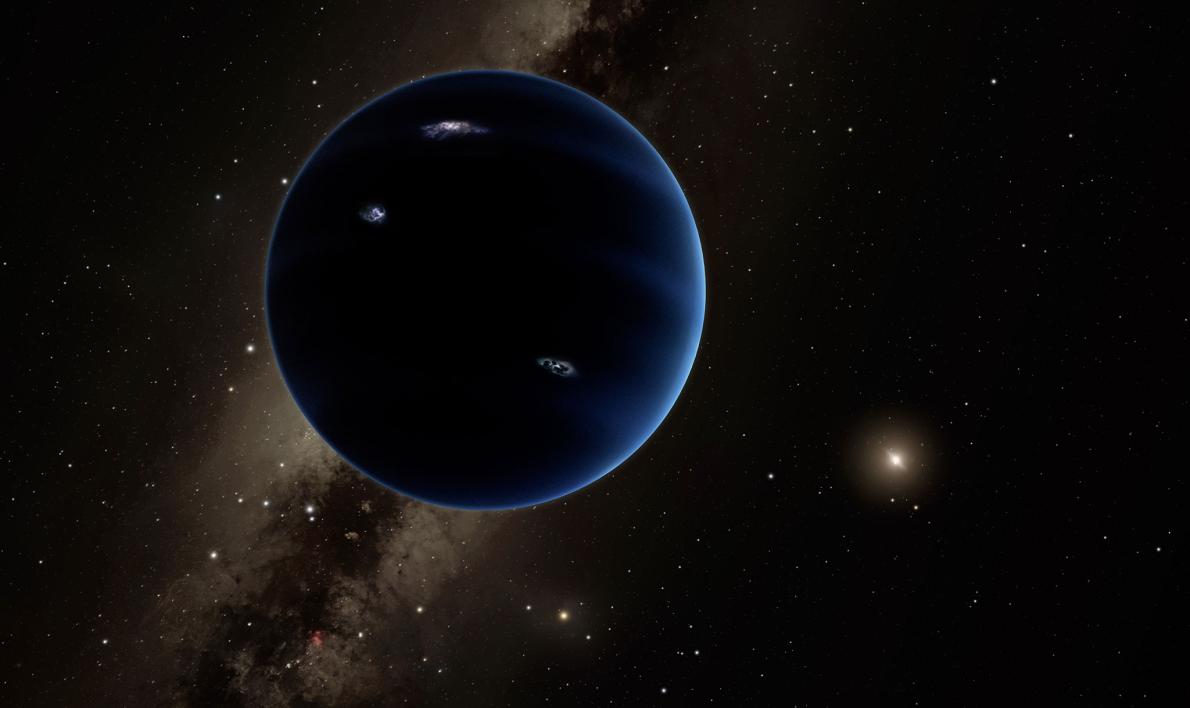
Planet X, if it exists,could equal Neptune in size, and orbits the Sun 200 times further away than Earth. Credit: Caltech / R. Hurt

Astronomers using the Gran Telescopio CANARIAS (GTC) in the Canary Islands looked at two distant asteroids, called Extreme Trans Neptunian Objects (ETNOs). Spectroscopic observations 2004 VN112 and 2013 RF98 suggest that the two were once a binary asteroid pairing that were pulled apart as a result of the influence of a mass massive body between 10 and 20 Earth masses in size and about 300 to 600 AU from the Sun. As a result of this, the two bodies drew further and further apart over, time they became more and more separated to become how we see them today.

“The similar spectral gradients observed for the pair 2004 VN112 – 2013 RF98 suggests a common physical origin,” said Julia de León, an astrophysicist at the Instituto de Astrofísica de Canarias (IAC). “We are proposing the possibility that they were previously a binary asteroid which became unbound during an encounter with a more massive object.”

de León and his team carried out thousands of computer-based simulations to see how this might have happened, and found the most consistent result suggested the bodies were separated as a result of a close passage by a massive planetary object around 5-10 million years ago.

As it might be: estimates concerning Planet Nine's possible size, mass, etc., should it exist. Credit: Space.com / Karl Tate
As it might be: estimates concerning Planet Nine’s possible size, mass, etc., should it exist. Credit: Space.com / Karl Tate

What is particularly interesting here is that the location of the two asteroids, coupled with the suggested mass of the body which pulled them apart and the distance it is believed to have been from the Sun, also fit the broader parameters for where the orbit of Planet 9 might reside, and the estimated mass of the planet. Thus, when combined with the eccentric orbits of several Kuiper Belt Objects believed to have been perturbed in their orbits around the Sun by planet 9, it gives further credence to the idea it really is out there, somewhere.

When – and if – it might eventually be found is open to question. However, it is hoped that a  recently started “citizen scientist project will encourage amateur astronomers around the world to join in the hunt for Planet 9.

Continue reading “Space Sunday: TRAPPIST-1, planet 9 and Europa”

Space update special: the 7-exoplanet system

An artist's impression of the sky from the outermost of the three TRAPPIST exoplanets in the star's habitable zone (see the 360-video below)
An artist’s impression of the sky from the outermost of the three TRAPPIST exoplanets in the star’s habitable zone (see the 360-video below). Credit: NASA

On Wednesday, February 22nd, US space agency NASA, working with a team of European astronomers, confirmed no fewer than seven extra-solar planets are orbiting a star some 39 light years away – with three of them within the so-called “Goldilocks zone” of habitability.

The star in question is TRAPPIST-1, named for the instruments used in its discovery, the Transiting Planets and Planetesimals Small Telescope (TRAPPIST),  and more formally known as 2MASS J23062928-0502285. Regular readers of my Space Sunday column might remember that I referred to the system back in November 2016, whilst discussing the James Webb Space Telescope and the hunt of exoplanets. The NASA announcement, which coincides with the publication of a new paper by the TRAPPIST team, adds dramatic new information to the distant star system.

The first two of the planets orbiting the star were located in May 2016, after the TRAPPIST team had studied the results of a continuous series of observations of the star between September and December 2015 using the telescope, located at the European Southern Observatory’s (ESO) La Silla Observatory in Chile.

Artist’s concept showing what each of the TRAPPIST-1 planets may look like, based on available data about their sizes, masses and orbital distances. Credit: NASA

What was intriguing about the two world was that not only were both within the so-called “Goldilocks zone” of their parent planet, where conditions might be “just right” for life to start, but both were roughly comparable to Earth in size, and therefore likely solid bodies, and spectral analysis suggested both have atmospheres.

A third planet, TRAPPIST-1d was also discovered the the same time, but it was behaving oddly. This prompted a further extended period of observation between September and October 2016, using both the ESO’s ground-based Very Large Telescope, and the Spitzer Space Telescope. This work revealed at “TRAPPIST-1d” was not one, but three worlds, again, all roughly in the Earth-sized category. Spitzer’s data additionally revealed two more planets of roughly the same size, taking the total to seven. Following this, Hubble turned its attention on the planets, looking for signs of hydrogen and helium – the chemical signatures that would indicate if any of them might be gas giants. It found none, further confirming they are likely rocky in nature.

The size, mass and density of these telluric worlds were obtained by measuring the periodic dips in TRAPPIST-1’s luminosity as a result of each of the planets passing in front of it. This allowed the international team studying the system to further assess whether each world was rocky, icy, or gaseous and determine which might be habitable.

trappist-1-3
Via: Space.com. Click for full size

TRAPPIST-1 is an ultra-cool red dwarf star only slightly larger than the planet Jupiter, and about 2,000 times dimmer than the sun.

Such stars, designated Class M, are the most frequent type of star in the Universe – making up an estimated 70% of stars in our galaxy alone. However, they do not radiate energy like our own sun, instead they are very volatile; all activity within them is entirely convective in nature, giving rise to massive stellar flares.

Given TRAPPIST-1 is so small, all of its planets orbit in very close proximity to it – closer than Mercury is to the Sun (the nearest orbits its parent star once every 1.5 terrestrial days, and the outermost, about once every 20 terrestrial days). This makes them very vulnerable to violent outbursts by the star, and could affect their surface conditions and their ability to retain an atmosphere.

This close proximity also means all of the planets are tidally locked – they always have the same side facing their sun. Thus they all are likely to have extremes of temperature, and those with an atmosphere are likely to have quite extreme weather as well. However – and conversely – it also means they could have the potential for liquid water to exist on their surfaces.

The innermost of the three planets in the habitable zone, TRAPPIST-1e, is very close in size to Earth, and receives about the same amount of light as Earth does, and may well have similar day time temperatures. The middle planet of the three, TRAPPIST-1f, meanwhile, might be a water rich world, also roughly the same size as Earth. It has a 9-day orbit, and receives about the same amount of light from its sun as Mars does from our own.

Another artist's impression of how the TRAPPIST system might look from the surface of one of the worlds - assuming they have liquid water present
Another artist’s impression of how the TRAPPIST system might look from the surface of one of TRAPPIST-1f, the middle one of the three planets in the star’s habitable zone – assuming it has liquid water present. Credit: NASA

Continue reading “Space update special: the 7-exoplanet system”