An Accidental No Exit in Second Life

Nitroglobus Roof Gallery: Milena Carbone – No Exit

No Exit is the title of the latest 2D art exhibition hosted by Dido Haas at her Nitroglobus Roof Gallery. It features the images and words of Milena Carbone, and is very much something of an “accidental” exhibition which still nevertheless offers food for thought – something Milena is prone to do with her art.

I’ll let Dido explain why No Exit might be considered an “accidental” exhibit:

[Milena] initially intended to work on a totally different project. However, this was cancelled due to her RL work as well as to her lack of motivation. So the images shown at the walls of the gallery this month were not created for an exhibition. Instead they were taken from the stream of images which Milena regularly produces for herself.
I made the selection and pointed out to Milena that there were always two characters in each image, .which made Milena think of the French philosopher Jean-Paul Sartre’s play “No exit” (“Huis clos” in French). And voila the title for this exhibition was born.

– Dido Haas, explaining the origins of No Exit

The connection between Satre and images is important to understand, because – as if so often the case with Milena’s work, there is a philosophical theme running through No Exit that invites consideration and, by nature of the framing of the play’s own central theme.

The title of the play actual comes from the French legal term “in camera”, denoting a private discussion behind closed doors; within it, three deceased people find themselves trapped in a room with no exit, doomed to face eternity with only one another’s company. Thus they are faced with Satre’s truth that “hell is other people” (L’enfer, c’est les autres), itself a reflection of his fascination with existentialism (perhaps most notably through L’Être et le néant), and of the internal struggle that arises when forced to view oneself from both the point of view (that is solely from how they see you in a particular moment) and the perspective (i.e. how they perceive you and your actions within the broader context of their own cultural and societal influences and personal biases / experiences) of another consciousness.
Nitroglobus Roof Gallery: Milena Carbone – No Exit

However, before delving into these deeper themes,  I would emphasise that these are images that can be seen and appreciated entirely in their own right and free from any more layer thinking. In fact, I would say they should be seen in this manner before being contextualised within the broader scope of theme and Satre’s world of ontological thinking; there is a beautiful minimalism to every piece that renders it fully as moment of narrative, encouraging us to freely construct a story around it, or to simply appreciate its form, tone, framing and expression.

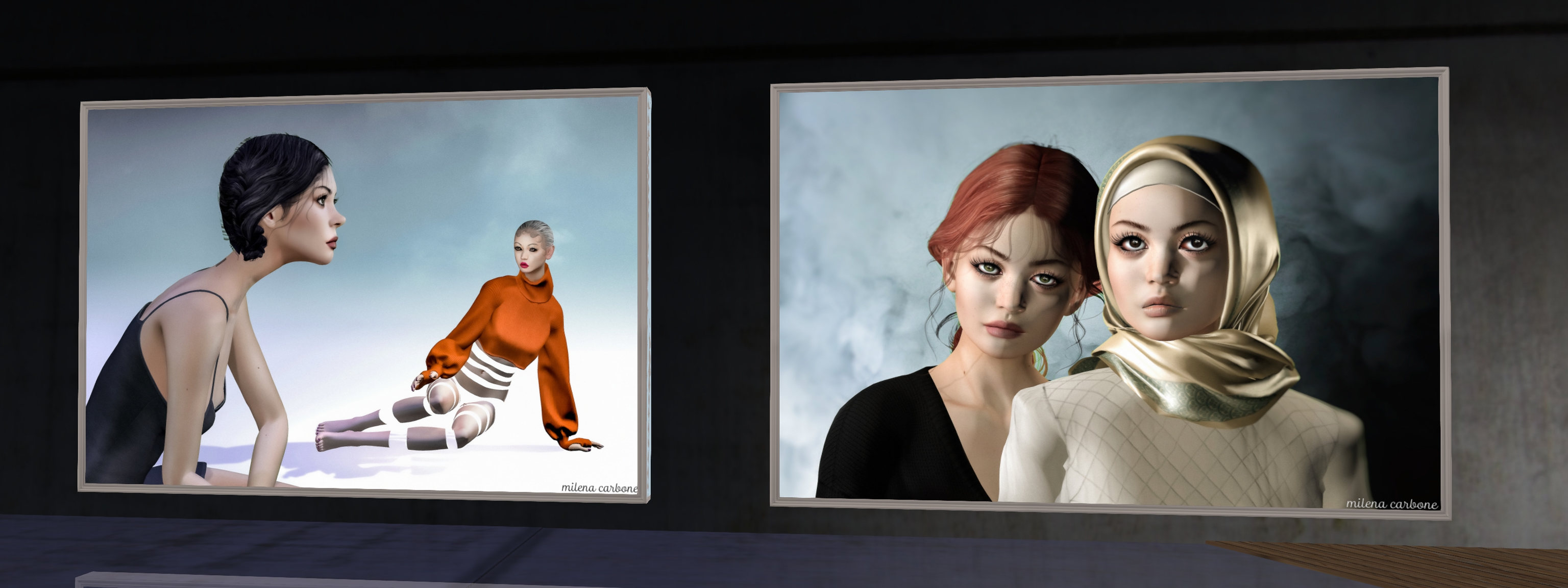
When Milena’s theme and Satre’s ideas are taken into consideration, these are images that taken on an entirely new depth. Take, for example, XXI Century. On the surface, a simple image of two women with different cultural heritages posing for a photograph – be they friends or relatives, it makes no difference. But, add the title of the piece into the equation, together with the fact one of the women is wearing an al-amira, and a more complex narrative emerges, that invokes thoughts of the manner in which during the first 21 years of the 21st century has continued to see the impact of “otherism” – the ostracising of those whose dress, system of belief and place of origin mark them as “different” and thus not to be trusted or allowed. It’s a negative attitude that has gripped many to the point of being without any exit; yet, were they to step outside of the strictures of peer / societal pressure, then the reality that we are all of one, single unique race would become that much harder to ignore.

Elsewhere, the questioning of self, and other others see is more direct (e.g. within Difference, Asymmetry, and The Invitation (the latter’s use of Black and white being particularly effective in bringing for the idea of differencing outlooks / perspectives that challenge our own). Whilst 7 Billion Bullets most clearly questions our entire attitude towards the preciousness of an individual life.

Nitroglobus Roof Gallery: Milena Carbone – No Exit

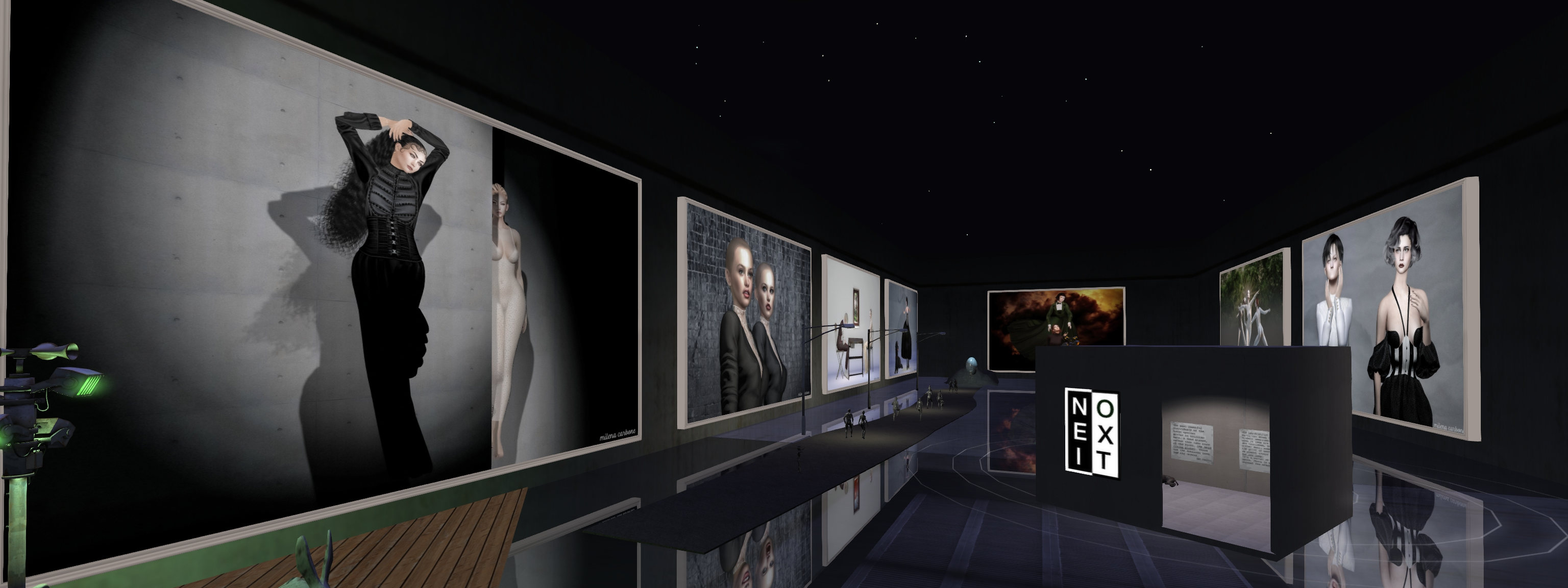
This image also leans itself to the central cube that sits between the two arms of the exhibition hall. Apparently open from the outside, in stepping in, it becomes a closed room with no exit – a physical representation of the room from Huis clos. Here we are forced to confront the fact that we are all essentially locked in rooms of self – everything we see or experience generates our world-view, making us all, in essence selfish; the imprint of those around us, through their thoughts and actions, rightly or wrongly, shaping our own views and outlooks, thus trapping us in our own hell of thought and convictions.

The words here carry both a startling reality of creating our own hell and – conversely – of allowing ourselves to become trapped in thinking that encourages us to retain that hell. The former is most succinctly stated through the commentary that global ammunition production means that each year, sufficient bullets are produced to wipe out all of humanity. Whether or not one is rooted in “the right to bear arms”, this is a grotesque factoid.; how much better might it be if the money poured into arms and ammunition were to be devoted to green sources of energy, improved food production, medicine and education?

Conversely, the fact that we are trapped within this one world is not an argument against attempting to expand elsewhere. For one thing, we are a naturally expansive race – and right now, we have nowhere else to go – a point of increasing concern given Earth’s finite resources. More to the point, space has more than anything else, given us the means to truly understand the fragility of this world and to actually start to take constructive (if limited) action to curtail damaging activities. For 60+ years, we have simply failed to more properly respond to what as been revealed, trapped as we have become in a materialistic, selfish need to have with no apparent exit – and pointing the finger of blame to a billionaire or two isn’t going to change (much less reverse) that; we – you, me, Milena, et al, are equally as guilty.

Milena is, I understand, absent from Second Life due to those physical world commitments mentioned above, and is liable to remain so for a while. As such, whether or not you are drawn to the philosophical / ontological expressions found with No Exit, or if you would simply like to again experience the attractiveness of her art for its own sake, this is an exhibition well worth witnessing.

Nitroglobus Roof Gallery: Milena Carbone – No Exit

SLURL DETAILS

Dido’s Minimal art in Second Life

Nitroglobus Roof Gallery: Dido Haas – Minimal

Dido Haas has slipped back into the smaller exhibition hall of her Nitroglobus Roof Gallery – a place I’ve taken to calling “Dido’s Space”, as it was used to be reserved for her personal art selections prior to her offering it as a space other artists might use. On display is a selection of eight images Dido is exhibiting under the title of Minimal.

All of the images are, as Dido notes herself, a step away from her usual style of work on a number of levels. Noted for her elegant, posed avatar studies and art that offers a clear narrative or sentiment to entice the audience into it, Dido’s work also tends to carry with it a delicate hand with post-processing to offer works that are richly finished in terms of their photogenic depth.

With this selection, however, Dido present pieces that are lighter in the touch of post-processing (if used at all) that is minimal in its finish, thus giving us the first reflection of the exhibition’s title. Further reflections of the theme are found in the way each piece is minimal in terms of its setting and framing, together with the fact that the props, etc. used by Dido all come by way of the Minimal in-world brand. Finally, there is the placement of Dido’s avatar; for those of us familiar with her exceptional still life and avatar studies, the majority of the pieces within Minimal reduce her avatar’s presence to a minimum, encouraging use to consider the scene as a whole.

Nitroglobus Roof Gallery: Dido Haas – Minimal

And this is where the final take on the idea of the “minimal” theme can be found: each and every piece is of such a nominal nature that, a Dido herself states:

The images … depict several scenes which make you wonder ‘what is happening there’? Use your imagination and make up your own story. 

In other words, these are pieces framed without overt commentary by the artists (other than the title), leaving the audience totally free to consider each piece, thus making them pictures that should be viewed as much by our imaginations as they should be by the eye of arts appreciation.

Take Telephone Booth for example – what brought the woman to the public telephone? Is it an innocent chain of events – such as being in a remote coastal area where cell ‘phone coverage is poor; or is due to more clandestine reasons – such as trying to avoid any record of the call appearing on her ‘phones records? Is her call to a loved one or is there something more to the call? Indeed, is she even making a call – or was it chance that she was passing when the ‘phone oddly rang; or is she even interested in it at all? It sits on the hook, and her attitude suggests she has no interest in it. Is the booth a means of escape, a place to hide  – and if so, from whom or what?  So many potentials for what may have happened  – or what may follow, as each image need not be the end of its narrative, but the beginning or even the middle.

Nitroglobus Roof Gallery: Dido Haas – Minimal

Intriguing and cosy in size, Minimal is an engaging experiment by Dido, one that exposes a different side to her work, one I certainly hope to see more of.

SLURL DETAILS

Hikaru Enimo’s Reflection in Second Life

Nitroglobus Roof Gallery: My Reflection

Who doesn’t know Hikaru? Dido Haas asks in reference to Hikaru Enimo in her introduction to the October art exhibition at her Nitroglobus Roof Gallery in Second Life. Well, to my embarrassment, I have to hold a hand up and say “me”; for despite Hikaru being a photographer, blogger, event organiser and Editor-in-Chief of L’Homme Magazine SL, I have not had a prior opportunity to view his work. Thus My Reflection, as his exhibition at Nitroglobus is titled, has been an opportunity for me to become better acquainted with, if not the man, then at least his work.

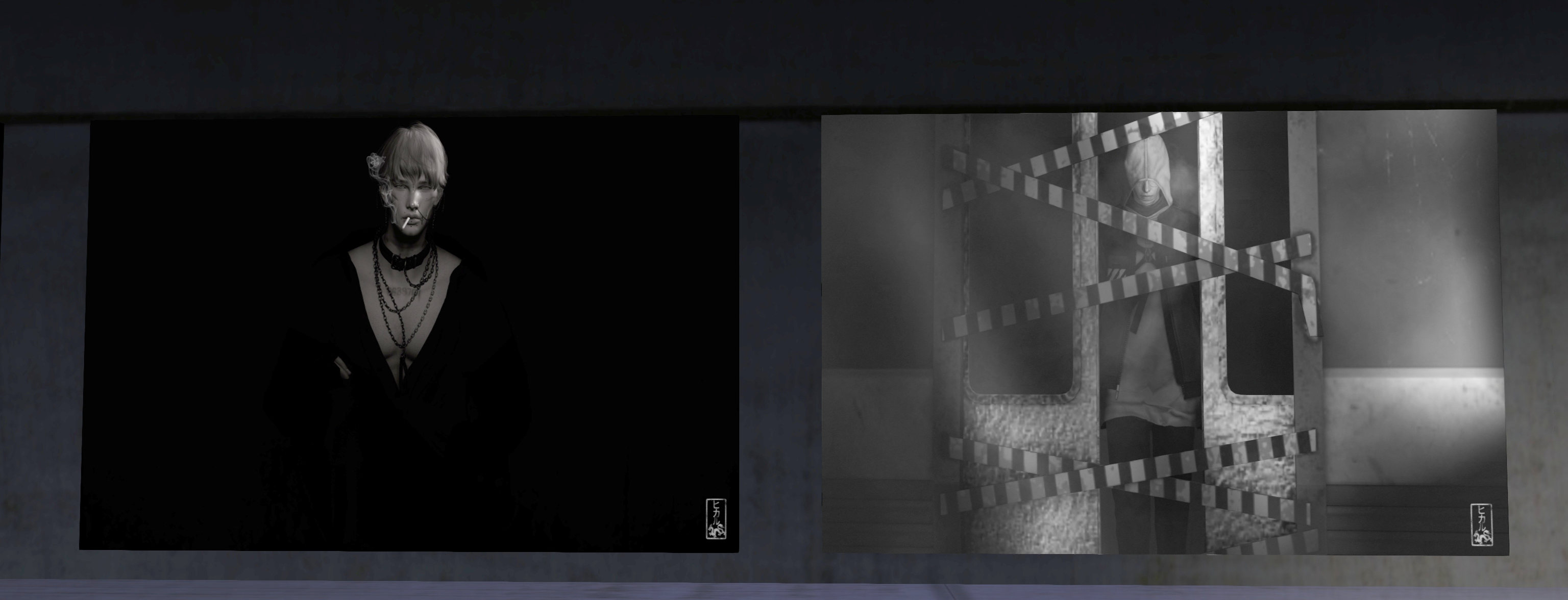
This is something of a person exhibition of pieces for Hikaru, as again the liner notes make clear. Each piece is intentionally designed to offer insight into the moods and emotions the artist was feeling during its composition of each shot, rather than just trying to evoke a mood or response in the viewer of his work. The result is a baker’s dozen of fabulously monochrome pieces that are presented in the large format that marks exhibitions at Nitroglobus, all focused on Hikaru’s avatar (joined in places by his dog), that are deeply expressive, and in which pose, tone, lighting and setting have been carefully crafted to as much give insight into the artist’s mindset as much as any facial expression.

Indeed, given that many of the images offered – in difference to Hikaru’s own comments on his use of his avatar’s gaze – eyes and face are not visible, the depth of feeling that is conveyed in some of these pieces just through pose completely captivates. Just take My Reflection 07, My Reflection 09 and My Reflection 10, for example, all of which contain a sense of listlessness borne of solitude and / or boredom. Similarly, Reflection 12 is a completely stunning narrative of mood in which, while it partially reveals a downcast face, the statement come no closer is perfectly portrayed through the placement of the stripped bars across the doorway before Hikaru’s avatar; so much so, I would suggest, that even whilst rendered in monochrome, bars mentally convey the idea they are in fact stripped yellow-and-black in that familiar warning do not cross.

Nitroglobus Roof Gallery: My Reflection

Where his avatar’s face is visible, the conveyance of mood / feelings is more directly pronounced, but not less marvellously framed. My Reflection 11 and My Reflection 04 (which I would not is definitely NSFW when viewing!) for example, utilise the placement of a hand over or before the face to charge each piece with its emotional content, the use of splayed or crooked fingers speaking volumes as to the thoughts that lie behind the avatar’s eyes even as those eyes remain hidden by lowered lids. Similarly, and alongside of it, the curl of cigarette smoke rising beside the steady gaze of Hikaru’s avatar in Reflection 01 draws us into his eyes and the sense of mood within them. And then there is My Reflection 14, where pose, directed gaze and the presence of a window (or door) frame between us and the avatar offers an entire story.

And it is in the idea of contained narrative that Reflections further unfolds before us. For while these are images intended to reflect Hikaru’s own moods, thoughts, feelings – and yes, his vitality – at the time of their creation, such is their depth and composition, we cannot help be see each as part of a larger canvas. Each image invites us in to it, awakening our imaginations to weave stories that can fill the rest of that unseen canvas. Stories in which our own role might also be defined: are we merely a observer of a moment in Hikaru’s life, or are we an invisible participant – lover, partner, friend, passer-by – looking upon someone we care for, like or just happen to see – or who has caught us unexpectedly within his gaze?

Nitroglobus Roof Gallery: My Reflection

Evocative, rich, personal, emotive and a tour de force of an artist’s talent for expression and story-telling, My Reflection is both a superb introduction to Hikaru’s work for those who like myself have not been fortunate enough to encounter it previously, and as a richly layered series of images that superbly straddle the line of “personal” and “public” in their conveyance of mood and narrative respectively.

SLURL DETAILS

Mihailsk’s Red Sky at Nitroglobus in Second Life

Nitroglobus Roof Gallery: Mikailsk – Red Sky

It was back to Dido Haas’ Nitroglobus Roof Gallery for the second time in less than a week, this time to visit Dido’s Space in the gallery (follow the bare footprints on the floor from the landing point to find it), where Greek photographer-artist Mihailsk makes his second appearance in a 3-month period, this time to offer a selection of new pieces under the title Red Sky.

Mihailsk is relatively new to the SL art scene in terms of exhibiting his work – his first such exhibition was actually the July appearance at Nitroglobus mentioned above, which took place in the main gallery space (see: Mihailsk’s Baptism of Fire in Second Life). The smaller Red Sky offers both an expansion on what made that exhibition so attractive whilst also contrasting very strongly with it.

In writing about Baptism of Fire I noted that Mihailsk – Miha to those close to him – produces work that is avatar-focused, but not necessarily avatar-centric. That is, whilst an image may include an avatar and framed in such a way to draw the eye to that avatar, it is the overall composition – pose, expression, surroundings – be they indoors or out – use of lighting and colour, etc., that are as equally as important in telling the story within the image, rather than sitting merely as a backdrop. With Red Sky, this is equally if more more true, with each of the pieces featuring – as the title of the exhibition suggests – a red sky of a deep crimson hue which serves to  additionally frame the emotional depth of each image.

Nitroglobus Roof Gallery: Mikailsk – Red Sky

Colour is oft used to define or evoke emotions and emotional responses; we talk in terms of someone “seeing red” when exceptionally angry, or of having a “black mood” or being caught in “the blues”; we believe muted tones and colours help evoke feelings of calmness or help people to relax, and so on. Red is especially evocative, as it generates so many responses / emotions / feelings. As noted here, it is often used to represent the stronger emotions of anger and rage, but at the same time it can also express the more tender – love, compassion, care; it can also express danger, the need to be careful or to keep away and, conversely it can emphasise attractiveness and wanting to attract through its use in the clothes we wear.

In his eight pieces, Miha offers six expressions / emotions with which were are all familiar: love, joy, longing, power, pain and danger, together with two pieces – Balance and Visualisation – that speak to broader themes. Within each image, the red sky / backdrop serves to reflect and enhance the sense of emotion already present through the use of other colours, pose, framing, and overall composition.

It is here that the contrast with Baptism of Fire is most evident: were the images there used darker or muted tones / monochrome shading that coalesced within each piece to express their emotion; here it is the strong contrast between the sky and other colours present – green, yellow, the tones of nature, etc., that frames the emotion. But at the same time, the use of colour / tone / shading in this way offers the same strength of narrative context through both exhibitions.

Nitroglobus Roof Gallery: Mikailsk – Red Sky

Writing in his liner notes for Red Sky, Miha states, “We are a part of the environment around us, not the main theme.” This is again evident through his work seen within this collection: the poses are natural in form, capturing simple gestures, etc., any one of us might naturally make in any situation; thus they are devoid of any sense of intentional construction, but appear as moments of life caught in a blink of a shutter, avatar and setting forming a natural balance. And here too, the crimson skies also play a role, for crimson is oft referenced as the colour of blood, the oil in our machine, so to speak, that keeps us running; thus we are reminded both through the emotional content of these pieces and the use of colour that life is not just about participating in it, it’s about experiencing it to the fullest extent we can.

SLURL DETAILS

Dido’s One Day: a visual sonnet in Second Life

Nitroglobus Roof Gallery – Dido Haas: One Day, September 2021

Dido Haas is taking a break from Second Life to enjoy a well-deserved vacation in the physical world, and in reflection of this, Nitroglobus Roof Gallery is taking a break from displaying the work of other artists in the main hall. Which is not to say it is empty: for September sees the hall host an exhibition of images by Dido herself, and quite marvellous it is!

One Day presents fourteen pieces framed around Amoretti LXXV, the 75th sonnet in a cycle of 89 written by English poet Edmund Spenser, a contemporary of William Shakespeare, relating his courtship of the well-off and beautiful Elizabeth Boyle. It is perhaps the most well-known of the cycle (itself a much overlooked collection when compared to his allegorical The Faerie Queen), opening with the line One day I wrote her name upon the strand (sand).

Nitroglobus Roof Gallery – Dido Haas: One Day, September 2021

One day I wrote her name upon the strand,
But came the waves and washed it away:
Again I wrote it with a second hand,
But came the tide, and made my pains his prey.
‘Vain man,’ said she, ‘that dost in vain assay,
A mortal thing so to immortalize;
For I myself shall like to this decay,
And eke my name be wiped out likewise.’
‘Not so,’ (quod I); ‘let baser things devise
To die in dust, but you shall live by fame:
My verse your vertues rare shall eternize,
And in the heavens write your glorious name:
Where whenas death shall all the world subdue,
Our love shall live, and later life renew.

Whilst breaking with the “tradition” of such works being about an unattainable love, the subject invariably already being married and thus beyond reach (Elizabeth Boyle was single, and she married Spenser in June 1594), this is a sonnet heavy in typical Elizabethan themes / conceits: the worshipping of beauty, the idea of immortalising that beauty (aka her name) through words (despite her honest rebuttal of said claims in her recognition that her beauty and name are doomed to fade and eventually fade with death), the promise, nevertheless of bringing her immortality by doing so, and so on; and these themes are richly reflected within Dido’s One Day.

The modern equivalent of immortalising a name and its associated beauty in word and sonnet, is via the photograph. Thus within this selection we have images with focus on Dido’s avatar – thus Writing her name”. These have a subtle eloquence in their suggestion of what makes a woman memorable to society: : her looks, her make-up, her clothing., a moment captured unexpectedly. Within these images are further layers I’ll come back to in a moment.

Nitroglobus Roof Gallery – Dido Haas: One Day, September 2021

Also to the found are several images of Dido on the beach. These are most clearly a reference / link to the opening line of the sonnet. But rather than being a simple hook on which to hang this exhibition, they also speak to something deeper within Amoretti LXXV. Elizabethan poets – Spenser included – waxed lyrical about “immortalising” their loved one’s name in writing – but invariably (and for assorted reasons) never actually use the name itself, instead leaving the reader with mere hints. Within Dido’s beach images we see this reflected in the way that we do not get a clear view of her face (her “name”, so to speak), but are left with hints thanks to the fall of hair, or distance of camera to subject, or that actual position of the camera relative to the subject, or the positioning of a parasol or seat, etc.

Elizabethan sonnets can be marked for the conceit of placing mortal love (oft bound with lust – itself perfectly presented in One Day 13) on a par with heavenly (virtuous) love. In Amoretti LXXV, Spenser in part touches upon this, proclaiming their love (and her beauty) is the kind of lover that shall continue after death (Where whenas death shall all the world subdue / Our love shall live, and later life renew.). Dido poignantly reflects this idea of beauty transcending to the heavens One Day 06 and One Day 07, both of which were captured at the fabulous Chouchou build of Memento Mori (see here for more on that stunning build).

The sestet in which Spenser makes his proclamation is a further extension of the central conceit within Elizabethan sonnets (at the end of the day, who is really being immortalised – subject or poet?). More particularly in this context, it comes after an attempt by his subject to rebuff him for his foolishness, noting that her beauty is but passing, and time and death will lead it to decay.

Whilst intended as a foil to allow Spenser his volta in to the sestet, Dido again captures the underpinning truth of the words uttered by Spenser’s love through those images depicting her avatar directly. The use of vivid red clothing One Day 14, One Day 12 and One Day 09, to draw the eye away from the face of her avatar, with One Day 14 and One Day 12 joining with One Day 08 to place her avatar off-centre. These positioning and use of colour thus causes the eye to shift focus away from the face – the name, if you will – of the subject, a visual metaphor for the passage of time dimming a woman’s beauty (and name). One Day 09 similarly presents this idea, but through the use of colour against monochrome, the bright red of the dress drawing attention away from the face (the “name”).

Nitroglobus Roof Gallery – Dido Haas: One Day, September 2021

So it is that One Day is a richly engaging exhibition. All of the images are marvellously presented and framed in their own right, each open to offering its own unique narrative, whilst together they offer an fascinating and layered visual interpretation of Amoretti LXXV. All of which makes the exhibition – which runs tough until the end of September-2021 – a display that should not be missed.

SLurl Details

The vulnerability of a Tough Man in Second Life

Nitroglobus Roof Gallery: Tough Man – August 2021

The terms tough guy and tough man are generally defined as a person who is  strong or resilient; a durable, often pugnacious and of undoubted resolution and resilience, able to deal with hard or difficult situations or a hard life. Both tend to bring to mind the hard-boned loner – cowboy, warrior,  etc., perhaps battling the odds.  Someone of a disposition to be reckoned with.

All of this is true enough, as far as it goes. But the “tough” part of these terms isn’t just about being a hard man, a fighter, or similar, or in having to show any particular prowess off. The genuine “tough man” is a person of confidence, understanding, and strength of conviction and ethics such that he is willing to do the right thing; he is a person that doesn’t see the need to hide behind façades of toughness or be afraid to should emotions or vulnerability. 

It is these latter points that make Hilaire Beaumont’s new exhibition Tough Man, which opened on August 11th at Nitroglobus Roof Gallery, curated by Dido Haas, an outstanding selection of single-frame stories.

Nitroglobus Roof Gallery: Tough Man

Hilaire is well-know for his avatar studies, although he does not tend to exhibit that often in-world – something that makes Tough Man even more appealing. He also does not regard himself as an artist – a point I would dispute, because his works contain all the richness to be found in any true work of art, not just from a technical perspective: framing, lighting, colour, etc., but because of the sheer depth of story each and every image carries with it, together with the richness of life, vitality and emotion each conveys.

This is doubtless in part because of his background in role-play in Second Life. Creating and inhabiting a character is very much an artform it itself; bringing that character to life such that they can be believed and interacted with requires a strength of imagination and willingness to emote and remain in character.  Coming from that background gives Hilaire, I would suggest, a deeper connection with his characters, and this is evidenced in the twelve images presented in this selection.

Nitroglobus Roof Gallery: Tough Man

In this 12 images (the exhibition poster is actually by David Silence, albeit based on an image by Hiliare), all of them new for this exhibition, gets inside his characters in a manner that sets his work above others; whereas an avatar study is generally posed  and framed to convey an emotion such that the image is essentially a moment out of time, the avatar a puppet in the telling of the story, Hiliare’s work genuinely conveys the story of the character within each of these images. Thus, rather than being a moment out of time, these are very much moments in time, capturing a specific point in the life of the character.

And while they well be framed in “tough man” situations, they go further than the typical archetype; each one offers a depth of emotion that is the true hallmark of the tough man – that willingness to stand firm for what is right, to show vulnerability, to stand against odds for something worth believing in; to be someone who finds not loneliness in being alone, but the comfort of his own company.

Nitroglobus Roof Gallery: Tough Man

As pieces of art or as stories or missives on the nature of the tough man, these are pieces that have a lot to say, and as an exhibition, Tough Man should not be missed.

SLURL DETAILS