Milena Carbone’s Africa at Nitroglobus

Nitroglobus Roof Gallery: Milena Carbone – Africa
Milena Carbone is an artist who is constantly pushing at both the boundaries of her own creative means of expression and what might be regarded as the bounds of comfort of her audience.  Through her work, she has encouraged us to consider the world around us and challenged us to face up to the harm we, as a race, appear hell-bent on doing to it – even though that harm may ultimately bring about out own demise. She has also often held up a mirror to humanity’s arrogance and poked us with the conceit of gods created in the image of Man, and she has dared to encourage us to face the failures of religion, the threat of climate change, and more.

Almost all of this is touched upon and / or embraced in Africa, her new exhibition of art opening on October 31st, 2022 at Nitroglobus Roof Gallery, curated and operated by the marvellous Dido Haas; a complex and layered exhibit, comprising images, interactive 3D elements, and external elements that present further depth to the installation, which takes as its central (but not exclusive) focus the subject of climate change.

The most obvious elements in the exhibition are the images. These are framed within the continent of Africa – a place of both unparalleled beauty and bio-diversity, and which has perhaps suffered more than most thanks to the uncaring hands of the so-called “developed” nations, and is set to do so even more unless those same developed nations are willing to actively work to reduce the global threat of climate change. They present two interwoven stories, those of Grace and Abel, which unfold as an almost Biblical journey from creation (symbolised by In the Beginning, located on the Gallery’s east wall to the right of the café building), to the end times and the fall of mankind, couple with latter-day plagues.

Nitroglobus Roof Gallery: Milena Carbone – Africa

These are stories we can enter into by clicking on the title plague for each image, located just below its lower left corner. These can be used to open “chapters” on Milena’s website which both offer narratives on Grace and Abel and their respective journeys, and offer-up broader food for thought -notably on the realities of climate change – for consumption.

Within the images themselves – which are also hybrid art pieces, utilising background generated via the Midjourney AI art generator combined with avatar images – can also be found reflections and dualities. Take Deluge for example. In title and tone, it echoes the story of Noah and the flood, and the destruction of all that went before; but even as it does so, it suggests more of a foreshadowing then a look back: because as climate change increases, the people of Africa – as noted in the preceding Burn Them All! – will face some of the greatest outfalls, prompting a mass migration – a literal deluge of peoples that could wash away our comfortable civilisations to the north and east of that great continent.

Running along the centrelines of the gallery’s two arms is a series of plinths mounting models of African animals. Each bears a label which may at first appear nonsensically humorous, but in fact offers commentary on the nature of our global society, where the divide between humanity and nature is becoming ever wider and more harmful, thanks to the former’s self-indulgent demands for instant gratification in all things. These models also carry additional subtext on both the issue of climate change and on the nature of “god” – whether seen as an independent consciousness or as a construct formed in our own image -, and our relationship with it. To appreciate this, it is essential that visitors to Africa approach each of the plinths in order to trigger its transformation.

Nitroglobus Roof Gallery: Milena Carbone – Africa
(There is also a further interactive element to the installation in the form of a dance video displayed at one end of the gallery, complete with dance positions visitors can use to join in with the performance.)

Further examination of our relationship with “god” can be found within the constructs of the images and the characters within them. Milena herself notes that “Abel” is drawn from the Biblical tale of Cain and Abel, whilst “Grace” is a name and a term often associated with “god”. The story of Cain and Abel is perhaps one of the clearest demonstrations of “god’s” fickleness whilst also presenting a metaphor for man’s inhumanity to man – something for which Africa, as a continent both straddling the equator and containing some of the world’s poorest and more in-need nations will perhaps pay one of the highest prices.

Nitroglobus Roof Gallery: Milena Carbone – Africa

From the above, it is hopefully clear there is a lot to unpack and interpret within Africa, and that it is an installation where interpretation should be guided via the artist’s words, and not an “interpreter” (or interlocutor) like me. As such, I will leave you with a recommendation that you visit Africa and allow yourself time to be immersed within the stories and flow of ideas lying within it.

SLurl Details

Invisible Cities: Fighting Women at Nitroglobus in Second Life

Nitroglobus Roof Gallery: Debora Kaz – Invisible Cities – Fighting Women

Invisible Cities – Fighting Women is the title given to a combined 2D and 3D art installation by Debora Kaz that is currently open to the public through until the end of August 2022 at Nitroglobus Roof Gallery, curated by Dido Haas.

Supported by a custom lighting environment created by Adwehe, this is perhaps one of the most complex installations and layered installations I have seen – something that in itself is saying a lot: Dido has a consummate skill in challenging the artists she invites to exhibit at Nitroglobus, consistently leading to installations that stand head-and-shoulders above those found elsewhere in Second Life in terms of their richness of presentation, meaning, and narrative.

Perhaps the best way to describe the installation is to use Debora’s own words, both from the introductory notes (available via the giver at the landing point) and the open letter Debora has written form women and which is displayed on the north side of the gallery space (and which is included with copies of each of the pieces in the exhibition when they are purchased):

Invisible Cities – Fighting Women wants to show the pain and difficulty of being a woman in a world where women historically were portrayed as objects of desire, exposed to consumption, which induces rivalry, resulting in us women not having a real union to fight the violence that is directed at us.

– Debora Kaz, introducing Invisible Cities – Fighting Women

Nitroglobus Roof Gallery: Debora Kaz – Invisible Cities – Fighting Women

Whether we like it or not, we live in a world that is largely derived in terms of patriarchy, be it societal, historic, or religious or a mix of all three. It is a global environment where even today, women are faced with a broad range of physical violence (1 in 3 women world-wide will be beaten or raped or face other forms of direct violence at the hands of males at least once in their lives) and more subtle psychological violence.

It is something many women the world over are trying to address and overcome through projects and activities such as One Billion Rising, through protests, activism and even through art – as has often been seen here in Second Life.

Nitroglobus Roof Gallery: Debora Kaz – Invisible Cities – Fighting Women

However, as Debora moves to point out in Invisible Cities – Fighting Women, we so often undermine these efforts by committing “violence” upon ourselves and one another: we cave to the demands of advertising, objectifying ourselves, turning ourselves into things of desire to attract others; we seek to dominate one another at work or socially, and so forth.

Within this capitalist game of consumption and desire, women compete with each other attack each other in an irrational way; and most of the time, they are not aware of it, because of the superstructure. Structural misogyny occupies the minds of not only men, but it is also present in the formation of every woman who is born objectified. The demand to be desired grows and seeks to be desired all her life – by men, but mostly by women; to be desired by another woman is to have power, to be better than others is wanting to be better than any other woman.
With this in mind, the union that women desire [in order] to combat violence against women [as] imposed [by] the history of patriarchal societies becomes unviable. It is not possible to unite when someone wants to have one power relationship over another.

– Debora Kaz, Invisible Cities – Fighting Women

Through the 16 images and 5 sculptures, Debora presents aspects of all of this in quite vivid and engaging pieces. Within them, we can find reactions to patriarchal dominance (Fuck God) to the need for mutual support (I’m By Your Side), and more. Throughout all of the pieces, colour pays a major role. Pink references both female empowerment and the struggles we face  – external and internal – to be understood as individuals, while harder, courser colours are used to represent emotional and the turmoil they can and create and the conflicts – again, internal and between one another – they induce.

Nitroglobus Roof Gallery: Debora Kaz – Invisible Cities – Fighting Women

Individually, these are striking pieces; each carries a weight of narrative that has impact – this cannot be denied. However, I would be remiss if I didn’t admit to being somewhat confused in understanding the core theme and message of this installation. I’m not sure if this is down to a shortfall on my part or because the artist has accidentally cast her net too wide and introduced to much in the way of narrative and subtext. As such, I encourage you to visit and explore Invisible Cities – Fighting Women for yourself and free from any confusion on my part.

SLurl Details

Art and Complex Chronic Disease in Second Life

Nitroglobus Roof Gallery, July 2022: Wicked Eiren – Body Language/The Invisible Woman

I’m going to open this piece with an apology to Dido Haas and – especially – to Wicked Eiren for coming to Body Language/The Invisible Woman relatively late in the day, the exhibition having opened at the end of June 2022.

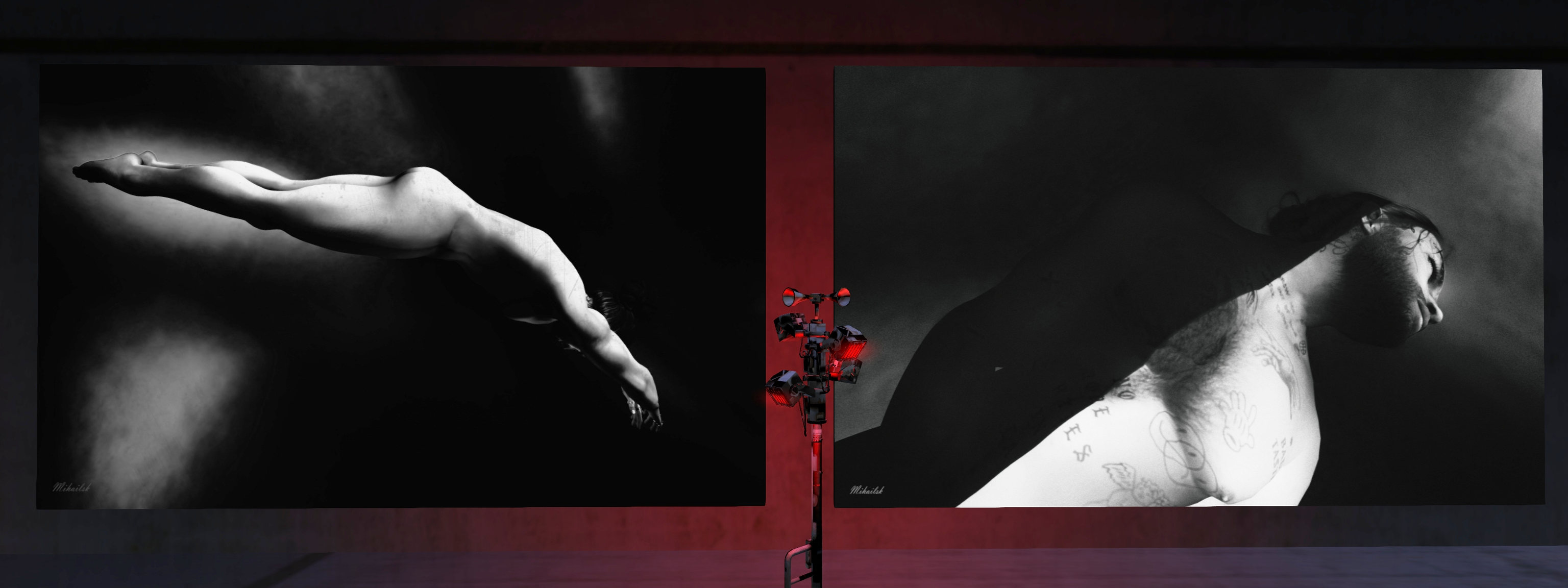
Located in Dido’s Space within Nitroglobus Roof Gallery, this is a tremendously powerful selection of black-and-white art in the personal message it contains – although the images themselves, as can be seen by the banner image for this article – should be considered NSFW.

Nitroglobus Roof Gallery, July 2022: Wicked Eiren – Body Language/The Invisible Woman

In the physical world, Wicked suffers from Complex Chronic Disease, also known as Central Sensitivity Syndromes (CSS), a health condition that combines a wide range of symptoms and conditions from a number of recognised illnesses including (but certainly not limited to) Fibromyalgia (FM) and Myalgic encephalomyelitis, and which can be complicated by chronic viral conditions such as the vicious Epstein–Barr virus (EBV) and bacterial infections such as Mycoplasma pneumoniae, each of which can give rise to multiple health conditions.

Such are the complexities and symptoms involved – physical, mental and psychological – CCD / CSS conditions are extremely hard to recognise or even correctly diagnose as they manifest in so many ways, individually and collectively. A further complication with the conditions is that they are further exacerbated by the central nervous system repeatedly misfiring, amplifying the sensory symptoms and leading to CCD / CSS being referred to as “pain without cause”.

This latter point does not mean that for the sufferer, the pain and related fatigue and mental anguish do not exist; the symptoms are very real and very physical, and require a complex approach to diagnose and care.

Unfortunately, the fact that the symptoms do seem to be without underpinning, easy-to-understand causes can result in those who have not experienced the conditions to dismiss both symptoms and sufferer (“oh you look fine!” or whispered “X has this mental thing” or “it’s just attention-seeking”, and so on) . This in turn can lead to a highly negative internalising of the conditions and the symptoms on the part of the sufferer, causing further withdrawal from the world.

Nitroglobus Roof Gallery, July 2022: Wicked Eiren – Body Language/The Invisible Woman

Body Language/The Invisible Woman is a subtle but exceptionally powerful statement on Wicked’s life with CCD / CSS, with the pieces presented speaking to both reality and desire. The desire to be seen, to be able to look at oneself free from the tyranny of discomfort, pain, fatigue and mental sluggishness – to be seen – in Wicked’s case – as a woman – beautiful, free, whole, and desirable; the reality in the ever-present company of those symptoms that force her to stand aside or hide, exemplified by both the poses used (note the use of light and show, the placement of hand, the crook of finger or thumb, urn of head, direction of look – all intended to hide as much as reveal) and the subtle rash-like lines of her body.

In this, the use of nude images should not be mistaken as being simply gratuitous or for the sake of titillation. The conditions associated with CCD / CSS are not something those experiencing can merely weather and “get over” through time and medication; rather, they defined the person experiencing them – however unwillingly – as keenly as their skin, that is as ever-present and familiar as the shape and lines of their own face. As such, the use of nude images serves to emphasise all of this, underlining the manner in which CCD / CCS is as much a constant to life as is flesh itself.

Similarly, the use of black-and-white images is evocative of the manner in which life might appear to feel: washed of colour and vitality; a plain mix of light and dark that personifies the wish to retreat, to hide. It also most effectively underscores the central tenet to the exhibition, as does the intentional monochrome lighting and overall presentation of the hall itself a monochromatic finish of its own: that those who experience CCD / CSS so often encounter a two-dimensional response from others: they are seen, but not who they are, because their pain causes them to be denied true expression and/or to be cosseted, be it out of lack of understanding (the aforementioned “it’s all in her head”) or over-protective response (“you shouldn’t be doing that! Let ME take care of it!”) that can be as equally denying and born of a lack of understanding.

Nitroglobus Roof Gallery, July 2022: Wicked Eiren – Body Language/The Invisible Woman

Remarkable and powerful, Body Language/The Invisible Woman is so deeply layer, there is much more I could say about it – but really, it is a collection of images that should be seen and allowed to speak for themselves, so I urge you to pay a visit before the exhibition closes, and let the pieces there speak to you directly – and be sure to taken the introductory note card from the board within the hall to learn more about Wicked and CCD.

SLurl Details

Loss, life and strength, Alone in Second Life

Nitroglobus Roof Gallery: Mihailsk
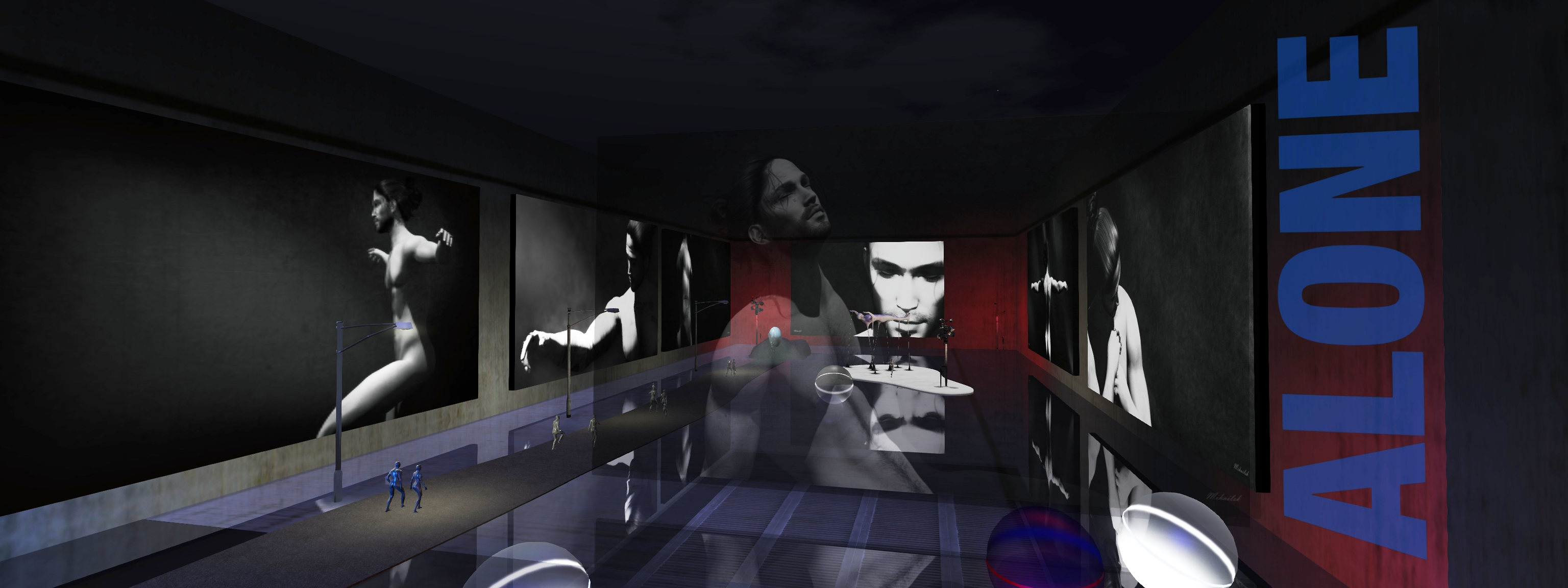
There are moments in life when you feel like you are losing everything; the laughter, the joy, in short the colour disappears from your life. You are ALONE, nude, mourning about what you lost. You have to find the strength to stand on your own feet again and find the light in the darkness that surrounds you.

– Mihailsk, June 2022

With these words, Greek photographer-artist and observer of life Mihailsk introduces guests to his exhibition Alone, which forms the June exhibit at Dido Haas’s Nitroglobus Roof Gallery. As might be gathered from his intro, this is an exhibition that leans into darker feelings and emotions: loss and loneliness, depression and hurt, whilst also offering a sense of hope beyond the shadow and pain.

The fourteen pieces Mihailsk presents are extraordinary in the depth of life they each offer. All are finished in black and white, using deep shadow and nudity to tremendous effect. But while nudity is present, it is not excessively NSFW, (although caution might be best employed with a couple of the pieces). Nor is its presence in any way gratuitous; rather, it is essential to the exhibition’s theme and tone.

Nitroglobus Roof Gallery: Mihailsk

This is because – as Mihailsk notes – nudity is the most physical manifestation of helplessness / being alone. When nude, we have nothing by which to hide our condition; we are literally and metaphorically laid bare to the world and our scars are openly visible; scars that are not necessarily physical, but certainly emotional (and represented here by the tattoos, marks and drawings present on Mihailsk’s torso and face). Thus its use within these images is a literal expression of naked emotion.

Similarly, the use of shadow and monochrome project feeling and mood. The shadows are perhaps most obviously representative of depression, feelings of darkness, loss and being lost. At the same time, the use of shadows to obscure eyes (together with eyes being closed) speaks again to sorrow, loss, and emptiness.

Contrasting with this is the use of light, both directed and visible. Through the pieces, whether indirect and lighting Mihailsk’s body and face, or direct in the form of beams of light falling across him or the presence of a ceiling light, give a sense hope for the future, and happier times will come again. More particularly, its presence within the images literally pushes back against the darkness, bathing Mihailsk in a sense of warmth, a visual reference to the fact that bad times do come to an end and that – to borrow from another expression – our darkest times come just before the brightest.

Nitroglobus Roof Gallery: Mihailsk

This hope is further expressed through pose. Nowhere is the figure slumped or huddled; instead, the poses all contain one or more suggestions of strength: a muscular outstretched arm, a seated back that is straight, not curved in defeat; the fluid movement of dance, and so on. Thus, they further add to the sense of hope for the future, that our inner strength will allow us to survive and to move forward as we seek the light of better times.

Accompanying the art are two quotes from Greek writer and poet Anastasios-Pandeleïmon Leivaditis and Belgian poet and novelist Eleanore Marie Sarton, both of which perfectly encapsulate the spirit of the exhibition. This can be found on the gallery wall, while lighting by Adwehe has been provided to add further atmosphere to the piece (make sure Advanced Lighting Model is enabled).

Rich in metaphor, meaning and very real emotion, Alone is an exhibition of enormous personal depth, but which offers a richness of feeling that it resonates strongly with anyone who has experienced one or more periods of loss and / or darkness.

SLurl Details

Dido’s Fade to Grey in Second Life

Nitroglobus Roof Gallery: Dido Haas – Fade to Grey

It was back to Dido Haas’s Nitroglobus Roof Gallery for me for the second of the May / June exhibitions on offer there. Fade to Grey, offered within Dido’s space at the gallery is an exhibition of Dido’s own images, all of which have been rendered as monochrome pieces, with some additionally post-processed to give the impression of drawings.

Dido is perhaps best known for her curation of Nitroglobus Roof gallery where – as I’ve oft stated in these pages – she is able to encourage artists from across Second Life to present exceptional exhibitions of their art. She is also, again as I’ve noted, a gifted photographer-artist herself. What may be less well known is that she is a blogger and Second Life traveller.

Since July 2009 I put a lot of my SL time in writing for my blog ‘Exploring SL with Dido‘, however the emphasize shifted more and more from text to images. In line with this I started to place my best blog images and more private photos in my Flickr account … Being so busy with curating the gallery, I have little time left to make images myself … But sometimes when I am in the right mood I do make images, most of them black/white. 

– Dido Haas

N

The eight images reflect Dido’s talent for black-and-white images and her love of exploration. They have been captured in various regions around Second Life, including Furillen, Quoted Memories and AEAEA islands. However, seven of the images are all very much studies in narrative, the focus being both Dido herself, and the embodiment of mood and emotion, while the eighth is presented as a self-portrait, finished as a drawing, an arm stretched forward as if in greeting / encouragement. All of them together offer an invitation for us to step into Dido’s Second Life and share in both her artistic view of our digital world and in her personal time in-world.

Small in size, intimate in content, Fade to Grey is a warm exhibition that can be enjoyed for itself – and for those who might like to, Dido suggests viewing the exhibition whilst listening to the most successful single released by British synth-pop group Visage, and which has the same name as the exhibition (and, as it was originally written as an instrumental piece, there’s also this version, if you prefer).

Nitroglobus Roof Gallery: Dido Haas – Fade to Grey

SLurl Details

Love as an artistic expression in Second Life

Nitroglobus Roof Gallery: Lika Cameo, Gravity
Love can be scary only because you realize you care about someone as much as you care about yourself. You open your hearth knowing that it could be broken, however being vulnerable is the only way to allow your heart to feel true pleasure, joy and excitement, and make you feel that true bond and energy that is pulling you to belong to the other.

– from the introduction to Gravity at Nitroglobus Roof Gallery, May 2022

Over the years – as I recently noted in writing about the gallery’s 10th anniversary – Nitroglobus / Nitroglobus Roof Gallery has been the home to some of the most remarkable exhibitions of art I’ve witnessed in Second Life down the years; so much so that singling one out over the others is practically impossible. However, I have to say there is something very special to be found within Gravity, an exhibition of work by Lika Cameo that will be open throughout May 2022 at the gallery.

Nitroglobus Roof Gallery: Lika Cameo, Gravity

An exploration of the nature of love, Gravity presents a series of images created by Lika that reflect, either individually or in groups of three, poems on the subject. The majority of the latter are by Celestial Demon, and are not what you might call “traditional” sonnets such as Barrett Browning’s Sonnet 43. Rather, there are more deeply focused on specific emotions both light and dark that accompany out love for another.

The imagery created by Demon’s words is powerful; within the poems we can find obsession, freedom, contentment, happiness, need, desire, comfort … Along with them are three further poems on love. Two are by Pablo Neruda and the third is by Lika herself, and offer the aforementioned more traditional approach to expressing thoughts and reflections on the subject.

Nitroglobus Roof Gallery: Lika Cameo, Gravity

Taken on their own, the poems offer considerable insight into the nature of love its push/pull / yin/yang nature it embodies.

Alongside of them, Lika’s art is literally poetry in images. As a mixed media artist, Lika has an extraordinary ability to offer expression and narrative through her pieces. Preferring to work in black-and-white / monochrome (there is one colour trio included in Gravity), she fully demonstrate this ability within this exhibition. There is a stunning richness of life and motion within every single piece on display, a richness that does more than reflect the emotions of the poems, it becomes a visual synonym for the emotions expressed within the poems.

Nitroglobus Roof Gallery: Lika Cameo, Gravity

What is particularly stunning with Gravity is the mutualistic symbiosis between art and poetry. All of the pieces, whether singletons or trios, stand independent of the poems to which they have been paired, making this an exhibition that can be enjoyed purely as a visual immersion. Similarly, if one chooses to do so, the poems can be read and appreciated without reference to the images alongside time. When taken taken together, however, they mutually benefit one another and Gravity takes on a depth of life and meaning that captivates.

With this in mind, and while I could prattle on at length here about Gravity, I’m going to spare you and instead genuinely urge you to see the exhibition for yourself.

SLurl Details