2018 Sansar Product Meetings week #3 – with audio

Sneaking a peep at Anu Amun’s new steampunk experience

The following notes are taken from the Sansar Product Meetings held at 4:00pm PST on the afternoon of Friday, January 19th, 2018. These Product Meetings are open to anyone to attend, are a mix of voice (primarily) and text chat, and there is currently no set agenda. The official meeting notes are published in the week following each pair of meetings, while venues change each week, and are listed in the Meet-up Announcements. and the Sansar Atlas events section.

Ebbe Altberg and Paul  (aka Pierre), Alex and Nyx Linden from the Sansar product team joined meeting host Jennifer for the event. Audio extracts from the meeting are included below for reference to key points in the discussions. Note that some subjects were discussed at different points in the meeting, and so some of the audio extracts here represent a concatenation of the different points at which a particular topic may have been discussed.

Web Atlas – Concurrency Indicators

The Web Atlas has been updated with a new search category – Popularity – and concurrency indicator. When selected from the sort drop-down menu (see below), the Popularity option orders the listed experiences in a tab by current real-time use,  so those with avatars actually visiting them will be listed first.

In addition, those experiences with avatars in them have a concurrency indicator in the top left corner of their thumbnail image. This is a near real-time indicator that the experience is in use at the time it is seen in the Atlas.
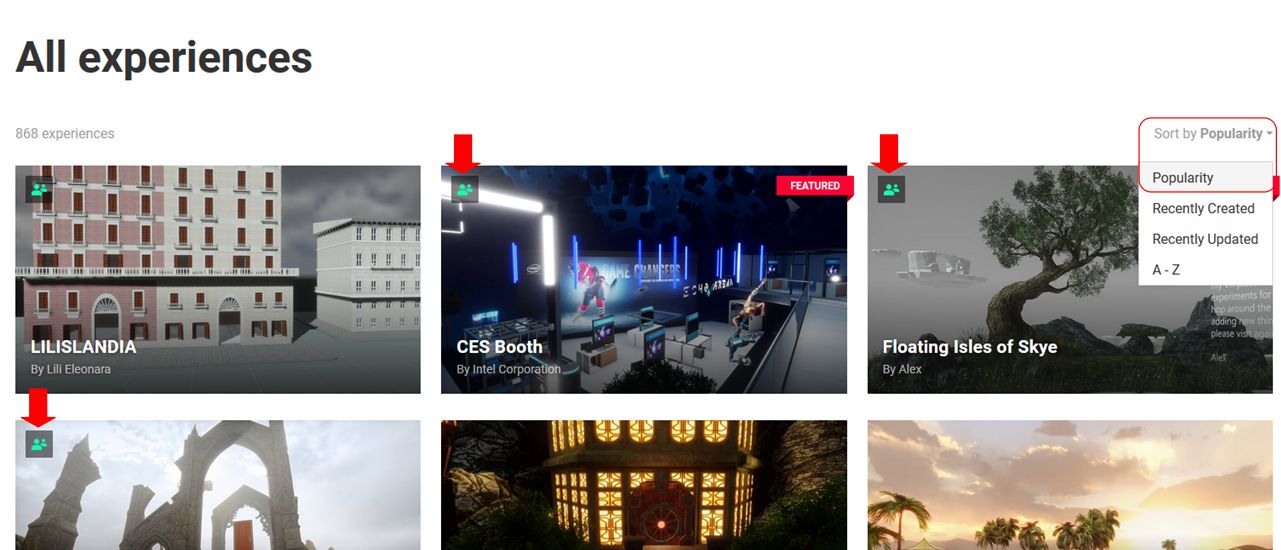
Web Atlas: popularity in the sort drop-down (circled), and the concurrency indicators (arrowed) available for all experiences with avatars in them on all tabs. Note the relatively low number of “active” experience in this image may appear low as it was captured at 10:40am UK time on a Saturday morning, a typical time for low concurrency numbers for VWs

The popularity search option and the concurrency indicator will be added to the client Atlas, possibly as an update in week #4. Both present a first step in presenting users with more information on popular experiences and in helping them locate spaces which have a “social” presence in Sansar.

Sansar Store Tags

It is now possible for creators to tag items when creating Sansar Store listings, and the Store Guidelines have been updated to reflect this.

January Release

The January 2018 release, referred to internally at the Lab as “Release 17” (the Fashion release having been Release 16), is primarily code / performance focused. In particular this update includes:

  • Bug fixes.
  • Performance improvements – for example, the amount of data sent to the client for avatar and dynamic object animations has been reduced by some 60%, which will hopefully make things more fluid for users in busy experiences.
  • An experience loading progress bar has been coded, although the scene loading page has yet to be revised to show it, and it is hoped this will be in Release 17, or deployed shortly thereafter.

User Sign-up / On-Boarding Process

The Sansar product team believe the current sign-up / on-boarding process for Sansar (see here for the basics) is too complex. It is hoped that a more streamlined sign-up process will form the nucleus of the February 2018 release, and that these updates, together with the Atlas popularity ratings / indicators, will make it easier for incoming users to sign-up and start finding experiences where they can meet and interact with other Sansar users.

Under discussion at the Lab is whether or not to create a dedicated “on-boarding” experience towards which incoming new users could be directed following sign-up, rather than just leaving them to find their way around the Atlas. This would not be part of the February release, and could be more of an exercise in testing which route  – via sign-up and then Atlas, or sign-up and “learning / tutorial” experience – is preferred by in-coming users / helps improve retention levels among new users.

Should Sansar have “on boarding” experiences akin to SL’s Social and Learning islands (shown above)? If so, should they be split between “general / consumer” users, and “content creator users”? How would such learning centres, as part of a sign-up / on-boarding process sit with experience creators providing their own gateways to their experiences? These are some of the questions the Lab is asking itself

One issue with providing any “centralised” on-boarding experience is how will it sit with user-created experiences? Part of the idea with Sansar is not to have a central / main “gateway” into the platform (as is the case with Second Life), but to allow experience creators to develop their own gateways directly to their own experiences (e.g. through a dedicated web presence, a corporate website, or via Facebook or Twitter, etc.). So, how do any on-boarding experiences supplied by the Lab fit with these routes of access?

Should a user signing-up to Sansar through a specific experience gateway be “diverted” to a Lab-created learning experience and then dropped into the experience they were signing-up to join? If so, how exactly should that work? Should they simply be dropped into the experience they were expecting, and be left to work it out for themselves / complete any tutorial options provided by the experience creator?

There’s also the question of how deep does any on-boarding experience have to go – can things be made easier to understand through the client itself – keeping the UI straightforward, offering on-screen indicators for controller buttons options when required, etc?

Mentors / Greeters

A suggest was made to have a “learning welcome” space where volunteer “Sansar ambassadors” (akin to Second Life mentors) can spend time helping new arrivals gain familiarity with using the Sansar client – the atlas, settings, walking, running, chatting in text, IMing, etc.

In response, Ebbe noted that – contrary to anecdotal views in Second Life – having mentors (either at their own welcome environments or those at the various Community Gateways in operation around Second Life) does not actually lead to any greater levels of retention among new users than the self-teach environments that have been presented to incoming users over the years. However, the is a willingness to experience with methods – with the use of AI-driven NPCs or the provision of some kind of “learning HUD” also being mentioned as possible options to help new users.

Events

Pierre reiterated his comments from the previous Product Meeting, that additional tools to help creators / users mount and promote their own experiences will be appearing in the very near future. This is again seen as a component in helping to drive user interest in Sansar.

Avatar and Fashion

Currently, the Sansar avatar is not – outside of the head / face – customisable other than with clothing and accessories. As recorded in my 2018 week #2 notes, there are plans to enhance the degree of customisation available within the avatar, starting with the head, and then with work on the body. This led to concerns on how additional avatar customisation capabilities might impact clothing design. Animator and creator Medhue Simoni in particular laid out his concerns in a video on the matter, which apparently became the subject of discussion at the first Sansar Fashion Product Meeting (which I was unable to attend), with it being indicated that the Lab’s Fashion Team had watched the video, taken note of the concerns raised etc.

As the avatar is enhanced, there may well be a need for clothing designers to go back and re-rig clothing created outside of Marvelous Designer (MD), although it should be possible to re-simulate MD clothing over a changed avatar body shape once this capability has been enabled with Sansar.

In the short-term for Fashion, there will be an update to fix the UV issues people are experiencing with MD, wherein the export to Sansar is using a different UV space to the export to other formats. However, the avatar customisations capabilities will be added gradually over a longer period of time.

To help compensate for the avatar updates, requests have been made for a deformer mechanism to be added to Sansar to allow rigged mesh clothing to more easily adjust to the avatar shape (and changes to it – think Fitmesh is Second Life as a broad idea), while potentially avoiding the need for clothing to be supplied in a range of sizes. This may not be so easy to introduce.

However, and whether it will be possible to implement or not is still unknown, the Lab is trying to determine if, where different clothing sizes are required, the platform itself can auto-generate different default sizes rather than the designer having to upload them all (e.g. if a designer uploaded an item in a “standard medium” size, the “standard large” and “standard small” sizes would be auto-generated from it).

One of the things the Lab wants to do is keep the fashion creation flow relatively straightforward, and avoid placing too many requirements on designers. They are therefore keen to avoid things like morph-based solutions and blend shapes (thus negating designers having to implement a whole series of body morphs into their designs or having to run through some conversion process to handle blend shapes, etc.).

Continue reading “2018 Sansar Product Meetings week #3 – with audio”
2018 Sansar Product Meetings week #2

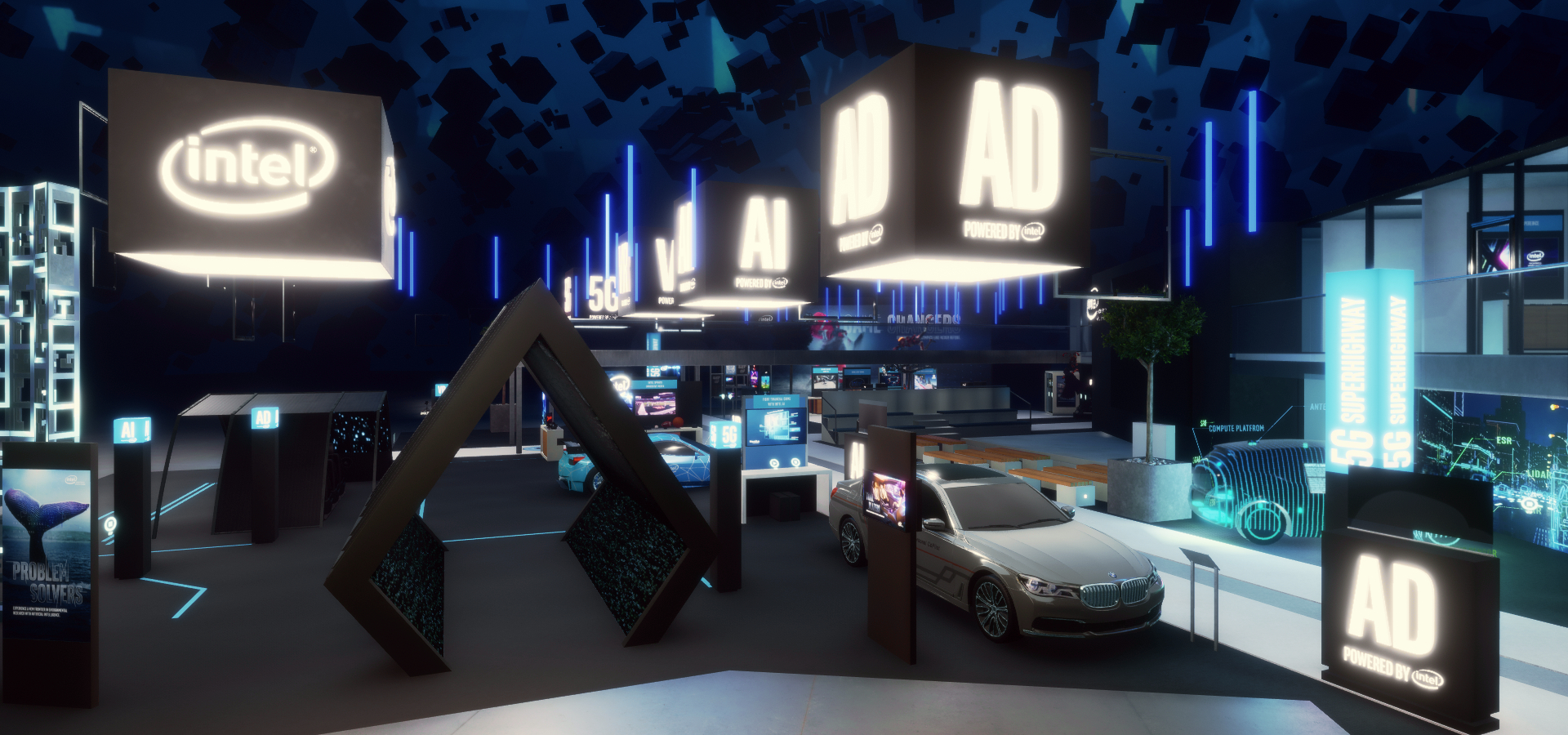
The Intel CES booth at the 2018 Consumer Electronics Show in Las Vegas, recreated in Sansar as a part of the show

The following notes are taken from the Sansar Product Meetings held on Friday, January 12th, 2018. These Product meetings are usually held every Friday at 9:30am PST and 4:00pm PST, and are open to all. There is currently no set agenda, and the meetings are a mix of voice and text. The official meeting notes are published in the week following each pair of meetings, while venues change each week, and are listed in the Meet-up Announcements. and the Sansar Atlas events section.

Joining both sessions alongside Jenn and Cara was Pierre (aka Paul), from the Business Operations team at the Lab, covering Sansar. His work involves the business side of Sansar (something not so in the public eye, but which particularly interests me), including corporate strategies and road maps, and among other things, he spoken about the Sansar presence at CES in partnership with Intel.

General Notes

Avatar Cap

There has been a 15 avatar limit imposed on Sansar experience during the past week. This has been to prevent individual instances of the experiences associated with the Consumer Electronics Show (CES – January 8th through 12th) becoming overloaded. As individual experiences cannot currently be capped for access, the 15 avatar limit was applied across all experiences. It should now have been lifted, or will be lifted soon.

Fashion and MD

The Lab will be starting a new series of meetings on Sansar fashion. It’s not clear what this will involve, but most likely will include information not only on what is upcoming on the fashion side, but also Marvelous Designer (MD). A request has also been put forwards for a new MD-specific channel on Discord. This is being considered, but for now, MD issues will be folded into the fashion channel.

Sansar Store 50 Item Limit for Free Accounts

In October, the Lab announced new Sansar Store policies, which at the time generated some negative feedback so that not all of them – e.g. the credit / debit card requirement – were implemented. At the Friday morning Product meeting, Jenn indicated that another restriction – limiting free Sansar account holders to only listing up to 50 items at a time – is also being lifted for the time being.

The Intel CES booth at the 2018 Consumer Electronics Show in Las Vegas, recreated in Sansar as a part of the show

Intel and CES

As noted above, Linden Lab and Sansar were represented at the 2018 Consumer Electronics Show, Las Vegas in partnership with Intel. Three experiences were made available as a part of this partnership: the Intel CES Booth (actually the entire Intel display floor), Step Inside Intel’s 8th Gen Core (a tour inside Intel’s latest CPU), and Aech’s Garage, an experience reproducing one of the film sets from the Warner Brothers Entertainment / Amblin Entertainment / Village Roadshow Pictures film Ready Player One, also presented in association with HTC – and which you can read more about here.

This partnership was so high-profile, it featured in the CES opening day keynote by Brian Krzanich, Intel’s CEO, and his specific remarks can be heard in this extract from his address.

While it may look a little cheesy to some, this kind of exposure is extremely beneficial for a platform like Sansar:

  • It offers huge exposure to an audience, even allowing for Sansar’s current stage of development.
  • Perhaps more importantly, it offers a practical demonstration of how an environment like Sansar can be used as a tool for business (e.g. running virtual booths where people can see / learn about products, innovations, etc., without necessarily being physically present), and for learning (e.g. take the Step Inside … experience, and learn how a CPU actually works…).

I should have more to say on this in a separate article.

2018 Plans

Pierre re-iterated that 2018 will see a shift in a lot  – but not all – of the Lab’s focus from content creation tool development towards encouraging general user engagement and retention. This was in part couched in terms of wanting to improve / smooth the user on-boarding process so that as and when experience creators start looking to bring their own audiences into their experiences, it will be a lot easier for them to do so. He also expanded on some points touched on by Ebbe Altberg in the January 5th meeting:

  • Concurrency indicators are to be added to the Atlas, providing a measure of people using experiences, and the Atlas can be sorted based on this.
  • Improved options for making friends.
  • A broadening of events support to allow experience creators and users to be able to host more of their own events and activities and promote them more easily through a range of channels – the Atlas, the web, social media, etc.
  • Performance is to be looked at to ensure the experience people have in Sansar is optimal, whether in terms of the number of people concurrently in an experience (e.g. 50-100 having a smooth experience in Sansar towards the end of the year), the load time of experiences, being able to appropriately hear people across and experience, etc.

Experience Numbers

In line with the above, the Lab is looking at  – and seeking feedback on – “ideal” limits for numbers within an experience. For example: is it better to have a band performing to one mass audience of 200-300 avatars (or more) in a single experience, or to have them play before a mass audience that is split between a number of experience instances “looking in” on the band? The later could help counter performance degradation with large numbers in a single space, prevent interruptions, etc., affecting the entire audience but – if the audience is so sharded to groups of 100-ish, each unable to see the other audience groups, it could detract from the overall immersion offered by the event.

There are also other issues to be addressed as well: audio (voice) roll-off seems to be problematic in Sansar experiences. Sometimes it is possible to have 3 or more little groups conversing around an experience without all the audio running together; at other times, even with groups spread around an experience, all the conversations seem to over-run one another, leading to an ugly mess of voices.

Continue reading “2018 Sansar Product Meetings week #2”

2018 Sansar Product Meetings week #1 with audio

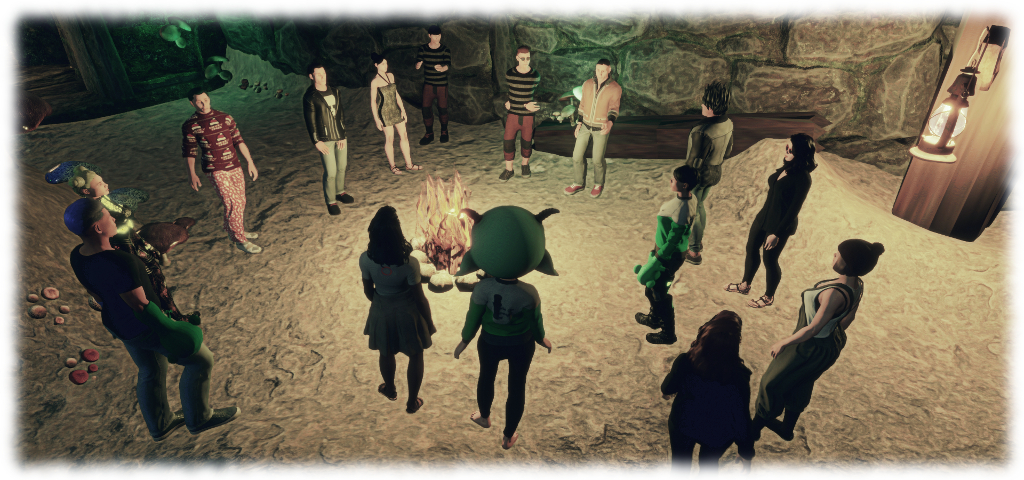
People gather around the camp fire for the first Sansar public Product Meeting of 2018

The following notes are taken from the Sansar Product Meeting held on the afternoon of Friday, January 5th, 2018 (I was unable to attend the morning meeting). These Product meetings are usually held every Friday at 9:30am PST and 4:00pm PST, and are open to all. There is currently no set agenda, and the meetings are a mix of voice and text. The official meeting notes are published in the week following each pair of meetings, while venues change each week, and are listed in the Meet-up Announcements. and the Sansar Atlas events section.

The January 5th afternoon meeting was attended by Ebbe Altberg, plus Carolyn from he Product Team and David and Sean from the Sansar character team. David has been working on the Marvelous Designer (MD) integration, and he and Sean were able to address questions around fashion, etc. Audio extracts feature Ebbe, David and Sean.

Avatar Notes

  • Custom skins: textures are seen as an important aspect of the avatar, allowing age, muscle definition, etc., to be applied. As such, it is something the Lab wants to expand upon. However, the focus at the moment remains on the fashion work, rather than on custom texture uploads and application, and it is down to the product team as to where the latter sits on the roadmap.

  • Texture resolutions: It has been noted that the avatar is a 60K polygon body apparently using 512×512 textures. Sean explained that the textures placed on the website aren’t actually the textures used on-line. Rather, an upload limit was hit within the ZenDesk software, forcing the use of lower resolution textures.
  • Avatar shapes / customisation: greater avatar customisation (changing height, shape, etc.), is “on the roadmap”. Currently, the focus is on increasing the amount of customisation available with the avatar face, with further bone morphs, work that is seen as “foundational” to adding the ability to customise the rest of the avatar shape.
    • How the facial work will be implemented is an open discussion. Sliders have thus far been used (as with SL), but this can be limiting when other forms of deformation are also applied. Recent games have tended to use a form of pick map for customising facial features – the user clicks on a point of the face (e.g. the cheek), and all the bones affecting that area respond to adjustments with the mouse, rather than having to adjust individual bones with individual sliders – and is mirrored where appropriate (e.g. cheeks, ears, etc.). This result in more natural looks, and is something that is being considered as a way of managing customisation in Sansar.

Fashion / Marvelous Designer

Cloth Physics and Layering

The integration of MD has allowed cloth physics to be used in Sansar – although currently these can only be seen / set within the Avatar App Lookbook (formerly My Looks) when editing an avatar. Cloth physics are actually “built-in” to the patterns exported from MD, with the cloth simulation code from MD being used within the client. This means it is unlikely that designers will be able to use other tools  – such as Blender – with the cloth physics capabilities without using MD as well.

The reason for restricting cloth physics to LookBook for the time being is that simulating cloth movement, etc., in Sansar’s Runtime Mode can generate a considerable performance hit; the Lab therefore want to focus on making  various performance improvements and further Runtime optimisations before they start looking at introducing cloth physics into the Runtime environment.

Currently, garments that are layered in MD (e.g a jacket over a shirt)and are exported to Sansar as a single item have their layering respected within Sansar (so the jacket renders over the shirt. However, individual items using the same layer will not be simulated correctly, and the Lab is working to rectify this. In the future, clothing should be layered relative to the order in which it is added to the avatar. So, for example, if you have a “layer 2” shirt and “layer 2” jeans, wearing the shirt first, then the jeans will result in the shirt appearing to be “tucked in” to the jeans, whereas wearing the jeans first, then the shirt, will result in the shirt appearing to be untucked.

In Brief

  • Roughness maps, handled directly by MD are coming into Sansar “too shiny”, requiring creators tweak them manually. This is to be referred back to MD.
  • It is currently anticipated that there will be no changes to the weighting / the way the IK rig is painted, etc.

User Engagement and Retention

2018 will see some attention switch away from developing technical capabilities towards broader issues of user engagement and retention.

  • Locating people: An upcoming change to the Atlas will allow experiences to be sorted in terms of current usage: those experiences with people currently using them will be listed with the most popular at the top, and then descending to those which are not currently being used.
    • This may be accompanied by a generic indicator that people are using an experience. This will not initially be a physical count of avatars, as there are issues around instancing (e.g. there may be 100+ in an experience, but spread across two or three instances, each with a different number of actual avatars in it – so while the count is 100+, you might be directed to an instance with only 15 other avatars in it).
    • An actual numerical indicator of the number of avatars in an experience might follow in the future.

  • Ebbe’s latest Sansar look

    Sansar forums blogs, etc: it has finally been recognised that the current tool used for these – ZenDesk – is not well suited to the task (YAY!), although fixing this is not a high priority. There have been internal discussions at the Lab about using the platform and tools employed in creating the Second Life forums, blogs, etc., to build something for Sansar – potentially more as a cost saving opportunity then for the sake of functionality. Frankly, I’m still stunned that this wasn’t the route taken from the start given the Lab have the tools and the experience to use them, which could have been easily leveraged, rather than going for a tool entirely unsuited to the task and which presents information in a very unfriendly – and dare I say amateur – manner.

  • Better in-world tools: emphasis will likely be given to providing “in-world” tools for better social interactions among users (e.g. things like group chat / group messaging, etc.).
  • Avatar Animations and Interactivity: giving people things to do in Sansar would also help with user retention. This could be as simple as offering basic animations to allow avatar to sit, dance, Animations such as sitting are seen as more complex, for reasons previously noted, unless objects are specifically scripted for handling this;  however, it might be possible for the Lab to implement a simple ground sit.
  • Improving the on-boarding process: the sign-up and getting started process is already seen (by the Lab) as a little complicated, so work may be put in on making this more straightforward.

One thing Ebbe indicated would be useful is collective agreements from creators / users on what they feel is needed to help with user retention. That is, not a myriad of individual ideas / suggestions, but a collection of ideas creator have agreed among themselves as perhaps being the most pertinent. While this should initially be geared towards the Lab’s focus of user engagement and retention, it might also include idea that help improve the creation and turn-around of scenes / experiences.

Feedback, Discussion, Engaging with the Lab and Future Meetings

In terms of engaging with the Lab, offering / receiving feedback (including discussing platform limitations / shortfalls)  can also be carried out through Discord, which can also draw other creators into discussions.  At some point in the future, the current meetings within Sansar may be expanded into a similar kind of structure as the SL User Group meetings: product, scripting, characters, engineering, etc.

Inventory – Scene and Avatar

Scene Inventory

The current inventory system in the Edit Mode doesn’t have any real inventory management tools. The have been discussions at the Lab on how to improve inventory & the inventory tools / options (e.g. use of nested folders, etc.). No single approach has been decided upon, but it is still being looked into – however, due to the emphasis on user engagement, it may slip down the priorities list.

Avatar Inventory

Unlike Second Life, Sansar avatars currently do not have a notion of inventory per se when in an experience; attachments and clothing can only be added / removed via the Avatar App – LookBook. This means that at present, an avatar cannot  simply change outfit or wear a gun or other accessory from within an experience – the use must go to LookBook, change the outfit  / add the attachment, then come back – and land at the experience’s spawn point.

From the point of view of games, this is hardly ideal. Options such as an avatar having a “backpack” (whether this would be physical or virtual is unclear) into which items can be placed and used, are being looked at. However, this kind of a solution also has questions around it: should such a backpack be persistent across experiences, so avatars can cross from one to another and retain items in it? Should it only apply to items collected in the current experience? Also, currently, only items from LookBook can only be associated with an avatar if worn / attached – so any notion of being able to “take” items from LookBook and drop them into a “backpack” to carry around experiences would require a considerable about of work – if possible.

Continue reading “2018 Sansar Product Meetings week #1 with audio”