Gem Preiz: Exoplanet II: On The Way Back in Second Life

Gem Preiz Exoplanet 2: On The Way Back

In February 2022, Gem Preiz opened Exoplanet: Once Step Further; the first chapter in a two-part series that combines a science-fiction story with his fractal art to offer a vision of humanity’s innate desire to explore, discover, learn about and understand the cosmos around us (see: Gem Preiz: Exoplanet – One Step Further in Second Life). Now, with its formal opening on Wednesday, June 1st, 2022 comes the second chapter of the series, once again hosted by Akiko Kinoshi (Akiko Kiyori) within her “Akipelago” art hub of regions.

In the first chapter (which remains open to visitors) we are invited to a crew of astronaut-scientists engaged on the deep-space exploration of planets beyond our own solar system – referred to as exoplanets in the science community – and to consider the remains of civilisations the crew have discovered, as represented by Gem’s fractal images displayed within the base the crew have established. Now, with Exolpanet 2: On The Way Back, we find the crew aboard a space station (or perhaps, for reasons I’ll come to, a ship-come-station) about to make the return to Earth.

Gem Preiz Exoplanet 2: On The Way Back
Astronomy is a science that makes you dream. The observation of distant objects transports us in space and time, and leads us to ponder the origin of the universe and the possibilities of hosting extra-terrestrial life there. The discovery of exoplanets in 1995 opened up a new field of exploration which could undergo even more spectacular development thanks to the new James Webb telescope. The enthusiasm for their discovery was nourished by science fiction stories, now legitimized by the proof of the existence of these worlds.

– Gem Preiz

As with the first chapter, Exoplanet 2 is both art installation and immersive environment intended to nudge visitors into thinking about life and and interstellar exploration. The station (/ ship) itself is built on a vast scale, with multiple levels to explore, both within the vertical central core (housing the essential systems and services – control, power, life support (including a hibernaculum), medical and essential crew facilities), surrounded by two concentric rings of additional facilities, including labs, crew sleeping quarters, access to docking facilities and small ship hangers, escape pods, etc. Through all of this are points of interaction (look for the hand icons), whilst floor-and-wall mounted teleport disks and buttons provide fast transit between different points of the station.

The art comes in three primary forms to be found throughout the station. The first is a series of eight framed fractal images depicting the worlds the crew has visited; the second, eight sketch-like images of locations within Second Life, serving to remind the crew of their beauty of their home world – and us of the fact they we are all bound to a single, beautiful but wholly fragile planet.

Gem Preiz Exoplanet 2: On The Way Back

The third art element sits within the Entertainment section of the station. Here can be found two large media screens which can display videos of some of Gem’s past installations. These include a video of Wrecks, itself part of a  two-element exhibition of Gem’s art from 2016 (called Heritage) and which also formed an evocative foray into the realm explored through Exoplanet (see: Of Heritage and Wrecks in Second Life).

A fourth artistic element might be said to exist outside of the station, where Gem has used a series of EEP settings to provide a changing backdrop of astronomical images. These include distant galaxies, stars, imagined worlds and moons a lot closer to home, and can be viewed either by camming out or by one of the little personal flyers found in one of the station’s hangers and taking a trip outside. Just be sure you are using the installation’s EEP settings (make sure World → Environment → Use Shared Environment is checked).

Not only do these EEP settings offer an additional layer of art, they also suggest the station is “jumping” its way through the cosmos to bring the crew back to Earth.

Gem Preiz Exoplanet 2: On The Way Back

Exoplanet 2 is also linked directly with Exoplanet: One Step Further via the teleport HUD, which can be obtained at the main landing point (and which provides direct access to the major points of interest in both installations), or by finding your way to the shuttle about to launch from the station, and which contains a teleport to Exoplanet.

A detailed introductory card is available to visitors on arrival, which both provides an overview of the installation and explains some of Gem’s thinking behind it. The card makes for a recommended read, and Exoplanet 2: On The Way Back makes for a rich, engaging visit.

SLurl Details

2022 SUG meetings week #22 summary

Tempura Project, April 2022 – blog post

The following summary notes were taken from the Tuesday, May 31st, 2022 Simulator User Group (SUG) meeting. It forms a summary of the items discussed and is not intended to be a full transcript. A video of the entire meeting is embedded at the end of the article for those wishing to review the meeting in full – my thanks to Pantera for recording it.

Server Deployments

At the time of writing, there was no server deployment thread for the week, or release notes for the RC updates.

  • On Tuesday, May 31st, the SLS Main and Event channel servers updated to simulator version 2022-05-20.571998, which includes a couple of fixes, including one for the issue with objects not showing up when you first log-in.
  • Wednesday, June 1st should see the RC channels receive an update with fixes in support of the upcoming Premium Plus capability.

Available Official Viewers

There have been no official viewer updates at the start of the week, leaving the current crop as:

  • Release viewer: version 6.6.0.571939 – formerly the Performance Improvements viewer, dated May 25th – NEW.
  • Release channel cohorts (please see my notes on manually installing RC viewer versions if you wish to install any release candidate(s) yourself).
    • Makgeolli Maintenance RC viewer (Maintenance M) viewer, version 6.5.6.571575, May 12.
  • Project viewers:
    • Performance Floater project viewer, version 6.5.4.571296, May 10.
    • Mesh Optimizer project viewer, version 6.5.2.566858, dated January 5, issued after January 10.
    • Legacy Profiles viewer, version 6.4.11.550519, dated October 26, 2020.
    • Copy / Paste viewer, version 6.3.5.533365, dated December 9, 2019.

In Brief

  • To avoid over-/mis-use, Mazidox reminded people when filing bug reports to differentiate between rezzing and rendering. The former only applies to objects being placed into the world; rendering refers to objects already in-world. So, when you TP to a location, the objects within it are not rezzing, they are rendering.
  • Options for dealing with BUG-232143 “Substitute with NULL_PARAM whenever a variable of llSetLinkPrimitiveParams is not being changed.”, and this will likely get further discussion at the next meeting.
  • Brad Linden touched upon the materials / PBR project the graphics team is working on – see my most recent CCUG meeting summaries for more background. He specifically raised the proposed scripting support for the materials aspect of the work, noting a draft specification of what is being considered will be published shortly. Currently, two functions are under consideration:
    • llSetMaterial(key material_id), with LL thinking this could be framed in a similar manner to llSetAgentEnvironment() and possibly  llSetPrimitiveParams() work.
    • and llSetMaterialParams( parameters TBD), which will override only the specific params that are modified by the function, and will likely be framed in a similar manner to how llSetTexture() works.
    • Those interested in learning more should likely attend the CCUG meetings, with the next due to take place on Thursday, June 2nd, 2022.
  • The above topic also incorporated texture preloading (which, given the new materials assets will be called directly by the viewer via the CDN, should have to be used for any pre-loading with them), with an “llPreloadAsset” function might ever be available (would need to be a project of its own), and object culling.

A Samurai’s Tale in Second Life

A Samurai’s Tale, May 2022 – click any image for full size

Justice Vought opened the next instalment of his journey through region designs over the last weekend in May 2022, and was kind enough to pass me a personal invitation to visit – my apologies to him for taking several days to get to drop in; life is being a little hectic at the moment, and my daily SL activities have been largely confined to logging-in and parking myself for IM’s etc.

This latest design, however, was guaranteed to pull me across to it sooner rather than later because not only is it Justice’s latest build – and I have never failed to appreciate and enjoy his work – it also carries visitors to the Far East, which as regulars to the pages will know is a part of the world I love.

A Samurai’s Tale, May 2022

In particular, A Samurai’s Tale presents something of a tribute to Japan’s feudal history and the time of the samurai military nobility, but perhaps not in the manner one might expect.

The samurai came to prominence during 12th century, with their power and responsibilities growing in the wake of their defence of northern Japan against the attempted invasion by the  Yuan dynasty in the 13th century. During the Edo period, (1603 to 1868) the role of the samurai  became a mix of soldier and administrator, steward and chamberlain within the daimyo estates.

A Samurai’s Tale, May 2022

However, in the latter half of the 19th century, with Japan formalising / consolidated its military and ruling structure under the emperor during the Meiji Restoration, the samurai’s feudal roles came to an abrupt end. However, they did not entirely from Japanese life as they adjusted to new, professional and entrepreneurial roles, whilst their traditions, memory, culture and weapons remain popular through until today.

So popular, in fact, that when considering the era of the samurai, we tend to often just think of the warrior, his armour, and the palaces and great daimyo estates of the shoguns, together with Edo period walls palaces, towns and so on. And this is why, for me, A Samurai’s Tale is refreshing. Rather than offering a single scene from feudal Japan, it instead presents vignettes that can be said to reflect the core virtues expected of the samurai: justice, courage, benevolence, respect, honesty, honour, and loyalty.

A Samurai’s Tale, May 2022

For example, from the landing point, visitors can walk through a small graveyard with shrines to remember the dead, thus witnessing honour.  Over a bridge sits a house representative of loyalty to family and master. Within the house are have period images on the walls, together with a stand holding a pair of katana blades (courage). Travel down the hill from the landing point, and a small fishing village awaits, the kind of little settlement a local samurai would consider as being under his protection (justice / benevolence), and so on.

By not confining itself to a particular period, the setting it allows the music and dance spaces located both close to the house and towards the middle of the region to blend with the rest of the design without looking out-of-place. Meanwhile, there are other numerous elements to be found within the region that fits with the theme – and one which even offers an subtle link to another chivalrous legend, even if it is the purely fictional Arthurian legend.

A Samurai’s Tale, May 2022

One of these touches I particularly like comes in the form of stone-carved versions of Kikazaru, Mizaru and Iwazaru, the three Sambiki-Saru (“mystic apes”), whom we better know in the west as Hear No Evil, See No Evil and Speak No Evil. Perhaps most famously represented by a 17th century carving over the entrance to the Tōshō-gū shrine in Nikkō, they represent the maxim of seeing or hearing no evil in others and speaking no evil of them; a maxim said to be the triple dogma of Tendai-Buddhist philosophy which should symbolise a person’s life. As such, their presence within the region underscores the elements of honour and respect within the samurai virtues.

This is also a place where you’ll want to have local sounds enabled whilst exploring, as Justice has created a local soundscape that blends with the various vignettes, giving them added depth.

A Samurai’s Tale, May 2022

SLurl Details

The week with Seanchai Library – May 30th -June 3rd

Seanchai Library

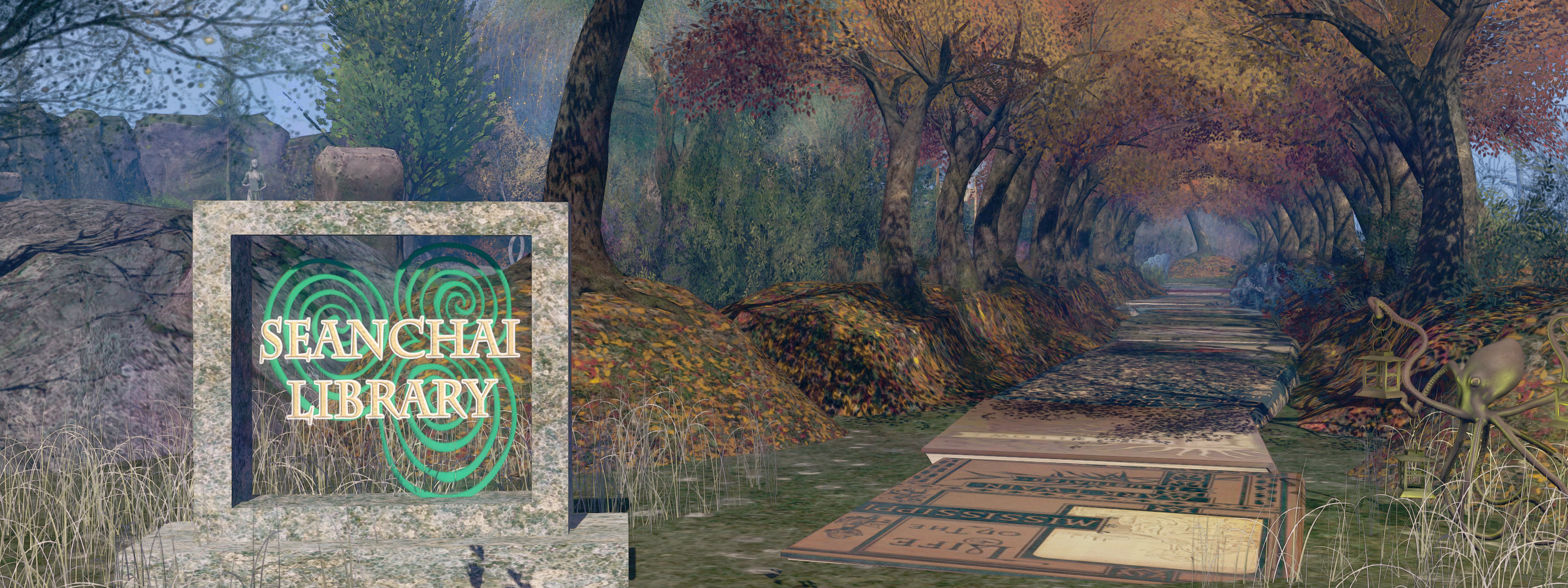
It’s time to highlight another week of storytelling in Voice by the staff and volunteers at the Seanchai Library. As always, all times SLT, and events are held at the Library’s home in Nowhereville, unless otherwise indicated. Note that the schedule below may be subject to change during the week, please refer to the Seanchai Library website for the latest information through the week.

Monday, May 30th, 19:00

A US Memorial Day Special.

The inventor who almost took the pleasure out of life by building a Happiness Machine; the young reporter who fell in love with an alluring lady of ninety; the old gentleman whose last act was listening to the clang of a green trolley car going round a corner, two thousand miles away.

These are just a few of strange and vivid people who entered the secret world of a twelve-year-old boy during one enchanted summer when he discovered the fact that he really was alive…


Tuesday, May 31st

12:00 Noon: Russell Eponym

With music, and poetry in Ceiluradh Glen.

Wednesday, May 25th: Seanchai Flicks

A special for Star Wars month as the Seanchai cinema space plays host to videos from the galaxy far, far away.

Thursday, June 1st, 19:00: Beggar’s Day: The Beggar Prince

The Kingdom of Galaway has a law – The Test of Kings –  that every heir to the throne must work a year and a day as a commoner in order to prove they are worthy of being ruler. Not a great law when you are as lazy and indulgent as Prince Larry.

He find that on his day, he must become servant to a former slave, Brishee, as she is conscripted to find the lost artefact, The Shield of Many Uses. However, the evil Percy has other ideas. Via murder and conspiracy, he intends to usurp the throne of King Willy.

Will Larry survive in his role as servant to Brishee? Will she succeed in her quest – and Larry, by extension, succeed in The Test of Kings, or will he be the first to fail, and Percy thus succeed?

The King, meanwhile, has problems of his own: why does Cruith the Crone keep stealing his chickens? Why is she always the first in line to bend his ear on Beggar’s Day?

Caledonia Skytower reads M.J. McGalliard’s first volume in the Beggar’s Day series.

2022 viewer release summaries week #21

Logos representative only and should not be seen as an endorsement / preference / recommendation

Updates from the week ending Sunday, May 30th, 2022

This summary is generally published every Monday, and is a list of SL viewer / client releases (official and TPV) made during the previous week. When reading it, please note:

  • It is based on my Current Viewer Releases Page, a list of all Second Life viewers and clients that are in popular use (and of which I am aware), and which are recognised as adhering to the TPV Policy. This page includes comprehensive links to download pages, blog notes, release notes, etc., as well as links to any / all reviews of specific viewers / clients made within this blog.
  • By its nature, this summary presented here will always be in arrears, please refer to the Current Viewer Release Page for more up-to-date information.
  • Note that for purposes of length, TPV test viewers, preview / beta viewers / nightly builds are generally not recorded in these summaries.

Official LL Viewers

  • Release viewer: version 6.6.0.571939 – formerly the Performance Improvements viewer, dated May 25th – NEW.
  • Release channel cohorts:
    • No updates.
  • Project viewers:
    • No updates.

LL Viewer Resources

Third-party Viewers

V6-style

V1-style

Mobile / Other Clients

Additional TPV Resources

Related Links

Space Sunday: NASA and Mars and some updates

NASA Moon-Mars concept. Credit: NASA

As NASA moves forward with plans to return to the Moon under the umbrella of Project Artemis, it is now stirring the pot on ideas for sending humans to Mars once more.

There have been many proposals for crewed missions to Mars since the 1950s, and in the last thirty years we’ve had a fair plethora, from the utterly unworkable ideas put forward in the Space Exploration Initiative SEI) of the early 1990s through Mars Direct, NASA’s Sprint and Mars Semi-Direct outlines through to what amount to pipe dreams expressed by Elon Musk / SpaceX.

On May 17th, NASA published a video and documentation outlining a set of high-level objectives identifying four overarching categories for developing a Moon-to-Mars exploration strategy, including transportation and habitation, together with ideas for initial missions which, for those who have followed all the various plans for exploring Mars, come across as a fresh pulling together of some very old concepts.

NAS’s latest conceptual strategy for using technologies for Moon and Mars exploration. Credit: NASA

Managed by the Exploration Systems Development Mission Directorate at NASA Headquarters in Washington DC, the purpose of the publications is to generate feedback from both interested parties within the space industry and from the general public (closing date, June 3rd, 2022). However, the process will not result in NASA issuing any RFIs or undertaking any procurement activity as a result of industry feedback received.

These objectives will move us toward our first analogue Mars mission with crew in space and prepare us for the first human mission to the surface of the Red Planet. After reviewing feedback on the objectives, we will work with our partners to discuss input and finalise our framework this fall.

– Jim Free, associate administrator, Exploration Systems Development Mission Directorate.

In particular, the outline seeks to leverage capabilities that can be utilised / tested on the Moon and then extended to Mars, such as in-situ resource utilisation (ISRU) – although arguably, scaled ISRU for water, oxygen and propellant production is somewhat simplified on Mars, thanks to its atmosphere); and combining robotic and human systems.

The outline also provides insight into how NASA’s initial thinking on how to undertake initial missions and this is where echoes of past proposals comes in. In brief, these ideas include:

  • A “Transit Hab” capable of carrying crews of 4 between lunar orbit and Mars, using a mix of chemical and electric propulsion. Delivered to the Lunar Gateway station in the early 2030s, this vehicle would be capable of both conjunction and opposition trips to Mars.
  • The use of precursor cargo flights to deliver equipment and supplies to Mars ahead of any crewed landing.
  • Precursor crew ascent vehicle missions to provide the means for crews to return to Mars orbit at the end of their time on the surface and return to the transit vehicle.
  • An initial conjunction mission (previously referred to as a “Sprint” mission) with two astronauts spending just 30 days on the surface of Mars utilising a pressurised rover.
  • The first opposition mission with a 4-person crew spending 540 days on Mars utilising large lander-habitats.
NASA 2022 first crewed mission concept. Credit: NASA

To explain the difference between “conjunction” (/”Sprint”) and “opposition” missions to Mars:

  • Opposition missions refer to Earth and Mars being on the “same side” of the Sun in their orbits around the Sun (so the Sun and Mars are on “opposite sides” of Earth), allowing for the fastest transit time between the two planets – 180 to 270 days -, but which require crews to spend up to 540 days on Mars, for a mission duration of 900 days.
  • Conjunction mission refer to Earth and Mars being (more-or-less) on opposite sides of the Sun relative to one another, requiring a mission to “sprint” to catch Mars (usually by making a gravity-assist around Venus). These missions are of a shorter duration (600-650 days total), but restrict crews to just 30 days on Mars but with highly-variable transit times (200-400 days).

There are arguments on both sides of the coin for opposition / conjunction missions, but overall, the choice of a conjunction approach to the first mission is a little odd: it maximises transits times (620 days in space), minimises Mars surface time and requires a Venus sling-shot.

Mars transit options: conjunction (left) and Opposition (right). Credit: NASA

However, the most interesting aspect of the NASA outline is that for this initial landing, the two crew making the descent to the surface of Mars will do so within a pressurised rover. The reasoning behind this is to deal with the crew potentially being “deconditioned” as a result of the transit to Mars, and so will use the rover to reduce the amount of time they will need to take adjusting to conditions on Mars, limiting the amount of actual science they can perform in 30 days.

In actual fact, the idea of making a rover the lander for a crew isn’t new. The first complete Design Reference Mission proposal that suggested this approach was put forward in 2004 – by none other than film director James Cameron!

The lander-rover from the 2004 Cameron DRM, note the landing motors and fuel tanks and fore-and-aft cabins. Unlike the proposed NASA rover, this vehicle required a separate habitat module.

Cameron’s rover was admittedly far more massive that the vehicle NASA is suggesting in their outline, but it was part of an overall strategy involving transfer vehicles, deployable habitation modules, and the use of biconic vehicles to descend through the Martian atmosphere (SpaceX have copied the biconic approach with the shape of starship, although the overall landing is very different).

Similarly, the ideas of sending equipment / supplies and the vehicle that will get the crew off the surface of Mars and back to orbit are not particularly new. Zubrin, Baker, Wagner et al, developed the first modern plan for doing these in the Mars Direct mission plan – although in that, the crew would make the entire trip back to Earth within the very cramped confines of their ascent / return vehicle.

This proposal also laid out who the propellants for the craft could be manufactured on Mars, with the general idea being modified by NASA as a part of their Design Reference Mission proposals, such that the ascent vehicle would only carry the crew up to orbit and a waiting transit vehicle – albeit one much larger than its outline suggests.

As noted, the ideas presented in the NASA document and video are for discussion and feedback, rather than for presenting actual plans. As such, they will be something I’ll return to in the future; once more definition has been given to actual mission outlines, the use of ISRU, etc.

Continue reading “Space Sunday: NASA and Mars and some updates”