Ribong Gallery Artspace: Bleu Oleander – A Nightingale Sang
Currently open at Artspace 3042, a part of the Ribong art hub curated by San (Santoshima), is A Nightingale Sang by Bleu (Bleu Oleander), a visually engaging celebration of the magic of working with prims in Second Life.
The piece takes its title from the British romantic song A Nightingale Sang in Berkeley Square (lyrics by Eric Maschwitz and music by Manning Sherwin), published in 1940; specifically the opening to lines of what has become the more traditional rendition of the song (Maschwitz actually wrote an initial opening verse that tends to be dropped from the majority of recordings):
That certain night, the night we met There was magic abroad in the air.
Ribong Gallery Artspace: Bleu Oleander – A Nightingale Sang
However, rather than referencing the love between two people, the lyrics here are used to underline that moment when human imagination and expression meet the creative promise and digital beauty of the humble prim, a moment when the most magical of relationships can begin.
In this age of external mesh tools, LODs, uploads and the need to familiarise oneself with dozens of workflows and practices in order to create something within the digital void, it is easy to forget just how powerful and rich Second Life’s in-built tools and capabilities are in their ability to give all of us the ability to build and create.
Ribong Gallery Artspace: Bleu Oleander – A Nightingale Sang
Prims don’t need complex workflows or multiple different applications; everything needed to create something captivating lies right here within the viewer, or, thanks to things like texture and script libraries, just a few clicks of the mouse away. And the skills to bring it all together can be acquired whilst remaining within Second Life, rather than far away within the near-isolation of this or that graphics tool.
From the landing point A Nightingale Sang takes visitors on a journey through a darkened space in which reside the most marvellous sculptures created and animated by Bleu. In both 2D and 3D, all of them are constructed by bringing prims together and then using scripts, textures, and the tools of the viewer – notably, for the visitor, the use of Advanced Lighting Model (Preferences → Graphics → make sure Advanced Lighting Model (ALM) is checked – this will also enable projected lighting without the need to keep Shadows enabled) – to create a richly visual installation.
Ribong Gallery Artspace: Bleu Oleander – A Nightingale Sang
Equally spaced through out the rising and falling levels of the space, the pieces are perfectly positioned so that each can be appreciated in turn – again, I’d advise using the local environment settings (World → Environment → Use Shared Environment). Also, as you explore, don’t forget to look up as well as around.
These pieces are simple yet complex living demonstrations of how we can use the tools before us to bring life to what might initially look to be little more than simple shapes to create something unique; of how once we have learn to rez and glue, an entire world of potential lies within our grasp, a world we can explore alone or with friends and in which the limits as to how far we go are defined by how far we want to go.
Ribong Gallery Artspace: Bleu Oleander – A Nightingale Sang
At the top of the installation can be found a little chapel, on the “alter” of which sit those basic shapes available within the Build floater that open the door to universe of creativity. Because, as someone once said: it all starts with a cube.
Scientists using data from NASA’s Curiosity rover measured the total organic carbon – a key component in the molecules of life – in Martian rocks for the first time, and have discovered that there is potentially more to be found on Mars than in the driest environments to be found here on Earth.
Organic carbon is carbon bound to a hydrogen atom and is the basis for organic molecules; they are created and used by all known forms of life, and it has been previously detected within Martian rock samples studied by the rover. However, the key difference between those results and those published within this study is that other attempts to examine rock samples for the presence of carbon have only looked for specific compounds that contribute to organic carbon or only represented measurements capturing just a portion of the carbon in the rocks; this study presents the total amount of organic carbon detected in samples gather by the rover during an intensive examination of exposed rock made in 2014.
Total organic carbon is one of several measurements [or indices] that help us understand how much material is available as feedstock for prebiotic chemistry and potentially biology. We found at least 200 to 273 parts per million of organic carbon. This is comparable to or even more than the amount found in rocks in very low-life places on Earth, such as parts of the Atacama Desert in South America, and more than has been detected in Mars meteorites.
– Jennifer Stern, NASA Goddard Space Flight Centre, Maryland
To make the measurement, Curiosity delivered the sample to its Sample Analysis at Mars (SAM) instrument, where an oven heated the powdered rock to progressively higher temperatures. This experiment used oxygen and heat to convert the organic carbon to carbon dioxide (CO2), the amount of which is measured to get the amount of organic carbon in the rocks. Adding oxygen and heat allows the carbon molecules to break apart and react carbon with oxygen to make CO2. Some carbon is locked up in minerals, so the oven heats the sample to very high temperatures to decompose those minerals and release the carbon to convert it to CO2. While the samples were gathered and analysed in 2014, it has taken years of ground-based analysis to fully understand the data and to put the results in context of the mission’s other discoveries at Gale Crater to reach a point of being ready for publication.
A mosaic of images captured by the Curiosity rover of the “Yellowknife Bay” rock formation, the location where the rover carried out its extensive search for carbon isotopes. The sedimentary rocks within the formation were laid down by an ancient stream and a lake that might have also contained the ingredients for life. “Yellowknife” was exposed about 70 million years ago by the removal of overlying layers due to erosion by the wind. Courtesy NASA/JPL / MSSS
A specific interest of the study was to identify the carbon isotope ratios. Isotopes are versions of an element with slightly different masses due to the presence of one or more extra neutrons in the nucleus of their atoms. In particular, two of the most common carbon isotopes are Carno-13, with seven neutrons tends to be of largely inorganic origin, while Carbon-12, with six neutrons, tends to be more associated with organic processes – and the study found this to be more abundant than had been anticipated.
But this doesn’t mean that it is absolute evidence that life may have formed on Mars. While the planet was once much warmer and wetter, with a dense atmosphere and free-flowing water on the surface that may have given rise to life, it’s important yo note the “more” used above for Carbon-12 -it can also be the result of non-organic processes such as vulcanism; and Mars was once extremely volcanically active.
Nevertheless, the confirmation that rock samples studied by Curiosity are richer than expected in Carbon-12, coupled with the general environment know to have once existed in Gale Crater – a place that once have an abundance of water and energy sources – further points to the crater being very conducive to life perhaps having gained a toehold there.
Exomoons as the Abode of Life?
We’re all familiar with the Star Wars franchise of films and TV series. In 1977, the original film in the series depicted a rebel base on the fourth moon of the fictional gas giant Yavin.
Many probably didn’t pay much attention to this at the time – beyond noting how the planet played a crucial role in keeping the base shielded from the Death Star, and its cool appearance in Yavin 4’s sky; however, the film was, in many respects well ahead of its time in its depiction of a habitable Moon. In 1977, the exact nature of moons like Jupiter’s Europa and Saturn’s Enceladus as places of ice and, possibly, water, was suspected rather than known, whilst guesses were also being made about what might lie under the atmosphere of Titan. It would be a couple of decades before we really started to understand the potential for some of the Moons of our outer solar system to have the conditions in which basic life might gain a hold.
The idea of a moon of a planet being habitable was an idea ahead of its time when visualised in the original Star Wars film, but given what we’ve come to understand about the moons in our own solar system, such potentially life-hosting places may exist elsewhere in our galaxy. Credit: 20th Century Fox / LucasFilm / Disney
While our own solar system moons like Europa are cold place and any life than may form within them sitting within an evolutionary cul-de-sac, the mechanics that make them potentially life-bearing is now being looked at as having the potential to make exomoons like Yavin 4 possible elsewhere in the galaxy.
The major factor in the life-bearing potential of places like Europa and Enceladus is that of tidal forces. In short, as these moons orbit their parents, they are subject to the gravity of the planet exerting a pull on them at the same time as the other moons orbiting the planet also exerting forces on them, all of which causes the moon to “flex”, heating its interior. With Europa and Enceladus, this heating may have resulted un liquid water oceans being possible under their icy surfaces.
Of course, such is the distance between the Sun and these Moons of Jupiter and Saturn than the moons don’t get enough solar heating to remain warm. However, a lot of exoplanets orbit their parent stars a lot closer than our gas giants do to the Sun. While some are clearly too close to their parent, forming what are called “hot Jupiters”, others are at a distance such that any Moons orbiting them could be subject to both tidal action and receive enough solar heating to maintain a potentially temperate atmosphere.
There are question marks around the theory – would such moons be tidally locked with their parent planet, such that the same side of the moon always faces the planet and the same face facing the local star? Would the planet itself be tidally locked to its parent star? How would the atmosphere of a moon fare caught between the outflow of radiation from both star and planet? However, it also promises a new avenue of research for exoplanets and exomoons and the search for signs of life elsewhere in the galaxy, as has been proposed in a paper published in the Astronomical Journal.
What is particularly interesting about the paper is that while the team behind it initially focused on gas giants and their possible moons, their computer modelling suggests that solid rocky planets of the size of Earth or a little bigger / heavier that have Moons could actually become far more habitable themselves.
Could moons orbiting the planets in the “goldilocks zone” of TRAPPIST-1 help those planets avoid becoming tidally locked with their parent, and thus be more naturally temperate and amenable to life than might otherwise be the case. Credit: NASA
This is because the majority of Earth-sized worlds, such as those of the TRAPPIST-1 seven-planet system are so close to their parent star so as to be tidally locked, so with one side in perpetual heat and the other in perpetual cold (and darkness), it would be hard for them to offer a foothold for life. However, should such worlds have a reasonably-sized moon orbiting them in a 2:1 resonance, the team’s results showed the planet would itself be far more likely to maintain its own axial spin, thus helping to even-out temperatures across its surface and possibly help maintain an atmosphere.
Thus the importance of exomoons as aiding life, either by supporting it directly or by helping their parent planet remain habitable, has gained further significance, as has the detection of such moons by direct infra-red and spectrographic analysis of their parent worlds by the likes of James Webb Space Telescope and the Extremely Large Telescope.
Walking on the Moon
With humans on the cusp of a return to the Moon, notably via the US / International Artemis programme, a lot of research is going into support systems crews on the Moon will require , such as surface rover vehicles and robot assistants capable of going where astronauts might encounter issues – such as climbing down the steep walls of craters while an astronaut might easily fall.
These robot assistants are being developed by a range of companies and agencies around the world, and one of those with considerable experience in the field is the German Space Agency (DLR). They have come up with a range of small rovers that can operate autonomously or via tele-operation be crews within pressurised environments such as a rover or a base station – or even from orbit.
For the last couple of months, DLR have been testing some of their designs on the upper slopes of Mount Etna, Italy, where the volcanic ash and loose lava is of a similar consistency to lunar regolith. One of the most intriguing of these robots is called Scout, a squat vehicle with a segmented body and which travels not on wheels or tracks, but on rotating “legs” that allow it to “run” over loose ground with relative ease.
The DLR Lunar Scout walking on the slopes of Mount Etna. Credit: DLR
Fitted with camera systems and capable of carrying science instruments within its segments, Scout could be used to both scout for safe routes through difficult terrain than astronauts might then use, and to carry out science functions of its own.
NASA Uses Cygnus to Boost the ISS Orbit
Not long after Russia invaded Ukraine, the head of Roscosmos, Dmitry Rogozin went on a bit of a Twitter / television bender, making a series of aggressive statements regarding Russian co-operation with the United States and the West in the matter of space activates and the International Space Station.
With regards to the latter, one of Rogozin’s claims was that Roscosmos could refuse to use their Progress resupply vehicles to carry out periodic “boosts” to the station’s orbit – required because, even at 450 km altitude, there is still sufficient drag exerted by the very tenuous atmosphere to cause the station to very slowly spiral back towards Earth. Since the US retired the space shuttle, Russia has carried out these boosts using their Progress vehicles. While Roscosmos pushed back against Rogozin’s rants, emphasising continued cooperation with the west with regards to the ISS.
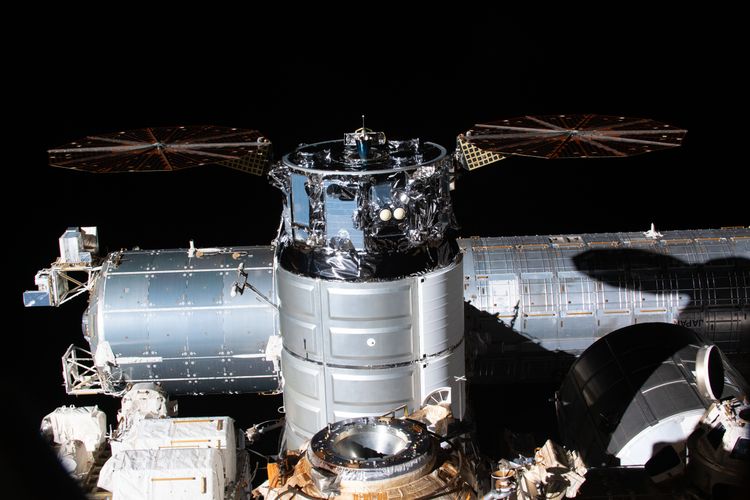
Cygnus NG-17 docked with the ISS. Credit: NASA
After Rogozin’s threat concerning the required boosts, the US said little, other than noting Progress was not the only option for raising the station’s orbit. In particular, there are two other vehicles with the propulsive capabilities able to perform the task: the Japanese Kounotori HII Transfer vehicle and the American Cygnus craft.
The latter of these performed a proof-of-concept attempt, raising the station’s orbit by 90 metres, but given the use of Progress, nothing further was tried. So, in the light of Rogozin’s comments, and with Cygnus NG-17 docked with the ISS (it had arrived in February 2022), NASA decided to use the vehicle to carry out a required ISS orbital boost.
The first attempt to do so was made on June 20th, but a data hiccup caused the Cygnus vehicle’s motor to cut after just 5 seconds. A further attempt was made on June 25th, with a 301-second engine burn raised the station’s perigee by 0.8 km and apogee by 0.2 km. With the move a success, NG-17 – called Piers Sellers in memory of the Anglo-American astronaut who passed away in 2016 – departed the station on June 28th, loaded with trash and waste from the ISS and performed a controlled re-entry into the denser atmosphere to burn up.
It’s been a year since my last visit to LeLoo’s World, a passage of time that would have naturally made it a destination for a return visit given I have tended to drop in once a year over the last couple of years. However, Shawn Shakespeare showed me a couple of pictures that meant I would have been hopping over as soon as I could.
For the summer of ’22, LeLoo (LeLooUlf) presents a setting she’s called a Critter Celebration, and which brings together wildlife from around the world (and some rather different critters!) in a series of settings carrying environments design to reflect the animals found within them, all linked together by a series of paths and tracks.
LeLoo’s World – A Critter Celebration, July 2022
The entire setting has the look and feel of an animal conservation centre and, needless to say, the opportunities for photography are rich throughout; as is, in theory, the opportunity for a little fun education, as the About Land description notes:
This summer, LeLoo’s World is celebrating the beauty and wonder of nature’s creatures. So put on those walking shoes, set the mindset dial to “happy!” and pick up your copy of the Critter Info HUD for some fun and interesting facts on various animals you will see here. All are welcome to this PG event!
LeLoo’s World – A Critter Celebration, July 2022
The HUD is offered (a little persistently!) on a visitor’s arrival at the landing point. The latter is laid out as something of a small commercial hub such as might be found at the entrance at a conservation park. The HUD, as per the setting’s description, is designed to offer up facts about the animals that can be found within the setting – although I’ll admit for some reason it didn’t want to work for either myself or my Alt.
Directly in front of the landing point is a path marked by a green arrow pointing the way under a rocky arch. However, before taking that, there are stepping stones winding off to the right, passing behind the market stalls that should be followed, lest it otherwise be missed. It offers the way to a little touch of North America, where brown bears, grizzlies and deer are enjoying the rocks and water as eagles circle overhead. Benches and chairs here offer seating for those wishing to stay awhile.
LeLoo’s World – A Critter Celebration, July 2022
Through the rocky arch is a further expression of North America, this a more wooded environment that is home to more bears and deer, together with foxes, raccoons and opossum Beyond this is a fun area for dog lovers; a place where cuddly little critters can also be found, tucked into their own corner and enjoying one another’s company.
From here visitors pass into Africa, and the Serengeti, a place where giraffe, elephants and zebra roam, and hippos and crocs cool themselves in the water. Visitors can rest up here at a safari camp, and it is worth taking your time to mouse-over some of the animals. Doing so will reveal poses with some of them for photography; a trend continues as the path passes on through to the jungles of India, watched over by tigers and where African elephants substitute for SL’s lack of Asian elephants.
LeLoo’s World – A Critter Celebration, July 2022
Onwards, visitors enter the world of the Far East, with SL’s traditional merging of China and Japan: a rich bamboo forest where panda can be found in family groups and beyond which can be found a house with more of a Japanese look and feel, a place where water and Zen gardens are mixed to present a haven for birds and not a few (Norwegian?) forest cats.
Covering half a region and located up in the air to limit the impact of thing like the water plane interfering with viewer performance, with – as noted – multiple opportunities for photography – A Critter Celebration at LeLoo’s World is a fun, easy-going visit that is highly enjoyable environment in which to spend time.
The following notes were taken from my audio recording and chat log of the Content Creation User Group (CCUG) meeting held on Thursday, June 30th 2022 at 13:00 SLT. These meetings are chaired by Vir Linden, and their dates and times can be obtained from the SL Public Calendar.
This is a summary of the key topics discussed in the meeting and is not intended to be a full transcript.
Official Viewers Update
One Wednesday, June 29th, The Maintenance M(akgeolli) RC viewer, version 6.6.1.572458 was promoted to de facto release status.
No changes to the rest of the official viewers through until Thursday, June 30th, leaving them as:
Release channel cohorts:
Nomayo Maintenance RC (Maintenance N) viewer, version 6.6.1.572179, June 1.
Project viewers:
Performance Floater project viewer, version 6.5.4.571296, May 10.
Mesh Optimizer project viewer, version 6.5.2.566858, dated January 5, issued after January 10.
Legacy Profiles viewer, version 6.4.11.550519, dated October 26, 2020.
Copy / Paste viewer, version 6.3.5.533365, dated December 9, 2019.
Work on an implementation of reflection probes which can be used both with PDR shading and with legacy content.
The overall aim of this work is to provide a means to support more physically accurate reflections in SL than can be currently generated (seen as a requirement for PBR support).
It applies to both PBR generated content, once available, and to legacy content.
Creating a materials type with an associated inventory asset. This will initially comprise the ability to copy a texture entry (with its specific parameters) to inventory, to be followed by initial work to work implement a PBR graphics pipe in the viewer.
Normals will likely be MikkTSpace, as per the glTF specification, but work needs to be done to see if supporting this could lead to clashes with the current normal maps rendering. This does mean that current Normal maps will not work on PBR materials.
The initially supported capabilities are:
RGB albedo + transparency.
RGB Occlusion/Roughness/Metalness: R = occlusion, G = roughness; Blue = metalness.
RGB emissive.
RGB normal (- alpha).
Double-sized supported (disables backface calling before issuing the draw call).
Two-sided lighting (so if the back of a triangle is visible, it flips the normal around).
In addition:
There will be an ability to “preview” materials on an item within your own viewer (similar in nature to Local Textures) before actually uploading them.
LSL support is still being defined, but should at least allow individual texture UUIDs to be replaced under script control.
The approach being taken is to may the system extensible so that further capabilities / plug-ins / options can be added with relative ease in the future.
However, Displacement maps will not initially be supported due to not being defined in the core of glTF 2.0; nor will any extensions that are not adopted into the core glTF standard (either glTF 2.0 or 3.0).
Materials Progress
The focus has been on under-the-hood work to allow drag-and-drop of materials assets onto objects / object faces (download demonstration mp4 here).
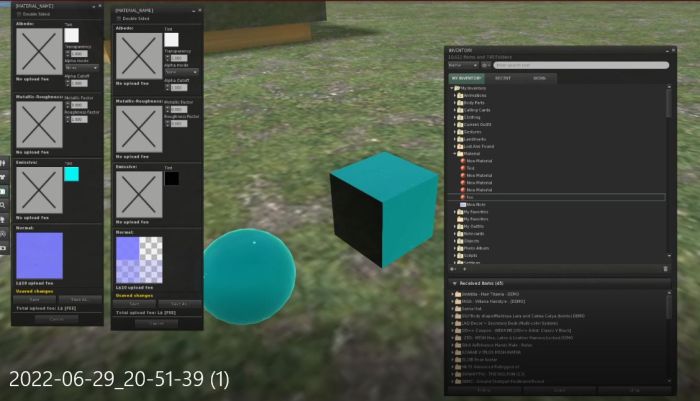
Screen Cap from a video by Runitai Linden showing (l) the basic PBR Materials UI, and right, materials assets in inventory, which can be dragged / dropped onto objects / object faces in-world (centre)
There is further work required on the back-end inventory services and asset store, and on some of the shaders in the viewer, before any of this work is ready for public testing on Aditi.
ALM Proposal / Work – Recap
At the #week #23 TPVD Developer Meeting (notes here), it was indicated that LL are “leaning” towards removal of the non-Advanced Lighting Model (ALM) (aka “forward rendering”) rendering path from the viewer, leaving just ALM rendering (aka deferred rendering”).
Were this to be done, it would only be done if it can be shown that this does not adversely impact performance (e.g. ALM runs roughly as well as non-ALM for those using the latter) on the broad cross-section of hardware most commonly operated by SL users.
The work will include:
A slider to manage the number of rendered local lights to lightening the load of rendering illumination on lower specification systems.
A “data saving mode” primarily intended to help those on metered connections by culling the download of additional materials / PBR maps and potentially downloading lower resolution textures mips, all of which will reduce the data passing over their connections. However, it will result in a much poorer visual experience once the PBR work has been implemented, and the hope is the mode will only be used in the minority of cases.
Given the ongoing work to support PBR and a more rounded set of materials, moving to deferred (ALM) rendering without fallbacks to non-ALM rendering – providing, again, the caveats noted above can be met / implemented – will in general help ensure a more reliable / consistent viewing experience across a broad range of hardware.
In Brief
The work to make full use of available video memory on a client computer is being put out to a hardware compatibility lab to help ensure the code changes are doing what they are supposed to be doing on a wide variety of hardware. These tests will also look at the impact of running the viewer with ALM active all the time across all hardware configurations.
On Animation:
The Puppeteering project highlighted at Grumpity and Mojo Linden’s Meet the Lindens session came in for criticism, but it was suggested people give the system a chance to reach a more advanced stage before judging, as the video presented in the talk does not do the work justice.
Vir indicated that while there is an understanding at the Lab that people would like the animation system overhauled:
Such a project currently isn’t on the roadmap
However, consideration is being given to allowing an on-the-fly adjustment of animation priorities.
Requests for additional animation work were requested via Feature Request Jira.
Runitai Linden suggested that as glTF supports animations it might – in the future – be a possible option for animation improvements. However, note that moving in this direction is also not part of the current roadmap.
Gateway Airport Terminal, July 2022: Rage Darkstone and Nils Urqhart
Erik Mondrian pointed me towards Gateway International Airport on the Mainland continent of Sansara – not, as might be suspected, because I’m a sometimes SL aviator, but because it is the setting for a newly-opened art exhibition featuring 2D and 3D artists.
Located in the airport’s gallery, a spacious setting with a large main floor and suspended walkways around it, the untitled exhibition features Zia Branner and Nils Urqhart presenting 2D art works, with Terra Merhyem and Rage Darkstone offering 3D pieces. The gallery itself is spacious.
Gateway Airport Terminal, July 2022: Zia Branner
The 2D art – more of Nil’s superb landscape photography from the physical world and Zia’s ever-engaging abstract art, together with a series of stunning floral pieces – is neatly spaces and framed around the outer wall spaces on the main level and catwalks and on some of the inner supporting walls. Each piece is ideally sized and positioned for individual viewing.The 3D pieces have been placed throughout the main floor and along the catwalks so that they stand both as individual pieces and both frame and have elements of the 2D works as backdrops. As might be expected given these pieces are by Terra and Rage, the 3D works are instantly attractive and engaging, with some static and others mobile, colours scintillating and samples twisting and turning as if alive.
Gateway Airport Terminal, July 2022: Terra Merhyem and Zia Branner
With still-life elements celebrating dance and motion, Rage’s selection of pieces presents a richly flowing narrative, their colours and tones perfectly off-setting the blue tint of Nils’ winter landscapes. Across the hall, Terra’s vibrant and animated pieces are grouped as a series of individual collections of mobile sculptures which also flow one to the next, while their colours and motion offer a transitioning reflection of the sense of life within Zia’s art. Also to be found within Terra’s pieces are books of her art, ready to be enjoyed by visitors.
To be fully and properly appreciated, this is an exhibition that must be seen with the Advanced Lighting Model mode enabled in the viewer (Preferences → Graphics make sure Advanced Lighting Model is checked), and make sure you are using the local shared environment. Also, as a last point, keep an eye out for the exhibition gift!
Gateway Airport Terminal, July 2022: Nils Urqhart
Richly contrasting, finely balanced and very visual and appealing, a superb exhibition of work by four very talented artists.
Dukedom, June 2022 – click any image for full size
As regulars to my Exploring series may know, Busta (BadboyHi) is a region designer whose work I enjoy, and I recently had the opportunity – courtesy of an LM passed to me by Shawn Shakespeare – to visit a design he has put together for Kn0cks Shad0ws (Whozyer Daddy) and his Full region, Dukedom.
Designed primarily for photography, the region is divided north-to-south by the presence of an elevated rail line, making this a setting very much of two parts. To the west, and occupying the majority of the region, are wild lands, a place of tall trees, waterfalls, streams and touches of the bayou along the west coast. Along this shore are wooden cabins, shacks and an old houseboat that mix their presence with mangroves, wetlands and a rocky shoreline to suggest a little community eking out a living by finishing – something added to by a number of fishing boats, one of which has seen much better days…
Dukedom, June 2022
This is a place where wildlife abounds. gulls wheel and turn overhead, ibis stalk the mouths of the streams emptying into the coastal areas, alligators bask in the dirt of the local tracks and ignore the fact potentially tasty seals are not that far away, also basking themselves out of the water; deer watch more domesticated animals – cattle, goats, and geese; peacocks strut their stuff, bids sing in the trees and more. Ways around the coast and through the hunched uplands behind it are marked by rough trails, boardwalks, tree-trunk bridges that span the streams and hard-packed earth paths and steps.
Sitting between the streams and set a little back from the waterfront lies a roughshod deck extending outward over rocky ground from where a glass-fronted cabin sits. At first looking to be a cosy retreat, closer examination with reveal it to be something of an apothecary-come-magic store; a place well in keeping with the bayou vibes exuded by the lands below. Around it are offered several places to sit, including a welcoming cuddle sofa.
Dukedom, June 2022
The sofa and benches around the cabin are a just a handful of all the places people can find to sit and pass the time; places that include swings watched over by baby chimps, and the carving of a giant hand holding a blanket in its palm which begs the question, was it carved over the bank of the stream against which it sits, or has come to reside there after the fact. Back down as the waterside sits a comfortable deck ideal for a small group, sitting alongside a makeshift watchtower.
Further back among the trees awaits more to be found among the trails; with two further cabins being chief among the sights. Each is comfortably furnished and offer welcomes to those passing, and both sit close to where the elevated train line cuts across the region and, beyond it, the purely urban setting.
Dukedom, June 2022
Occupying a little over one third of the region, this urban area sits as a busy, if a little run down, corner of a much larger town. The area under the elevate tracks looks to be undergoing repair / renewal, lots of people are out and about on the streets, a building is being heavily refurbished / rebuilt, cars are everywhere, and a military helicopter is clattering around overhead.
The latter might have been called by the local law enforcement as they attend a rather grisly homicide that has been committed on some waste ground to one side of the town. It’s a scene that – as is the way of things – has drawn a crowd of its own, some of whom are more interested in catching the situation on film and selfie, rather than offering respect for the life lost. But not everyone is drawn to the tragedy; at the back of the waste ground, a skateboarding area has been set-up and is of much more interest to local teens – although perhaps that is also a reflection on modern-day human nature and indifference…
Dukedom, June 2022
Throughout the region there as many points where photography is possible, although sadly, group membership is closed, so no props rezzing available. As an adult-rated region, there are apparently some adult-rated items spotted around – but nothing too obvious that I noticed from my ramblings through the wilds and along the streets.
I would also say that as a Full region with both the private island additional land capacity and with a lot of mesh and textures, Dukedom can hit some people’s performance, so be prepared to make some adjustments to your viewer if required. But that aside, Dukedom has a lot to commend itself; just take your time when visiting – and try not to disturb the sleeping bunny!


 Scientists using data from NASA’s Curiosity rover measured the total organic carbon – a key component in the molecules of life – in Martian rocks for the first time, and have discovered that there is potentially more to be found on Mars than in the driest environments to be found here on Earth.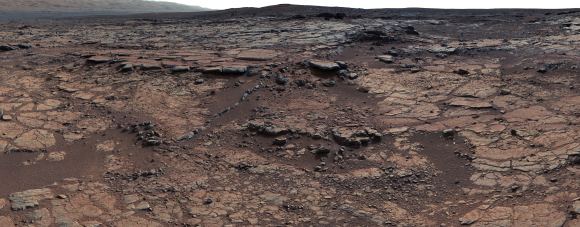







 Inara Pey: Living in a Modemworld