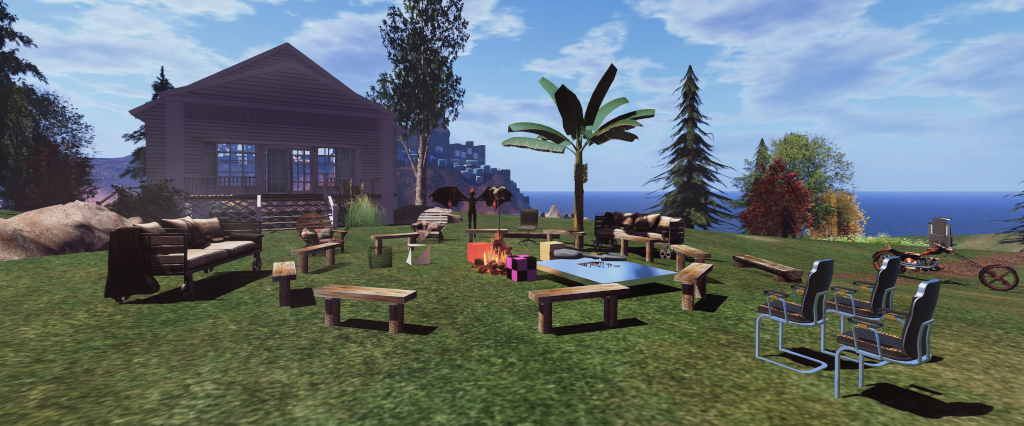
Reality Escape, July 2025 – click any image for full size
It’s been just four months since my last visit to Reality Escape, the Full private region held by Tripty (triptychlysl). It’s a place I appreciated at the time (as noted in A Reality Escape in Second Life), both for its own beauty and for the way it carried forward themes and elements found in Tripty’s earlier build, Books, Coffee and Chairs, Oh My! which I’d visited in 2023. So when Tripty dropped an invite on me to come visit the latest iteration of the setting, I was only too happy to accept.
Tripty’s region builds are always somewhat personal to her, something made gently clear by a sign waiting to be found within the landscape: WARNING You Are About To Enter Someone Else’s Dream. However, it’s a dream that likely resonates with anyone visiting the setting, allowing Reality Escape to live up to its name: a place we can all visit and experience a season of escape and indulge in a little dreaming of our own.
Reality Escape, July 2025
As with its previous iteration, this version of Reality Escape once again embraces three comforts I always appreciate: coffee, chairs and books; it also embraces some familiar motifs echoing Tripty’s past builds.
The Landing Point sits to the west of the setting, where wooden decks, complete and partially complete, all standing at the water’s edge with those that are complete offering outdoor seating from the Reality Escape coffee house. From here, the island offers a west-east orientation, with a smaller island to its eastern extent and two very small isles lying just off the coast, one of which lies between Reality Escape and Tripty’s private home and workspace within the adjoining region.
Reality Escape, July 2025
A number of routes of exploration are available from the Landing Point. For example, you can go through the café and the arch of rock beyond it to ravel along the middle of the main island; or you can take the path on the left side of the café as it offers access to paths on the island’s north side and along its coast. Or you can veer to the right of the coffee house and either head down to a small meadow and pond sitting on a little headland, or take another path rising up towards the island’s middle, or follow that path part way up the island and then turn aside to follow the trail and decks offering views and a walks along the southern coast.
What matters here is not the path you take, but the time you take in exploring; while the island might be comparatively small, it is rich in detail, large and small. Some of the obvious locations are sure to attract the eye and camera. One of these are the decks reaching out over the southern waters with their intervening chair bridges, and chair tower and arch – the latter offering a memory of both the setting’s previous iteration and that of Books, Coffee and Chairs, Oh My without imitating either.
Reality Escape, July 2025
Balancing this on the north side of the island is what I think is Reality Escape’s most engaging feature within this iteration. It is here that a slender finger extends out from the island proper, wetlands and shallows at its feet, its sides hanging with ivy and railings along its top marking the route of a path along its back.
Only this is no rocky promontory. Instead, it comprises a series of giant books either stacked up or standing upright or on their edges (allowing their spines to act as the walkway). Thy overlook more giant books floating on the water below, their pages open, together with the words Knowledge Is Power – a valuable admonition is this age where ignorance or falsity are increasingly valued over knowledge, experience and expertise.
Reality Escape, July 2025
With swings and sit points, this promontory is both imaginative and attractive. It is also braced by two more features. To the west of it, and looking like a great flat shelf of rock, lies another giant book its cover festooned with grass and more ivy hanging down from it. Sitting on it is a table set for a tea party and seemingly just missing a certain chap in a hat, a March hare, a dormouse and their guest. To its eastern side, wooden decks and steps descend the cliffs beyond to reach the wetlands whilst offering places to sit of their own.
The smaller details come in many forms and are all-encompassing. From the natural beauty of the setting with its burst of flowers and colour, to the presence of the cats and rabbits keeping an eye on things and the signage to be found scattered around, through the bees busily collecting pollen, these little touch add so much sense of life to the setting. I also liked the little touches of humour, such as the seagull cadging a ride rather than flying himself, or the stone Tibetan monks, one of whom is clutching a curious choice of book…
Reality Escape, July 2025
The little island to the east is neatly linked to the main isle by the hollowed-out trunk of a giant sequoia tree. This bridges the waters between the two, meaning there is no need to get wet feet when moving between them. Small it might be, but with its pond, garden and open-fronted pavilion (where fortune readings can be obtained), it has an attractiveness entirely of its own whilst also fully in keeping with the rest of the setting.
Throughout all of this are multiple places to sit and pass the time. These come in many forms, while most of the chairs in the region offer artistic statements (such as those mentioned above) more than presenting a place to sit. Which is not to say they cannot be sit upon; I enjoyed a latte whilst sitting amidst one chair tower!
Reality Escape, July 2025
As noted, this iteration of Reality Escape might appear small, but it packs a lot into it – more than I’ve described here. As such, I not only suggest you go see it for yourself, but that you allow time to explore all its trails and paths, nooks and crannies and allow the islands and their accompanying sound scape smooth away worries and concerns.
My thanks to Tripty for the invitation to re-visit!
The following notes were taken from the Tuesday, July 29th, 2025 Simulator User Group (SUG) off-week meeting (which I’ll be referring to as the “SUG Leviathan Hour” going forward). These notes form a summary of the items discussed, and are not intended to be a full transcript. The notes were taken from my chat log of the meeting and Patera’s video, which is embedded at the end of this article – my thanks to her for providing it.
Meeting Overview
The Simulator User Group (also referred to by its older name of Server User Group) exists to provide an opportunity for discussion about simulator technology, bugs, and feature ideas is held every other Tuesday at 12:00 noon, SLT (holidays, etc., allowing), per the Second Life Public Calendar.
The “SUG Leviathan Hour” meetings are held on the Tuesdays which do not have a formal SUG meeting, and are chaired by Leviathan Linden. They are more brainstorming / general discussion sessions.
Meetings are held in text in-world, at this location.
Simulator Deployments
There are no planned deployments to any channels this week, only restarts.
In Brief
Also refer to the video for the full meeting.
Leviathan has turned his attention back to the issue of some people experiencing failures on logging-in, which he describes thus:
So… the problem is the login.cgi computes a big “viewer return value” (aka the VRV) which it sends back [to the viewer]. It has “Content-type: llsd+xml” header on it, and can be several MB in size. It contains, among other things, the list of your friends, groups, and a skeleton summary of all of your inventory folders. When the data package is very big and your download rate is low… it can take a while for it to arrive. If it takes too long the viewer can timeout on the request… even though login.cgi thought it “succeeded” and sent an alert to the Region where you were supposed to arrive.
– Leviathan Linden
Leviathan believe one aspect that makes the VRV so big is the number of folders within inventory (not the contents of folders, just the count of folders). However, Leviathan believes he has a solution (which is pending deployment):
So anyway: a relatively simple change on the login server allows the data to be gzipped, which can speed up the transmission … The Second Life Viewer (SLV) uses libcurl for its http requests, and it can handle gzipped data implicitly. Any viewer that picked up that capability from SLV should see benefits when login gets the update.
– Leviathan Linden
Another issue Leviathan is looking into a bug where Premium+ users can’t upload mesh for L$0 after crossing a region boundary, although he hasn’t found a root cause as yet.
There is apparently some exploratory work going on with in the engineering team(s) on the potential to use AI tools for code generation.
An update to SLua is in development, and might be deployed to Aditi (the beta grid) in the next week or so.
A general discussion on the (currently stalled) game_control project. As noted in my previous Leviathan Hour summary, the game_control work (and the work for a Linux version of the SL Viewer) is currently archived during the most recent switch to the viewer development and release workflow.
A Function to Detect Right click (which has it own debate) was raised. Leviathan Linden noted there subject is stalled. This led to an extended discussion on the ticket, and the issue(s) it encompasses. This discussion extended to one on Touch Pointer Capture, together with ideas for extended mouse hover operations, and expanded use of the mouse scroll wheel.
Date of Next Meetings
Formal SUG meeting: Tuesday, August 5th, 2025.
Leviathan Linden: Tuesday, August 26th, 2025, due to Leviathan being on vacation (unless he can find a volunteer to fill-in for him).
† The header images included in these summaries are not intended to represent anything discussed at the meetings; they are simply here to avoid a repeated image of a rooftop of people every week. They are taken from my list of region visits, with a link to the post for those interested.
Lost Place of Norbu, July 2025 – click any image for full size
Designed by Miri (SilentChloe), Lost Place of Norbu is located within a Homestead region and offers a sub-tropical setting which fully lives up to the Tibetan meaning of its name – “jewel”.
The setting is presented as two islands set within an azure sea and sitting just off what appears to be a rugged and wooded coastal headland. The larger of the two islands is partially surrounded by a sandy beach, the sands of which also reach across the intervening shallows to brush against the smaller island.
Lost Place of Norbu, July 2025
Defined within its About Land description as a lost place near Taiwan, this adult-rated setting offers a lot to appreciate in a relatively small area (a good portion of the region being given over to sandy shallows); including places to sit and pass the time, assorted wildlife, and a partially hidden location that might easily be missed in a rushed visit.
The Landing Point sits on the north side of the region within the aforementioned shallows and facing the larger of the two islands. In appearance, this island almost has the look of a volcanic uprising about it; a tall peak rising from the sands to sit as a high plateau dominated by a huge headless, one-armed statue which may have once represented Buddha.
Lost Place of Norbu, July 2025
Densely canopied with the kind of foliage one might reasonably expect to see somewhere close to Taiwan (itself noted for its sub-topical evergreen forest), the bulk of the this peak – which put me in mind of the sold basalt core of a long-dead volcano – is hidden from the Landing Point by this green canopy, causing the eyes to be drawn to the shoulder of rock extending into the sea on the island’s on its north side and the single-storey wooden building standing upon it.
Reached via a set of stone steps rising from the beach between two lines of bamboo trees, the build mixes places to sit, enjoy Japanese tea or engage in Adult activities, its cool interior.
Lost Place of Norbu, July 2025
Behind it, meanwhile, a path arcs around the eastern side of the main peak, travelling through a small Zen garden and under a Torii gate to reach a southern shelf of rock extending out over the southern waters. Another, stone Buddha, small than the one on the island’s peak and semi-clothed in moss, sits within a stream of water running outward across this rock shelf and fed by a waterfall at its inland end, and which drops into the waters below at its outer end. A simple wooden boardwalk crosses this stream, allowing visitors to follow the path onwards, and so circumnavigate the island’s peak and return down the stone steps back to the beach.
As the sands of the beach do not fully encircle the island, it is impossible to use them as a similar means of circumnavigation, but follow them west and then around to the south from the landing point, and you’ll find yourself passing under the shelf of rock where “little Buddha” sits, then onwards to the island’s hidden gem.
Lost Place of Norbu, July 2025
Guarded by a mix of tall pagoda-like lamps and a Torii gate, all of which stand ankle-deep in lilies and other greenery happy to grow in the shallows, together with hovering water lily lanterns, sits the Shibari House.
Almost entirely hidden from view from above thanks to the rain forest canopy, the name of this place might sound like it is a centre for Adult activities. However, whilst such activities are possible, unless in actual use during a visit, they and cleverly hidden away, allowing the place to apparently take its name from the artwork mounted on the walls of the open-air rotunda.
Lost Place of Norbu, July 2025
Across the sandy shallows and tucked into the south-west corner of the region, the smaller of the two islands is equally as rugged as the larger and well canopied by sub-tropical foliage. A little harder to get around, it offers numerous places both beach-side and up among the rocks of s backbone to sit and pass the time, including an onsen watched over by egrets and with its outer ring of water patrolled by large koi carp.
If the onsen is not to your liking, then there is a waterside gazebo where it is possible to keep an eye on the location’s three elephants. I’m not sure how they found their way here, but they appear to be enjoying wading around in the warm waters, whilst colourful birds circle overhead. Some of the latter appear to appreciate the presence of a Japanese dragon fountain as it dribbles water from a rocky outcrop part-way up the side of the island. It sits close to another little retreat overlooking the Onsen, but I confess I had to resort sitting on the couch within it in order to reach , as I couldn’t find a path up to it.
Lost Place of Norbu, July 2025
It is in several of the couches, chairs and sit points in general that the setting’s more adult nature can be found, rather than in anything overtly displayed; thus, there is nothing within Norbu that might offend the sensitive when visiting. Rather, this is a peaceful setting which genuinely offers a lot to see, appreciate and to photograph.
Finished with a (perhaps too) subtle soundscape and presented within an appropriate EEP setting, Norbu offers an engaging fusion of ideas: a sub-tropical island off the coast of Taiwan but with a strong Japanese influence, wandering elephants, and even a little puffin enjoying a little bit of a tropical vacation. As such, it is well-worth the time taken to visit it.
Logos representative only and should not be seen as an endorsement / preference / recommendation
Updates from the week through to Sunday, July 27th, 2025
This summary is generally published every Monday, and is a list of SL viewer / client releases (official and TPV) made during the previous week. When reading it, please note:
It is based on my Current Viewer Releases Page, a list of all Second Life viewers and clients that are in popular use (and of which I am aware), and which are recognised as adhering to the TPV Policy.
This page includes comprehensive links to download pages, blog notes, release notes, etc., as well as links to any / all reviews of specific viewers / clients made within this blog.
By its nature, this summary presented here will always be in arrears, please refer to the Current Viewer Release Page for more up-to-date information.
Outside of the Official viewer, and as a rule, alpha / beta / nightly or release candidate viewer builds are not included; although on occasions, exceptions might be made.
An artist’s impression of the Skyfall concept mission about to deploy its helicopters over Mars. Credit: AeroVironment – see below for details
Multi-planet star systems are of considerable interest to astronomers, as they offer opportunities for comparative study which might answer questions about the formation and development of solar systems like our own. They can also help astronomers better understand star system architectures in general, help us gain more understanding of the nature of other planetary systems and the potential for life elsewhere in the galaxy, and so on.
This is why the discovery of the seven planet TRAPPIST-1 system caused such interest in 2016 onwards (see here for more), together with the Kepler-90 system (see: Space update special: the 8-exoplanet system and AI). Now there is confirmation of a further candidate for intriguing study, the rather boringly-called L 98-59.
Located in the southern hemisphere sky, within the constellation of Volans, L 98-59 is some 34.6 light-years from our Sun. An M3 red dwarf star with around 0.3 solar masses, it measures approximately 0.31 solar radii. This week it was confirmed as being the home to a family of at least five planets. Three of these – L 98-59 b, c, and d were located by NASA’s Transiting Exoplanet Survey Satellite (TESS); then in 2021 a fourth non-transiting planet (i.e. one orbiting a star but which does not cross directly between the star and our solar system was located, with hints of a second potentially orbiting the star.
An artist’s impression of the five planets of L 98-59, seen from over the top of the outermost planet in the system. Credit: Benoit Gougeon, Université de Montréal
The fourth planet, labelled L 98-59 e was confirmed using the transit timings method and the ESO ESPRESSO system, with the fifth planet –L 98-59 f was finally confirmed this year, using the ESO HARPS system and the radical velocity method – which also suggested a sixth planet might be lurking in the system.
Given the size of their parent star, all of the planets occupy orbits very close to it. L 98-59 b orbits its parent every 2.25 terrestrial days and has an Earth-like density; but is only about 84% Earth’s mass and half its size. L 98-59 c is slightly larger than Earth, its radius being around 1.3 that of Earth, with approximately twice the mass; it orbits its star every 3.7 terrestrial days. The fourth planet, L 98-59 e is roughly the same size as L 98-59 c, but with 2.8 Earth masses and takes 12.8 terrestrial days to complete an orbit. All three of these worlds suggest they are rocky and potentially volcanic in nature, although they do not appear to have significant atmospheres.
Sitting between L 98-59 c and e, and orbiting its parent every 7.4 days, is L98-59 d, which is believed to be a hycean (water) world with around 30% of its total mass made up of water. Reports on its atmosphere vary, and it is around 1.6 Earth radii in size and has 1.6 Earth masses. The newly-confirmed planet, L 98-59 f, is in the optimistic habitable zone of the star. It has a minimum mass of about 2.80 Earth masses, about 1.4 Earth radii, and follows a 28 day orbit.
An artist’s impression of the sizes of the three planets located by NASA’s TESS orbiting L 98-59, compared to Mars and Earth. Credit: NASA’s Goddard Space Flight Centre
One of the most interesting things about this system is that all the planets follow near circular orbits. This means they’re amenable to atmospheric spectroscopic studies by the JWST or other telescopes. Their comparative sizes also offer an opportunity to answer some key question, such as: what are super-Earths and sub-Neptunes made of? Do planets form differently around small stars? Can rocky planets around red dwarfs retain atmospheres over time? The fact that there appears to be both a hycean world and a world located within the star’s nominal habitable zone presents opportunities for studying potentially habitable worlds orbiting low-mass stars.
This latter aspect is of significance, as habitable environments within planets orbits low-mass stars like L 98-59 (and indeed, those around the likes of TRAPPIST-1) is highly contentious. Firstly, while they are long-lived and can enter into a stable maturity, red dwarf stars can also be subject to massive solar flares which, given how closely their planets orbit them, could easily rip away atmospheres make it that much harder for life to gain a toe-hold.
Additionally, because of their close proximity to their parent star, these planets are liable to be tidally locked, always keeping the same side pointing towards the star. This could play havoc with any atmosphere such a planet might have, the star super-heating the side facing it whilst the planet’s far side remains frigid and dark, potentially limited any habitable zone on the planet to the pole-to-pole terminator between the two sides of the world.
Joining a select group of relatively nearby planetary systems, L 98-59 is to become the focus of some intense study through the likes of the James Webb Space Telescope.
Skyfall: Dropping Helicopters on Mars?
Building on the success of the Ingenuity helicopter delivered to Mars as a part of NASA’s Mars 2020 exploration programme (and covered extensively in these pages), Skyfall is a new mission concept being proposed by NASA’s Jet Propulsion Laboratory and their principal partner with Ingenuity, AeroVironment.
Were it to develop into a mission, Skyfall would see a total of six Ingenuity-class helicopter drones delivered to Mars and deployed in a manner indirectly drawing on the Skycrane system used to deliver the Mars Science Laboratory rover Curiosity and the Mars 2020 rover Perseverance to the surface of Mars.
An artist’s impression of one of Skyfall’s Ingenuity-class helicopter drones falling free of the aeroshell which help protect them on the trip to Mars and entry into the Martian atmosphere. Credit: AeroVironment
Skyfall would see the six helicopters carried to Mars within a protective aeroshell and heat shield. Once within the Martian atmosphere and descending under a parachute, the heat shield will be jettisoned and a “launch tower” extended below the aeroshell, allowing the helicopters to start their motors and fly clear of the aeroshell to start six individual but parallel missions.
By releasing the helicopters in the air, the mission avoids the need for a complex landing and deployment system, in theory reducing both mission complexity and cost – although there are obvious challenges involved in making aerial launches from under a descending platform.
The six drones would be enhanced versions of Ingenuity, charged with a variety of tasks including recording and transmitting high-resolution surface images back to Earth, using ground-penetrating radar to investigating what lies under the surface they overfly – such as potential pockets of water ice that could greatly assist future surface operations -, and identifying possible landing sites for future human missions to the Red Planet.
Like Ingenuity, the six drones would be capable of landing in order to use solar arrays to recharge their battery systems. However, exactly how far each vehicle will be able to fly between landings has not been defined, nor has their total mass, or the portion of that mass given over to science instruments and battery packs. If the concept progresses, these details will doubtless be defined and made public. As it is, AeroVironment has begun internal investments and coordination with NASA’s Jet Propulsion Laboratory to facilitate a potential 2028 launch of Skyfall.
NASA to Lose 3,900 Personnel and Gains a new Acting Administrator
For the last couple of weeks, rumours have been circulating that a large number of NASA personnel has applied to take the Trump administration’s “deferred resignation” offer, by which staff can go on paid administrative leave until such time as an actual departure date can be agreed.
The numbers had been put at somewhere between 3,500 and 4,000 personnel – many from senior management and leadership roles. Some of the rumours had been played down by the current temporary NASA senior administrator, but on July 25th, the date the offer of “deferred resignation” closed, NASA News Chief Cheryl Warner confirmed a total of around 3,900 personnel – 20% of the total workforce – have, or will be departing.
The figure might yet be subject to adjustment (up or down) as a post-offer analysis is carried out to ensure that those applying for deferred resignation do not impact the agency’s focus on safety and the Trump-demanded focus on sending humans to the Moon and Mars.
Sean Duffy, official portrait, 2025, via Wikipedia
At the same time as the rumours of the workforce cuts started circulating earlier in July, the Trump Administration further caught NASA off-guard by announcing that secretary of transportation Sean Duffy will be taking over as interim NASA Administrator until a permanent appointment can be made. The announcement came just days after Trump abruptly withdrew nominee Jared Isaacman from the running just ahead of his expected confirmation, allegedly as a result of Trump’s public spat with Elon Musk.
No-one at NASA headquarters was informed of the decision ahead of Trump’s social media announcement. It had been expected that existing acting administrator, Janet Petro, would remain in place until a suitable nominee was put forward in Isaacman’s stead. Whilst not a part of the Trump administration, Petro has tended to move in the direction the administration wants with regards to NASA – such as encouraging workforce reduction through early retirements, etc., – and had been regarded within the agency as a safe pair of hands.
A television presenter turned prosecutor turned politician, Duffy is primarily known as a vocal supporter of Donald Trump and his various policies, notably in the areas of decrying climate change, and diversity and equality in employment.
Some have attempted to paint his appointment positively, stating he could bring NASA the kind of direct access to the White House Petro lacks. However, others seen his appointment as a means of forcing through changes at NASA that are in line with Trump’s goals of reducing spending on science and R&D, and focusing only on human missions to the Moon and Mars.
Spain to the Rescue?
The Thirty Metre Telescope (TMT) has been in development since the early 2000s – and if it ever gets built, it will be the second largest optical / infrared telescope in the world, with an effective primary mirror diameter of 30 metres. Only the European-led Extremely Large Telescope – ELT – will be larger, with a primary mirror effectively 39 metres across.
A computer rendering of the Thirty Metre Telescope complex on Mauna Kea. Credit: TMT Corporation
Primarily a US-led project but with strong international involvement from Europe, Canada, Japan, India and even China, the TMT has been beset by problems. Most notably, these have involved protests over the proposed location for the observatory – on Mauna Kea, Hawaii, within the area designated the Mauna Kea Observatories Grounds, and home to 13 other astronomical facilities. However, Mauna Kea is also a sacred site and largely conservation land, and the telescope, coupled with all the environmental impact that it would bring, was seen as a step too far by many, and a battle has been waged back and forth for some 16 years, preventing any construction from proceeding.
In 2019, a proposal was made to have the TMT built in Las Palma in the Canary Islands. This was initially approved by the Spanish authorities, but has also been subject to objections. Some of these again relate to the environmental impact of such a massive construction project, but there are also astronomical objections as well; in particular, La Palma does not have the same elevation as Mauna Kea, meaning that high atmosphere water vapour could limit much of the telescope’s infrared operations (water vapour tends to absorb light in the mid-infrared spectrum).
Most recently, TMT has been under threat due to the Trump Administration’s cuts to the National Science Foundation’s budget (the NSF having the remit of oversee the construction and operation of the TMT), with the telescope directly singled-out for cancellation – and this despite the fact that China and India have agreed to meet the lion’s share of the estimated US $1 billion construction cost, and Canada offering to contribute US $24.3 million a year over ten years for the telescope’s operation.
Several observatories already located at La Palma’s Roque de los Muchachos Observatory. From left: Carlsberg Meridian Telescope; William Herschel Telescope (domed); Dutch Open Telescope; Mercator Telescope (silver dome, just visible); Swedish Solar Telescope (solid tower); Isaac Newton Telescope (domed, second from right); Jacobus Kapteyn Telescope (far right). Credit: Bob Tubbs
Now the government of Spain has stepped in, offering to commit US $471 million (400 million Euros) towards the telescope’s operating costs – if the US agrees to have the facility located on La Palma. It’s not clear how the US will respond to the offer – or what can be done over the possible limitations of TMT’s infrared mission. However, TMT is also seen as critical to providing very large optical telescope coverage of the whole sky, with the TMT covering northern skies and the Giant Magellan Telescope (GMT), based in Chile to cover the southern skies, with the two intended to work in collaboration and with Europe’s ELT (also in the southern hemisphere).
GMT has a significant advantage over TMT in that its location is not controversial, allowing construction to go ahead to a point where the National Science Foundation has given the Trump administration a guarantee the project can be completed to reach operational status without the need for additional funding in 2026. Thus there have been no calls for its cancellation.
Raven’s Bay, July 2025 – click any image for full size
Sam Rougefeu, curator of the destinations SL blog, pointed me toward Raven’s Bay, a homestead region held and designed by Lilly Blackwood. Open to the public, it’s and engaging location with a hint of alchemy about it.
An island of mystery and magic. Explore the trails, meet friends at the café, dance on the beach, explore the Paranormal Academy!
– Raven’s Bay About Land
Raven’s Bay, July 2025
Caught in the onset of autumn, Raven’s Bay is another of those settings that bucks the trend of aligning its design with the northern hemisphere seasons; the golds and oranges present in some of the foliage is matched by the rusty folds of hills and ridges across part of the landscape to create what is largely a tranquil setting.
The Landing Point sits just offshore within a large bay cutting into the landscape from the west, watched over by a tall lighthouse raised on the bay’s northern headland. A short walk along the boardwalk from the landing point sits the squat form of an old castle.
Raven’s Bay, July 2025
This home to the Raven’s Bay Apothecary and Paranormal Academy, the latter of which appears to offer refreshments – but perhaps these should be treated with caution, given the way the biscuits are decorated and the labelling on the tea pot!
To reach the castle, visitors must cross a ribbon of single-track road. This connects to two further hoops of road as they loop around the northern and southern side of the region, with latter connecting to a spur of track running up to the sandy headland of the bay’s southern side.
Raven’s Bay, July 2025
These roads make it easy to circumnavigate the setting using either one of the bikes or Segway-style personal transports available from the rezzers outside of the Raven’s Bay Apothecary. For those of a more magical disposition, broomsticks are available for transport as well (not you will be asked to allow the AV Sitter Experience for seamless use of the broomstick).
Following the roads will reveal both the island beauty and its points of interest. The latter include the aforementioned beach, which runs part-way along the region’s southern coast; the statues places along the roadside at various points; the local café (which likely offer more palatable beverages and treats than the arsenic tea and poison biscuits offered elsewhere 🙂 ).
Raven’s Bay, July 2025
There are also two tree-lined footpaths awaiting discovery. The first is fairly easy to find, extending as it does from the far side of the tunnel running through the castle and visible from the Land Point. It leads to a smaller bay on the east, and the gazebo built out over it. The second runs to one side of the castle (and helpfully signposted “Nowhere”! 🙂 ). It leads to an old chapel and gazebo, the former of which looks like godly worship is no longer its primary aim.
For those who are seeking something spiritual, a place to stop might be at the round ruin on the north side of the region, where Buddha awaits and cushions are set-out for meditation – or for simply passing the time.
Raven’s Bay, July 2025
With places to sit throughout, together with dancing, the hint of a coastal swamp, Raven’s Bay has a lot to offer visitors and photographers, and is finished with an appropriate sky setting and environment, as well as being rich enriched with a natural soundscape.
In all, a very worthwhile place to visit.
Raven’s Bay, July 2025
SLurl Details
Raven’s Bay (Serena Hamilton Isle, rated Moderate)