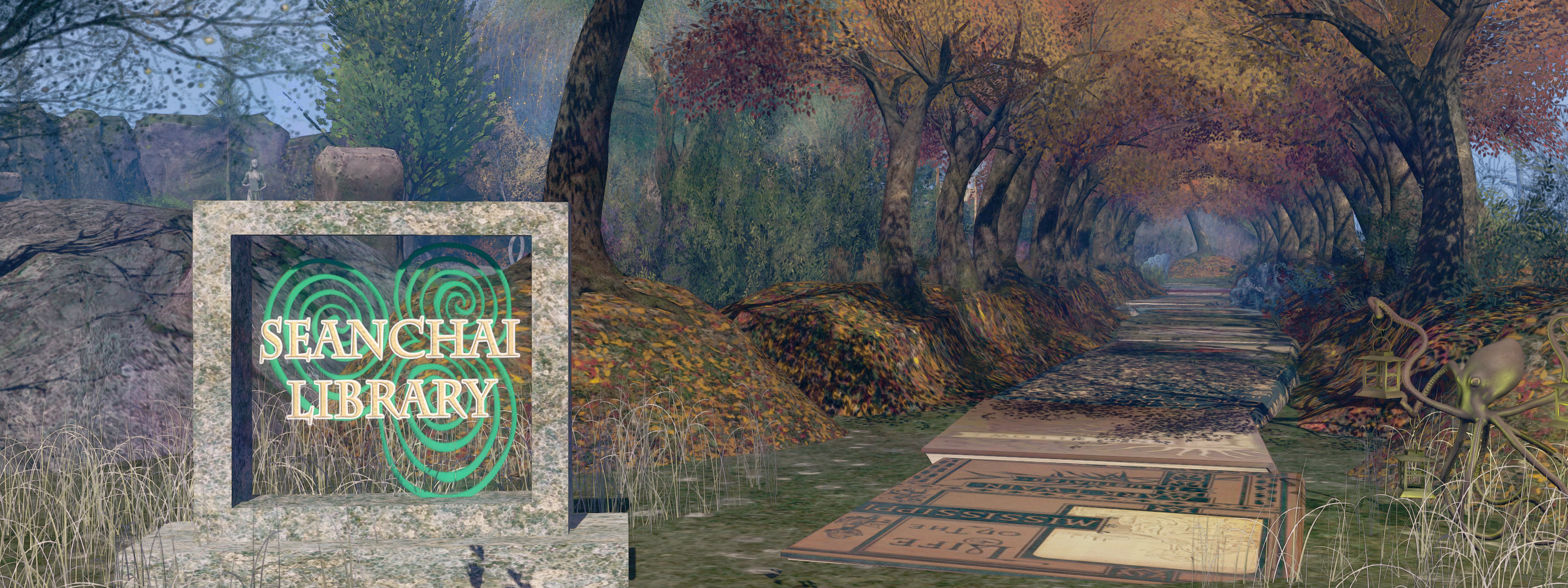
It’s time to highlight another week of storytelling in Voice by the staff and volunteers at the Seanchai Library – and this week previews the launch of a very special event.
As always, all times SLT, and events are held at the Library’s home in Nowhereville, unless otherwise indicated. Note that the schedule below may be subject to change during the week, please refer to the Seanchai Library website for the latest information through the week.
Monday, November 28th, 19:00: Frek in the Grulloo Woods
Frek’s father left the planet in a big hurry after Gov (the government) peeped him with their rather invasive brain scrambling techniques. Ever since then, Frek and his family have been seen as kind of renegades and outsiders, not really proper company for the upstanding citizens.
But when Frek discovers that some alien intelligence is trying to get in touch with him, he decides to follow in his father’s footsteps; only the Gov have noted his connection with the alien force, and come after him.
With the help of a Grulloo, a second class citizen with a tail – and some new alien friends, Frek escapes the clutches of Gov and blasts off to sign a branecasting deal – branecasting being greatest technology craze sweeping the universe …
Gyro Muggins offers a reading based on the first two chapters of Rudy Rucker’s Frek and the Elixir.
Tuesday, November 29th, 19:00: Selections from Terry Pratchett’s The Hogfather
Thursday, December 1st, 21:00: Seanchai Late Night
Sci-fi / Fantasy with Finn Zeddmore.
Advanced Notice: The Dickens Project
The Dickens Project has officially announced an opening date of December 8th, 2022 and will run through until January 3rd, 2023. Old favourite guests and features will return along with an exciting new land configuration and new collaborators. Details to be published in due course!
Logos representative only and should not be seen as an endorsement / preference / recommendation
Updates from the week through to Sunday, November 27th, 2022
This summary is generally published every Monday, and is a list of SL viewer / client releases (official and TPV) made during the previous week. When reading it, please note:
It is based on my Current Viewer Releases Page, a list of all Second Life viewers and clients that are in popular use (and of which I am aware), and which are recognised as adhering to the TPV Policy. This page includes comprehensive links to download pages, blog notes, release notes, etc., as well as links to any / all reviews of specific viewers / clients made within this blog.
By its nature, this summary presented here will always be in arrears, please refer to the Current Viewer Release Page for more up-to-date information.
Note that for purposes of length, TPV test viewers, preview / beta viewers / nightly builds are generally not recorded in these summaries.
Official LL Viewers
Release viewer: version 6.6.7.576223 – MFA and TOS hotfix viewer – November 1 – No change.
Release channel cohorts::
Maintenance P (Preferences, Position and Paste) RC viewer updated to version 6.6.8.576812 on Wednesday, November 23.
Oshu, November 2022 – click any image for full size
It’s fairly well established through the pages of this blog that I have a thing for regions with a Far Eastern design, whether they are intended to offer a Japanese setting, a Chinese setting or a fusion of the two. Learning about such places (particularly if they are intended for public visits, rather than focused on residential settings!) tends to have me reaching for my camera and then mashing the teleport button.
So when Ryū Ojo (Sosaki) sent me an invite to visit her Full region design of Oshu, it moved pretty much to the top of my list of places to visit and start prepping a post about. However, on my arrival I quickly realised that rather than following my usual practice of visiting a region, exploring and writing notes, then returning to later to photograph and blog, this was a place I had to write about immediately – although in fairness to Ryū, she is still working on the final details within the region, so if you do drop in on reading the post around the time it is published and see some unfinished elements – blame me for being too keen to write about it, not Ryū!
Oshu, November 2022
Oshu is Ryū’s first full region build, and she has gone all out with it, opting to use the additional Land Capacity option available to Full private regions. In doing so, she has created what is effectively a tranquil setting cast with a Japanese theme that is completely timeless in nature. When exploring, you feel you could just as easily be in a remote part of modern-day Japan, far removed from the hustle, noise and heat of city life in the modern era as you could setting foot into a feudal province in the country’s Edo period. However, also awaiting discovery are elements which offer visitors a touch of fantasy and of futurism.
No formal landing point hand been set at the time of my visit, although Ryū indicated to me one would eventually be set, complete with a welcome area, so things many change in this regard when you visit when compared to the description of my explorations below. That said, my wanderings commenced in the north-east uplands of the setting, where a board meadow backs itself against the off-region surround.
Oshu, November 2022
This is the first indication of the care Ryū has been taking in designing the region, carefully blending it along the northern edge and to the west and east with the surround, giving the impression that the region is part of a greater landscape, one rising to high mountain peaks as can be found throughout the islands of Japan, their foothills blanket in rich woodlands.
This meadow is itself a place of mystery; great standing stones lie within the shade of autumnal Japanese maples, their general colour and look suggesting then have been hewn from the rock strata running through the region (including thrusting up through the grasslands of the meadow), but who may have roughly formed and erected them is a mystery. Upslope from the meadow, and backed by a ridge of rock, is a stone arch. Perhaps it may have once been part of a larger structure with some connection with the standing stones, although its carved nature suggests that it is of later origins than the standing stones. Lit by a shimmering green light, it is in fact an experience-based portal offering a connection with Naruru Bay, a modern-era role-play-focused Homestead region.
Oshu, November 2022
The core of the region is focused on a small settlement surrounded by trees. At the time of my visit, these were still being furnished, with the largest being built over a pond, falls to one side allowing the water to tumble to a smaller pond and thence over larger falls which step there way down over southern cliffs to where a channel meanders out to the south-side bay.
This settlement is an utterly tranquil location, the trees shading it from the Sun (and hiding it from view), the paths and terraces linking the houses to Zen gardens, and bridges spanning the waters, all watched over by dragons either made of bronze or flying free. As well as its sense of serenity, the settlement contains the greatest sense of timelessness within the region, while a long stone stairway descends the slope below the west side Zen garden, pointing the way down to the southern bay and a temple of light built out over the waters.
Oshu, November 2022
Time should be spent exploring the region, as it offers many points of interest and detail. Wildlife and domestic animals can be found throughout, as well as elements of fantasy – the aforementioned dragon, a kitsune statue and, for those who seek it out, a hidden secret.
The latter is not easy to find, but it lies beneath the settlement: a series of tunnels winding down to a series of caverns where huge fungi grow, and a path might be found passing from cavern to cavern to eventually come to two pairs of doors. At the time of my visit, the entrance to these tunnels came by way of passing through a tall curtain of water and then carefully treading between it and another; however, Ryū noted to me this may change.
Oshu, November 2022
However, these tunnels further contain another aspect of the timeless mix within the region: the tunnels leading down to the caverns appear to have been cut suing modern tools and are lit by electric lights, suggesting they were made using tools of a later era than the Edo looks of the settlement. The caverns, meanwhile have that sense of fantasy, whilst the pairs of double doors take visitors into a sci-fi like set of rooms of unknown purpose (again, at least at the time of my visit).
For a first-time Full region build, Oshu is engaging and richly detailed and something for which Ryū should be justifiably proud. Primarily designed for photographer / explorers, Ryū also indicated to me it might also offer some degree of role-play (possibly connected to Naruru Bay given the presence of the portal), although time will likely tell on this. In the meantime, this is a destination well worth visiting, and which I hope Ryū will submit to the Destination Guide when she is happy with the design, so that it might be appreciated by folk from across SL.
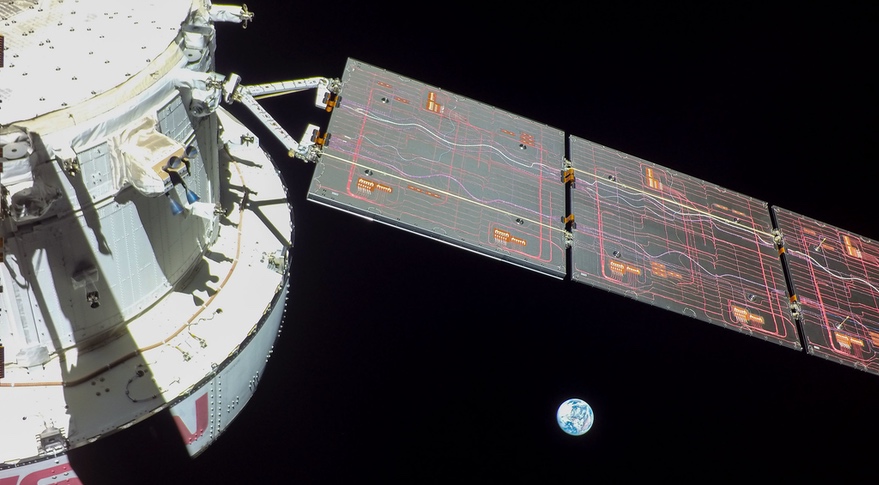
A view of Earth taken by a solar array mounted camera on the Orion spacecraft on November 24th, a day before the spacecraft entered a distant retrograde orbit around the moon. Credit: NASA
NASA’s Artemis 1 mission, launched on November 16th, 2022, has become the first vehicle capable of carrying humans that far, to return to the vicinity of the Moon since Apollo 17 in 1972.
The Orion capsule reached the Moon on Monday, November 20th, the fifth flight day of the mission overall. At 12:44 UTC, the vehicle, swinging around the far side of the Moon and so out of communications with Earth, closed to within 130 km of the lunar surface and a velocity of 862 km/h. It then fired the single motor mounted on the vehicle’s service module for 2.5 minutes, the first engine burn designed to push the vehicle into a distant retrograde orbit (DRO).
The DRO is a path that loops the vehicle away from the Moon in the opposite direction to the Moon’s own orbit around the Earth. Confirmation of the manoeuvre’s success came as the vehicle cleared the Moon and resumed communications with Earth – returning a colour image of our home in the process.
The DRO provides a highly stable orbit where little fuel is required to stay for an extended trip in deep space to put Orion’s systems to the test in an extreme environment far from Earth.
– NASA blog post
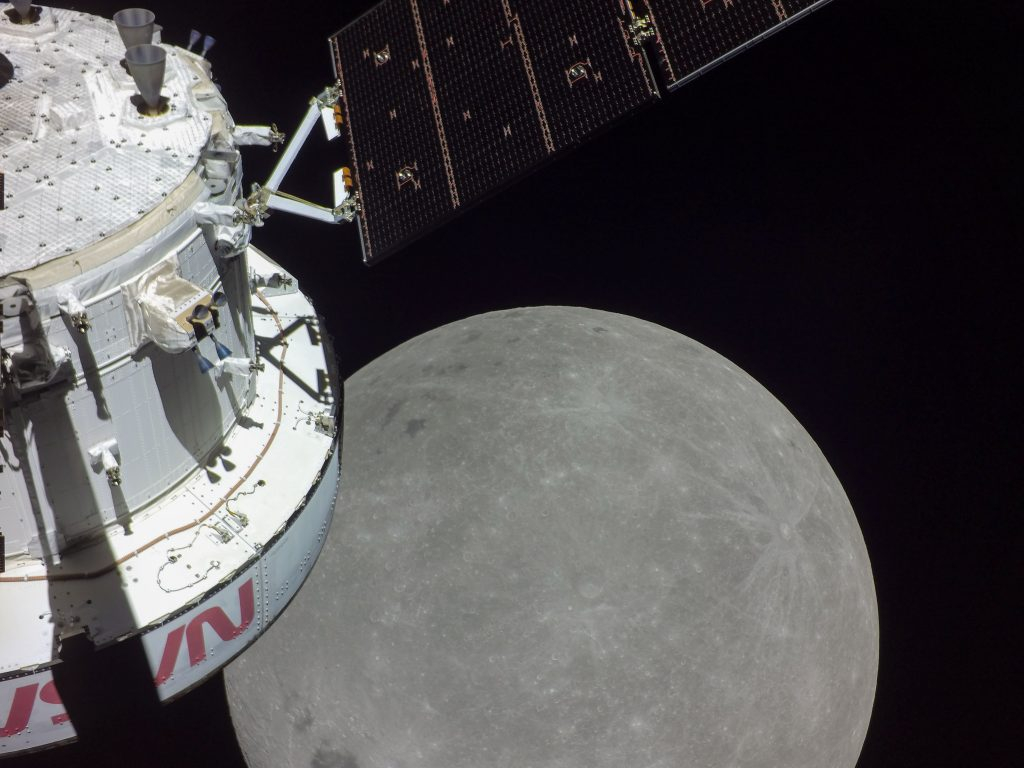
A portion of the far side of the moon as seen from the Orion spacecraft on November 21st, 2022 during the Artemis 1 mission. Credit: NASA
An hour later, as the vehicle proceeded away from the Moon, it passed over a historic landmark – Tranquillity Base, the landing zone for Apollo 11 in 1969 at a distance of 2,227 km. It continued outwards from the Moon with all systems functioning as expected. However, on Wednesday, November 23rd, all contact with the vehicle was suddenly lost and remained so for 47 minutes prior to contact being re-established.
The cause of loss-of-contact lay with the reconfiguring of the communications link between the spacecraft and NASA’s Deep Space Network (DSN) – the orbiting and ground-based communications network used to maintain contact with all of NASA’s operational missions. The reconfiguration should have been routine, having been carried out several times during the mission as DSN carried out its multiple duties, and at the time of writing it was not clear what caused the glitch.
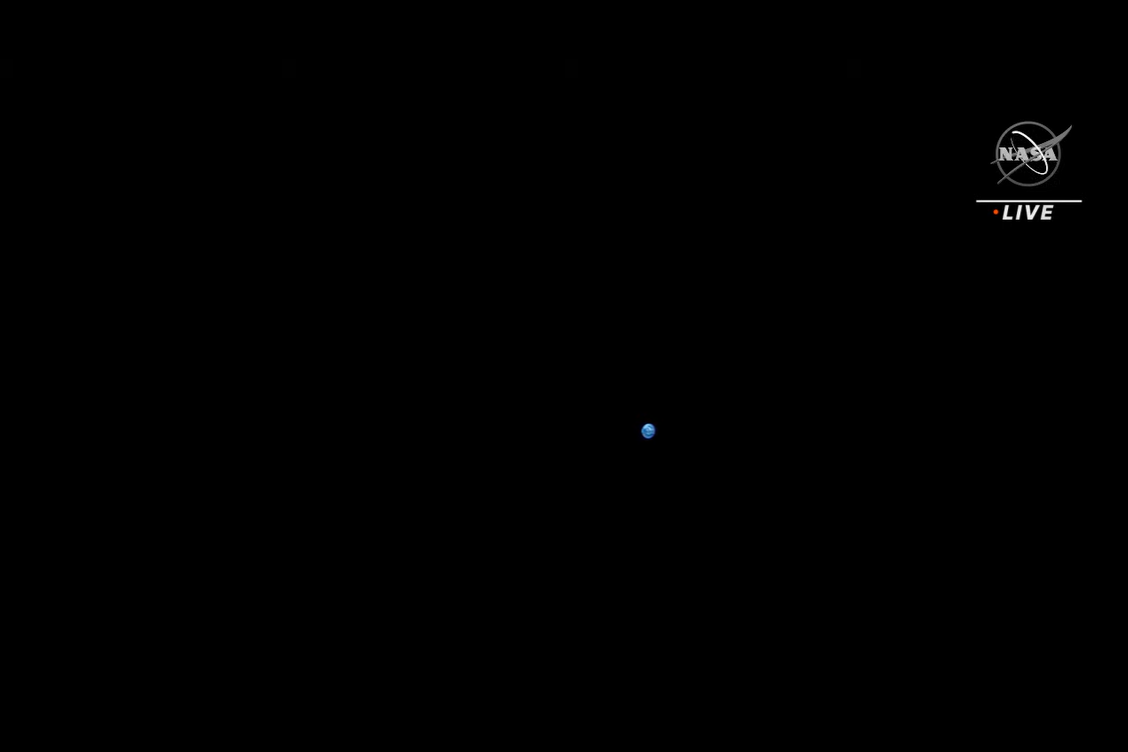
looking back at Earth from beyond the Moon, November 2st, 2022. Credit: NASA
At 21:52 GMT on Friday, November 25th, Orion made its second DRO engine burn, one that lasted 82 seconds, sufficient to push the vehicle into its outward loop away from the Moon travelling at 396 km/h. This outbound leg of the flight saw Artemis 1 breaking the record for the for the farthest distance from Earth travelled by a human-rated spacecraft, surpassing the 432,000 km distance set by Apollo 13 in April 1971; Artemis will reach a maximum distance from Earth of 435,000 km on Monday, November 28th, the point marking the start of its return to close proximity to the Moon, which it will reach on December 1st.
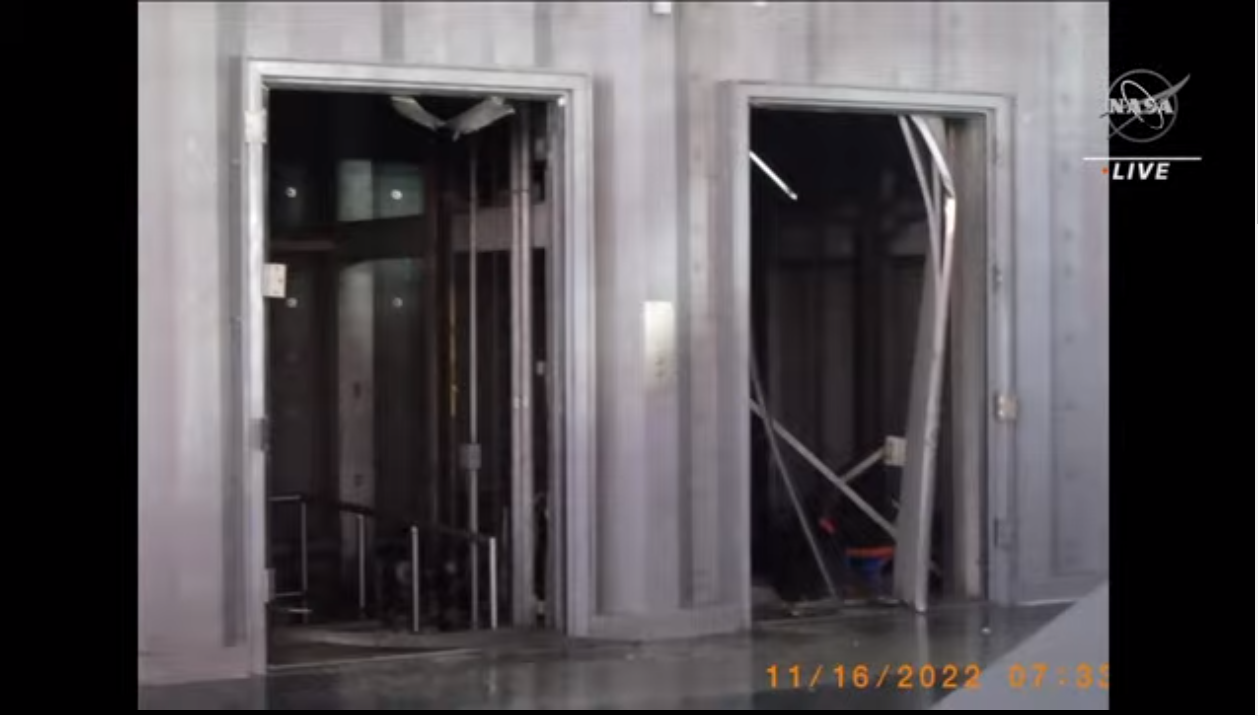
The mission has not all been smooth sailing, however. As noted in my previous Space Sunday update, the launch facilities at Kennedy Space Centre suffered damage during the Artemis 1 launch, although at the time of that article, NASA had not confirmed how much damage had occurred on the mobile launch platform.
Immediately following the launch, NASA asked the media not to image or record the launch platform and tower, citing security issues and ITAR (International Traffic in Arms Regulation), sparking speculation (particularly among SpaceX fans) that the Space Launch System rocket have caused considerable damage to its launch facilities and was therefore somehow a “failure”.
The elevator stations at the base of the mobile launch tower used in the launch of Artemis 1, showing the extent of the damage with the protective blast doors entirely blown-in. Credit: NASA
Since then, however, NASA has completed an initial damage assessment exercise and has been more forthcoming. Whilst a more in-depth assessment is required on the internals of the launch tower structure, the initial assessment suggests the launch platform overall faired a lot better than expected, given the huge strain it was under (SLS generates more thrust and heat than either the space shuttle vehicles or the Apollo Saturn V at launch).
Lizbeth Morningstar is relative newcomer to Second Life, but is making her mark as both a photographer-artist and – as from November 26th, 2022 – a gallery owner and curator, with her Starborn Gallery.
Located on the southern coast of Geata V and with a beachfront setting offering space to host exhibition opening events, the gallery utilises its own shared environment for ambient lighting, and it is recommended visitors set their viewers to Used Shared Environment (World → Environment) so that it is used when viewing the art on display. The building itself – designed and built by Lizbeth – presents two display wings, one of which features selections of Lizbeth’s own work, and the other to guest artists who will be displaying at the gallery on a rotational basis. For the Gallery’s opening, Pedro (PedroGlande) is the guest artist.
Starborn Gallery, November 2022 – Lizbeth Morningstar
SL is such amazing world for photography inspiration. I Love Photography; for me, it is the Fusion of mind and scenery. I take photos to express my feelings. My photos vibes varied by flowing mood. Self-Healing is the theme of this exhibition.
Taking photos in SL is my Self-Healing, Self-Meditation process. You may find a sense of purification or calm in these photos. I want to breathe fresh air and embrace sunshine in both RL and SL. Let’s take a soothing step to recall the light of our lives.
– Lizbeth Morningstar
Despite her relatively recent arrival in Second Life, Lizbeth has fairly immersed herself in the world of Second Life art and photography, developing an approach and style that is both eye-catching and somewhat unique. Many of her images are semi avatar-centric, in that her own avatar is featured within her pictures; however, they are not avatar studies in the traditional sense of that term. Instead, they are what might be called “life studies” in which her avatar (or one of her pets!) is seemingly caught in a natural moment so that while our eyes are drawn to both avatar and / or pet, it is the setting as a whole that gives the image both context and sense of spontaneity that counters the fact it has been posed and post-processed.
Starborn Gallery, November 2022 – Lizbeth Morningstar
In many of her images, Lizbeth opts for a combination soft focus and depth of field to bring her avatar to the fore, with her colour palette tending towards softer tones. This gives many of her pieces a slightly dream-like effect, helping her work to be instantly recognisable.
In the second wing, Pedro presents Transmute, a collection of images which also feature his avatar. However, rather than being individual narrative pieces, the images in Transmute are offered under an over-arching theme: our relationship with (and perhaps, the discovery of) our relationship with nature and natural things.
Starborn Gallery, November 2022 – Pedro PedroGlande
Within these images, we find Pedro within natural woodland settings, exploring, relaxing, and exulting in the natural cast of tress, woodlands and tall grass. These are pieces that use angle, focus and post-processing to enormous effect to present single-frame, tightly focused narratives, each beautifully tied to the core theme; a theme also framed by the lyrics from Pendular by the Brazilian indie rock group Scalene.
The one exception to all this can be found at the rear of the hall’s lower floor. It takes the form of a small photo studio complete with a chair for posing and three greyscale self-portraits of Pedro in various poses on the chair. The images are engaging, their greyscale tones providing a level of natural reality in a manner which colour renders would require much more intrusive post-processing to achieve. I’ll be honest, I had hoped the chair within the little studio would offer a series of poses so that visitors might try their own hand in capturing themselves whilst seated / standing on it and thus experiment with their own artistic expressionism, but alas, the chair had (at the time of my visit) just the one pose.
Starborn Gallery, November 2022 – Pedro PedroGlande
It is always pleasing to see new artists and new galleries appear in Second Life, and I certainly look forward to witnessing further exhibitions at Starborn and in witnessing Lizbeth’s evolving journey as a Second Life photographer-artist. And now that I’ve been properly introduce to Pedro’s work, I hope all be able to witness more exhibitions where he is a focused artist.
Otter Lake, November 2022 – click any image for full size
In looking through my Exploring Second Life archives, I was surprised to note that it’s getting on for two years since my last visit to Sharon Hinterland’s Otter Lake, a place which has relocated since my last visit in February 2020, so I took a quick TP to renew my acquaintance.
The last time I dropped in, the region offered a rural location, rich in a layer of realism (as with the first time I visited in 2019) which made it instantly attractive and memorable. The rural element has been retained with this iteration, but mixed with certain waterfront small town feel. For those already finding locations in SL a little cold from the northern winter setting many are already hosting, Otter Lake retains (for now at least!) a feeling of summer and warmer days.
Otter Lake, November 2022
A tranquil place to hang out with friends, listen to ambient music, or to walk about and explore. If you’re a photographer come by and take some amassing photos. This is not a rental sim, so come explore the , town, take a walk or ride around the sim.
– Otter Lake About Land
The “real” sensibilities folded in the region commence at the landing point. Located on the north side of the region, it takes the form of vehicular ferry drawn up to a wharf, giving the sense that visitors have just cross the waters separating the region from the surrounding hills. The ferry perhaps came via the river winding into the waters from the north and a ferry terminus that might lie somewhere along its length.
Otter Lake, November 2022
Those arriving are offered a note card to introduce the setting, noting that it is not residential, and entirely open to exploration and photography.
This card also points out the setting has, as far as possible, been built along a natural scale, meaning that avatars with an average height in excess of 2 metres might suffer from headaches when trying to pass through doorways, and camera positions (especially those offered as a default on the official viewer and those TPVs using the official viewer’s defaults) may require adjustment to avoid being stuck behind intervening walls and ceilings. To help with this, those using the official camera defaults might want to read the following: Tutorial: Viewer Camera Presets in this blog.
Otter Lake, November 2022
A paved road runs south from the ferry wharf. Follow it, and it will lead you all the way to the southern coast of the region before turning east and then back north to reach the the waterfront town. Here the road passes between the water’s edge and squat apartment blocks with shops and places of business on their street-level floors. A second road runs behind these buildings, separating them from the woodland at the heart of the region and the places they in turn hide from view.
Two routes branch from the main road as it runs south from the the ferry wharf. The first offers a shorter route to the town, looping past the local garage along the way. The second is where a junction in the paved road gives way to the rutted track running to the west through the woods and forking to offer access to the west side of the setting, and a very rural mix the is rich in its composition.
Otter Lake, November 2022
Here can be found wooden buildings both set back from the water and braced against it. From the fishing lodge through the stores and bait shop, one half of these waterfront areas seems to be from a bygone era, with vehicles dating from the 1930s through 1950s. Touring it, I gained a slight Bayou vibe to the place, added to by the the more tumbledown waterfront huts to the north.
However, given the surrounding mountains, the stone-built houses and the modern floatplane moored at the fishing lodge, this vibe quickly faded to give way to one more fitting: that of a remote place deep in the wilderness somewhere in the America or Canada, accessible as something of a place far removed from the rest of civilisation, surviving by its own merits as both a place to visit and a remote spot open to fishing vacations, with patrons flying in via the floatplane, if they so wish.
Otter Lake, November 2022
All of the cabins, houses, ground-level stores, the places of business, the shops and garages are furnished and open to visitors to explore and / or use for photography. Rezzing of props is open to Otter Lake group members (with the group free to join) – but as always, please make sure you pick things up when done!
As always, an engaging, worthwhile visit – and keep an eye out for some “hidden” sitting spots within the woodlands.
 Frek’s father left the planet in a big hurry after Gov (the government) peeped him with their rather invasive brain scrambling techniques. Ever since then, Frek and his family have been seen as kind of renegades and outsiders, not really proper company for the upstanding citizens.




 Inara Pey: Living in a Modemworld