Hailey’s Mystical Forest, September 2024 – click any image for full size
Note: This is coming on very short notice as a place to visit, as this setting will be closing on September 14th, but I really wanted to write about it.
Occupying a Full private region leveraging the Land Capacity bonus, Hailey’s Mystical Forest is a fantasy / romantic setting beautifully created by Hails (Hailey Enfield), a long-time resident of Second Life who started out on the Teen Grid and who graduated to the main grid where she continued to create through landscaping regions. She also has one of the most engaging outlooks on life, which I hope she doesn’t mind me sharing here, as it really is inspirational:
There are a thousand different possibilities for anything, our lives could be infinitely different, and we don’t know how it would look if it was different, because all we know is this. There is no certainty that you will live until tomorrow. There is no certainty that the universe will last as long as we think it will last. . . And that’s amazing.
– Hailey Enfield
Hailey’s Mystical Forest, September 2024
Within Hailey’s Mystical Forest, she has given us one of the wonders that were it able to do so, the universe itself might create as a garden for beings to wander. Split between two levels, the region offers a mix of public and private spaces (the latter limited to the sky platform, so no risk of interrupting things when exploring the ground level).
Spend Romantic time with that special someone or relax in a serene setting surrounded by fantasy; mountainous forest terrain and enjoy some solitude. To see the world In a grain of sand, or heaven in a wildflower. Enjoy the lush meadows.
LGBTQIA+
– From Hailey’s Mystical Forest About Land description
Hailey’s Mystical Forest, September 2024
This is a setting that makes extensive use of Elicio Ember’s creations in the forms of his glowing mushroom trees, fungi, moulds, lotus blossoms, and plants all used to great effect among Alex Bader’s tall Scots pine and across the undulating landscape. Given the nature of these plants, travelling through the region using the shared environment (World → Environment → Use Shared Environment) as recommended at the landing point is an absolute must. I was lucky in that my visit to the setting took place mostly during its night-time period, which brought the luminous nature of many of the plants to the fore.
The Landing Point is slightly elevated above most of the landscape, stone steps (from Alex Bader’s excellent Zen Garden building kit, which is also used extensively within the region) providing a way down to the gravel paths that meander around the trees and between rocks and plant life, branching here and there to offer multiple routes of exploration. Signposts along some of the paths will point to places of interest, such as the natural hot spring sauna / bath and the beach, but for the most part, it really is a case of following your nose and the paths and seeing where they lead.
Hailey’s Mystical Forest, September 2024
Along the paths it is possible to find places to sit and pass the time, be it in the natural rock pools, on the modern stone benches at a camp site or on blankets and logs found on a hill-top. Exploration will also likely introduce you to the setting’s plethora of kitties (like me, Hailey is a lover of cats and the region’s name helps preserve the name of one of her former kitties). Most of the felines will quietly observe you as you pass, although one does appear to have the duty of keeping an eye on one of the the forest’s pandas!
Those who find their way up to the top of the settings’ north-eastern rocky promontory can take a ride on a zip line (by Cube Republic) across the landscape and between the tree to where an ancient meeting place sits of the flat top of another hill. Also tucked under the lee of the northern promontory and best reached via the setting’s east-side beach, is a small hideaway where the romantically-minded can enjoy a cuddle / snuggle / more.
Hailey’s Mystical Forest, September 2024
The sky platform can be reached by climbing down the ladder sitting within a hollow tree stump at the Landing Point (and watched over by another cat!). This will deliver you inside the trunk of Elicio’s massive Tree of Life. A path exits the tree, quickly branching to offer a choice of routes.
As already noted, this platform, whilst a continuation of the forest, includes (at the time of my visit) two private residences to the south-west and west, so I’ve advise that if you make the trip up, to keep away from these to avoid trespass, and instead head eastward to the Japanese Water Temple. long the way you’ll pass another tree-trunk teleport to get back to ground level (or if you prefer, you can return to the Tree of Life and use the water portal there, you’ll just need to accept the Experience to do so), and also pass another of the setting’s pandas. This one is wandering the grassland in front of the temple, where further seating spots can be found.
Hailey’s Mystical Forest, September 2024
Per the note at the top of this article, Hailey’s Mystical Forest will be closing on September 14th (would that I have discovered it earlier in order to write about it much sooner!), so opportunities to visit are limited. However, I really did want to get something down in writing, both as a small measure of preserving its memory and to encourage folk to pop along and appreciate Hailey’s creativity.
So, please be sure to take the time between now and the end of September 14th and pay the region a visit!
The Annex, Nitroglobus, Sept / Oct 2024: Frank Atisso – Echoes of Illusion
Frank Atisso makes a return to The Annex at Dido Haas’ Nitroglobus Roof Gallery for September / October with Echoes of Illusion, a selection of bold – in a literal sense – images that offer a series of challenges to be considered; some of which are intentional on the part of the the artist – as he states as much in his own introduction to the exhibition – others of which, given the nature of the world in which we currently live might well not be entirely the artist’s intent, but which may nevertheless resonate with those viewing the pieces.
Frank explains Echoes of Illusion thus:
The images I created … reflect and amplify the deceptive nature of concepts like peace and freedom.
I chose the combination of black, white, and red as it best represents the stark contrasts and underlying truths of these dark themes, highlighting how illusions and false promises resonate and reverberate through society.
– Frank Atisso, introducing Echoes of Illusion
The Annex, Nitroglobus, Sept / Oct 2024: Frank Atisso – Echoes of Illusion
Thus on offer are nine very large images presented purely in red and/or black and/or white. Each one can be interpreted both directly and indirectly, and many carry the idea that contrary to the general (and mistaken) perception that white is akin to purity and goodness and black and red are so often associated more with anger, violence, darkness and death, as with many things in life, things are not so clear cut, and the purity of white can veil much that is itself harmful or hold harmful intent. Within them is also that broader commentary on the current state of society to which Frank alludes, and the increasingly pervasive dangers of false promises and the use of disinformation to blind people to realities that could so easily entrap them.
The best way to appreciate each image is to right-click it and view the title, and then allow it and the title to permeate your thoughts. In this way the core meaning of an image is readily identified, whilst the mind is free to consider it in light of the aforementioned boarder state of increasingly polarised (particularly western) societies: the echo chambers of social media; the aggravation of ill-conceived “injustices” as a means to foment anger and resentment under the guise of bringing hope, strength and security; the false realities of so-called wealthy “thought leaders” and their thirst for authoritarian control of those they seek to persuade and the reality that they care little for the welfare of those same followers, other than then heed the call and be ready to spread divisiveness and inflict chaos, no matter what the cost to themselves or their own rights.
The Annex, Nitroglobus, Sept / Oct 2024: Frank Atisso – Echoes of Illusion
It is because there is so much potential here, coupled with the fact that outside of Second Life I hold very particular views concerning those leading the extreme right and the realities of their words and deeds which has already potentially biased my commentary, that I do not want to inflict my own views further on this exhibition. Instead I urge you to go along and spend time within it and allow it to speak to you.
Logos representative only and should not be seen as an endorsement / preference / recommendation
Updates from the week through to Sunday, September 8th, 2024
This summary is generally published every Monday, and is a list of SL viewer / client releases (official and TPV) made during the previous week. When reading it, please note:
It is based on my Current Viewer Releases Page, a list of all Second Life viewers and clients that are in popular use (and of which I am aware), and which are recognised as adhering to the TPV Policy. This page includes comprehensive links to download pages, blog notes, release notes, etc., as well as links to any / all reviews of specific viewers / clients made within this blog.
By its nature, this summary presented here will always be in arrears, please refer to the Current Viewer Release Page for more up-to-date information.
Note that for purposes of length, TPV test viewers, preview / beta viewers / nightly builds are generally not recorded in these summaries.
Official LL Viewers
Release viewer: version 7.1.9.10515727195, formerly the Altasaurus RC, promoted August 26.
Performance boosts. Memory management has been optimized and users will experience a higher FPS across various systems. A comprehensive range of bug fixes are also provided. This includes better PBR material handling and resolving frequent crashes. See the release notes for more.
UI for scheduling region restarts now available via a new button located in the Region/Estate floater. (Note: there is currently an issue with scheduled region restarts working correctly and a fix is due to come in the next server release).
Grauland / Primary Colors, September 2024 – click any image for full size
Cube Republic gave me a poke in the ribs recently to suggest I hop back over to Jim Garand’s Grauland to see what Jim has done since my last visit. As I’ve frequently noted, I enjoy visiting Jim’s work and writing about it, but the first time I popped over to visit this iteration, I was interrupted by a bout of “real life” and didn’t have time to see much. Fortunately, the past few days have enabled me to hop back, so here we are.
With Grauland / Primary Colors, Jim takes us into the American heartlands (at least going by one of the billboards) and an industrial setting of a chemical plant of some description. It appears to be producing vivid primary colours for who-know-what purpose (perhaps they are for painting prims shipped from the Prim Rig in the ANWR Channel 😀 ).
Grauland / Primary Colors, September 2024
Sitting alongside a busy road, the complex is impressive and speaks to a slick operation. The bulk raw materials arrive by rail to be dropped from their hopper cars as they sit on elevated track. From here, they’re bulldozed into piles so that articulated yellow loaders can scoop them up for transfer into more hoppers where they can be conveyed to huge tanks. Once in these, they appear to be dissolved into a a liquid mix, and so pass onwards through associated processing (including the burning-off of waste product) to eventually end up in tanker wagons as finished goods, ready to be hauled of along the very same rails they arrived on.
Part of the processing also seems to involve deliveries by road through the plant’s main gates, the materials stored in a small warehouse on that side of the grounds. Everything appears to be watched over from the vantage point of a control room sitting to one side of the main plant on four stout concrete legs. Although, looking at the screen savers on a couple of the PCs in the room, staff there would appear to at times have their minds on things other than monitoring systems!
Grauland / Primary Colors, September 2024
Throughout the tanks, risers, piping, silos and whatnot are ground-level and elevated walkways and catwalks offering visitors the opportunity to explore the complex in detail, whilst the surrounding hills make it clear the place is well inland and away from the sea. Exactly where it might be is left to the imagination; one of the billboards hints it might be along Route 66 and maybe in Missouri – why else the advert on the board? – But this is pure supposition on my part, although said ad did allow me to learn that “The Best Fudge Comes from Uranus” really is an advertising slogan for a tourist attraction on US Route 66 in Missouri.
This is a setting with a lot of subtle detail built-in; the screen savers on the computers suggests the desire to break with the cycle of mundane duty when at work; the condition of some of the towers and storage tanks give the impression of age while the colour-coding on some of the pipes gives a further sense of authenticity, as do thinks like the first aid equipment at the gate house. Some of the controls in the main building have some curious labelling – but such is the way of things when building a scene in Second Life, and certainly nothing to complain about.
Grauland / Primary Colors, September 2024
With the landing point (which includes the teleport up to Jim’s M1 Poses store) located in the north-west corner of the region, this is a setting that spreads itself out before you to the east and south as you arrive, begging to be explored (and I liked the way the north edge of the region has been raised to suggest spoil tips from the plant that have been in place so long, the local grass has claimed them even as they denote the edge of the walkable region and the start or the encompassing region surround).
Opportunities for photography abound through the setting, particularly for those who appreciate a more industrial background to their avatar studies. So with that said, I’ll leave you to hop along and see for yourselves.
Now open through until Sunday, September 22nd, 2024 (inclusive) in Second Life is the 2024 edition of the Spoonful of Sugar festival in support of Médecins Sans Frontières (MSF), the globe-spanning non-profit organisation delivering emergency and humanitarian aid to people affected by armed conflict, epidemics, natural disasters and similar.
Also known as Doctors Without Borders, MSF was originally founded in Paris, France in 1971 and is entirely self-governing; the support and treatment it provides is given on the basis of need, irrespective of race, religion, gender or political affiliation. It is often one of the first organisations to have feet on the ground wherever and whenever humanitarian aid and medical support is desperately needed, and since its founding, MSF has grown to a movement of 24 associations, bound together as MSF International, now based in Switzerland. Thousands of health professionals, logistical and administrative staff – most of whom are hired locally in respect of the care they give around the world – work on programmes in some 70 countries worldwide to provide medical and social care & support for a staggering 10+ million people annually.
Since its own establishment, the SOS event has raised more than US $100,000 for MSF’s global work, in keeping with its mission statement.
We believe the simplest form of compassion is to simply care for the life of another. And we believe medical care to be the most fundamentally basic means by which to do that.
– The Spoonful Of Sugar Festival Mission Statement
Spoonful of Sugar 2024 (September 7th-22nd)
This year, SOS is taking place across a total of six regions with the theme of En France!, with five of the six regions very much focused on MSF’s founding city of Paris. Four of these regions present the core shopping elements to the event, each one presented as scene featuring the kind of French townhouses and business façades found along places like the Champs-Élysées, surrounding a central area representative of I. M. Pei’s glass-and-metal Louvre Pyramid, located in the Palace’s Cour Napoléon.
With pairs of these regions sitting to either side, the two central regions are more open in their design. The first forms the main landing point and activities venue for SOS, and is dominated by the Eiffel Tower and the park below it, into which has also been placed a giant Ferris wheel, which I take as representing the 60-metre wheel at the Tuileries Gardens. This region – SOS Uber Global – is connected to two of the shopping regions by bridges, with a further bridge connecting it to the other central region in the group.
The latter is mindful of rural France, and is home to various spaces given over to breedables, landscaping and gardening – and most notably, a special 10th anniversary art display presented by Harmonic Sanctuary, founded and operated by Harlow Jones Blues (harlowjones) and Jess Blues (JessBlues).
Une Célébration Du Pays Basque, spoonful of Sugar 2024 (September 7th-22nd)
Une Célébration Du Pays Basque “takes you on a journey through the stunning landscapes and rich culture of the Basque region of France”. Centred on a watermill similar to those which might found in the region, and here offered and in homage to Jess’ father, who was born in such a building. The exhibition offers a rich and engaging collection of images in celebration of the French Basque region – the landscape, the people and the lifestyle, with an additional display of art located in the cave to one side of the gallery building.
Beyond this, the setting continues as a place to explore and spend time within, and I recommended taking time to pick up a note card from the information board at the gallery’s landing point. It contains a wealth of information that’s worth the time taken to read it – and remember that much of the art (produced by Jess and Harlow) is offered for sale exclusively at SOS, with a goodly portion of the cost going directly to the event.
Spoonful of Sugar 2024 (September 7th-22nd)
The best way to find out about all that’s going on at SOS 2024 and which stores are where within the region is via the official website, where you can find the schedule of entertainment, and the region list page with SLurls directly to all stores and points of interest. The base of the Eiffel Tower is the location for the event’s raffle, and also a place where Animesh mime artists can be found performing (this is Paris, after all!), with a select of low-cost items with 100% of all proceeds going to the event right next to them. I didn’t notice any hunt this year – but might have missed it in my travels.
As always, Spoonful of Sugar is an event well worth visiting. Even if you don’t find anything to buy in the shopping regions, the donation kiosks will welcome your Linden dollars, and you can be absolutely sure that your money is going to a very worthy cause.
A high-resolution image of the vestibule area within the nose of CST-100 Calypso showing some of the docking mechanism as the vehicle clear the International Space Station (ISS) on September 6th, 2024. Credit: NASA
Boeing’s Starliner capsule Calypso is back on Earth after what appears to have been an almost pitch-perfect automated return flight form the International Space Station (ISS).
The vehicle departed the ISS at 22:04 UTC on September 6th, after almost a day of preparations during which Starliner’s inner hatches were sealed as was the hatch on the ISS’s Harmony docking adaptor, prior to the “vestibule” at the forward end of Calypso, containing the vehicle’s half of the docking mechanism, being slowly depressurised. Some time prior to the undocking, and while awaiting the formal ATP – authority to proceed – the two control rooms at Johnson space Centre, Texas, one for the ISS the other for Starliner, did a final go / no-go poll, after which ISS Flight Director Chloe Mehring called the station.
Station Houston space-to-ground 2 for Starliner undock.
Go ahead, we’re with ya.
Hey, Suni both the Starliner and the ISS flight control teams have polled GO for undock at this time. Expected undock time is 22:04 [UTC].
Okay, copy. 22:04. Hey, y’know, just looking at the flight control roster, and like wow! It is the all-star team! You guys, it IS time to bring Calypso home. You have GOT this! We have your backs, and you’ve got this. Bring her back to Earth.
– Exchange between Flight Director Chloe Mehring and astronaut Suni Williams on the ISS prior to Starliner’s departure.
The Starliner Mission Operations Control Centre during the Starliner return to Earth operation, Friday, September 6th, 2024. Credit: NASA
ATP came at 22:02 UTC, and the 12 docking “hooks” on the ISS docking adaptor rotated to their “open” position, allowing springs on the Starliner’s docking mechanism to very gently push it away from the space station two minutes later. The use of such springs avoids the need for the vehicle to use its forward thrusters, potentially spraying ISS docking adaptor and hatch with toxic hydrazine exhaust gas.
Once the separation between station and vehicle had exceeded 5 metres, Starliner commenced a series of 12 short firings of the forward facing reaction control thrusters on the service module, pushing itself outside the 200-metre Keep Out Sphere (KOS), an imaginary zone around the ISS within which a spacecraft must be on what is called a “4-orbit safe free drift trajectory”, meaning that it can float freely in close proximity with the station for a period of 4 orbits (roughly 6 hours) without any risk of collision should its manoeuvring system fail.
These burns were more or less a “reversing manoeuvre” in a straight line. Once outside the KOS, Starliner was within the larger Approach Ellipsoid (AE), another imaginary area of space around the station within which spacecraft must be able to float freely for up to 24 hours without risk of impacting the space station. Once in the AE, Starliner continued to move away from the station whilst starting to raise its orbit until some 19 minutes after undocking, it was clear of the AE as well and moving on to an orbit that would carry it around the Earth several times and bring it to the required position for its de-orbit burn.
Starliner is pushed clear of the ISS by springs within the nose of Calypso, the vehicle’s capsule. Credit: NASA TV
Once clear of the AE, the ISS involvement in the flight concluded, leaving the NASA Starliner flight team to oversee the rest of the return, an operation of multiple parts.
In particular, the Calypso’s own Reaction Control System (RCS) thrusters were tested. Entirely separate from the problematic thruster systems on the service module, Calypso’s RCS allow the capsule to manoeuvre and maintain orientation once it has separated from the service module after the de-orbit burn, in order for it to successfully re-enter the denser atmosphere. These 12 thrusters are divided to two “strings” of 6, with only one “string” being used in flight operations, the other being there for redundancy purposes. One of the thrusters did fail to fire during the tests, but posed no threat to the flight.
A view from the ISS television camera as the departing Starliner fires its forward-facing thrusters as it moves away from the station. Credit: NASA TV
Similar redundancy exists within the service module RCS (hence why it has 28 thrusters in 4 banks of 7 apiece), and a test of 10 of the unused RCS thrusters on the service module during the same period saw them all operate without a hitch.
Then, immediately prior to the de-orbit burn was due to commence, a final weather check was carried out over the landing zone to confirm everything was above the required minimums for a Starliner landing. These checks include ensuring that winds be no greater than 12 knots, temperatures at ground level will be no lower the -9.4ºC, and the cloud base must not be lower that approx. 300 metres and allow for an all-round visibility of no less than 1.85 km (1 nautical mile). It must also be confirmed that there are no thunder or electrical storms within a 35.4 km radius centred on the landing zone which might interfere with data transmissions / reception. Should any of these criteria not be met, the de-orbit burn would be postponed until such time as all could be met.
Mission control graphics of the de-orbit OMACS de-orbit burn of the CST-100 Starliner, September 6th/7th. 2024. The four OMACS motors (white) can be seen firing along the vehicle’s line of flight, with reaction control thrusters (coloured) also firing to maintain the vehicle’s orientation and rotation. Credit: NASA TV
As it was, everything was well within tolerances at the landing zone, and at approximate 03:15 UTC, four OMACS – orbital manoeuvring and Attitude Control System– motors on the service module fired in a 59-second burn, with several RCS thrusters also firing to maintain the vehicles overall orientation and attitude, slowing the vehicle sufficiently for natural drag to start pulling it into the denser atmosphere.
Immediately following the de-orbit burn, Calypso separated from the service module and oriented itself so the primary heat shield was at the correct entry for atmospheric interface, whilst the service module dropped into an uncontrolled re-entry so it would burn-up in the atmosphere and any surviving debris full into the southern Pacific Ocean. Calypso reached its re-entry interface – the period when it passed into the upper reaches of the denser atmosphere and experienced maximum re-entry temperatures – some 15 minutes after jettisoning the service module, and as it approach California’s Baja Peninsula. After this, things happened rapidly.
An infra-red, low-light image of Calypso deploying her drogue parachutes during her atmospheric descent. The bight disk of light below the vehicle is the forward heat shield falling away. Credit: NASA
At 22km altitude, the forward heat shield at the top of the capsule was jettisoned, clearing the way for parachute deployment. This commenced almost immediately with the deployment of the vehicle’s two drogue parachutes, designed to help reduce its speed. These opened slowly over a 28-second period in order to reduce the stress on their canopies and the degree of sudden deceleration on the vehicle.
The drogues were in turn released at 10km altitude, allowing the three main parachutes to deploy and open over a 16-second period, again to reduce the strain on them and the vehicle. They then carried Calypso down towards landing. With a couple of hundred metres left in the descent, the primary heat shield was released, exposing the six airbags sitting between it and the base of the capsule, allowing them to rapidly inflate to cushion the actual landing.
At an altitude of around 10km, with the main parachute deployed and the capsule held upright, the main heat shield is dropped, freeing-up the six airbags under Calypso to inflate. Credit: NASA
Touchdown came at 04:01 UTC on September 7th, and the recovery teams started their operations shortly after, moving in to the landing site from upwind of the vehicle to avoid risk of any harmful gases from the propulsion systems, etc. Safing of the vehicle and preparing it for transit away from the landing zone proceeded over the course of the next several hours.
With Calypso now on Earth, the focus will shift to trying to rectify the causes of the issues with the service module propulsion systems. As I’ve previously noted, this is made harder as engineers have no physical parts to eyeball; they will have to continue to work on data gathered through ground testing of identical units and data gathered during all the test-firings performed during the flight (including those carried out during the vehicle’s return to Earth).
Seconds before touchdown: with the airbag inflated, Calypso is a seconds from landing within the White Sands Space Harbour, New Mexico, Credit; NASA
Calypso, meanwhile, with two flights under her belt, will now return to Boeing for a thorough check-out, overhaul and refurbishment. Although when she or the unnamed Capsule S2 (which performed the seconded uncrewed flight test to the ISS in 2022) will fly again is unclear. Currently, S2 is scheduled to fly the first Starliner operational mission (Starliner-1) in August 2025; however, NASA is now hedging its bets: it has recently double-booked the SpaceX Crew Dragon Crew-11 mission (crew yet to be assigned) to fly in the same period if it becomes apparent Starliner-1 will not be ready to fly.
As previously noted, this means that astronauts Barry “Butch” Wilmore and Sunita “Suni” Williams will be remaining aboard the ISS until February / March 2025, when they will return to Earth on the SpaceX Crew Dragon Freedom. This is due to lift-off from Kennedy Space Centre on or around September 24th, carrying astronaut Nicklaus “Nick” Hague, and cosmonaut Aleksandr Gorbunov to the ISS, where they will complete a 5-day hand-over with the Crew 8 team. The latter are set to depart the ISS around October 1st.
A high-speed tracking image of Calypso passing through re-entry, the plasma around it glowing bright and leaving a heated trail behind the capsule. Credit: NASA
However, Crew 9 will not be the first the reach the station following Starliner’s departure. Soyuz TM-26 is to due to depart the Baikonur Cosmodrome on September 11th, carrying cosmonauts Aleksey Ovchinin and Ivan Vagner, and NASA astronaut Don Pettit.
They will dock with the ISS a few hours later, after a “fast” ascent and rendezvous, and raise the total crew on the ISS to 12. Then on September 24th (the day NASA is targeting for the launch of Crew 9 / Expedition 72), Soyuz TM-25 is set to depart the station and bring Oleg Kononenko, Nikolai Chub, and NASA astronaut Tracy Caldwell-Dyson back to Earth .
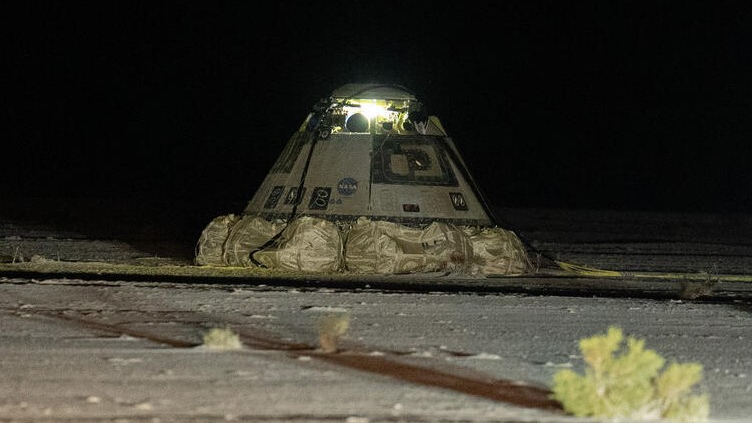
Calypso on the ground on September 6th / 7th, 2024. following her return to Earth at the end of her second flight into space (and first to the ISS). Credit: Boeing
Blue Origin Advances New Glenn Maiden Flight, But Without NASA’s EscaPADE
Blue Origin is progressing toward the maiden flight of its New Glenn semi-reusable medium-to-heavy lift launch vehicle – although there are doubts about whether the company will meet the mid-October launch window NASA originally set it.
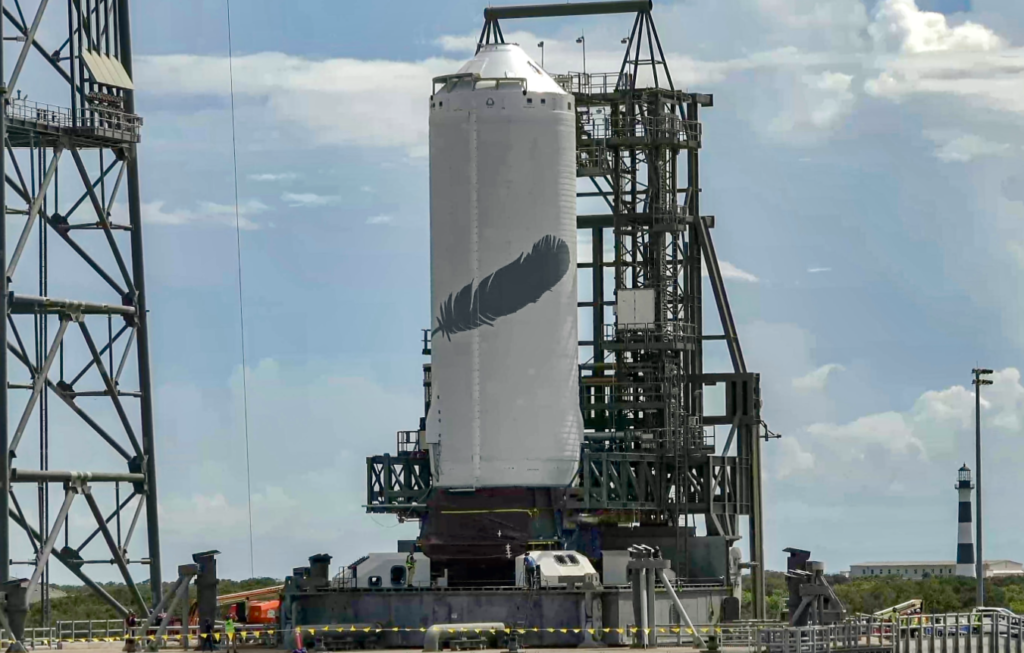
On September 3rd, the company deployed the new rocket’s 23m tall second stage to its launch facilities at Cape Canaveral Space force Station, Florida, where it will undergo a static fire test of its two Blue Origin BE-3U motors. However, this is just one of a number of milestones the company must meet in very short order if it is to make the mid-October launch window they state they still intend to meet.
The second stage of the first New Glenn rocket built for flight by Blue Origin, is moved to Launch Complex 36 at Cape Canaveral Space Force Station, Florida where it is due to undergo static fire tests. Credit: Blue Origin
This date was set by NASA when Blue Origin offered the flight as the launch vehicle for NASA’s EscaPADE Mars orbiter mission. A part of NASA’s Small Innovative Missions for Planetary Exploration (SIMPLEx) programme, whereby missions costs are to be reduced by launching them as secondary payloads alongside primary missions, thus reducing their launch costs.
In this, EscaPADE – standing for Escape and Plasma Acceleration and Dynamics Explorers – a pair of identical satellites designed to study Mars’ atmosphere, were supposed to be launched with NASA’s Psyche mission, which originally was going to make a fly-by of Mars whilst heading for asteroid 16 Psyche, eliminating virtually all launch costs. However, Pysche’s launch was revised to a point where the Mars fly-by was no longer possible, and EscaPADE needed a new ride.
The New Glenn second stage raised to its vertical position on on the static fire test stand, Cape Canaveral Space Force Station, Florida. Credit: Blue OriginWhile Blue Origin offered the maiden flight of New Glenn at the bargain basement price of $20 million, it was still more that the original budget for the mission. With the launch facing a host of deadlines, including the second stage static fire test, and things like the integration and testing of the vehicle’s seven first stage BE-4 engines; stacking and integration of the vehicle’s two stages together with the payload and payload fairing; pad roll-out and countdown demonstration tests, NASA has been understandably concerned about Blue Origin’s ability to make the launch window for the last couple of months.
These concerns gained momentum because in order for EscaPADE to be ready for the launch, both satellites must be loaded within toxic hypergolic propellants. This is a costly, time-consuming exercise, and if New Glenn cannot make the October launch window, then NASA will have to go through an equally costly and delicate “de-tanking” exercise and purging of the propellant tanks of the satellites – and then go through the process again when the mission is ready for launch. So the decision was taken to avoid the additional costs and pull EscaPADE from the New Glenn launch. Instead, the agency is looking to launch the mission in spring 2025 – but still using a New Glenn vehicle.
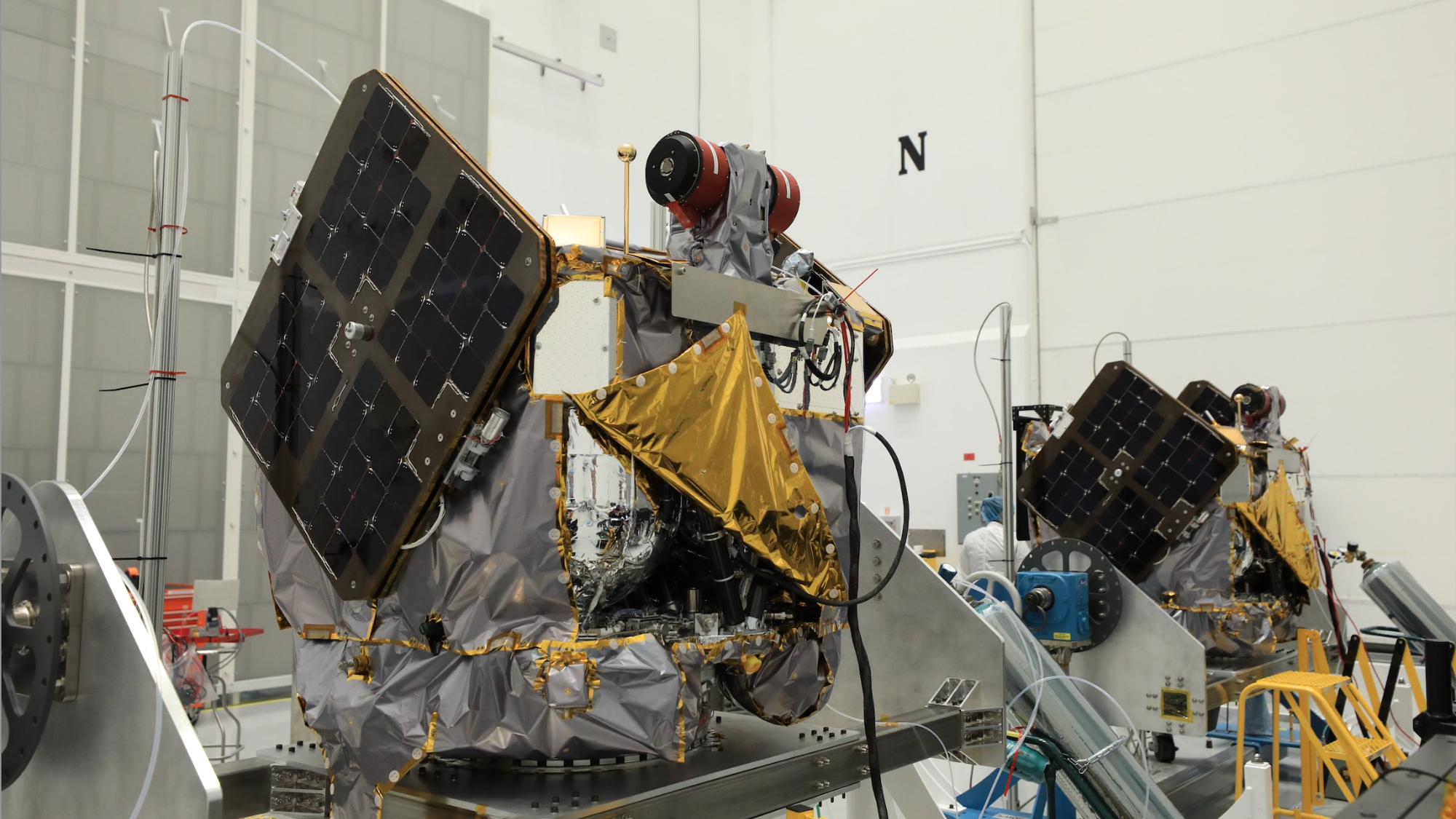
Blue and Gold, the two identical EscaPADE satellites, built by Rocket Lab for NASA, seen in their “folded” configuration within an NASA clean room. Credit: NASA / Rocket Lab
This in itself has raised eyebrows; optimal launch windows to Mars occur around every 26 months, which spring 2025 does not meet. As such, it currently looks as if EscaPADE, a 990 kg all-up weight – will be the sole payload for the launcher, which will have to throw it into a heliocentric orbit around the Sun and out to Mars on an extended transfer flight.
In the meantime, and as noted, Blue Origin have stated they are still aiming to launch New Glenn on its maiden flight in October. With the removal of EscaPADE, they now intend to use the launch to place its Blue Ring “space tug” into orbit. This is a vehicle at the centre of a new operation for Blue Origin – providing on-orbit maintenance and movement of satellites. The company is also talking to the US government about using the flight to certify New Glenn as National Security Space Launch system.
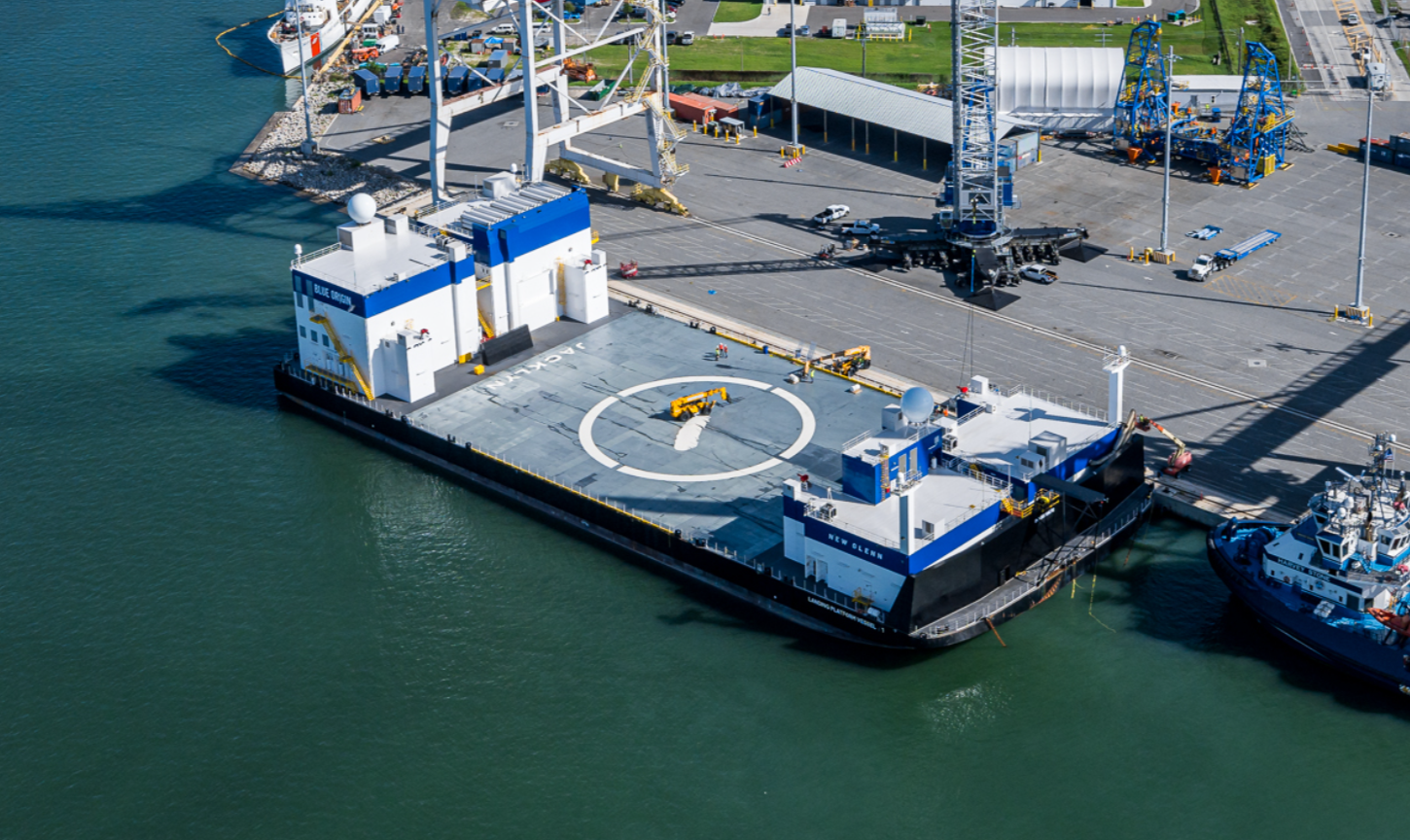
As a semi-reusable vehicle, the first stage of New Glenn is designed to be able to land after each use. To achieve this, it will use a sea-going landing barge akin to, but larger than, the SpaceX autonomous drone ship landing platforms. Officially called a landing platform vessel (LPV), the first of these barges arrived at Port Canaveral at the start of September 2024 in readiness for the maiden flight of New Glenn.
Built in Romania and outfitted and commissioned in France, LPV-1 Jacklyn, named for the mother of Blue Origin founder Jeff Bezos (who has also personally financed the company), the 115-metre long platform has already caused raised eyebrows as it has four large structures fore and aft of the 45m wide landing area. It’s not clear if these are integral to the barge (although the do seem to be) and what they might be for.
Blue Origin LPV-1 Jacklyn alongside at Port Canaveral, September 3rd, 2024
Certainly, putting such large structures on the barge is an interesting choice. Trying to successfully land a tall, thin tube containing the remnants of liquids that like to go kaboom when mixed and given the excuse, is not exactly a sinecure (just ask SpaceX). As such, hemming-in the landing zone with tall structures that could cause an even greater conflagration were a booster stage to topple into them whilst going the way of said kaboom seems to be somewhat tempting fate; I guess time will tell on that.






 Inara Pey: Living in a Modemworld