Updates for the week ending: Sunday, September 20th
This summary is published every Monday, and is a list of SL viewer / client releases (official and TPV) made during the previous week. When reading it, please note:
It is based on my Current Viewer Releases Page, a list of all Second Life viewers and clients that are in popular use (and of which I am aware), and which are recognised as adhering to the TPV Policy. This page includes comprehensive links to download pages, blog notes, release notes, etc., as well as links to any / all reviews of specific viewers / clients made within this blog
By its nature, this summary presented here will always be in arrears, please refer to the Current Viewer Release Page for more up-to-date information.
Notifications project viewer updated to version 3.8.4.305083 on September 18 – new Notifications floater separates incoming notifications into System, Transactions, Invitations, and Group. It provides a better way to view, interact with, prioritize and manage incoming notices for busy residents (download and release notes)
Importer RC viewer updated to version 3.8.4.305119 on September 17 – provides a modified mesh uploader & optional debug information (download and release notes).
Project viewers:
Quick Graphics project viewer updated to version 3.8.4.305063, on September 16 – provides the new Avatar Complexity options and the new graphics preset capabilities (download and release notes)
Updates for the week ending: Sunday, September 13th
This summary is published every Monday, and is a list of SL viewer / client releases (official and TPV) made during the previous week. When reading it, please note:
It is based on my Current Viewer Releases Page, a list of all Second Life viewers and clients that are in popular use (and of which I am aware), and which are recognised as adhering to the TPV Policy. This page includes comprehensive links to download pages, blog notes, release notes, etc., as well as links to any / all reviews of specific viewers / clients made within this blog
By its nature, this summary presented here will always be in arrears, please refer to the Current Viewer Release Page for more up-to-date information.
Quick Graphics project viewer updated to version 3.8.4.304916, on September 10th – provides the new Avatar Complexity options and the new graphics preset capabilities for setting, saving and restoring graphic settings for use in difference environments / circumstances (download and release notes)
Project (HTTP updates) project viewer version 3.8.4.304871 released on September 8th – provides improved performance and stability. Impacts include: asset uploads, AISv3 inventory manipulation, VVM, Experience management, LSL compilation, Simhost event polling, etc. (download and release notes)
Cool VL Viewer Stable branch updated to version 1.26.14.6 and the Experimental branch updated to version 1.26.15.5, both on September 12 (release notes)
Mobile / Other Clients
Pocket Metaverse updated to version 1.9.4. on September 8 – core updates: iOS 9 compatibility
At the TPV Developer meeting on Friday, September 11th, the Lab provided further information about the ongoing work to improve inventory handling and management in Second Life.
As has been reported through these pages, the Lab has been tackling a wide range of issues related to inventory, inventory management, inventory losses, etc., over the last several months. The updates given at the TPV Developer meeting were to provide information and news on both the work to help fix issues around large “flat” inventories, and on new and upcoming work in rationalising inventory related code within the viewer, with Izzy and Aura Linden providing the updates.
The video of the meeting can be seen here, and time stamps are given below to the relevant points in the video where the items are discussed.
“Flat ” Inventories
[10:15] This is something that has been mentioned through a number of project updates in these pages. However, in summary: if you have a large “flat” inventory structure with tens of thousands of items contained in single folders at a time, rather than being split between multiple sub-folders, you can experience significant issues in logging-in to Second Life, up to and including being completely unable to log-in at all.
Earlier in the year, the Lab developed an inventory transform tool which, when run, can take the contents of such large folders and split them into smaller, easier-to-load sub-folders. This tool has been undergoing testing for some time, but has now been issued to the Lab’s support teams. So, those encountering log-in issues and know they have large, relatively “flat” inventory structures can raise a support request (Premium or Basic) and have the tool run against their inventory, thus hopefully fixing matters for them.
Inventory Code Improvements
Task Paths
[12:50] Currently, the viewer has multiple paths and mechanisms by which inventory tasks can be undertaken / completed. Aura is therefore working through the viewer code to try to rationalise how inventory is handled, ensure that older paths / mechanisms are properly deprecated / removed and replaced by newer and more robust mechanisms.
[14:20] The first set of changes Aura is working on is to remove from the viewer all of the old UDP inventory messaging paths which have already been replaced by more robust mechanisms (and in some cases already had the server-side support for them removed), but which have until now remained a part of the viewer’s code.
These changes should be appearing in a project viewer for testing by TPVs in the next month or so. This is to allow them to identify possible impacts on any dedicated inventory handling mechanisms they may use (e.g. RLV / RLV/a) which may also use the older UDP messaging paths, and address any updates they may need to made as a result.
Once this viewer reaches release status, the Lab will seek to remove any server-side support for legacy UDP for inventory operations from the simulator code. Again, this will be done in consultation with TPVs, with testing regions available on Aditi beforehand, so the Lab can again be warned if they are triggering potential problems which may need to be thought about / addressed.
Code Refactoring
[19:35] The second element in the work is a refactoring of the viewer inventory files. This work will initially rationalise inventory functions within the viewer so that they are more closely coupled with their actual purpose, rather than being more widely scattered through the viewer code, and will not involve any actual code changes.
However, a further part of the work will involve code changes, with the overall aim being to make the code a lot more readable, easier to test and maintain and understand.
Server-side Inventory Rules Enforcement
[23:32] Additionally, once the above work has been carried out, new checks will be added server-side to prevent actions which are known to cause inventory problems from happening.
For example, there have been issues where people have found themselves with more than one Current Outfit folder or with multiple Trash folders, both of which can result in complications when using the viewer. The simulator-side rules, when put into place, will be designed to prevent these kinds of instances occurring.
Time Frames
As noted, the first phase of Aura’s work – the initial code deprecation work – will be appearing in a project viewer in the next month or so, and the work will progress from there in the stages, thus:
Remove the deprecated inventory message paths from the viewer
Remove any remaining simulator support for deprecated inventory messaging support
Rationalise the inventory functions in the viewer
Refactor the viewer’s inventory code in the interests of stability, maintenance, testing and update
Add simulator checks to prevent folder duplications, etc
How long it will take to implement each phase isn’t currently clear, and will to a degree depend on feedback about issues discovered by TPVs, as well as the results of continued testing by the Lab.
Updates for the week ending: Sunday, September 6th
This summary is published every Monday, and is a list of SL viewer / client releases (official and TPV) made during the previous week. When reading it, please note:
It is based on my Current Viewer Releases Page, a list of all Second Life viewers and clients that are in popular use (and of which I am aware), and which are recognised as adhering to the TPV Policy. This page includes comprehensive links to download pages, blog notes, release notes, etc., as well as links to any / all reviews of specific viewers / clients made within this blog
By its nature, this summary presented here will always be in arrears, please refer to the Current Viewer Release Page for more up-to-date information.
Importer RC viewer updated to version 3.8.4.304605 on September 1st – improved mesh uploader and additional debugging output (download and release notes)
Project viewers:
Quick Graphics project viewer updated to version 3.8.4.304761, on September 3 – provides the new Avatar Complexity options and new graphics preset capabilities for setting, saving and restoring graphic settings for use in difference environments / circumstances (download and release notes)
Bright Canopy have announced they’ll be holding an in-world meeting at their home island in Second Life on Saturday, September 5th at 11:00 SLT.
The meeting will feature an update on the current status of the Bright Canopy streaming service, together with the decisions the company is facing to move forward.
“I’d like to invite those interested in an update on the status of Bright Canopy and its future to attend,” Bright Canopy founder Bill Glover (Chaos Priestman in SL) said.
“The goal is to share what we have learned with the launch and this past week of down time and to have a discussion with the community about what is needed to make this service sustainable and what our options are going forward.”
Those who have been using Bright Canopy will be able to catch up on events following the official launch of the service, and which forced the company to re-evaluate its pricing mechanism, prior to technical issues combining with pricing concerns and forcing the company to suspend subscriptions while matters were worked on.
Bill Glover: meeting to discuss matters and update Bright Canopy on Saturday, September 5th at 11:00 SLT at Bright Canopy Island
The technical issues have now been resolved, and Bright Canopy have indicated that in theory, the service could be back up and available on Monday, September 7th.
However, they are emphasising this is the earliest point at which the service might be up. The company has also indicated whether this in fact happens may depend in some degree on the decisions reached during the meeting.
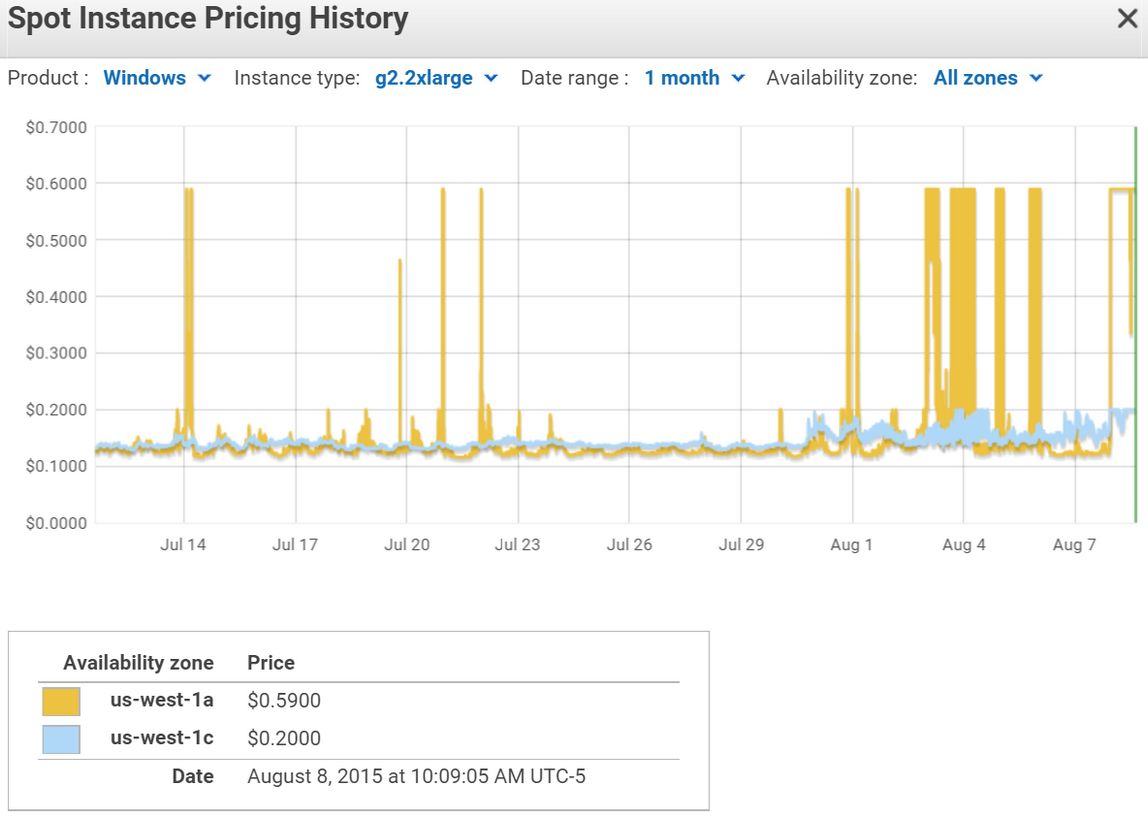
As I recently explained, part of the issue Bright Canopy has faced is with the Amazon Spot instance pricing model. Generally the most cost-effective means of supplying services through Amazon’s infrastructure, this has been incredibly volatile over the past several weeks.
In the last few days, Amazon’s US Spot Instance prices have come down somewhat and are showing a little more stability, although the prices for Ireland remain volatile and unpredictable.
Given this, one possible option for Bright Canopy might be for them to split their service between the US West and East coast POPs they are using, and drop Ireland for the time being. However, this is also not without potential issues. There is no guarantee, for example, that the US pricing will remain stable – as Bright Canopy are only too aware; for another it could be months before Ireland has reached a point where operating through the Dublin POP is a viable option once more.
Thus there is a lot to be discussed, and so all those with an interest in the service are being encouraged to attend Saturday’s meeting. There will be plenty of scope for questions to be asked, and a transcript will be provided through the Bright Canopy blog for anyone unable to attend.
For those who would like to submit a question in advance, either because they cannot attend the meeting in person, or to guard against being unable to access the Bright Canopy region if there is a large turn-out, they can do so by e-mailing Jerri Glover (jerri-at-brightcanopy.com/).
Update, September 4th: Please note there will be a Bright Canopy community meeting in-world in Second Life at 11:00 SLT on Saturday, September 5th, at the Bright Canopy island. All those wishing to catch-up on the latest situation for the service are invited to attend.
Saturday, August 29th saw Bright Canopy, the new cloud streaming service delivering Second life (and the viewer) directly to your web browser, officially launch.
Already extensively previewed by SL bloggers – you can catch my overview of the service here – the launch was given a further boost when the Lab also blogged about it. announcement of the formal launch led to a huge amount of interest being shown in the service.
While there were the inevitable hiccups which tend to accompany such launches, it was the overall demand which perhaps caused the fledgling company the most problems. So much so, that Bright Canopy have been forced to revise their subscription model, and suspend the service while they do so.
The news of the change to the subscription model came via an e-mail to existing subscribers which was also posted to the Bright Canopy blog. Currently the plan is that:
From Sunday, September 6th, those signing-up to the service will be charged $17.00 a month for up to 20 hours of use. Additional time will be charged at $0.013 per minute
From now until 12:00 am on Sunday, September 6th, those who signed up for the service will be charged $7.00 for 20 hours, then at the $0.013 per minute
All existing subscriptions have been cancelled, and all existing users will need to subscribe to the new plan once the door is open to subscriptions once more.
Bright Canopy are the first to admit this is hardly an ideal situation, and the hope is that it will be an interim measure, until more favourable terms can be introduced in the future, once a few more things have been put in place.
Discussing the situation with me, Bill Glover, Bright Canopy’s founder said, “It’s been a whiplash weekend. We had more than 1000 sign-ups in just a few hours and that actually worked really well.”
However, there were some niggling issues as the launch progressed into the weekend. Transitioning those users who had been on the beta / pre-launch service raised a few problems, as did the migration for those users best served by it to Bright Canopy’s US East coast POP, which also came on-stream as a part of the launch. It was while working on these issues the alarms started ringing around unconstrained cost risks due to the volume of use, forcing Bright Canopy to take action.
Bill Glover: remarkable response to Bright Canopy forced a re-think in approach
“The alarms required us to throttle down use,” Bill told me. “When the experience suffered long wait times, I pulled the plug [on accepting subscribers]. We’re not going to charge people unless we can be sure this is going to be there for them and they will get value for the money.”
The throttling also meant that over the launch weekend, users were limited to one hour’s in-world time before they were disconnected and had to re-log. To compensate people for this, Bright Canopy have indicated they’ll not be charging anyone for their time over the weekend of 29th / 30th of August.
To understand why the pricing structure change was required despite the good response, it is necessary to understand how Bright Canopy is provisioned. Currently, when logging-in to the service, users are hosted on individual servers, supplied by Amazon’s Spot Instance bidding system. The problems here are twofold.
On the one hand, using an entire server to host just one user isn’t terribly efficient; Frame, as Bright Canopy’s infrastructure partner, are already working to offer more efficient means of hosting without impacting individual user’s experiences with Bright Canopy. On the other, and as I’ve previously reported, Amazon’s Spot Instance mechanism, so long the most cost-effective means of obtaining server space, has become subject of bidding wars which have caused sudden and unpredictable spikes in service pricing.
Volatility with Amazon’s Spot Instance pricing has caused huge fluctuations in pricing, making it had to predict how realistic fees charged by small start-ups like Bright Canopy are in meeting costs – click for full size
While Bright Canopy were aware of this, and developed contingencies they hoped would be sufficient to handle pricing fluctuations, etc., until such time as better hosting options were ready to roll, the sheer volume of demand for the service meant that these contingencies were burnt through in the course of the first weekend, thus prompting the current situation.
As noted earlier in this article, Bright Canopy hope the new plan will be an interim measure. The problem here of course is that 20 hours + $0.013 a minute isn’t going to be that attractive an offering to users – something Bright Canopy is all too aware of. With many users spending tens of hours a week in-world, the additional costs could easily mount up, and so people are understandably going to be more focused on the potential for additional costs than on the potential for improved pricing down the road.
As a result of the overall situation, Bright Canopy have opted to keep the service suspended while discussions on the situation continue.
The announcement that Bright Canopy will remain down as they continue to try to work through the price / cost issues, as Tweeted and delivered via in-world message
“We are verifying and double verifying so that when we come up, we stay up,” Bill said to me as the announcement was sent out.
I’ll have more updates on this as further information becomes available / announcements are made.




 Inara Pey: Living in a Modemworld