Project Bento User Group update 4 with audio

Project Bento extends the avatar skeleton, adding a significant set of bones (e.g. 30 for the face, 30 for the hands Project Bento - extending the SL avatar skeleton
Project Bento extends the avatar skeleton, adding a significant set of bones to the existing skeleton (avatar by Matrice Laville)

The following notes and audio were taken from the weekly Bento User Group meeting, held on Thursday, February 4th at 13:00 SLT on Aditi.  For details on each meeting and the location, please refer to the Bento User Group wiki page.

Bent Bones Survey

The Bento bones survey is now closed. Vir presented an overview of the results during the meeting and subsequently published the results on the Bento forum thread. Some 54 responses were received, which he has been analysing.

Additional Bone Groups

In terms of the questions on the 7 proposed joints or sets of joints, no clear winner emerged, with the average ranking for the seven coming between 3.18 and 4.32 (lower being better). Additional wing bones fairing the poorest of all, with additional facial bones and / or additional ear bones fairing the best.

Since the survey results were published, Gaia Clary has pointed out that it did not include the proposal for a group of three additional bones for the centre lip and forehead, which have been viewed as being important for natural facial expressions such as decent smiles. The exclusion might explain why one of the proposals was effectively listed twice in the survey (options 1 and 3). There’s currently no indication as to how group indicated by Gaia might now be considered.
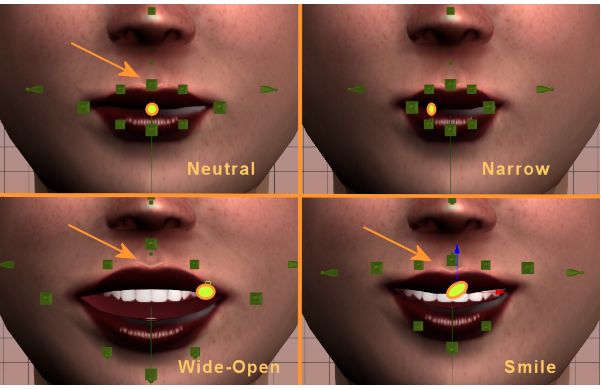
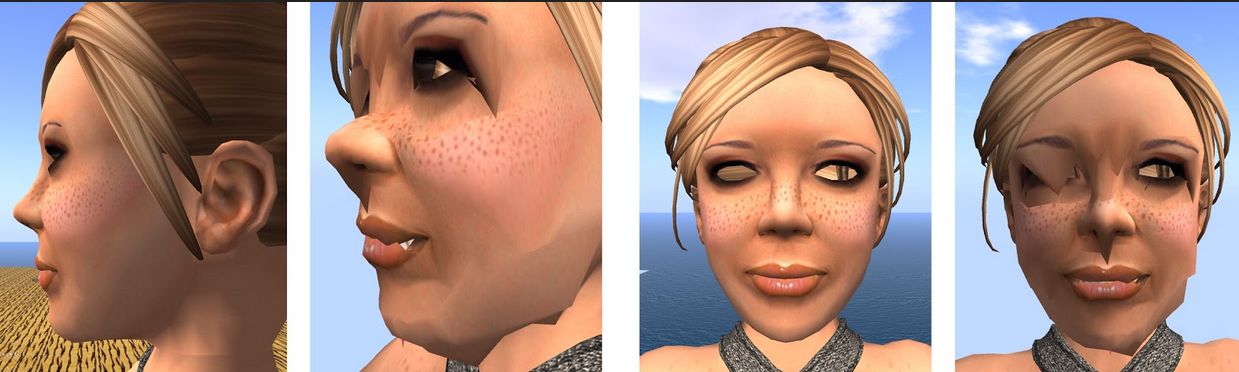
Gaia Clary indicated the bone survey missed a proposal for 3 additional forehead / lip bones to allow more natural expressions, the inclusion of which would also allow for better automatic weighting of the lips (the pictures above, as Gaia notes, use the default avatar head)

Written Feedback

The open questions asking for written feedback did produce a clear winner: more tails / limbs or more tail joints, with most of the respondents to the questions (18 and 14 respectively) citing a desire to support hexapods, centaurs, or other multi-limbed creatures.

The requests for additional tail  / limb bones saw Vir ask for further feedback on matters to make sure he was grasping the reasons for the requests correctly – notably that people would be using bone translations for the additional limbs, allowing the spine to act as an initial anchor point for the bones, which then could be translated into their preferred positions.

Wing Roots, Pelvis Bones and Options

A contributing factor for wing root bones not proving popular is because they were originally included to compensate for the fact that Bento initially didn’t support bone translation, only rotation; thus additional bones were required to assist with achieve more natural wing, etc., movement. Now that bone translation is considered part of Bento, the need for multiple extra wing root bones is removed, with the result that some could be replaced by more meaningful bones used elsewhere.

A set of bones which came in for particular discussion were extra pelvic bones, with Vir asking for clarification on the benefits would be in having them. My apologies for the extract from this part of the meeting, a mis-click on my part meant that part of the conversation in which Teager explained how it would allow for easier compatibility with existing animations so that, for example a centaur might be able to make use of existing upper body animations for arm / head movements wasn’t cleanly recorded and so is not a part of the extract.

Bone Constraints

When  discussing working with initial versions of the Bento skeleton and developing the Avastar face rig to help in producing facial animations in early January, Gaia Clary raised the subject of utilising bone constraints as a means of adding a further level of control for bone movement within the avatar.

This would allow root bones to effectively be paired such that the movement of one is controlled / constrained by the movement of another (see this comment from Television as well).  This is a common approach to animation, and greatly eases the animation process, and if completely followed through, could add enormous flexibility in what could be done with the avatar skeleton, as Gaia notes:

If constraints can be implemented in general, then this concept could be generalized to work for all limbs, then users can for example constrain the root bones of the legs, arms, wings and tail to mSpine and create a 7 legged creature that can be animated without adding odd rules to the animation.

Thinking even further, if location constraints were allowed, then this idea allows to constrain any limb to any bone. Wings could then be constrained to eye brows for antennas, tail(s) could be constrained to chest for 4 winged creatures, etc.

The problem here is how to implement such a system of constraints within Second Life. While there are animation programmes and system which do allow for constraining bone movement, it’s not clear if they all utilised a standardise approach, or whether then could be easily replicated within Second Life, or what the overhead involved would be in trying to develop the means for the platform to support bone constraints.

Given this, and while the ideally has not been ruled out for future evaluation, adding such a capability at this put in time for Bento has been seen as being out-of-scope for this phase of the project.

Continue reading “Project Bento User Group update 4 with audio”

The Drax Files 35: exposing the bones of Project Bento

Project Bento extends the avatar skeleton, adding a significant set of bones (e.g. 30 for the face, 30 for the hands Project Bento - extending the SL avatar skeleton
Project Bento extending the SL avatar skeleton

Project Bento is an ongoing project running as a collaboration between Linden Lab and content creators / animators to extend what is possible with the standard Second Life avatar. It’s also the subject of a series of reports and updates in this blog and, more importantly in this particular context, the subject of segment #35 of The Drax Files World Makers.

At just under 3.5 minutes in length, the segment is somewhat shorter than previous editions of World Makers, but what it lacks in time, it more than makes up for in terms of content. Anyone wishing to grasp the intent of the project, its complexity, and its collaborative nature can do no better than to sit down and watch World Makers 35.

Bento’s roots as a real project go back to around the start of 2015. The Second Life team at the Lab (which is probably larger than many people are prepared to give credit, comprising as it does product managers, engineers, designers, coders, the viewer team, etc.), periodically get together to discuss how and where they might improve Second life and offer new features.

Improvements to the avatar skeleton is one of those things that has long been requested by SL users and content creators, and thanks to work previously undertaken under-the-hood within Second Life, both within the servers and the viewer, it had, by early 2015, reached the point where it was felt it could be undertaken in a manner which would both yield a positive outcome.

Vir Linden, Senior Software Engineer at Linden Lab, and technical project lead for Bento

Vir Linden has been the engineering lead in the project, which is by managed from a product perspective by Troy Linden and from an engineering standpoint by Oz Linden. It has over the months involved many from the SL team at the Lab including Aura Linden, Grumpity Linden, Dan Linden, Simon Linden, Rider Linden, and Coyot Linden, many of whom feature in the World Maker’s Video.

Perhaps most importantly of all, from a user’s perspective, is that from very early on, Bento featured – one might say almost driven – by content creators themselves, including Cathy Foil, Siddean Munro, Flea Bussy, Toady Nakamura, and Matrice Laville.

These are the people who focused on what bones should be thought about in order to extend the avatar skeleton, and who undertook a lot of the work testing ideas and feasibility, options for integration into tools already available to support avatar creation (such as Avastar, Mayastar), and so on. Several of the LDPW moles were also involved in the work, offering input and ideas based on their long-term experiences as content creators and developers.

Meetings for the project were held on a weekly basis (transitioning into the public Bento User Group meetings on Aditi once the work had reached to point of being available in a project viewer), and both Drax and I were invited along to witness the collaborative nature of the work between residents and Lab staff (although I admit, my attendance was sporadic, as the scheduled meeting time ended up being awkward for me to make in the latter part of 2015).

Bento project meetings were held in-world, allowing Lab staff and content creators / animators develop the project collaboratively.

The complexity evident in Bento can be summed up in the fact that there are now 106 bones in the SL avatar skeleton, plus the original 26 collision volumes of the basic avatar, giving a total of 132 joints. These new bones include:

  • 11 extra limb bones for wings, additional arms, or extra legs.
  • 6 tail bones
  • 30 bones in the hands (all 10 fingers!)
  • 30 bones for facial expressions
  • 2 other new bones in the head for animating ears or antennae
  • 13 new attachment points associated with the new bones
Bento has huge implications for avatars of all kinds - even bunnies, as Etheria Parrott demonstrates with the facial features on this Bento Bunny . watch the video
Bento has huge implications for avatars of all kinds – even bunnies, as Etheria Parrott demonstrates with the facial features on this Bento Bunny . watch the video

Getting to this point alone took time and effort – and no small amount of testing. How many bones could the avatar realistically support within Second Life? What would be the data load placed on the simulator (allowing for a considerable amount of work the simulator used to do having been moved to the CDN service, something we’ll also be seeing more of in the future)? What happens when you get a lot of animated avatar appendages all operating in the same space?

These are just some of the questions which had to be addressed by those initially working on Bento, and are still being considered now in the more open Bento beta. Nor is it just a case of providing the bones and the options for animating them: there’s also the matter of ensuring the data relating to  bone movements, etc., can be reliably managed, tracked, communicated and visualised by both the simulator and the viewer.

All of which adds up to a complex project, but it is one seen as genuinely important by those at the Lab working on it, as Troy, Coyot, Aura, and Vir note in the video:

[Troy] The avatar is an extension of the resident. It’s an extension of their personality in a Very detailed way. [Coyot] Enabling  that imaginative element of ourselves is really important and not to be under-rated. People can go, “ah well, it’s fantasy, whatever,” but the imagination is an expression of who we really are. [Aura] By allowing avatars to have these new expressive modes, we can really increase this visual communication that people have. [Vir]  That’s going to increase the sense of presence in the 3D world.

Continue reading “The Drax Files 35: exposing the bones of Project Bento”

Project Bento User Group update 3 with audio

Project Bento extends the avatar skeleton, adding a significant set of bones (e.g. 30 for the face, 30 for the hands (both of which can be seen inaction in the image above of an avatar by Matrice Laville), plus bones for wings, tails, additional limbs and ears / antennae

The following notes and audio were taken from the weekly Bento User Group meeting, held on Aditi every Thursday at 13:00 SLT.

For details on each meeting and the location, please refer to the Bento User Group wiki page.

Bone Survey

The  Bento Bone Survey, intended to gauge the level of interest in various bone proposals for the Bento skeleton is now available. The Lab is requesting animators and content creators with a vested interest in Project Bento to rank the bone proposals to help with prioritising which additional bones people would like to see added to the Second Life avatar skeleton as a part of the Bento work.

If you are an animator / content creator with such an interest, and you haven’t already completed the survey, please ensure you do so as soon as possible, as it is likely to be closed on or shortly after Monday, February 1st.

The Lab notes they do not currently know how many additional bones we can reasonably add, or whether some of the associated bugs can be fixed.

Drax Files Filming

The final session of Bento filming for The Drax Files World Makers will take place on Monday,  February 1st at 11:00 SLT at the Bento Island region on Aditi. All those with an avatar developed using the Bento avatar skeleton extensions are invited to attend.

Deformed Avatars

Distortions with Altitude

Cathy Foil has been examining issues with deformations at altitude occurring in avatars using the Bento  skeleton. She first noticed the issue whilst Bento was in closed session and reported details to the Lab. However, efforts at pinning down he precise cause have been hampered up until recently by not being able to gather sufficient data from the skeleton and a lack of detailed comparisons between the effects as seen on various viewers utilising the Bento code.

Cathy has been addressing this using the most recent release of the Bento project viewer, and carrying out further detailed tests at various altitudes to document the severity of the issues more fully (they tend become noticeable at altitudes over 1000 metres). She has now passed her latest findings over to the Lab for their investigations.

Distortions and deformations in avatars using the Bento skeleton were noticed in the closed session Bento development cycle. Since then, Cathy Foil has been digging more deeply into the problems
Distortions and deformations in avatars using the Bento skeleton when at altitude (the greater the altitude, the more noticeable the issues, as seen left-to-right, above) were noticed in the closed session Bento development cycle. Since then, Cathy Foil has been digging more deeply into the problems

“Squished” Avatars”

Cathy has also been investigating the issue of avatars deforming as a result of using a mesh uploaded with different joint positions. This tend to result in avatars looking “squished” or otherwise deformed.

As she uses Maya, part of her investigations point towards possible issues with versions of the plug-ins used by Maya to convert .FBX format mesh files to .Collada .DAE (the format used by SL). Whether or not the plug-ins are the cause isn’t definitive as a cause, but may be a contributing factor. As Vir noted in the meeting, if this is the case, then it is unlikely the Lab can do much about it, but those using Maya affected by the issue may need to check the version of the Collada plug-in they are using, and make sure they have the most recent to see if this clears the problem.

If it is more of an issue with the mesh uploader, however (because the Lab have missed something, for example), then obviously, there is more of a chance of the Lab taking remedial action.

Cathy Foil discusses her investigations into avatar deformations at altitude

Joint Reset Issues

A long-term problem with Bento has been it is easy for joints to get into the wrong state and / or position when animating an avatar using the Bento skeleton extensions. It’s often not clear why this happens when it occurs, which can be somewhat random. Vir has started collecting data on the issue. Nothing definitive has been identified in terms of a cause or causes, but Vir will be continuing to work on the issue.

“First Frame” Animation / Default Avatar Pose Issues

Another issue which has been noted is that of a first frame of an animation begin played three times as the animation is run, and which may be connected to default avatar poses within Second Life. This is a fairly “old” bug, dating back as far as 2007 (see BUG-11194), and which seems to be more prevalent with Bento as a result of bones being used differently (e.g. arm bones being used as forelegs, etc).

Medhue demonstrates the forleg crossing using his wolf avatar. The issue is a lot more extensive than this, with the avatar sometimes looking as if it is standing with forelegs folded in the same way a human folds their arms

Medhue Simoni demonstrated the issue using two of has non-human avatars, an elephant and a wolf, which saw both attempt to cross their front legs (as a human might try to fold their arms) when transitioning between animations.

A lengthy discussion followed on the problem, which might also involve a number of other issues, including poses “baked” into the default avatar skeleton, possible race conditions between the viewer and the server, and issues with animation prioritisation.

It may also be related to how Second Life handles transitions between animations (referred to as animations “easing out” and “easing in” when moving from one to another), which has had other problems reported against it as well – see also BUG-11122, for example.

As indicated in Vir’s comment on BUG-11194, and noted in the discussion, there is some initial concern from the Lab that if the playing in triplicate was an intentional change – and one made well before most developers currently at the Lab having joined the company – or if it requires symmetrical changes on both the viewer and the server, it might result in some content breakage without detailed analysis, although Vir has now started digging into the code to have a look.

Continue reading “Project Bento User Group update 3 with audio”

SL project updates 16 3/2: Server, viewer, Bento and CEF + Flash

The Keys; Inara Pey, January 2016, on Flickr The Keys (Flickr) – blog post

Server Deployments, Week 3 – Recap

As always, check the server deployment thread for any updates.

On Tuesday, January 19th, the Main (SLS) channel received the server update package previously deployed to the three RC channel. This comprises:

  • Feature Request: llGetObjectDetails() constant OBJECT_TOTAL_INVENTORY_COUNT – when targeting an object, OBJECT_TOTAL_INVENTORY_COUNT will return the total of all inventory types in each link of the linkset. See BUG-10575 for further details
  • Feature Request: llGetObjectDetails() constant OBJECT_PRIM_COUNT – provides a means to get a worn attachment’s prim count (rather than just returning 0).  See BUG-10646 for further details.
  • Simulator crash fixes.

On Thursday, January 21st,  three RC channels received a new server maintenance package comprising a simulator crash fix and a further feature request: llGetObjectDetails() functionality to get the parent_id of any task in the region (OBJECT_REZZER_KEY). This returns the parent_id of any task in the region. If the object came from an object rezzer it returns the ID of the parent object, while If it was rezzed by an avatar, it returns the agent ID of the avatar. The function only works for those objects rezzed in-world after the code deployment (objects in-world prior to deployment will return NULL_KEY).

SL Viewer

The HTTP updates Vivox RC viewer updated  to version 4.0.2.310097 on January 19th, while January 20th saw the Quick Graphics RC viewer updated to version 4.0.2.310127, and the Project Bento (avatar skeleton extensions) viewer updated to version 5.0.0.310099.

Project Bento

I missed the greater part of the Project Bento meeting on Thursday, January 21st, so my apologies for not having a full report.

Cathy Foil demonstrates what can happen when an avatar using a mesh incorporating the new Bento bones deforms ...
Cathy Foil demonstrates what can happen when an avatar using a mesh incorporating the new Bento bones deforms …

Deformed Avatars: The lab is still asking for examples of avatars deforming as a result of using a mesh uploaded with different joint positions. If people have examples, Vir Linden requests that both the .DAE file and a copy of the mesh model are forwarded to him so that the Lab can test items for themselves.

Elizabeth Jarvinen (polysail), also points to some discussion on the Bento forum threat on how to possibly correct the problem when it occurs. see: here, here and here).

.BVH and .ANIM uploaders: It was noted at the meeting that the .BVH and .ANIM uploader have different capabilities. The .BVH uplaoder is viewed as being not as robust as the .ANIM uploader, although it does include optimisations for animations which are not present in the .ANIM uploader. Oz Linden suggested that it would be nice if both uploaders shared the same level of robustness / capabilities.

Vir pointed out that the .BVH uploader has various optimisations which are not present for .ANIM uploads. So how parity between the two is achieved is unclear. fore example:

  • Is the optimisation code removed from the .BVM uploader or added to the .ANIM uploader?
  • Are the updates server-side, or should they be viewer-side, with the ability to preview animations prior to final upload to ensure they are playing correctly?

It is also open to question whether any such work, were it to be undertaken, would form a part of this initial Bento project.

Bento Bone Survey

I was absent (as noted) when this particular item was discussed, so I may have the details wrong. However, it appears that, as previously reported, the Lab are going to put out a survey asking for creators and animators to indicated their preferred additional bones out of those which have been suggested. The survey is liable to be published via the Bento forum and / or the Bento user group wiki page.

World Makers Filming

There will be a final Bento filming session for the upcoming Drax Files World Makers special on Monday, February 1st. Creators and animators who have examples of content using the Bento skeleton extensions and are willing to take part in the filing should contact Draxtor Despres in-world for further details.

Aditi Inventory Syncing

The code for merging main (Agni) inventories into beta (Aditi) grid inventories is still subject to final testing before being deployed to Aditi. As previously noted in these updates, when this does happen, it will mean that logging-in to Aditi will trigger an automatic merge of your Agni inventory with your Aditi inventory as a part of an overnight (PDT) process. This means that items unique to people’s inventories on Aditi will no longer be lost as a result of their Aditi inventory being overwritten by their Agni inventory (as is currently the case). Once deployed, this update also means that a password change will no longer trigger an inventory sync between the two grids.

Suggestions have been put forward that rather than merging Agni inventory directly into the Aditi inventory structure, the incoming Agni items are delivered to a new top-level folder (perhaps called “Agni” or “Main Grid”) during the merge process, so that people can easily distinguish between unique versions of items they’ve been editing on both Aditi and Agni.

Adobe Flash on CEF Viewers

As has been covered in this blog and others, the Second Life viewer, version 4.0.0+, and all v3 TPVs using that code now makes use of the Chromium Embedded Framework for supporting rich media, including Adobe Flash.

However, for the latter to work with the viewer, it requires a specific version of Flash to be installed on your system. For those interested, Jeremy Linden has provided a knowledge base article on what needs to be installed for the official viewer, and how. With thanks to Willow Wilder for the pointer.


Project Bento: Drax Files filming party reminder

Project Bento extends the avatar skeleton, adding a significant set of bones (e.g. 30 for the face, 30 for the hands (both of which can be seen inaction in the image above of an avatar by Matrice Laville), plus bones for wings, tails, additional limbs and ears / antennae
Project Bento extends the avatar skeleton, adding a significant set of bones for better avatar animation (human and non-human), including facial expression and jointed fingers (image: Matrice Laville)

Project Bento is the Lab-led project, working in collaboration with Second Life content creators, to enhance the SL avatar skeleton with over 90 new bones. The intention is to enable creators to accommodate features like subtle facial expressions, articulating fingers, smoothly flapping wings, waving tails, and much more that was previously impossible or required complex workarounds.

During the project, Draxtor Despres and I were invited along to the (initially closed) project development meetings, starting in June 2015, to witness the collaborative effort between the Lab and content creators, and document things once the project entered public knowledge.

Now, as a part of this work, Drax and the Lab are working on a special edition of The Drax Files World Makers series, which takes a look behind-the-scenes from the project, featuring interviews with Lab staff and moles engaged in the project, together with content creators who helping with the development and improvement of the project.

Etheria Parrott demonstrates how the new Bento bones can animate the head of a bunny avatar

To help with video, and as Linden Lab recently blogged, there were be two special filming sessions taking place on Aditi, the beta grid, to which those actively working on content utilising the Bento skeleton extensions are invited.

The two sessions, with dates and times, are described thus in the official blog post:

On January 19th at NOON SLT, there will be an open casting call for anyone who has built something with Bento to come show off their work. Selected creators may be filmed and/or interviewed to be featured in an upcoming episode of the Drax Files. You will need to login to Aditi in order to access the location (secondlife://Aditi/secondlife/Bento%20Island/128/128/23).

In addition to the open casting call, creators are encouraged to contact Draxtor Despres in-world with information about what they’re making. Video, screen-shots, descriptions – the more information the better, and the sooner you can share that – the better as well. Chosen creations and their creators will be contacted with information for a private filming on  January 20th, 2016, with Draxtor and Torley Linden.

Aki Shichiroji demonstrates her centaur avatar, which uses the new wing bones to animate the rear legs

Nor is the invitation limited to those directly involved in the  project: machinima makers are also encouraged to log-in to Aditi and enjoy an opportunity to film some of the creations which are currently being developed as a result of Project Bento.

Note that access to Bento Island may not occur prior to the start of the filming event (the official blog post quotes the island will be open from “January 10th”; however, given the post wasn’t published until January 14th and I’ve been unable to access the region when logged into Aditi, I believe this is a typo, and should read “January 19th”).  Also, if you haven’t logged-in to Aditi before (or in a good while), you are advised to do so well beforehand. Instructions on how to this, for those who need them, can be found on the SL wiki page.

In the meantime, Drax had produced a little teaser to help whet appetites, and I’ll see you over on Aditi on the 19th, and you can keep abreast of Project Bento through the project updates in these pages, which will also include more on the background to the project.

Project Bento User Group update 2 with audio

Project Bento extends the avatar skeleton, adding a significant set of bones (e.g. 30 for the face, 30 for the hands (both of which can be seen inaction in the image above of an avatar by Matrice Laville), plus bones for wings, tails, additional limbs and ears / antennae

The second public user group meeting for Project Bento took place on Thursday, January 14th 2016, continuing discussions on the new avatar skeleton extensions for Second Life. The following is intended to provide a summary of the discussion, together with audio excerpts from the meeting. It is not, however, intended to present a full transcript.

Additional / Alternative Bones and Experimental Region

The experimental region for those wishing to try additional / alternative bones (see my report from the first Bento public UG meeting), is now available on Aditi at BentoExperimental1. It had been misbehaving when first set-up, but is now thought to be running smoothly. 

mtg-2-2_001
Aki Shichiroji demonstrates her (untextured and in-development) centaur avatar, which uses the new wing bones to animate the rear legs

One concern among content creators who are already working on Bento is the potential for additional / alternative bones to be disruptive, that has they are added, it will break content being used for ongoing testing of Bento, particularly for those working on complex, multi-limbed avatars.

Vir pointed out that while the Lab don’t want to necessarily add to the workload in testing new bones, it’s better to look at possible additions / alternatives sooner rather than later, and accept test content may break if charges are to be made in the near future as a part of developing the project.

He also pointed out that so far, the focus on additional / alternative bones has been on the face, which shouldn’t have any impact on those working with the new wing bones, etc. Although that said, there is no limitation on proposing additional bones for wings, legs, etc., even if they do prove a little disruptive at this point in time.

End dates and Selecting New Bones

Currently, the Lab hasn’t determined any date by which proposals for additional / alternative bones must be made, or the process by which any of the proposals might be adopted. However, creators are encouraged to use the experimental region to develop models as demonstrations sooner rather than later.

While it is not 100% certain, given there is currently no clear consensus as to what additional / alternative bones might be seen as a priority among those proposing them, the Lab is considering making any potential selection the matter of a poll at some point in the future, and make any determination based on that.

Vir also indicated that ideally, the Lab would like to make as few further changes to the skeleton as possible, and so may opt to add additional bones as a single pass in the viewer, rather than gradually adding them (which might also cause problems when testing, due to the repeated risk of breaking test models as noted above).  Either way, the code will be stabilised well before any attempt is made to move Bento to the main grid, in order to ensure that people have adequate time to test things and to allow TPVs sufficient lead-time to integrate the Bento code into their offerings so that they can support it when it is deployed.

mtg-2-3_001
Oz flew into the Bento meeting directly from the Lab’s monthly “all hands” review

IK Bone Issues

A problem has been noted within the skeleton between the new toe bones and the IK (inverse kinematics) bones which connect the avatar physically to the world. The latter are focused on the foot bone in the avatar skeleton, with the result that when the new toes bones are used to animate the avatar (as might be the case with digitgrade legs), a conflict with the IK bones can occur, causing the animation to go awry. It doesn’t happen all the time, but when it does, it is very noticeable.

Exactly what can be done to deal with this is open to question; Vir’s initial thoughts were to consider changing the logic so that IK bones are focused on the toe, rather than the foot. Alternatively, Oz suggested adding a new flag which would allow a mesh to indicate it does not want a joint manipulated by IK, and idea which was seen by some creators as offering greater potential for use.

To help the Lab better understand issues and gain a thorough insight what might be required in order to address issues where they can, a request was once again put forward for very concise in-world examples and models.

Both Oz and Vir concurred that any large-scale alternations to the IK chain, such as extending it to include the new bones is unlikely, due to the risk of breakage with existing content on  the main grid and due to the additional overheads it will place on Bento in terms of testing, lead times, etc.

Continue reading “Project Bento User Group update 2 with audio”