The Drax Files 25: adding to the substance of our existence

The Drax Files World Makers closes-out 2014 by reaching its 25 instalment, which arrived on Tuesday, December 30th. Since the original debut show in March 2013, the series has covered a huge amount of ground and given a tremendous insight into the impact a virtual platform like Second Life can have on people’s lives.

Over the months we’ve been allowed to see inside the lives and work of content creators, animators, artists, fashion designers, educators, film-makers, musicians, actors and more, and have been able to see not only the incredible creative freedoms the platform offers, or the unique opportunities for learning and giving it presents, but also how it can become fully intertwined into our physical worlds, allowing us to form friendships and relationships that otherwise simply would not have happened, and deepening our experiences in life and our understanding of the world around us in ways unimagined prior to setting through the magic portal of the viewer.

Oblee at work in his studio

Segment #25 of the show is very much a reflection of all of this. In it, we get to share time with Obeloinkment Wrigglesworth – Oblee for short, a musician who has found that success in Second Life does carry over into the physical world, although this is not his primary motivation for being in-world; it is simply a by-product of discovering the huge freedom and reach the platform has given his music – and his self-confidence in the process.

“I don’t see a conflict between the virtual and the natural world,” Oblee says of the time he spends in Second Life. “So little of our entertainment is a two-way street. So many people say, ‘oh I don’t have time for that,’ and then they’ll sit and they’ll watch TV for hours. Here we have a world that is built by its users and it’s filled with music, and it’s filled with visual art and its filled with all these wonderful things.

“It’s not an alternative to life. It’s adding to the substance of your existence.”

This is more than amply demonstrated in his own experiences and story. As both an individual musician and a session performer with other SL musicians, Oblee has been able to perform before international audiences through his gigs, the convenience of the virtual allowing him to share time with people on the opposite side of the world to him, and develop friendships and contacts as a result, be they with other musicians or the audiences he performs before. “You can do a world tour in one day,” he notes in reference to the platform’s reach.

That reach has allowed him to develop his confidence to the point where he’s recently released his first physical world album. This not only features songs written for his in-world gigs, but has also been entirely paid for through the tips he’s earned in-world through his performances. It has also achieved international sales on the iTunes store – thanks again to his Second Life supporters.

It is this idea of adding to the substance of our existence that, for me really resonates through this segment  of The Drax Files. It’s a beautiful term to describe our relationship with the platform, and one so clearly demonstrated in Oblee’s life, as noted. As such, I’ll leave the final words on this piece to him.

“Without Second Life, I don’t think I’d be doing the things musically that I’d doing today … If you have an idea in virtual reality, what’s to stop you from taking it to real reality?”

Continue reading “The Drax Files 25: adding to the substance of our existence”

The Drax Files Radio Hour: DMCA explored

radio-hourThe December 19th Drax Files Radio Hour podcast tackles something of a difficult (and emotive) subject: the Digital Millennium Copyright Act (DMCA), and its potential for good and bay in environments such as Second Life.

The DMCA, which is somewhat matched by the European Union’s Directive 2001/29/EC, is intended to protect the rights of copyright holders and to prevent copyright infringement, whilst simultaneously providing ISPs and other intermediaries with exemption from direct and indirect liability in situations where infringement is alleged to have taken place (what is referred to as their “safe harbour” status).

While it is a shame there was no qualified legal voice on the show, it does feature two extremely competent and level-headed commentators in the form of Tracy Redangel, co-owner of {NanTra} Poses, and Kitty O’toole of Kittywitch fame. Drax also chats with former IMVU content creator Fatima Mekkaoui (Imokon Neox in SL), and she also profiles excellent insight into matters and a balanced view of things.

The show was prompted by the  recent Belleza DMCA situation, which although now resolved, has been the latest in an increasing new of cases where the DMCA process appears to be employed as a means of harassment or in anti-competitive behaviour.

How the DMCA process works on the web (click for full size) – an infographic provided by web hosting company Nexcess

This is because of the manner in which the DMCA operates. In essence: if party A believes (emphasis intentional) that party B is using material that infringes upon their copyright, they issue a DMCA notification to party B’s service provider.

The service provider must then act “expeditiously to remove, or disable access to, the material that is claimed to be infringing or to be the subject of infringing activity”, and then notify party B that the content has been removed to comply with a DMCA notification.

Party B can challenge the claim by filing a counter-notification, which is passed to party A (at which point the original notification is passed to party B).

Party A then has 10-14 business days in which to indicate they have filed a claim with the court. If no indication is forthcoming, then the content must be restored by the service provider within 14 business days of the counter-notification being received.

The bias here is clear: a claimant only needs to indicate they are acting in a good faith belief that their copyright is being infringed to warrant content removal. No actual proof is required.

Thus, the door is open to potential misuse of the process. Google, for example, has indicated that around 37% of DMCA notifications it receives “are not valid copyright claims” (as opposed to incorrectly filed claims, which account for just under 10% of all notices filed in the USA). The Electronic Frontier Foundation’s Hall of Shame further demonstrates how the process is frequently used for questionable reasons by corporations and businesses.

In terms of misuse of the process, the Belleza situation is particularly interesting / worrying, as it appears to be rooted in harassment. Not only did the DMCA notification come at a time when the brand was facing significant issues in-world, up to and including the crashing of their store region, it now appears that the DMCA itself had been filed entirely fraudulently, using the details of someone not even involved in using Second Life. In other words, it was a deliberately fraudulent document aimed at disrupting Belleza’s business.

Continue reading “The Drax Files Radio Hour: DMCA explored”

The Drax Files Radio Hour: taking flight with an aeronautical legend

radio-hourI’ve not covered recent Drax Files Radio hour shows, primarily due to time constraints. However, show #49 features a special guest whose work has brought fun to a lot of people’s lives in SL (including my own), Steve “Cubey Terra” Cavers. Given his work has had such an influence in various aspects of my SL life, I couldn’t pass-up writing about this show.

The interview kicks-off after the usual preamble,  at the 21:35 minute mark. Cubey Terra may be a name unfamiliar to those who have come to SL in recent years, particularly as he decided to take a break from the platform for a couple of years. But to many in the SL aviation community and who have been around for a while, his name is instantly familiar, and often linked to the nickname “the grandfather of SL aviation”, a term he’s personally uncomfortable with, for reasons which are explored as his conversation with Drax unfolds.

As well as being active in SL from the earliest days (that is, from just after it opens its doors to the public in June 2013), Cubey also spent time working for the Lab as a part-time support volunteer. As such, he is ideally placed to discuss Second Life from several perspectives: content creation, the very early days of the platform and the users it attracted, and that of providing user-focused support and assistance back when the platform was just starting to grow.

Cubey Terra
Cubey Terra

However, before all of that is reached, the conversation kicks-off with an interesting exchange on the subject of alt accounts and our level of comfort with them, but from the perspective of using them ourselves, and the reactions from friends and those around on on discovering we have alt accounts.

What is interesting here is the somewhat divergent views Cubey and Drax, as individuals who don’t use their avatars as characters, but rather fully invest their personality into their avatar, have about their alt accounts. On the one hand, Drax finds it constraining, and consciously feels more of a puppeteer with his alts, while Cubey perhaps find his alts somewhat more liberating when used. These reactions aren’t uncommon; I’ve particularly identified more with Drax’s perspective in the past, although my view has perhaps started to lean towards Cubey’s more recently and in certain situations.

While he worked for the Lab “only” for a year, Cubey provides some fascinating insights into what it is like to be involved in user support back when Second Life was a lot smaller than it is today, and matters could more easily be handled in more of an on-going, hands-on and proactive manner:

Right from the beginning of Second Life, Linden Lab decided that it would be a good idea to have staff in-world, standing around in welcome areas or going around from sim to sim, making sure that things are running correctly, problem-solving, putting out fires – literally, because people would rez fires and worse. And so it was more a personalised experience than what you get now … so that’s basically what I would do.

As a personalised experience, it was, inevitably, something that couldn’t easily scale given the sudden and missive influx of users Second Life gained during the 2005-2007 period. This is something Cubey notes in the interview, explaining how the influx resulted in the support staff logging-in to the support service outside of their assigned hours in order to to try to ensure problems could be dealt with. Such was the situation, that even as early as 2005, those working in support were openly voicing opinions that the approach simply wouldn’t scale to meet the constantly rising demands for assistance – something which helps put the pivoting of support and assistance towards other means and channels into better perspective.

This part of the conversation also touches on broader aspects of governance and on the needs for some structure and rules, and Cubey offers-up so sage observations on matters of finding a a balance between creative freedom and a balance, open social environment.

One of the reasons Cubey may be averse to his title of "the father of SL aviation" is that he took his inspiration from those at the Kazenojin aviation group and Andrew Linden
One of the reasons Cubey may be averse to his title of “the father of SL aviation” is that he took his inspiration from those at the Kazenojin aviation group and Andrew Linden

Around half-way through the interview, matters turn more to Cubey’s involvement in the Second Life aviation community. In particular, Cubey touches upon how he got started in aviation via the Kazenojin aviation group, and Andrew Linden’s first aeroplane script. It is because his work was pre-dated by Kazenojin and Andrew Linden that he feels uncomfortable with titles such as “grandfather” of SL aviation.

Even so, for many of us who came into SL around 2006/7, his name is pretty synonymous with flying and aeronautical matters in Second Life. To use myself as an example; long before I started flying aeroplanes in SL, I was deeply into SL skydiving as a direct result of discovering the Terra range of parachutes, which in turn led my to joining a skydiving club  / group in SL (and I still use the TerraSport III Pro ‘chute in-world to this day). And when I did start flying in earnest, it was the Terra Stingray I turned to to get started (and I still fly that today as well!).

The Cubey Terra Stingray was one of my first real forays into flying in SL - a great aircraft (which also doubles as a speed boat and submarine!)
The Cubey Terra Stingray was one of my first real forays into flying in SL – a great aircraft (which also doubles as a speed boat and submarine!)

The end of the interview turns its attention to what draw Cubey back to SL after his break, and start creating once more. The answer is given pretty much in one word: mesh. Through it, Cubey now has the opportunity to learn new content creation techniques and develop the kinds of aircraft he’s always wanted to create, but has been unable to do so due to previous constraints within the platform.

All told, another fascinating interview (and one deserving of a full hour, frankly), providing a lot of insight into times past in SL, and not a few thoughts on times present and times yet to be.

Cubey marked his return to SL with the release of the Terra Xplorer "hover disk"
Cubey marked his return to SL with the release of the Terra Xplorer “hover disk”, a fun way to travel around

The Drax Files Radio Hour: land of the Lindens

radio-hourTime has meant I’ve not had time to mull over the last few Radio Hour podcasts, which is a shame as there have been some gems. If you’ve not already done so, do try to catch show #41 for a brilliant interview with Justin Esparza the man behind one of the great legends of SL – Salazar Jack. Then there’s show #44 with Jaimy Hancroft, one of the great talents behind Dwarfins and the creator of the magnificent Hope’s Horizon at the 2014 Fantasy Faire.

However in the latest podcast, show #46, Drax ventures out on his own to visit the Lindens on their home turf, dropping in on the Battery Street offices for an informative visit, offering a lot to listen to and absorb.

The Lab's Battery Street staff (image: Ebbe Altberg, via Twitter)
The Lab’s Battery Street staff (image: Ebbe Altberg, via Twitter)

The first big interview, kicking off at the 18:08 mark into the show, is with Monty Linden, who provides a clear-cut explanation for the Content Delivery Network (CDN) and also talks about his HTTP project work. Such is the level of information in this conversation, rather than condensing into a couple of paragraphs here, I’ve included it in a separate article, as it really does help frame both the CDN work and the HTTP work in non-technical terms.

That said, Drax also leads Monty into a discussion about net neutrality starting at the 24:50 minute mark in the interview (and continues through until the 30:13 mark), which is also something worth listening to in detail (and which I’ve deliberately excluded from the article on Monty’s CDN / HTTP discussion).

Down in the basement – looking down on the Lab’s engineering team at Battery Street (image via The Drax Files Radio Hour)

Elsewhere in the show, Drax gets to try out the DK2 with Second Life (36:27), with Ebbe revealing that a popular destination when demonstrating the Oculus and SL to journalists is Mont Saint Michel, which for those who have not visited it, is a glorious Second Life reproduction of the “real thing“. Ebbe also makes mention of one of the problems that preclude SL from being an “ideal” companion for the Oculus – the render engine isn’t up to consistently manage the 90 frames-per-second already utilised by the Oculus Crescent Bay prototype in order to eliminate issues of image judder when the wearer turns their head.

In discussing the Oculus Rift, Ebbe indicates that the Lab is working to make the abstraction layer for input devices as open as possible on their next generation platform, so that new devices can be added as easily as possible. He also reveals the new platform already works with game pad devices and the Leap Motion.

The discussion of the Oculus and Leap Motion is particularly interesting as it opens the door on the myriad of challenges encountered in user interface design. For example, with gesture devices, not only do you need to define the gestures required to move an avatar and interact with in-world objects, etc., you need to consider what’s required in order for the user to interact with the UI itself – to press buttons, make menu selections, and so on. These complexities of user interface design get even deeper when you consider that not only do they have to work across multiple client platforms, they have to work across multiple combination of client platform, input and other devices (screens, headsets, etc.).

Mont Saint Michel; Inara Pey, June 2013, on FlickrMont Saint Michel – a location the Lab uses to demonstrate the Oculus Rift and Second Life to journalists

Mention here is also made of High Fidelity. While the two are entirely separate companies, there is an intimation from Ebbe that High Fidelity may be one of the “technology partners” the Lab is talking to with regards to facial recognition capabilities in the next gen platform. Given that the Lab did provide some seed money towards High Fidelity’s first round of funding, this would make some sense.

As Drax tours the Lab’s office with Ebbe (35:13), some interesting snippets of what is going on are provided – such as the work that’s already going on with the “next generation Marketplace”. This is further touched-upon in a conversation (43:59) with Brooke Linden from the SL Commerce Team. She not only discusses aspects of the the Marketplace such as trying to address performance issues, improve search and so on, she also confirms that the Commerce Team is working closely with those working on the next generation platform to ensure that lessons learned in operating the SL Marketplace are carried forward in support of that project.

A potentially interesting snippet about the SL Marketplace from the conversation is that it handles a larger volume of sales than most on-line e-commerce sites. As Brooke points out, given that it does deal with micro-transactions, it is somewhat easier for the Marketplace to generate volume sales; however, this still makes it a challenge when trying to manage things.

Kona, Shaman and (looking like he's fresh from the set of Star Trek sans insignia!) Caleb Linden
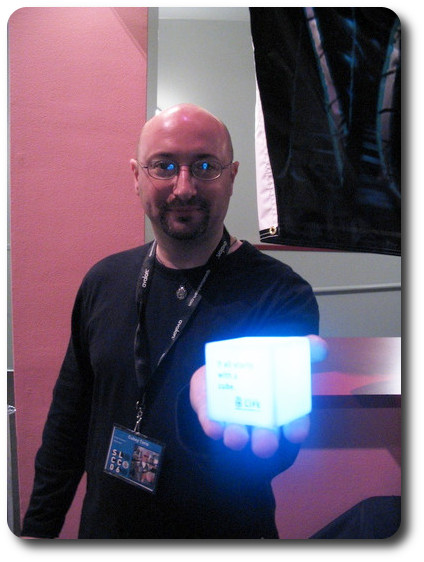
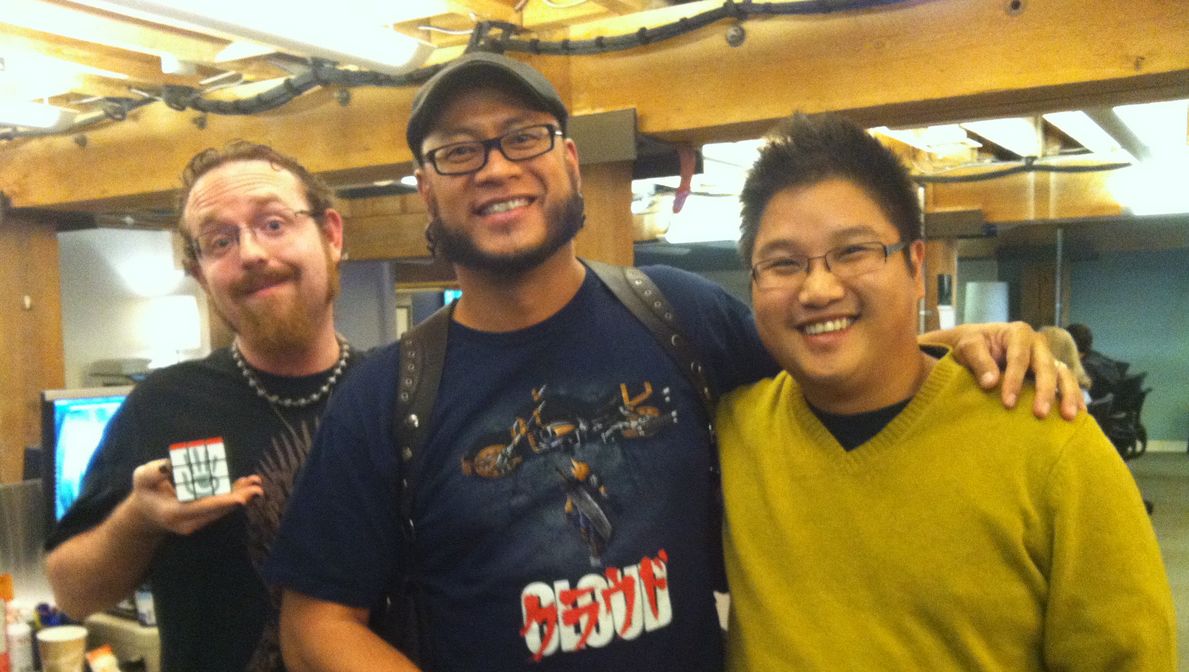
Left-to-right: Shaman and Kona Linden from the QA  team and (looking like he’s fresh from the set of Star Trek sans insignia!) Caleb Linden. Shaman (one of the friendliest and welcoming members of the Linden team I’ve met in-world) and Kona discuss with Drax the idea of making Lab’s internal merchandise, such as the Rubik’s cube Shaman is holding, available to users, as well as matters of community (both within the Lab and in SL). Caleb co-leads the Server Beta User Group meeting on Thursdays (image via The Drax Files Radio Hour)

One interview that didn’t make it to the podcast features Jeff “Bagman Linden” Peterson, the Lab’s VP of engineering, who is heading-up the next generation platform work (Don “Danger Linden” Labs having the lead on Second Life). Apparently, a little too much was revealed about the new platform considering the growing commercial interest in virtual world spaces, so the Lab has requested that  Unfortunately, dues to the fact the Lab is keeping a tight lid on the new platform for the time being, the interview has been shelved for (hopefully) a later date.

All told, a really interesting podcast, one that shouldn’t be missed.

The Drax Files 24: let the virtual world be our stage

ART-logoThe 24th instalment of The Drax Files takes to the boards to bring us a story of the theatre, performing arts, Shakespeare, plays, stage adaptations and more, as offered to the virtual community through the remarkable folk at the Avatar Repertory Theatre (ART), the oldest and longest-running live theatre company in Second Life – and probably the metaverse as a whole, as we currently regard it today.

Storytelling has been a central part of humanity’s development since pre-historic times, and has fulfilled many role: as a means of preserving history, educating the young, providing cultural structure through mythological / religious tales, and, of course, as a source of entertainment.

As such, it’s really no surprise that theatre is an art form which we have brought with us into the virtual realms. Like the spoken word, as exemplified by the likes of the Seanchai Library, or the use of film to provide machinima and episodic series like The Blackened Mirror, live theatre is presented with many opportunities and advantages within virtual environments which are not so readily available in the physical world.

For one thing, virtual environments offer any incredibly cost-effective means of presenting a stage production. Where else, for example, can a repertory company with an interest in Shakespeare establish its own reproduction of London’s Globe Theatre in which to stage their performances? How else could they recreate scenes for a production that can completely surround and immerse the audience itself?

The Avatar Repertory Theatre Company's reproduction of the Globe Theatre in Second Life
The Avatar Repertory Theatre Company’s reproduction of the Globe Theatre in Second Life

Then there’s the fact that the virtual medium has such a global reach, couple with a unique way of bringing people together. No longer is a company’s members or its audience constrained by geographic location, virtual reality truly makes a theatre production a world-spanning event.

These points are beautifully and engagingly made by MadameThespian Underhill, an actor / director with ART, and an actor in the physical world. Not that ART is made up entirely of professionals; another great power of the virtual is the way in which it forms a melting pot of creative talent, everyone working together equally to present a production to a live audience.

Through Madame Thespian’s eyes and words, we’re given an insight into the creative and technical complexities in bringing together a virtual world production which, as well as potentially offering greater immersive richness for the audience, present broader technical challenges for all involved – the actors, the backstage staff, the musicians, and so on. Actors, for example must bring together voice acting talents and controlled pupeetering of their avatars; gestures must be developed and tested, musicians must work to produce suitable pieces which can be pre-recorded and then added-in to productions at the required points, and so on and so forth.

Madame Thespian Underhill: "When people ask 'what's the purpose of doing theatre in virtual reality?' Well, we as human beings relate to each other by telling stories ... this is another avenue that has been opened-up to live storytelling
Madame Thespian Underhill: “When people ask ‘what’s the purpose of doing theatre in virtual reality?’ Well, we as human beings relate to each other by telling stories … this is another avenue that has been opened-up to live storytelling”

The virtual realm perhaps offers one of the richest environments in which technologies such as facial expression translation, motion capture, immersive headsets and so on all have a real and far-reaching use. In short, it’s an ideal testing-ground for such capabilities, as Madame Thespian notes towards the end of the video.

More than that, taken together, live theatre and these emerging technologies offer audiences something even more unique and not so easy to be translated into the physical world – they could potentially become part of a production, fully immersed in what is happening, and even – to a degree – participating in in as extras. The Basilique Performing Arts Company, for example (the subject of the Drax Files #18), used scripted pupeetering and custom-made avatars  to make the audience of Paradise Lost an integral part of the story.

There’s also a very human dimension here as well, growing out of the freedom of expression virtual environments like Second Life give to all of us.  “I’m ageing out of most Shakespearian roles,” Madame Thespian notes. She continues:

But then again, in Second Life, I don’t have that problem, because we have these avatars that we can make look like anything we want them to be. That levels the playing field when we interact with each other. The value for older people, not only for actors, is wonderful! The ability to be able to, from your home,  interact with other people from all over the world of other ages. You are being judged by what you say … the pure essence of who you are.

And that’s a powerful thought on which to close.

If you’d like to see the Avatar Repertory Theatre live, in addition to their scheduled productions, they offer an ongoing series entitled Plays Around, a kind of “open workshop in which the company performs a ser­ies of staged read­ings, mon­o­logues, drama and im­prov­is­ation. Generally held at the company’s theatre, Plays Around takes place on Fridays at 17:00SLT, and members of the public are invited to come along and watch.

Coinciding wit the release of The Drax Files World Makers on Friday, November 21st, the ART company is hosting a special Plays Around event, Shakespeare By Request, which you can read about here.

Related Links


The Drax Files 23: it’s all about empowerment

The 23rd video instalment of the Drax Files: World Makers series turns the spotlight onto Loz Hyde of Meshworx fame, and the designer of the iconic pier setting for The Arcade – a design based on England’s Brighton pier.

This is another fascinating look at the appeal of Second Life which comes with a unique perspective: in the physical world, Loz is a visual effects creator working in the US entertainments industry, and he’s worked on some pretty major movies in his time – 2012, Terminator Salvation, and Guardians of the Galaxy – as well as providing VFx for commercials, etc.,  yet he’s at least as engaged in SL as he is in his work for films, etc., if not more so.

“Coming into Second Life, I realised [that] here, I could create an entire world with real people in it. That really got me,” he says early on in the piece, before going on to encapsulate the magic of creativity and sharing in Second Life in a few simple, but powerful statements.

As a creator, commerce in SL is obviously of interest to Loz, and this gets a good amount of exposure through the conversation, with Drax underlining the potential for people to generate a revenue stream through the platform and Loz talking about some of the broader aspects of commerce in SL – notably it’s 24/7 nature and the nigh-on unlimited availability of goods.

Loz's iconic The Arcade pier under development in Maya
Loz’s iconic The Arcade pier under development in Maya (image: Loz Hyde / The Drax Files)

It is around the mid-point in the segment, however that  – for those of us familiar with SL at least – that things kick-up a notch, as we enter into Loz’s physical world, seeing him out and about in Los Angeles, camera in hand, and witness how it melds with his in-world creativity back at his studio.

“For me, creating a mood is really important,” he says of his approach to his work. “Taking reality, and what is there, and bringing it into Second Life is an organic process that take time to do. It takes me a month to do one building,” he says.

Clearly, as someone engaged in the VFx industry, where attention to detail is critic in creating an effective illusion that’s going to be projected onto a huge screen were even the smallest imperfection will be hugely magnified, potentially shattering the magic, attention to detail is bound to be a focus for Loz; but there is something more here. Listening to him talk about his work, you can’t fail but hear his passion and enthusiasm for the platform – and perhaps something else as well, an unabashed awe with the idea that one platform can offer so much. “I changed my career into 3D at the age of 40,” he says, pointing to another aspect of the magic of digital creation. “If I can do it at the age of 40, I think anyone can do it.”

Loz Hyde at work in the physical world
Loz Hyde at work in the physical world (image via The Drax Files)

But it’s not all about the content creation or the commercial opportunities; far from it. “People have tried to analyse why Second Life is so successful,” Loz observes. “There’s the environments themselves, and then there’s the people inside the environments, and I think I’m more deeply touched by the people. In Second Life, you get to know people from the inside out. There’s this protective layer that allows a more intimate relationship right from the start. you tend to focus more on stuff that really matters.”

There’s a fair chance that these observations will draw comments and finger-pointing at the likes of Facebook and their determination to focus on wallet identities for their users. However, such comments, if made, are really by-the-by in this context. Loz’s views are clear-cut and strike the nail on the head: Second Life in and of itself is a place where people are  – to use his words – more open to being open.

Whether this is a result of the anonymity presented to users of the platform or whether it is driven out of our self-identification with the avatars we create, or whether it is a combination of the two in whatever measure, is really irrelevant; it is the fact that Second Life does lead people in that direction, allowing them to express more of themselves in a positive, honest way that is important. That’s the very special magic of Second Life, and it is something that isn’t, as Loz again rightly points out, dependent upon having special gadgets.

This entire piece is about empowerment and – whether it be through creativity, running a business or in opening ourselves to others within the virtual domain – the ability of Second life to present ways and means for each of us to be positively empowered. This is perhaps the biggest thing detractors of the platform don’t get about it. Which is a shame, because as Loz notes at the end of the video, “If people on the outside could really see what is possible in Second Life, there would be a lot more people doing it.”