Matrescence is a term which may not be familiar to many, although it was first coined in 1973 by American medical anthropologist Dana Raphael. The dry dictionary definition of the term (when available – not all dictionaries even recognise it) reads as:
The process of becoming (and coming to inhabit the role of) a mother. From the Latin mātrēscēns, mātrēscō (“I become a mother”)
I say “dry” as the definition actually leaves so much unsaid. The birth of a first child is profoundly transformative for a woman – as transformative as that any human passing through adolescence, bringing as it does physical, psychological, hormonal, etc., changes. However, while science and culture keep us well informed about the latter, matrescence is far less understood (and thus often confused with postpartum depression / PMAD).
ARTCARE Gallery: Carelyna: Matrescence
The difference is, motherhood is quite literally life-changing; one that unlike adolescence, can be experienced more than once, although the first time is probably the most impactful because it is a step into the unknown: a complete watershed – physically, emotionally, mentally / psychologically and spiritually, – between all that came before and all that follows after. It is a transition which artists and ARTCARE Gallery owner Carelyna beautifully sums up within her exhibition entitled Matrescence:
Matrescene is … a ritual of passage, a spectrum of emotional and existential ruptures, it’s much like a caterpillar becoming a butterfly. Matrescence is lifelong in the sense that one you become a parent, you will forever be.
This is a description offering much to ponder about motherhood. However, and more particularly here, it is used as a personal way to recognise and pay tribute to Carelyna’s own mother and all she offered, and who passed away at the end of 2023.
Comprising twelve pieces in Carelyna’s distinctive abstract style, Matresence presents rich interpretations on many of the elements and changes associated with becoming a mother (offering the safest place for the life within her to grow, the blooming of her pregnancy, birth, the psychological and emotional pressures, the gaining of strength and wisdom, and more). At the same time the pieces offer insight into all that Carelyna’s mother meant to her: a pair of loving arms to hold and protect, a giver of wisdom, a soother of fears and worries, a guide and comfort through puberty / adolescence – and (again) more.
ARTCARE Gallery: Carelyna: Matrescence
Carelyna’s work is always rich and vivid in its use of colour and tone. Here the choice of colour and use of brushwork results in a series of pieces which individually stand on their own merit as a work of abstract art, whilst the subject framing and personal nature folded into each of them brings added depth and interpretation.
Woodland Café and Library, February 2024 – click any image for full size
A whimsical café & library built on its own serene lake with lots of areas to explore and relax. The library is stocked with short stories for readers to get lost in. Bring your friends and family or come alone and enjoy a meal, relax with a warm drink, read some books, or just lounge around and take in the scenery. It is all ages and newcomer-friendly!
Having read these words via the Destination Guide, it was back on one of my café hopping expeditions in Second Life for me as I set out to visit the Woodland Café and Library, the work of Sienna Skye (Sienna Foxdale). And as I quickly discovered on arrival, they offer just a hint of what this thoroughly relaxing setting has to offer visitors.
Woodland Café and Library, February 2024
Nestled within the enfolding arms of the Briarwood residential estate, Woodland Café occupies its own Homestead region, and is largely separated from the rest of the estate by the surrounding lake, thus eliminating the risk of accidental incursion into someone’s house or garden. The one route into the estate on foot is presented by two bridges passing by way of one of the small islands sharing the waters close to the café island, making it possible for the local residents pop in.
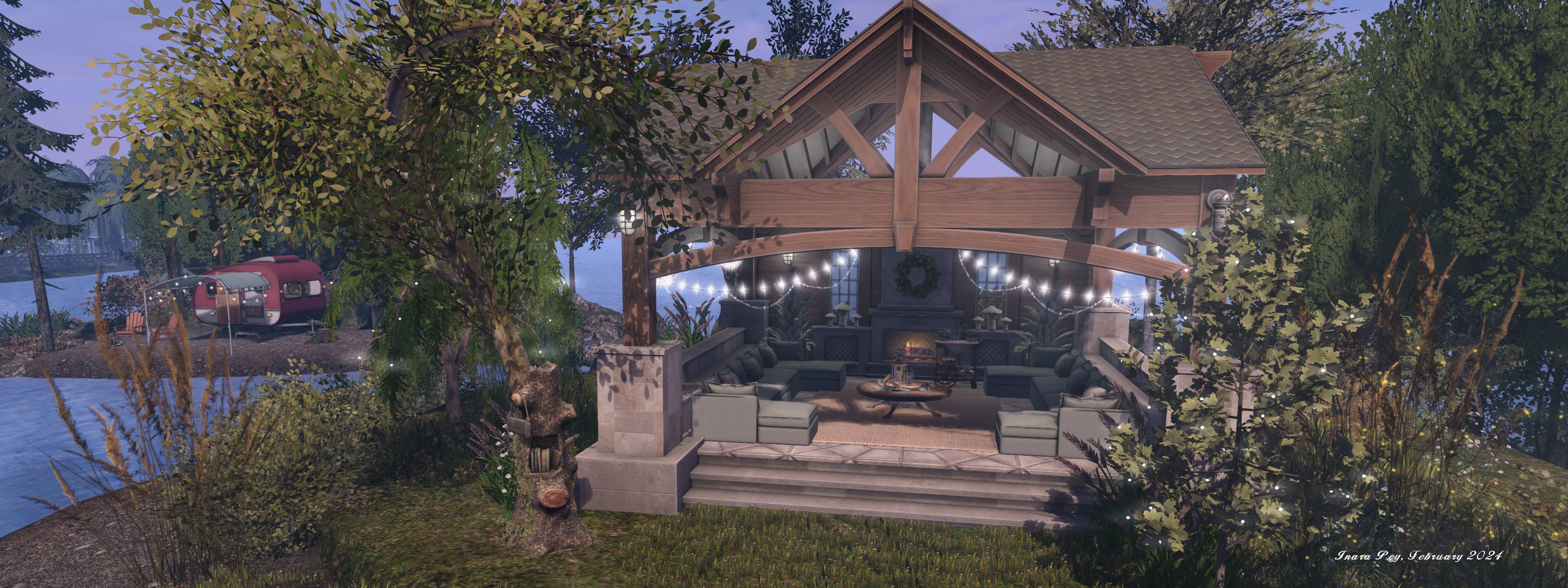
Those teleporting to the Woodland Café will find themselves delivered to the island on which it stands, arriving roughly equidistant from one of the bridges leading back to the estate, a stone-and-wood pavilion (one of Cory Edo’s always excellent designs) and the path leading up to the café itself. Like me, Sienna appears to have a fondness for Cory’s designs, as the café is another design from Trompe Loeil, whilst another of the little islands sitting alongside the café is home to Cory’s Jetje vintage caravan.
Woodland Café and Library, February 2024
This little islet can reached via stepping stones spanning the short neck of water between it and the café’s island; just follow the shingle cover shoreline as it curve around the side of the stone pavilion to find it. Warmed by a log fire and lit by lanterns and strings of light, the pavilion presents a comfortable retreat in which to relax or join friends (and strangers!) in quiet conversation whilst partaking of the refreshments offered on the tea trolley.
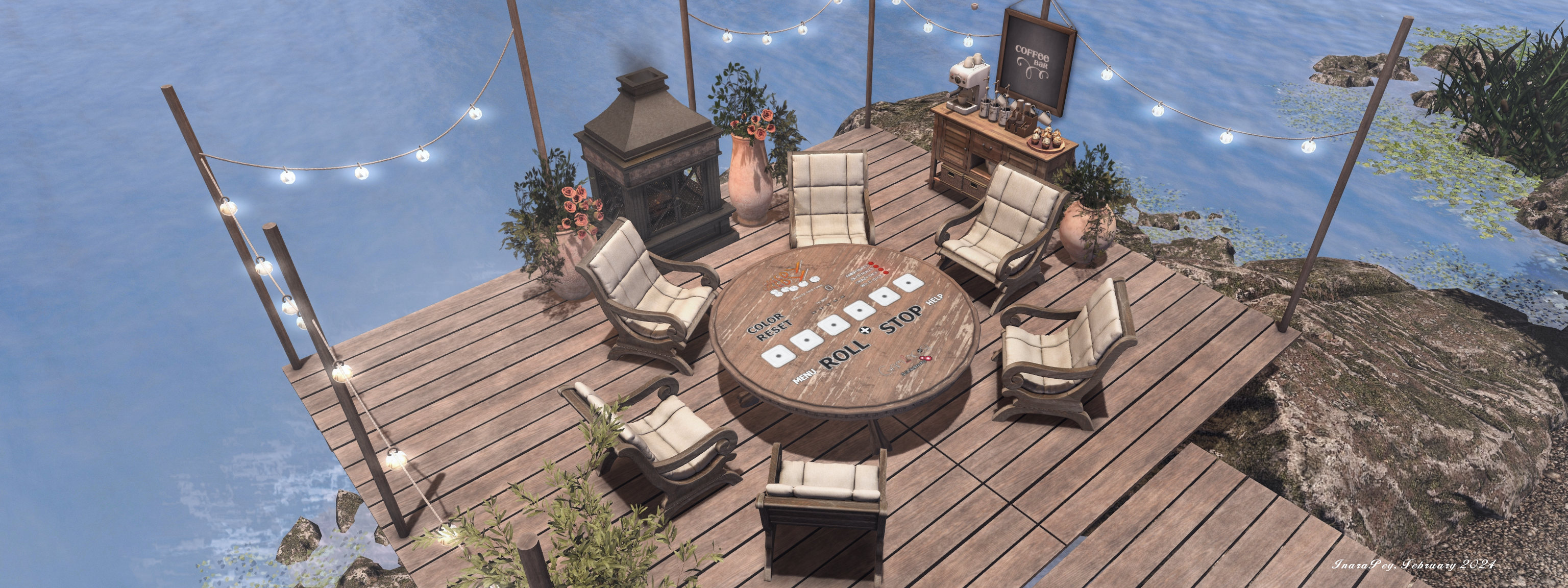
For those seeking a little more entertainment, a gravel path branches from the foot of the route up to the café proper. Skirting between the flat-topped mushroom of rock on which the café sits and the raised location of the pavilion, to provide access to a wooden deck where people can engage in Greedy Greedy, again warmed by a wood-burning fire and with refreshments taking the form of an espresso machine and frosted cupcakes.
Woodland Café and Library, February 2024
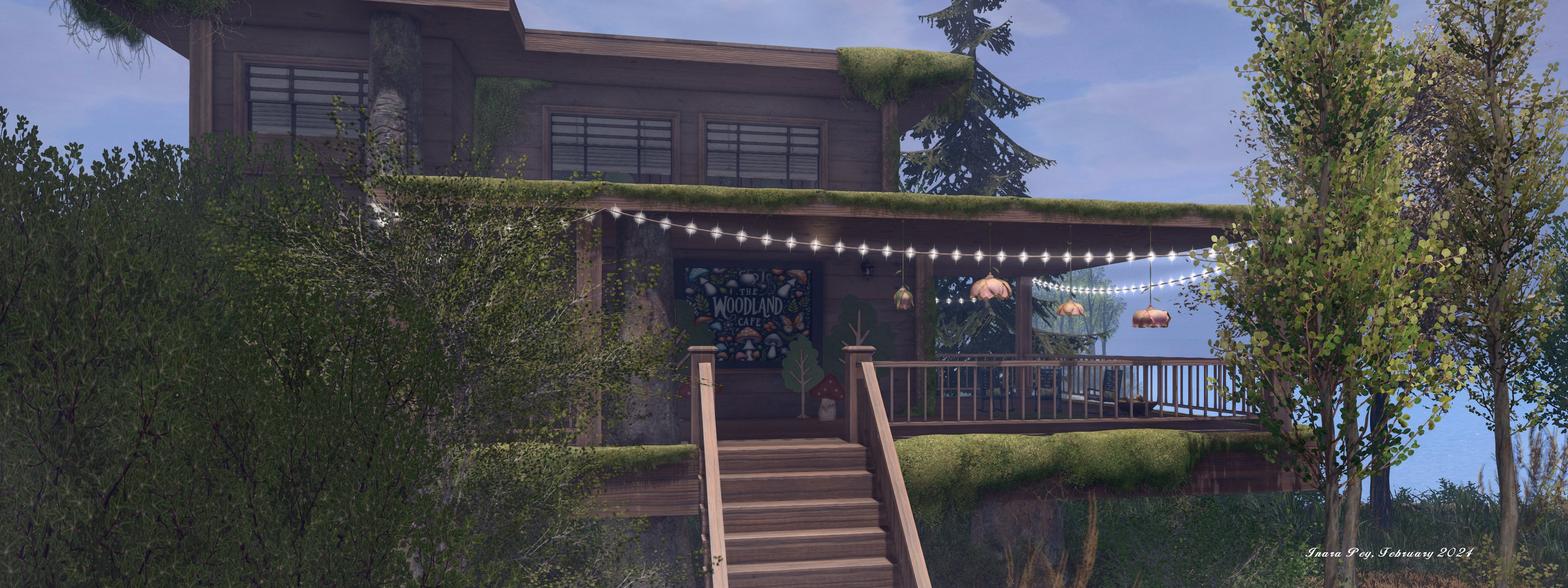
Once up on the rocky “mushroom”, visitors have a choice of taking the wooden steps leading to the café’s balcony and outside seating, or scrambling up a rocky lip to a wild garden area where someone appears to be cultivating mushrooms. Sadly, no places to sit are on offer in the garden, which is a bit of a shame as a blanket and some nibbles to enjoy would make it a nice little place for relaxing as well.
Fortunately, the café makes up for this by offering plenty of places to sit and relax or browse the web (sort-of! 🙂 ). Downstairs the counter with its temptations of drinks and waist-expanding goodies is imaginatively set is if in a woodland glade, the tables and chairs before equally set upon grass-like rugs to enhance the glade-like atmosphere. Mushrooms can also be found here, although there are far more decorative and functional / playful in nature, and Tiny visitors might well appreciate the mushroom fort with its cushions and opportunity to avoid being trodden on by oversized, clodhopping humans!
Woodland Café and Library, February 2024
The upper floor reveals why the café is also a library: interactive bookcases line two walls. When touched these will offer a menu of books, plays and short stories by the likes of Shakespeare, the Brother Grimm, and other available to read on the web, although here they take note card form and the selection is apparently updated weekly (note that these can also be obtained from the bookcase tree trunk outside of the pavilion). The seating on the upper floor is also set out so as to suggest or invite discussions or perhaps a reading circle.
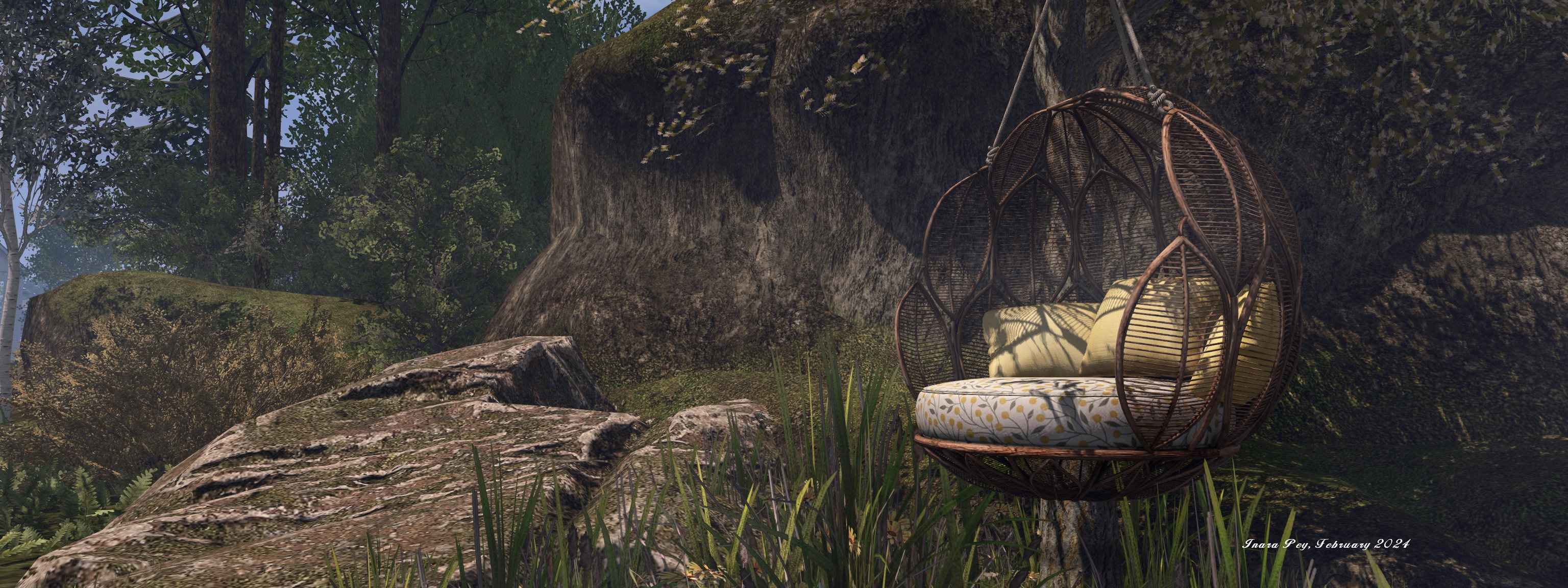
People who desire a little more solitude are also catered for within the setting; a little rowing boat with mixed singles and couples poses is anchored in the lee of the islands, whilst the route towards the rest of the estate passes by a shaded hanging chair overlooking the little model boats sailing on the nearby pond. There is also the tiny island mentioned above, with its caravan and outdoor seating, whilst another rowing boat has been turned into a cosy sofa for those who are willing to seek out its semi-hidden location.
Woodland Café and Library, February 2024
To call this setting delightful would be an understatement; there is a natural blending of charm and nature (including local wildlife) throughout which is thoroughly engaging and photogenic throughout and well worth a visit.
February 2024 brings us a touch more whimsy from Cica Ghost, with the opening of her latest installation, Colourado. Continuing the theme found within several of her more recent installations, Colourado presents a seen designed to raise a smile and allow with child within each of us a little room to come out and play, a sentiment reinforced by the quote accompanying the installation:
Inside every old person is a young person wondering what happened.
– Terry Pratchett
Cica Ghost: Colourado, February 2024
It’s a sentiment I find increasingly true with the passing years, although I also admit that I try to live by Ashleigh Brilliant’s words as well¹, so whimsy and fun always appeal.
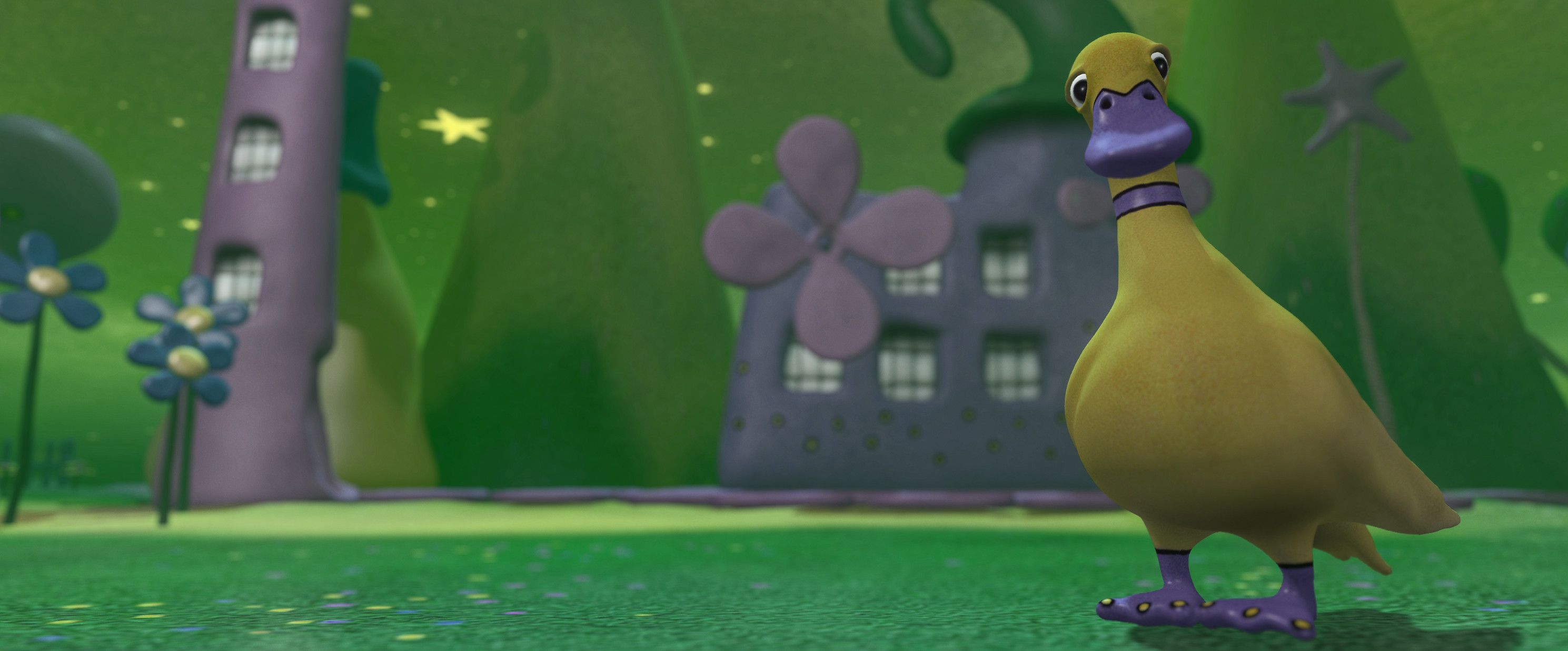
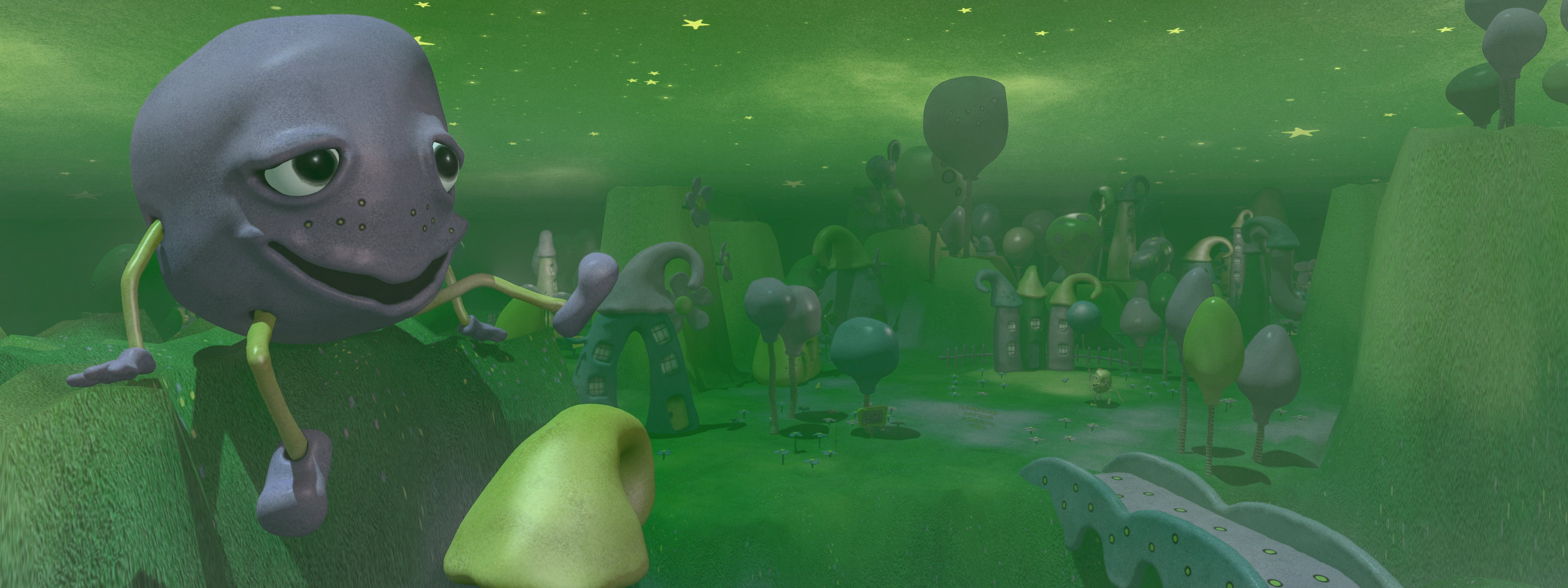
Within the installation, we are presented with a sleepy village with its houses scattered among open spaces and high plateaux and peaks which go some way to explaining Cica’s play on the installation’s name and that of a certain US state (the name also obviously reflecting the setting’s colour palette). And when I say “sleepy”, I’m not writing figuratively; the houses all wear curly night caps of the kind beloved of cartoon, and some have a look about them suggesting they are ready to toddle off to the land of dreams (particularly those with wide-open fronts, even if the large space is really for people to practice balancing on the gently pogoing stools within).
Cica Ghost: Colourado, February 2024
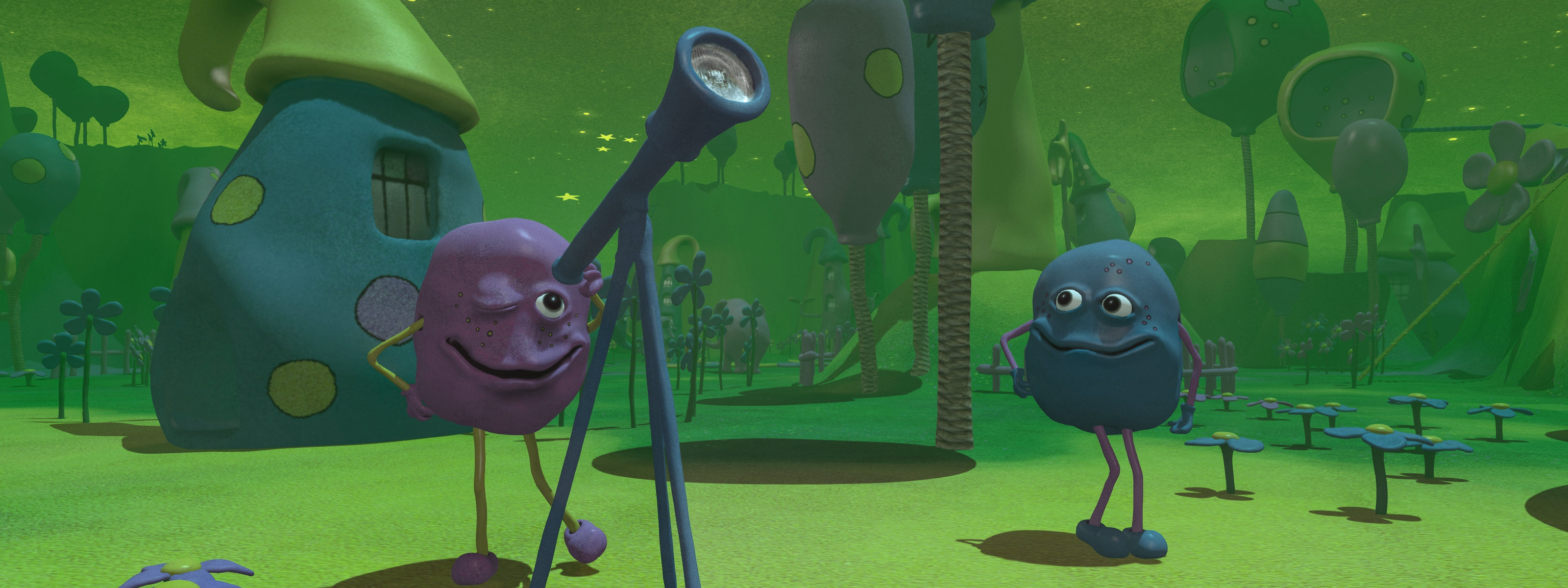
On first encountering them, I thought the denizens of this little hamlet were fruit. I think this was because the first ones I encountered were purple in colour and they put me in mind of the adverts for a certain blackcurrant cordial drink we have in the UK (and which may well be known by other names elsewhere). However, they are in fact potatoes, small and (very) large, and are far from limited to being purple in colour. These happy villagers share there space with a mix of wildlife, all of whom appear to be equally at home in the village and its surroundings, and equally friendly.
As is common with Cica’s installations, there are several interactive elements, so you can sit and chat with a potato, try the stool balancing mentioned above, express your joy through dance under the eaves of house or the balloon-like trees, climb and cross ladders – you can also go for a spin if you wish, although wearing a swimming costume and being prepared to hold you breath are both advisable!
Gallery Asaki Yume Mishi, Jan / Feb 2024: Noa Cloud – Photopoetry
I recently had the opportunity to visit two small and very different art exhibitions presented by two diverse creative talents in Second Life; and while they are entirely unrelated in terms of their visual composition and content, both appealed to me in such a way that writing about both within a single article struck me as not unreasonable.
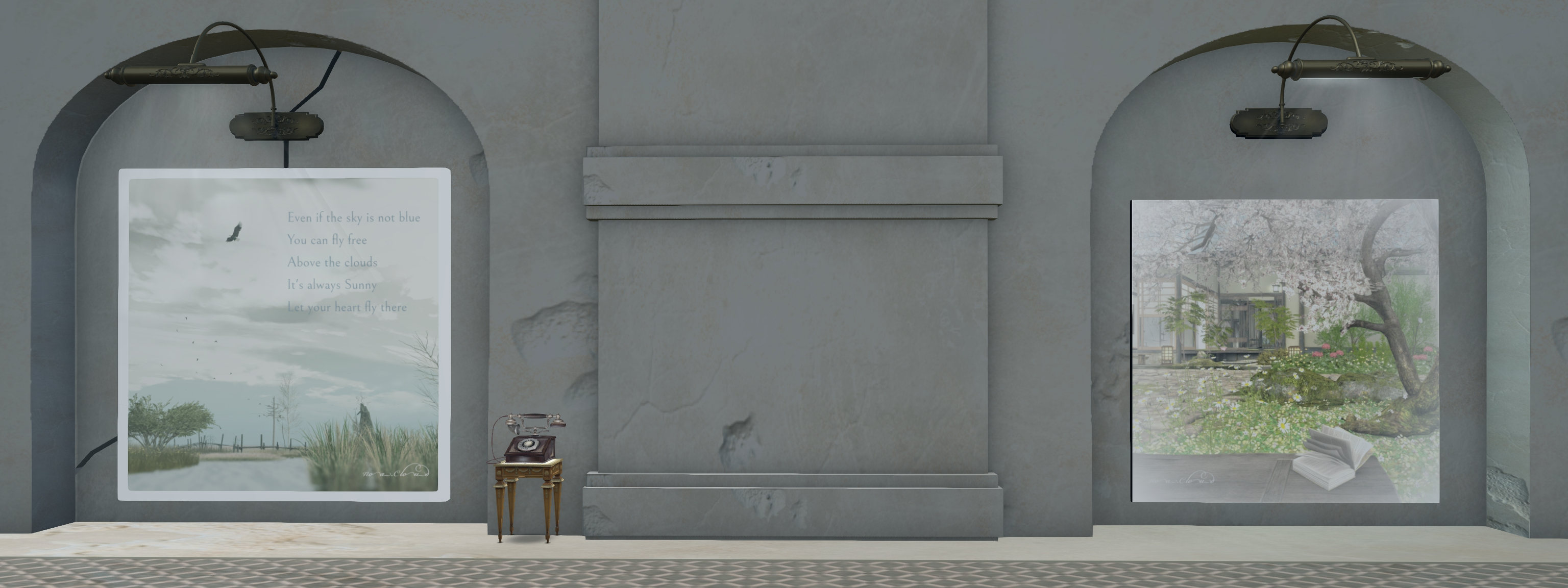
The first is a very modest – I wish it were more extensive! – exhibition by Noa Cloud, presented at the Gallery Asaki Yume Mishi, which has a novel underwater setting. Noa is perhaps best known amongst SL explorers as the holder and creator of [REN], with its seasonal designs and opportunities for photography (and which is also the home of his own gallery); however, he is also a gifted writer, a musician and actor, and an explorer of Second Life as well as an expressive photographer of both avatars and Second Life landscapes.
Gallery Asaki Yume Mishi, Jan / Feb 2024: Noa Cloud – Photopoetry
Within Photopoetry, Noa combines both his writing and his photography both directly and indirectly. Directly, because within the selection of pieces is a slideshow featuring all six of the presented pieces taken from around Second Life, each with its own single-stanza poem presented in both Japanese and English. As I don’t speak Japanese myself, I cannot say of they all form traditional Haiku, but the flow of their English metre suggests they are free-form Haiku (which do not necessary follow the 5-7-5 on), and each certainly has an implied kigo.
Indirectly, because while the combination of each image with a poem leans the observer into a line of thought suggested by the poet-artist, Noa also includes the six pieces individually around the gallery space (and within the slideshow prior to its accompanying poem gently fading-in), allowing visitors to view them free from any suggestion of rhyme and meaning. Thus, each piece is able to speak to us in its own right – and there is much each has to say; Noa’s photography carries within it a mix of homage to Nature’s beauty – often combined with a sense of spiritual reflection or uplift – together with a hint of mystery or social commentary, all of which makes for a thoroughly engaging visit.
Nitroglobus Roof Galley Annex: Frank Atisso – Shadows and Strength
Frank Atisso is also well-known within Second Life. He was the founder of the Art Kornersl blog which later morphed into the Art Korner Exhibits HUD and the Art & Photography Calendar. He also founded the Art Korner Gallery and currently co-runs the Artsville Hub, exhibitions at both of which have been, and continue to be, featured within this blog. And if that weren’t enough, Frank also keeps himself busy as a DJ in-world! However, his work as a photographer is something which may be less well known, and so his exhibition at the Annex of Dido Haas’ Nitroglobus Roof Gallery offers an excellent opportunity for those who have not done so to acquaint themselves with it.
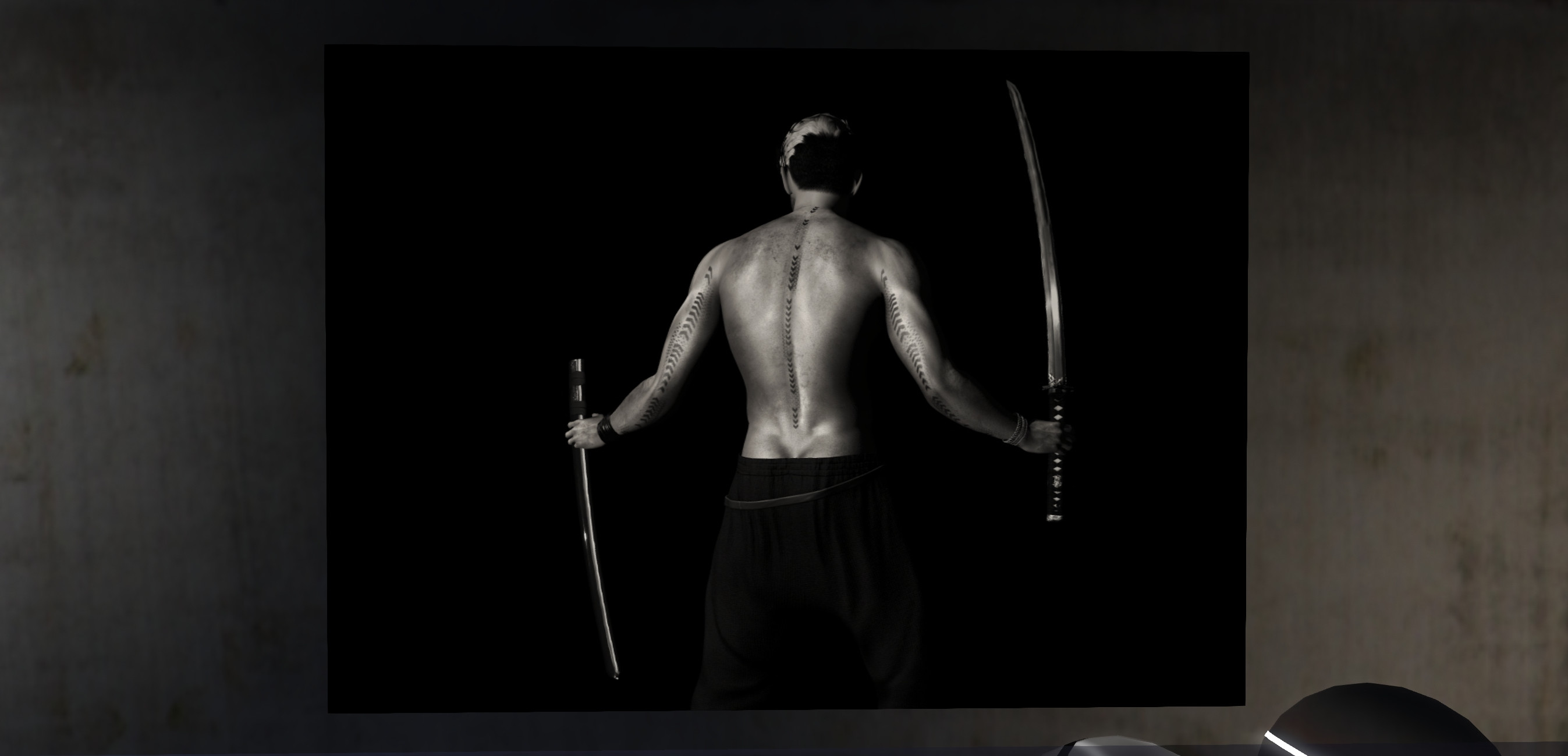
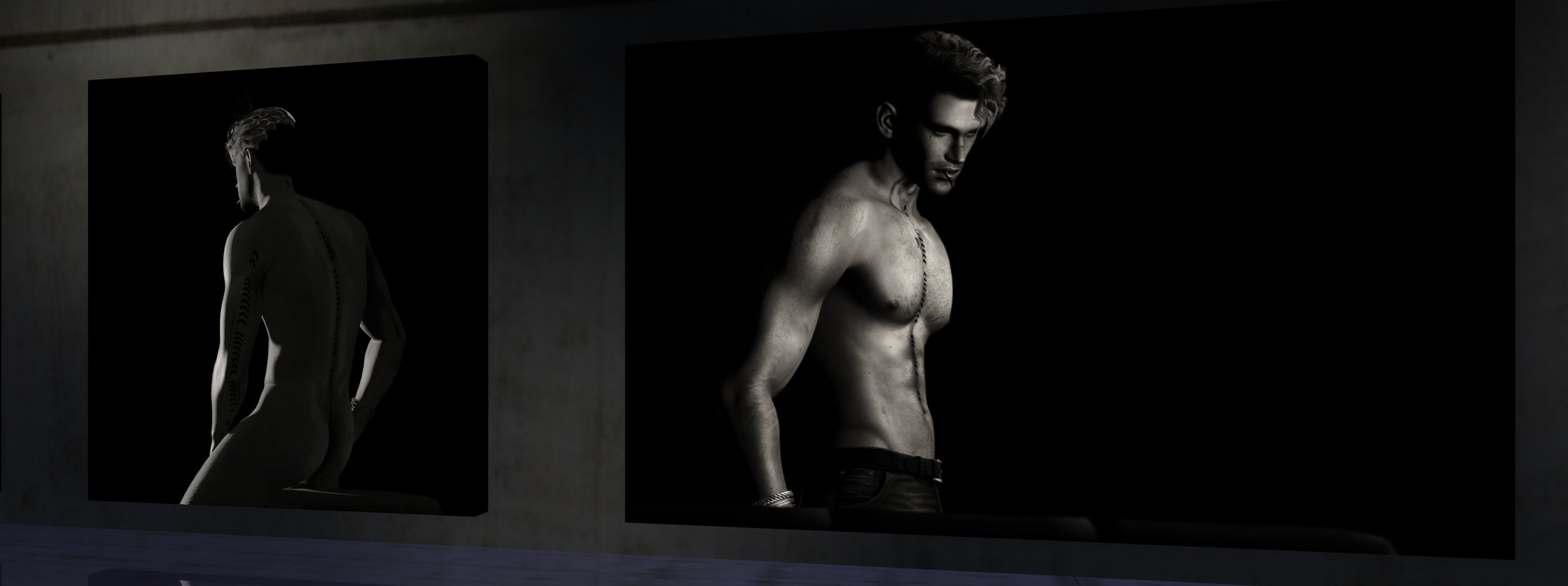
Entitled Shadows of Strength, this is an exhibition of male semi-nudes (something of a rare subject in SL!) which are specifically designed to explore the complex interplay of light and shadow within photography. Presented as chiaroscuro greyscale pieces, the nine images comprising Shadows of Strength are on a technical level a perfect embodiment of the technique: using bold contrasts (light / dark) to frame the entire composition and achieve a sense of volume and depth in modelling three-dimensional objects and figures within a two-dimensional canvas.
Nitroglobus Roof Galley Annex: Frank Atisso – Shadows and Strength
However, these are pieces that achieve for more than a technical embodiment of a technique. Such is the subtle interplay of contrasting light and dark in all their varying volumes and as determined by the subject’s pose and the positioning of the (off-camera) illumination, the eyes is naturally drawn to the manner in which both light and shadow ebb and flow across the subject, both of them giving subtle emphasis in their own way to changing skin and muscles tone which also highlighting features and hiding others to give an intrinsic and life-giving depth to each piece.
Thus, within each of these pieces we have not only a single-frame study of the human form and the use of light and shadow, but also an exploration of mood, thought, emotion, even vulnerability (particularly in those images where the subject is not looking at or towards the camera), conveyed as narrative threads to further engage the eye and mind.
Nitroglobus Roof Galley Annex: Frank Atisso – Shadows and Strength
Both Photopoetry and Shadows of Strength will remain open through February 2024, and I recommend both to fellow patrons of the arts in Second Life.
Oblivion, January 2024 – click any image for full size
There are many beautiful regions in Second Life presenting all manner of settings and environments and put together with care and love for the enjoyment and appreciate those who visit them. It has been my privilege and joy to visit many of them over the years, and to write about them. Some have faded away with the passage of time, but remain in photos and memory; others are reinvented periodically to offer something new and enchanting or mysterious or fun to visit, and some – and their designers – have become established in a growing catalogue of places I regard as personal favourites; places I will happily revisit time and again.
One such region was that of Winter Moon, a place I visited on several occasions between 2013 and 2020 and wrote about on three of them. A Homestead region held and designed by Dream Shadowcry, it was always a place of serene beauty and opportunities to decompress and renew. However, and for reasons unclear to me – or perhaps because the region was retired at some point; I genuinely have no idea – I lost track of Winter Moon in late 2020; so when a little bird whispered in my ear that Dream was back with a new setting (and with a new name for herself – Dream Softpaw), this time occupying a Full region, I knew I’d have to play a little catch-up.
Oblivion, January 2024
Oblivion – for that is the name of the setting – offers all that I found so attractive in Winter Moon, but with a richness of detail which can only come within a Full region’s additional Land Capacity. A veritable tour de force of design, it is – without hyperbole – simply magnificent in presenting a place that is rich in celebrating nature’s beauty; a veritable tapestry of ideas and themes deftly woven together into an engaging whole.
The “official” landing point (not actually enforced, so people can teleport out and back in anywhere within the region) sits at the southern end of a suspension bridge which appears to have been modelled after Liberty Bridge connecting Buda and Pest across the Danube. However, rather than spanning a river, here the bridge links a large sandbar occupying the south-east portion of the region with the main landmass. Also unlike its namesake, this bridge has only one suspension span, and is not a walkway in the traditional sense; rather, it is a garden space reaching out over the water to the rocky northern tip of the sandbar, where it drops down by way of steps to ain unsurfaced path leading to a grove of fir trees crowning the highest point above the surrounding sands.
Oblivion, January 2024As well as suggesting the region enjoys a temperature rather than tropical climate, the trees lay gathered around and on the sandy hill in a manner which suggests the surrounding beaches – despite the deckchair and parasol placed close to the current water’s edge – might well be subject to periodic submergence by the tide; a suggestion additionally made by the fact the sandbar’s lone wooden deck extends out over the sands whilst raised well above them on stout timbers.
Both ends of the bridge are marked by boxwood hedge arches, with the northern end also having steps descending from it to a small headland of sand dunes matted by wild grasses, together with a beach where a large deck has been constructed, complete with a walled garden area and upon which comfortable chairs, braziers and parasols have been set out to allow visitors to relax and enjoy a cocktail or glass of wine, together with selections of fresh fruits, – just don’t sit on the furry occupants of one of the chaise lounge!
Oblivion, January 2024
Westward, and beyond another boxwood arch, the path climbs the slopes of the main island, meandering through and between grasses, ferns and wildflowers and beneath the tall fingers of high fir trees and redwoods as they form a not-too-dense woodland. Branching mid-climb, a part of the path wriggles its way to stone steps as they slip down to a further deck, this one raised over the rocks and cliffs sitting at the landward end of the setting’s sheltered bay. Meanwhile, the rest of the trail continues upwards to run along the spine of the island, skirting the edge of a wash of lavender as it adds a splash of deep colour to the greens and browns – and even the pinks and reds of the blossoming trees sitting amongst the fir trees.
Bursting clear of the trees, the path provides access to a huge glass-and-iron greenhouse, now converted into a chandelier-hung bar, a further place to sit and relax. Beyond it, on the high headland, an eye-catching floating stage reached by wooden steps and held aloft by three large balloons as it overlooks and small and slightly overgrown dance floor to outside and the cliffs that drop away to a further beach on the other. The latter is marked by a massive rock arch which itself sits close to a final sentinel at this end of the island: a stone pavilion raised at the end of a slender finger of sand – although how you reach it is a matter for you to determine 😉 .
Oblivion, January 2024
Across the endite setting are hints of fantasy and romance gently woven into the setting to add to its beauty: a gentle voice might in places be heard singing on the breeze; an empty mausoleum has been converted to a quiet retreat; the beacon-like braziers point blades of light towards the sky; an armchair surrounded by (mostly!) quiet cattle content to simply observer whoever uses it, awaits those in a contemplative mood; a clockwork owl keeps a careful pair of eyes on the comings and goings of visitors…
Oblivion is without a doubt one of the most visually engaging, soul warming settings it has been my pleasure to explore; the depths of detail Dream has provided are wonderful to find – hence why in some cases above I’ve given hints, not directions, on what you might witness! – and the sheer natural flow form location to location is utterly sublime, while the many places to sit and share or rest in solitude further add to region’s welcome – and increase the desire to spend time within it.
Lalie Sorbet invited me to visit her latest collaborative piece – working with Chrix (chrixbed) – entitled Bloom:Flowers of Evil, and which is currently open to visitors at the Second Life Endowment for the Arts. A dynamic installation built around what I understand to be a scripted particle system of their own design (and called, appropriately, Bloom), mixed with 2-dimensional elements also under scripted management.
The result is a hard-to-define but infinitely beautiful series of collages-in-motion, centred on a 3D element of standing stones and a “starfish” which looks to be an elegant star-like piece of lava. Close by is an upright piano atop which a female form reclines and with an arc of benches with singles and couples poses ranged before it, allowing people to sit and appreciate the particle display.
SLEA6: Bloom: Flowers of Evil, January 2024
The artists state that the installation is inspired by the works of French art critic, poet and essayist, Charles Baudelaire – the title being the English translation of what is regarded as his most famous volume of work, Fleur du Mal, first published in 1857. The original volume, with its focus on decadence, eroticism, sexuality, original sin and death, caused a considerable stir when it first appeared, with six of its poems leading to Baudelaire and his publisher being prosecuted for “creating an offense against public morals”, resulting in both being fined and the six “offending” poems being suppressed for several years, only appearing in volumes of their own published outside of France (as with Épaves – The Wrecks – published in 1866 in Belgium).
However, both despite and because of the outrage it caused, Fleur de Mal not only remained in publication – less “offensive” works by Baudelaire were substituted in place of those which caused some to try and suppress the volume entirely – it became synonymous with all his works, with the title being used for successive collections which both incorporated the original poems and other works, including an edition printed in 1868 following the poet’s death at just 48 and which includes 14 of his previously unpublished poems.
SLEA6: Bloom: Flowers of Evil, January 2024
It is in this wider guise, and as a source of inspiration / reflection that Lalie and Chrix appear to utilise the title, rather than offering a more direct visual interpretation of poems from the volume (although there are what appear to be small nods towards some of the themes, here and there, for those familiar with the various sections of the volume). Baudelaire is regarded as a master of rhyme and rhythm within his prose-poetry – demonstrated by the fact that his style and work not only influenced poets down the years, but also artists and musicians, with some of the latter utilising Flowers of Evil or Fleur du Mal – and it is this aspect of his work which appears to be celebrated most directly through the ebb and flow of the piece, where particle patterns and images might be seen as poems and the stanzas therein, caught in a delicate dance of imagery.
Within Bloom: Flowers of Evil, the artists capture the essence of Baudelaire’s rhythm through the particles and images offered, whilst also reflecting the romanticism which also lay at the heart of his work. It also (possibly in part coincidentally) offers echoes of other ways in which Baudelaire’s influence has been felt; within the audio stream accompanying the installation is Sahalé’s Fleur du Mal, a piece with takes the iconic title and mixes it with the rhyme-like rhythm of Eastern and African music, whilst the presence of the piano put me in mind of Susanna Wallumrød’s Baudelaire and Piano (2019), which set several of Baudelaire’s works to music.
SLEA6: Bloom: Flowers of Evil, January 2024
Whether or not you are a follower of Baudelaire or feel compelled to seek out his works (I admit to finding some of his work “florid” (for want of a better term), although Tableaux Parisians is a captivating read, presenting both a contemporary walk through Georges-Eugène Haussmann’s renovation of Paris at the behest of Napoleon III and a critical response to its modernity, thus combining Baudelaire’s gift as a poet with his work as a critic), Bloom:Flowers of Evil stands in its own right as a visually engaging installation; just be sure to try sitting and viewing it in Mouselook, rather than purely through a 3rd-person view!






 Inara Pey: Living in a Modemworld