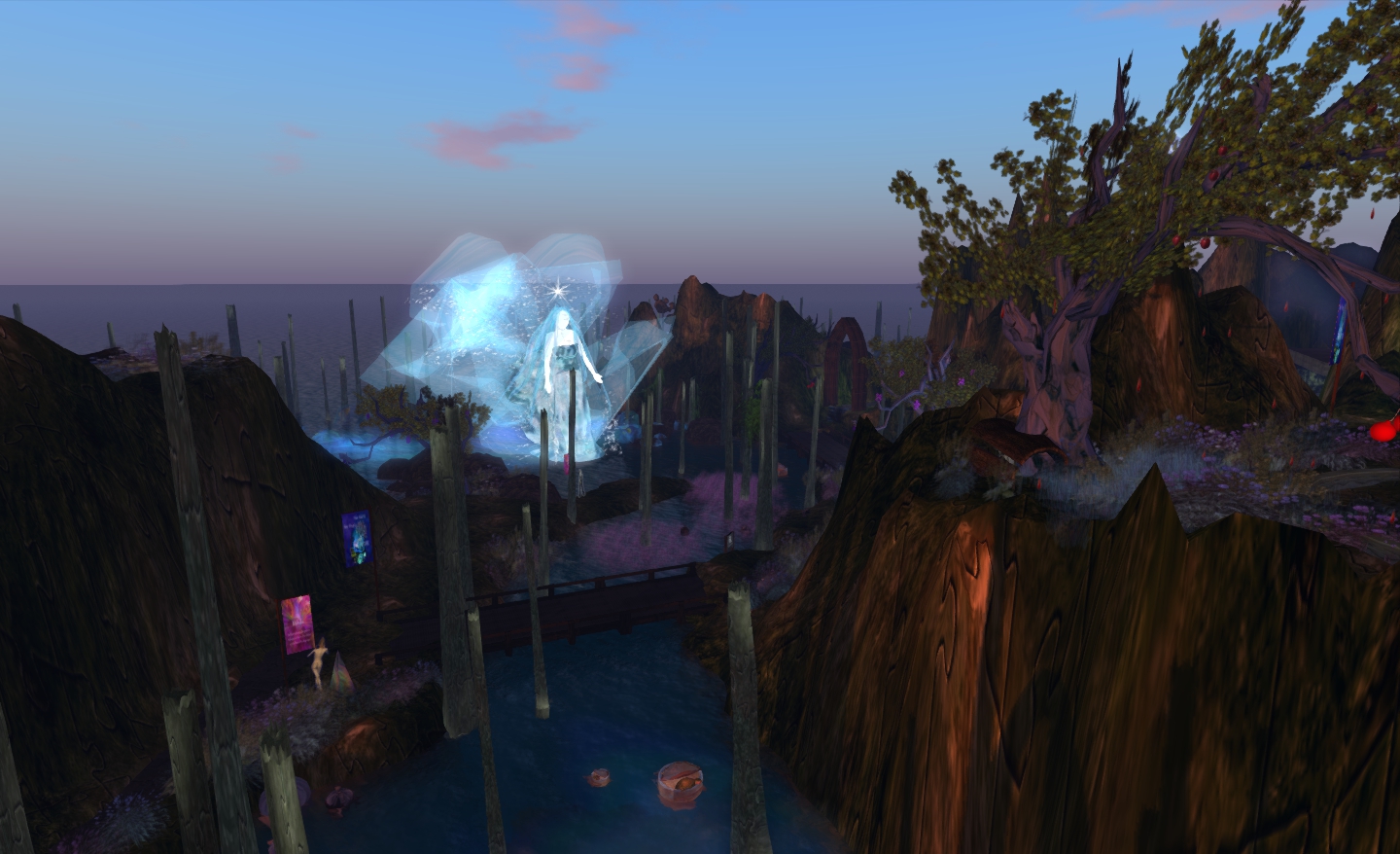
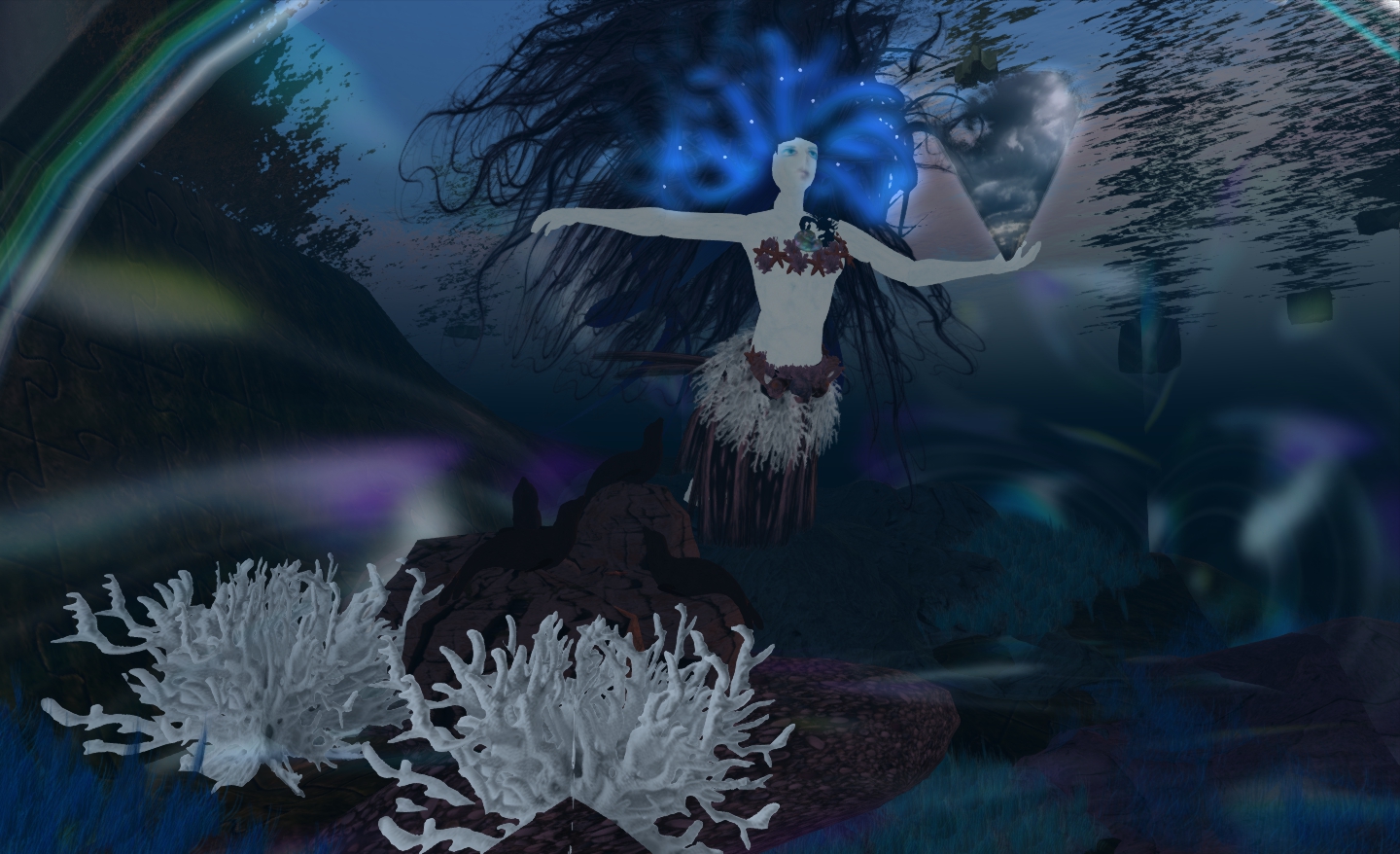
Katz Jupiter recently re-opened her art sim, Slightly Twisted with a new centrepiece full sim installation called The Gathering of Sky Women. This is a collaborative piece by Katz and fellow artists Asmista Duranja, Fuschia Nightfire, Louly Loon, Lilia Artis, and Trill Zapetaro.
Katz describes the installation thus: “I approached each of these artists to create a piece focused on a selected goddesses from different cultures around the world. The common denominator of all of the ones featured is they were all responsible for creating the world or aspects of the world in which we live in (elements, animals).”
The inspiration for the work is Judy Chicago’s The Dinner Party, produced from 1974 to 1979, which depicted place settings for 39 famous women of myth and history, with the goal to “end the ongoing cycle of omission in which women were written out of the historical record.”
Slightly Twisted – The Gathering of Sky Women
“For this exhibition and the bringing together of these goddesses is a remembrance of sorts of women who at one time figured largely in the creation stories of their respective cultures,” Katz further explains, referencing The Dinner Party, “But with the passage of time their role and their stories have been largely ignored or re-written to their exclusion.”
The six goddesses featuring in the piece are:
Ariadne (Fuschia Nightfire), who as a goddess may have been the first divine character from Greek mythology to be recognised in Crete, and who is here described as, “She spins the world into existence. Hidden places and the life forms found in those places are associated with her.”
Awehai (Katz Jupiter), a goddess of the Iroquois nations, who is associated with renewal, continuity and community
Botthisattva of Willendorf (Trill Zapetaro), perhaps better know as the Venus of Willendorf, representing fertility and stability of the Earth
Mahuika (Asmista Duranja), a Maori fire deity from whom Māui obtained the secret of fire by tricking her into giving him her fingernails
Sedna (Lilia Artis), the Inuit goddess of the sea
Yemanja (Louly Loon), a Brazilian goddess from the Candomblé and Umbanda religions, regarded as a the spirit of the sea.
Sedna
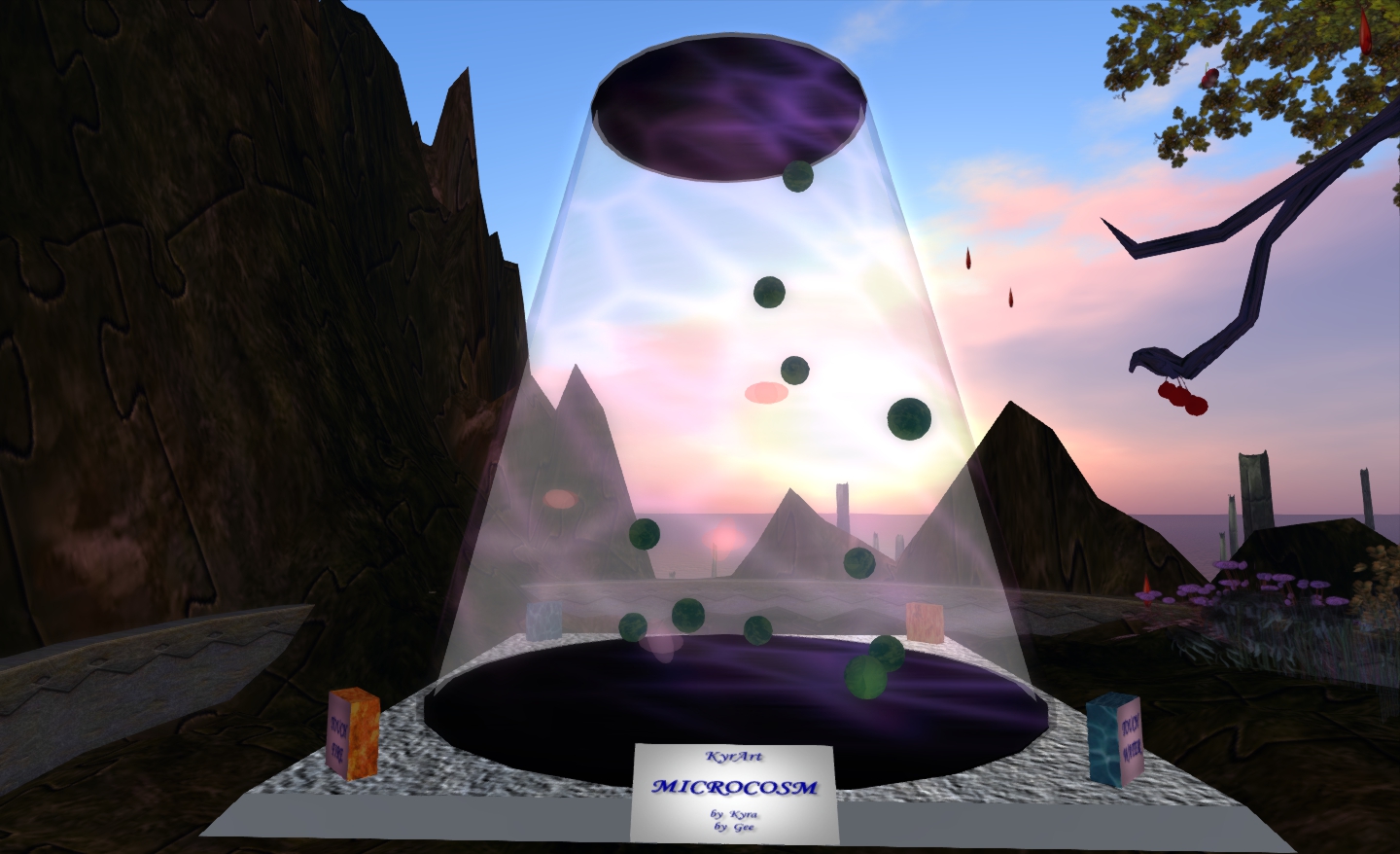
As mentioned above, this is a sim-wide installation, and you can either reach the various exhibits on foot (with the exception of Mahuika, who resides on a platform over the sim) or by clicking on the banners at the arrival point and obtaining a landmark to each goddess. However, I do recommend that you use your pedal extremities and walk around the sim as there is a lot to see in addition to the main installation, including additional works by Anna Anton, Cherry Manga Gee Blackadder, Kyra Roxan, Spirit Radikal, Treacle Derlande, Briawinde Magic and Fae Varridale.
Microcosm by Gee Blackadder and Kyra Roxan
These additional pieces also examine modern civilisation’s relationship with the world around us and the nature of ecosystems, and are themselves fascinating pieces. Across the island one will also find other elements of Katz’s work, making careful exploration very worthwhile.
Veiled in a dream, Romance dances through a wild meadow overlooking a sparkling sea. Inspired, a lone jeweller plies her craft, immortalizing the magic of Love’s kiss in prims. Art, friendship, and passion beckon. Embrace the possibilities!
This is the description given to Wanderstill in the region of Ode, a place that I’ve read about in a number of places and from where Honour McMillan took a series of pictures that caught my eye (albeit in a post dealing with a particular SL problem). It is the creation of Elizabeth Tinsley and it is simply stunning.
*~Welcome to Wanderstill~*~: You have found your way to a tiny cottage in the middle of a wild meadow. This is the home of Frippery, a jewellery shop for imaginative minds. You are warmly welcome. Come in, make yourself comfortable, peruse the baubles, take a gift, and leave a message.
Wanderstill (Flickr)
The store itself is genuinely charming, and creates a relaxed atmosphere that continues out into the meadows surrounding it. Where you roam is up to you – but there is plenty to explore and to discover – and be sure to look down as well as up! There are places to sit and relax, places where you can dance – and places where you can get a little exercise!
Wanderstill (Flickr)
When exploring, I recommend you have the audio stream on – the music from sky FM matches the idyllic surroundings beautifully.
When I was a teenager, many moons ago, a frequent insult passed around was, “If brains were dynamite, s/he wouldn’t have enough to blow her/his own ears off.” If a girl was particularly disliked, this sometimes became “….She wouldn’t have enough to blow her own tits off” (boys had a similar twist, which involved parts of their anatomy much lower than the chest).
So, any art installation that invites you to Blow Your Own Tits Off tends to ring bells of teenage years past in my noddle, and send me investigating.
The full title of the piece is “Celebrity Blow Your Own Tits Off”, and it is by Maya Paris with assistance from a number of other SL artists. It is located on LEA 10, and is modelled on a game show (proudly sponsored by “Braino, Ransom & Wow™”), with five interactive levels.
“Will the next contestant … COME ON DOWN!
The main part of the experience is to follow the dotted red arrows (well I had to get something that fits the metre of “follow the yellow brick road”) through the various exhibits looking for “holes” to pass through (or touch). You’re encouraged to touch anything else you come across as well, and to have sound on and your AO off (so your avatar can be animated).
“She’s a pinball wizard, there has to be a hole…”
Along the way you get the opportunity to pick up various items as well. Whether you wear the accessories or not is up to you…some are decidedly … novel!
Some of it is a little ominous … some a little confusing … some might be considered a tad rude – although one cannot help but be reminded of Kenny Everett’s Cupid Stunt and that really, “It’s all done in the best PASSSS-ABLE taste!” :).
“It’s all done in the best PASSSS-ABLE taste!”Careful, or I’ll show up on *your* doorstep like this….
Crash Bang Trollop, which is where you end-up on exiting Blow Your… is similar in theme, and is described thus:
Tired of being bombarded by the crazy tornado that is the beauty industry?
Time to CrashBangTrollop!
Now you have your ZAP suit, wear it and find the 7 Trollop gadgets in the “ZAP” boxes around the sim ( all free)
Run Wild, turn up your sound and click everything! Dodge the needlefish, tiptoe through the aggravated follicles, help those boobs escape the underwires, Wax on….and off….claw your way through the waters, dare to try the trollop-rocket? Spray yourself orange, and don’t forget to Vajazzzzz.
Aerosol a*se kisser?
Trollop is open-air, and opposed to enclosed, as with Tits, and offers a number of things to click on to animate your avatar or which give you further bits’n’pieces.
If I’m honest, I’m not at all sure what to make of either piece – apart from feeling decidedly silly when I emerged from Tits. As interactive experiences go, they are both certainly that; I’m just not sure if there is meant to be a commentary on the state of television today and / or the cosmetics industry, or whether it is all simply meant in fun.
Best thing, possibly, is that if you’re curious you go along and find out for yourself. I man, the worse that can happen is you do manage to Blow Your Own Tits Off, right ;-)?
Arrehn Oberlander recently contacted me concerning MetaHarpers and the -io- Team’s new Linden Endowment of the Arts installation, The Inspiring Orientation – a smaller version of which was recently displayed at SL9B.
The installation, which opened on June 22nd, is described as: “Part art walk, part tutorial – a vision of a future where new SL citizens are introduced to an interactive combination of gallery and orientation course.”
The inspiring orientation – from the outside
Teleporting to the venue brings you (a little wet-footed, but that seems par for the course at LEA venues!) to a greeting area, where you are welcomed in a wide range of languages and get to meet your guides for the tour – tablet-like creations that display information and instructions on their screens.
A guide
Following the path takes you through various rooms, each with a specific focus on using your viewer and interacting with the world around you, starting with the basics of movement. Each section is quite cleverly put together, and the section on sitting cleverly introduces the idea of sitting on objects directly (scripted or otherwise) and using poseballs. Elsewhere there are lessons on using chat, which uses a range of animals with which to interact on a basic level, and there is a section devoted to camera movement and control.
Talking to the animals: “If I were asked to sing in hippopotamus I’d say “whynotamous?” and I would!!
At the end of the walk there is the opportunity to explore SL itself, with a series of teleport alcoves. These are divided into categories: Music and Stage, Art and Fashion, Exploration, Games, and Social and Chat. Each of these has two (or more) vendor boards visitors can scroll through to see a range of destinations. Clicking on an image brings up the Place Profile floater, allowing the visitor to read more on the destination and, if they like it, click on the Teleport button and go visit.
Each alcove also has a notecard giver that explains a little more about the subject matter, and can provide additional help. The Art and Fashion notecard, for example, defines the major forms of clothing (system, prim/sculpted and mesh) and the differences between them. While one might grumble the presentation of this information could be better, it is nevertheless more informative than anything currently on offer to new arrivals in SL.
Where next?
Most importantly, this area of the installation offers a way back for those that need a little more assistance – something massively lacking in recent orientation offerings from LL, where once you leave, the way back is barred to you in a “Thank you, and good night!” approach.
There isn’t much else beyond this in terms of orientation – but its is enough to give a flavour of what might be achieved.
Not only is the tour a visual experience, it is also very aural: the various sections are filled with a range of atmospheric sounds or music. The section on flight features elements of Glyph Graves’ The Forest of Water and Strangers also Dance, which uses sounds and tones very cleverly and is definitely worth wandering around rather than simply flying straight through. Elsewhere sounds of the jungle accompany the animals in the chat section and Lily of the Lamplight provides an accompaniment as you learn about camera controls.
Given that sound is enabled by default on the official viewer, then the use of music and sounds adds a clear dimension to an orientation experience and helps demonstrate the rich immersive experience one can enjoy with SL.
Glyph Graves’ combined piece deep inside The Inspiring Orientation
Clearly, as a demonstration, the installation only offers up just a sampling of lessons that could be provided in order to provide a feel for the idea. It would seem to naturally lend itself to further lessons being added without over-burdening the new user, so I’m not going to critique the creators on the basis that it doesn’t show X or Y in terms of basic lessons – something easily fixed were this to go into production.
However, I would be a little concerned should the idea be used with some of the graphics as seen in this installation. The animals in the chat area and the cartoon bedroom used to demonstrate sitting and touching objects in-world may look cute – but they also run the risk of giving entirely the wrong first impressions about SL to the newcomer, who ends up simply turning around and walking out in the belief they’ve wandered into something aimed towards younger children, rather than a sophisticated immersive world.
Perhaps a little too much like a cartoon?
While the lessons don’t have to be totally rooted in the “reality” of SL, I can’t help but feel that they should at least have a greater rooting in what SL as actually like in terms of what the new user can reasonably expect to see and encounter once they pass on in-world. Doing so should help build familiarity and confidence in the user, and enable them to better respond to the things they see with greater familiarity.
Another area that isn’t really covered in the exhibit, which is perhaps more important, is that of language. Beyond the many greetings in the welcome area, The Inspiring Orientation is presented entirely in English – and that’s fine for a piece designed to stimulate the mind and demonstrate what might be achieved. But how would it handle multiple languages, given that those coming into SL do so from all over the world? Would multiple “tablet” screens be used? If so, the lesson areas might get a little crowed. Would screens operate in more than one language? That could easily lead to confusion were someone to start reading instructions in German, only to have someone else click the button for the French option to be displayed…
In fairness, the team behind the piece may have already considered this issue and have an answer – if so, it would have been nice to see something presented here, if only to further demonstrate the practicality of the the approach.
As a small aside, it would be nice to see an orientation system that actually points to the assistance that is available in the Viewer – particularly the How To guide, which even LL ignores (in favour of the Destination Guide). It’s a small niggle, but the built-in help is there, and there is no harm in pointing people towards it.
But leaving my niggles aside, The Inspiring Orientation does offer an interesting and entertaining attraction that takes a fair crack at answering a question that has stumped LL to the point where they have seemingly abandoned it entirely: just how do you get users engaged with the viewer and introduce them to Second Life in a visual and informative medium? This exhibit doesn’t have all the answers, but it does offer an immersive and engaging alternative to what has been offered-up recently elsewhere. As such, it is very much a worthwhile visit, whether you enjoy SL art or have an interest in issues of new user orientation.
I first came across Tyrehl Byk via his SL performance art pieces, Catharsis and Particle Phastasmagoria last year, and was completely enchanted in his use of particle effects and music to create marvellously immersive art shows. Now Tyrehl is back at the Linden Endowment of the Arts with a new full-sim feature, Almost Flat Land, which again uses particle effects, this time in an immersive environment in which you are very much a participant.
Arrival: take heed of the notes
On arrival at the installation, you will find yourself deep in a cavern – a foreword, if you will, to the piece itself. Here are instructions on setting your graphics particle and media settings to get the most out of your experience. High-end graphics do not need to be enabled, so long as you ramp-up the particle count to its fullest extent. You will, however, need both media and sound enabled to gain the most from Ultraviolet Alter’s soundscape – visiting the installation without either enabled with greatly diminish your experience.
Gallery
Once you are set, take the teleport down to the surface, where you will find yourself in the gallery, a hall that appears to have suffered the ravages of some geological event – and possibly something more. Here your task is to find a diary, one which offers a vivid tale of stranded explorers, missing team members and strange creatures from another dimension. It also perhaps carries a stark warning: the final pages incomplete and spattered with blood.
Diary
However, to consider Almost Flat Land a mystery waiting to be solved, would be a mistake. The diary isn’t a narrative device that guides you through a story. Rather it is a means of providing context for the rich soundscape and of encouraging you to explore; to simply stand and cam your way around would be a mistake, and would leave you missing out on a lot. And there is a lot to discover – far more than the water-encroached landscape might suggest, including a hidden portal taking you to another aspect of the piece.
Portal
The installation offers itself to a wide range of interpretations. There are stories to be told here, whether you chose to frame them with the passages of the diary or not. As an immersive experience, it offers images and sounds that will doubtless resonate differently and uniquely for each of us, even when using the diary as a guide for the imagination.
Why not take an hour to discover what it says to you?
Earlier in the week, Salazar Jack dropped a lovely picture into Twitter of a magnificent steampunk-esque flying machine being flown by Tish Coronet. He included a link to the SL Marketplace, and I set off to look, rather intrigued.
The photo that piqued curiosity: Tish Coronet’s Lepidoptera (captured by Tish, uploaded to Twitter by Salazar Jack)
The machine itself is the Mechanical Lepidoptera, a partial mesh build which is being offered free by its creator, Bunnys Fride, who describes it thus:
By visiting the Jules Verne Museum in Nantes (french town, west coast) I noticed a painting that represents this machine to takeoff from one of the most beautiful place of Nantes. This same painting appears in the foreground on the poster for the International Festival of Science Fiction of Nantes in 2009, named Utopiales.
I propose you this beautiful concept of lepidoptera mechanical imagined and painted by James Gurney, a talented artist, famous illustrator and creator of Dinotopia.
Standing next to my Lepidoptera
The Lepidoptera is exquisitely detailed, with a two-tone metal body, beautiful passenger cabin (the vehicle will take up to eleven passengers, included one seated beside the pilot / owner) and detailed cockpit in the “head”. Detailing continues through the landing legs, which “droop” below the body when in flight, just like the legs of a flying insect seem to hang limply beneath its body. On landing (on the ground), the legs splay out, again in a life-like look. Another lovely piece of detailing is in the mechanical operation of the wings themselves.
Detailing
Flying the machine requires a HUD, which allows you to correctly set your camera position, and which controls the start-up of the machine and the forward / interior lights. This attaches to the top right of your screen. To fly the Lepidoptera, right click on it and select FLY from the menu, this will sit you in the cockpit. Tap ESC to position your camera correctly (if required – or use the HUD options), and then click on START on the HUD to set the wings flapping (complete with engine / mechanical sounds). Flight controls are then use PAGE UP / DOWN to ascend / descend, and the arrow keys / WASD keys to manoeuvre (you’ll need to key the UP / W key depressed to maintain forward motion).
Airborne!
Natascha Randt has produced a great video showcasing the Lepidoptera:
On the Ground
Flying the Lepidoptera reminded me that a few months back I picked up another freebie from SLM, the Autoworks Classic 43S GT by Angie Xenga / Ed Zaurak.
The Autoworks Classic 43S GT
A two-seat sports coupe, the 43S GT is sleek and attractive – and quite a handful if you’re not used to SL driving, as I found out when given the chance to try it out on a multi-sim racing circuit for the first time yesterday!
The basic controls are simple enough: UP key / W to accelerate, LEFT / RIGHT or A / D to turn, and DOWN / S to break. PAGE UP / PAGE DOWN operate the gear changes (although there is an automatic option). However, there are a range of other options and capabilities that can make driving an Autoworks car pretty much the same experience as driving a high-performance car in RL: 50% fun, 50% seat-wetting and 100% adrenalin! There is also an option HUD displaying speed and revs which you can attach to your screen.
Additional menu options allow you to alter the colour of the car – royal blue is the default, but I like the silver look – adjust your driving position, adjust the transmission options, the engine – and a whole lot more. Touching the car allows you to open the bonnet (“hood”) or the doors.
Ready to get behind the wheel
The cockpit itself is nicely detailed, and I love the fact that this car is designed to be driven on the correct side of the road being right-hand drive ;-). All-in-all, great fun to have, if you can find the space to use it (the handling is such that you can rapidly run out of sim!).
If anything spoiled it for me, it was not the car, but the fact that to appreciate it fully you do need to drive across multiple sims – and this brings up the ogre of region crossings. Given the speeds you can reach behind the wheel, this means it is easy to find yourself on top of one before you realise, and you’re suddenly sailing off into infinity. Hopefully, with multi-threaded region crossings on the way plus other improvements, this will reduce the problem, but it did put a bit of a dampener of the thrill of driving this superb car.
Ready to roll
As well as the Classic 43S GT, the package comes with the Autoworks Type ZII, a single-seat car that offers a broadly similar range of options, but didn’t, for me, have the same appeal.
Apparently the Classic 43S GT represents the first in a new range of cars Autoworks will be producing “just for the fun of it”, the business itself having closed as an SL commercial venture in February 2012. It is a sample of what is to come; so far one more car has been added to the free range, and I’m intrigued to see what else is produced in time!