You win or you die 2: Highgarden

Earlier this month I paid a visit to the Mountains of the Moon, a Game of Thrones role-play region in Second Life. The region is linked with that of Maui West and Maui Central, wherein can be found Highgarden, the seat of House Tyrell. Given my love of George R.R. Martin’s A Song of Ice and Fire – or Game of Thrones as it is perhaps now more widely known, thanks to the HBO series of the same name – I could hardly visit the one without also visiting the other. So today I made a journey to the rose-enfolded walls of Highgarden.

Bandor Tyrell: Lord of Highgarden

The arrival point  is a small gazebo standing just outside the walls of the great fortress (although you can also reach Highgarden via the Game of Thrones Role-play Welcome Centre). Here you will be able to obtain background information on the setting for role-play within the sim, an “observer” tag (which you should wear if you are a casual visitor and wish to make it clear you are not actively engaged in role-play), and a wealth of additional information, including establishing a suitable character, historical information on House Tyrell, and information on how to address others when in character (a useful primer – even as an observer, it is polite to address others in-kind). Simply click the large image of Highgarden to receive the information pack.

Role-play here is set in the same period as Mountains of the Moon – before the seven kingdoms of Westros were “united” under the rule of Aegon Targaryen; this allows characters to move freely between the two regions, allowing full continuity of role-play.

As with the Mountains of the Moon, the visualisation  here (created by Bandor Tyrell, otherwise known as Bandor Beningborough) is impressive. As depicted in the books, Highgarden sits on the Roseroad linking Oldtown on the coast with Kings Landing, as the road follows the broad river Mander. Like the Mountains of the Moon, sim extenders have been used to great effect here, particularly in reference to the creation of the Mander itself.

Highgarden

Details on the design and layout of Highgarden itself is not as well-defined within the books as somewhere like The Eyrie, and this tends to leave matters open to interpretation in terms of look and feel.  Bandor Tyrell has opted for a look that has echoes of a romanticised Arthurian period (think BBC’s Merlin series, or Le Morte d’Arthur), with the castle having something of a French / German fortified château / schloss look combined with the more traditional curtain walls and round-towered gatehouses more often associated with medieval times. In this, the look of the castle reflects the high chivalric and romantic ideals personified by the Tyrells herein as well as presenting an environment entirely in keeping with G.R.R. Martin’s vision of Westeros as a whole.

Within the curtain walls sits a small town, complete with sept, bathhouse and housing for some of the members of the Game of Thrones Roleplay group. During the personal tour he kindly volunteered to give me, Bandor explained that the housing, when available, is offered free to group members. The town also continues beyond the walls, where the “small folk” – peasants and farmers to you and me – live and work and where the local brothel resides.

The brothel underlines the fact that role-play here mirrors the lifestyles found within the books; while outright nudity or public lewdness for the sake of it is not welcomed, role-play that remains true to the overall themes and ideals of Martin’s world is allowed (and sometimes encouraged!) and this can involve a degree of bawdy goings-on in some public spaces; hence the regions – as with Mountains of the Moon – are rated Adult.

This open nature of role-play here allows many other elements found within Martin’s novels to be played-out as well. Political intrigue, treachery, false alliances – all have their place and serve to make matters all the more – interesting – for those immersing themselves in the role-play.

The lists

The diverse richness of role-play is also reflected in the fact that combat  – for honour or for sport (in the form of competitive melees or jousts) – is very much part of the events that take place at Highgarden – all of them handled in character.  The castle also hosts dances, which are open to all, either in character or OOC, and which offer the curious the opportunity to sample Highgarden life in a more relaxed atmosphere than full-on role-play might allow, while at the same time offering an experience more immersive than might be obtained when visiting as a casual observer.

As with the Mountains of the Moon, there is much to explore and see here. You can witness the seven new gods of Westros in the sept, or sit under the spreading branches of the weirwood in the godswood and contemplate the old ways. If you prefer, you can explore the buildings of the town and wander the halls of the castle. If you are so minded, you can venture further afield and follow the Roseroad out into the wilderness – but be warned! There are both wolves and brigands wandering the woods and hills, neither of whom may take kindly to your explorations.

Highgarden has been put together with a lot of forethought in order to encourage the broadest possible GoT role-play, with the layout on both Maui Central and Maui West having been recently overhauled to enhance this. Together with The Mountains of the Moon, they are generating a significant amount of interest among GoT role-players. Both have certainly piqued my interest, and it is entirely possible I’ll be returning to both not only as a visitor – but also with a character backstory!

Related Links

Neva River: where thoughts drift

Update: Neva River is currently closed to public access

I’ve previously written about Wendy Xeno’s work in Second Life, having covered both Hazardous and Humanoid in these places. So I was intrigued to learn that she had helped with the design of Neva River, owned by Atteris Amarth and Neva Crystall.

Neva River
Neva River

Those who visited Humanoid will find Neva River somewhat familiar in terms of broad themes and tones: the same use of water and warm colours. The region offers a contemplative setting, with two houses designed by yacchan Clip and interior fittings by Neva Crystall which are open to exploration. Visitors are welcome to wander around the ground level areas and the houses, take photographs and simply pause and reflect in the last rays of a setting sun as clouds skitter overhead and birds wheels around the tree-tops before settling as the night draws in.

Use the local Windlight environment settings and enjoy.

Related Links

LEA launches 3rd round of land grants

LEA_square_logo_60The Linden Endowment for the Arts has announced applications for the third round of land grants is now open. For artists not familiar with the LEA or the land grant process, the following is taken from the formal announcement:

The LEA Land Grant program seeks to promote and nurture the arts in Second Life, through a six-month land grant to recipients. Recipients can be individuals or groups interested in creating or curating art, or proposing cultural projects which would require/utilise a full-sim build and can be completed within the allotted time frame. The LEA is able to offer land grants through the generosity of Linden Lab.

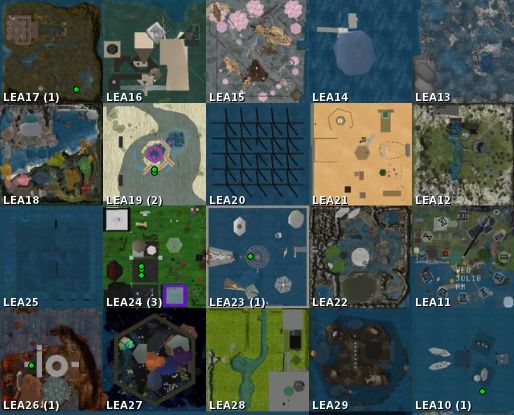
Twenty regions, donated by Linden Lab and managed by the LEA, are generally offered under the land grant programme, and successful applicants will be granted the use of one full region for a period of six months. The region may then be used on an individual or group basis for such diverse activities as:

  • Full sim exhibitions and / or immersive installations
  • Curated projects, especially those which have a connection to physical exhibitions and events (augmented reality)
Land grant regions: LEA10 through LEA29

Applications are not limited to visual art but are welcomed from all areas of artistic expression, including performance, music, and film.

Preference is for submitted works to be original in nature, although curated projects may present extant works. Successful applicants will have up to four months in which to execute their build, and must have it open for public viewing for at least the last two months of the grant period. Artists may alternatively use the land for multiple exhibits, but it is imperative that projects will be ready within four months from acceptance, and this time-frame should be considered (and reflected) in applications.

Application Timeline

(Dates subject to change by LEA in the event of unforeseen circumstances)

  • July 18th: applications open
  • August 15th: deadline for submissions
  • August 26th: final decision by the LEA Committee for primary applications
  • August 27-31st: Notification period for successful applicants / selection of alternates (if required)
  • September 1st: region hand-overs and public announcement of successful applications.

You can find the application form at the end of the LEA blog entry, together with all other necessary information.

You win or you die 1: Mountains of the Moon

Update December 1st, 2012: The Mountains of the Moon appears to have now closed

I am a huge fan of George R.R. Martin’s epic A Song of Ice and Fire, which is now perhaps more widely known as Game of Thrones due to the world-wide success of the HBO series, now commencing production of its third season. Over the last year or so, a number of role-play regions have been established within Second Life that are based on the world Martin has created in his novels, so I thought I’d start paying them a visit.

The Mountains of the Moon is one such region. Here you will find the city-port of Gulltown and the mountain-top fortress of House Arryn, The Eyrie. Whether you are into Game of Thrones related role-play or simply a fan of the books and series, it is a feast for the eyes.

Using the main landmark will bring you to the arrival point, 1500 above the region – and if you are making your first visit, I strongly recommend that you do start here; while visitors are always welcome, this is first and foremost a role-play sim, and it is best to familiarise yourself as to what is going on. On arrival, you’ll be given a short introductory notecard, and you can also take a copy of the map of Gulltown (texture), as well as collecting a suitable free outfit which will allow you to blend-in with things at ground level, if you haven’t anything suitably medieval-looking to wear in your inventory.

When you are ready, you can proceed through the doorways at the far end of the ruin in which you’re standing, where a large basket – which should be familiar to those who have read Martin’s descriptions of the Eyrie – is waiting to “lower” you to ground level. Also here is a further series of notecard givers which provide additional information – such as the setting for tales within the sim (several hundred years before the events of A Song of Ice and Fire, and prior to the unification of the seven kingdoms of Westeros under the  rule of Aegon Targaryen, with information drawn from the Westeros.org wiki), combat information, notes on central conflicts, and so on.

“After the cold, grey hostile waters of the Shivering Sea, it was with joy that we arrived at the port of Gulltown, where I looked upon the mighty walls of the fortress they call The Eyrie for the first time.”

Teleport to the ground via the waiting basket, and you find yourself on a ship, apparently newly arrived at the port of Gulltown, largest city in the Vale of Arryn, the stern walls of The Eyrie, fortress of House Arryn, dominating the landscape high atop the Giant’s Lance.

This is quite an amazing visualisation of both Gulltown and The Eyrie which has been put together by Alysanne Lejovy – or Alysanne Arryn, the Lady of House Arryn. The attention to detail is wonderful – right down to being able to ride a basket up the face of the Giant’s Lance to reach The Eyrie itself, the ride commencing, as in the books, from a point part-way up the mountain.

Sim extenders are used to create an authentic backdrop of the Mountains of the Moon…

The attention to detail is also much in evidence in the use of sim extenders which are used to convincingly create a stunning backdrop of the Mountains of the Moon, and to also create the Bay of Crabs leading out to the Narrow Sea beyond.

…and also of the waters of the Bay of Crabs and the Narrow Sea beyond

This is a place worth exploring carefully as there is a lot to see and take in, both on the ground and up inside the high walls of The Eyrie. If you are exploring, though, please (again) be aware of any role-play that may be going on; you’re not obliged to join in, but you may find yourself being treated as a participant; should this happen and you do not feel comfortable joining in, simply have a quick word with the person concerned via IM.

During my visit, I had a chat with Elduran Stormcrow – also known as Thane, a mountain clan leader (and one of the principals behind The Mountains of the Moon) – and he informed me that the sim has been open a month and the associated RP group now has over 150 members.

With direct teleport links to the house Tyrell at Highgarden and to the Game of Thrones Role-play Welcome Centre, Mountains of the Moon offers a fabulous means of exploring a part of George R.R. Martin’s mythical world and of joining in the adventures of the people who populate it.

Related Links

The Returning: a spiritual reconnection

Now closed

The Returning
The Returning

I love Marcus Inkpen’s work. The Looking Glass is one of my favourite regions to visit, and I’m massively tempted by his Floating Victorian Home. In mid-June LEA opened a full sim installation featuring Marcus’ work, and I’ve finally managed to get myself over to see it.

The Returning is described as exploring “the spiritual connection we once experienced, as an integral part of life, now lost – but lying in wait for our return” – and it is simply enchanting.

There is a rich mix of cultural elements here, most of them seeming to come from Asia, but also with some European / Middle Eastern elements as well. You arrive at a wooden landing stage facing a lush rain forest-like environment, split by meandering waterways. Where you go from here is up to you – follow the wooden piers around the small lake to the woodlands, or take a row-boat. There are only two building here, and whichever route you take will eventually lead you to them.

The Returning
The Returning

The main building carries echoes of many historical sites; some have compared it with Angkor Wat – and the similarity is strong. For me, and without wishing to sound like a cracked record, the building carries a strong Sri Lankan resonance, reminding me particularly of the great stupas and pools of Anuradhapura.

For me, the Sri Lankan element was certainly heightened by the fact the music stream accompanying the installation features pieces by Lakshman Joseph De Saram. Having the music stream on is not a vital part of a visit – if anything, I’d say that in parts it actually might detract from the overall atmosphere. However, I was curious as to what might be accompanying the installation and in what was undoubtedly a serendipitous moment, I turned media precisely as Beggar / Charles Is Dying from De Saram’s soundtrack for Bel Ami was playing – and so the mental association with Sri Lanka was cemented.

Inside the structure lay the deeper spiritual elements: manuscripts that appear to be from the Kabbalah, including what looks to be the Sēpher Yəṣîrâh; on the floor in the central chamber is a carving featuring the seven Chakras, adding a Hindu / Buddhist element, around which a pendulum slowly rotates.

The remaining building appears to be more western in style and design – almost a folly. It contains a device resembling an orrery, enticingly called Know Thyself. Around the walls are empty frames and pictures that appear to be from the 19th Century; perhaps another piritual echo – the memories of those who have passed before us.

Exploring the region will reveal strange incongruities. Alongside the “folly” run a set of power / telegraph wires; up on a hill you’ll find a US Postal Service mail box. Near the end of the reflecting pool at the front of the main building sits a pianola.  Are these random placements, or do they carry meaning themselves? You’ll have to decide, as I’m saying nothing.

I’m not sure how long The Returning will remain open. If you haven’t visited already, I urge you to do so – and don’t be surprised if you find me sitting in quiet contemplation by the reflecting pool or among the trees.

The Returning
The Returning

Charting the growth of Second Life

With over 20,000 regions currently active on the grid, it is sometimes hard to picture just how big Second Life is, much less under how all the various component parts – continents, famous regional groups, places like the Blake Sea and Bay City – look and fit together. Harder still is to picture exactly how SL grew over the years.

Maps of Second Life

So, if you do have an interest in the physical growth and development of Second Life, or are curious about SL cartography, Maps of Second Life is well worth a visit.

Brought together and curated by Juliana Lethdetter, the exhibition features maps charting the history of Second Life from 2002 onwards, and features maps supplied by groups such as the Historical Society of Second Life, the SL Coast Guard, and individuals such as Carl Metropolitan and Marianne McCann.

Together, the maps present a fascinating portrait of Second Life over the last decade, not only tracing the growth of the main and beta girds, but also providing insight into regions such as the Steamlands, Blake Sea, Nautilus and Bay City. The SL roads and railways are also represented here with a series of maps, and there are a number of unique maps from residents and LL on display as well.

Carl Metropolitan’s famous maps of the SL continents (2009)

The exhibition also delves into the legend of Magellan Linden, who has been credited with the discovery of much of the historic landmass of the grid and documenting many of the pre-Linden artefacts found in these regions. Magellan himself mysteriously vanished in 2006, but an expedition formed by the intrepid Salazar Jack found evidence that Magellan was continuing his explorations as late as 2008, although his whereabouts today remains unknown.

Magellan Linden

The exhibition opened on June 30th, and is described as a “limited-time exhibit”. If you’ve not already done so, take time out and go and visit – you won’t be disappointed.

Historic Maps
New Babbage

Related Links