Taking wing

After my recent outings by boat to the Blake Sea and further afield to Second Norway, I became intrigued by the idea of aviation in SL.

Now, truth be told, I have owned an SL helicopter (rarely used) and I did recently pick up the wonderful Lepidoptera (which I still think is pretty amazing), and I love to occasionally zap around on my little Neuspa. However, I’ve never really tried my hand at piloting an aeroplane in SL (much to my shame, given my father actually does fly RL, and has had me at the controls of his ‘plane).

So, spurred on by the number of aircraft flying around Blake Sea, I decided to give things a go. Again, I’ll be honest here. I wasn’t sure how I’d take to things, so I too a cautious approach, and perused the SL Marketplace, visited a few in-world stores and saw what was available. I didn’t want anything “high performance”; I just wanted something to enjoy, and perhaps share with a friend or two. While I did find a couple of attractive light aircraft, I decided that, initially, I’d wet my feet (so to speak) with a couple of freebie offerings, and then if I liked things, would up the stakes from there.

I ended up getting two aircraft: a Terra Stingray and the Pitts S2C – and the proved to be very, very different in handling!

The Stingray is from Steve “Cubey” Cavers of Abbot’s Aerodrome fame. He’s actually single-handedly responsible for getting me into SL skydiving waaay back in 2007, and which I still enjoy today; Ziki Questi and I were going to try to do a “Felix” and make an almighty freefall jump in SL… but I digress.

The Terra Stingray

The Stingray is a jet aircraft with land and sea capabilities. It comes packed with features, including colour and decal changing, a flight HUD, menu system, and – in typical SL fashion – also coverts itself into a speedboat or submarine!

I started my flight in the Stingray from Ey Ren’s awesome new airport at Second Norway. This in itself is a magnificent build making prime use of the available space (departure area, complete with signage, check-in desks, security, etc., all neatly tucked under the runways, taxiways and airport apron).

Dawn take-off: awaiting ATC clearance to turn out onto runway 09L, Second Norway airport

Flying the Stingray is a pleasure. Simply attach the HUD, rez the plane (it’ll sense whether it is on land or water and either deploy the landing gear or not) and climb in. The throttle is controlled via PAGE UP / PAGE DOWN, and the HUD provides your fuel and throttle settings, among other necessary data. Pitch and turn are controlled via the arrow keys.

Ready to roll: opening the throttles

The Stingray is beautifully responsive, and I really enjoyed flying it. Once airborne I could raise the gear and just enjoy myself. Water landings were a simple affair: come down to around 20m, retarding your throttles back to about 40% along the way, then ease back gently, hold the nose steady and gently pitch the nose up before touching the water. Once your speed is down low enough (10%-ish), retract the wings and cruise boat-like to the pier / ramp.

Landing on a runway was equally easy, and helped with the visual references from the VASI lights.

The Pitts S2C is by Michie Yoksuka is an altogether different plane. It comes in three variants: the Mk1 (which is a tad blocky) and the updated Mark 2 with either wheels or floats. There’s no HUD and climbing into the Pitts starts the engine, otherwise controls are pretty much as for the Stingray. As I was flying over Blake Sea, I opted for the seaplane version and started my journey from Half Hitch. The build is a little blockier than the Stingray, but it does capture the essence of the Pitts very nicely.

Me and my Pitts S2B

Like its namesake, the Pitts S2C is fast and very friskly. The RL Pitts is designed for aerobatics, and in no time at all, I was barrel-rolling with wing tips just clearing the waves, and pulling impressive climbs which should have resulted in some pretty hard stall turns….

I wasn’t actually intending to do either, but as I said, the Pitts 2B is very frisky!

I opted to fly the Pitts from Half Hitch, out in the middle of Blake Sea. I’m glad I did as I encountered an unexpected visitor sailing through….


Yikes! Who put that there?! It can’t possibly be….
…it is!

One thing with flying a plane which did take some getting used to was the speed – particularly in the Pitts, where I was zipping through regions at a stunning rate at times. The Stingray was slightly more sedate, especially when eased back on the throttle, and as a result tended to handle region crossings with more panache – several times in the Pitts I ended up being booted to 0,0,0, and sometimes I could TP home, other times I simply crashed. That said, there were a couple of times in the Stingray when a region crossing left my camera wedged in the engine air intake behind the cockpit…

Flying high: the Pitts S2B is a frisky little plane

Of the two aircraft I used, I have to say the Stingray perhaps offered the better experience for me as novice. The controls felt smoother and left me feeling more in control. The Pitts tended to respond to everything so fast, I was wibbling about all over the sky (and probably scaring the pants of those sailing by below me at times). But again, that’s perhaps how it should be: learning to fly in a racy plane like the Pitts isn’t perhaps the brightest way to go about things… I also have to confess I like the fact that the Stingray can also turn itself into a natty speedboat.

From plane to boat: Stingray shows its versatility

As to flying in SL, I have mixed feelings. It’s a great way to get to see more of the major areas of Second Life – particularly if you can up your draw distance a little to see beyond the next region as you fly. Landing a plane in SL isn’t always easy – it’s hard to make a good approach without making at least one region crossing, and this did throw me the first few times.

Region crossings are, inevitably problematic, and I did find myself getting frustrated when I wound-up at 0,0,0 on a number of occasions, as mentioned. Certainly, the problem hasn’t put me off flying in SL, so I’ll doubtless be back for more – and I still have my eye on one light aircraft on sale both on the Marketplace and in-world in particular.

Related Links

The beauty of a Scribbled Heart

Update August 19th, 2013: Scribbled Hearts has returned to Second Life in its own region. Find out more in my review!

There are many beautiful and inspiring regions throughout Second Life, some of which I’ve explored through the pages of this blog. Thanks to Ziki Questi, I discovered one more recently, which completely captivated me.

Water Reserve is the home of Scribbled Hearts, a collaborative group with a focus on photography, one of whom, Randi Lenroy, is responsible to landscaping the region. There are two small stores to be found here, *. emm { shop }, operated by Snowy Melody and Clementine Ishtari’s Hello, September. However, Water Reserve is not simply a sim-with-stores-and-landscaping.

It is a work of art.

Water Reserve: Scribbled Hearts

From the moment you arrive, it is evident that everything in the region has been put together with considerable thought, artistry and an eye which looks at the world oftentimes through the lens of the camera. Everything is composed to present a stunning array of photo opportunities and a place which can be truly and completely appreciated and savoured. Just make sure you accept the local windlight settings on arrival, as they are very much a part of the region’s beauty and atmosphere.

Water Reserve: Scribbled Hearts

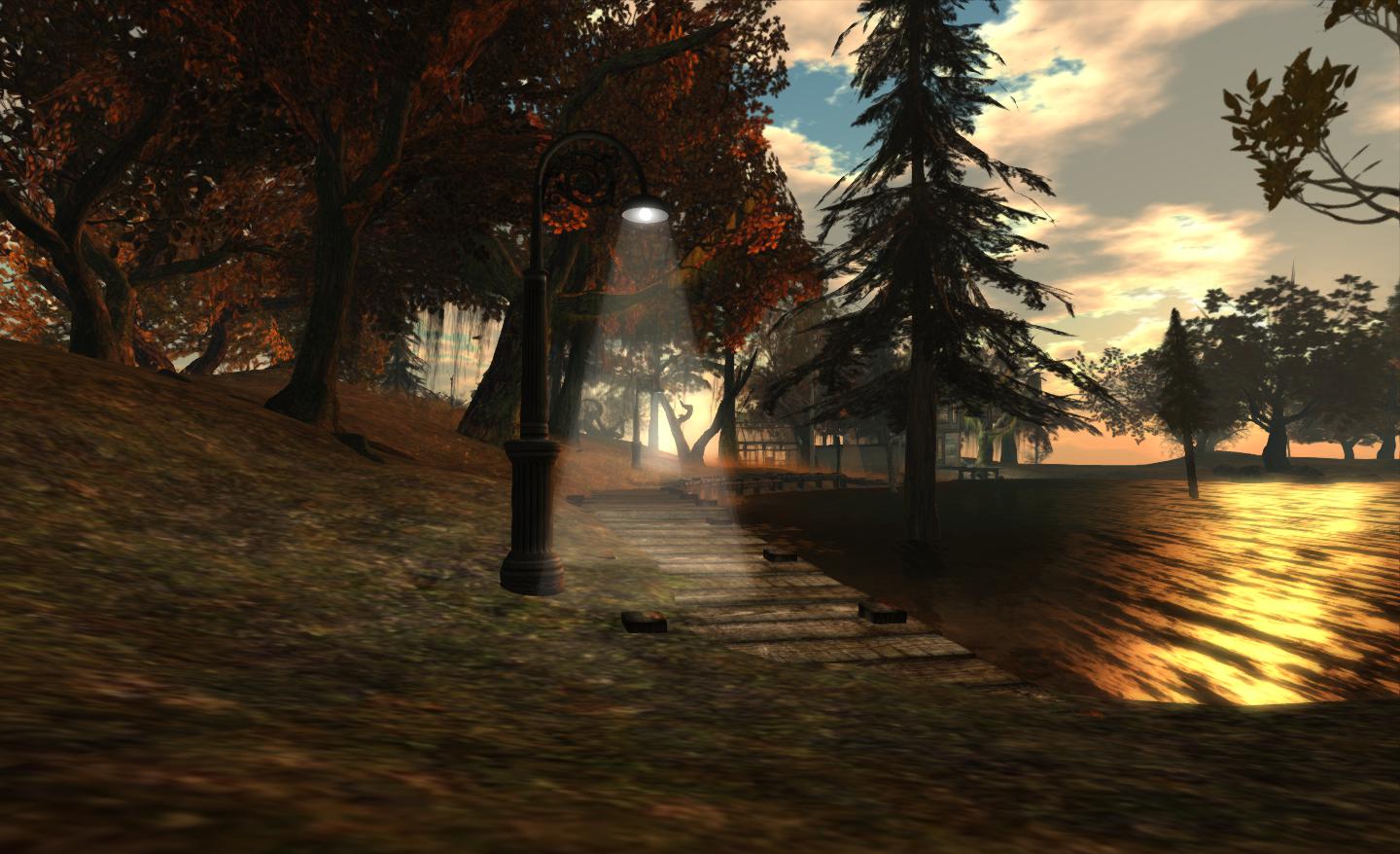
This is a place where you can wander and admire for its simplicity and for its attention to detail. While it may well have been carefully designed, it is nevertheless entirely natural – perhaps the most life-like natural setting I’ve ever seen in Second Life.

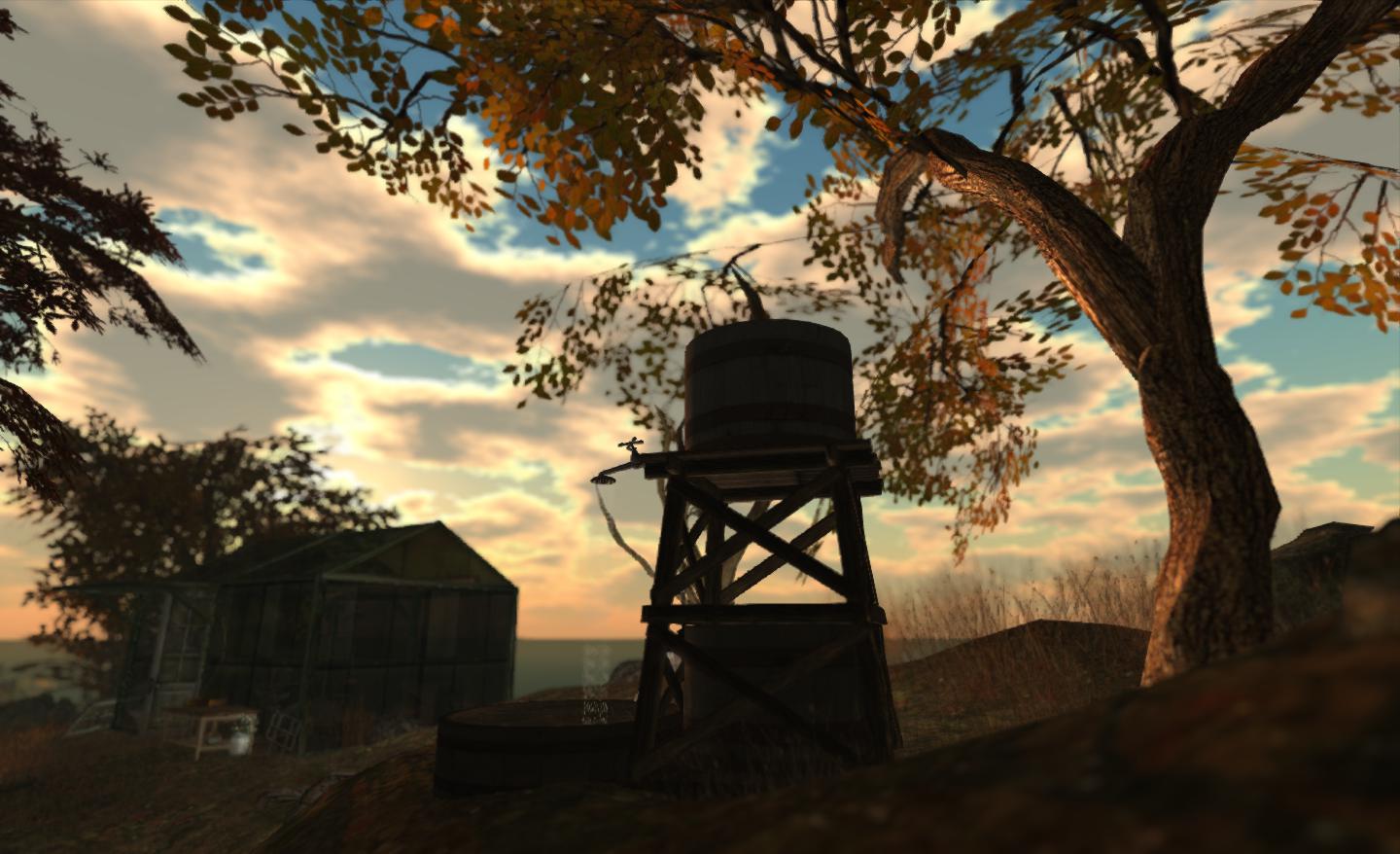
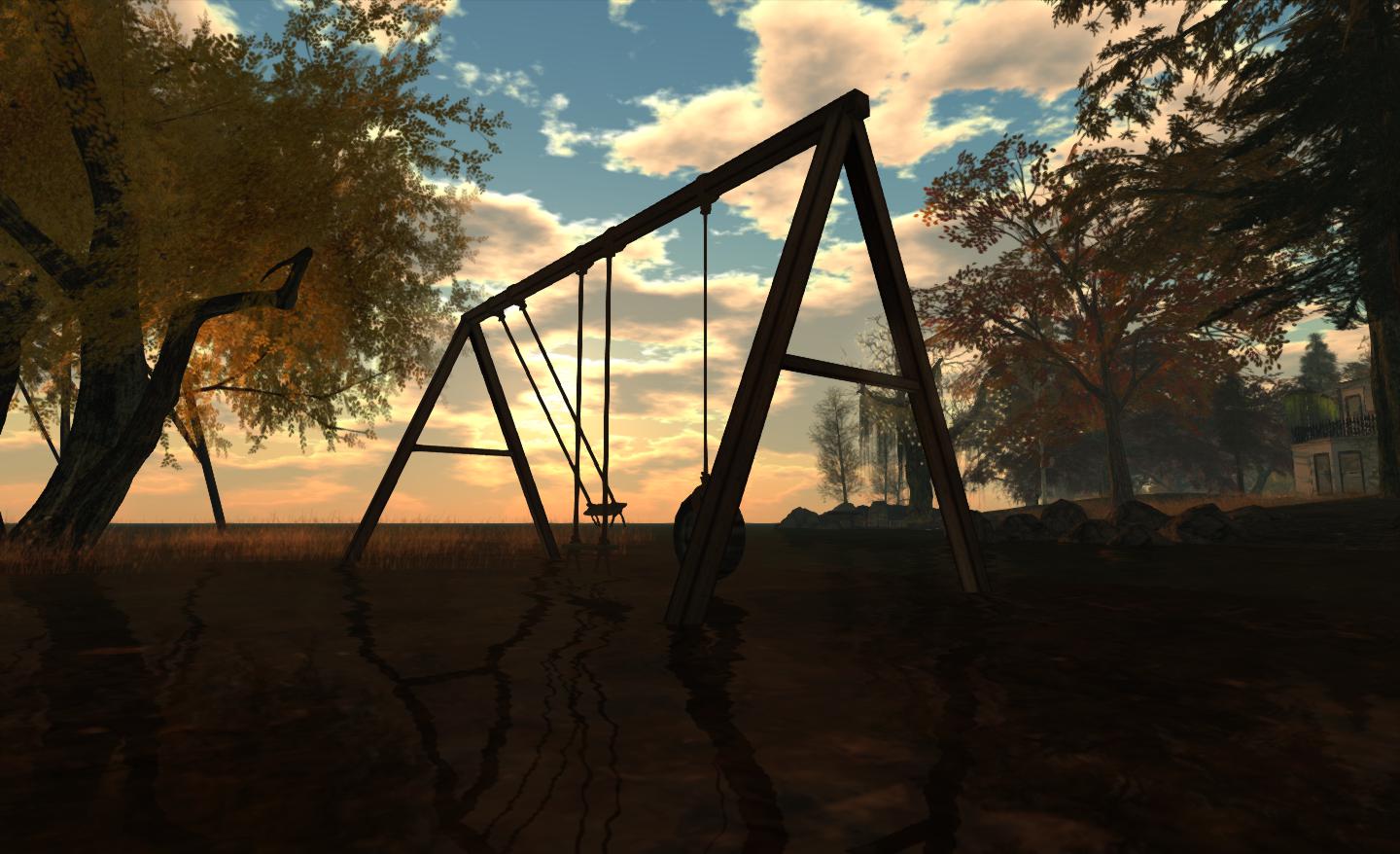
I’ve no idea if the region is updated to suit the season, but right now it is autumn at Water Reserve, the sky is lit by a beautiful September sun dipping towards the horizon, the trees are mostly golden brown, with the odd fir-tree standing as a green sentinel, and as you walk under the trees, falling leaves tumble and swirl their way to the ground.

Water Reserve: Scribbled Hearts

There are trails here to be followed, together with wooden walkways, or you can stroll at your leisure – the entire region is open to public visits. Rezzing is allowed (Autoreturn set at two minutes) if you have anything you’d like to use as either a photo prop or as something to sit on somewhere and admire the view.

Water Reserve: Scribbled Hearts

The stores here are small and blend perfectly with their surroundings – so much so that it is easy to miss the fact that they are stores.

I’ve been in a solitary mood of late, preferring to spend much of my time in SL on my own rather than among people, and Water Reserve suits that mood perfectly. Which is not to say it should be only experienced alone; there is much here that demands to be shared with a close friend or two. But it did speak to my prevailing mood and resonate with thoughts and feelings, particularly given the autumnal look and feel to the island and my frequently-changing moods towards Second Life.

Water Reserve: Scribbled Hearts

This is a region which has done more than scribble a message on my heart – it has written it in indelible ink. It will on yours as well.

[gigya src=”http://www.flickr.com/apps/slideshow/show.swf?v=71649″ width=”500″ flashvars=”offsite=true&lang=en-us&page_show_url=/photos/inara-pey/sets/72157631815156661/show/&page_show_back_url=/photos/inara-pey/sets/72157631815156661/show/&set_id=72157631815156661&jump_to=” allowFullScreen=”true” ]

(view slideshow full-screen)

Related Links

Calavera! Celebrating the Day of the Dead

Update 29th October: Elicio has contacted me with a slight change in plans; due to a need for a sim redesign, Calavera! will now be closing on the 16th November, and the raffle draw will be held then.

I’m an unashamed fan of Elicio Ember. Cerridwen’s Cauldron never ceases to amaze, and his wonderful builds of Nu Orne and Siren’s Secret at the 2012 Fantasy Faire completely enthralled me. So when he sends me a personal invitation to explore his latest installation, you can bet I’m not only ready to accept – I’m there!

Calvera! is located high over Cerridwen’s Cauldron, and brings the famous celebration marked throughout Mexico and in other cultures around the world to life in Second Life for its third year under Elicio’s skilled hands. It’s a small installation, but one which, as with all of Elicio’s work, has been finely crafted by a master of the visual feast.

Day of the Dead arrival point

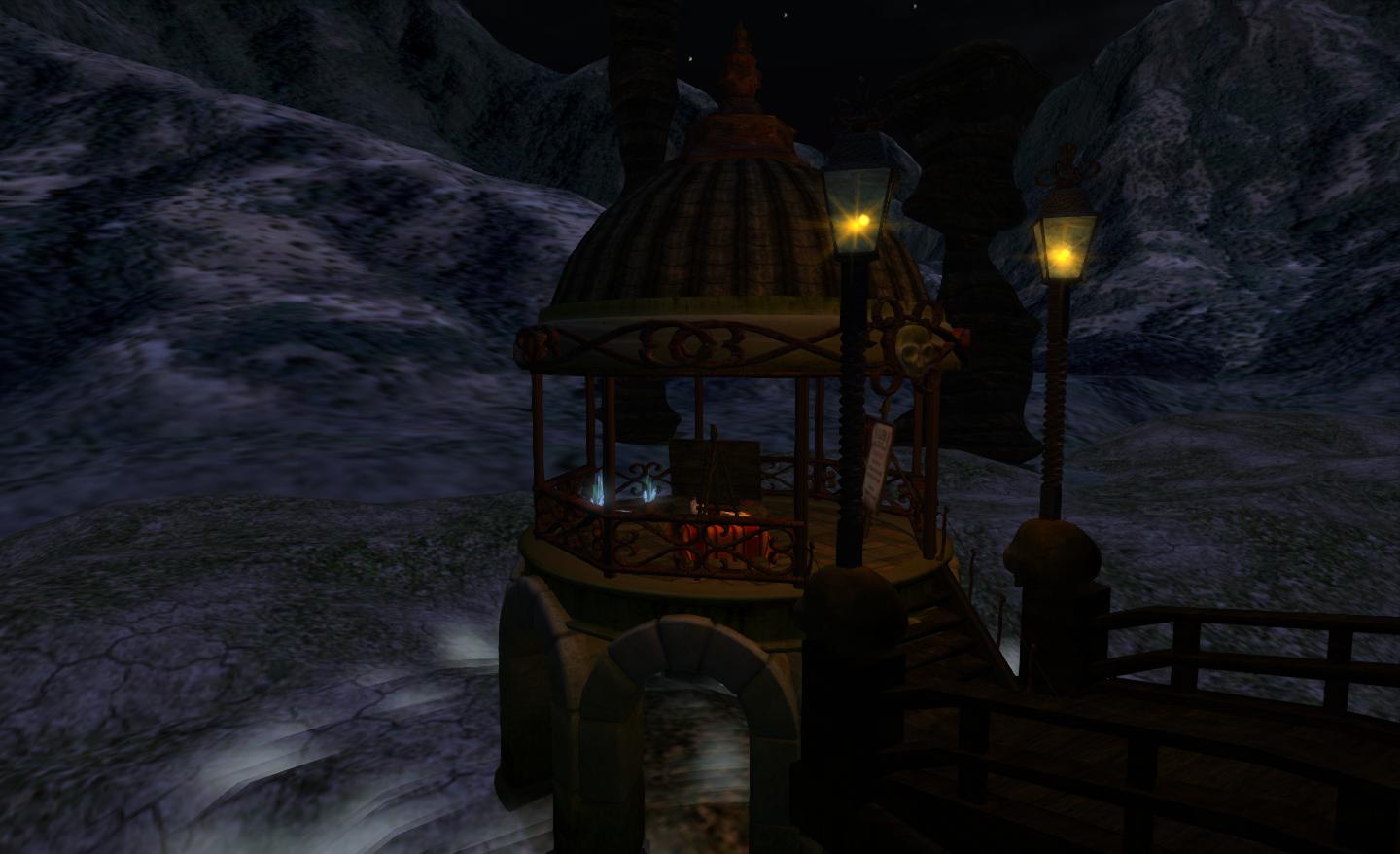
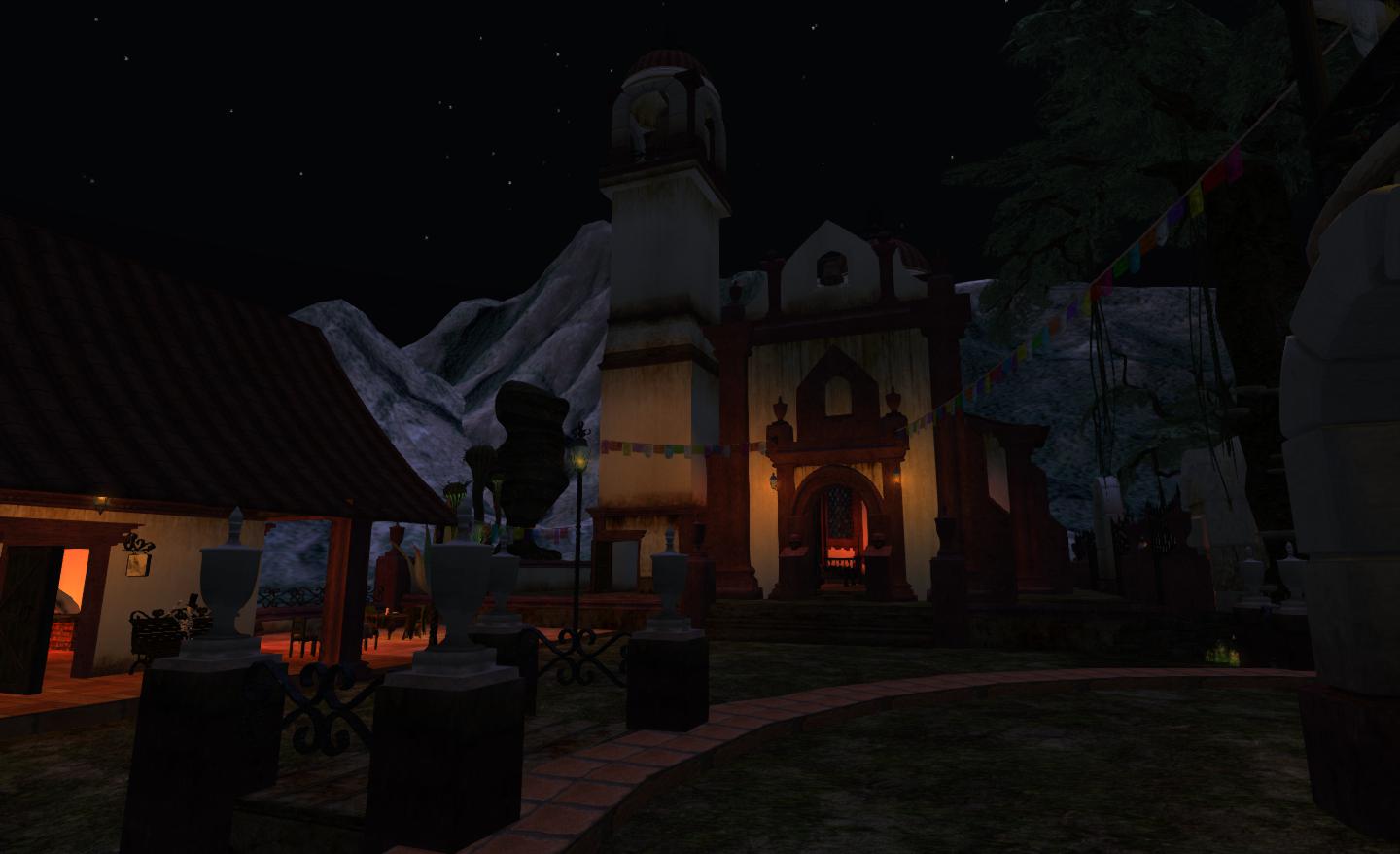
You arrive on a small gazabo-like platform just outside of a churchyard, beyond which lies a small village. Here you’ll find background on the exhibit and the Day of the Dead celebrations, as well as information about José Guadalupe Posada, whose work features in the exhibit, and about the Calavera Hunt. It is also here that you should set your viewer to Midnight in order to fully enjoy the installation as intended. I opted to use the windlight “A-12 AM” preset, as I love the vibrancy it gives to colours – and Day of the Dead is a colourful festival.

There are two of Elicio’s beautiful teleports here as well, one to his store and one to other highlights in the region. If you’ve not visited Cerridwen’s Cauldron below, I cannot emphasise enough how much it is worth to make use of both once you’ve seen Calavera! and see the rest of Elicio’s work first-hand.

Calavera! at Cerridwen’s Cauldron

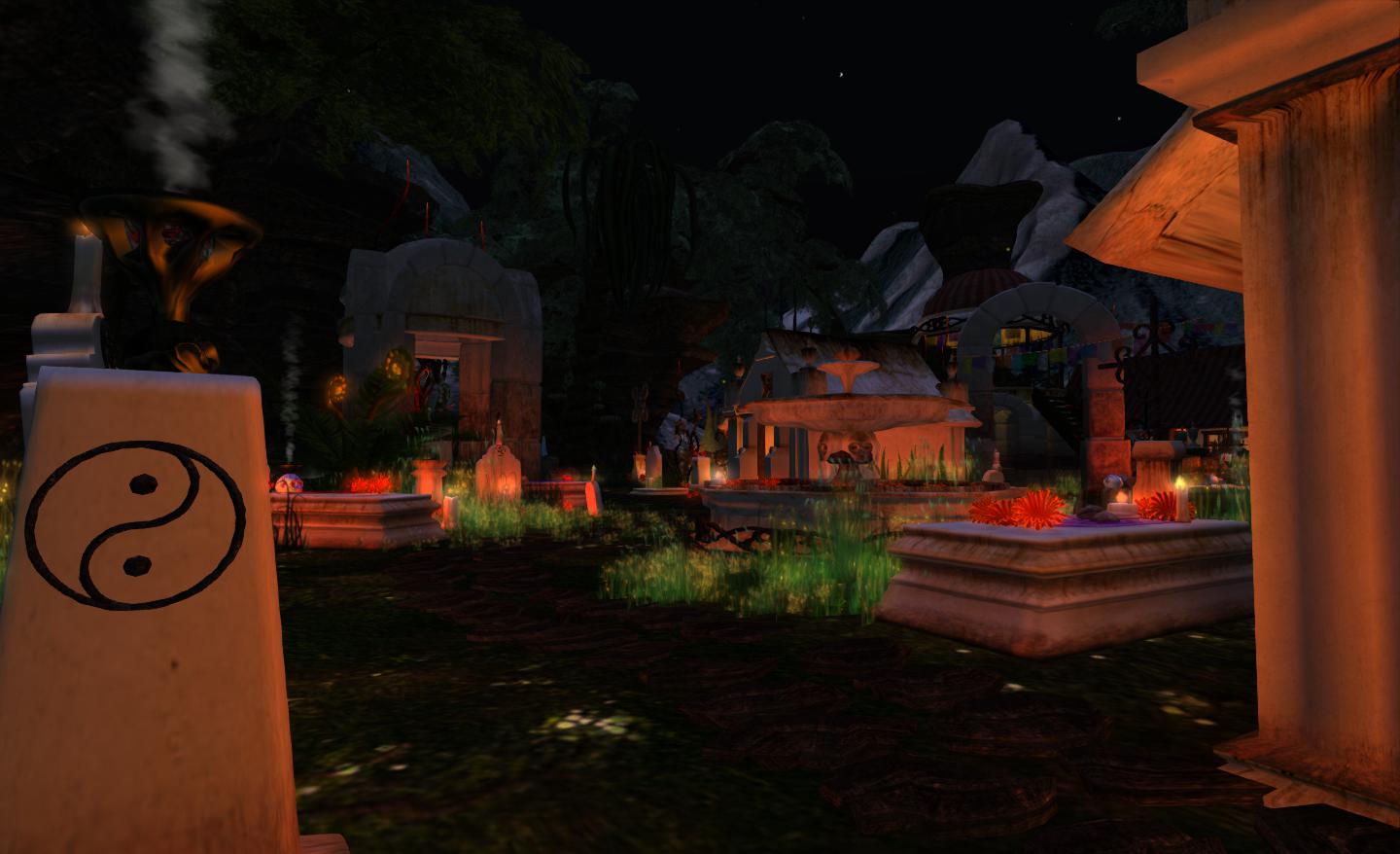
From the arrival point, you cross the bridge into the graveyard itself. Here are tombs, headstones and graves, many with candles burning in memory of the departed and gifts of flowers and el pan de muerto on them. You are free to wander either left or right from the bridge, although I’d tend to favour going to the right first and working your way around the installation counter-clockwise.

Calavera! at Cerridwen’s Cauldron

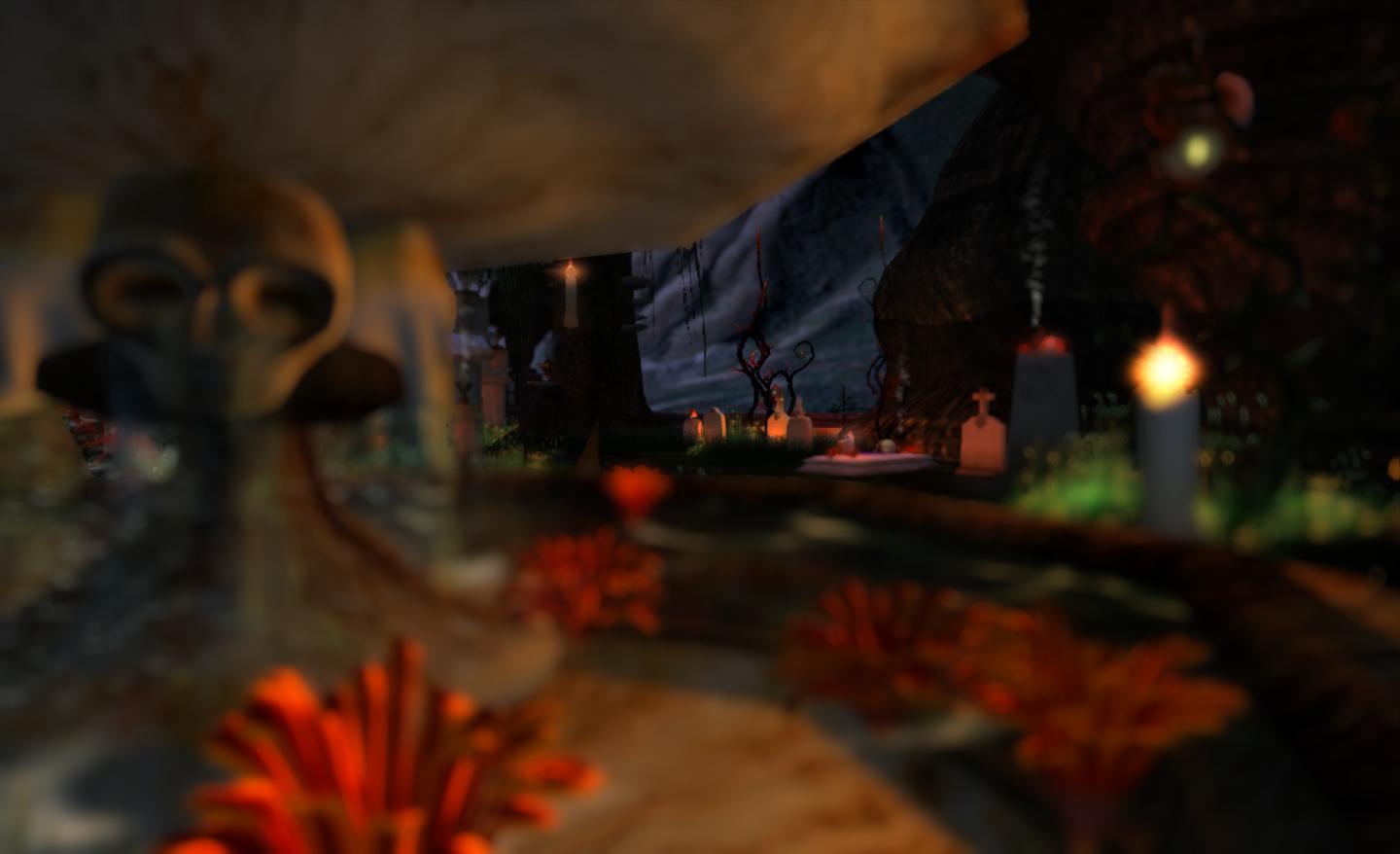
There is a lot to see here as you walk – and be aware that you will, for at least part of the way, be under observation yourself from the leafy shadows! Elicio has made fabulous use of light and darkness to achieve a beautiful effect for what to some western eyes at least might seem a faintly macabre celebration, complete with painted skulls, or calaveras (albeit made of papier-mâché or candy) from which the installation takes its name.

Calavera! at Cerridwen’s Cauldron

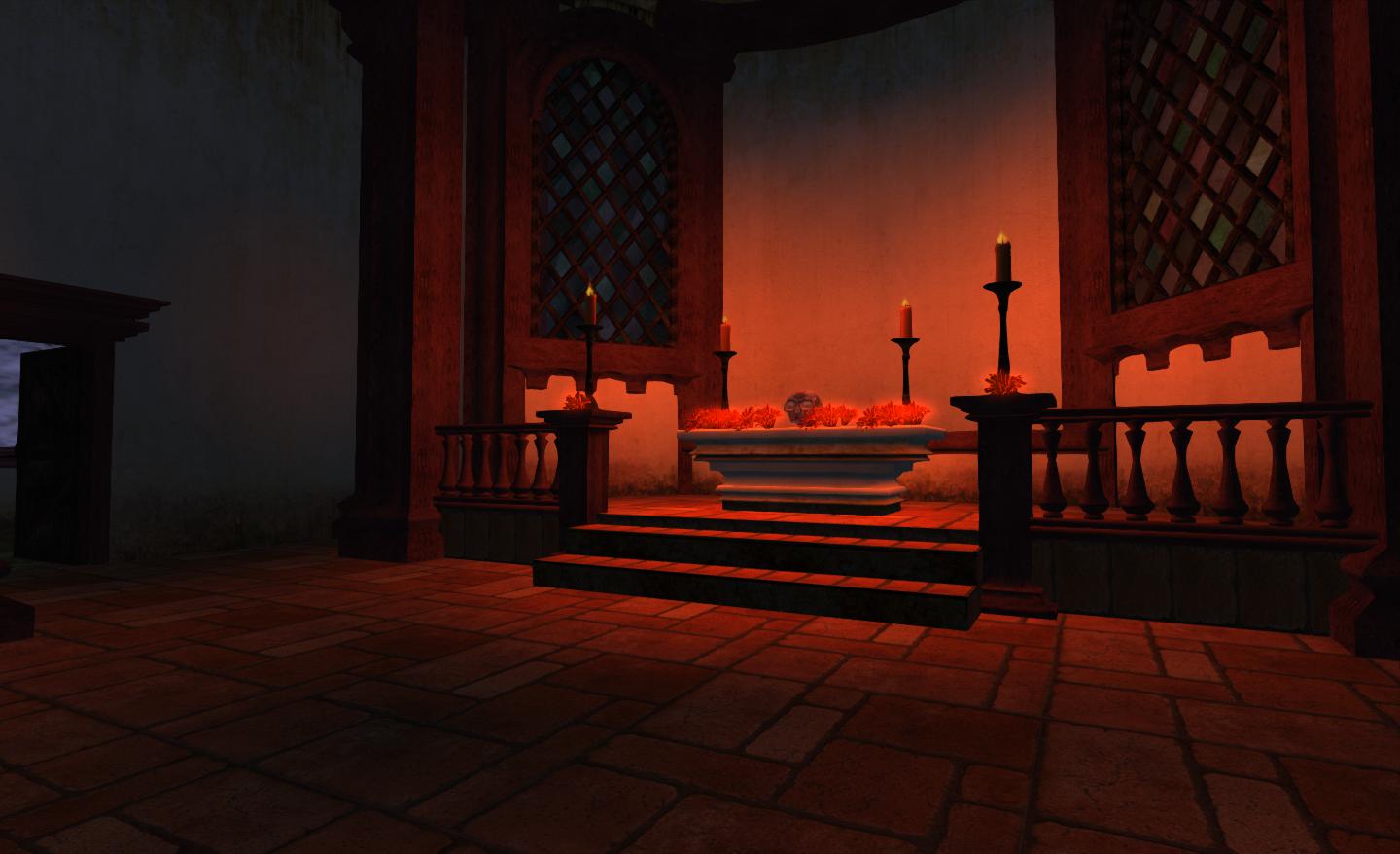
On the far side of the graveyard from the entrance point is a tall church, again bearing all the hallmarks of Elicio’s eye and skill, lit from within with a welcoming warmth, with candles flickering around the altar. Form here it is a short walk to the village square and a recommended visit to the Calavera Cantina, which offers a tribute to the work of José Guadalupe Posada.

A cartoonist illustrator and artist, Posada used calveras in his work as a means of satirical and religious commentary. Largely unnoticed following his death in 1913, Pasada’s engravings were “discovered” by the French artist Jean Charlot in the 1920s, who brought them to a wider audience, where they have since become associated with The Day of the Dead.

Calavera! at Cerridwen’s Cauldron

This is the third Calavera! exhibit Elicio has put together, and represents over 100 hours of work. To help support this effort, Elicio is running a hunt throughout the installation’s open period. On offer are a range of limited edition gifts, which will not be available anywhere else, and those completing the hunt will be entered into a raffle to be drawn on the last day of the exhibition, November 30th 16th, with a chance to win one of five special prizes. The hunt involves following clues, doing a little research and having some fun. There is a L$100 entry fee payable in order to received further information, which is how the hunt is being used to offset the costs of the exhibit.

Calavera! at Cerridwen’s Cauldron

Calavera opened on October 21st, and runs through until November 30th 16th. It is well worth a visit and an exploration; and if you’ve never visited Cerridwen’s Cauldron before, then do please leave yourself time to do so – you really won’t be disappointed.

Related Links

A Rusted Development; an overdue visit

A Rusted Development is a collaborative art installation on LEA1 at the Linden Endowment for the Arts. It isn’t a new feature – anyone with an eye for art in SL will know it opened in May and is enjoying an extended run as part of the LEA’s Guest Curator initiative. I’ve taken my time getting to it as I wanted to leave others far more qualified than I to give thought and feedback on the installation – and then (to my shame) I forgot about it, only to be reminded when attending the opening of Solkide Auer’s new installation earlier in the week, and which sits adjacent to A Rusted Development.

A Rusted Development

The installation is curated by Rowan Derryth and the theme was inspired by her own works, although the overall structure and story for the piece came from Haveit Neox, whom Rowan credits as “The Conjuror”.

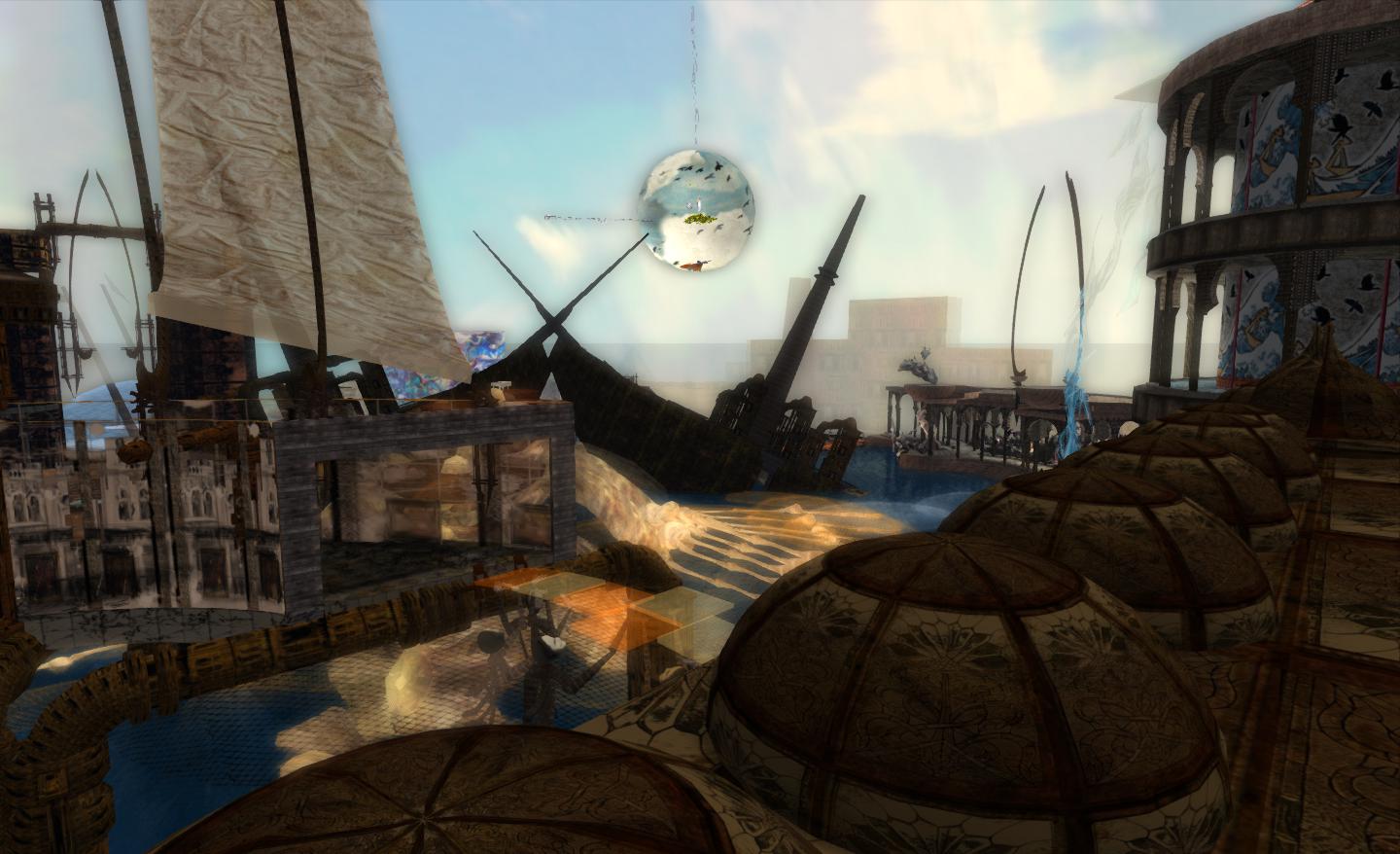
What firsts appears to be a bizarre conglomeration of industrial wasteland, water, bones, and scattered exhibits actually has a strong backstory, written by Havit Neox, which forms the basis for the installation itself, and provides a canvas for those collaborating in its final form in which to paint their own elements of a story.

The fabled merchant city that rode atop the back of a gigantic whale met with a calamity that ended its existence abruptly. In the middle of the ocean, a horrific storm caused two huge ships carrying toxic chemicals to collide into the swimming whale city. The whale and all the populace died in the flood of chemicals that saturated the waves.

The whale turned to bones, and the city to rust, it was nearly half a century before this city adrift was discovered. An expedition of artists, searching for land to build an art colony, came upon the decomposing city. With the intent to regenerate the place, they set to work by first towing to safe harbor the floating mass. Each artist then undertook their vision. The empty shell of the city suddenly filled in and expanded as each artist found their niche in the Rusted Development. No longer at the mercy of invisibility, the city humbles its rusted façade to the highlights of the art within.

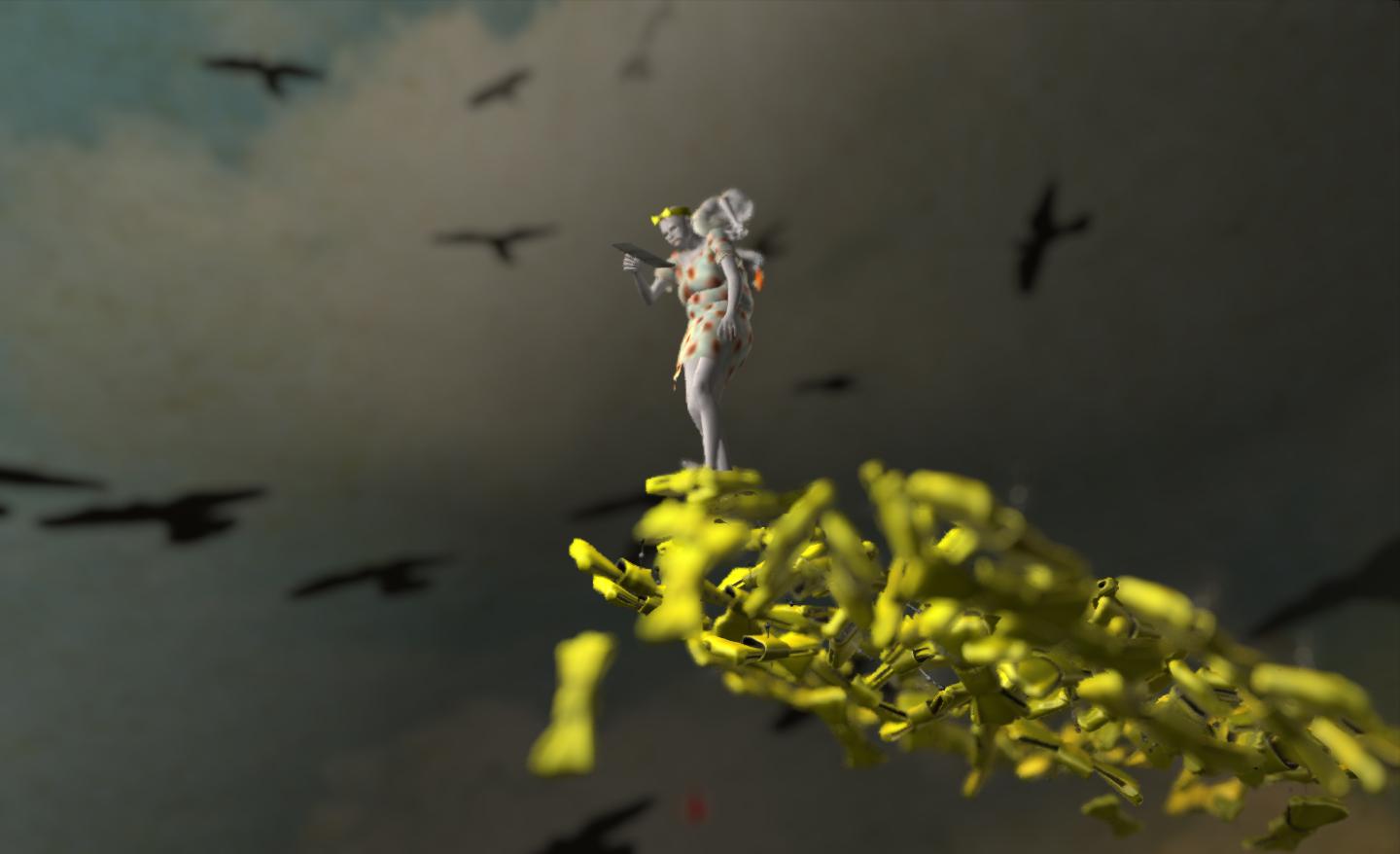
Within Haveit Neox’s build, A Rusted Development features pieces from some of SL’s most highly regarded artists – Rose Borchovski, Artistide Despres, Claudia222 Jewell , Bryn Oh, Scottius Polke, Ziki Questi, PJ Trenton, Blue Tsuki, Stephen Venkman, Eliza Wierwight, and Trill Zapatero. Each is both an individual piece and also part of the larger whole, providing a further facet of the story, both in terms of the destroyed city itself and the lives of the artists who discovered it.

It would seem the community of artists who came across the ruins of the merchant city had been bound within a society where rules outweighed individuality and expression. Their reactions to the constraints under which they’ve lived, and what it has done to society as a whole appears to be a ventral running theme through many of the individual elements of the installation. Several pieces have a dark edge to them, perhaps reflective of the fate of those who once lived within the city as it was carried across the oceans.

There are works here which scale the range from the very large to the incredibly small and delicate. Each has its own tale – some dark, some perhaps edged with the macabre and others filled with a delicate pathos. Each offers a unique interpretation and a further expansion of the backstory. All of them present a genuinely immersive piece which requires more than one visit if one is to witness everything on offer, both above and below the waves.

If you’ve not already visited, you should.

Related Links

“Lights, cameras, action!”

Update, April 12th: The Machinima Open Studio Project has moved to a new, permanent location at LEA7 and has been extensively updated, which I’ve also reviewed.

If you ever dreamed of being a movie mogul, the time is now. The Machinima Open Studio Project (MOSP) at LEA20 offers a wide variety of locales and sets built with filming in mind.  Nine structures dot the countryside with more to come. Peaceful Valley sits in the shadow of tall mountains, should you keep the region Windlight setting, while the cottages and outdoor locations along Beach Walk are definitely a sun lover’s paradise.

So reads the promotional material for the Machinima Open Studio Project (MOSP), which formally opened on October 1st. A part of the Full Sim Art series operated by the Linden Endowment for the Arts, MOSP is curated by Artist-in-Residence Chic Aeon, and is located on and above LEA 20, where it provides a wide range of facilities and options for machinima makers and photographers alike. The facility will be open through until the end of February 2013.

Part of the MOSP Welcome Area

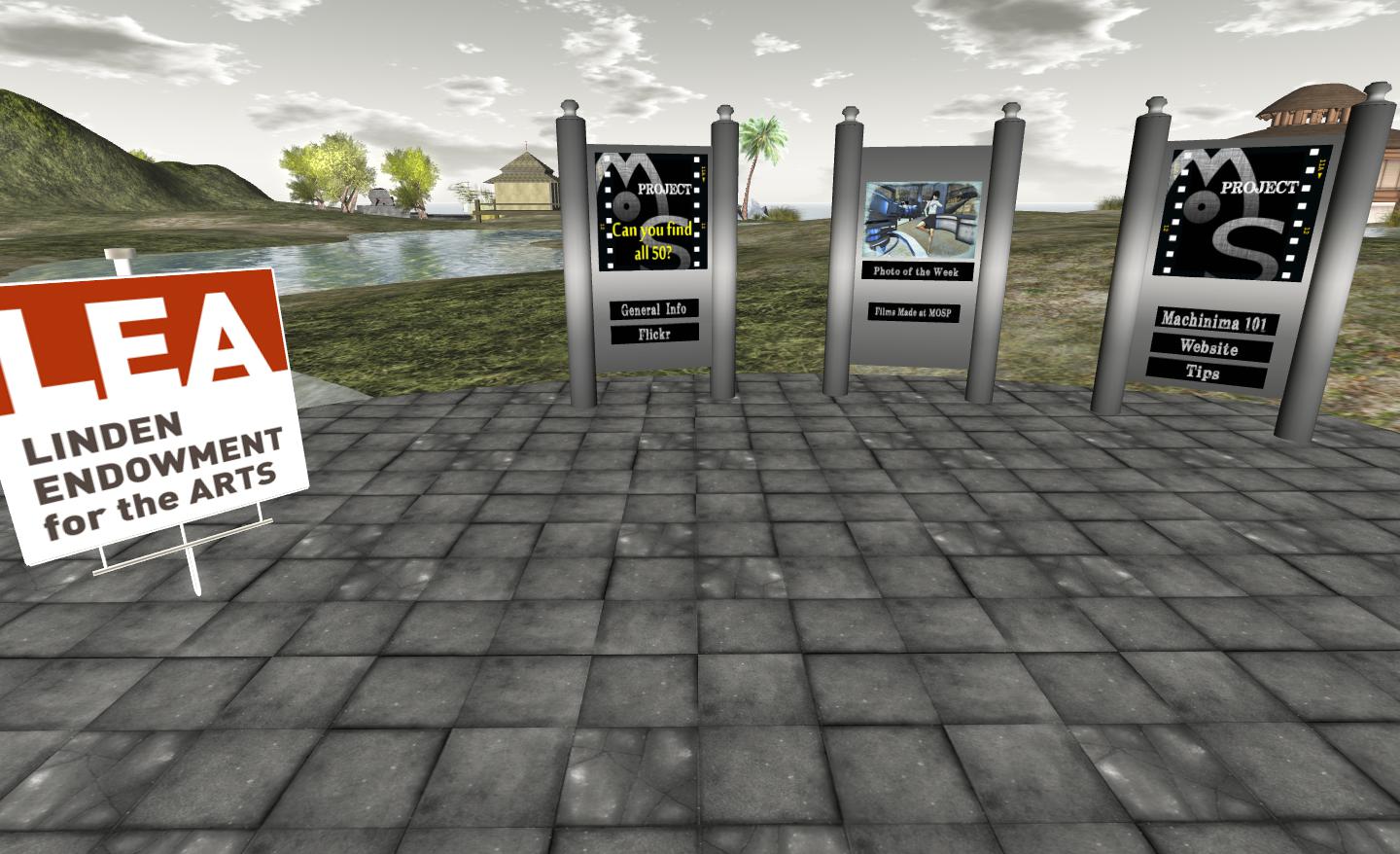
Visitors to the facility are advised to start at the Welcome Area. This is a simple, open-air platform with a series of information boards which provide quick and clean access to essential information about MOSP and its facilities. One of these also supplies you with a teleport HUD, and I strongly recommend you grab a copy and use it in order to see everything on offer – there is a lot to see.

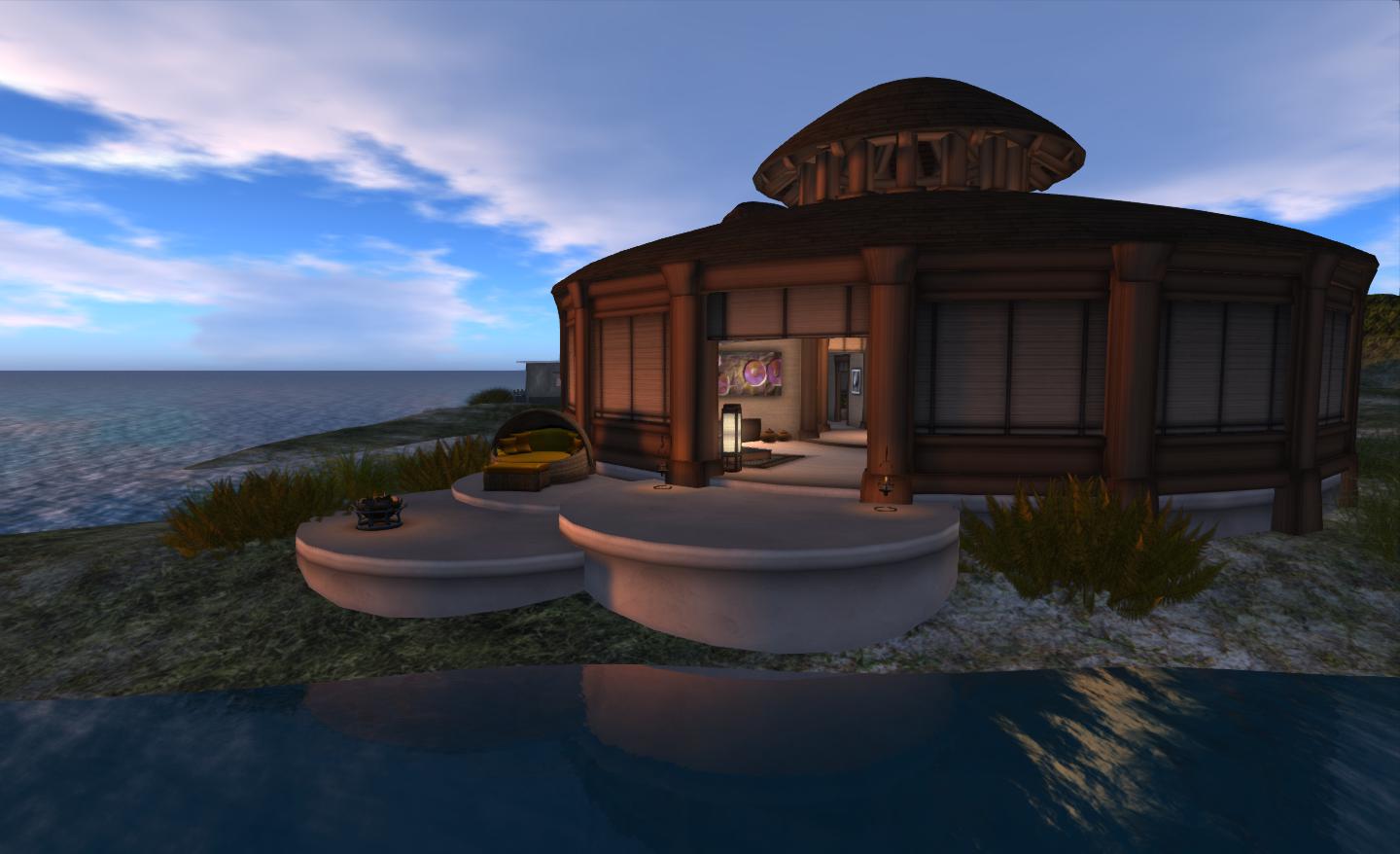
Around the Welcome Area are a number of the pre-built sets. There are simple, open affairs which offer scope for the machinima maker and photographer alike, either using the established windlight presets or custom set-ups. All of the ground-level sets use the same landscaping and design, allowing several or all of them to be used in productions / photo shoots.

One of the ground-level outdoor sets

Above ground is a further range of individual themed sets – subway, New Orleans, ruins, gypsy camp, park and Shadowlands – each with its own possibilities for filming and photo-shoots, either on its own or, again, in unison with some of the other sets.

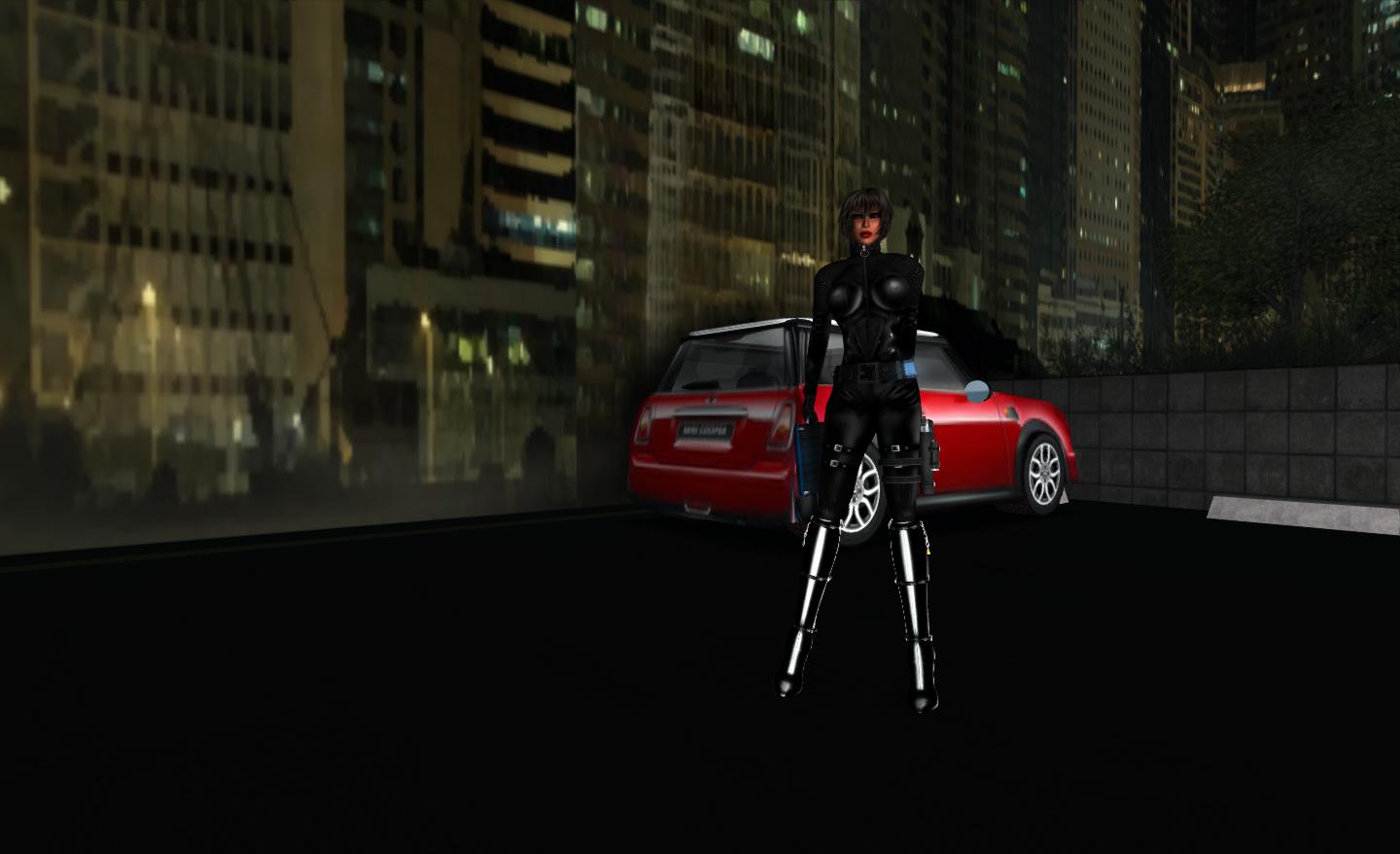
“I knew the only reason Calhogie picked the time and place was not only because he didn’t want to have anyone see him taking possession of the case, but because he wanted somewhere quiet to tie-up loose ends. So I let Mr. Redemption hitch a ride on my thigh as insurance…” – on one of the MOSP sets

There are also four sound stages available for interior shooting. The layouts are very studio like, with each containing a number of related sets, allowing scenes to be quickly and easily filmed, ready for assembly into a completed show or film.

One of the soundstages with pre-built sets

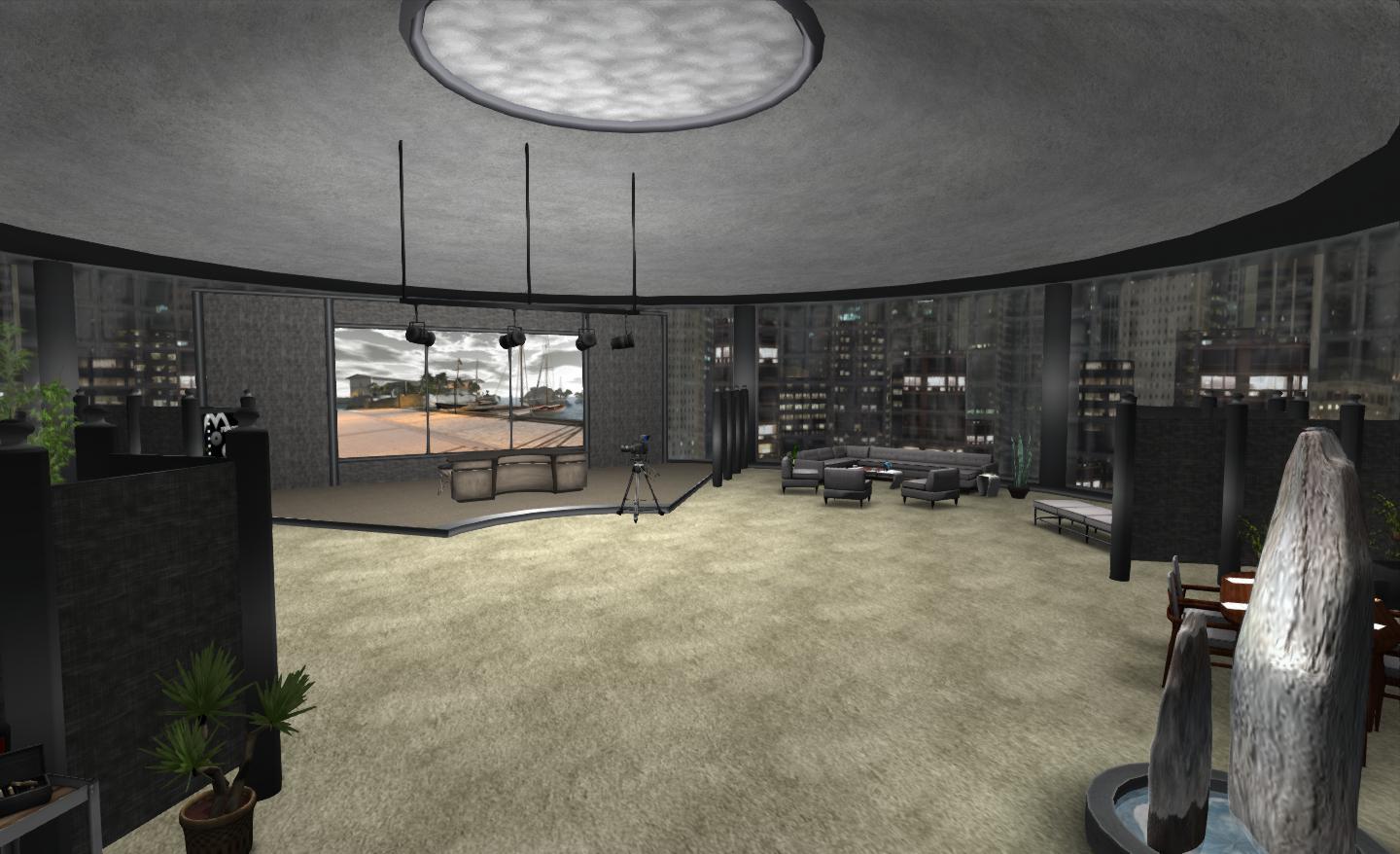
Finally, there is the Corporate Office, space that lends itself to a huge range of uses – chat show studio, teaching environment, news studio, meeting place, all presented in a professional and well laid-out environment in the heart of a “city” sky scene.

The Corporate Office space

Everything at MOSP has been put together with care and attention; the soundstages and specialised sets, together with the Corporate Office are well above ground level to get the maximum advantage from increased frame rates. One the ground, the sets are spread well apart, allowing for plenty of camera movement. Further, Chic has brought together some excellent supporting material,  including notes on getting started in machinima making, a dedicated website for the project, a Flickr group for those using MOSP for photography and promotional boards for films made in whole or in part in the region.

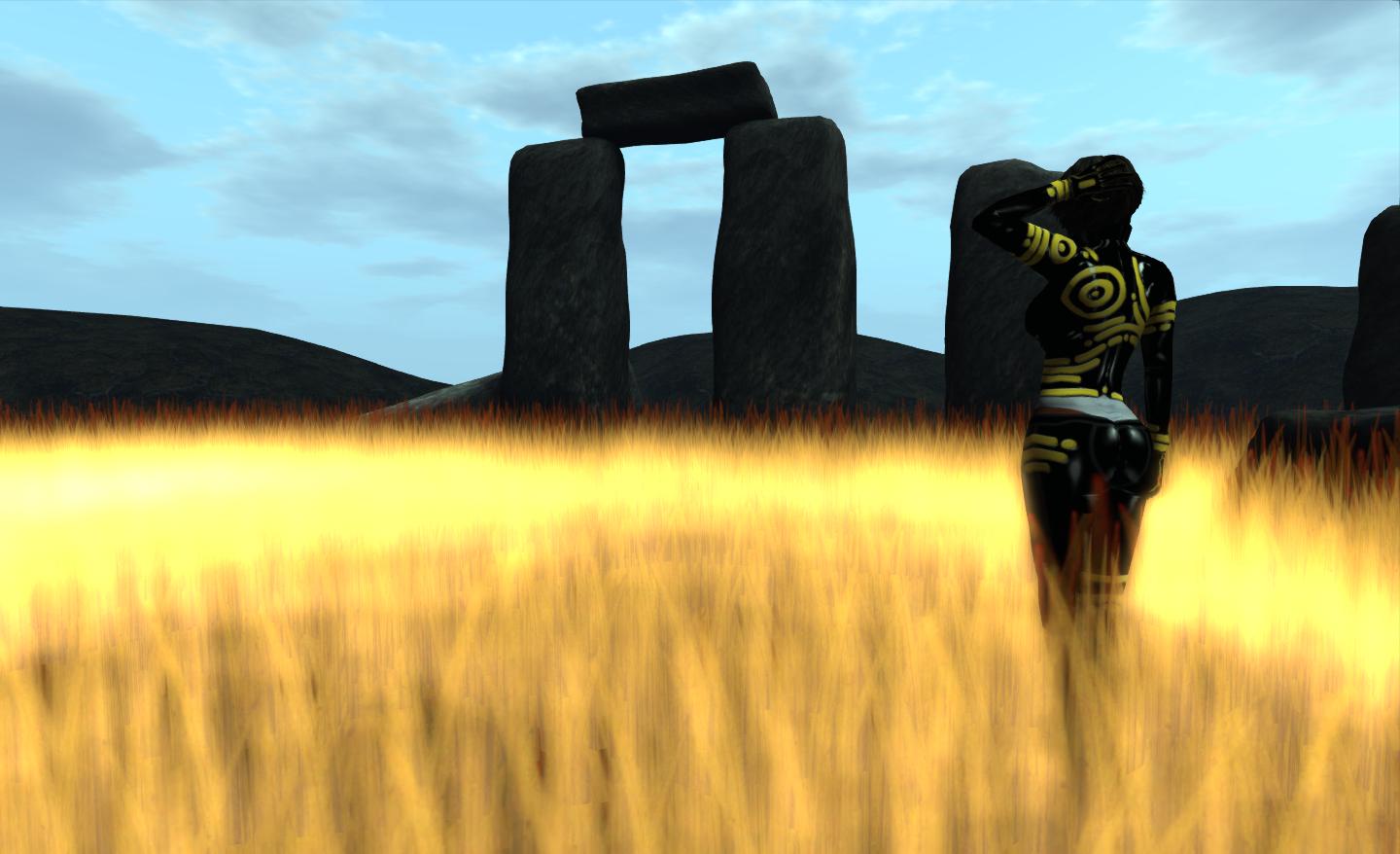
Standing in the sun-dried grass and looking at the stones, only one thing ran through my mind was, “We’re not in Kansas any more…” – on the “ruins” set at MOSP.

The soundstages and themed sets, together with the Corporate Office are well above ground level to get the maximum advantage from increased frame rates. One the ground, the sets are well space to allow for plenty of camera movement. Given the close proximity of the LEA regions, it is advisable to keep draw distance down. This not only (again) helps improve frame rates when filming – to also means there is less risk of accidentally capturing a pice of the neighbouring region when filming / shooting. There a lots of clear extras on the ground sets as well, which can be used to great effect with the right ambient windlight / lighting – I particularly love the train track, which can be made to look as if it is disappearing into the distance.

If you’re into machinima, want to make a start or need a number of pre-made locations for a photo shoot, MOSP is definitely worth a good look. And if you’re curious, there’s also the Explorer Hunt, with up to 50 gifts for the keen-eyed!

“Calhogie was gone and I knew the Feds would be coming after me. Rikhard’s had done a bang-up job ensuring that. But I had the case, and I figured what was inside could keep me pretty comfortable even on the run. For now, it was just a long walk back done the track, but I still had Mr. Redemption on my thigh, ready to keep me company on the way….” – making use of the rail track section at MOSP

Related Links

Video courtesy of Chic Aeon

Nouveau steampunk with a rural seasoning

I first visited Steelhead, albeit very briefly, earlier this year when I was poking my nose into mazes around Second Life and dropped in on the Southwest Gate Hedge Maze of Nevermoor. I had a quick look around at the time and added Steelhead to my list of places to review for my series on SL destinations – something I finally managed to do over the past few days.

Steelhead is described as “an American Victorian Steampunk Community in the Second Life Nestled in the Coastal Pacific Northwest”. It’s a group of seven regions, which bring together commercial, residential and role-play elements in a themed community focused steampunk and which bring together an eclectic and fascinating range of themes.

Steelhead Port Harbour

There are a number of teleport points through the community, so rather than scatter them across this article, I’ll list them at the end.

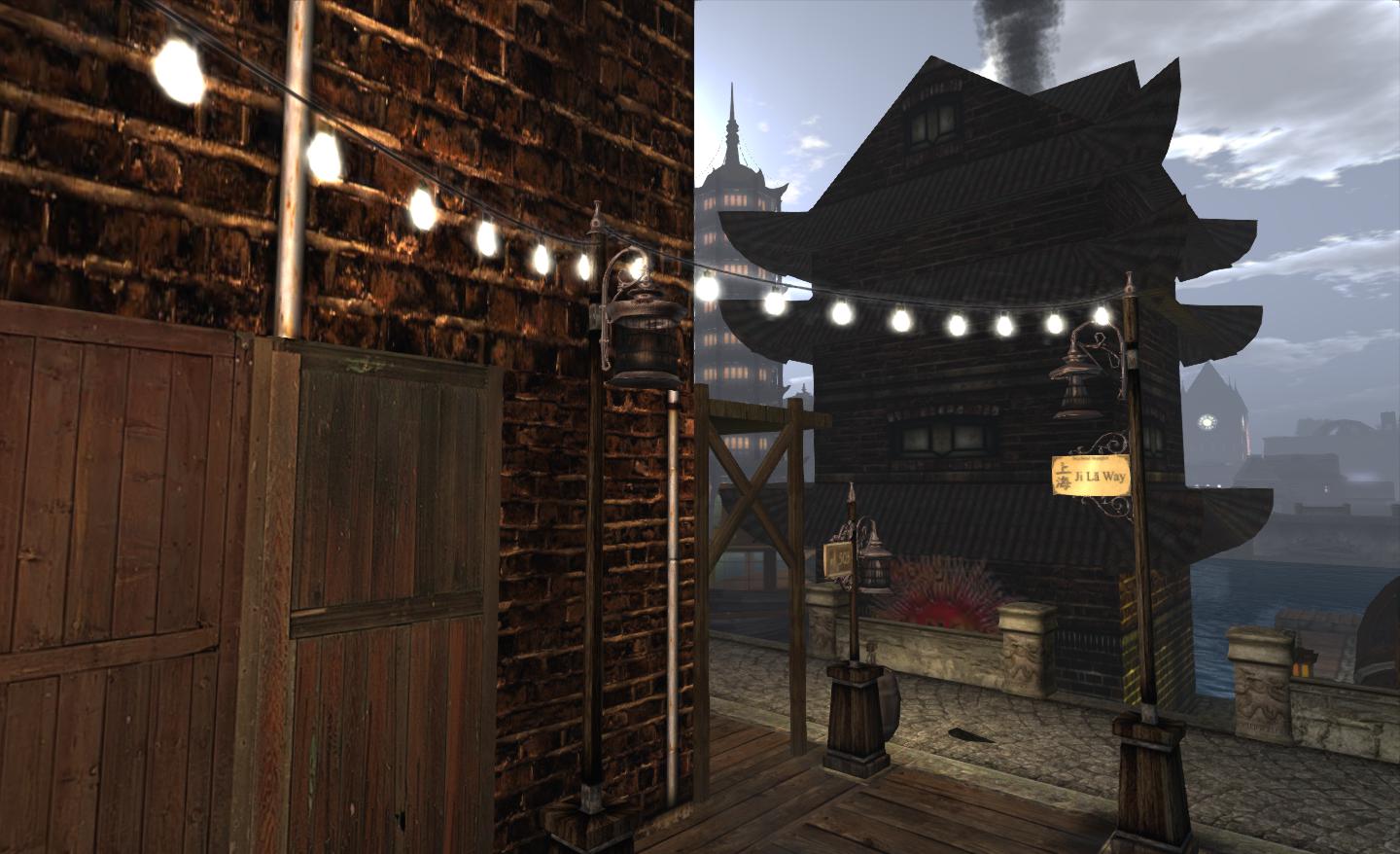
Steelhead itself is the commercial centre for the community. here you’ll find the train station, stores and wide streets and the town hall, wherein a weekly meeting of residents is held to discuss community matters. To the west of this is Steelhead Shanghai, a fascinating “Sino-steampunk” region which brought to mind photos I’ve seen of the Hong Kong harbour front circa the 1920s (although Hong Kong admittedly never had dirigible junks sitting on the waterfront).

Steelhead Shanghai

Steelhead Harborside is mostly residential, and offers a nice walk along footpaths bordered by houses which keep to the theme of the community, and across bridges over canal-like waterways which give the place a very homely and attractive feel. To the north sits Steelhead Nevermoor, which brings a touch of mystery and magic to the estate (and which I most enjoy exploring at night). It is also where you can find the maze mentioned at the top of this article.

Steelhead Nevermoor

Continue reading “Nouveau steampunk with a rural seasoning” →