Quan Lavender dropped me a note on a new exhibition taking place over the Christmas period in aid of SOS Children’s Villages India.
Hosted by Art India Gallery, which is operated by Veekay Navarathna, the exhibition presents a range of works donated by 25 of SL’s top artists. All of the works are displayed in a beautiful winter landscape created by Trill Zapatero, who also provides a free pair of ice skates for visitors, who are encouraged to skate around the exhibition.
Items on display are available to buy or are supplied as individual works available for auction. All proceeds from both sales and the auction will go directly to SOS Children India.
Purchases for items on sale can be made via the gift-wrapped boxes alongside of each exhibit (each has a box for purchasing a copy of the art and a box which gives out a notecard on the piece / artist). Each has been created on the theme of a music box – hence the title of the exhibition, Music Box for Children. Prices range from L$10 through L$1000.
The auction runs through until December 22nd, so that the highest bidders will receive their work in time for Christmas. The entire exhibition will be open through until January 22nd 2013.
Participating Artists
chefkoch, Rebeca Bashly, Igor Ballyhoo, Rose Borchovski/Caer Balogh, Giovanna Cerise, Shari Davies, Linus Humphreys, Kicca Igaly, Pol Jarvinen, Pallina60 Loon, Haveit Neox, Bryn Oh, SaveMe Oh, Melusina Parkin, Secret Rage, Sir Real, Arduenn Schwartzman, Josiane Sorciere, Lorin Tone, Betty Tureaud, Eupalinos Ugajin, Eliza Wierwight, Ub Yifu and Trill Zapatero.
About SOS Children’s Villages India
SOS Children’s Villages is an independent, non-governmental, social development organisation that provides family based care for children in India since 1964. It advocates the concerns, rights and needs of children. More than 6000 children and young people live in 33 SOS Children’s Villages and 27 SOS Youth Facilities in the country.
The organisation believes that every child should grow up in a strong family environment, and so helps families to create a loving, caring home. Work focuses on strengthening families, helping them to stay together during difficult times and provide the best care possible to their children. As family needs can be varied, SOS Children’s Village experts work with families to help them develop a wide range of skills, from house-hold budget planning, how to get a job and earning a living, to bonding with a child or young person and learning to create a stable family life at home.
Breedable animals aren’t exactly new to Second Life. Chickens, bunnies, horses, meeroos, cats, dragons … we’ve had them all and more. We’ve even seen the odd legal punch-up between brands; never a pretty sight where cuddlies are concerned. They’ve been the delight – and at times the bane – of regions across the grid.
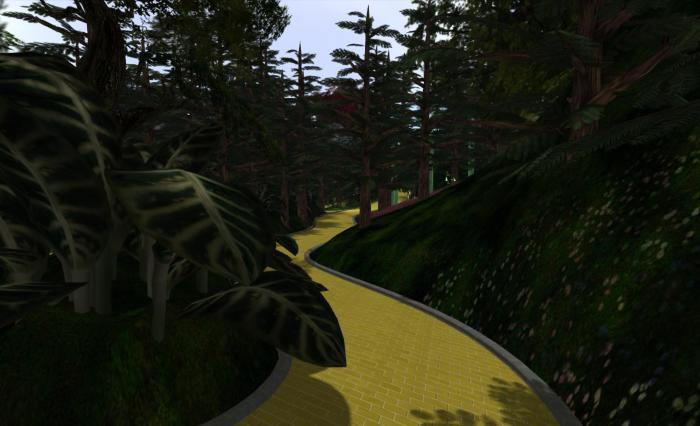
Strangelings are the latest offering to turn up in-world, and they’ve done so in quite a different way. Follow the yellow brick road, and I’ll tell you more – if you haven’t heard already, that is.
Strangelings are a kind of breedable fox (with elements of unicorns in some, which itself suggests some interesting interbreeding…). However, whereas other breedables we’re familiar with live in-world, Strangelings have an entirely different domain. Or will, once they’ve fully launched, because they are creatures of the web and iOS.
Strangelings is the first creation to come out of Flying Monkey Interactive, a company founded by two former Linden Lab employees – Chris Collins and Hamilton Hitchings, both of whom were apparently engaged in the ill-fated Second Life Enterprise product – and the people behind Ozimals.
A pet breeding focused game for iOS and web. Strangelings are fantasy fox-like animals that have many different traits and colors. Breeding these animals will produce outcomes that are based on the genetic code with dominant and recessive traits passing through to the offspring.
Which is great. But what does that have to do with Second Life? Well, given the popularity of breedables across SL, it is possible that Strangelings could have a strong customer base in in-world keen to give the game a go as they are on the go. With this in mind, the team at Flying Monkey have developed a series of customisable, fully rigged avatars people can purchase and use to create copies of their favourite Strangelings and wear them in-world.
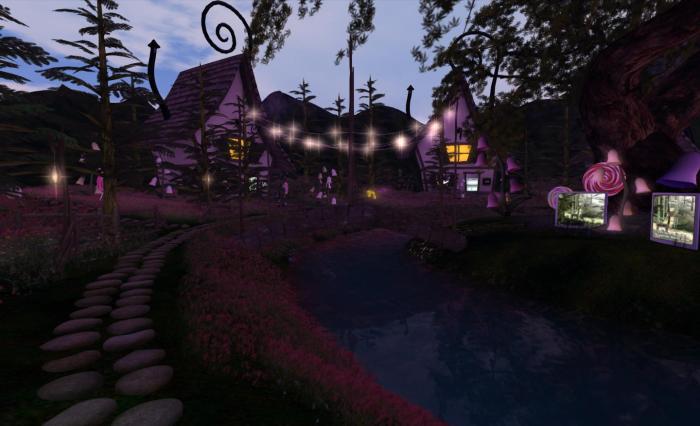
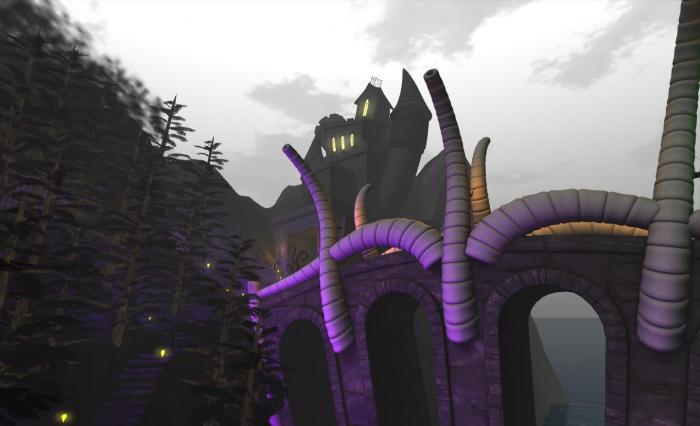
To accompany the avatars, the team have also created two neighbouring in-world regions: Strangelings and Magic of Oz. The former looks like it might be offering land rentals in the future, while the latter takes familiar settings from The Wizard of Oz and gives them a new and interesting twist in the form of a series of mesh builds. It features a munchkin’s village (store area for other merchants) the Emerald City (home of the Strangeling avatars) and the Wicked Witches’ castle.
Magic of Oz is very well executed and avoids all of the kiddie-toon feel of Linden Realms in terms of trees and flora. As such, it makes it an interesting place to visit and explore, and offers more than a few opportunities for photography. Exploration doesn’t take long, but it does show what can be achieved mesh-wise in world to create an attractive, fun environment.
I’m not one to have ever been attracted to breedables in-world (I remain firmly of the opinion that the best meeroo is one served roasted, with seasonal vegetables and a suitable jus). As such the Strangeling game is unlikely to appeal. Nor, if I’m honest, are the avatars (because I’m a boring fart and prefer sticking to a human form in-world). I am, however, a little curious to see how the promotional aspect of things works out for Flying Monkey and Strangelings – it’s an interesting approach.
as to the Magic of Oz itself, it is a finely crafted region and well worth a look around if you’re curious.
Earlier this week I reported on and reviewed a new Virtual Landmark (VLM) system designed to provide and alternative to traditional landmarks. Created by Darrius Gothly, the Virtual Landmarks for Virtual Worlds system is designed to provide a comprehensive means of ensure landmarks and web links to in-world locations never need to expire.
Now Darrius, has taken the system a step further forward, and make the maintenance and update of VLMs even easier through the use of the VLM Location Beacon.
The VLM Location Beacon logo
The VLM location beacon is a single-prim object which can be linked to a VLM. Once rezzed and configured (using the VLMurl for the required location), the Location Beacon will become invisible and phantom and will continuously monitor for any changes that need to be posted to the VLMVW Database.
This means that if you need to move your store or a teleport location within a store or exhibit, etc., simply move the Location Beacon associated with the location (either physically if moving it within the same region, or by taking it back to your inventory and then re-rezzing it at your new location), and the VLMVW database will be automatically updated with the details of the new location.
Location Beacons which are in use will also periodically check the VLMVW database to ensure their “parent” VLM record is still active. If either the location referred by the Beacon has been removed from the VLM / VLMVW database (remembering that one VLM record can store up to eight in-world locations) ro the VLM itself has been deleted, the Beacon will self-delete, sending you IM to inform you it has done so in the process.
The VLM location Beacon now forms a standard part of all VLM packages offered by DGP4SL through the SL Marketplace. Anyone who has purchased package should receive an update from DGP4SL which includes the Location Beacon.
Rebeca Bashly is hailed as one of most successful artists in the Linden Endowment for the Arts Full Sim arts series. She deserves to be. A little over a year ago, in October 2011, she presented a stunning, immersive interpretation of Dante’s Inferno as the initial piece in the 2011/2012 Full Sim Arts series.
Now, in December 2012, she is back with a piece which is equally evocative.
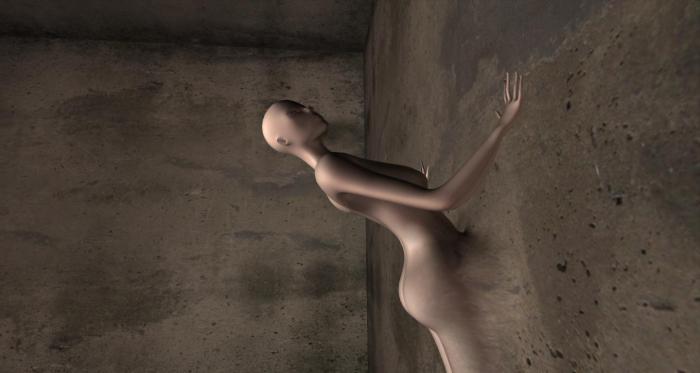
Rebeca describes The Tower as being “symbolic of restrictive areas, of closed minds, of self limitations and the like, as in kids fables.” It is a marvellous piece, not only because she established the entire installation in less than 24 hours, but because the scenes it presents are so emotive powerful.
It is a piece which needs no intermediary descriptions or explanations; it speaks loudly and clearly for itself. Simply use the orchid floating on the water to commence your journey, climb the stairs and look for further orchids as you pass through each level.
Everything is a testament to the artist’s vision and skill. The imagery is perfectly balanced by the ambience of the setting. It is also a tour de force demonstration of the visual power of immersive environments as a medium for art and expression.
The Tower is open through until the end of the month. Don’t miss it.
Update: June 2020: following the sad passing of Darrius in late 2019, his VLM product is no longer available.
Update, February 2013: The number of VLM packages has been reduced to two, an Unlimited Version and a free Business Promo Version (30-day trail period with 5 VLMs. The details of this post have been updated to reflect these changes and the associated pricing restructure.
Update December 9th, 2012: Darrius has now produced an online Quick Reference Guide (QRG) to getting started and using VLMs.
Update December 6th, 2012: In order to make VLM management even easier, Darrius has now introduced the VLM Location Beacon as a part of all VLM packages. You can read more here. I first reported on Virtual Landmarks, Toysoldier Thor’s revolutionary idea for bringing the likes of SL landmarks into the 21st century, back in August 2012. The idea started as a post in Toysoldier Thor’s blog before it moved to a forum thread post he started, and which generated a good deal of discussion, finally moving to a JIRA on the idea – SVC-8082.
The idea initially received favourable feedback from “front-line” LL staff at various User Group meetings, but appears to have been stuck in the “Someday / Maybe” category of things to do on the Lab’s side of the fence. However, things have now started to move elsewhere – but before we get to that, a brief recap.
Virtual Landmarks – What Are They?
The VLM promotional poster by Toysoldier Thor
It’s a problem we’ve all faced one way or another; as a user, we’ve opened inventory and double-clicked on a landmark to a store to find it has moved elsewhere; as a merchant, we’ve moved location only to realise that every landmark in every one of out magic boxes, vendor packs, Direct Delivery folders, recorded in every Marketplace listing now needs to be updated, not to mention every LM we’ve ever given out is now invalid; as a role play group we’ve relocated or revised our regions so that all previous teleport points and their associated landmarks are obsolete… The list goes on.
In his proposal, rather than creating and distributing a landmark, a store-owner (or whomever) would create a user-friendly VLM (e.g. “My Wonderful Store”) which can be associated with one (or more) landmarks people can teleport to. The association(s) between a VLM and the landmark(s) are stored in a dedicated database (Toysoldier called it “VLM Mapping Service”). Copies of the VLM can then be created in-world and distributed exactly as landmarks are currently distributed. When someone uses the VLM, their viewer sends a request to the Mapping Service, which looks-up the physical landmark associated with the VLM and sends the information back to the viewer, enabling the user to be teleported to their desired destination.
The power of VLMs is that should one of the underlying landmarks associated with a VLM subsequently change, all the creator of the VLM has to do update the VLM record stored in the VLM database with the new landmark – and every instance of the VLM in existence will automatically route people to the new location when used. There is no need to pass out new LMs, replace existing LMs or anything else.
Toysoldier also proposed a range of other capabilities as well, and it is worthwhile reading his blog post on the subject; but the above is enough to give you a flavour of the idea’s potential.
Sadly, and as noted, while the idea received initially favourable feedback from LL, there has been little or no movement on the idea. Until now.
Enter VLMs for Virtual Worlds
VLMVW – VLMs for Virtual Worlds has been developed by Darrius Gothly, the man behind DGP4SL, one of the most respected brands in Second Life, and who has been a strong supporter of the idea since Toysoldier Thor first proposed it.
VLMVW is primarily a subscription-based service designed to provide a powerful and integrated implementation of the VLM concept. Highlights of the service include:
The ability to create VLMs which can be linked to up to eight in-world locations
The ability to create as many copies of a VLM as desired. Note that:
Copies can be distributed in exactly the same ways as “traditional” landmarks
Copies of a VLM take the form of an in-world scripted attachment which is worn in order to faciliate teleporting
The ability to create “VLMurls” for use in webpages and in SL Marketplace listing. These function in the same way as SLurls, but with the advantage that if the location they refer to within a VLM is updated, all instances of the VLMurl will automatically point to the new location
A publicly viewable web Listing page for all VLMs a subscriber has created
A private (key-protected) web page displaying statistics on VLM usage
An optional “Store Kiosk” system which can be placed around a store / location and provide visitors with a means to quickly teleport between departments / locations.
The service is provided in two packages:
A free Business Promo Version which allows you to create up to 5 VLMs and provides a 30 day trial period. This allows you to test out the VLM system free of charge to see if it works for you. It is also available from the SL Marketplace
An Unlimited Version which allows for an unlimited number of VLMs to be created and has no account expiration date. This now sells for L$499 and is available from the SL Marketplace.
Both packages is supplied with comprehensive documentation and an optional info / demonstration pack using the DGP4SL stores.
Please use the page numbers below to continue reading this article
Rokuro is one of a number of programs created by Second Life user Yuzuru Jewell under the Kanae Projects name. It can be used to create sculpt maps outside of SL, which can be saved as .TGA files and then imported for use in-world to generate sculpted shapes
In the new release, version 4.2.0, Yuzuru has added the ability for Rokuru to additionally save generated maps as Collada file, allowing them to be uploaded into Second Life as mesh items (XML, OBJ are also supported).
Rokuro – meaning lathe – offers a simple and effective way of creating symmetrical shapes for use in Second Life, and the website provides a host of samples and templates with which to get started with the tool and which can be easily modified to suit your needs.
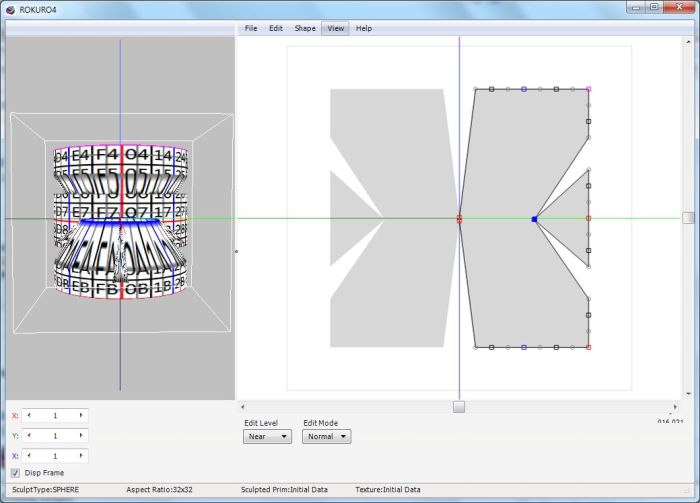
Rokuru – create symmetrical designs as sculpts or meshes
The UI itself comprises two parts – on the left, a “finished product” preview pane which displays a representation of your model, which can be drag-rotated in all three axes to examine the design, and an editing panel on the right, in which is displayed as a plan view of your shape, the right side of which can be edited (the left will automatically reflect all adjustments made). A range of menu-supplied options (including access to default shapes) and a range of settings provide a good degree of flexibility within the tool.
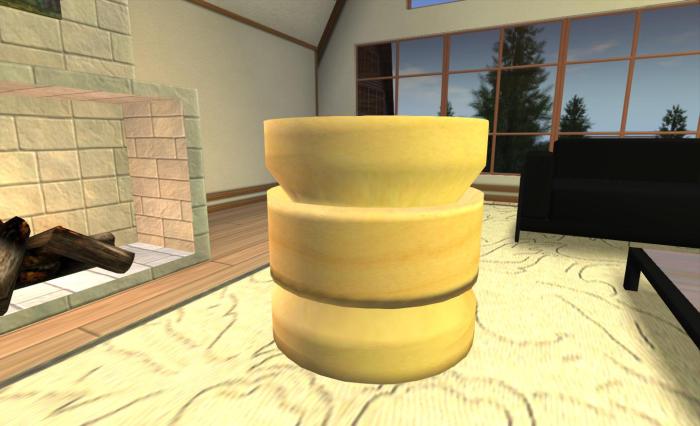
A shape created in less than a minute on Rokuro and uploaded to SL
Rokuro is offered free of charge (although donations towards its ongoing development and the development of Yuzuru’s other products are always welcome), and is available in Window 32- and 64-bit versions, and is also available for the Mac. For those wanting to explore the capabilities of the tool in more depth, there are a range of tutorials available both in-world and on the Marketplace.
As mentioned above, Rokuro is one of a range of products made by Yuzuru to assist content creators, the entire range currently comprising:
Rokuro
Rokuro_Pro – a version of Rokuro which includes a texturing capability and a series of plug-in tools
Tokoroten (“extruder”) – creates extruded forms of sculpted prim
Tatara – an advanced sculpted prim editor which includes functionality from Rokuro and Tokroten and well as three additional modes, which can be used individually or collectively to create sculpt maps
Shibori (“iris” – as in camera eye) – a “shrinkwrapper” for shrinking a sculpt around a given shape
Nomi (“chisel”) – creates a sculpted prim or mesh with a relief surface from one picture using the picture’s brightness
Hanko (“seal”) – a tool which allows you to add your signature to a sculpt map
Note that some of these tools require the purchase of a serial number from Yuzuru’s in-world store, but time-limited versions are available for download through the Kanae Projects website in order to “try before buying”.





 Earlier this week I reported on and reviewed a new