Assis in April: masks, cards and reflections on the world

You Wear That Face, Assis Art Galley

I dropped into Assis Art Gallery as a result of discovering a lapsed notice of an installation opening there at the start of the month. Curated by Joaopedro Oh, the gallery is currently home to four exhibitions for the month of April (and possibly longer), three of the photographic, and the last a 3D exploration of identity.

The various exhibits are displayed in different levels within the gallery space, and a teleport is required to move between some of them – look for the blue mask in the lobby and temporary building levels.

Hikaru Enimo, Assis Art Gallery

Located in the gallery’s lobby area is a small exhibition of photo art by Hikaru Enimo. These are quite exquisitely rendered, and occupy a space towards the back of the lobby space. Small though it may be, the works on display are worth casting a very close eye over, as they really are marvellous life studies.

In the Gallery’s “temporary building” area are two exhibitions which can be viewed without the need to teleport between them.

Gatekeeper Gustafson, Assis Art Gallery

The first is a series of real life studies by Gatekeeper Gustafson. This as another stunning display, with some of the pieces containing two images each which are displayed in turn for around 30 seconds apiece. The themes for the photographs, whether paired like this or individually framed, are diverse, as are the post-processed finishes evident in some, making for a fascinating display of studies and subjects, which again rightly demand time to be appreciated.

Alongside of this, just down the stairs. is a further exhibit called Playing Cards, by Edward Nussbaum. This comprises images set as the face cards from a deck of cards, together with the joker and ace. The face cards and aces are displayed in sets of four, each image in a set representing one of the four suits in a card deck.  There is a high level of  nudity in the images presented in this display, together with sexual themes and a degree of homoeroticism, so be prepared!

Edward Nussbaum, Assis Art Gallery
Edward Nussbaum, Playing Cards, Assis Art Gallery

Accessible via teleport, Blue Tsuki’s installation is called You Wear That Face, and is a simple but effective exploration of identity. Blue describes the piece thus:

We all wear masks. In SL we present ourselves with a mask every day. In this landscape find a hole in the ocean, armillary spheres of orbiting electrons, shafts of memory and our masks. “You Wear That Face” is a nexus, a vortex, an analogue of neurons and a self-reflexive look at our mask in a sideways dream.

You Wear That Face, Assis Art Galley

This is a mix of physical elements and particle displays which combine to from a dream-like space with a lavender-coloured ocean flowing into a central vortex (which you’re standing over when you arrive), and over which golden armillary spheres float.

A spiral of prims descends into the vortex beneath you, images flickering across them in rapid succession, perhaps representative of the many masks we wear within SL (and life itself?). Around the spiral sit four rectangular shafts and four masks each within a pattern of particles. These are interactive pieces – click to sit on them – which place you either looking out from behind one of the masks – again, the reference to identity – or floating at the mouths of the shafts and looking down onto old photographs – our shafts of memory.

You Wear That Face, Assis Art Galley

There is not set order for viewing the exhibits, so you can visit them as your muse takes you. If you do start from either the lobby or temporary building, watch out of the Assis Art Gallery signs – these will furnish you with a notice on the exhibitions and news of the gallery. If you visit you Wear That Face first, the teleport is the small red inverted pyramid in the centre of the vortex (under your feet on arrival).

Related Links


Paradise Lost: an outstanding masterpiece of performance art in SL

image via Canary Beck

On Saturday March 29th 2014, I was one of a number of people privileged to witness a special preview of The Basilique Performing Arts Company’s production Paradise Lost: The story of Adam and Eve’s original sin, which as I’ve covered in the blog, is an ambitious attempt to visualise Milton’s epic 10,000-word poem Paradise Lost through the medium of dance set to the Süssmayr completion of Mozart’s Requiem Mass in D minor.

By the time of the preview, I’d covered some of the technical complexity of bringing together the production, which features some 43 roles on-stage, plus audience participation as those hosts of both heaven and hell, and Caitlin Tobias had been covering a lot of the behind-the-scenes news on the production. So, needless to say, anticipation was running high as I joined the rest of the audience for the event.

Members of the cast with Harvey and Canary (centred) before the press preview of Paradise Lost
Members of the cast with Harvey and Canary (centred) ready themselves for photos ahead of the press preview of Paradise Lost …

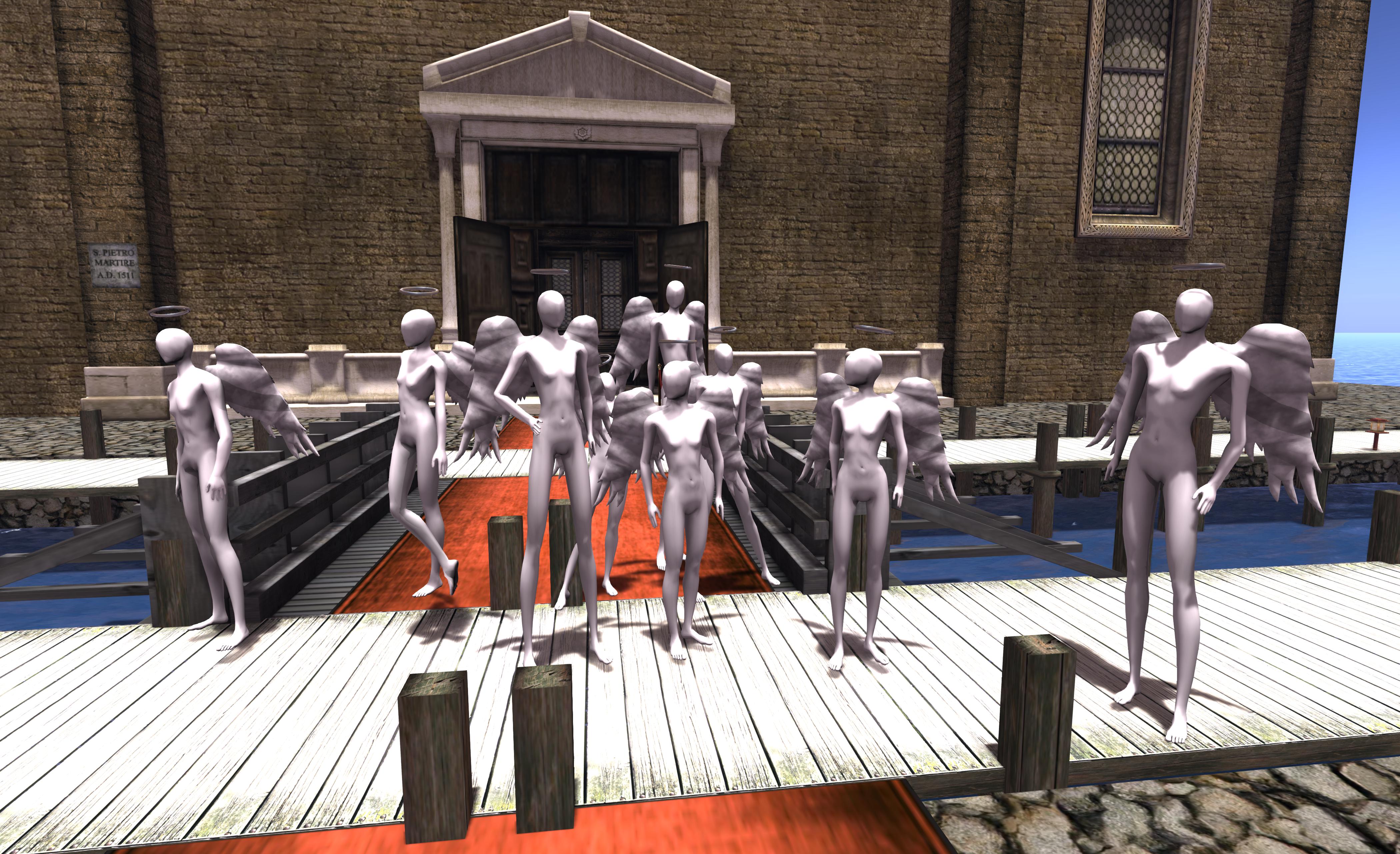
Ahead of time, there was a red carpet moment, with members of the cast available for photographs against the traditional backboards bearing sponsor logos. This made for something of an interesting session, the cast in formal attire – suits and gowns – and a host of angels taking photos…

And the angelic host proclaimed,
… And an angelic host proclaimed, “smile, please!”

I don’t plan to offer a long descriptive review of the production. Really, this can be summed-up in (almost) a single sentence:

This is not something you should risk missing. It’s. That. Good.

The poem has been broadly broken down into three acts, each accompanied by a number of movements from the Süssmayr Requiem. The acts are:

  • Act One: the fall of Satan, the creation of the heavens and the Earth, the creatures of the Earth, Adam, and from Adam, Eve. Featuring Introitus: Requiem, Kyrie Eleison, Dies Irae and Tuba Mirum
  • Act Two: Satan crowned by the hosts of hell, the corruption of Eve, the first sin and expulsion from Eden. Featuring Rex Tremendae, Recordare, Confutatis and Lacrimosa
  • Act Three: the war between the hosts of heaven and hell; Adam and Eve’s despair; Michael’s revelation to Adam of future events leading up to man’s redemption to God through Christ. Adam and Eve venture forth into the world with their baby sons Featuring Domine Jesu, Hostias, Sanctus, Benedictus, Agnus Dei and Lux Aeterna.
Satan and followers, post fall, amidst the fires of hell

These acts are played out in three stage areas – hell to the right of the audience, Eden to the left, and the world beyond the gates of Eden to the front. Extensive and agile use of scripting is made such that the various sets fade in and out as required, and even the floor of the theatre itself is rendered transparent in order to help visualise the Flood as revealed to Adam by Michael in the third act.

The positioning of the stage areas like this serves two purposes – one obvious, and the other perhaps more subtle. The more subtle aspect is that it places the audience physically between the damned and the divine, precisely as someone of Milton’s mindset might well see humanity. The other aspect is that it places the audience squarely in the middle of events, which unfold to their left and right and even overhead, as well as in front of them, enhancing the sense of immersion in the story.

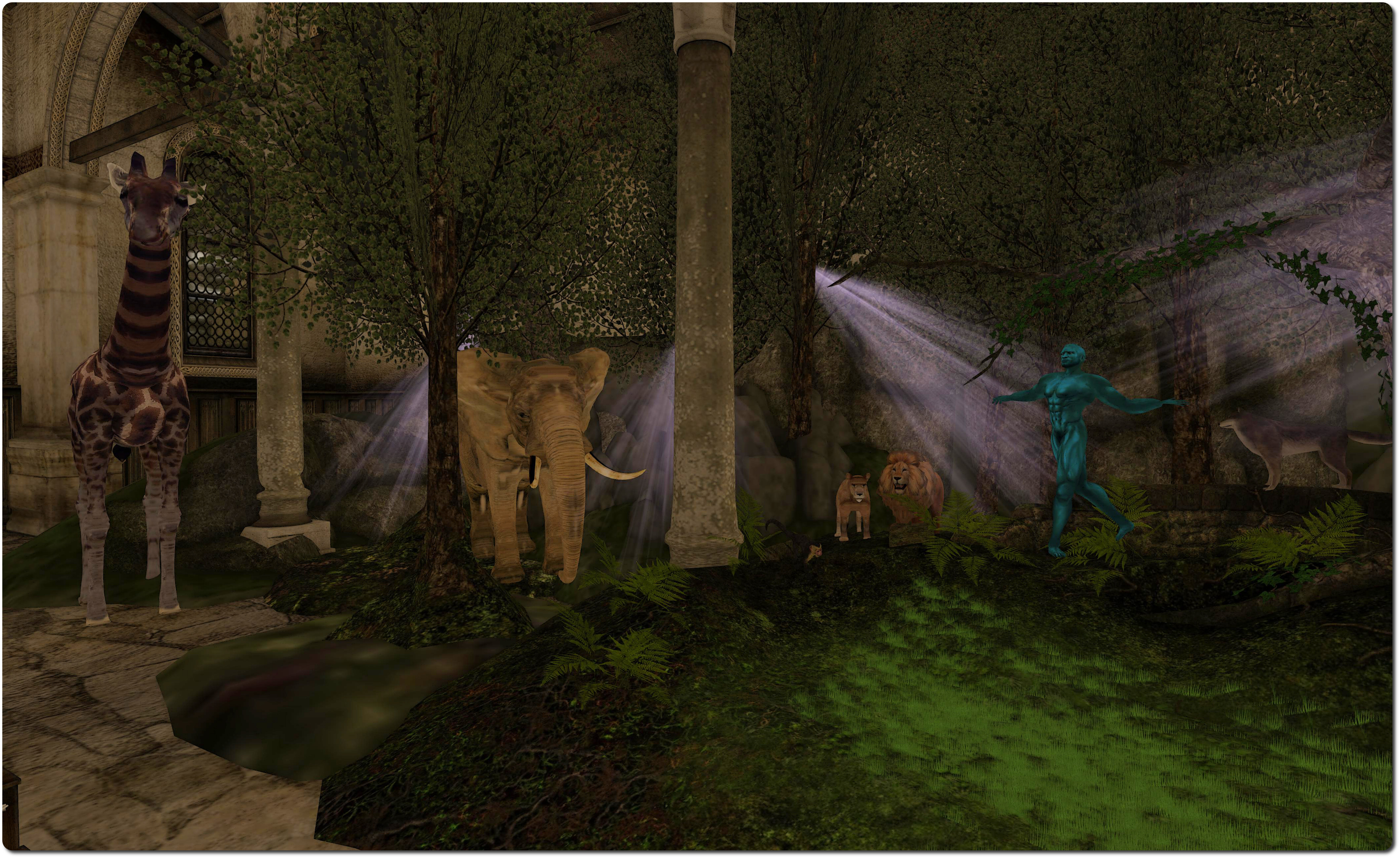
Then God said, “Let the land produce vegetation: seed-bearing plants and trees on the land that bear fruit with seed in it, according to their various kinds … Let the land produce living creatures according to their kinds: the livestock, the creatures that move along the ground, and the wild animals, each according to its kind…”

The immersive element is further deepened by the fact the audience has a role to play in the proceedings, a feat achieved through the creative use of the Restrained Love (RLV) API. Each ticket purchased for a performance includes an avatar set, which audience members are asked to wear when attending a performance. Initially the guise of an angel, RLV is used to make the avatar to change to that of a demon and back as the story moves between the two stages representing paradise and hell, without any intervention on the part of the wearer. RLV also enables the audience to effectively become the chorus within the story.

As a visualisation – given the music selected for the intermissions between the acts (a beautiful rendition of McCreary’s Passacaglia, itself preceded by The Shape of Things to Come prior to the performance commencing), I’m almost tempted to say reimagining of Milton’s poem – one of the most striking elements of this production is how well both the elements of the poem presented within the performance sit with Süssmayr’s completion of Mozart’s Requiem. While Becky, Harvey and I discussed something of the complementary nature of the two works when placed together in this way (see the conversation linked to above), it is not until one sees the performance in full that it becomes clear just how apposite the Requiem’s movements are to the unfolding story.

Continue reading “Paradise Lost: an outstanding masterpiece of performance art in SL” →

Petrovsky’s future in Flux?

A Petrovsky Flux by Inara Pey, April 2014 on FlickrA Petrovsky Flux, April 2014

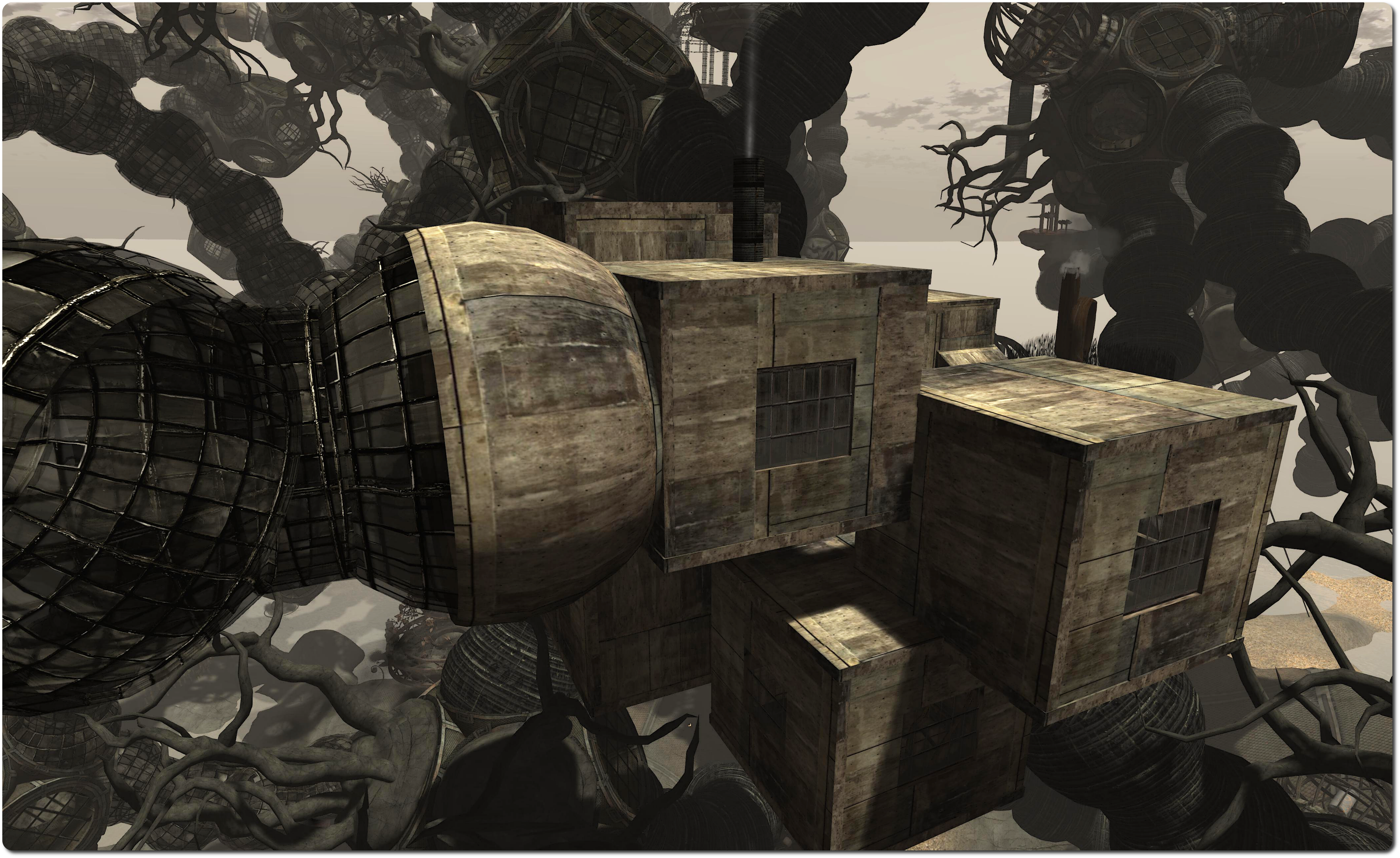
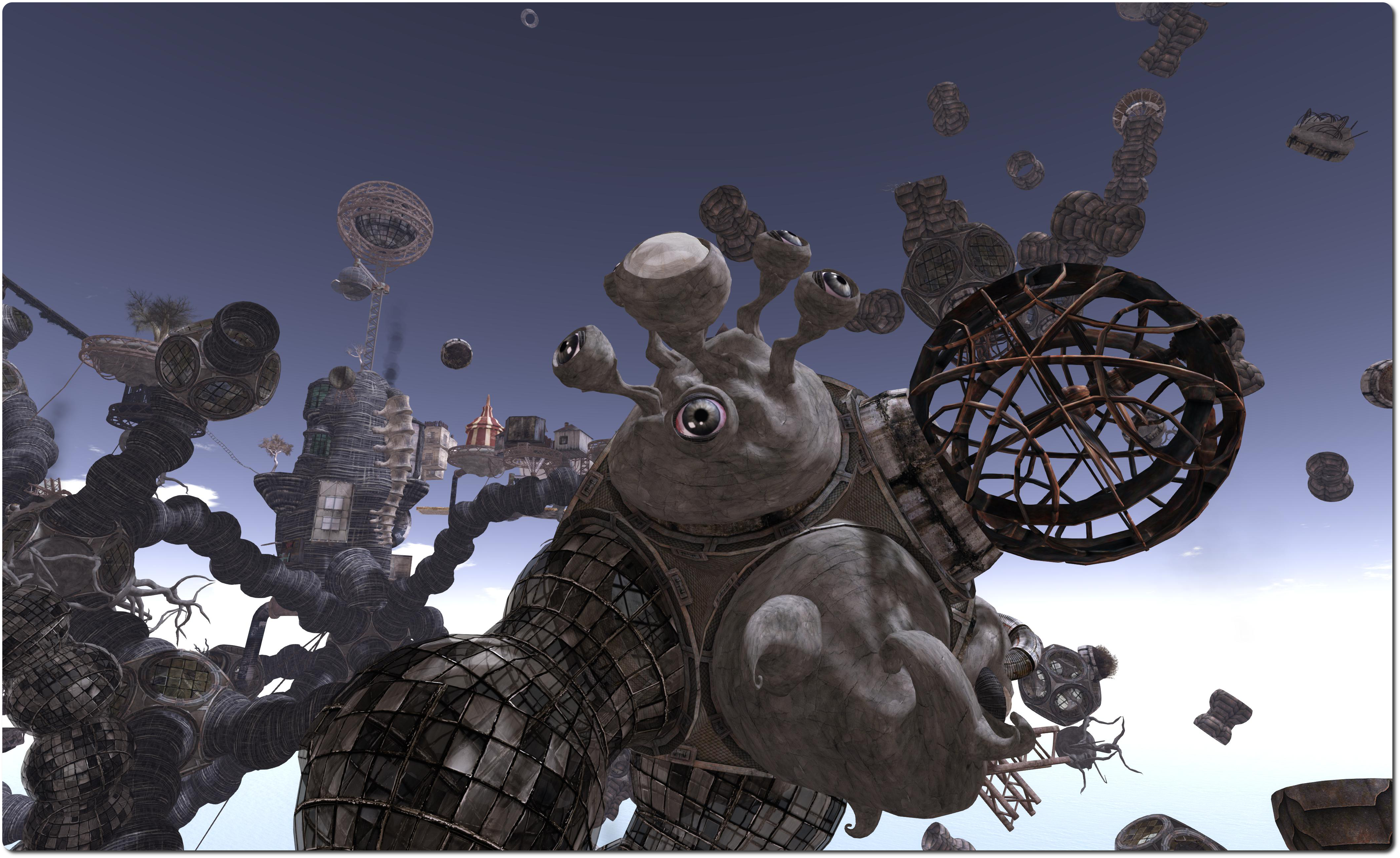
A Petrovsky Flux, a collaborative piece by Cutea Benelli and blotto Epsilon and curated by the University of Kansas at their Spencer Art Museum region in SL, has been a popular destination since it opened in around 2010. It’s also, I’m somewhat ashamed to say, a destination that has been on my list of places to visit for a good while now, but I’ve never actually managed to get there.

However, as it has been in the news of late, both in notices circulated in-world and in blog posts. So I decided to hop on over and take a look – and see if I could find out what was going on.

A Petrovsky Flux by Inara Pey, April 2014 on FlickrA Petrovsky Flux, April 2014

For those unfamiliar with the installation, I’ll borrow some words from Steve Goodard, the Spencer’s associate director/senior curator of Prints & Drawings, who overseas the Museum’s region in SL:

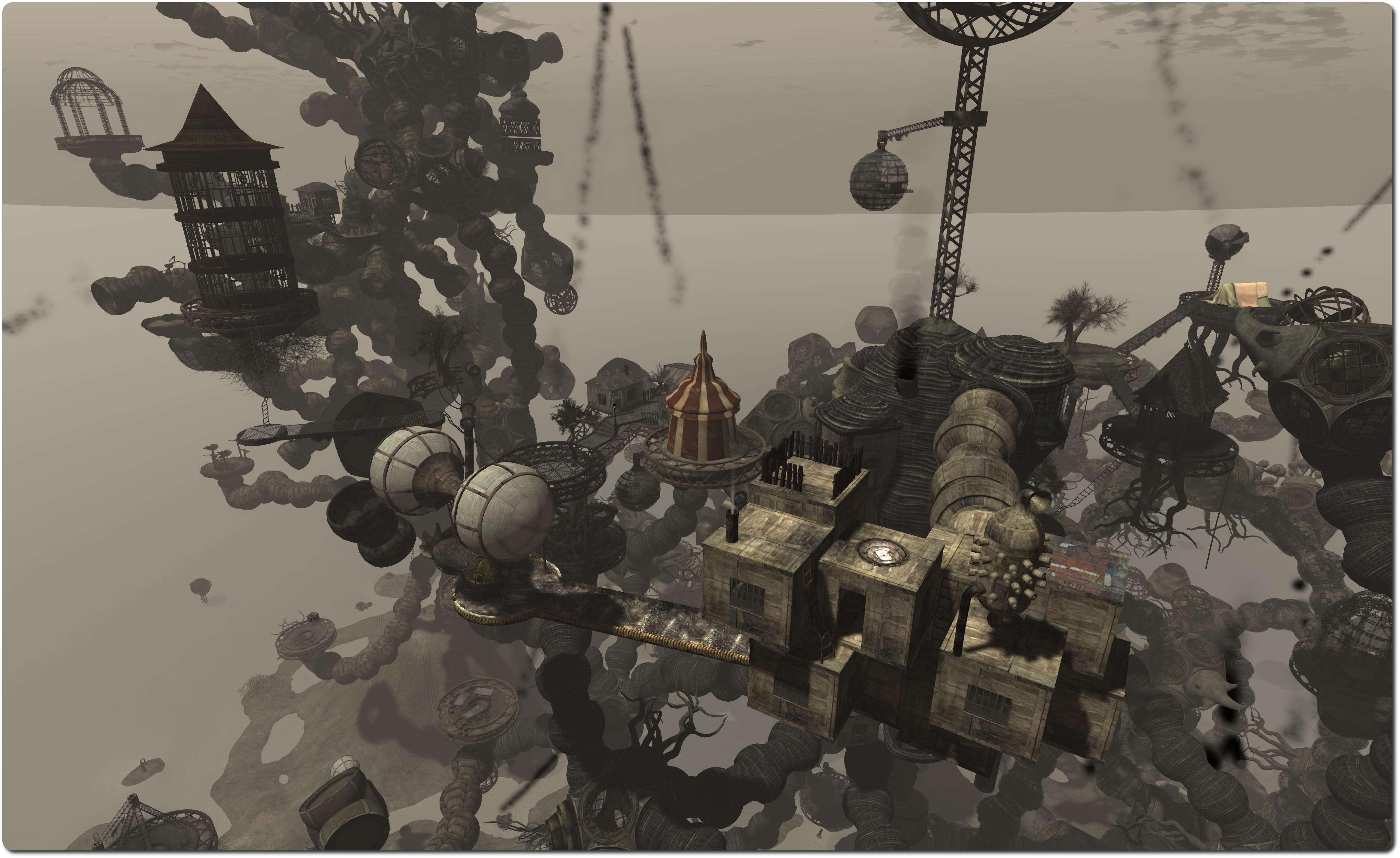
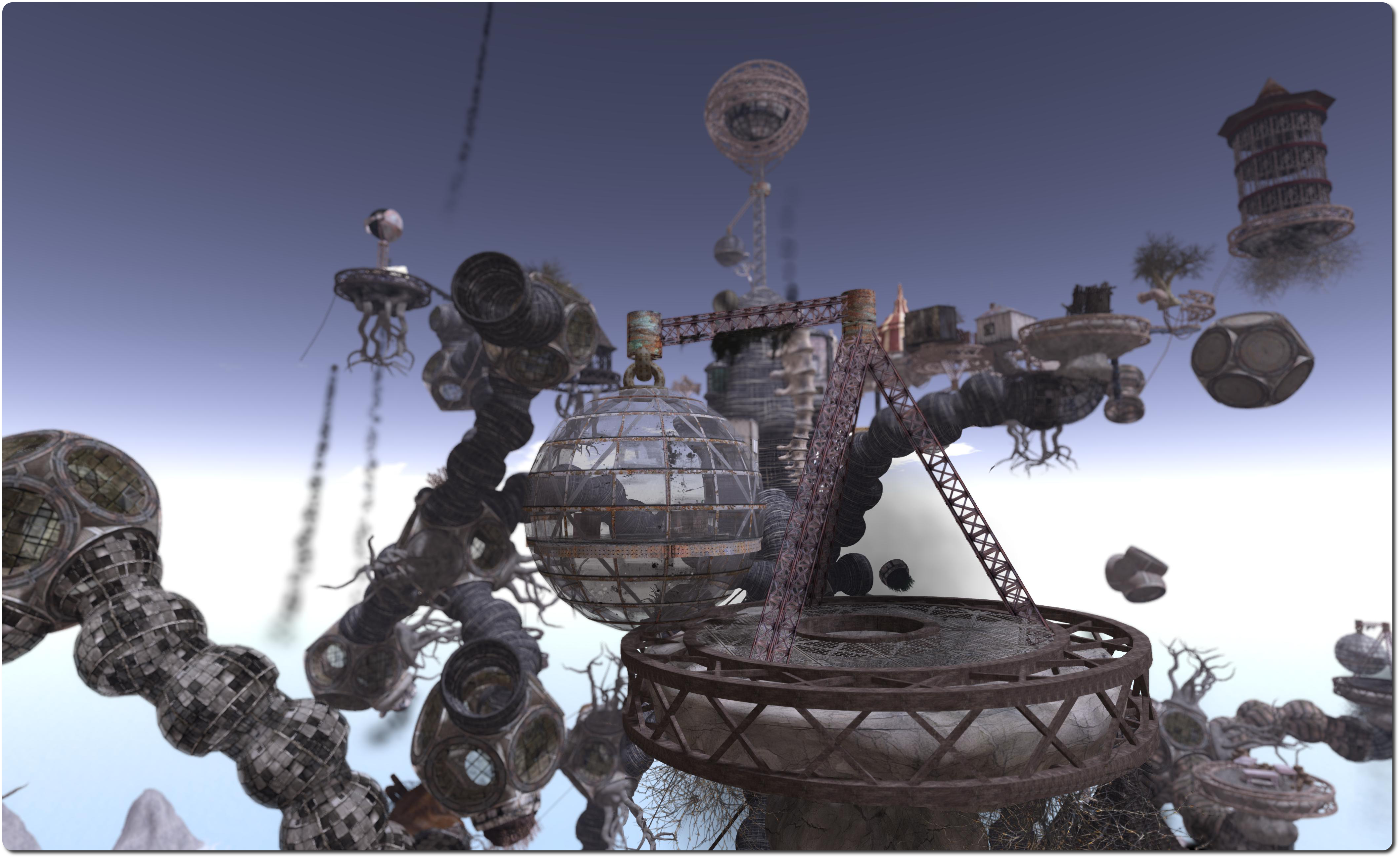
A Petrovsky Flux is a cluster of devices that grow, assembling themselves from modular units, only to blow apart and rebuild themselves. Each time they rebuild differently so the overall flux is, as the name implies, constantly changing. Visitors … can also explore the inside of the organic architecture, and they also receive a free “noggin protector” — a miniature version of the flux that is worn on the head to protect against falling debris. The project takes its name in part from a previous project, the “Bogon flux,” and in part from the “Petrovsky lacuna,” named for Russian mathematician Ivan Petrovsky.

The “noggin protector” is well advised, as this is living art in the most literal sense. As Steve states, it is constantly building and falling apart, building and falling apart, and each rebuild is unique compared to the last. “Organic” is also an appropriate term to use with the installation, many of the elements are spherical in form, and when joined, result in undulating, hollow structures you can travel through and which from the outside resemble segments of a gigantic worm. These are often topped by dodecagon-like pieces which look like they could be maws and  / or multiple compound eyes.

A Petrovsky Flux by Inara Pey, April 2014 on FlickrA Petrovsky Flux, April 2014

There is also something a little Gilliam-ish about the installation. Sheep and pigs are prone to flying past suspended beneath clover-like rotors (you are offered a tiny version of one of these “Henrycopters” to wear as a gift, along with your noggin protector). There are also spring-loaded armchairs that will carry you around the region, boucning randomly here and there.

Amidst all the chaos are islands of relative calm which survive the construction / destruction cycles, offering places to sit, including outdoor cafés where the unfolding spectacle can be observed; and places of reflection, such as a little Buddhist shrine. Do be warned, however, given the industrial nature of the design, there’s as least one dump which may be toxic in nature…

A Petrovsky Flux by Inara Pey, April 2014 on FlickrA Petrovsky Flux, April 2014

The installation has been in the news a fair bit of late, as mentioned towards the top of this piece, with notices circulating over its impending closure, together with blog posts on the matter. Quite why it should be closing has been a little confusing, as information has been prone to shifting and changing over the last few days. Initially, it appeared to be due to an issue of billing; however, I’ve been in contact with the Spencer Art Museum, and assured this is not the case.

Right now, and without delving into specifics, it is reasonably fair to say that any decision over the future of the Flux still lies with the Museum and with Cutea and blotto. It may yet be than in order to survive, the Flux will need to find a new home; it may equally be that it is safe where it is. I’ve been promised I’ll have word as soon as decisions have been made by the Museum.

Whichever way it goes, this does open-up a wider issue regarding the preservation of long-standing builds and installations which have come to be regarded as a genuine part of SL’s history. As Saffia Widdershins correctly points out – Keeping great sims on the grid is not Linden Lab’s responsibility. It is ours. But how this can be achieved is a complex subject in its own right; even if some form of resident-led funding mechanism can be established to fund regions, there are many thorny issues remaining, as Saffia points out in responding to comments following her post.

A Petrovsky Flux by Inara Pey, April 2014 on FlickrA Petrovsky Flux, April 2014

For example, how it is determined what should be saved and what should be allowed to naturally die? Who should be the arbiters of fate? Why should they have more say than others? How are vested interested best avoided? Should the LEA perhaps have a broader remit where art is concerned? If so, what of all the other region types considered worthy of preservation – role play environments, public parks, and so on, which over time may have significantly contributed to the betterment of Second Life?

This is a subject worthy of debate and discussion. and while matters relating to Petrovsky Flux may not be as Ziki first thought – and through no fault of her own – she has also started putting some thoughts together, discussing ideas in person with others.  But in the meantime, and if you have yet to see A Petrovsky Flux – even if it does prove to have an assured future at the Spencer Art Museum’s region, I strongly urge you to visit sooner rather than later. You will not be disappointed.

To encourage you, I’ll leave you with Toxic Menges’ brilliant video of the installation.

Related Links

The geometry of art

3D Fractals
3D Fractals

That fractals as art fascinate me is no secret. I’ve covered Gem Preiz’s work several times in this blog, and more recently enjoyed Mac Kanashimi’s marvellous Dragon Curves at the LEA. So when I heard by way of Caitlin Tobias that Mac had another fractal-based art exhibit opening in SL, I had to add it to my places to hop over to.

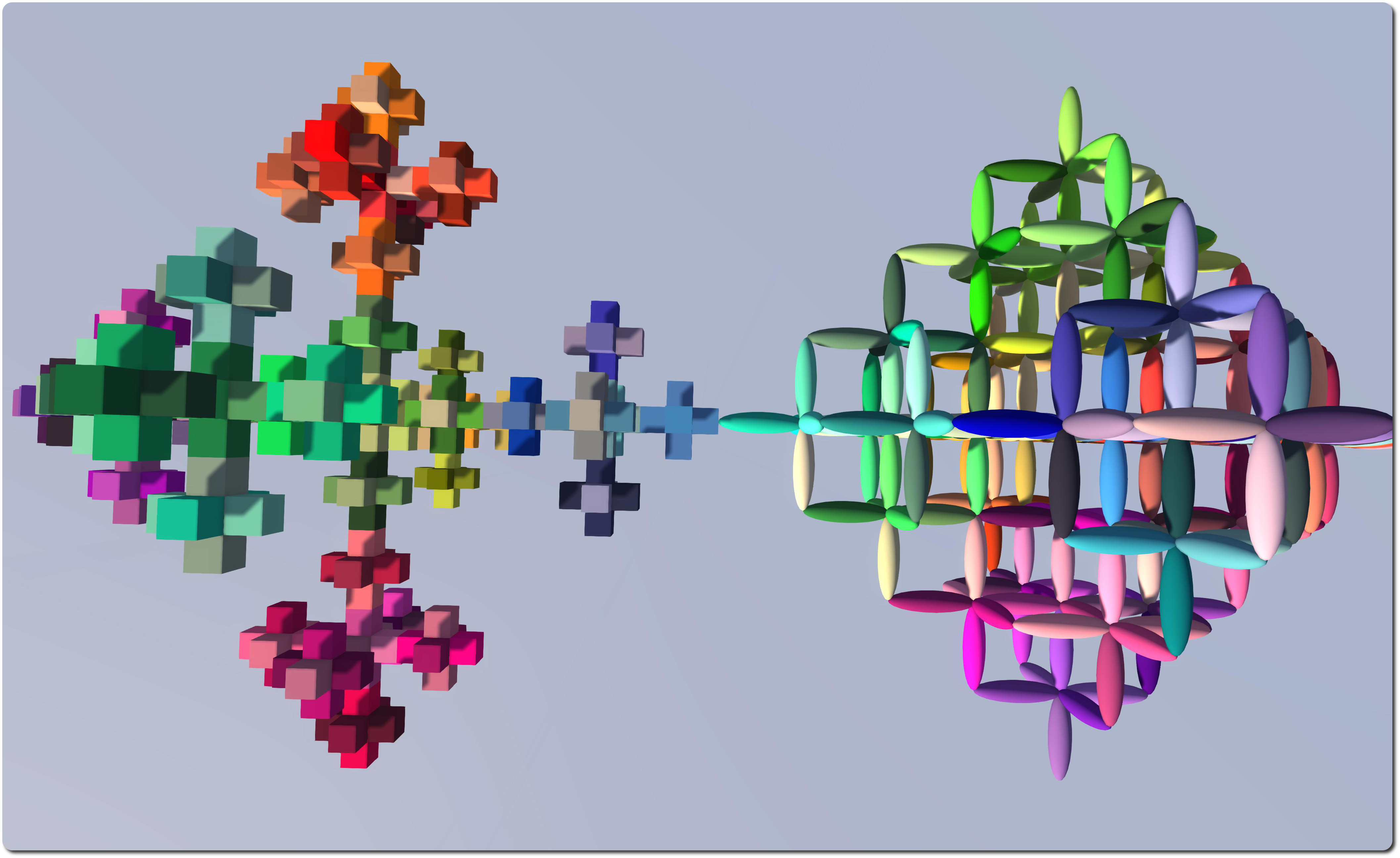
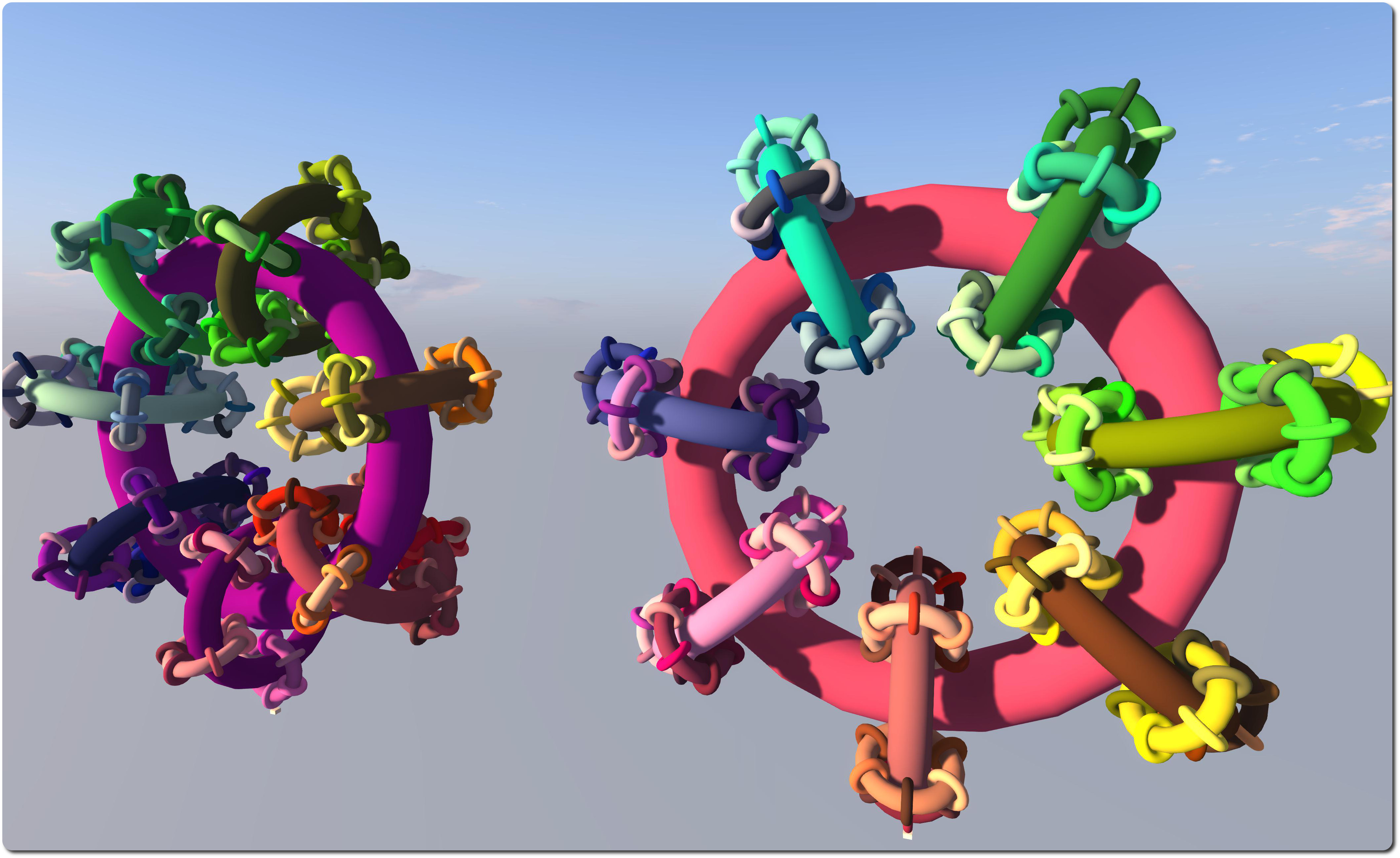
3D Fractals opened at SperiMenta on Monday March 31st, although I missed the actual opening. Co-hosted by SperimentArt & Tanalois Art, it is like Dragon Curves, located high in the air. However, it is also on a much smaller scale, not that this makes it any less interesting. It features two pattern generators which, over a period of time, individually generate a range of deterministic fractals defined by their Hausdorff dimension, and which – once rendered  – stand both individually or as a pair.

3D Fractals
3D Fractals

The fractal forms created by the generators include the greek cross, Hilbert curve, Htree pattern, Menger sponge, octahedron, Sierpinski triangle (tetrahedron / pyramid), solenoid fractal,  and Vicsek snowflake. Several of the shapes have additional complemented or inverted forms as well, and all are cycled by the generators in turn, each appearing for several minutes at a time prior to the next being rendered.

If all this sounds terribly dry, it isn’t; the shapes can be quite fascinating to watch and compare / contrast as they rez and are coloured, their structure a mix of prims and mesh. If you decide to visit, and assuming your viewer supports de-rendering, I suggest you temporarily de-render the black platform prims over which the shapes appear. This give a much better impression of them, as they seem to hang in the air, and allows for a spot of photography as well!

3D Fractals
3D Fractals

Related Links

Seeking secret Sauce of love

Sauce
Sauce

On Thursday April 3rd, Maya Paris returned to the LEA with what is in some ways the follow-up to her popular Celebrity Blow Your Own Tits Off, only this time she’s inviting people to discover the secret sauce of relationships … via spark plugs, fish and chips and a touch of sauce science which, visitors are assured, contains no dangerous or explosive chemicals.

Sauce
Sauce

Sauce, which forms a part of the LEA AIR round 6 entries, is designed to be enjoyed by people exploring it in pairs or as couples. As with Celebrity Blow Your Own Tits off, this is an interactive piece, with giveaways (including your very own spark plug avatar!), rides and more, which invites you to click, click, click as you explore. In difference to the earlier game, however, there is no overall aim or goal to the piece, rather the aim is to have fun in a British seaside saucy humour kind-of way, as Maya explains:

Slap on your wig and flash those knobbly knees because this time it’s personal.

Test your Sauce Factor, try your luck at the Modern Love Bureau, get sparky in the Saucy Science lab and take a headlong dive into a sea of plenty more fish&chips.

(Bring your own hair or teeth…and a friend)

Sauce: "Oh yes you did!"
Sauce: “Oh yes you did!”

Maya kindly granted me the opportunity to partner-up with Honour McMillan ahead of the opening and try-out the installation. All I can say is – it’s fun. And I’m not entirely sure we discovered everything. Indeed, to say too much about this piece would be to spoil the fun; you need to explore it for yourself and the good of your own teeth / hair / relationship with a friend…

Transportation around the installation is via public telephone box. If journeying with a friend, you should each select the same one to get the most out of your trip. There are a number of boxes available at the start, depending on your hair / teeth status, and it’s up to you which category you choose. Do keep an eye out for the number 1, however. You’ll need that to find your way back … or out. And while the sauce my not be explosive, at least one lot of chips is, when fired from a fish…

Sauce
Sauce

As well as being a lot of fun, the piece seems to include some very English cultural references – the seaside humour and sauce, the fish and chips being two. There also seems to be an oblique reference or two to the 1960s TV series The Prisoner, with large penny farthing wheels emblazoned with a “9” that so easily might be an inverted “6”, and the appearance of translucent spheres prone to hunting you at one point. There’s even a hint of Brief Encounter with the trains…

However, I’m not saying a word about how the fireworks at the end might be interpreted! Instead, I’ll just say, go and enjoy. And take a friend.

Related Links

Son of a gun, we’ll have big fun in The Bayou

The Bayou, April 2014The Bayou, April 2014

The Bayou first opened its doors – albeit it briefly – in September 2013. Designed by BuTToNs (pecandeluxe), it was a beautiful recreation of a bayou environment. At the time, it didn’t remain open long, although I did get to take a quick peek.

The doors re-opened to public access around the end of February, retaining all of its original beauty (with some small additions). As I’ve made several quick hops back since then, I thought it about time I actually blogged about it.

The Bayou, April 2014The Bayou, April 2014

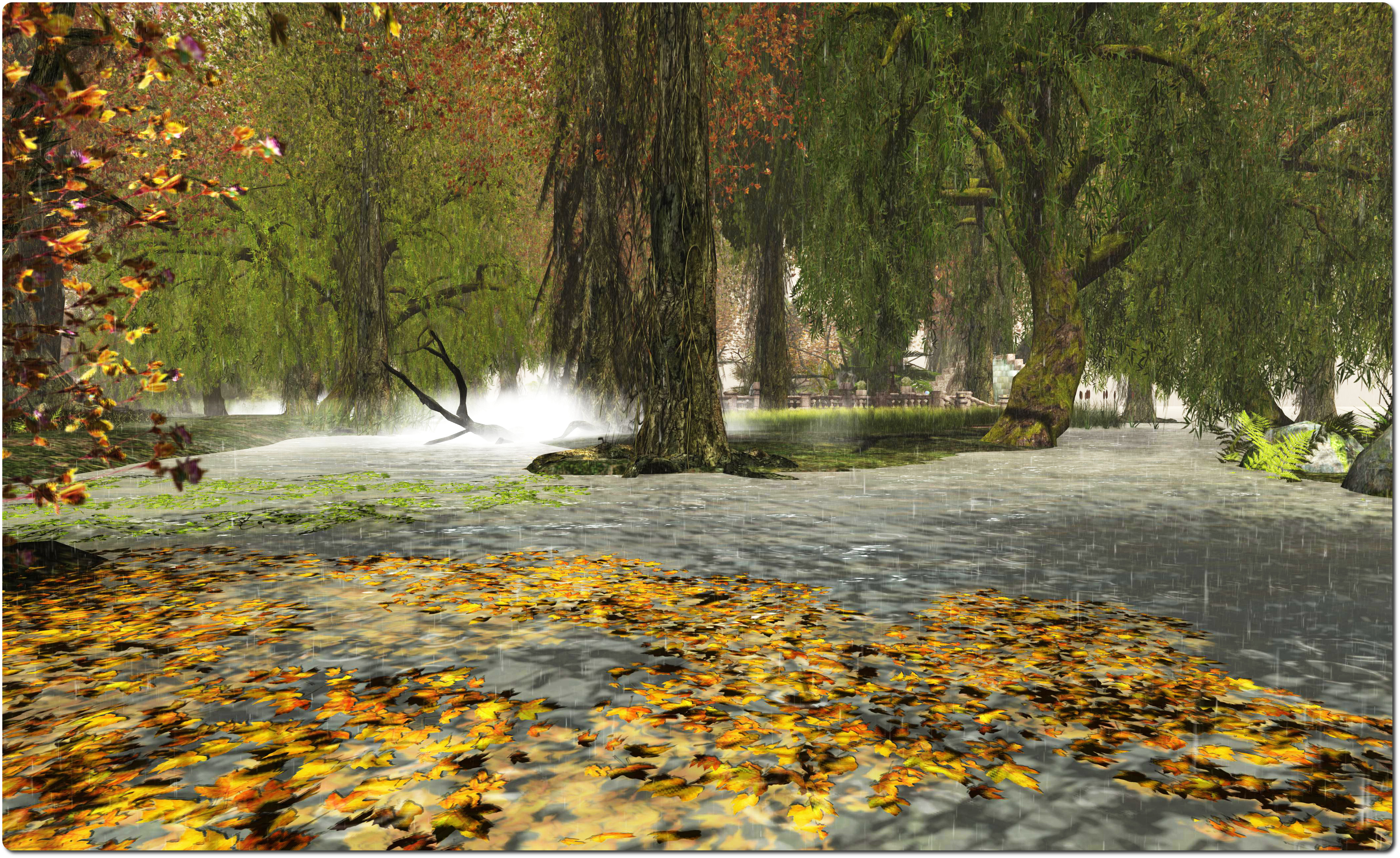
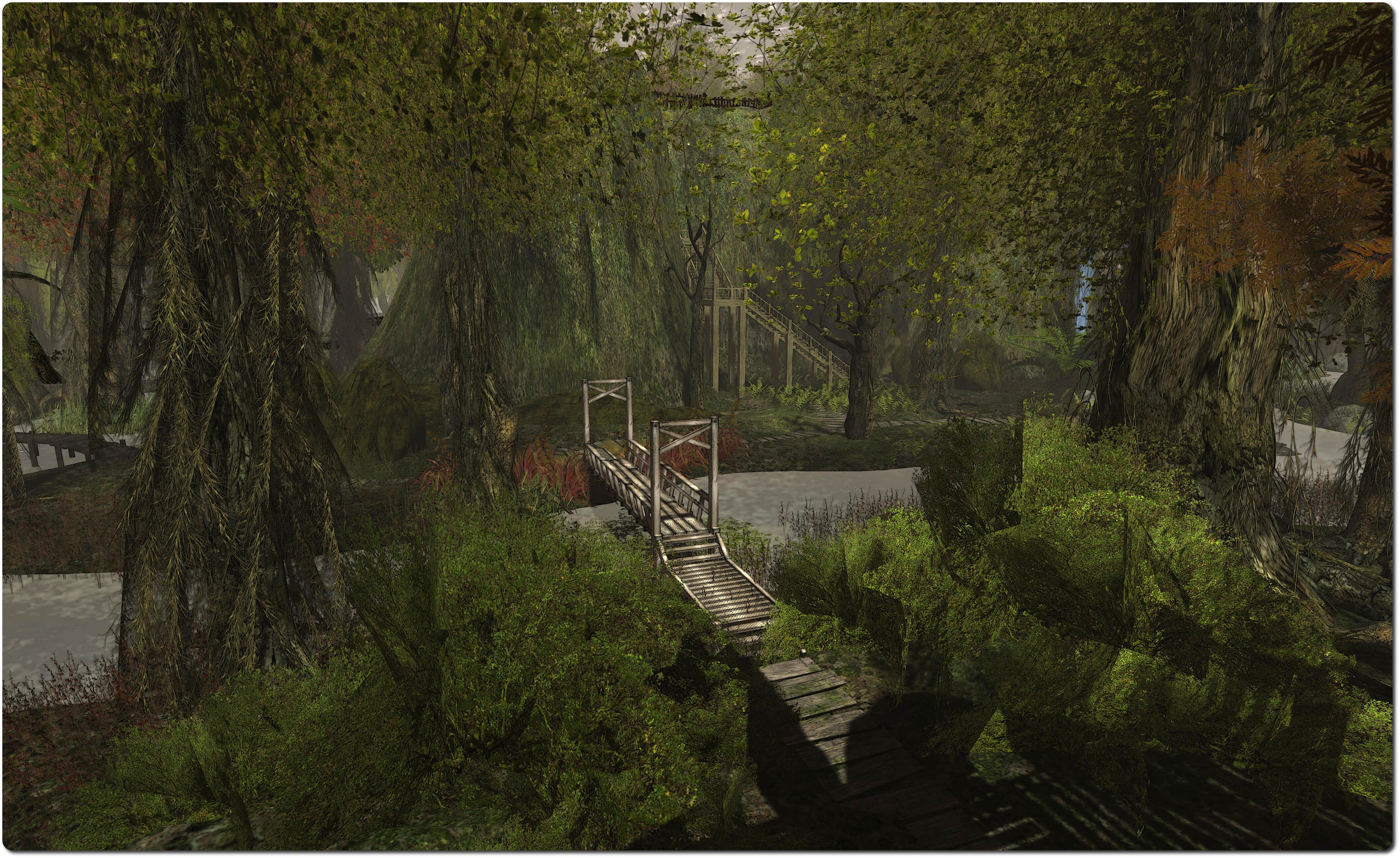
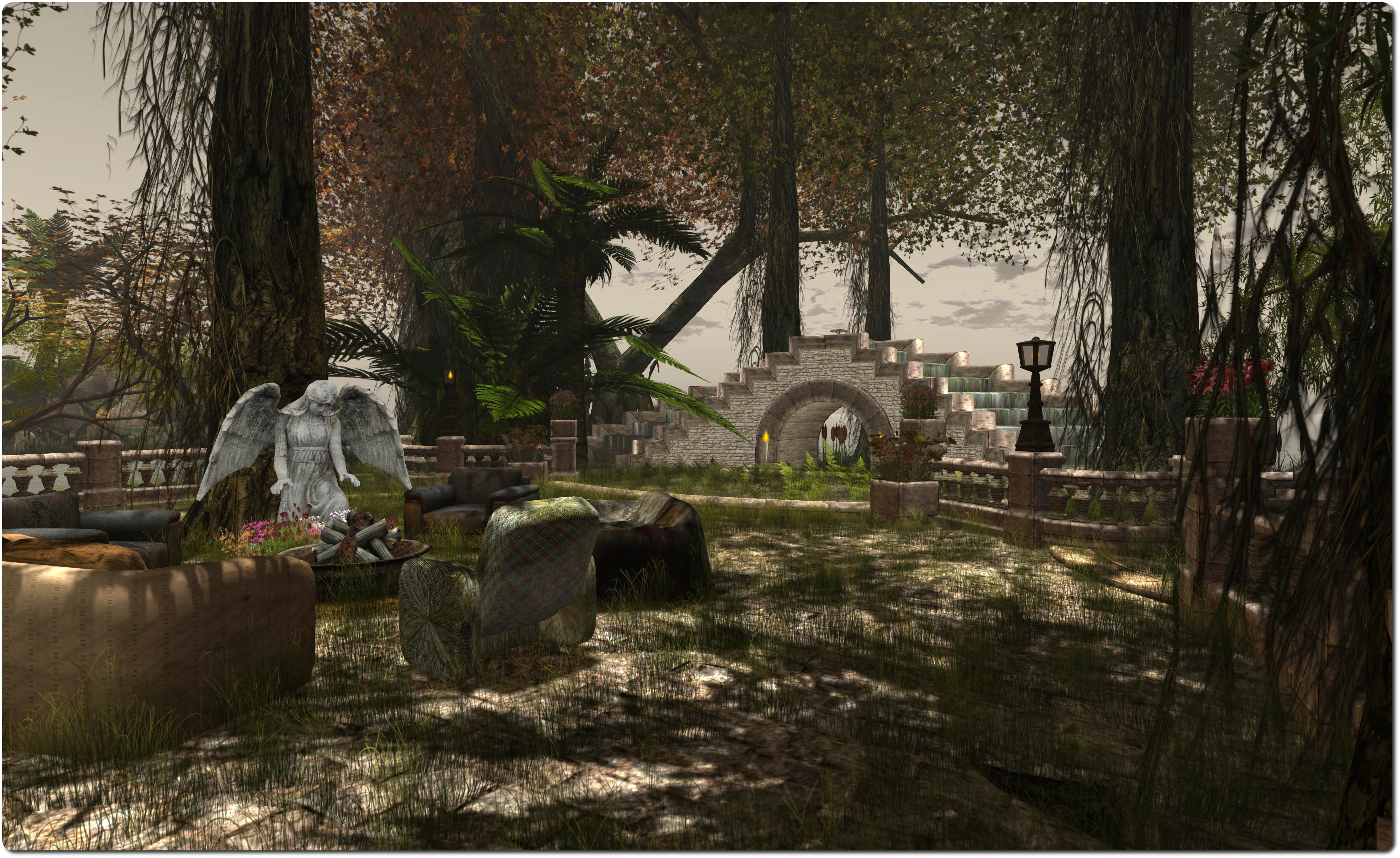
Those who love really natural-looking environments in SL should love The Bayou. The signs of habitation are minimal: there’s a ramshackle cabin and a tree platform, plus a seating area to one side of the region. but beyond these and a couple of other scattered indications, the majority of the region is given over to trees, undergrowth, dark, flowing water and wooden walkways over what might otherwise be waterlogged ground.

The wooden board walks lead the visitor around the region, little wooden bridges providing the means to cross the water – and avoid the alligators. You might want to take a brolly with you, as it is raining heavily in one place. Along the way you’ll pass a fair number of InTan dance systems – so those of a romantic inclination will find a welcome in The Bayou (and don’t forget the couples’ pose systems near the landing point, which allow you to explore hand-in-hand).

The Bayou, April 2014The Bayou, April 2014

Wander inland, and you’ll eventually find your way to a couple of wooden stairways leading upwards. One will take you up into the hills on the far side of the region to the arrival point, where a path winds up to the start of the waterfalls. The other provides access to a grassy plateau where couples can again enjoy a dance.

There are some open areas down at ground level as well, but one of the things that makes The Bayou so attractive is that in places you can look around yourself and see nothing but trees and meandering water; with the ambient sounds, it really gives a feeling of being in the bayou.

The Bayou, April 2014The Bayou, April 2014

Several of the trees found in the region are the work of Serenah Raynier, who has a store and rezzing platform in the sky overhead. These can be reached via the teleport near the region’s landing point. The store offers the trees and other items for sale, while the rezzing platform offers the ability to view  / purchase prefab packs up to a full region in size.

Now, given this is a post about The Bayou, there is really only one way to sign-off, and that’s with a song.

Related Links