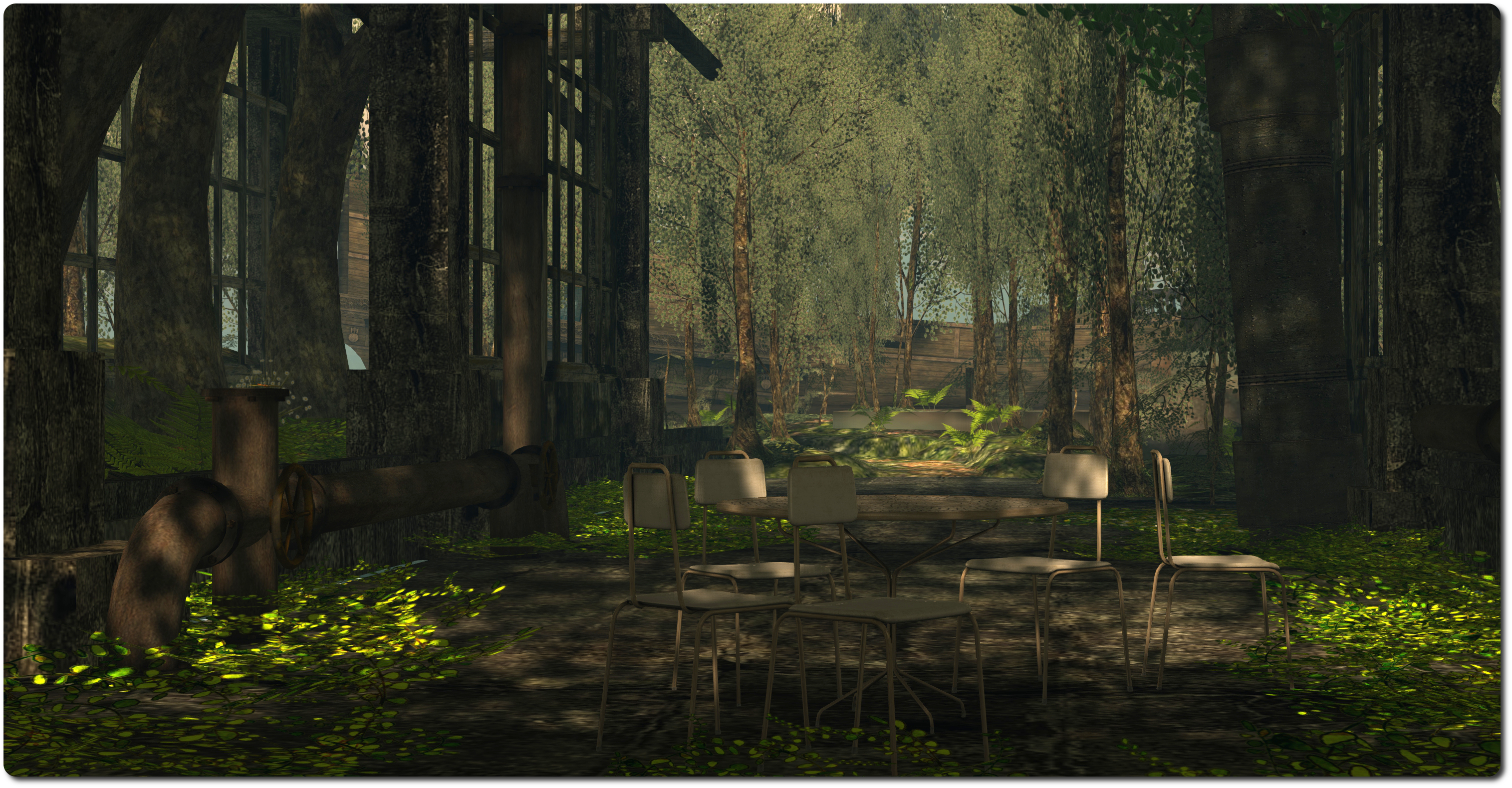
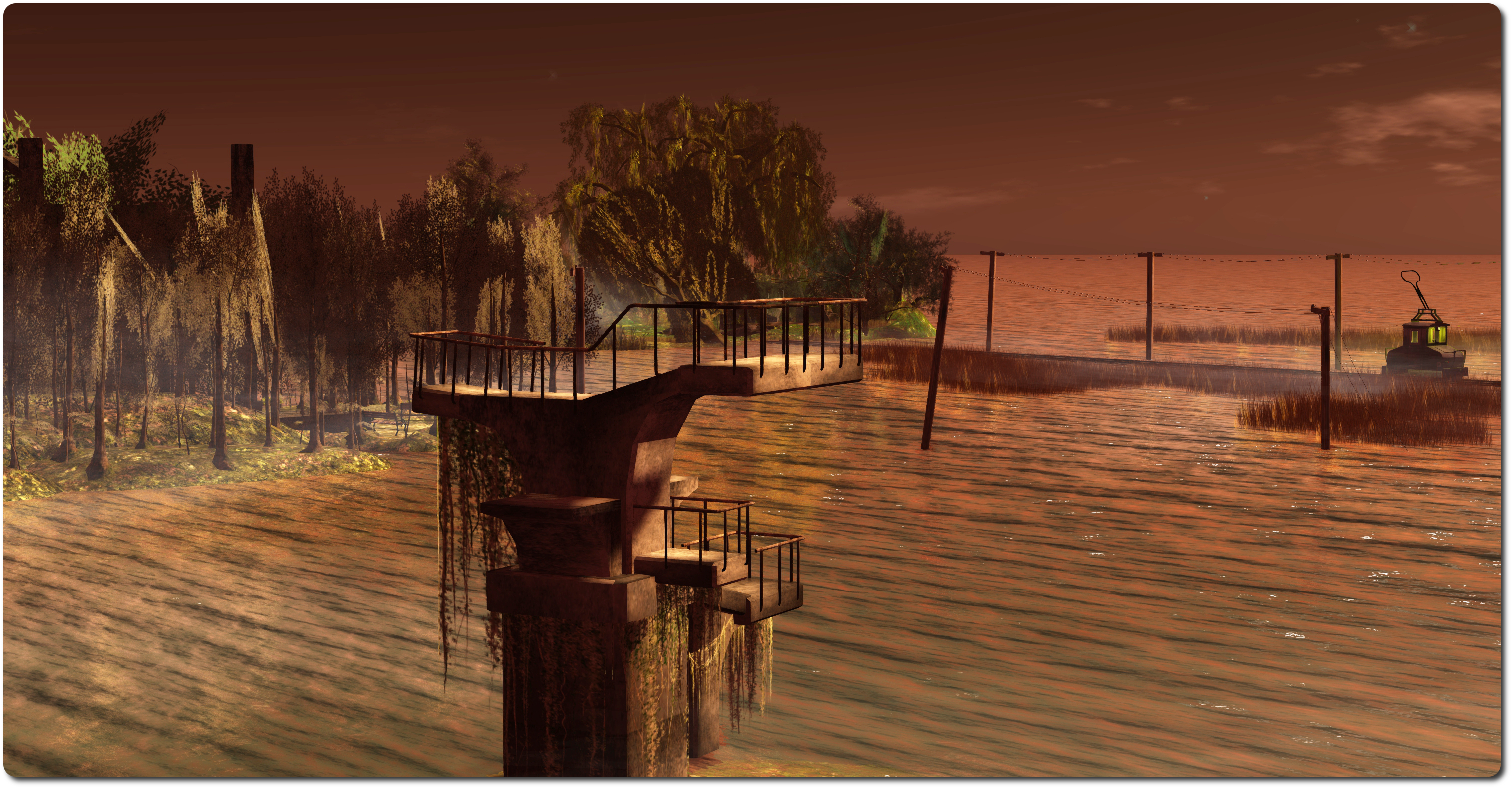
Contemplating an Absence of Colour

Absence of Colour
Absence of Colour, Timamoon Arts

Art Blue recommended I make time to see a new exhibition which has just opened at the Timamoon Gallery, and which features as it subject … fractal art. Needless to say, I was immediately curious, so when an unexpected free 60 minutes popped-up I hopped over to take a look.

Absence of Colour is a joint exhibit by Milly Sharple and Ranadeep. As the name suggests, this is a presentation of monochrome and greyscale fractal art by the two artists and is, I have to say, stunning; even the setting is a continuance of the overall theme, albeit it with a slight hint of colour.

Absence of Colour, Timamoon Gallery

Spread across three levels, the exhibition space comprises 24 large cubes arranged eight to a level in a square around a communal area. Four cubes open onto this central communal area, and are linked to the remaining four cubes by short tunnels. All of the cubes has at least one element of art displayed within it. The interiors of the cube further reflect the title of the exhibition, alternating between white and black as you walk through them.

The entire arrangement means it as possible to wander between the cubes, crossing back and forth over the communal areas, or to enter one cube and then proceed through each of them in turn to see the displayed pieces before returning to your start point. Teleporters provide the means to move between the three levels.

Absence of Colour, Timamoon Arts

The central level forms the landing point. The cubes here combine pieces by Milly and Ranadeep, while the upper level is devoted to Milly’s work, and the lower to Ranadeep’s. While both artists have used similar software for their work, both employing  Apophysis (although Ranadeep also uses Ultra Fractal and Incendia), their individual styles are apparent in many of the pieces. Ranadeep’s work often features bold lines and linear forms (although not exclusively so), while Milly’s often display more cursive elements and softer lines (although again, these are not exclusive to her pieces).

That all of the pieces have been rendered in black-and-white gives them a remarkable depth; some of the images in the cubes with a black interior have a particular perspective that makes the observer feel they are looking into them, rather than at them, as if they are not pieces of two-dimensional art, but actual constructs located in front of the observer and into which one might climb – or fall. The effect is both captivating and mesmerizing. It is also, while not unexpected given the nature of the art, perhaps far more heady in impact than might be the case had the pieces been rendered in colour.

Absence of Colour, Timamoon Arts

Within each cube, as well, stand figures, male and / or female, apparently studying the pieces on display. These are as much a part of the exhibit as pieces on the walls, seeming to represent each of us as we explore and study, the subtle tones, swirls and lines on their bodies reflective of the impact the art on display has on our own thinking and perception.

This is a quite stunning exhibit, in terms of both the art on display and the manner in which it is presented. It’s not often that one encounters an exhibition where the very space in which it is presented actually forms a part of the overall work, but such appears to be the case here. Even the very subtle use of colour in some of the sofa and seats and on certain walls of the cubes, carries a meaning of their own which adds to the whole.

Absence of Colour, Timamoon Arts

Definitely not one to miss. Highly recommended.

Related Links

Of dreams and memories: rare things, fine as a Beeswing

Beeswing, Banana Island, May 2014; Inara Pey, on FlickrBeeswing, Banana Island

I was drawn back to Banana Island, Bowie Zeplin’s homestead region, which I last visited in March, due to a post from Honour which indicated Bowie’s new build is now close to completion. As her work is always stunning to see, as anyone who saw Pangloss will know only too well, I knew I’d have to hop over and see for myself as soon as the opportunity presented itself.

As with her previous pieces, Beeswing is beautifully composed, striking to the eye and with a “natural” surrealism which makes it truly unique.

Beeswing, Banana Island, May 2014; Inara Pey, on FlickrBeeswing, Banana Island

The first thing you’ll notice on arrival is the region is darkly atmospheric – I’ve taken the liberty of either toning-up my images or of using a slightly different windlight to the default. The landscape is largely given over to water surrounded by hills, and features raised wooden walkways which wind through the region and under the thick roots of trees which float serenely overhead.

Wander the walkways, and you’ll come across vignettes, large and small, many of which appear to be memories of childhood or of events from childhood. Some may be happy: an innocent game of hopscotch or a favourite book. Others appear less happy: the tiny apartment house, ripped open by an upthrust tree, perhaps an echo of a parental divorce, the shattering of a home, the tiny figure within the broken building representing a daughter standing isolated and alone as her parents go their separate ways.

Beeswing, Banana Island, May 2014; Inara Pey, on FlickrBeeswing, Banana Island

Elsewhere, the images appear to be all that remains of dreams and hopes once held, or the memories of roads not taken: the dancer under a single spotlight; the naked figure rising from water displaying ever-changing images, her hand extended towards a star above her, as if reaching for her future. Mixed with these are other little vignettes I’ll leave to you to interpret.

Toward one side of the region sits a gilded cage, doors flung wide, within which sits an idyllic image: a house sitting in a beautiful landscape, smoke rising from its chimney as water tumbles from a waterfall nearby to feed a crystal blue lake before passing under a quaint stone bridge. The kind of thing society tells us is the ideal lifestyle we all should strive to attain; yet still those gilded cage doors sit, both inviting us in and perhaps warning us of the price we may yet face should we do so …

Beeswing, Banana Island, May 2014; Inara Pey, on FlickrBeeswing, Banana Island

To determine a meaning here, if one is indeed intended, is not easy. Nor, frankly, is it required, given the captivating beauty apparent in each of these scenes. To me, if there is a theme here, then perhaps it echoes the meaning behind Richard Thompson’s song Beeswing, a refrain from which can be found in the region; that the installation is about the choices we make in life, or which are thrust upon us, and the price they carry.

If that sounds dark, then don’t be put off: Beeswing is an evocative place, stunning in composition and with a beauty as fine as a bee’s wing. More than worth the time taken to visit it.

Related Links

Of atolls, ivy and tranquility

Ivy Glad, Beauty Atoll, May 2014; Inara PeyIvy Glad, Beauty Atoll

Back in early April, I dropped-in to Ivy Glad  on the Homestead region of Beauty Atoll. Held by the Katz >.< Meow group, the region has been beautifully and artfully crafted by the combined talents of Cipher Silbersztein and Shaw Noel.

Mostly flooded (hence my attraction to the region, given my enjoyment of places with a watery focus), Ivy Glad looks like a lowland area overcome by water, yellow grass still visible above the waves to the south, with areas of higher ground forming islands rising from the surrounding flood.

Ivy Glad, Beauty Atoll, May 2014; Inara PeyIvy Glad, Beauty Atoll

On one of these, slowly being lost from sight in the encroaching woodland, stands what’s left of a large  building, perhaps the shell of some former industrial plant. To the west of this sits a smaller outbuilding, also in a losing battle with nature, some of its windows now without glass, sections of roof gone, and its brick interior now the playground of butterflies. Sitting tied-up alongside a wooden jetty reaching out from this outbuilding  sits the unexpected bulk of a 17th Century sailing ship, mist wrapping itself around her.

To the north-east of the region lies another area of dry land, an old railway track – perhaps a spur line – leading from it and out into the flooded plain. Here are signs of habitation nestled within what remains of another old brick building, its walls now mostly gone. Rocking chairs gently pitch back and forth as stream rises from cups of tea or coffee set before them, rugs and books add a touch of colour and homeliness while an old washstand offers a place for a gardener to work.

Ivy Glad, Beauty Atoll, May 2014; Inara PeyIvy Glad, Beauty Atoll

Stories lie throughout the flooded landscape and the structures to be found here, from the ruins on the main island to the great brick arches of a broken bridge and the ivy-hung remnants of a concrete and iron tower, rising from the waters like some lonely sentinel. Then there is the  incongruous presence of the sailing ship, at once a part of the landscape yet at odds with the bricks and concrete and hints of abandoned industry.

For those who simply want to visit and sit and pass the hours, Ivy Glad offers much as well; be it the rocking chairs and rugs mentioned above, the sofas sitting on a small rising amidst the flooded grasslands, or under the great beams of the ruined building, where lie a wrought-iron  table and group of chairs, park benches also not far away. For the romantic, a bed lies atop a sturdy wooden platform on the water, offering cuddle and conversational poses.

Ivy Glad, Beauty Atoll, May 2014; Inara PeyIvy Glad, Beauty Atoll

Photographers are well-served here; the layout of the region is wonderfully photogenic and invites one to play with sky and water windlights. For those who need accessories, rezzing is allowed – but as always, do please remember to clean-up behind yourself if you do rez anything.

All told, a lovely and tranquil setting well worth a visit.

Related Links

Of art in hedges and sculptures under trees

ARTWALK2014_POSTER_BLOGSunday May 4th marked the start of the ninth annual Raglan Shire Artwalk.

Running through to May 25th, the Artwalk brings together over 140 artists from across Second Life in a display of 2D and 3D art ranged across four regions of Raglan Shire, providing visitors not only with the opportunity to see  photographs, artwork, and sculptures, but to also explore the Shire itself.

2D art of many kinds are exhibited along the hedgerows in the central area of Raglan Shire sim. SL sculpture works are exhibited among the trees and along the shores of the western half of Heron Forest in Heron Shire, in the park on Morning Shire and around the Athen Shire village.  TP kiosks to the display locations are throughout the grounds of the festival.

The Raglan Shire Artwalk is an excellent way to see art from a broad cross-section of SL painters, sculptors, photographers and artists, some of whom otherwise rarely exhibit their work, while others may well be very well-known. At the same time, the Walk brings with it the opportunity to discover more about the Tiny community of Raglan Shire.

Raglan Shire Artwalk 2014
Raglan Shire Artwalk 2014 (shown: art by Trinity Yazimoto)

From any of the starting points, one is free to wander the footpaths and glades of the Shire, admiring the art and perhaps meeting some of the local residents.  For those not that fond of walking,  but who nevertheless prefer not to teleport everywhere, there is also a tour guide system available as well. Simply click on one of the green spheres at an arrival point, and let the caterpillar take you on a ride around the exhibits!

The SLurls

Note that all regions are rated General.

Contemplating the art (and meaning) of time

The Timewalkers, LEA15

Time present and time past
Are both perhaps present in time future,
And time future contained in time past.
If all time is eternally present
All time is unredeemable.
What might have been is an abstraction
Remaining a perpetual possibility
Only in a world of speculation.

These words from the opening of Burnt Norton, the first of T.S Eliot’s Four Quartets, were the first to enter my head while visiting LEA15 and Solkide Auer’s The Timewalkers, an installation which encourages you to contemplate time and its meaning, as you ride a pod up through the giant clock, and upwards into the wealth of colour, pattern and light, set against the backdrop of night.

The Timewalkers, LEA15

Riding the pod up through the installation, I personally found a strong resonance between the piece and Eliot’s contemplation of time. Time is the one immutable force we cannot deny. It rules every aspect of our lives, past, present and future. It surrounds each of us as we live our lives of colour and light.

When contemplating time in reference to our own lives, we so often we look back; wondering what might have been, had a different path been taken. So even as we look back, we also catch a glimpse of a future that might have been. Thus our thoughts themselves  span the past, present and future, even as well continue to travel forward.

The Timewalkers, LEA15

And yet, here lies a conundrum: to be conscious of time  is to be apart from our understanding of time, for consciousness implies a fixed perspective while time is characterised by a transient relativity focused on a fixed point in the present. Yet at the same time, the contemplation of time is also the contemplation of the eternal, as Eliot himself noted when he wrote:

Time past and time future
Allow but a little consciousness.
To be conscious is not to be in time
But only in time can the moment in the rose-garden,
The moment in the arbour where the rain beat,
The moment in the draughty church at smokefall
Be remembered; involved with past and future.
Only through time time is conquered.

The Timewalkers, LEA15

Wherever your thoughts take you, Solikide offers a stunning display, rich in colour while deeply evocative of the passage of time itself, be it through obvious elements such as the clock, the pendulum and the metronome, or in more subtle fashion through the slowly rotating circles which suggest the never-ending cycle of time, or the slow rocking of the bell-like objects hanging below them, or the colour terrible clefts which seem to fall like dying leaves, their time of growth now done, and which also carried more of Eliot’s evocative poem to my mind.

The Timewalkers, LEA15

And what then of life and death? Time is all-encompassing, and a journey through it can hardly be devoid of thoughts on where we all are destined to travel. The symbolism here also seems apparent as one ascends up through the piece, rising towards the light, passing the “bells” tolling silently (and perhaps causing an echo of another writer’s words – those of John Donne), to arrive at a place of intricate beauty.

Wherever your own thoughts take you, do make sure you spend time – no pun intended – as a Timewalker. It’s a visually stunning installation, and one that stirs the grey matter. Recommended.

The Timewalkers, LEA15

Related Links

Ascend through chromatic atmospheres

The Ascension
The Ascension

This project began as a self guided spiritual learning path but quickly became an all-encompassing Journey of Ascending To A Higher Place with each individual choosing how they want to perceive the experience and to what degree of Complexity and learning they choose. Life is a continuous journey of choices, represented by the many choices provided for you at many levels.

So states Tansee in her opening remarks about her new exhibition at LEA16 on Sunday May 4th.

Ascension is further described as “a celebration of colour, sight, sound and  spirit”, and presents a series of themes and ideals in the form of an exploratory journey. This starts at an underwater landing point, where you can take a note card on the installation (recommended). Seven tunnels, each a particular colour intended to represent a specific chakra, all  lead to an undersea environment which can be explored before selecting one of seven ropes and climbing up to the Ascension island.

The Ascension
The Ascension

Here one can take one of seven further tunnels, each leading out to an encircling garden which is divided into seven areas, each representing a state / mood reflective of one’s state of self (“I  Know”, “I Do”, “I Feel”, etc.). Here, different activities are presented to be shared and enjoyed, with each area having a slide show present thoughts on self and one’s being.

The circular nature of the garden, complete with path leading the way between each of the seven areas, represents the endless infinity of birth and rebirth. The areas bordering the path are intended as places where people can seek refuge, relaxation, renewal and a sense of spiritual growth.

The Ascension
The Ascension

As well as providing access to the garden, the central Ascension island offers visitors a very literal journey of ascension, flying up through a series of chakra spheres, each one offering the opportunity to learn about the chakra in question, and the emotional states associated with it. Each sphere provides a place of rest and meditation, so one’s journey need not be rushed. For those who prefer, teleport boards offer a means of moving up and down between the spheres – although I recommend flying, as it’s easy to miss things along the way when teleporting.

At the very top of the installation is a MerKaBa, a vehicle of Ascension, which it is believed can be activated by certain principles in meditation. These involve breathing changes, and mind, heart, and body changes that alter the way a person perceives the reality. A fully activated MerKaBa field enables you to turn your body into a ball of light and bring it with you as you travel between worlds on different spiritual planes.

The Ascension
The Ascension

Towards the back (north side) of the installation is the International Mountain of Peace, a place where visitors are invited to use a series of direct input boards to leave their own thoughts with the world on matters of wisdom, love, hope, peace and more, either signed or anonymously.

As well as representing a spiritual journey and an encouragement for us all to celebrate joy, compassion and understanding, and carry these ideals into the world at large, the Ascension also represents a personal journey undertaken by Tansee herself, who notes, “When I began this project in December, I was not sure what a script did, had no idea what a particle was, and did not really know how to form a group. What a Beautiful Challenge it has been! This opportunity was a facing of fears for me personally.  I wanted to prove to myself that despite my personal challenges, determination and success can and will prevail if you believe in yourself.”

The Ascension
The Ascension

To mark the opening of the installation, The Ascension will be hosting a special live performance. Sky Fires, will feature the work of Particle Tom and Lexi, with music by DJ Sunshine. The event will take place at 14:00 SLT on Sunday May 4th, on the Chromatic Atmospheres particle platform.

Related Links