Of Linden themed islands

The Baronial Castle - a Linden Lab themed region
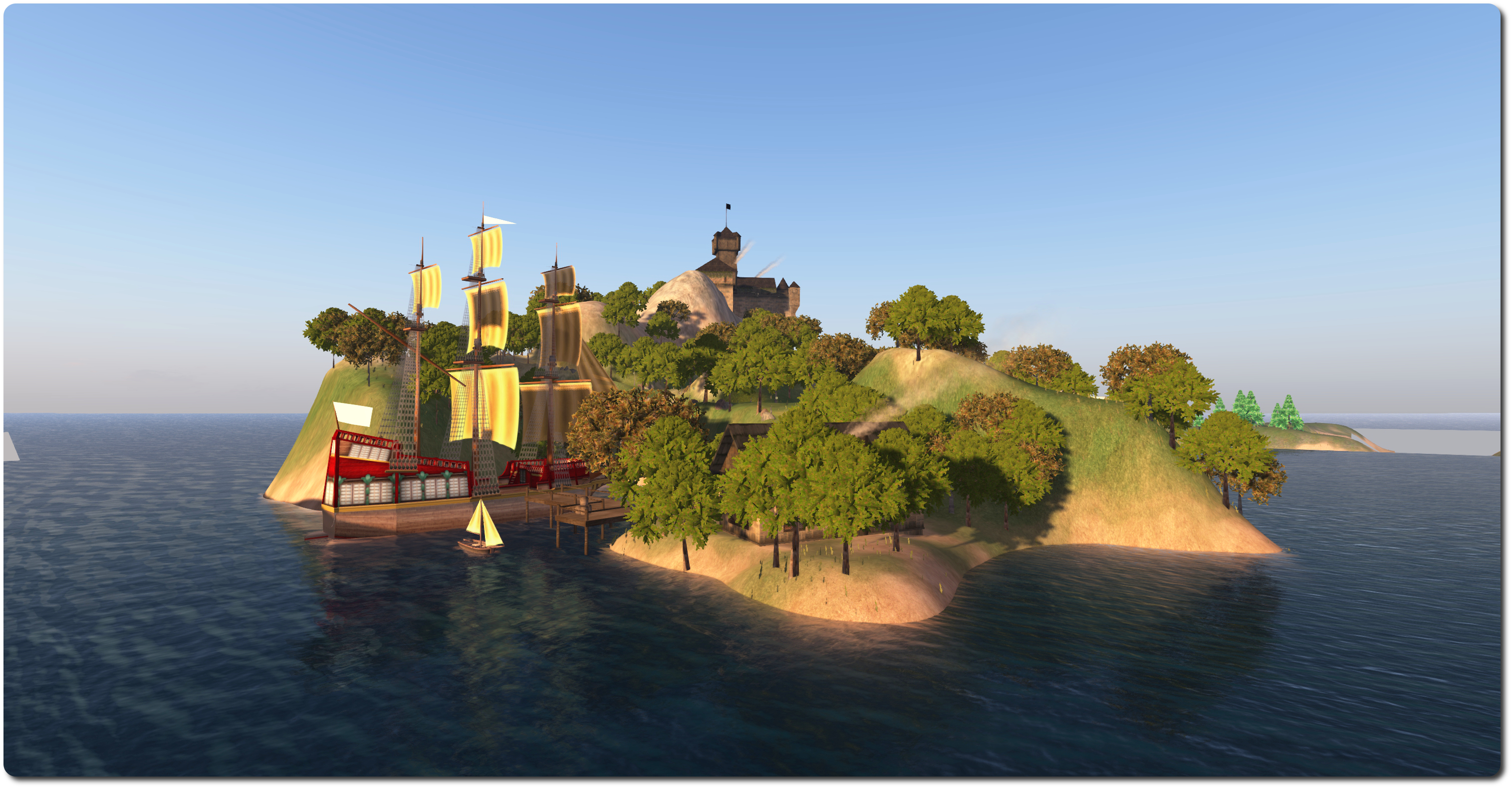
The Baronial Castle and bits – a Linden Lab themed private island

Whenever SL private islands are mentioned, it is usually in terms of unthemed full, homestead and openspace regions. However, the Lab has, for some time, offered “themed private islands” for anyone who would care to lease one.

These offer pre-terraformed regions (full or homestead) available in one of four themes: “Baronial Castle”, “Conference Centre”, “Theatre” and “Moonbase”. Each of these themed island types comes at a slight premium in terms of set-up costs (an extra $29 applicable to full regions and $20 on homesteads – both ex VAT), although tier is the same as for “regular” full and homestead regions.

There are SLurls leading to in-world samples from the various website pages offering these regions. However, as it’s been a few years since I last looked at them (which was around the time of the whole openspace / homestead fiasco – which is about when they first appeared, if I recall correctly), I decided to pay them a refresher visit.

The first up was the Baronial Castle, which is described on the website as an “imposing mountaintop residence, complete with tavern, boat and dungeon. Host the royal ball or role-playing fantasy game you’ve been waiting for, or have your friends over for an intimate chat in the tavern.”
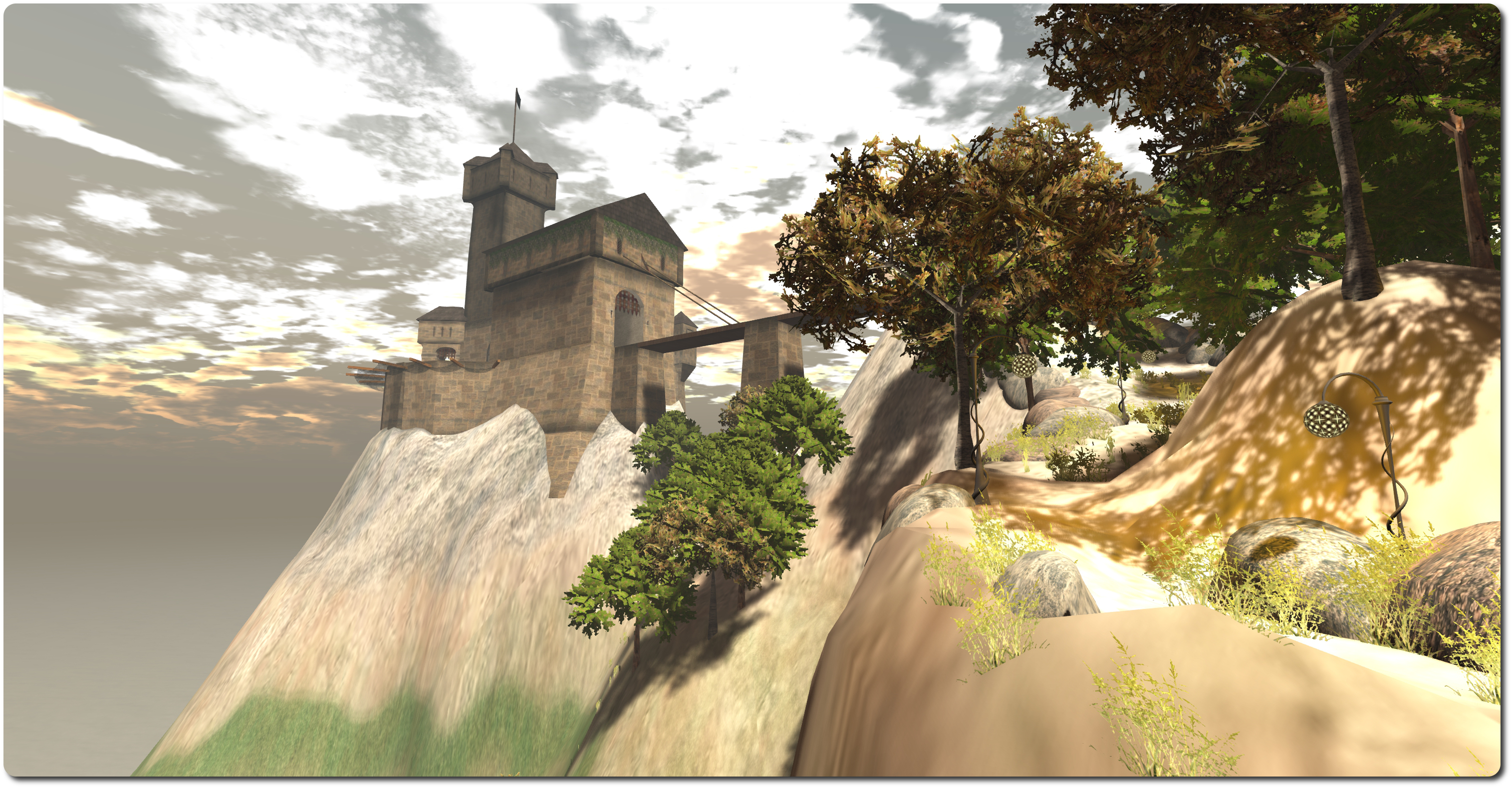
The Baronial Castle and hillside path

The tavern forms the landing point for visits to the sample castle. This is located at the base of the hills atop which the castle sits, alongside a small cove wherein a large ship (all 246 prims of her) sits with sails unfurled, a smaller sailing skip sitting close by.

From the tavern, one can follow the path, lit at night by Ye Olde Iron Lampposts (must be powered by magic…), up the hill to the bridge spanning the divide between hilltop and castle. The castle itself offers a great hall, complete with hidden passage down to the dungeons (why hidden? Wasn’t a dungeon pretty much expected with castles, a sort-of medieval equivalent of today’s games room found in many upmarket homes?). A ramp leads to the upper levels, where sit a couple of bedrooms and a very narrow tower. In difference to the lampposts lighting the way up to the castle, everything within it is lit by wall-mounted torches (which some people might recognise as Ryan Linden’s handiwork and available from the Library folder in inventory).

A short hop across the water from the castle lies the Conference Centre. This offers two main venues and a smaller offshore island with an open-air venue. The landing point for this region is between the two main buildings, and connected to both by a paved foot path.
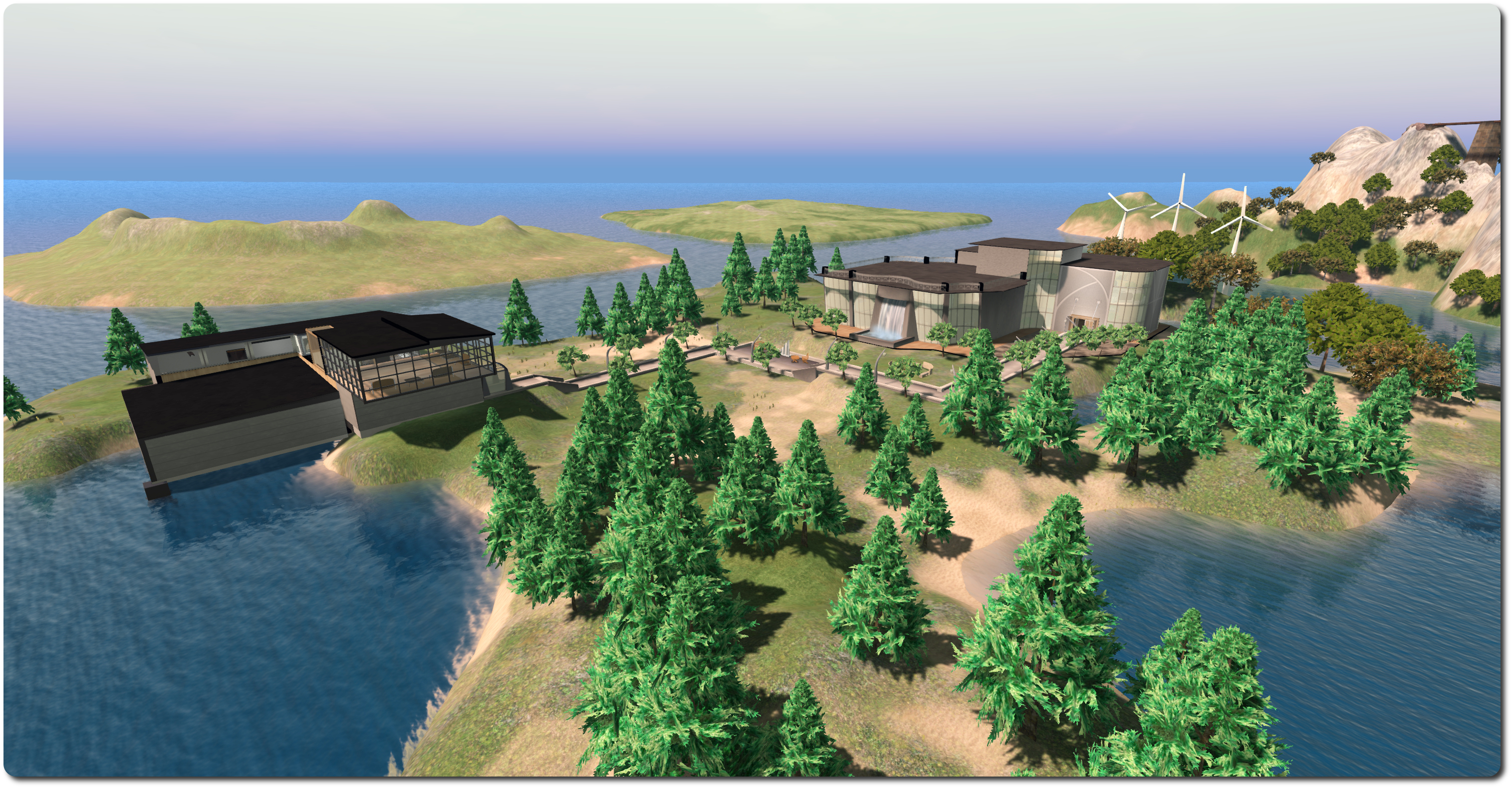
The Conference Centre

The nearer of the two buildings to the landing point, which has its own built-in waterfall, offers a large ground floor conference area and a mezzanine area for informal meetings as well as rooftop access for those needing additional space.

Across from this, the second building offers a reception area, a couple of meeting rooms and an upstairs seating area. One of the meeting rooms has positionable tables. The small offshore venue area offers open-air seating, and the design is finished-off with simple landscaping, non-functional video screens and an offshore wind farm.
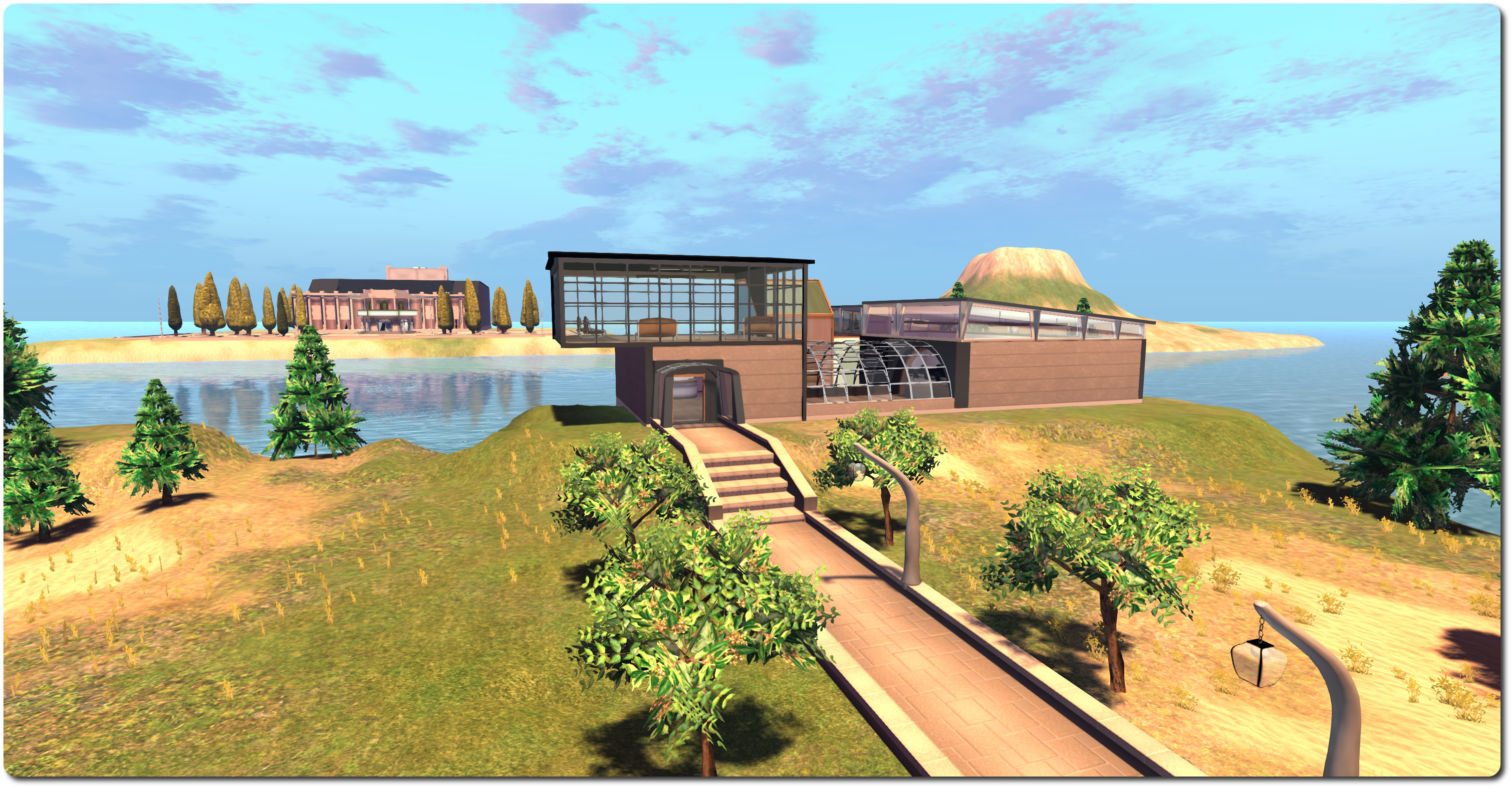
The Conference Centre and the Theatre beyond
The Conference Centre with the Theatre beyond

Another short hop from the Conference Centre is the Theatre. This is the only themed region which is solely available for full regions, there is no homestead option. The reason for this is that the theatre is designed to accommodate up to 100 avatars at a time.

The landing point drops visitors in the plaza directly in front of the theatre, which is perhaps the largest of the themed region structures in terms of volume, and the one demonstrating a degree of appreciated humour: the film posters can hardly fail to raise a smile, and include The Little Molemaid, Moletropolis, Dances With Moles, and such Moleywood stars as Mole Gibson and Worm Hanks.
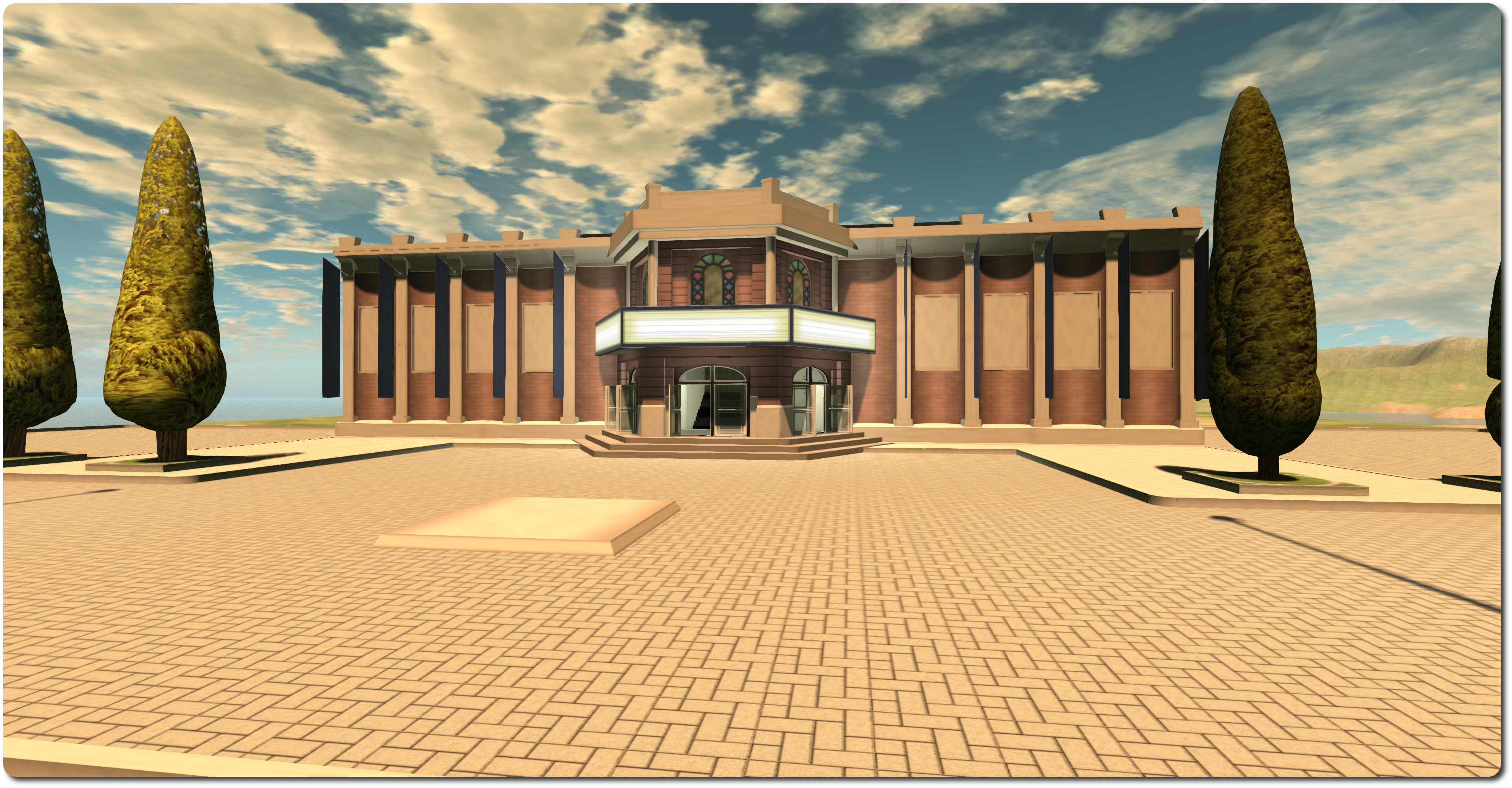
The Theatre
The Theatre

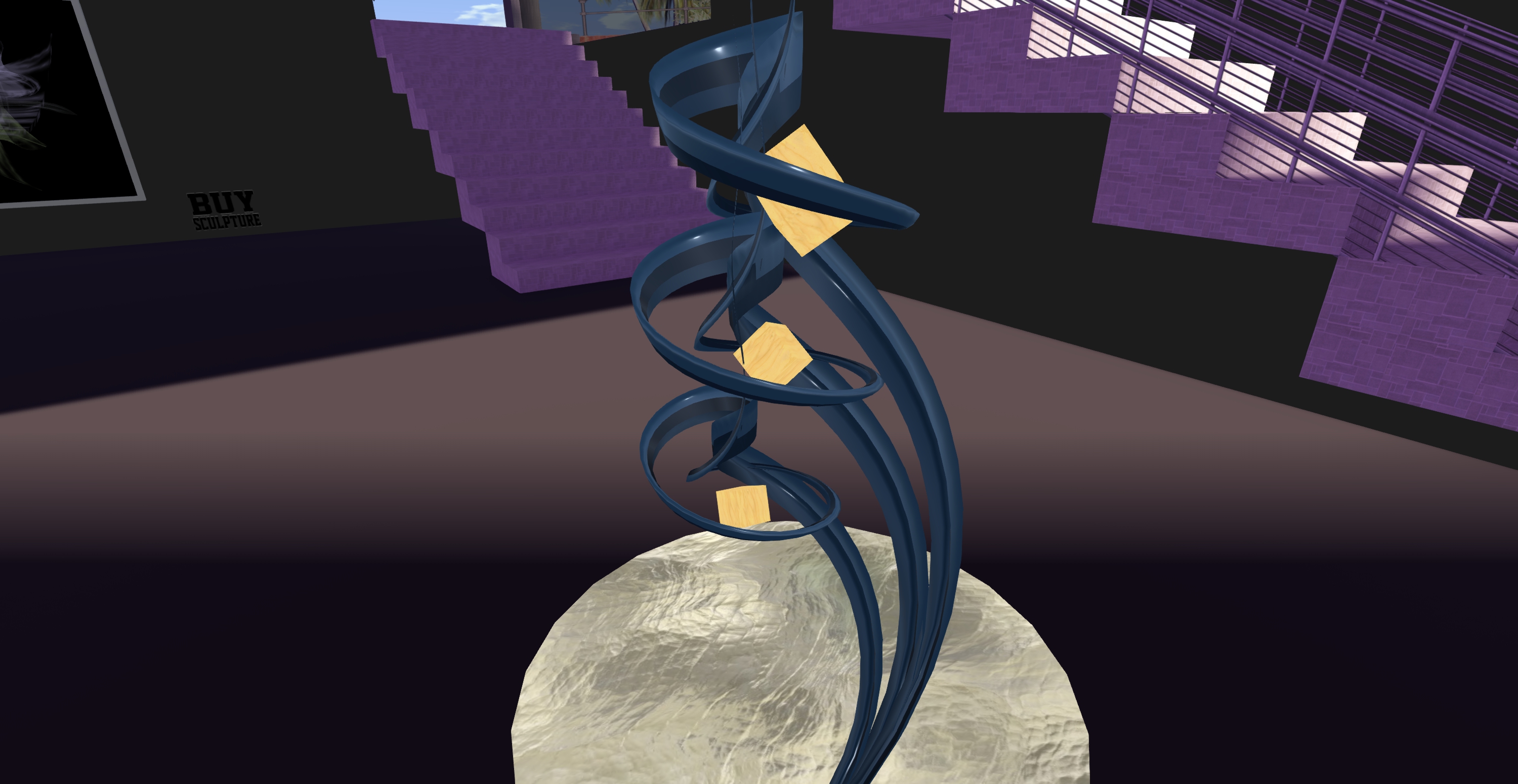
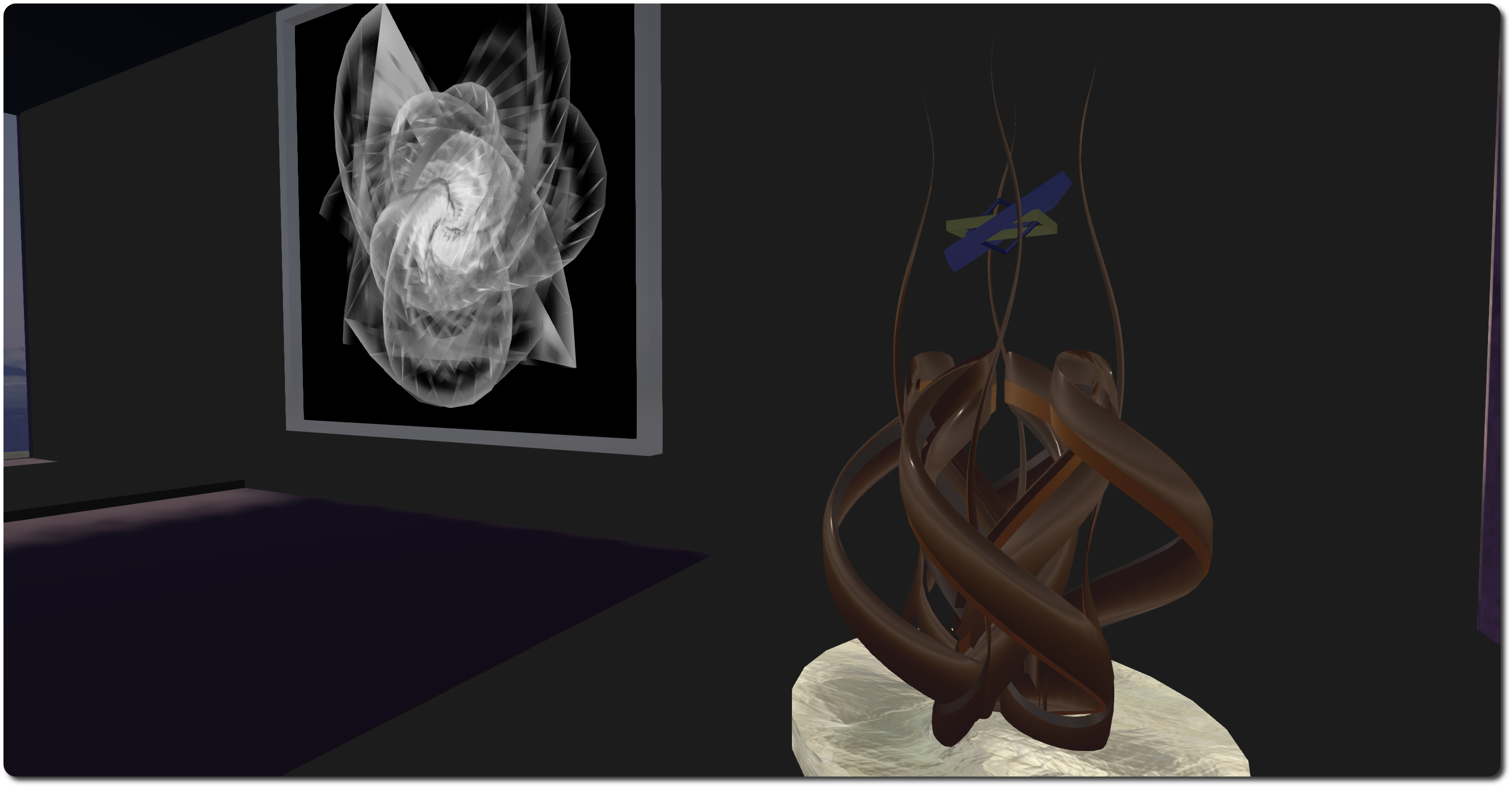
The theatre interior is pretty much what you’d expect: a foyer area (with the aforementioned posters on display), a lot of banked seats facing a stage / screen area, and box seats on either side. At the back of the theatre, with a good view of the stage area is a control room, complete with a scripted panel for operating the stage lights and curtains, etc., and controller for displaying the various foyer movie posters. Backstage is the dressing room, reached via hidden doors in the stage wings.
Continue reading “Of Linden themed islands” →

Sculpture in motion

Neeks Karu - Kelly Yap Art Gallery
Neeks Karu – Kelly Yap Art Gallery

Kelly Yap Art Gallery is hosting two exhibits, both of which opened on Saturday July 26th, 2014. On the ground floor of the gallery is a series of sculptures by Neeks Karu, while upstairs is Betty Tureaud latest installation.

I confess that Neeks Karu is not a name that rings bells with me – which on the strength of this exhibit, really is to my loss. On display are a dozen free-standing and wall mounted sculptures, all but one of which include a degree of moment, and many of which appear to be founded on geometry – several of the wall-mounted pieces in particular are mindful of fractal progressions.

Neeks Karu, Kelley Yap Art Gallery
Neeks Karu, Kelly Yap Art Gallery

There are no descriptions accompanying the individual pieces – or at least, none I could find in clicking, but the names are evocative: “Exclusion”, “Web”, “Safety”, “Quest” and so on. Each piece is also somewhat hypnotic in its influence; or perhaps mesmerizing might be a better term, drawing the observer into them, encouraging close-in camming in order to watch the changing forms and patterns.

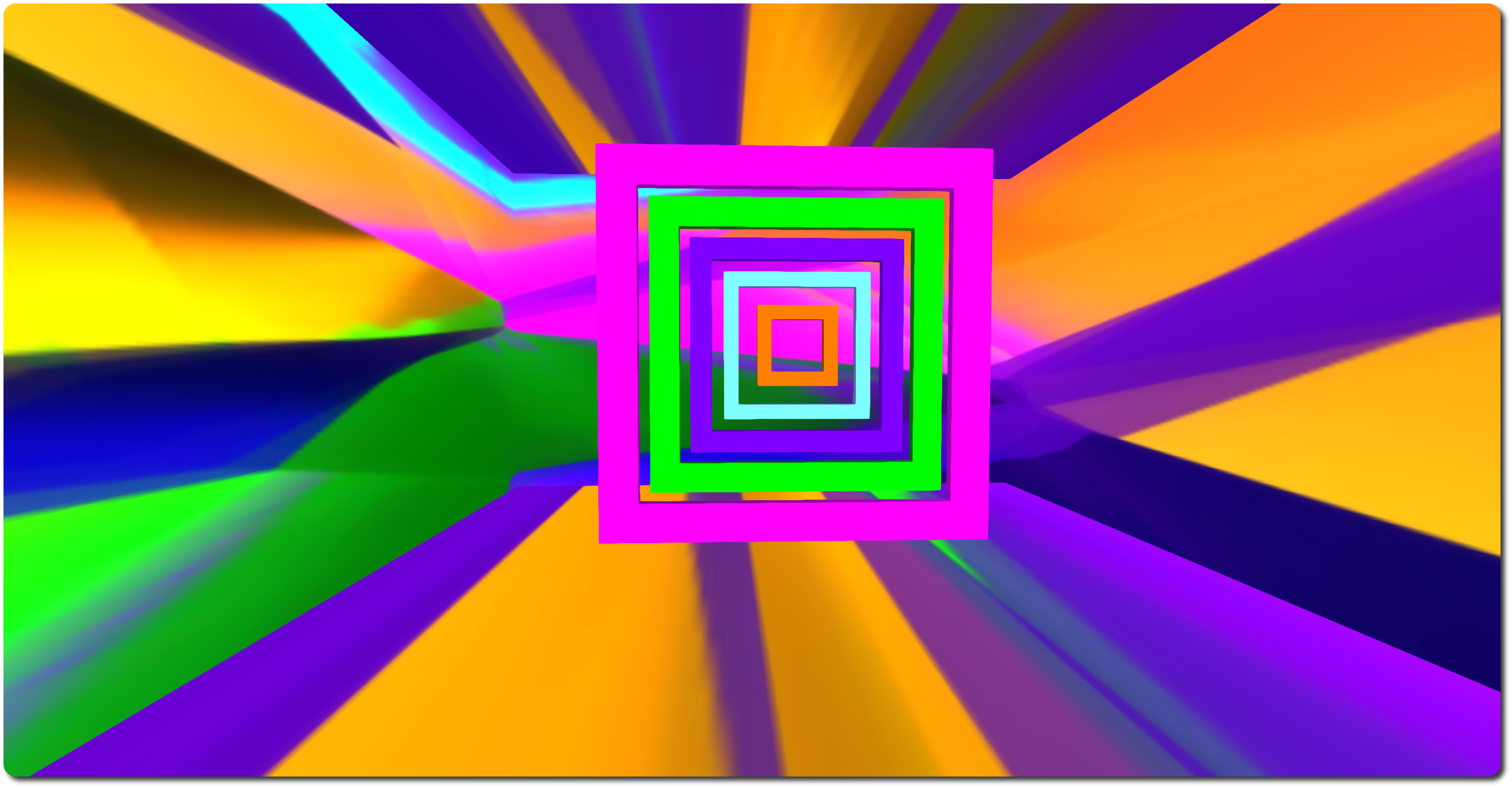
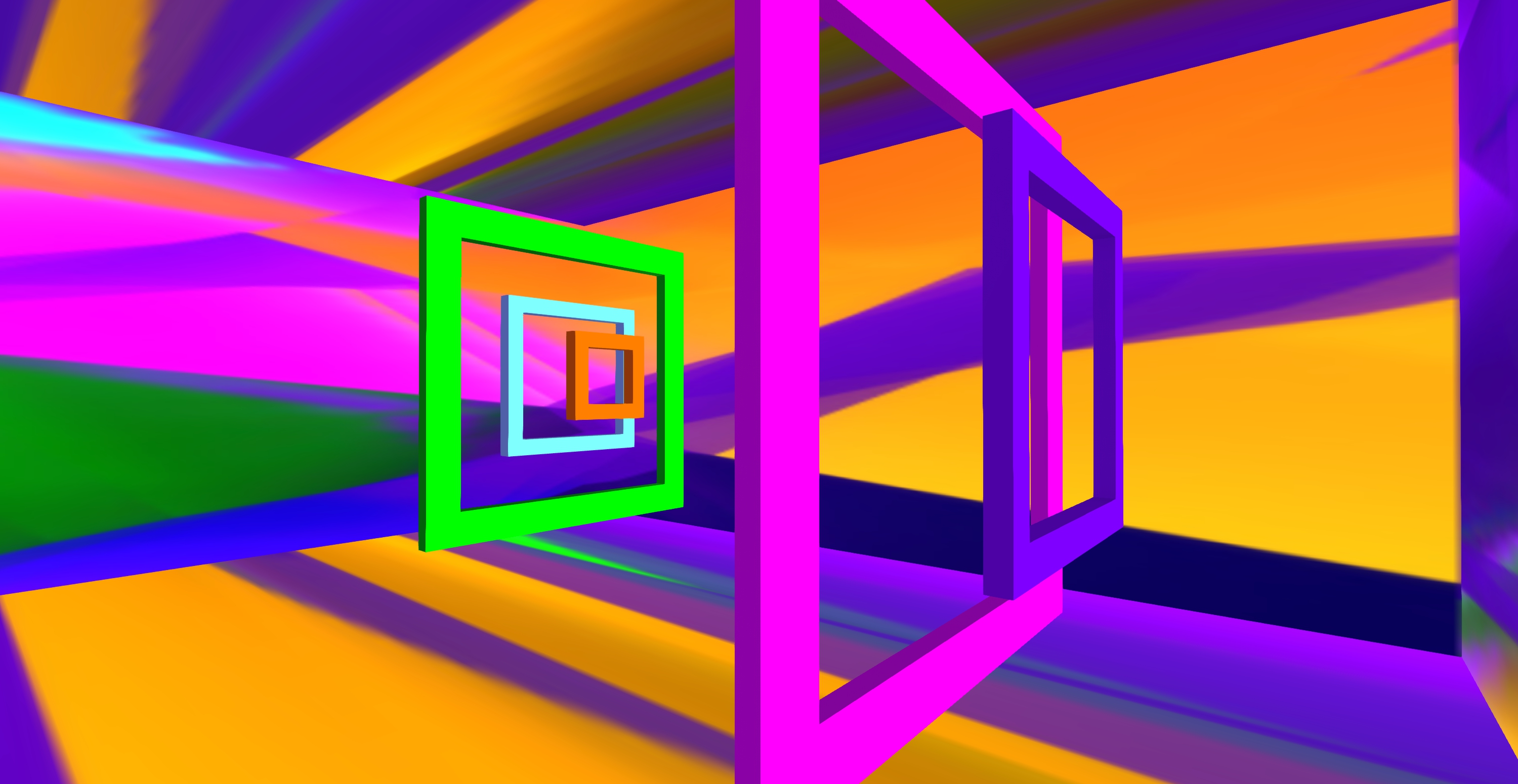
Providing you’re not completely hypnotised by Neeks’ work, make your way upstairs and you’ll find Betty’s latest work, rendered in her hallmark rich colours. This also uses geometry and movement in a piece which is quite deceptive when first perceived, and actually requires a little time (and perhaps a little careful camming) to appreciate fully.

Betty , Kelly Yap Art Gallery
Betty Tureaud , Kelly Yap Art Gallery

Floating in the multi-hued space are five brightly coloured frames. These wash back and forth along the length of the space, as if to the ebb and flow of the tide – or tides, as each frame can move both faster and slower than the others in a seemingly random pattern, and can suddenly reverse direction or pause. Depending on the rate of motion and speed of change, every so often the frames come together to brief nest one within another within another, largest to smallest. Or, if not all of them, then perhaps three or four of them, while the remaining frames slide away in one direction or the other, as if unwilling to be a part of the orderly gathering.

Careful camming is in order because when viewed from certain positions, such as either end of the room in which they sit, the frames use distance and perspective in an optical illusion familiar to all of us, but which is nevertheless fascinating to witness. Depending on their positions relative to one another, their sizes appear to be reversed: the largest may appear to be medium-sized, a medium-sized frame appears much smaller and the smallest suddenly appears to dominate the rest. Only when they reach their nested equilibrium as they slide along their shared path, is the truth of their relative sizes revealed.

Betty T, Kelly Yap Art Gallery
Betty Tureaud, Kelly Yap Art Gallery

All told, two interesting and complementary exhibits.

Transcending Borders: first art entries on display, audience prizes reviewed

On Monday July 21st, 2014, the University of Western Australia (UWA) announced the opening of their new combined Art and Machinima challenge, Transcending Borders, which brings together their 7th MachinimUWA and their 5th UWA Grand Art Challenge into one event.

I provided an overview of the challenge at the time, including the fact that there are prizes amounting to L$1,030,000 on offer to artists and machinima makers – and to members of the public who wish to participate in the voting process on entries.

Transcending, by Xia Firethorn

Submissions for the challenge have already started, and FeeWee Ling, curator of the UWA’s 3D OpenArt challenges, brings word that the first two 3D art entires are now on display in the Transcending Borders gallery area above the UWA’s home regions. Machinima entires will be listed on the SLArtist website as they are received.

The entries are Transcending, by Xia Firethorn (shown above) and Union by Silva Khandr (below).

Union by Silva Khandr

As noted in my initial coverage, there are special prizes on offer in the audience participation part of the challenge (a total of L$135,000 for audience participation in the art category and a total of L$105,000 in the machinima section). All you have to do is list your personal Top Ten entries in either the art or the machinima sections of the challenge (or both!). Prizes will be awarded to audience members whose top 10 lists most closely align to the final juried top 10. Keep your eyes on the UWA blog for details on how to enter.

For full details on the competition and prizes, please refer to the UWA blog post announcing the launch of Transcending Borders.

The challenge is open to entries through until midnight on October 31st, 2014; judging will conclude in December 2014, when the winners will be announced.  I’ve always enjoyed following the UWA challenges, and with Transcending Borders, I’m particularly looking forward to seeing all of the entries, art and machinima, having been privileged with a request to join the judging panel. Hope you’ll also enjoy viewing the entries and drawing-up your own Top Ten lists.

Related Links

Melusina Parkin: Closer Looks

Closer Looks, Melusina Parkin

I received an invitation to preview Closer Looks, a new exhibition of photography by Melusina Parkin, which officially opens on Monday July 28th at 15:00 SLT at La Sociedad de los Poetas Dementes gallery on Mexico MX.

I last reviewed one of Melusina’s exhibitions in May 2014, when she was exhibiting Themes, which featured 42 of her pieces on display at the The Nite’s Place Red Line Exposition Area. Closer Looks presents around 45 of her photographs, taken of various locations around Second Life and which, as the name of the exhibition suggests, presents them in close-up, focusing down on a specific element within each image, encouraging the observer to similarly focus their attention.

Closer looks, Melusina Parkin
Closer Looks, Melusina Parkin

“Watching things from close-up is an amazing practice,” Melusina says in the liner notes accompanying the exhibition. “Isolating an element or detail in a scene, focusing on it, is like when you repeat a word in your mind until it does lose its meaning; it starts then revealing unexpected associations suggesting unusual relationships, showing unforeseen details in it.”

As with Themes, many of these images in this exhibition appear to be drawn from certain thematic elements: cars, structures, ships, skylines, which at first appear to suggest associations between them. However, each picture in fact works on a far more subtle level than that, encouraging the observer to consider the associations which lie not so much between them, but in what is within each of them, and what they start to suggest to the observer’s own mind. It’s an effect Melusina intended to achieve within each of the pictures.

Closer Looks, Melusina Parkin

“When photographed, the most trivial object, thanks to framing, light, shadows and colours handling, can acquire a completely different than its own actual or usual one,” Melusina notes. “This is what I tried to do in each of these photos. Enhancing the evocative power of daily life objects and landscapes, showing them out of their context or catching their hidden fascination by camera framing and lighting.”

In this, this exhibition stands as something of a comment on Second Life, where the incredible diversity of creative expression can so easily become trivialized or marginalised by the incredible scope and beauty evident is seeing whole regions and estates, where houses, trees, vehicles, and everything else can so easily blur together that we can miss so much. It is only when we pause, when we take the time to focus down on things, that we can really see just how amazing things in this digital world really are and how incredibly different things really are, even when seemingly alike – and how they can so often challenge our own creative perceptions, encouraging us to think of ways and means of doing things, and so further adding to the creative diversity others can see and learn from.

Closer Looks, Melusina Parkin

All told, another thought-provoking and visually stylish exhibition from Melusina, with each of the images on display on sale for anyone who would like to take a piece home with them.

Related Links


Le Botanique: a materially beautiful creation

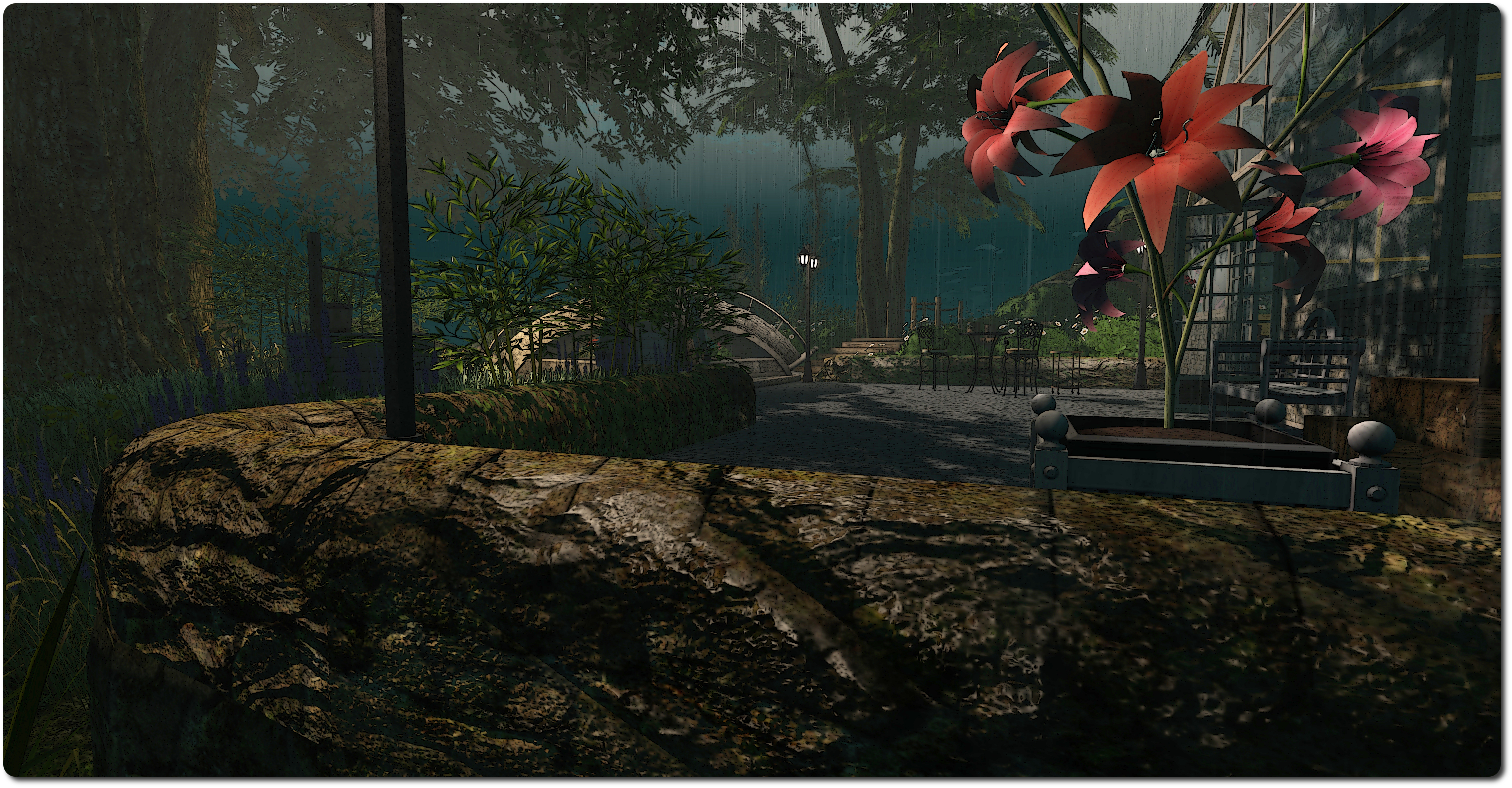
Le Botanique, Mirriam Brown; Inara Pey, July 2014, on FlickrLe Botanique, Miriam Brown, July 2014 (Flickr)

I first met Liara Okiddo as a result of visiting her home on the Region of Golden Rose back in July 2013, Garden of Eden was a 8192 square metre parcel of land where she had built a compact tour de force of what can be achieved without necessarily needing an entire region of your own in which to create an eye-catching build. It was a truly amazing and verdant design, rich in colour, flora and fauna, creating a tropical island like feel in which she had located her in-world studio and gallery.

In November 2013, Liara extended an invitation for me to see her next project – then a work in progress, Isla Okiddo, her own homestead, which opened to the public in February 2014, forming another visually stunning build where she had again created a wonderful tropical paradise in which she located her gallery and her home.

Le Botanique, Mirriam Brown; Inara Pey, July 2014, on FlickrLe Botanique, Miriam Brown, July 2014 (Flickr)

Sadly, Garden of Eden and Isla Okiddo now only exist in memory and pictures, although they remain two of my top 10 all-time most beautiful locations in Second Life.

More recently, Liara has been working on a new project, which she pinged me about early on (and for which I still owe her an apology, and life, the universe and everything meant I never really supplied the feedback she’d requested). The project opened earlier in July (and which the physical world again conspired to keep me away from) and is another masterpiece.

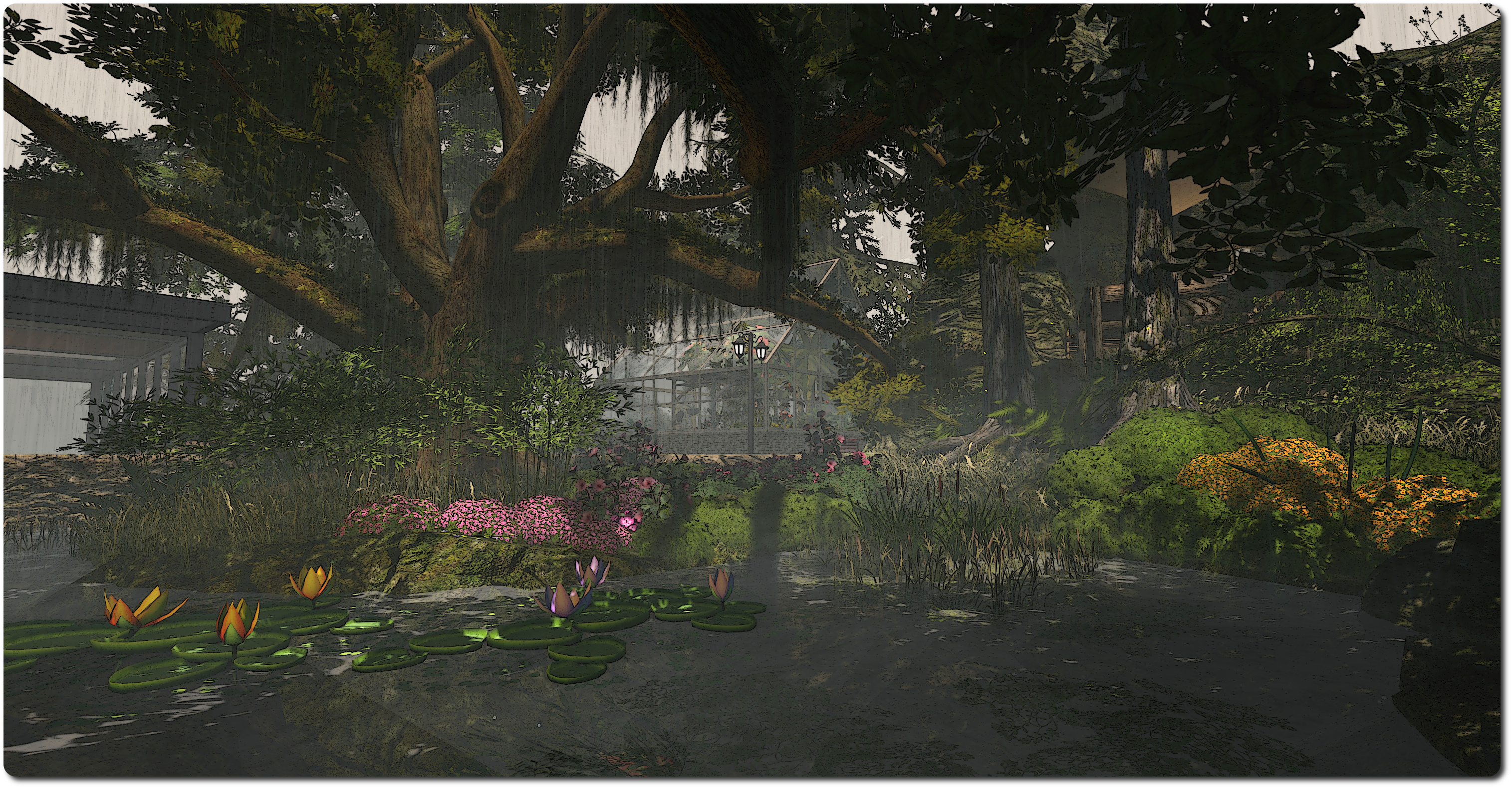
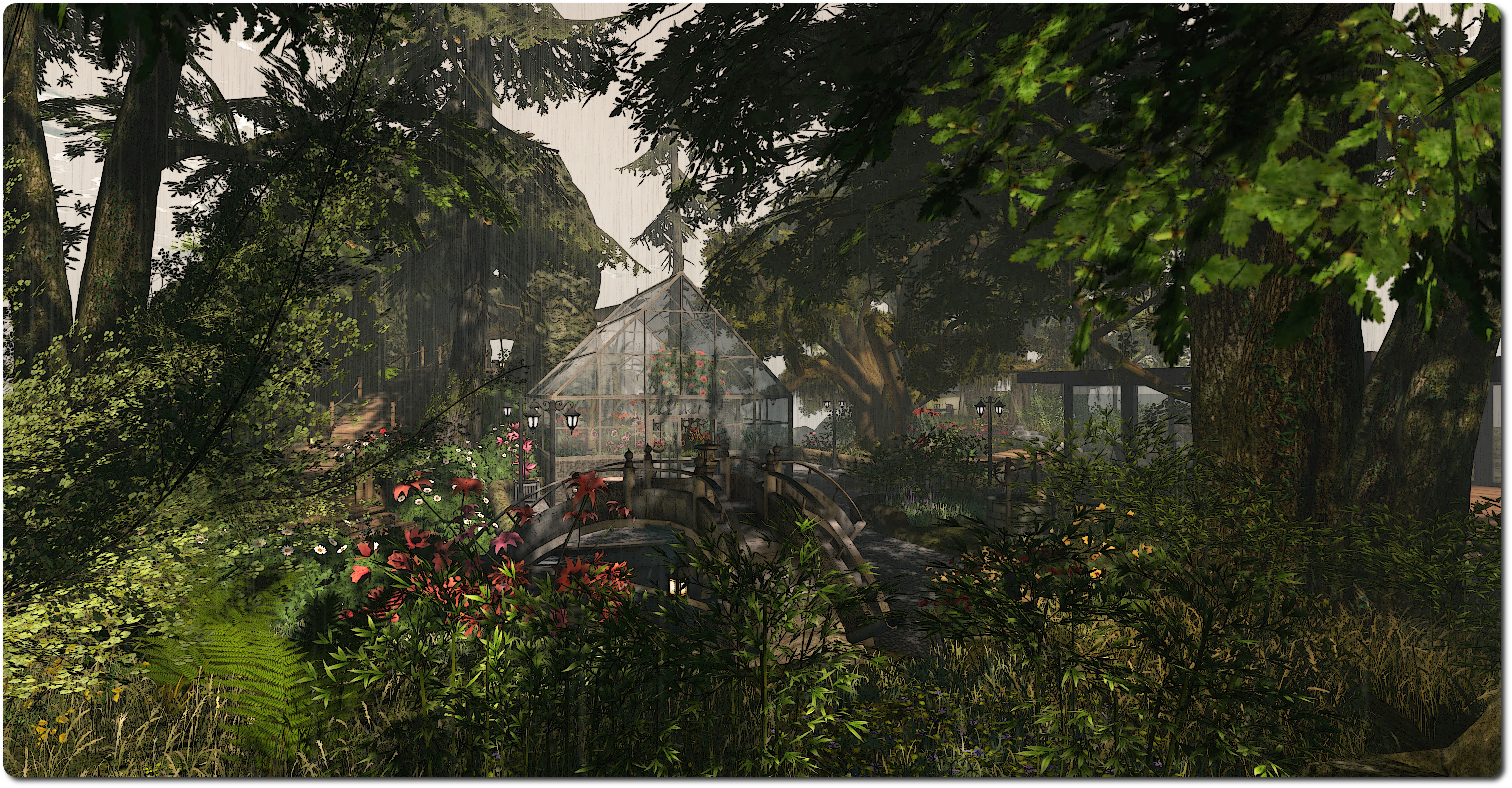
Le Botanique is a 64 metre square slice of rain forest-like beauty floating in the air above Miriam Brown, and it is a marvel of design and the use of materials – around 75% of the build is materials enabled.

Le Botanique, Mirriam Brown; Inara Pey, July 2014, on FlickrLe Botanique, Miriam Brown, July 2014 (Flickr) – note the beautiful wet sheen to the stone wall in the rain as it reflects the light from the lamp-post above; the beauty of materials

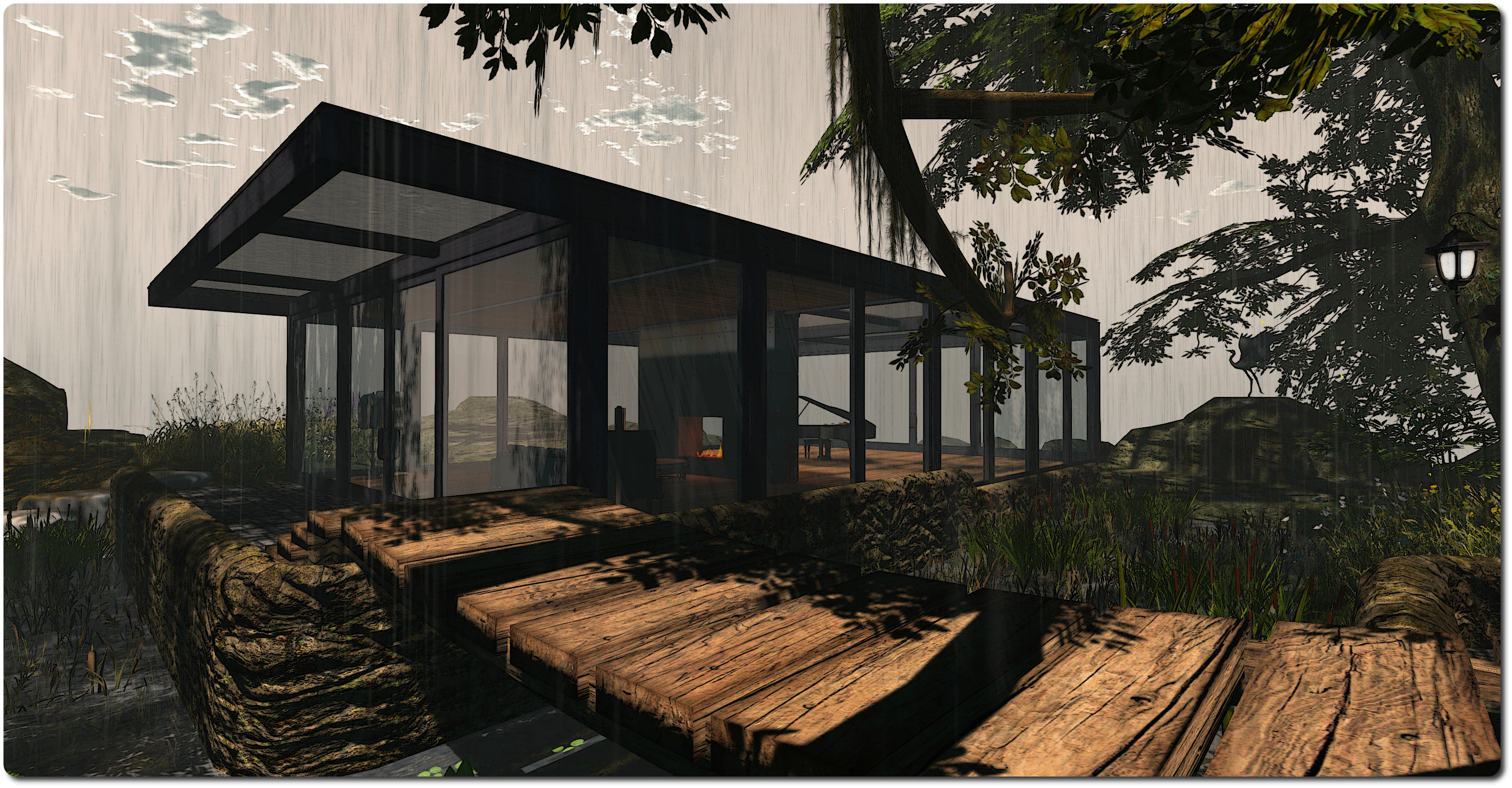
You arrive inside a summer-house in one corner of the forest (do make sure you accept the local windlight, if offered, on your arrival). The staccato beat of rain falling on the glass panels of the roof is your greeting, together with the crackling pop of wood burning in the hearth its accompaniment. A piano from the other room in the house might also add a little harmony to your arrival. But all these serve as background to the lush, rain-soaked slice of tropical splendour which awaits you beyond the sliding doors.

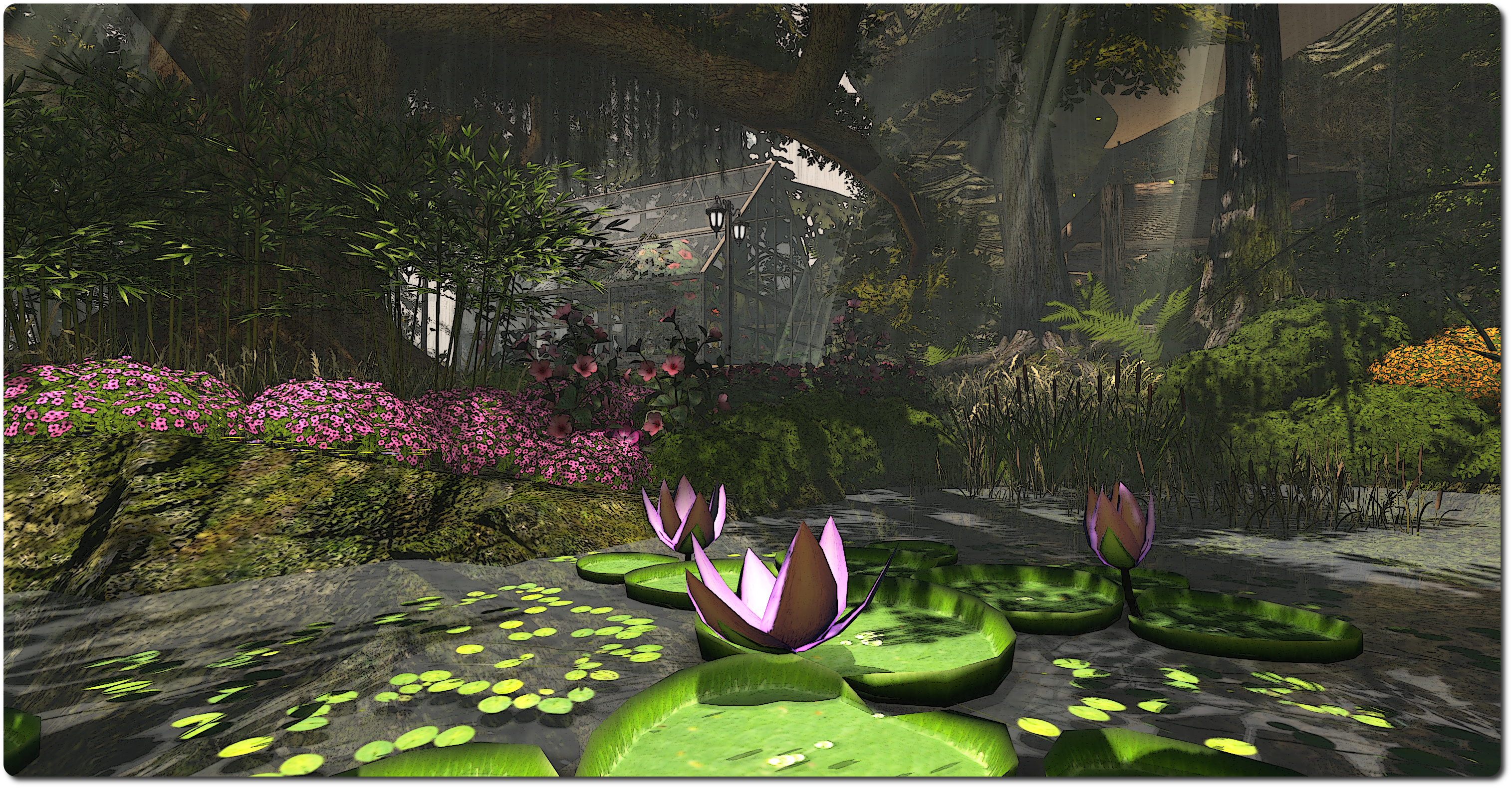
Rain splashes over everything here, pattering across cobbled terrace and wooden walkways alike, leaving a wet sheen over mossy walls, grassy rocks and dripping from the lush vegetation. A wooden bridge passes over a narrow channel of water separating the summer-house from an old terrace where sits a wrought iron garden table and chairs, dripping in the shower alongside a tall green house in which grow where exotic lilies and other plants are growing in rich abundance, sheltered from the rain.

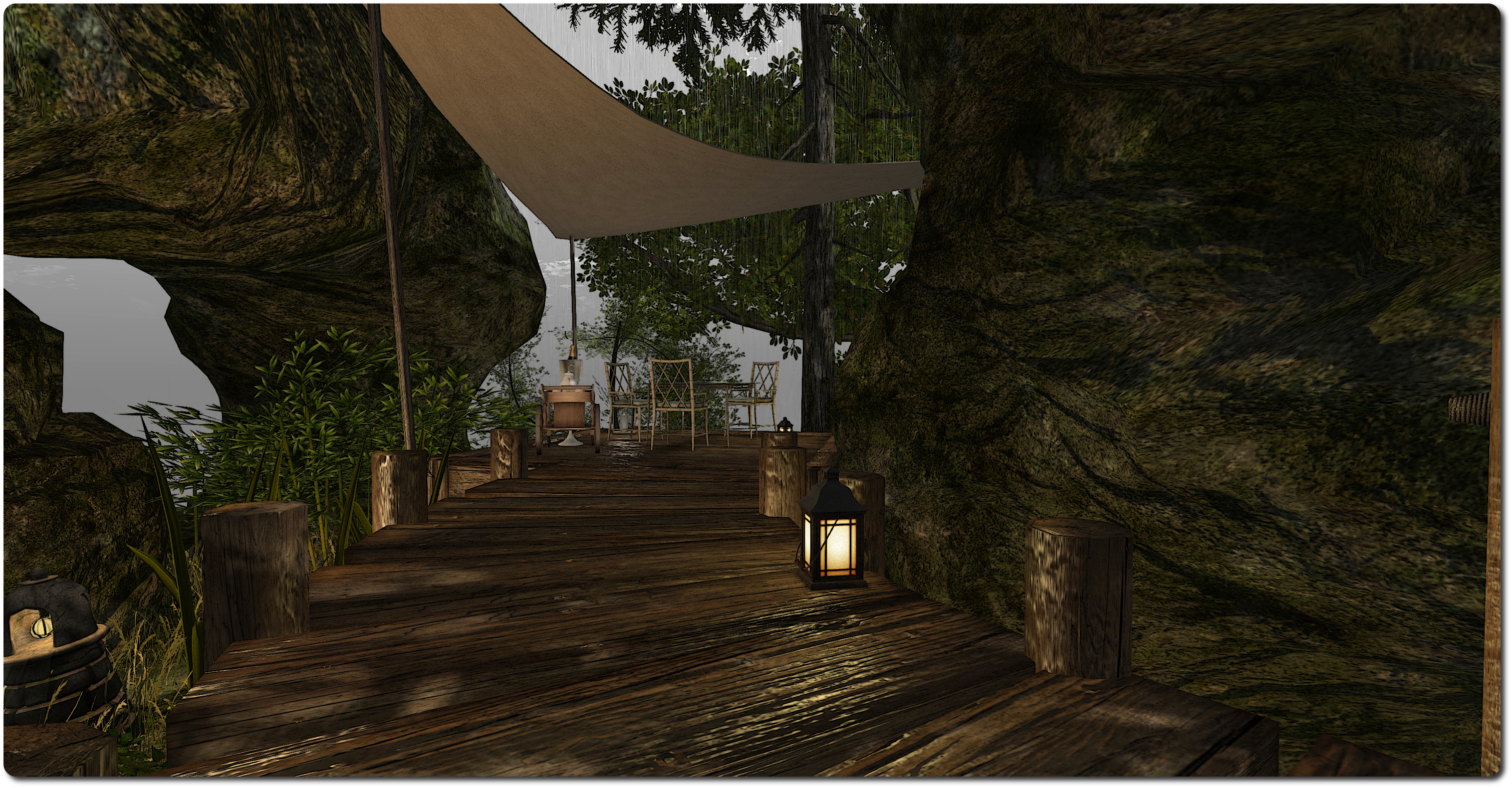
Follow a set of wooden steps from here, and they take you up to the high point of the build, a rocky grotto where sits a table an chairs under a canvas awning.  Elsewhere, stepping-stones guild the visitor across the expanse of rain-speckled water below the summer-house and up to another rocky ledge offering another little seating area under canvas, this one with a touch of romance added: candles on the table, complete with a bottle of wine, two glasses, and a red rose.

Le Botanique, Mirriam Brown; Inara Pey, July 2014, on FlickrLe Botanique, Miriam Brown, July 2014 (Flickr)

All of this exists an in rich spread of flowers and plants, tall trees through which sunlight slants, and over which the rain falls steadily. It’s an amazing sight for even the most causal visitor. However, if you want to experience Le Botanique to the fullest, then you should enable your viewer’s Advanced Lighting Model (Preferences > Graphics > check Advanced Lighting Model) option, if it is not already active.

This shouldn’t result in too big a performance hit on your system – you don’t have to enable Shadows as well (which are the performance killer). When you do so, Le Botanique will spring into even greater life as the wet sheen on the rocks and walls becomes visible, and the light from lamps and lanterns is reflected in the wet surfaces around you.

I’ve fiddled around with materials myself in SL and more noticeably on Kitely with Fallingwater, but I’ve done nothing to the depth of Liara’s project. As noted above, the built features the use of materials across about 75% of it, and this has involved Liara carefully selecting copy / mod items which she has then painstakingly retextured with custom diffuse (texture), normal (bumpiness) and specular (shininess) maps, and the results are truly stunning, and incredibly life-like; so much so in fact, that it’s possible to miss some of them without a degree of careful camming, therefore time is the order of the day when visiting.

Le Botanique, Mirriam Brown; Inara Pey, July 2014, on FlickrLe Botanique, Miriam Brown, July 2014 (Flickr) – note the relief on the stone work and on the wooden boards

For those interested in the technical aspects of the build, Liara has created a special Flickr album charting her work on Le Botanique, and to be honest, her photos far outweight my meagre efforts here should you need any visual persuading to make a visit.

I never cease to be amazed and awed by Liara’s work; each of her creations builds on the foundations laid by the last, and each is in turn an incredible and beautifully immersive environment. In this, Le Botanique is no exception. It is simply glorious; a stunning demonstration as to what can be achieved with time, patience and materials, and (again) without needing an entire region in order to do so.

Le Botanique, Mirriam Brown; Inara Pey, July 2014, on FlickrLe Botanique, Miriam Brown, July 2014 (Flickr) – the light of the lamps reflected off the wet surface of the wooden boards

It is, in a word, glorious.

Related Links

A walk through SL’s history on the way to the future

Second Life History
Second Life History

Open now through until the end of July 2014 at LEA23 is Sniper Siemens’ brilliant installation Second Life History, a glorious walk through the platform’s past, marvellously presented in a series of visual vignettes which recapture events which are bound to be both familiar and new to Second Life residents.

From the landing point, one is invited to tread a watery path through a partially submerged park, only the trees, lamp posts and railings visible, the route leading the way from the gates and 2001, through successive years charting the highs and lows of Second Life’s past and present, before climbing a set of stairs towards the open door of the future, and the promise of the Lab’s “next generation” platform.

Second Life History: the arrival of new primitive shapes (2004)

Along the way you can meet a Primitar (looking rather broken and forlorn, lying in the water) and various characters who point the way to different events and occurrences represented by information boards and self-contained scenes which evoke those moments of history and / or the emotions to which they gave rise.

So it is you can learn about (or recall, if you’ve been around long enough) such events as the initial Second Life closed beta in 2002, the opening of the gates to all in 2003, the tax revolt later that year, the arrival of the Linden dollar as a virtual currency and the advent of free accounts, Black September (2006), the banking shutdown of 2007, the Lab’s withdrawal from paying VAT on behalf of users in the European Union, and so on.

Second Life History: marking the arrival of the Teen Grid
Second Life History: marking the arrival of the Teen Grid (2005)

Technical innovations are also marked, both by overhead SL version numbers, and by their own little vignettes – LindenWorld, the first viewer, the arrival of the famous blue UI, prims, pay-to-TP teleport hubs, streaming media, open-sourcing the viewer, voice, windlight, viewer 2.0, it’s all here, as well as all the more recent technical innovations on the platform.

To call the installation a delight is an understatment; if you have any interest at all in SL’s history, it is guaranteed to stir memories, raise a smile, and more. There are a lot of cheeky little touches, and one or two personal pieces; one little vignette marks the rezday of sniper’s first avatar incarnation, while further around the installation is a wonderful little poke at Philip Rosedale’s stepping-down as CEO. Similarly, the arrival of viewer 2.0 is announced by the appropriately named (given users’ reaction to the viewer’s arrival) Curveball Resident.

Second Life History: a whimsical look at Philip Rosedale vacating the CEO's chair
Second Life History: a whimsical look at Philip Rosedale vacating the CEO’s chair (2008)

While exploring the build, don’t miss the web icons; clicking these will take you the official blog posts on the subject being displayed / discussed. These include the very first official blog post from Philip Rosedale in 2004.

This really is a marvellous installation, and shame on me for not having found the time to write about it any sooner. If you’ve not already dropped-in, I really do urge you to do so before the end of July; I seriously doubt you’ll be disappointed!

Given the subject matter, it seems only appropriate that I close with yet another look back at LindenWorld from August 2001.

Related Links